




Abstract
A novel hybrid optimization (HO) method efficiently combines parameter optimization (PO) and topology optimization (TO) is proposed. The novelty concerns introducing the mesh deformation technique for model regeneration to make a connection between the TO and PO, in this way, the geometric features can be inherited in iterative optimization to fasten the convergence. The proposed HO is applied to the optimal design of a baseline V-type permanent magnet synchronous machine (PMSM), in which the topology of air barriers and the layout parameters of permanent magnets (PMs) are simultaneously optimized, for torque property enhancement. Comparative numerical results show that the proposed HO is more efficient in optimal solution searching compared with traditional methods, as good topological features can be inherited in the iterative optimization. The numerical results also indicate that the proposed HO has good compatibility with different solvers, it can always provide good convergence to provide PMSM designs with excellent torque property when an evolutionary algorithm such as a genetic algorithm and evolution strategy is used as the solver.
Keywords
Introduction
Structural design is mainly the conceptual design for a device, it can effectively improve performance and reduce the cost of an electromagnetic device. Generally, the structure design methods can be classified into parameter optimization (PO) and topology optimization (TO). The PO normally does not change the structural topology during the optimization process, that is, new cavities could not be freely generated inner the design. Thus, a solution obtained by PO will have the same topology as that of the initial design. In contrast, TO can freely manage the material distributions in the design domain for achieving the desired specification. Compared to PO, TO has higher freedom, basically, the number of finite elements, to express the shape and create a radical design. TO methods were originally developed by the structural and mechanical community in the 60s [1,2]. As the capabilities of modern computers increase, the TO has found application in the applied electromagnetics community for the conceptual design of electric devices [3–7].
Generally, a structure optimization problem could be PO or TO, the combination of PO and TO is rare [8]. However, in the design of some electromagnetic devices, it will be more desirable to combine PO and TO. For example, in the rotor design of a PMSM, it is desirable to adopt block PMs due to manufacturing ease [9]. On the other hand, free-form lamination steel is acceptable as air barriers in the lamination steel are relatively easy to produce by stamping dies or laser cutting [10,11]. To retain the shape of PMs, while having a free-form created rotor core, a combination of PO of PMs and TO of rotor core is necessary. Few papers have dealt with the combination of PO and TO as well as its application on electric machines. In [12] a magneto-structural combined dimensional and TO using the density method was presented, in which the smoothness of the rotor core was not well considered. Hiruma et al. [13] studied a hybridization method of PO and TO for PM motors, in which the re-meshing is necessary for each new PM configuration. Kuci et al. [14] attempted to combine PO and TO by solving an adjoint formulation by a sequential gradient-based convex programming approach. As has been pointed out in these pioneer studies, it is a challenge to combine PO and TO for structure optimization, the difficulty is how to solve the formulated problem effectively as the additional parameter variables (movable components inner the structure) may make this optimization problem multi-modal. Mesh deformation is an approach for model regeneration, it has the merit of keeping the geometric features of the structure while morphing the movable components [15].
Configurations of the baseline V-type PMSM
Configurations of the baseline V-type PMSM
In this paper, a novel hybridization optimization (HO) method that efficiently combines the PO and TO is proposed. The novelty concerns introducing the mesh deformation technique for model regeneration to make a connection between the TO and PO, allowing good topological features to be inherited to fasten the convergence of iterative optimization. The proposed HO can be solved by a great variety of the existing real-coed evolutionary algorithms (EAs), such as genetic algorithms (GAs) and evolution strategies (ESs). Although the proposed HO is general for structural design, this paper only investigates its application on a PMSM because of the background of the authors. We apply PO to design the layout of the rectangular PMs and TO to design the air barrier for torque property enhancement.
This paper is summarized as follows. In Section 2, the specifications and modeling of the numerical example, i.e., the baseline V-type PMSM, are briefly introduced. The mechanism of the proposed HO is also encompassed, explaining how the PO and TO are coupled to deliver the optimal solution effectively. In Section 3, the V-type PMSM is optimized, the optimization result produced by the proposed HO is compared to that of the conventional HO and the traditional TO. The compatibility of the proposed HO with different solvers is also investigated. The optimal designs of the V-type PMSM provided by different solvers are discussed. In Section 4, the characteristics of this proposed HO method are summarized, and the main conclusions are given.
A V-type PMSM, in which the great number of PM layout parameters and core topological variations make it difficult to design, is used as the numerical example. Specifications of this PMSM are based on a baseline model from IEEJ for testing numerical methods [16]. Specifications can be found in Table 1. As depicted in Fig.1, due to the symmetry, 1/8 of the rotor is the optimization domain, 1/4 model of the machine is used for two-dimensional (2-D) finite element analysis (FEA). Delaunay triangulation is used for meshing, the number of meshes in the 1/4 rotor is 2334. The PMSM is modeled in terms of a nonlinear magneto-static formulation.
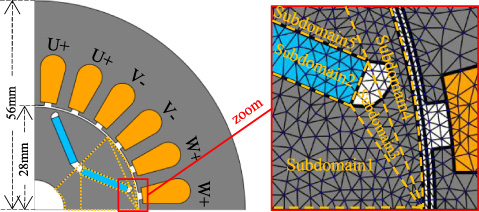
Cross-section of the baseline PMSM (T ave = 2. 8 Nm, T rip = 1. 6 Nm).
To freely generate, annihilate, and deform the air barriers in the rotor, the TO should be employed. The broad category of TO techniques can be generally classified by deterministic-based methods such as the level-set method and density method, and stochastic-based methods such as the ON/OFF method and the NGnet method. In this study, we employ the NGnet method considering the global search ability and smoothness of shape [4,6].
For a 2-D TO problem, the NGnet function f(x) is:
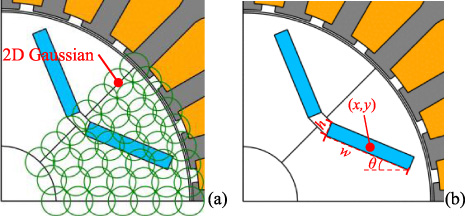
Gaussian distribution and parameters for HO.
NGnet method defines the interfaces between materials by the iso-contour of f (x). Specifically, when the center of the jth mesh in the TO domain is c j , if f (c j ) ≥ 0, the jth mesh will be filled by electrical steel (core), otherwise it will be filled by air (barrier). The iso-contour of NGnet is spatially smooth. More importantly, the NGnet method reduces the TO problem to a PO problem in which the weightings (from −1 to +1) of the normalized Gaussians are variables for optimization.
As shown in Fig. 2(b), let us consider the location, dimension, and angle of the rectangular PMs, which can be governed by five parameters: width d, thickness h, PM angle θ, and PM center (x, y). To treat different PM layouts, the meshes in FEA models must be modified. There are two approaches for regenerating new FEA models: re-mesh or move nodes with a mesh deformation algorithm. Table 2 compares the two approaches. Leaving aside the other advantages of mesh deformation, in this study, it is employed because the rotor features can be preserved even if the PM layout is modified. More specifically, by introducing the mesh smoothing, each Gaussian no longer manages material properties near it in global coordinates, but manages material properties in relative positions with the PM as a reference coordinate. In this case, the convergence of iterative searching can be speeded up because it is obvious that the optimal core topologies with different PM shapes have some common features. For example, the air barriers should not be in the magnetization direction of the PMs, but should play the role of guiding fluxes around both sides of the PMs.
Comparison of model regeneration approaches
Comparison of model regeneration approaches
There are several algorithms for computing the mesh deformation: Laplace smoothing, Winslow smoothing, Hyperelastic smoothing, etc. In this study, a subdomain-based Laplace mesh deformation technique, which was proposed by COMSOL® for model regeneration in fluid-structure interaction problems, is introduced to treat the structural design problem [15]. As depicted in Figs 1 and 3, this mesh smoothing technique firstly constructs helper lines (yellow dashed lines) to divide the domain (TO domain in this paper) into several polygonal subdomains, then Laplace’s equation in the 2-D domain as Equal (3) is solved for achieving the new vertex positions in each subdomain.
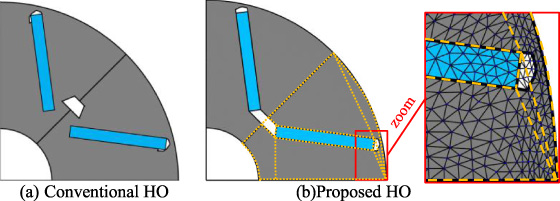
Comparison of different HO approaches.
It is well known that the mesh shapes will influence the condition number of the coefficient matrix and convergence speed. According to our numerical experiments, the solving time due to mesh deformation is increased by no more than 20%.
To combine the TO and PO, the w, which manages the rotor core topology, and the aforesaid five parameters which govern the PM layout, are cascaded for optimization. The chromosome string in the black-box optimization problem is:
The chromosome string can be solved by a great variety of real-coded algorithms such as sample-path optimization, response surface methodology, deterministic search methods, and heuristics. In this study, we strongly suggest using heuristics like EAs as the solvers, in which the concept of good features being inherited can well co-work with maintaining core shape features realized by mesh smoothing. The optimization flow of the proposed HO is shown in Fig. 4. For each newly created chromosome string, the meshes in the TO domain are firstly filled by air or electrical steel according to the weightings of NGnet, then the meshes on the rotor are deformed controlled by the PM layout parameters.
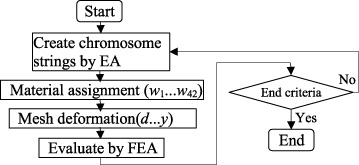
Flow for the proposed HO solved by EA.
Comparison with conventional optimization methods
We give a figure, in which the chromosomes that manage the PMs are changed while the chromosomes that manage the rotor core topology are unchanged, to clearly illustrate the difference between the proposed HO realized by mesh deformation and conventional HO. As shown in Fig. 3, for the conventional HO, the topology of the rotor core and the parameters of the PMs are relatively independent. For the proposed HO, however, a connection between the core features and PMs layout is made, allowing the core features to be kept even if the PM layout is modified.
The efficiency of the proposed HO method is compared with conventional HO realized by re-meshing and traditional TO in which only the rotor core topology is optimized. For impartial comparison, the optimizations are based on the premise that a constant PM volume. Aim to improve the torque property, the fitness of the optimization problems is defined by:
GA with the classical BLX-𝛼 crossover is employed as the solver. Population (POP) size and 𝛼 are set as 200 and 0.3, respectively. The structures of the initial populations are randomly generated. The initial populations for the proposed HO are drawn in Fig. 5. Evaluation 80000 individuals are stopping criterion.

Initial 200 populations with randomly created structure.
Converge history of the three methods is shown in Fig. 6. The proposed HO found the best solution in comparison to the other two methods.
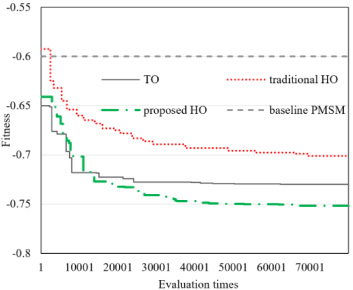
Convergence history of different methods.
By comparing the Converge history of traditional TO and the proposed HO, it can be inferred that the additional PM layout parameters will not significantly slow down the convergence. As the result, the proposed HO found a better solution in comparison with traditional TO, this must have been caused because of the freer PM layout.
On the other hand, the traditional HO converged to a worse design than the other two methods, this must be because the core shape features cannot be inherited. For the traditional HO, every PM parameter combination corresponds to an optimal topology, making the black-box problem too multi-modal to be solved. As the result, there is still a far way for the traditional HO to converge, even if 80000 designs have been created and evaluated. In addition, it should be noted that the model regeneration of the traditional HO is also slower. The elapsed time of TO, traditional HO, and the proposed HO is 108 hours, 150 hours, and 120 hours, respectively.
To fully investigate the compatibility of the proposed HO method with different EAs, we adopted different solvers to steer the formulated optimization problem in the former section. Two GAs, i.e., GA with BLX-𝛼 crossover (BLX𝛼-GA), GA with AREX crossover (AREX-GA) and Just Generation Gap (JGG) strategy [17], and a state-of-the-art ES with restart mechanism called BI-population covariance matrix adaptation evolution strategy (BIPOP-CMA-ES) [18], were employed for investigation.
Characteristics of the three EAs are summarized in Table 3. The tuning of parameters in the two GAs was recommended settings for multi-modal problems [17], whereas the BIPOP-CMA-ES directly adopted its default recommended settings [18]. Multiple experiments for the three solvers were performed. The number of trials is 10.
Comparison of different evolutionary algorithms
Comparison of different evolutionary algorithms
Two measures were used to evaluate the BIPOP-CMA-ES and two GAs. The aim of the first measure – the average fitness in 10 trials – is to show the ability to explore the optimal solution. It is depicted as colorful lines in Fig. 7. The second measure – the fitness maximum deviation from the average fitness in 10 trials – is used to display how much the final solution is affected by the initial populations. The smaller the value, the more robust and the freer from the designs of initial populations. The second measure is depicted as the width of the colorful shadow in Fig. 7.
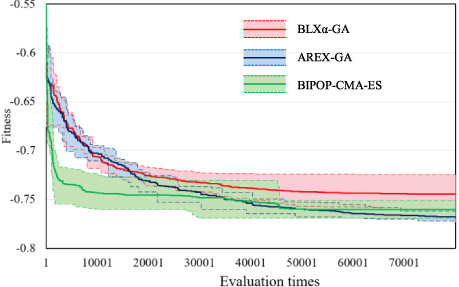
Convergence history of the proposed HO with different solvers.
Convergence history in Fig. 7 confirms that the two GAs have very close performance in the early stage. After 20000 evaluations, AREX-GA gradually widens the gap with BLX𝛼-GA in terms of the average fitness. Moreover, the maximum deviation of AREX-GA gradually narrows, while that of BLX𝛼-GA is gradually wide. The final maximum deviation provided by BLX𝛼-GA is about 3 times that of AREX-GA. Figure 8 shows the optimal designsprovided by different solvers. Compared with BLX𝛼-GA, the shapes provided by AREX-GA in the 10 trials are more similar, which is consistent with the smaller fitness deviation. AREX-GA provides better average fitness must have been caused because it can learn more information from the bigger parent group and the rotational invariance, while the narrower deviation may be the JGG enriched the population diversity. Overall, the data indicate AREX-GA can find better solutions than BLX𝛼-GA and is more robust, which is consistent with their performance in traditional TO problems.
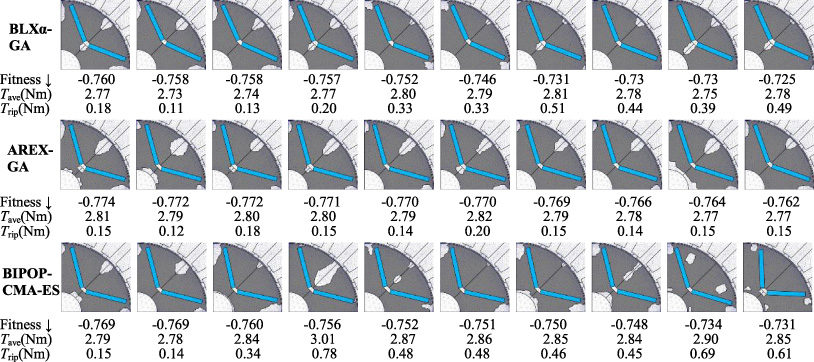
Optimal design in different trials provided by different solver (ranked by fitness).
As for BIPOP-CMA-ES, it hugely outranks the two GAs in the early stage. This must have been caused because it detected the natural gradient of the problem from the existing and previous parents. BIPOP-CMA-ES provides better solutions in most trials in comparison with BLX𝛼-GA, while it finally cannot provide better solutions than AREX-GA. As we can observe from Fig. 8, this must have been caused because BIPOP-CMA-ES fell into local optimal designs. A possible explanation for this might be that the existence of restrictions e.g., nconnect = 1, leads to the HO problem discontinuous, making the BIPOP-CMA-ES easy to fall into local optimum. Overall, we can infer that BIPOP-CMA-ES has stronger exploitation ability but weaker exploration ability in comparison with the two GAs for the formulated HO problem. This result also corroborates the ideas of Hansen [18 ], who first proposed CMA-ES and suggested that “CMA-ES is a robust and fast local search method. With a large(r) population size a more global search can be accomplished successfully”.
When we focus on the optimal designs shown in Fig. 8, the PM becomes slimmer, and most of the optimal rotors have anchor-shaped salient poles with an air slit on the d-axis. According to our comparative analysis, the slits can significantly suppress the cogging torque and torque ripple with almost no loss of average torque. This must have been caused because of the optimized flux in the air gap. These optimal designs also corroborate the findings of Yamazaki [19] that an air-slit in the d-axis can reduce the cross magnetization thus improving torque in the V-type PMSMs.
A HO which efficiently combines TO and PO for structural design is proposed. We applied the proposed HO to the design of a baseline PMSM where the layout of the PMs and topology of the air barriers are optimized simultaneously. The comparative numerical results prove that the convergence of the proposed HO is faster because good topological features can be inherited along iteration thanks to the Laplace mesh smoothing being used for model regeneration. The numerical results also indicate that the proposed HO has good compatibility with different solvers, it can always provide good convergence to provide PMSM designs with excellent torque property when an evolutionary algorithm such as a genetic algorithm and evolution strategy is used as the solver.
Footnotes
Acknowledgements
This work was supported by Japan Science and Technology Agency (SPRING: Support for Pioneering Research Initiated by the Next Generation), Grant No. JPMJSP2153.