



Abstract
A multiple-input and multiple-output planar actuator is proposed, which utilizes mechanically driven stator magnet arrays to levitate a permanent magnet mover. A state of levitation and actuation is obtained by mechanically altering the orientation of the stator magnets to control the forces and torques on the mover. A challenge for the design and control of the actuator is inverting the relationship between the force and stator magnet rotation angles, as there is no closed-form analytical solution. In this study, a feed-forward neural network is applied to model the forward relation between stator magnet angle input and a force and torque output to reduce the forward computation time for the design process and for error estimation in real-time applications. Additionally, the neural network is considered for inverting the solution for a motion profile sampled at 1000 Hz. The developed forward model is able to calculate the forces and torques on the mover a factor 10 faster than the equivalent charge or Fourier model with an absolute error of 3 mN and 0.1 mNm for the forces and torques, respectively, and a feed-forward neural network is able to accurately learn an inverse solution for small motion profiles.
Introduction
This paper presents a multiple-input and multiple-output (MIMO) magnetic levitation actuator (MLA) that utilizes permanent magnets (PMs) in both stator and mover as shown in Fig. 1. The stator is composed of a mechanically driven PM assembly, with each magnet rotating around its z-axis to control the PM mover [1].
The MLA has several advantages over conventional current-based levitating actuators. The system has a lower thermal footprint, as significantly less heat is generated in either the mover or the stator. Additionally, the air gap in the actuator can be significantly increased due to the strong fields of permanent magnets. This allows for a non-magnetic separating structure between the mover and stator, enabling the mover to be operated in a locally controlled environment and this allows for theoretically unrestricted 6-DoF motion. Furthermore, the utilization of PMs in both the stator and the mover enables the system to be operated through repulsion or attraction without altering its mechanical properties, e.g., a levitating planar actuator, a ceiling-mounted planar actuator, or a combination of both.
In current-based levitating actuators, the interaction between the current in the coils and the permanent magnets is described by the Lorentz force, which gives a linear relationship between the current and the forces and torques in the system, and a closed-form inverse relation exists for the straight coil parts [2] for a non-rotated mover, i.e. the mover magnet array is perpendicular with the long coil sides. In the proposed MLA, the relation between the stator magnet rotation angles and the forces and torques on the mover is non-linear, and there is no analytical solution to this inverse in closed form. However, this inverse relationship is necessary for the control and design of the MLA and is a challenge that should be solved.
In this paper, a feed-forward neural network (NN) [3] is considered as a possible solution to the inverse problem in the MLA for stator magnet angle estimation. An NN has a fast evaluation time, which is mandatory for real-time control of the MLA and allows the possibility to compensate for modeling errors from the semi-analytical methods used to build the network by applying an adaptive neural network-based compensator [4]. In addition to the inverse solution, the network is also considered a substitute for the forward modeling of the forces and torques on the mover by learning the non-inverted relation. This allows the use of a feed-forward NN to estimate the errors in forces and torques based on the estimated stator magnet angles from the inverted model. Lastly, by adding physical parameters to the dataset, the NN can be used in the design of the actuator to reduce the time required for design. Therefore, the investigation of the applicability of an NN is considered an important step towards the proof of the actuation principle.

Overview of the considered magnetic levitation actuator. (a) A single stator magnet and a 5-pole mover in the first quadrant. (b) A full magnetic levitation actuator configuration with a 25-pole cylindrical PM stator.
The forces in the MLA are calculated using the Lorentz force principle and the equivalent charge method as
The forces are evaluated for all stator magnets on a single mover magnet, as illustrated in Fig. 1a. Similar to the current-based systems [2], a wrench is introduced as
For the forward model a feed-forward neural network is considered to replace the equivalent charge model of [1]. A feed-forward neural network can approximate any function arbitrarily well, given there are enough neurons in the hidden layer [3]. The number of hidden layers and the number of neurons are hyper-parameter optimizations [5] depending on the required accuracy and the approximate function complexity.
As introduced in (5), the total forces and torques on the mover are calculated by taking the sum of all individual force and torque components.
For design and error estimation, the computation of the wrench of (5) should be performed as fast as possible. The computation time of the equivalent charge model scales with the number of mover magnets [1], which is unsuitable for a real-time environment, and is undesirable during the design process of the MLA.
In this paper, a simple, non-optimized mover, as in Fig. 1, is chosen to demonstrate the applicability of a feed-forward NN as a forward model for the MLA. To reduce the required collection of data and to show the applicability of a feed-forward neural network, mover rotations are excluded from the dataset, and the placement of mover magnets in the mover topology is fixed. By excluding mover rotations and by considering a single mover topology, the summation of the number of mover magnets is removed from (5), and the wrench of the forward network is then calculated as
By applying symmetry, the wrench is super-positioned for positions when the mover is in a different quadrant with respect to the stator magnet. By evaluating the trained network in parallel for all stator magnets after applying the necessary super-positioning steps, the wrench of a single stator magnet to the mover assembly of Fig. 1a, is extended to a full stator mover topology, as shown in Fig. 1b. This eliminates the computational time scaling for the number of mover magnets due to the numerical integration and results in a computationally fast forward model.
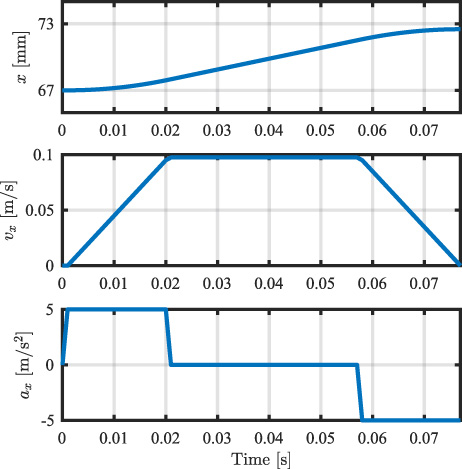
Motion profile used in the optimization as in (9).

Training performance of the forward network.
For the inverse model of the MLA, ideally, the reduced forward model wrench model of (6) should be inverted such that the solution for all individual stator magnets is directly obtained, however, an optimization is required to find the necessary stator angles, because of the summation in (6). Another option to find the inverse is to generate data on the response of the actuator for random stator magnet angle inputs. This would however require more advanced network architectures, a feed-forward network will not work due to the dimension of the data. Instead, the forward model is applied in a multi-objective optimization for a motion profile, as shown in Fig. 2 to find the inverse solution. An optimization is performed for three wrench vectors, with a constant force F
z
of 1 N and a varying force F
x
in the x-direction for a force of −0.5 to 0.5 N with a step size of 0.1 N, all other wrench components are set to zero. The rotation angles

Force and torque on a mover as in Fig. 1b. (a) Force evaluation of the NN forward model for a mover translation. (b) Torque evaluation of the NN forward model for a mover translation. (c) Force discrepancy between the NN and the charge model. (d) Torque discrepancy between the NN and the charge model.
The resulting dataset is obtained for a single trajectory consisting of the non-zero components of the wrench vector of (6) and the position vector

Force profile reference and the predicted forces from the inverse model solution and the discrepancy between the reference and the forward NN.
The result section is split into two parts, the first part consists of the forward modeling of the MLA and the secondary part shows the results of the inverse modeling of the MLA.
Forward model
The goal for the forward model is to reduce the forward computation time by removing the time scaling as introduced in [1] and to obtain a forward error estimator. In Fig. 3 the training performance of the forward network is shown for the configuration of Fig. 1b. As can be seen, a training performance of 5e−8 is obtained for the training, test, and validation sets respectively, which indicates a good convergence for both the training and new data. Figure 4 shows the forces and torques on the mover. As shown by Fig. 4c and d, the forces and torques are accurately calculated using the forward model, with a discrepancy of less than 10 mN and 0.35 mNm or a maximum RMSE of 3 mN and 0.1 mNm. The computation time is independent of the number of mover magnets, and with parallel evaluation of the networks, the model is a factor 10 faster than the forward model based on the equivalent charge or harmonic modeling technique [1]. More performance may still be obtained by tweaking the hyperparameters and by increasing the training time.
Inverted solution
The inverted solution is trained for the full system, where all stator magnet angles are optimized according to the minimization problem as in (9) for a motion profile as shown in Fig. 2. In Fig. 5, it can be seen that the inverse solution from the optimization is accurately tracked with local errors with a maximum of approximately 20 mN. This error follows from the optimization algorithm as these local errors are present in the dataset obtained with (9). The rounding to two decimals of the input vector
The inverted computation of the stator angles
Conclusion
A feed-forward neural network implementation for a multiple-input multiple-output magnetic levitation actuator has been presented. The network is able to accurately replace the forward calculation of the forces and torques on the mover and can be used in the design process of the actuator, and it is able to function as a black box environment for controller design. Discrepancies of less than 10 mN and 0.3 mNm have been obtained for the force and torque computation, respectively, while decreasing the required computation time by a factor of ten.
The inverse solution has been demonstrated for a motion profile sampled at a frequency of 1000 Hz. The resulting discrepancy in force follows from the multi-objective global optimization and indicates that a neural network will be able to function for the angle estimation; however, as the control of the system is timing-based, a slight alteration of the network architecture may be necessary to allow system delays within the network. The bottleneck of using a feed-forward neural network is obtaining the inverse data which is time-consuming and not viable with the particle swarm multiple objective optimization algorithm.