




Abstract
A new sequential blind source separation algorithm is proposed based on intelligent single particle optimization. The signal variability is used as the objective function and the separation vector is transformed by using the spherical coordinate transform method. The intelligent single particle optimization is used for solving the objective function. By de-correlation method, the separated source signal component is removed from the mixed signals, and source signal could be separated out respectively according to the decreasing order of the signal variability. Simulation results show that the proposed separation algorithm can realize sequential separation of source signal efficiently and the separation precision is very high.
Keywords
Introduction
Blind source separation technology is separating each of the source signal components from the observed mixed signals at the unknown source signal and mixing parameters. With the deepening of blind source separation studies, blind source separation algorithm has been widely used in various fields of voice, image, communication and bio-medicine [1, 2, 3, 4].
In recent years, bionic intelligent optimization method of genetic algorithm,colony algorithm and particle swarm algorithm have been a lot of scholars’ attention and research, and a lot of results have been gotten in the algorithm research and practical applications [5, 6, 7]. A new bionic intelligent optimization algorithm was presented on the basis of particle swarm algorithm in 2010, it is called smart single particle optimization algorithm [8]. The algorithm can be performed using a single smart particle self-learning search in the solution space, In the search process, the position vector of the particles will be divided into a certain number to the sub-vector, the speed and position are dynamically adjusted with the sub-vector unit, smart single particle is close to the global optimal solution. Smart single particle optimization algorithm has strong global search capability, and it has been used to solve the cluster analysis and distribution network reactive power optimization problems, and good results are achieved [9, 10].
Materials and methods
Intelligent single-particle optimization algorithm
PSO is an intelligent heuristic optimization algorithm [11], the optimization problem solving is achieved through simulation birds foraging process. During the solution process, PSO first initialize M particles in the m-dimensional search space, wherein the location of the n-th particle is
In particle swarm optimization algorithm, all dimensions of each particle are updated in each course of evolution and in its position vector and velocity vector. But the existence of this update mechanism has certain blindness, it can not guarantee that the particles are moving towards better direction on all dimensions. To solve this problem, an Intelligent Single Particle Optimizer (ISPO) was proposed, the PSO algorithm changes the position and velocity updating policy [8]. In each generation particle evolutionary process, the whole velocity vector or position vector are not updated simultaneously. But the entire vector is divided into several sub-vector, each sub-vector is updated cyclically based on learning strategies. Single particle analyzes the the prior update situation during the speed update process, sub-vector new speed is determined in the next iteration. Position sub-vector diagram is shown in Fig. 1.
Position sub-vector diagram.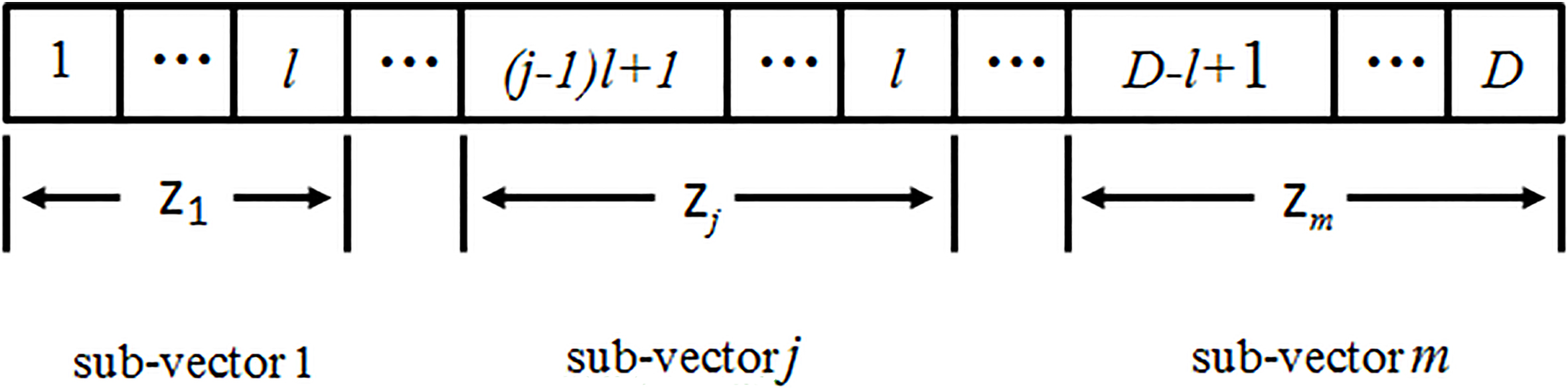
In ISPO algorithm, sub-vector velocity and position update formula is as follows:
In above formula,
In single-particle Intelligent optimization algorithm, all vectors are divided into several sub-vector, according to the prior speed analysis ability and the learning strategy, each sub-vector is updated in order loop, the algorithm has a very good global convergence and high optimization accuracy.
The solving problem of blind source separation mainly contains to determine and optimize the objective function. In this paper, the separation vector is transformed by spherical coordinate transformation method and based on the objective function of the signal change thinking, and a smart single-particle optimization algorithm is used for solving optimization objective function, a successful separation of source signals are achieved. The mixed-signal itself and its delayed signal are used only in this algorithm to constitute the covariance matrix, which is a effective blind source separation algorithm with simple principle, clear, low computation.
Separation principle based on the signal change degree
For blind source separation,
In the formula, A is full rank mixing matrix, and it is reversible.
The signal change degree was defined [12], and the linear mixed signal change theorem was given: For a group of independent source signals, change of its linear mixed signals are between the minimum change degree and maximum of the source signal. For a certain source signal
For successive blind source separation model, separating the signal can be expressed as Eq. (7):
Blind Source Separation objective function is the Eq. (9):
By using intelligent single-particle, objective function of Eq. (9) is optimized to obtain solutions, the separation vector
According to the principle of the signal change gegree, blind source separation problem can be attributed to the solving optimization inf the Eq. (9). In this paper, intelligent single-particle search algorithm is used, the objective maximum function value of Eq. (9) is taken to separate vector
If smart single particle algorithm is used to obtain the maximum value
The objective function of blind source separation is converted to Eq. (11):
Before the source signals of the second largest signal change degree are further isolated by intelligent optimization algorithm single particle, The removing method need be used to eliminate the largest signal change components of the original mixed-signal source [13], the eliminating source methods is Eq. (12):
According to the principles of the above algorithm, the concrete steps of blind source separation algorithm based on intelligent single particle and signal change degree are as follows:
Smart single particle dimensions and the particle position encoding are determined according to the mixed signal number, the whole position vector is divided into m sub-vector of position. Within the constraints, smart single particles are randomly generated, the position and velocity of smart single particles are initialized. Initialization evolution generation counter The initialization vector counter Learning initialization variable According to the Eq. (11), the fitness value of smart single particle is calculated, the j-th speed sub-vector is updated based on the Eqs (1) and (3), the location of j-th vector is updated based on the Eq. (2). If If If If If all source signal are recovered, then to stop counting; otherwise, according to the Eq. (12), the computing source signal is eliminated from the mixed signals to get new mixed-signal, then return to step 1, and repeat the above steps.
In order to verify the effectiveness of the proposed algorithm blind source separation,the mixed-signal of sound signal and mathematical function are taken respectively as source signal, and blind separation experiments are made. In experiment with different source signals, the unified matrix A is randomly generated, and source signals are mixed, and then this algorithm is used to separate the blind signals after mixing.
Smart single particle parameters in our algorithm are set for
Sound blind signal separation experiments: the waveforms of its source signal , mixed-signal and separating signal are in Fig. 2.
Sound signal separation results.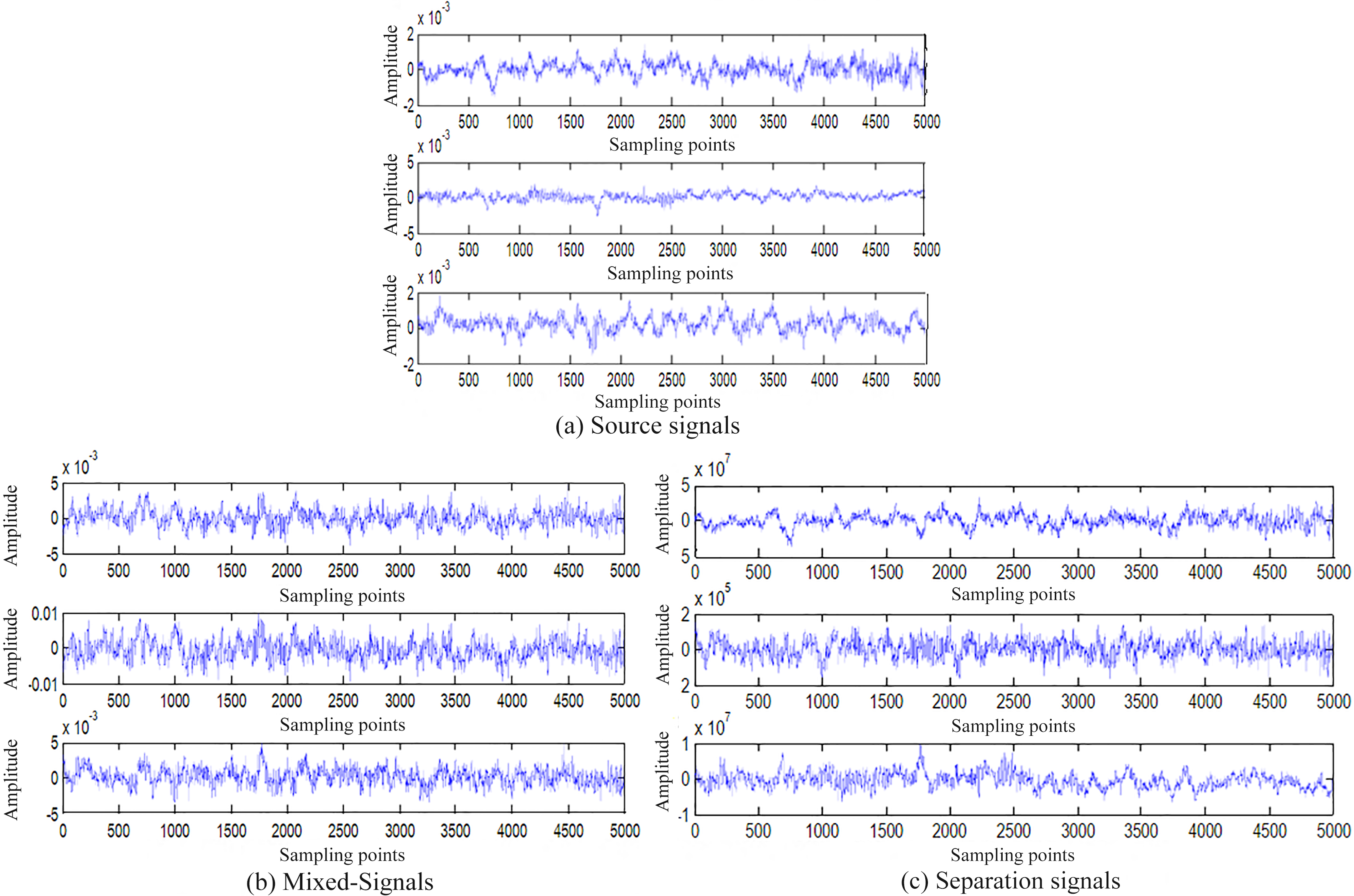
Mathematical function blind signal separation experiments: the waveforms of its source signal , mixed-signal and separating signal are in Fig. 3.
The algorithm isolated signal waveform is compared with the source signal waveform , the proposed algorithm achieves a good separation for different mixed signals. Further, the signal change values of the separated signal (in Eq. (5)), the absolute value of the correlation coefficient and the reconstruction SNR are used to objective and quantitative evaluation of the algorithm performance, and these are compared with FastICA algorithm [14]. The absolute value of the correlation coefficient
Algorithm separation performance comparison
Mathematical functions’ signal separation results.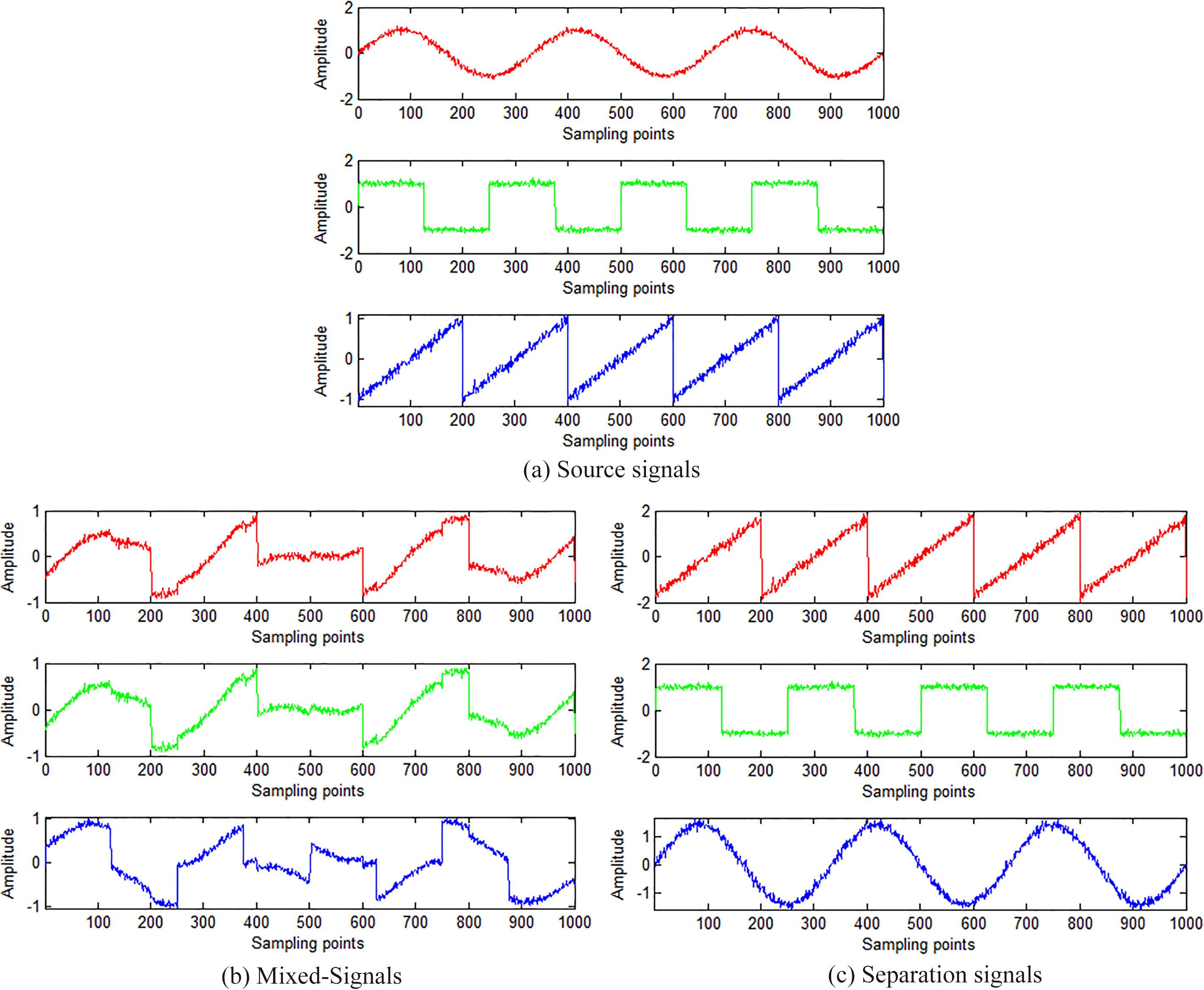
Reconstruction SNR is defined as Eq. (14):
Table 1 shows that the proposed method is closer to the source signal than FastlCA algorithm in the separating signal value change, the correlation coefficient absolute value and the reconstruction signal to noise ratio between the separated signal and the source signal are better than FastICA algorithms. This is that solving optimization objective function is derived from the gradient of thinking in FastICA algorithm, and thus local extreme situation is converged, it results in the reduced separation accuracy. In FastICA algorithms, the nonlinear function need be selected to approximate negative entropy, which can introduce errors to affect the separation accuracy. Intelligent single-particle optimization algorithm is used in our research algorithm, the algorithm itself has a good global convergence and high precision optimization, the objective function optimization solution can avoid falling into local minima; our algorithm uses intelligent single-particle objective function to optimize solution directly, without approximation, the algorithm with respect to FastICA algorithm has higher separation accuracy.
Because smart single particle in every separating mixed-signal has the source signal component with the largest signal change degree, there is the “orderly” in such separation process, which can separate the brightest source signals sequentially in descending order of the signal changes. FastlCA algorithm is to use the principle of the independence in signal separation, there is randomness in ordering the separation signal. Therefore, the signal separation “orderly” is the algorithm characteristics of the place with respect to FastICA algorithm.
Conclusion
Based on the signal change degree and smart single particle optimization, a sequential blind source separation algorithm is proposed in this study. The signal change degree information of the source signal is used in our algorithm, a smart single-particle optimization algorithm is used to solve the optimization objective function based on the theory of signal change degree, and after every one source signal is separated by the related methods, the separated source is eliminated by going for mixed signal. By repeating the source signal separation and elimination process, the algorithm can effectively separate the source signal in descending order of their signal change values. Simulation results show that the algorithm can ensure orderly source separation and high separation accuracy.
Footnotes
Acknowledgments
This work is sponsored by the Scientific Research Project (NO. 13C495) of Hunan Provincial Education Department, China and Hunan Provincial Natural Science Foundation of China(No. 2017JJ2135.