



Abstract
An improved method based on immune genetic, which is successfully used to fuse the infrared and visible images,is proposed in this paper. Feature vectors are constructed by extracting the characteristics of infrared and visible images, and then apply the modified immune genetic algorithm to fuse the image.The experimental results show that the improved algorithm has a good search ability and high convergence speed. Meanwhile, the method can also reduce the vector feature dimensions effectively on the basis of maintaining sufficiently effective information , the efficiency of target recognition is improved significantly.
Introduction
It is conducive to fuse the infrared and visible image on the basis of the comprehensive utilization of space exploration capabilities for infrared image and the target details for visible image, the fused features can provide a good basis for judgment in subsequent target recognition and classification, and enhance the ability to identify the target as well [12].
At present, image fusion is divided into pixel level fusion, feature level fusion and decision level fusion. Feature level fusion reduced the redundancy of information, because the data cost is low, and its accuracy stays between pixel level fusion and decision level fusion [1].
The feature fusion algorithm is aimed at the original target feature space extracted and reduces the dimension of the feature space. and eliminates the redundant information between the feature representation vectors in the extracted feature space, ensures the entropy, energy and correlation of the feature data after dimension compression does not change, which is beneficial to the subsequent target recognition [15, 25].
Immune genetic algorithm is an improved genetic algorithm which combines immune operator and traditional genetic algorithm. However, the traditional immune genetic algorithm has its own shortcomings, such as the slow process of searching and selecting antibodies, and even the stagnation of population evolution [24]. In this paper, the improved immune genetic algorithm overcomes the shortcomings of traditional immune genetic algorithm to some extent, realizes the effective fusion of the features of visible and infrared images, removes redundancy and reduces the dimension.
The traditional immune genetic algorithm
Immune genetic algorithm flow chart.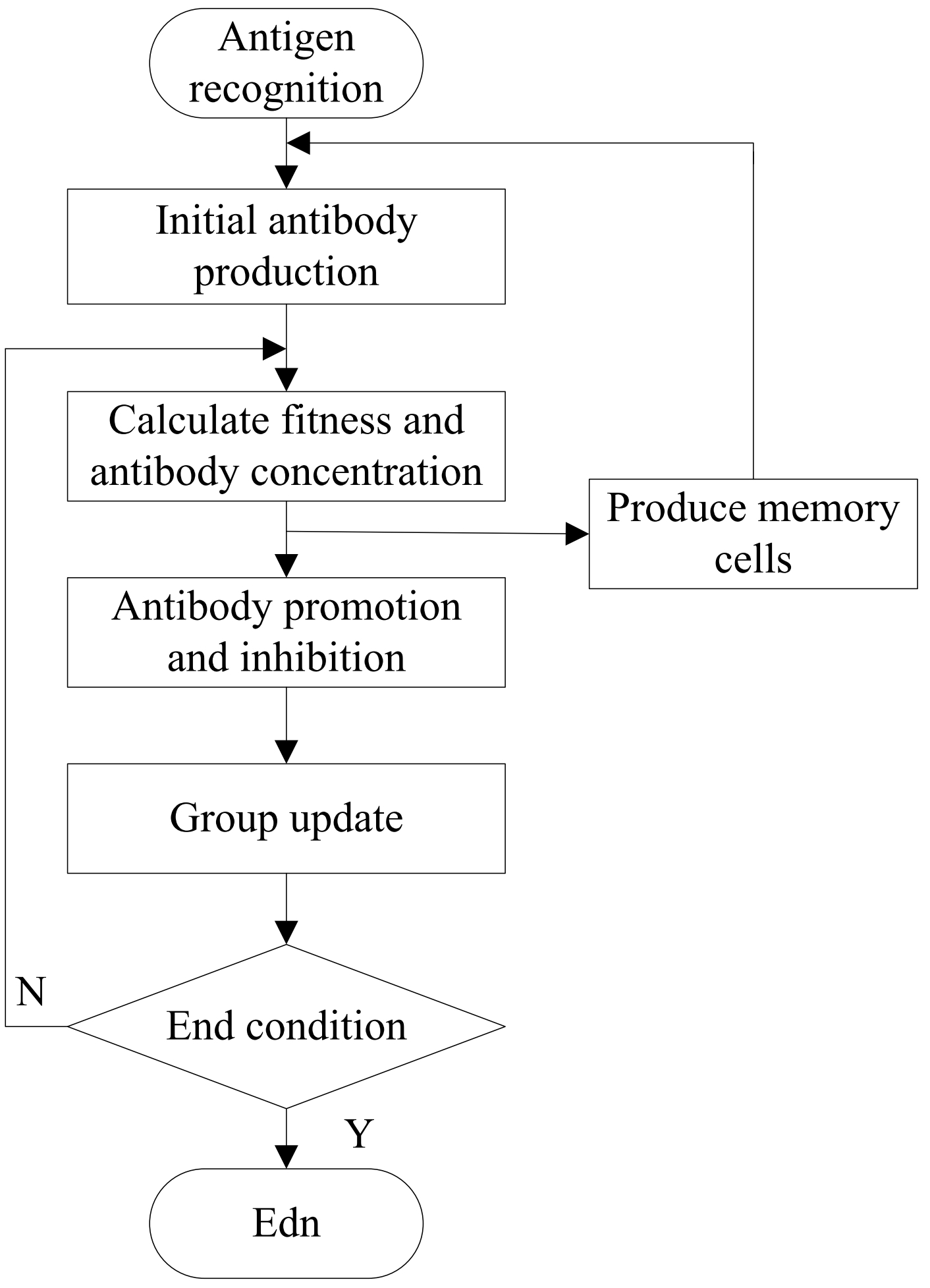
Immune genetic algorithm can overcome the defect that the convergence direction of genetic algorithm can not be controlled, using objective functions and constraints as antigens. This ensures that the generated antibody is directly associated with the problem and that the direction of convergence can be controlled [26]. The antibody generated can effectively exclude antigens, which is equivalent to finding the optimal solution of the problem. Memory of antibodies with high antigen affinity can facilitate rapid solution, that is, when the same antigen is encountered, the corresponding antibody can be produced quickly. In many ways, it shows advantages surpass genetic algorithms and immune algorithms [29].
When solving practical problems, the antigen corresponds to the problem to be solved, and the antibody corresponds to a solution of the problem. With the affinity of the antigen and antibody, it describes the approximation degree of the feasible and optimal solution. Immune genetic algorithm begins with a randomly generated antibody population, and give the parent (current) antibody group the genetic operation such as crossover and mutation, calculate the antibody concentration, and choosing the operation according to the antibody expectation reproduction rate, see Fig. 1 immune genetic algorithm flow chart [3]. The individuals with high expectation reproduction rate have a higher probability to be selected and copied to the next generation, so the children usually is superior to the parent. The process will be iterated circularly until conditions are met. Finally, it makes the optimization process with large probability approach to the global optimal solution [9].
But the traditional immune genetic algorithm has its own defects, crossover and mutation rates are fixed values, the process of searching and selecting antibodies is slow, even population evolution stagnated [5, 24].
Aiming at the traditional immune genetic algorithm premature convergence, the crossover rate and the mutation rate of fixed search process are low, resulting in disadvantages of the population evolutionary stagnation, so we investigate a method that improved immune genetic algorithm by adding the “elite select” [18] strategy and the adaptive strategy.
“Elite selection” strategy
The biggest problem of genetic algorithm is easy to fall into local optimum. In order to avoid the best individual of the current population is lost in the next generation, resulting in that the genetic algorithms get into local optimum and cannot converge to the global optimal solution. De Jong gave an idea called the “elite select” strategy in his doctoral thesis, which is also known as “elitist” policies [18]. Elite selection strategy is to copy directly the beds individuals (called elite individuals) so far appeared in the evolutionary process to the next generation without paired cross.
In order to make the genetic algorithm converge quickly to the global optimal point, it is necessary to ensure the existence of excellent individuals with higher fitness values, and give full play to the feature of “evolution” of the genetic algorithm. In this elite selection strategy, on the basis of keeping the best individual, it adds elite individuals instead of the smallest fitness value one in a new generation, the elite individual has a large dissimilarity factor compared to the best individual, and its fitness value is also should not be too small. This is not only keep the optimum fitness value of each generation monotonically increasing, but also maintain the diversity of individuals in a population by adding the newly individual [13]. It improves the overall search capability of the algorithm and makes the algorithm have the global convergence.
Fitness function
It shows that the features about the advantages and disadvantages of the individual, the selection of fitness function is the key to whether genetic algorithm can fuse the effective features. Fitness function is the decision basis of genetic algorithm in the process of evolutionary search, without external interference. Always constantly calibrate the solution space of the problem so that it evolves into a region that contains or approximates the optimal solution [11].
The purpose of feature fusion is to produce the most powerful fusion feature, so a quantitative criterion is needed to measure the classification ability of each individual’s corresponding fusion feature [20]. The fitness function adopts the inter-class distance value
In the formula,
In the formula,
The selection of crossover probability and mutation probability in immune genetic algorithm controlled parameters is a key factor, which is affecting the genetic algorithm behaviour and performance. It directly influences the convergence of the algorithm. The bigger the crossover rate
Self-adaption can be adjusted according to the fitness of the individual and the group situation; automatically change a
Adaptive crossover rate and mutation rate of the change, can make the algorithm has higher robustness, global optimality and efficiency. In this paper,
Among them,
In this paper,
Among them,
Feature fusion Schematics based on improved immune genetic show in Fig. 2. Infrared and visible light images were extracted from the target characteristic, compositions of the obtained feature vectors. The improved immune genetic algorithm for optimizing the combination of features, the ability of identifying is evaluated to find the best combination of feature fusion.
Feature fusion schematics based on improved immune genetic.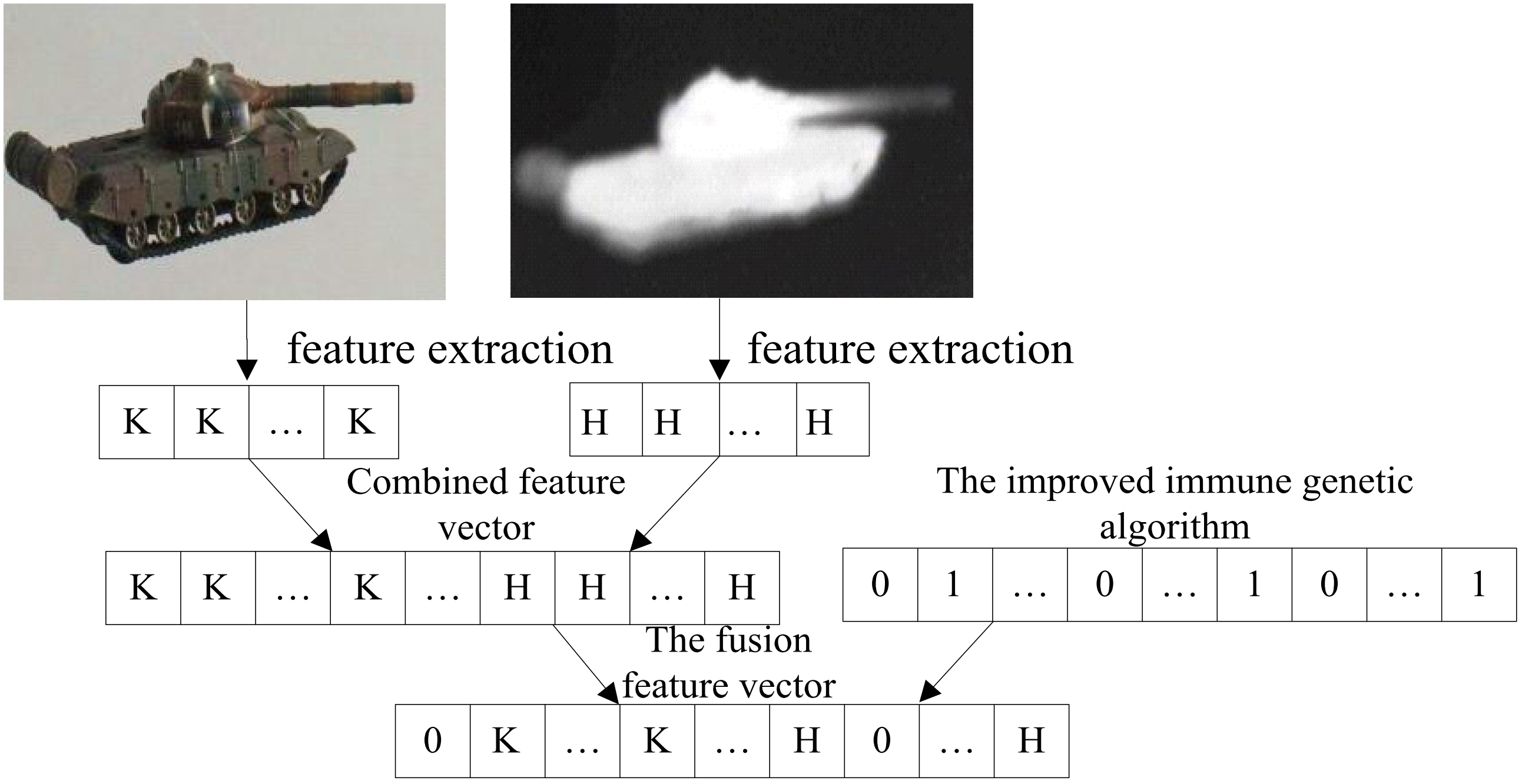
Based on the introduction of antibodies similarity, antibody concentration definitions, elite selection strategy and adaptive strategy, specific steps of image feature level fusion based on improved genetic immune algorithm are given as followed for.
The purpose of feature fusion based on immune genetic is to select d features optimal combination from the original feature vectors and constitute fusion feature. This binary code, the selected characteristic is taken as 1, otherwise 0; the antibody coding length is the number of the original feature vectors [10]. According to the actual needs of the population size, it determines selection rate, mutation rate and termination of evolution algebra.
Generate the initial antibody group
For the primary response, initial antibody is generated randomly. And for secondary response, by using memory function of the immune mechanism, some initial antibody is obtained from the memory cells, other antibody is generated randomly [10].
Calculating antibody affinity, concentration and motivation degree
Characterization of antibody affinity immune cells and antigen-binding strength is defined as:
In the formula
Ten-fold cross-validation is a way that the training samples for every class target is divided into ten parts, nine of which will be used as training data in turn, one as the test data, and do the test [19]. Each cycle takes ten times normally. All ten copies of data have all been selected as test data. The average value of ten times verifying correct rate is
The concentration of antibodies characterize whether antibody population diversity is good or bad. The high concentration of antibodies means that there are much similar to the population of individuals, optimization search will focus on a range of feasible solutions area, which is not conductive to global optimization. Therefore, individuals in population with high concentrations should be suppressed for ensuring the diversity of individuals [2]. Antibody xi concentration is defined as:
In the formula,
Antibody excitation degree is the final evaluation results of antibody quality. It’s inseparable with antibody concentration and antibody affinity. Generally, antibody with low concentration and high affinity has a high excitation degree. Excitation degree can be got from the antibody affinity and concentration through simple math as:
Calculate all antibodies excitation degrees, and according to the degree put them in order from small to large. The largest fitness antibody is reserved for the elite, then copy it and saved [23].
Set the memory size as ten, select two individuals with the best excitation degrees from the initial population of antibodies for storage.
Selection, crossover and mutation operations
In this paper, antibody selection operation is performed with proportional selection strategy.
Groups updates
Antibodies were ranked in ascending order of excitation and memory antibodies were used to replace the first few individuals in the new population resulting from genetic manipulation. If there are no antibodies in this generation of antibodies that are the same as the elite antibodies, one copy of the preserved elite antibodies will be copied into the antibody population and the ones with the lowest stimulation in the population will be deleted. If this generation is stimulated, the highest degree of antibody has a value greater than the value of the elite antibody, and then the one with the highest degree of inducibility is copied and replaced with the elite antibody as a preserved elite antibody.
Update antibody memory
If the antibody memory is not full, choose the best two new individuals to update supplemental memory; if the antibody memory is full, then choose the best two new individuals to replace the worst two individuals in the memory.
Termination inspection
If it reaches termination evolution times, then the whole algorithm running is end, output fusion feature; otherwise, return to step 3.
Improved immune genetic algorithm for image feature fusion flow chart shown in Fig. 3.
Improved immune genetic algorithm flow chart.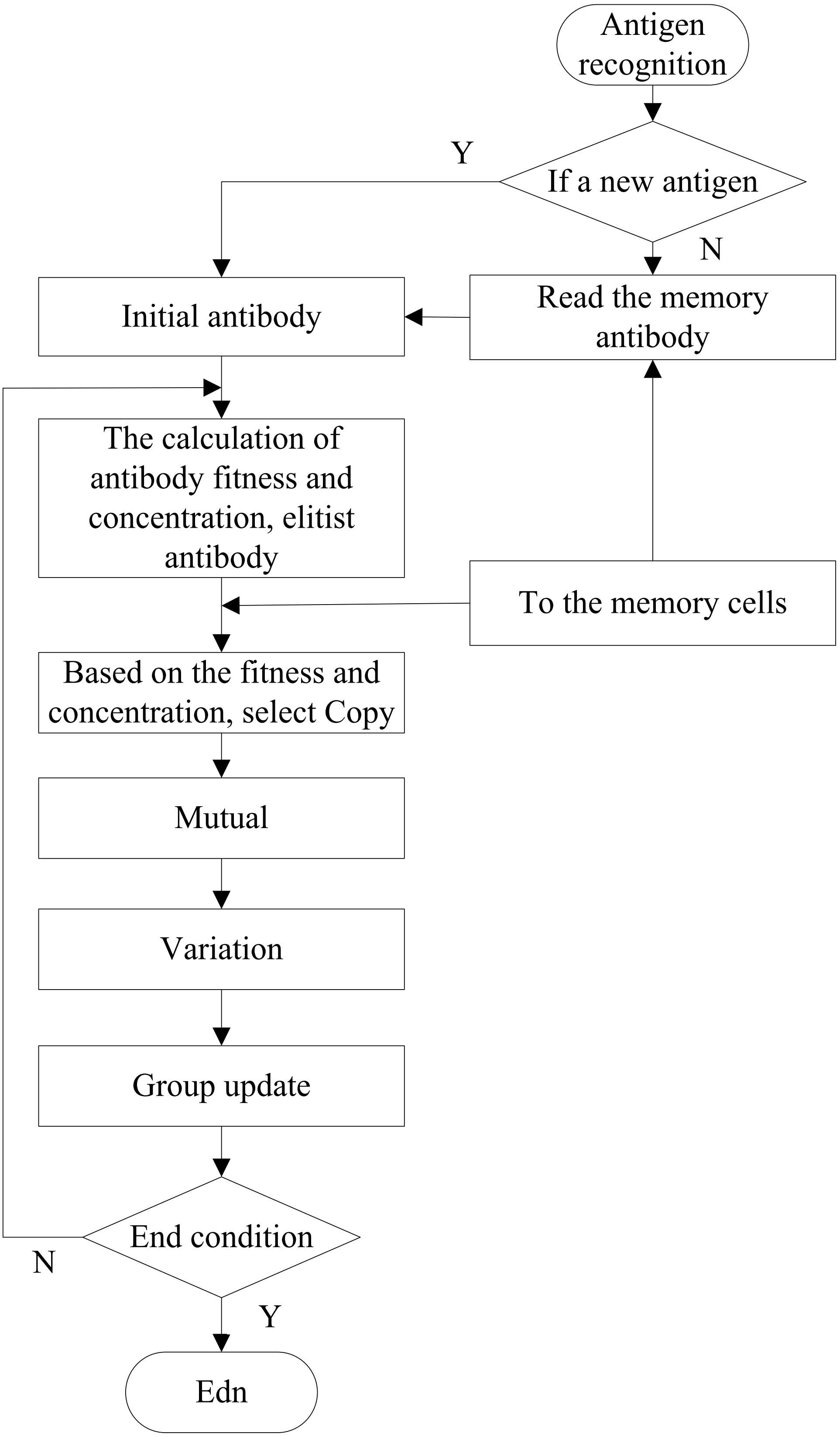
Thee gray eigenvalues of the gray-level co-occurrence matrix to extract the target
Hu moments extract the target eigenvalues
Affine invariant moments to extract target feature values
Because the target is different and the environment is different, the extracted target feature should be unique and stable on the same type of target, and, as far as possible, does not depend on the condition and environment of extracting the target feature. Feature extraction methods should be able to extract distinguishing, reliable, independent and less redundant target features. It is necessary to ensure with-class clustering and inter-class separability, avoid redundancy and obtain effective target features [6].
In this paper, aiming at the target (cars, tanks, helicopters) of infrared and visible images using the gray level co-occurrence matrix, Hu moment, affine invariant moment features, wavelet moment feature extraction methods to extract target feature.
Affine invariant moments to extract target feature values
Affine invariant moments to extract target feature values
Part of the sample target image.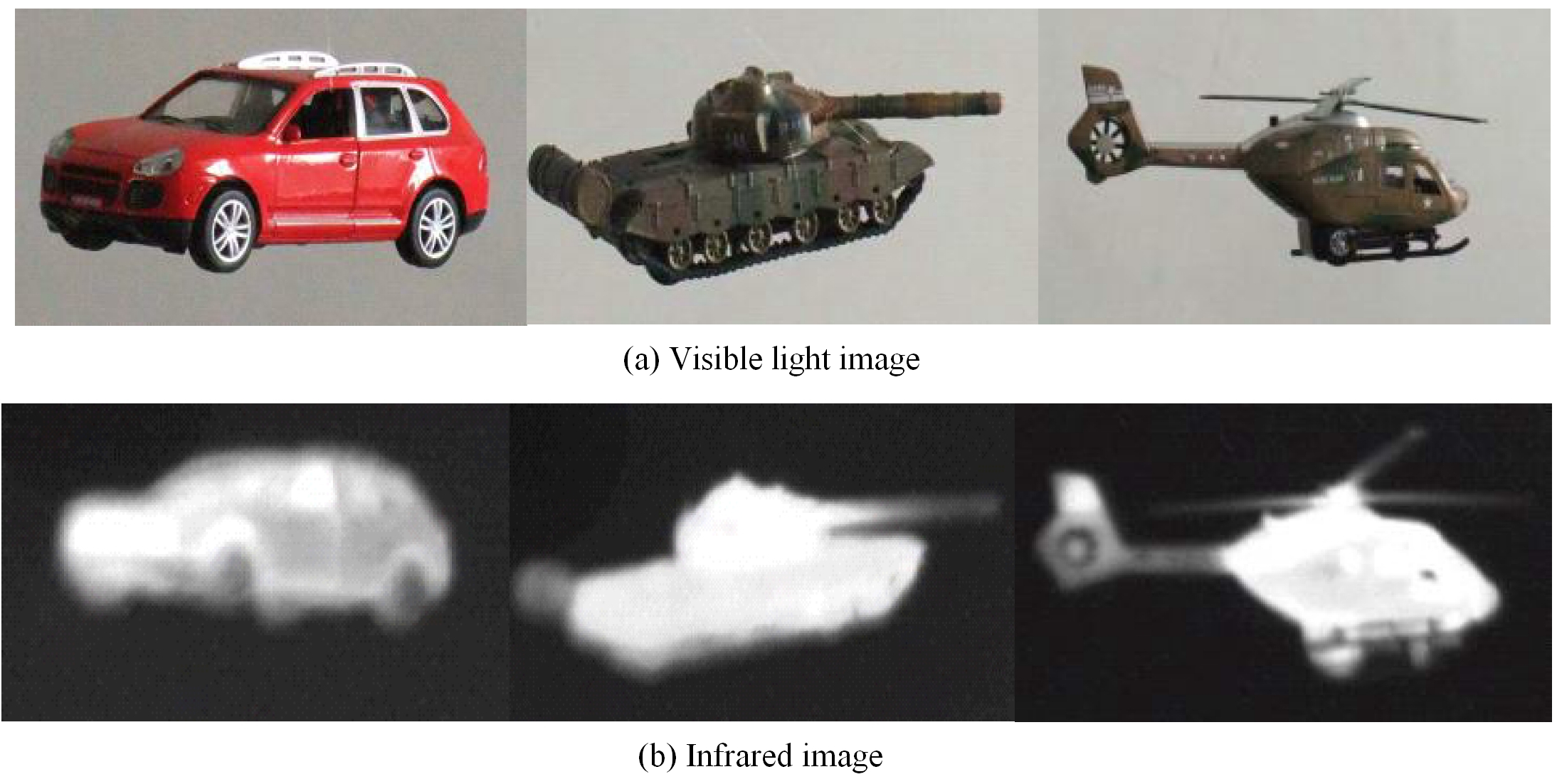
The curves of different feature extraction methods and different target eigenvalues.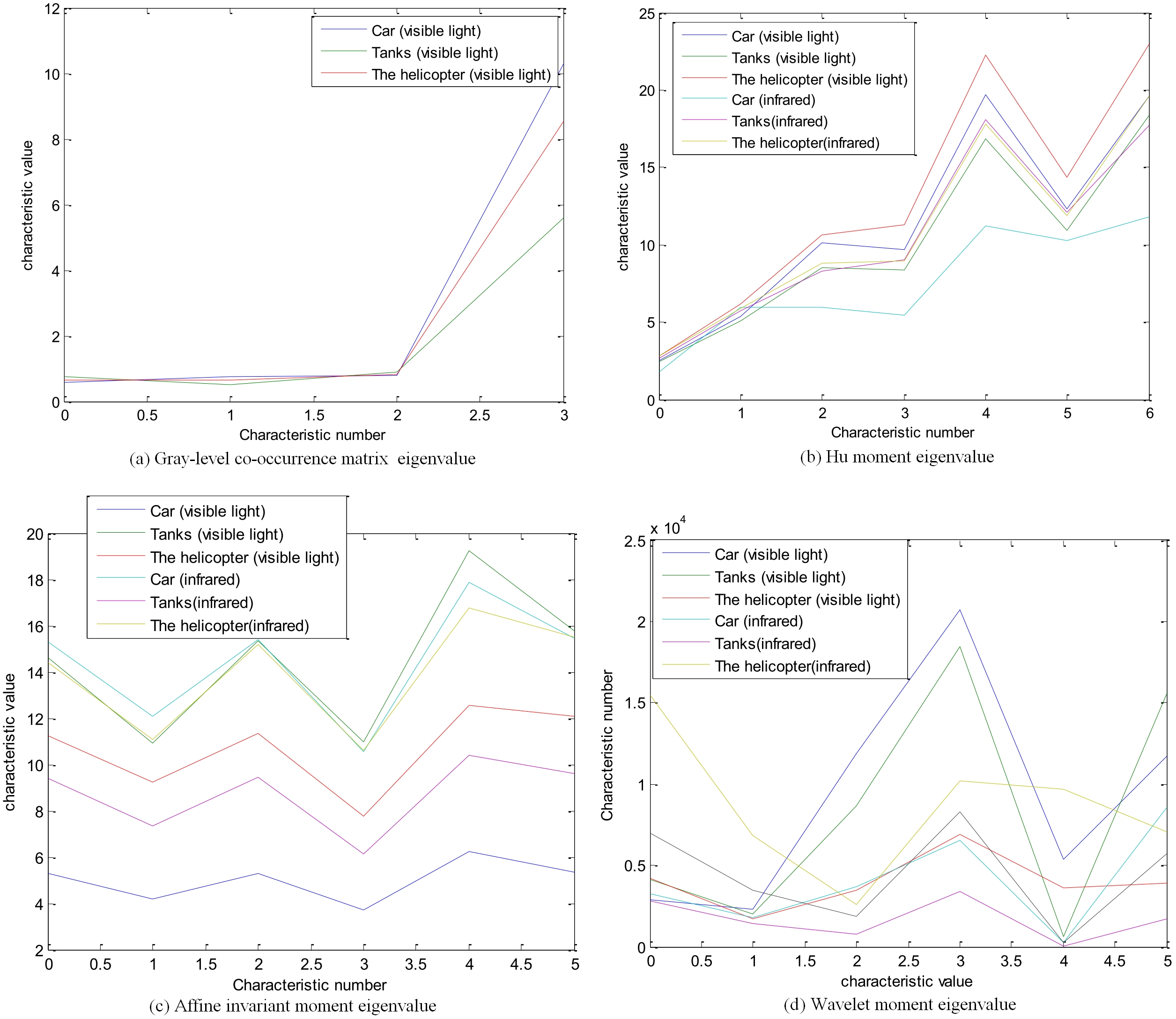
The feature data Tables 1, 2, 3, 4, and eigenvalue curves 5 extracted from four feature extraction methods. It can be seen that the feature data extracted by these four methods can distinguish different target features in different degrees. However, the eigenvalues are redundant, which are easily affected by the target and the environment and do not have stability. But, it’s hard to make a choice with a lot of feature data, so it is necessary to study feature fusion, which is also called feature selection, feature optimization, selecting and reducing the amount of data, so that feature data fusion can be used to enhance the stability and effectiveness of feature vectors, reducing the dimension of feature data [8].
There are 4 features of gray level co-occurrence matrix
In the formula,
In the formula,
In the formula,
Use Eq. (13) to compress the data between [0, 1].
In the formula,
In this paper, 25 eigenvalues are obtained by using the gray-level co-occurrence matrix, Hu moment, affine invariant moment and wavelet moment. The experiment of feature vector fusion of infrared and visible images using improved immune genetic algorithm is carried out. The experiment is implemented under the environment of Matlab 7.0. The hardware is configured for AMD Athlon (TM) II X2 240 Processor 2.81 GHzCPU, memory 2.0. Set the initial population size as 50, through cross practice, the initial crossover probability is 0.9, the second generation of crossover probability is 0.6, the initial variable rate is 0.1, the second generation of mutation probability is 0.001, and set the stopping criteria for the number of iterations to reach 200 generations. After running 10 times, excitation degrees are up to 95.33. After the integration, the character is complexity, aspect ratio, local stationary. In order to facilitate comparative analysis, compare the algorithm in this article with the genetic algorithm and feature fusion method and the immune genetic algorithm; choose the same selection as above. Draw the curve of fitness and the change of the number of iterations as Fig. 6.
Convergence curve.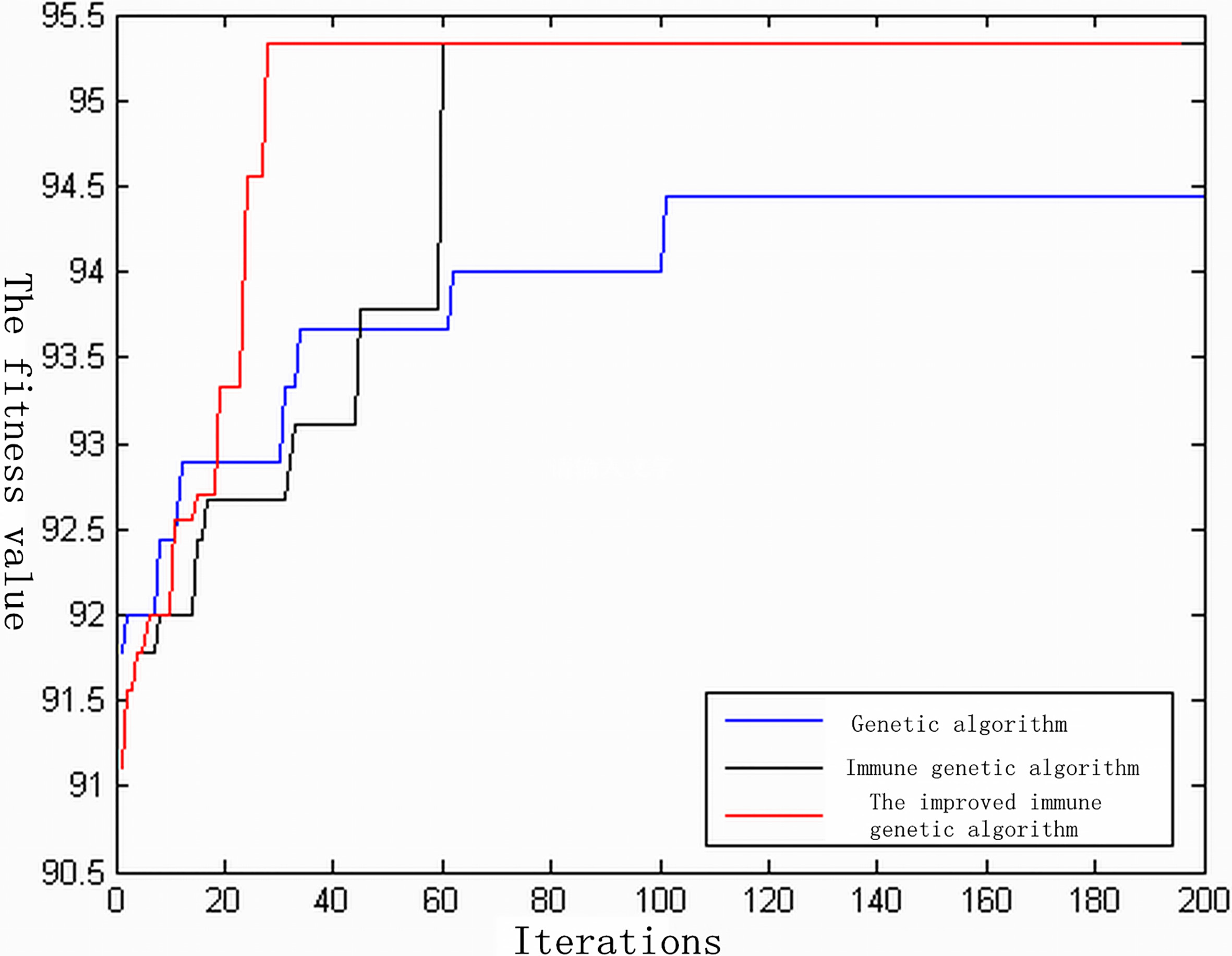
Different fusion target eigenvalue distribution.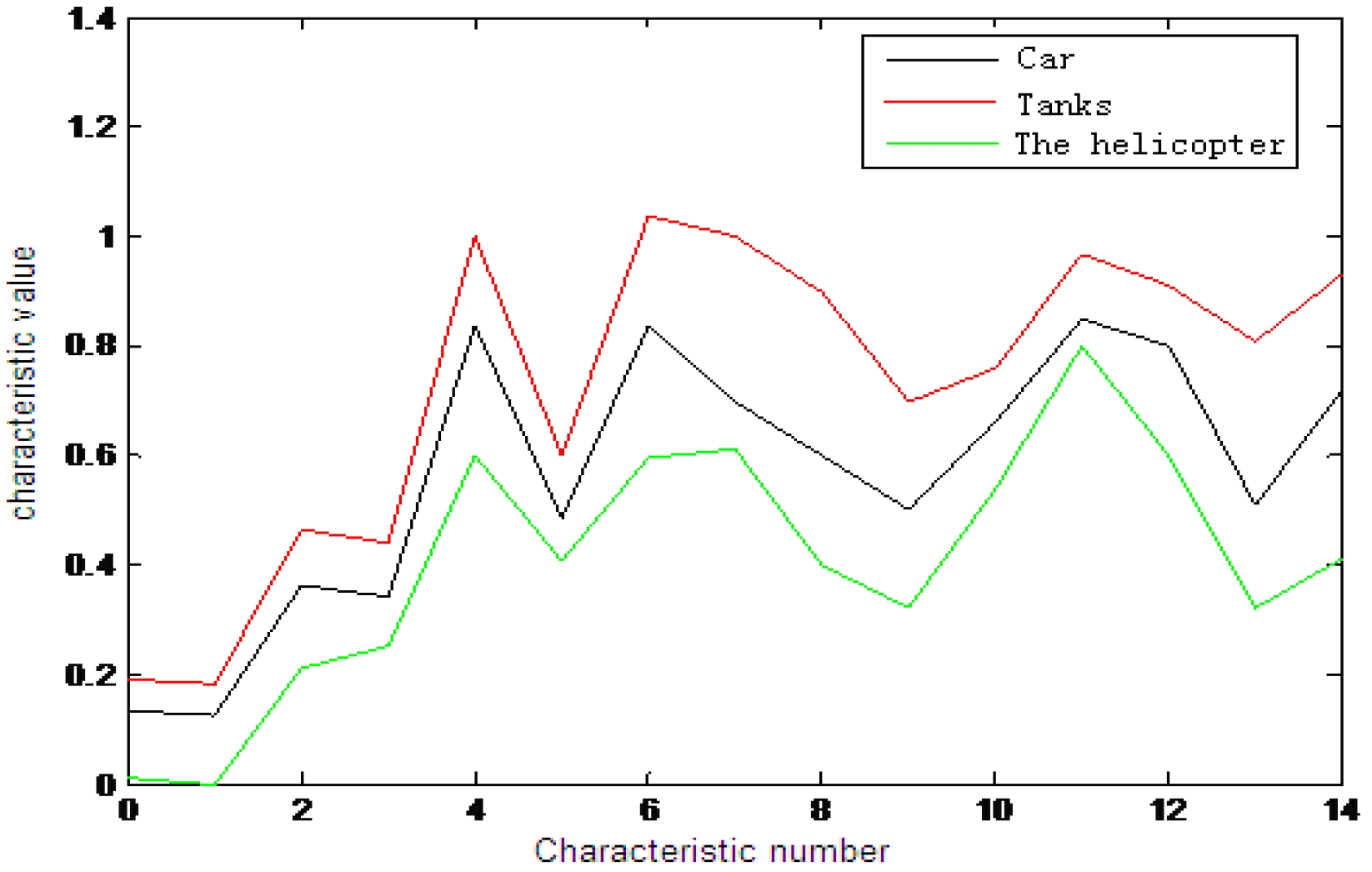
The best combination of features after fusion is shown in Fig. 7. Therefore, the 15 feature combinations are selected as the fused feature quantities. After fusion, some redundancy is removed, the dimensionality reduction of feature quantity is realized. The feature quantity after fusion has strong discriminating and clustering, it lays a good foundation for the subsequent target recognition and classification.
The improved immune genetic algorithm in this paper, searches the global optimal solution in the 31st generation. “Elite selection” strategy takes the best elite directly into the next generation individuals, without any change. It keeps the diversity of individual chromosomes in the population, and improves the ability of global search. “Elite selection” strategy can also avoid the algorithm to search too much redundant space and accelerate the speed of search. To join the adaptive strategy into crossover rate and mutation rate, when the crossover is operated, combination the good genes of two individuals to produce new off spring. It accelerates the speed of search during the population evolution, keeps the diversity of genes when variation, improves the calculation speed and efficiency of the algorithm. It ensures the convergence of the algorithm while maintaining the population diversity, and ensures rapid convergence to global optimal solution [17]. The mainly experiment dates of convergence in the algorithm are collected together, as shown in Table 5.
Affine invariant moments to extract target feature values
The data in Table 5 can be more intuitive to prove the above conclusion. Algorithm in about 30 generations will be able to converge to the optimal solution. This suggests that the improved immune genetic algorithm is proposed in this paper, the study has a faster convergence speed and not easy to appear premature phenomenon.
On the basis of immune genetic algorithm which combines the immune operator and genetic algorithm, and for the lack of immune genetic algorithm, an improved immune genetic algorithm that added “elitist” strategy into immune genetic algorithm is proposed and studied. In order to study the image feature fusion based on the improved immune genetic algorithm, firstly encode the feature, then initialize the population and fuse the features by the improved algorithm, and finally compare and analysis the performance of the improved algorithm, genetic algorithm and immune genetic algorithm through experiments. And experimental results show that the improved immune genetic algorithm has faster convergence speed and better search capabilities, image fusion characteristics based on improved immune genetic algorithm has a better recognition rate.