



Abstract
Develop with modern Internet technology and basic technology, new terms such as big data (BD), cloud computing, continue to flood our daily lives. At the same time, in such an intense market competition, how to use these new technologies and adapt to the changes brought about by these new technologies better, will become particularly important. Whether in academia or in the corporate world, the wave of intelligence brought about by BD has swept the world. This article studies the development model and strategy of international e-commerce in the context of BD, starting with the development of cross-border (CB) e-commerce (EC) for small and medium-sized (SAMS) enterprises. Modeling and analysis methods are used to simulate and calculate various indicators, and finally to obtain development optimization suggestions. The research shows that after optimizing the organizational management and strengthening the introduction and retention of talents, the results have been greatly improved compared with the previous ones. The contribution of this paper is putting forward suggestions for the internationalization of China’s EC mainly from the theoretical level.
Introduction
Against the backdrop of the world being plagued by the new crown epidemic, China’s foreign trade has shown a steady growth trend due to its scientific decision-making and unity in epidemic prevention and control [1, 2]. The international e-commerce industry is showing a vigorous development momentum. By the end of 2021, there are nearly 5000 international e-commerce companies registered in mainland China, and the scale of cross-border e-commerce exports is nearly two trillions [3, 4]. While making this series of remarkable achievements, China’s international e-commerce development is also facing very serious problems, such as the maintenance of customer groups and product innovation, etc., are under enormous pressure. As countries relax their epidemic prevention and control policies, encouraging exports has become one of the most important economic tasks for countries. China’s international e-commerce industry is facing extremely severe challenges, and certain changes have been made to effectively meet such challenges and help the country’s international e-commerce industry maintain stable development. The point where changes are made to improve service levels [5, 6]. The rapid development of big data and its various branch applications provides useful ideas for the reform direction of China’s international e-commerce industry. The past development has allowed Chinese international e-commerce companies to accumulate a large amount of relevant data, and the analysis of this data will further clarify the changes in user needs. At this stage, many scholars have paid great attention to how to effectively use big data technology to promote the development of international e-commerce, and have carried out research from multiple perspectives [7, 8].
With the development of modern Internet technology and basic technology, new terms such as big data (BD) and cloud computing continue to impact our daily life [9, 10]. At the same time, in such a fierce market competition, how to use these new technologies and how to better adapt to the changes brought about by these new technologies will become particularly important [11, 12]. Whether in academia or business, the wave of intelligence brought by BD has swept the world. There are many research results on the development mode and strategy of international e-commerce under the background of big data. For example, some scholars conducted a comparative study on the development of e-commerce in several countries, and found that the global development of e-commerce entering the international market will be affected by many factors [13, 14]. Some scholars have conducted research on the current international e-commerce model and proposed that the B2B model is a business model suitable for the development of most enterprises [15, 16]. Other scholars have collected information on cross-border e-commerce in a certain region, and analyzed the existing problems, such as the lack of e-commerce awareness of small and medium-sized enterprises, the lag in e-commerce development, and the imperfect legal system. Finally, they proposed the use of e-commerce strategies for developing the national economy. Generally speaking, although the research on the development mode and strategy of international, e-commerce has achieved good results, in order for e-commerce enterprises to be in line with international standards, big data technology should be used to analyze user needs to formulate trade plans [17, 18]. This paper firstly uses the method of literature analysis to briefly analyze the relevant concepts, and then constructs the optimization model of international e-commerce through the method of data analysis and comparative research. Research shows that after optimizing organizational management and strengthening talent introduction and retention, the international e-commerce performance of enterprises will be greatly improved compared with the past. The contribution of this paper is mainly to propose optimization suggestions for the internationalization of Chinese enterprises’ e-commerce from the theoretical level.
The development model of international e-commerce
Under the background that the computing and analysis capabilities of big data technology are becoming powerful more and more, and the application fields are becoming extensive more and more too, the international e-commerce model is also showing a diversified development trend, and the B2C model that once only occupied a very small market share has emerged. achieved rapid development [19, 20].
International EC development model and its characteristics
At this stage, the development of international e-commerce is mainly divided into the following types, and their respective advantages are shown in the following table. For the convenience of display, the advantages of each aspect are divided into three levels, which are assigned as Acceptable, Medium, and Good respectively.
Characteristics of international e-commerce development models
Characteristics of international e-commerce development models
It can be seen from Table 1 that the B2B model has outstanding advantages in terms of “Transaction amount”, “Return Guarantee” and “Cyber security”, and is also at the intermediate level in the other two aspects, with no obvious shortcomings as a whole. The B2C model has strong competitiveness in “Logistics”, “User-scale transactions” and “Cyber security”, and the other two aspects are also in the middle level, and there are no obvious shortcomings as a whole. And its advantages in “Logistics” and “User-scale transactions” make it attract more and more attention. Compared with the previous two modes, the C2C mode has obvious disadvantages at this stage, except in the “User-scale transactions”. “Scale transactions” has strong strength unexpectedly, and its performance in other aspects is unsatisfactory, and its market contribution at this stage is also very limited [21, 22].
Since 2020, the global economic market has been plagued by the new crown epidemic. China’s foreign trade has shown a steady growth trend due to scientific decision-making and unity in epidemic prevention and control. The international e-commerce industry is showing a vigorous development momentum. By the end of 2021, there are nearly 5,000 international e-commerce companies registered in mainland China, and the scale of cross-border e-commerce exports is nearly two trillions. While making this series of remarkable achievements, China’s international e-commerce development is also facing very serious problems, such as the maintenance of customer groups and product innovation, etc., are under enormous pressure [23, 24]. As countries relax their epidemic prevention and control policies, encouraging exports has become one of the most important economic tasks for countries, and China’s international e-commerce industry is facing extremely severe challenges. In general, China’s international e-commerce market has shown an overall positive trend, but external challenges are increasing.
Internationalization of China’s e-commerce companies
At this stage, Chinese e-commerce enterprises are mainly facing the following problems in the process of nationalization. The first is the lack of core competitiveness. Although the number of Chinese enterprises participating in international e-commerce is increasing rapidly, and the types of goods exported are also becoming more and more abundant, through in-depth analysis, it can be found that the substitutability of the goods in them is too high, the scale of enterprises is generally small, not only the product innovation ability is limited, but also the ability to resist market risks is also low. At the same time, the lack of professional talents makes most Chinese e-commerce companies not aware of the taxation and other related policies of exporting countries, which often leads to fines and other phenomena [25, 26].
Minimize tax structure risks
The tax systems of different countries are very different, especially in the face of the new form of trade such as international e-commerce, there are usually unique tax methods. This situation will result in China’s international e-commerce companies facing a potentially threatening tax structure risk. How to scientifically minimize this risk is a very important issue at this stage. In this study, the index of empirical risk is selected for model construction. It is approximately equal to the estimated value of expected risk, which is used to represent the learning error of the training data set in the machine learning process, and let
Among them,
Among them,
Construction of an international EC system
Through the calculation of the tax structure risk model, the research proposes the optimal construction of the current international e-commerce system.
The composition of the international e-commerce system.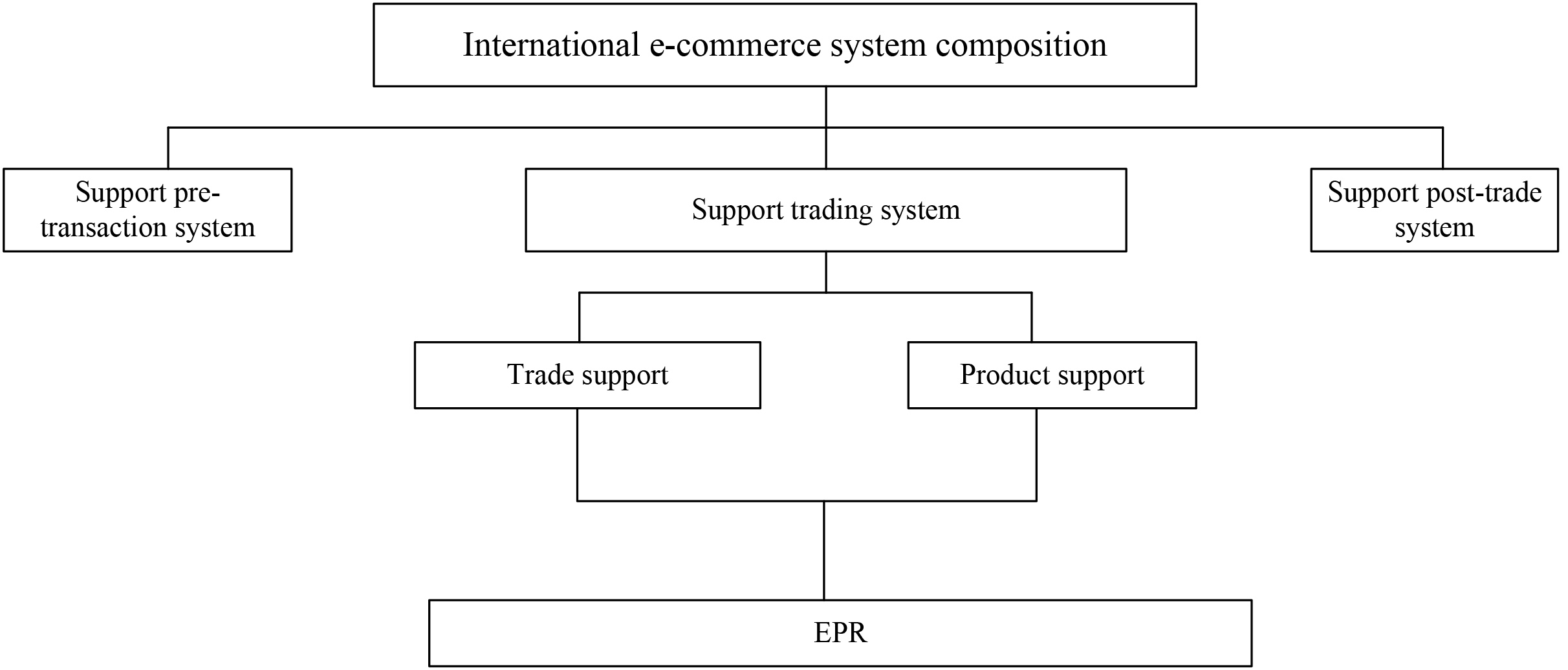
As shown in Fig. 1, it is an international e-commerce system suitable for enterprise development. The system mainly includes three systems, namely the front, middle, and back systems that support transactions. In the optimized design, it can be found that the document EDI system is indispensable in the transaction process, which uses EDI in the sales and procurement modules to implement electronic payment and sales processes between customers or suppliers. Compared with the traditional system, this system highlights the importance of the EPR system, making the EDI function the most important function [27, 28].
This paper takes the development of cross-border e-commerce of small and medium-sized enterprises as an example, and collects relevant data on the transaction volume of enterprises from 2015 to 2020 on the official website of the National Bureau of Statistics to ensure the authenticity of the research data and to analyze the e-commerce development model of small and medium-sized enterprises and Suggestions for its future entry into the international market. The methods adopted in this study mainly include literature analysis method, comparative study method and modeling method. The application of the literature analysis method is to summarize the concepts and era background involved in the research through the analysis of the recent representative research results in this field [29, 30]. The comparative research method is to summarize the trends and reasons of changes by comparing various representative data of international e-commerce in recent years. Modeling analysis is to use empirical risk indicators to build a model to explore how to minimize the risk of tax structure, and based on this, put forward suggestions for developing China’s international e-commerce enterprises.
International e-commerce development model and strategy analysis
Status quo of international e-commerce development in China
(1) B2C cross-border business model is gradually emerging
2016–2020 China’s cross-border e-commerce business structure
2016–2020 China’s cross-border e-commerce business structure
As shown in Table 2, China’s e-commerce business structure from 2016 to 2020 is mainly based on B2B and B2C models, but it can still be seen that B2B occupies a dominant position in international e-commerce. The reason is that B2B transactions realize online business distribution. Trade information, the final transaction is completed offline, the foreign trade transaction amount is large, and the order is fixed for a long time. Each transaction needs to be negotiated several times to be determined. It can be seen from the data in the table that the proportion of B2B transactions has gradually decreased and the proportion of B2C transactions has gradually increased over time. In 2020, the proportion of B2B transactions will reach 77.5%, which is still an absolute advantage. The changes in the development trend of the two must be paid enough attention.
(2) Emerging industries are emerging, while traditional industries are still dominant
Although the Chinese government has vigorously promoted the development of “intelligent manufacturing” recently, hoping to enhance the contribution of science and technology in exporting foreign exchange earnings, the adjustment of industrial structure and product innovation cannot be accomplished overnight. The proportion of products exported by China’s international e-commerce in 2021 is shown in Table 3.
Types of international e-commerce transactions
As can be seen from Table 3, in 2021, among the proportion of international e-commerce products in China, the total proportion of information technology products will be about 35%. Although the proportion has increased compared with previous years, in comparison, there is still a small gap. At the same time, there are few types of export information products, making it difficult to meet the diverse needs of customers. Clothing and food still occupy a very important position. Such commodities are traditional advantageous projects of China, but the space for product innovation is limited, the profit margin is relatively low, and the substitutability is strong, so it is difficult to occupy the target market stably for a long time.
(3) The scale of international development of Chinese SMEs in e-commerce
International development scale of SME e-commerce (trillion yuan)
Cross-border e-commerce transaction volume.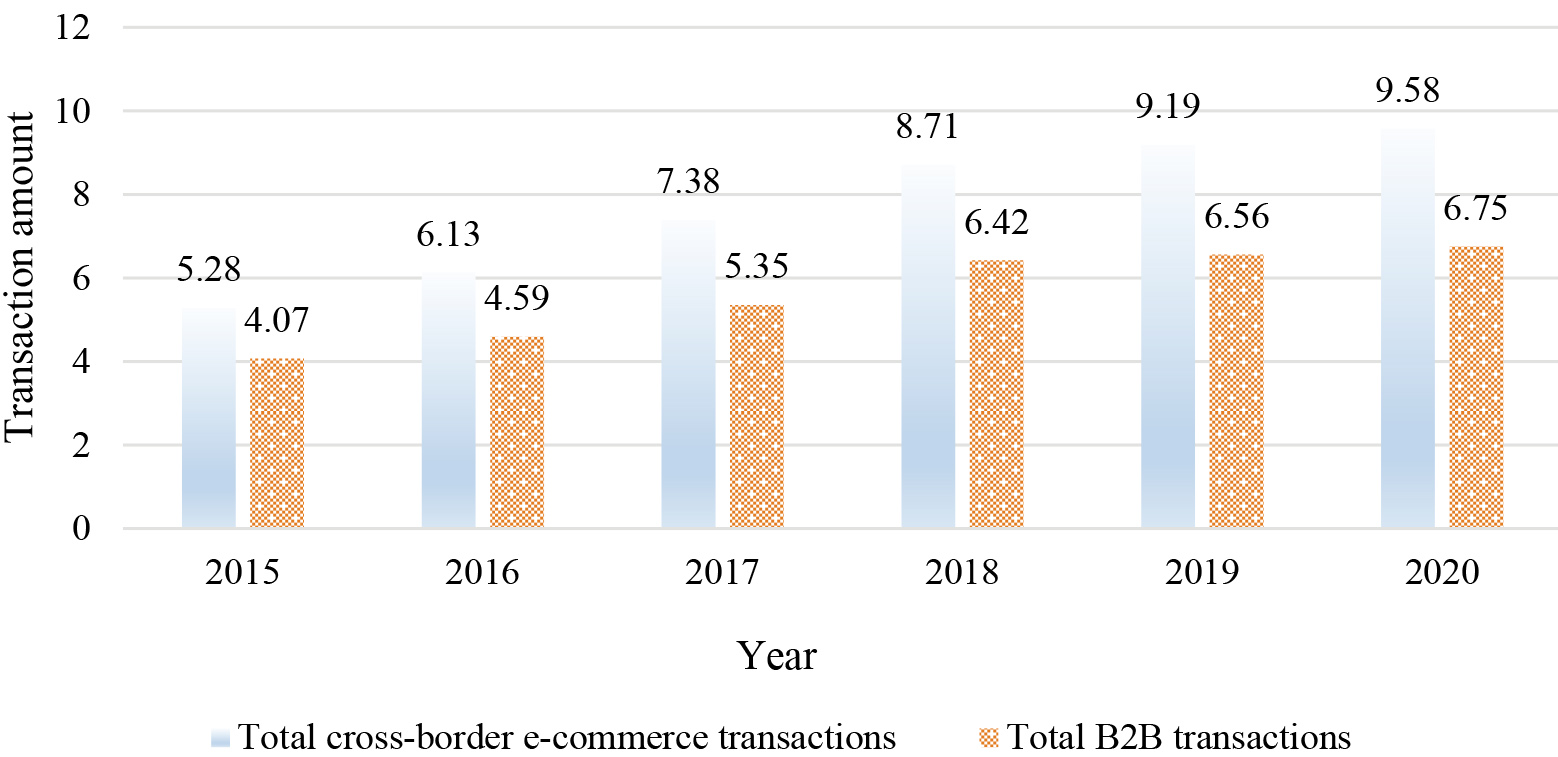
It can be seen from Table 4 and Fig. 2 that the development scale of China’s small and medium-sized international e-commerce enterprises has maintained a continuous growth momentum, from 5.28 trillion in 2015 to 9.58 trillion in 2020. This leap-forward development benefits from the Chinese government’s emphasis on the construction of information infrastructure, which invests huge sums of money in this field every year. Coupled with the popularity of smart terminals in the society, a large number of small and medium-sized enterprises can participate in the field of international e-commerce, and the proportion of B2B business has increased year by year. The growth rate is starting to slow down, as shown in Fig. 3.
Growth rate of CBEC transactions.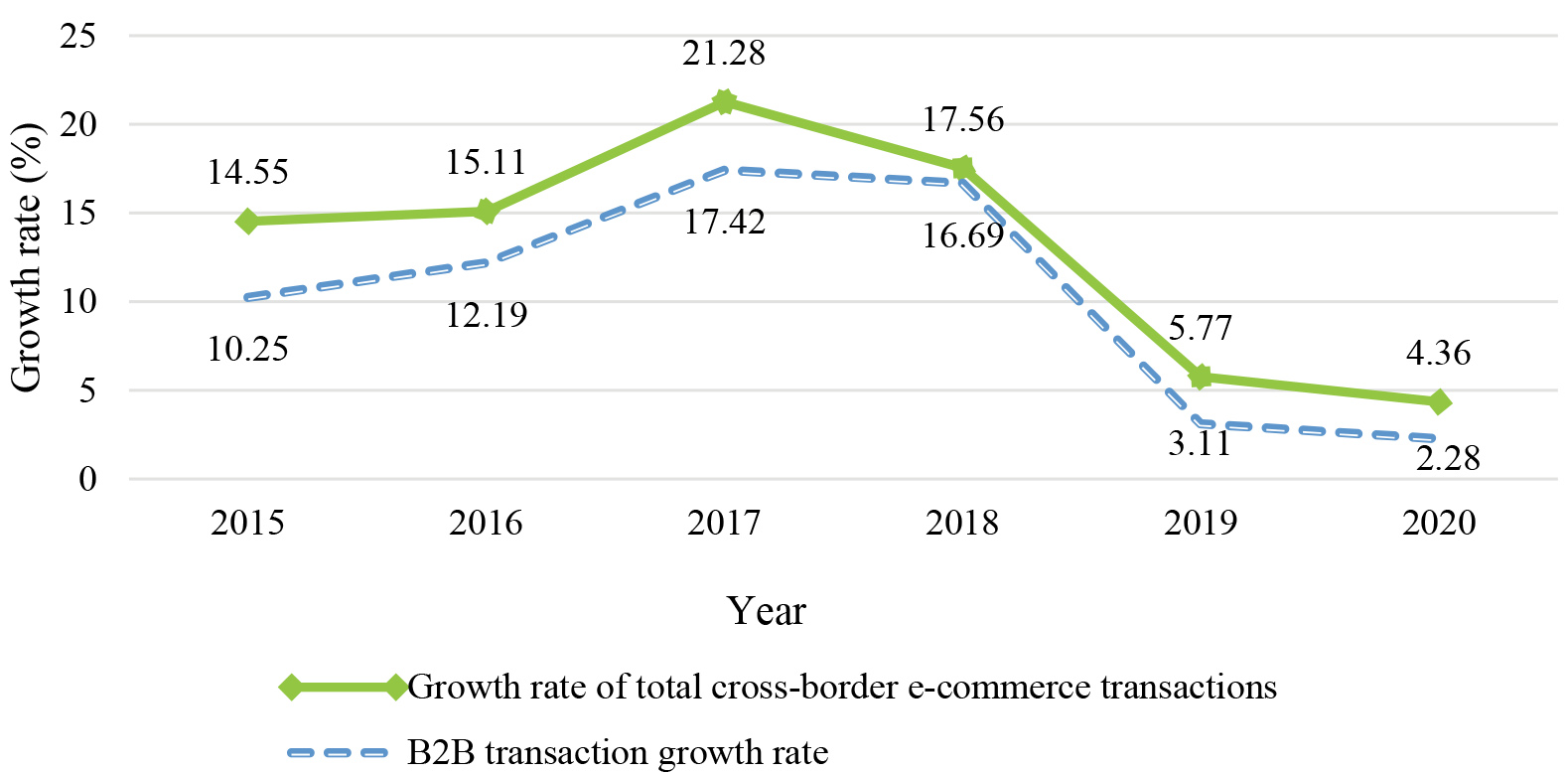
In the past five years, the number of registered enterprises related to cross-border e-commerce in China has increased year by year. By the end of 2021, the number of cross-border e-commerce-related enterprises in mainland China will exceed 30000. Especially in the context of the global epidemic, the number of cross-border e-commerce-related enterprises registered in 2021 will increase by 10900, a year-on-year increase of more than 70%. Among them, more than 90% belong to small and medium-sized enterprises. In Fig. 3, you can see the growth curve of China’s international e-commerce sector from 2015 to 2020. After reaching the peak in 2017, the growth rate gradually slowed down, and the decline in the growth rate in 2018 was particularly obvious, and even dropped to about 5%, less than one-third of that in 2017. Such a huge magnitude has brought an unbearable crisis to many small and medium-sized enterprises with insufficient anti-risk capabilities. In addition, cross-border e-commerce also faces many uncertain risks. For example, different countries have different requirements for cross-border e-commerce taxation and qualifications. Moreover, cross-border e-commerce has stricter logistics requirements. This requires cross-border e-commerce companies to have sufficient anti-risk capabilities [31, 32].
Aiming at the problems that China’s international e-commerce enterprises are facing in the process of development, the research puts forward a strategy system for further development.
(1) Enhance the shopping experience
Carrying out product innovation and enhancing the added value of technology is a work that requires a lot of time and money investment, which can be gradually realized. In order to ensure the market share of existing products and attract the attention of new customers. International e-commerce companies in China can make efforts to enhance the shopping experience, among other things. At this stage, China’s automatic identification technology has taken the lead in the world. The majority of enterprises should take the initiative to take advantage of this advantage, and convert traditional pictures and texts as the main media of publicity advertisements into automatic identification of customer needs, relying on the calculation of big data. Ability to quickly reach customer needs.
At this stage, many shopping platforms provide scanning functions. Relying on the scanning device of the information terminal, the user can scan the QR code of the product or even the product itself in the shopping APP. This not only shortens the time for customers to search for products, but also allows customers to use keywords to locate products that better meet their needs. The data shows that more and more users choose to shop directly by scanning. In this context, e-commerce companies should actively adapt to this trend, design more recognizable and attractive products, and enhance customers’ shopping experience. A good customer experience has a great impact on consumers’ willingness to purchase, and enthusiastic pre-sale experience and responsible after-sale experience will be favored by consumers. Cross-border e-commerce enterprises can only win a place in the fierce competition if they have a good customer experience [33, 34].
(2) Strengthen the training of professional talents
At present, an important bottleneck in the development of China’s international e-commerce is the increasing shortage of professional talents. Judging from the scale of participating international e-commerce enterprises, small and medium-sized enterprises occupy an absolute advantage in quantity. These enterprises lack sufficient strength and attention in the construction and maintenance of professional talent teams. This is obviously difficult to meet the demand for information technology talents for the development of international e-commerce. In addition, there is no substitute for the contribution of professionals in areas such as target market analysis and tax minimization. Therefore, Chinese international e-commerce enterprises should strengthen the training of professionals in this field. Small and medium-sized enterprises with limited strength can adopt the mode of joint training, or funded by enterprises, sponsor universities to set up scientific research teams to carry out research, train on-the-job talents according to the actual needs of enterprises and the job market, and cultivate a group of talents who can adapt to international e-commerce as soon as possible [35]. The development of the work team, in order to alleviate the urgent needs of enterprises.
Conclusion
Big data technology can process massive amounts of data, which brings great convenience to people’s lives, and also greatly changes many traditional forms of work. Especially for the e-commerce field, which is rapidly emerging with the development of information technology, it is a great significance. The customer groups for international e-commerce are all located in other countries and regions. In the vast majority of cases, Chinese international e-commerce companies cannot obtain the specific needs of local customers through accurate market research. Through big data analysis, this dilemma faced by Chinese international e-commerce enterprises can be effectively alleviated. However, as discussed in the article, after the emergence of alternative products in the market, the development of China’s international e-commerce has slowed down significantly. If the big data technology cannot be fully utilized to make active adjustments, the development of the enterprise will be in trouble inevitably. By analyzing the development of cross-border e-commerce of small and medium-sized enterprises, this paper finds that e-commerce enterprises are still dominated by the B2B model, and the B2C model is gradually emerging. After comparative research, it is concluded that if Chinese e-commerce enterprises want to develop foreign markets and go international, they must increase investment in product innovation, reduce the substitutability of commodities, and pay attention to the cultivation and use of relevant talents to enhance the international competitiveness.