



Abstract
With the continuous implementation of the Belt and Road Initiative of China, cross-border e-commerce is gradually becoming one of the main ways of trade. The smart operation of cross-border logistics has become an important factor affecting the quality of cross-border e-commerce transactions by its characteristics of high-efficiency, high-quality, and low-cost. As China’s first smart city in China with the theme of the aviation economy, the top priority for developing cross-border e-commerce in the Zhengzhou Airport Economic Zone is to construct cross-border e-commerce smart logistics. This paper expounds on the significance of applying big data technology on the construction of the intelligent logistics, analyzing its important roles not only in further promoting the cross-border e-commerce development in the Zhengzhou Airport Economy Zone but also during the process of the entire national economic transformation and escalation. The smart logistics constructing strategy in the Zhengzhou Airport Economy Zone is expected to provide ideas and support for the Zhengzhou Airport Economy Zone making continuous improvement in leading and pushing the Henan regional economy to achieve sustainable development in the future.
Keywords
Introduction
The magic development of e-commerce cannot be separated from the support of the government. In the Chinese government work report for Two Sessions 2019, key words about E-commerce and the internet were mentioned lots of times and became a hot spot of concerns in the society soon. These terms included Internet+, the cross-border E-commerce, the industrial Internet, the digital economy, the sharing economy, the online and offline consumption, Internet+education, etc [1, 2]. Cross-border freight transportation flows are intervened by government policies [3]. With the implementation of the Belt and Road Initiative of China, cross-border e-commerce has become one of the main ways of trade and a new engine pushing the economic and trade development of China and other countries such as Russia [4]. In the process of cross-border e-commerce transactions, customers care about both the product quality and the logistics service quality while they purchase goods [5]. Retailers are selling product+logistics to customers [6]. Now, driven by the controllable relevance big data of cross-border e-commerce, implementing Internet+foreign trade will help to achieve dynamic, smart, quantitative, and qualitative predictions on export sales [7].
In the current era of the fourth industrial revolution, the accurate planning and cost-effective management on product delivery are the key factors leading most manufacturing sectors to the success [8, 9]. High attention has been given to the field of smart logistics and witnessed its rapid improvements. As the steady evolvement of swarm robotics toward high artificial intelligence and capabilities, it would improve the management level of the warehouse delivery system and do more intelligent work with more challenging tasks [10–12]. Big data goes far beyond the analysis features used before [13]. Since executives can obtain and measure more valuable information than ever before, they can make better predictions and smarter decisions and achieve precise management finally. [14]. Big data technology has been used to establish a comprehensive data analysis platform [15]. The ideas of data management have been changed greatly in the following detailed information: from result-oriented to process-oriented, namely changing the management objects from after-action management to whole life cycle management and management goals from data management to data governance [16]. The concept of Industry 4.0 is the fourth industrial revolution dominated by intelligent manufacturing. It aims to transform manufacturing into an intelligent enterprise by leveraging the combination of ICT and the cyberspace virtual system, the Cyber-Physical System [17]. The Industry 4.0 project is divided into three main themes, that is a smart factory, intelligent production, and intelligent logistics. With logistics efficiency increasing, we can collect new types of data to improve the product and process service quality [18].
In such an era that the Industrial Internet of Things develops rapidly, a smart production unit can be regarded as a large connected industrial system [19]. It contains materials, parts, machines, tools, inventory, and logistics which can relay data and communicate with each other [20, 21]. More and more companies apply big data analytics and IoT in logistics to implement global information systems to improve their global operations [22]. People would play a key role in enabling collaborative smart logistics [23].
At present, with the continuous development of intelligent systems, it has been used in many industries including the e-commerce field, such as the supplier intelligent management system in the cross-border e-commerce platforms [24]. In the development of cross-border e-commerce, comprehensive pilot areas play a positive role in promoting cross-border e-commerce in China. The main driving force for its development comes from the growth of service support level, the comprehensive development levels, present regional characteristics, economic characteristics, and reverse cluster characteristics [25]. Managers can make use of the advanced data analysis method and particular management infrastructures to optimize the logistics and transportation operations and improve the service quality to a higher level [26, 14].
Zhengzhou is China’s first smart city built on the theme of the “aviation economy” and one of the logistics centers among international aviation [27]. The level of development of urban aviation hubs is one of the important indicators for evaluating whether a city has great influence. To build a better international aviation center in Zhengzhou, the State Council and Henan Provincial Government approved to build the Zhengzhou Airport Economy Zone in October 2007. In October 2010, the comprehensive bonded area in the Zhengzhou Airport Economy Zone was approved by the State Council. In November 2012, the state passed the China’s Central Regions Economic Zone Planning, showing that the Zhengzhou Airport Economy Zone is the main body of the Zhengzhou Airport Economic Comprehensive Experimental Zone. Meanwhile, Xinzheng Comprehensive Bonded Zone and Industrial Cluster Park were considered as two major development platforms. In March 2013, Plan for Zhengzhou Airport Economic Comprehensive Experimental Zone Development (2013–2025) has been passed. It symbolized that the first national airport economic experimental zone of China started to be established, which is the only aviation economic city established by the State Council at that time. From then on, Zhengzhou Airport Economy Zone would play a major role in achieving economic transformation and sustained prosperity in Henan and even China. It would lead Henan to the world.
In recent years, as a leader in the construction model of aviation metropolitan cities, Zhengzhou Airport Economy Zone has attracted high-quality resources at home and abroad by its national policy supports, its geographical advantages in all directions, and the international aviation network of countries in the major economies of the world. Based on its cross-border e-commerce infrastructures and international hub logistics parks, a cross-border e-commerce cluster is gradually forming.
With the basic and strategic status of logistics in the entire national economy, it is of great importance to actively explore the strategy of building the cross-border e-commerce smart logistics system in Zhengzhou Airport Economy Zone under the big data perspective. It not only can further promote its overall cross-border e-commerce trade development but also play important roles in promoting the transformation and upgrading of the entire national economy.
Overview of the cross-border e-commerce development in the Zhengzhou Airport Economy Zone
Cross-border e-commerce development status in Zhengzhou Airport Economy Zone
Being the first national new aviation economy zone and the window of Henan Province opening to the outside world, Zhengzhou Airport Economy Zone has won great attention from the national government and Henan province government in terms of policy support and industrial cluster construction [28].
The Zhengzhou Airport Economy Zone adopts the One Zone with the Multiple Parks model. Currently, it has established multiple cross-border e-commerce industrial parks, including Central International E-commerce Industrial Park, Window of World Airlines Cross-border E-commerce Demonstration Park, the International Commodity Bonded Exhibition and Trading Center, Cross-border E-commerce and International Trade Industrial Park, and China Zhengzhou Airport Economy Zone Merchandise Expo Center. It also attracts many cross-border platforms, which include the JD Worldwide, Tmall Global, Taobao Global Purchase, Suning Overseas Purchase, and Vipshop, which are stationed. According to the data displayed on the official website of the Zhengzhou Airport Economy Zone, there were more than 500 cross-border e-commerce companies registered in the Zhengzhou Airport Economy Zone before June 2018, including 113 exporters and 392 importers. In 2018, the import and export value of the Zhengzhou Airport Economy Zone continued to grow to 52.7 billion US dollars, accounting for more than 60% of the total import and export value of Henan Province. The cross-border e-commerce import and export business volume of the Zhengzhou Airport Economy Zone totaled more than 21.1 million units, accounting for more than 20% of Zhengzhou’s whole cross-border e-commerce business volume. Compared with 2016, it has increased by 5.6 times. Figure 1 shows that since 2016, the import and export volume and the total value of cross-border e-commerce in the Zhengzhou Airport Economy Zone have shown a linear upward trend. The rapid growth of cross-border e-commerce in the Zhengzhou Airport Economy Zone has effectively promoted the continued growth of the regional economy.
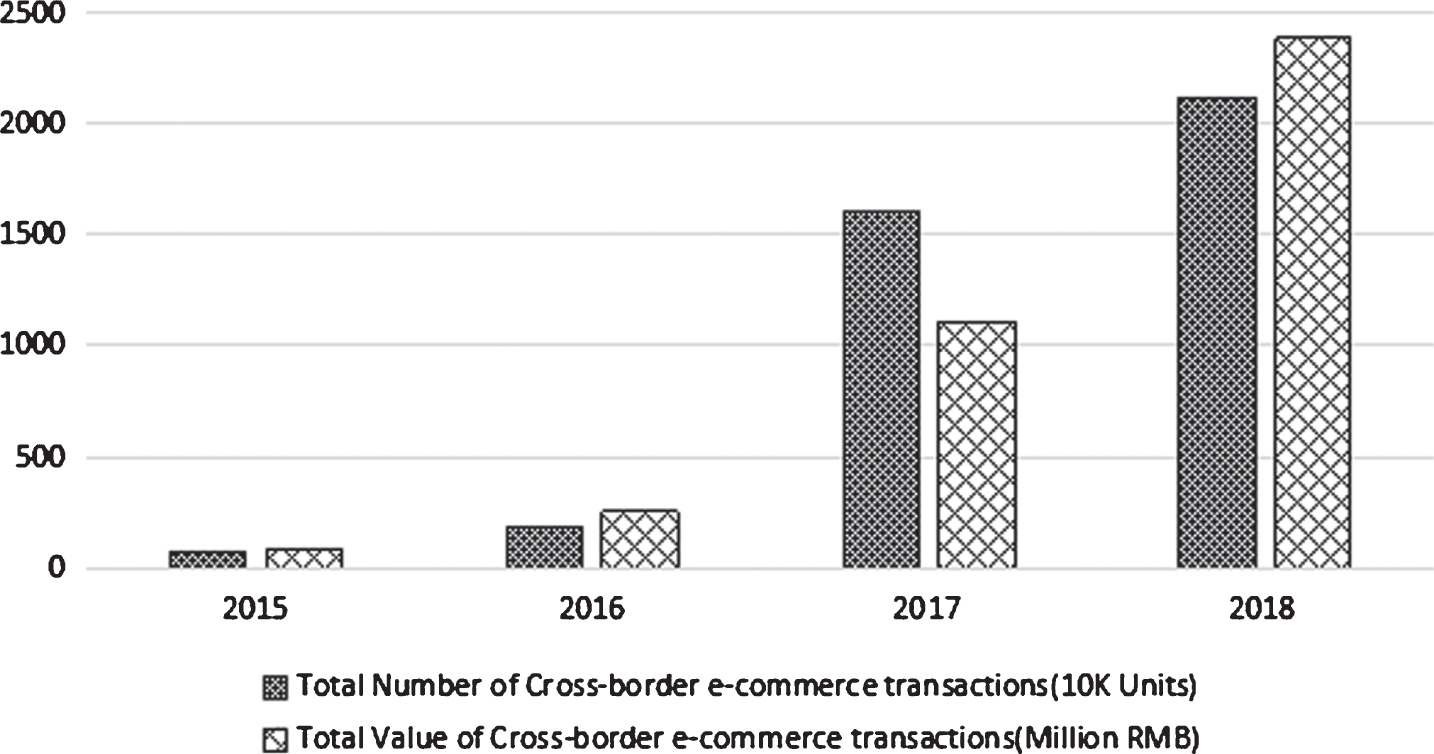
The cross-border e-commerce development in the Zhengzhou Airport Economy Zone.
The Zhengzhou Airport Economy Zone is an important window for Zhengzhou City and even Henan Province to open to the outside world and to go international. Being an integrated logistics system integrating characteristic industry logistics, air express logistics, international transit logistics, and aviation logistics; it realizes many functions of an aviation logistics center such as transshipment, warehousing, transaction display, processing services.
Based on the international logistics center and following the Belt and Road initiative, Zhengzhou Airport Economy Zone has formed a variety of transportation networks, which take the airport as the core and includes Integrated Aviation Hub, High-speed Railway being extended in all directions, Intermodal Train between Zhengzhou and Europe, National Expressway and Intercity Railway among the middle areas of China, to realize the three transportation routes by air, land, and sea”[29]. In 2018, the air cargo of Zhengzhou Airport Economy Zone reached 3 million tons, and its GDP exceeded 80 billion. This logistics promotes the cross-border e-commerce of Zhengzhou Airport Economy Zone to make a continuous development greatly.
i. Aerial Silk Road
Xinzheng International Airport, which is located in Zhengzhou Airport Economy Zone, has opened 15 destinations in the top 20 international aviation hub airports and established a shipping network covering major international economic development countries to ensure the smooth conduct of cross-border e-commerce activities.
ii.Terrestrial Silk Road
Among the Sino-Europe Intermodal Trains, the comprehensive operational level of the Zhengzhou site is ranked first. The train departure from Zhengzhou can directly reach 6 destination sites including some European cities such as Hamburg, Munich, and Liege, Central Asian cities such as Tashkent of Uzbekistan, Almaty of Kazakhstan, and Hanoi of Vietnam [30]. There is cooperation with more than 5,000 cooperative companies at home and abroad, covering more than 30 countries and 130 cities abroad.
iii. Marine Silk Road
Henan Province is making efforts to build a water-free port. Nine sea-rail intermodal trains have been opened and the annual total shifts are more than 200 ones. Having been connected to the ports in Lianyungang, Qingdao, Tianjin, the land-rail intermodal trains have gradually connected with the ports in Shanghai, Ningbo, Fujian, Guangzhou, Guangxi, and other cities. Zhengzhou has become the core of this terrestrial-marine transportation hub and made the logistics link more convenient during the cross-border e-commerce transaction in the Zhengzhou Airport Economy Zone [31].
Problems of cross-border e-commerce in Zhengzhou Airport Economy Zone
Compared with the domestic e-commerce, cross-border e-commerce is more complicated and its service quality will directly affect the smooth progress of cross-border transactions. According to iMedia Research’s 2018 report, more than 30% of cross-border consumers are not satisfied with consumer experience on popular cross-border platforms and nearly 70% of customers are not satisfied with its after-sales service [32]. These are consistent with the problems of cross-border e-commerce transactions in the Zhengzhou Airport Economy Zone. The reasons are mainly as follows.
Longer logistics distribution cycle during a cross-border e-commerce transaction
Within the cross-border e-commerce transaction process, since its entire supply chain involves multiple links, so we need to improve the efficiency of transportation and customs clearance. Cross-border logistics needs to go through two customs in the home country and the destination country. Shipped from the home country to the buyer, the goods need to be transported several times during the whole process. For example, shipping goods from China to the United States, it usually takes half a month or more if the destination is far away or have difficulty in logistics distribution. During the shipping and delivery processes in cross-border e-commerce, the goods always have to be transferred too many times. Therefore, it is more prone to breakage and loss of parcels as well as the uncertain timelines. Having to wait for a long time or receiving the wrong goods would lead buyers to get poor consumer experiences ultimately.
Trivial after-sales process of cross-border transaction
Returns can occur in various forms of trading. But, since the return and exchange process of cross-border e-commerce transaction includes multiple complex aspects such as domestic suppliers, foreign suppliers, customs clearance for returning goods, customs tax rates, etc. Most of the goods cannot be returned to the sellers in the cross-border platforms. Also, the current system implemented by the customs is not conducive to the logistics or after-sales process in the cross-border e-commerce and there are blind spots in the e-commerce supervision. So consumers are difficult to safeguard their rights if they encounter troubles during transactions.
Backward cross-border logistics system
Although more and more cross-border e-commerce platforms have entered the Zhengzhou Airport Economy Zone and cross-border e-commerce has been prospered, the development of cross-border logistics has not kept pace with this rapid growth. As the only international airport of the Zhengzhou Airport Economy Zone, Xinzheng International Airport plays an important role in its multimodal transport logistics system in this zone. However, among the 24 major airports in China, its comprehensive efficiency ranks 21st and the pure technical efficiency ranks the last. Lower technical efficiency would bring the overall efficiency of the aviation logistics industry decreasing. Pure technical efficiency is generally related to human capital, management level, system, and openness.
We can get some information from Table 1. Compared with Baoan Airport, in the case of similar input levels with the same runways and parking stands, the cargo throughput in Xinzheng Airport is only 41% of that in Baoan Airport. Compared with Lukou Airport, the area of Xinzheng Airport is 46% higher than that of Lukou Airport, the routes of Xinzheng Airport is 11% higher than that of Lukou Airport and the parking stands of Xinzheng Airport is 198% higher than Lukou Airport. However, the cargo throughput of Xinzheng Airport is only 33% higher than that of Lukou Airport and its number of aircraft movements is even 5% lower than that of Lukou Airport.
This shows that Xinzheng Airport has not fully utilized its resources in the aviation logistics industry, and its technical efficiency has a lot of room for growth. As cross-border logistics plays an important role in promoting the cross-border e-commerce to continue to grow in the Zhengzhou Airport Economy Zone, Zhengzhou Airport Economy Zone should use big data technology to improve cross-border logistics and develop smart logistics [33], to promote the cross-border e-commerce industry upgrade and achieve its overall goal in the Zhengzhou Airport Economy Zone.
Comparison of aviation logistics industry input and output in Zhengzhou Xinzheng airport, Shenzhen Baoan Airport and Nanjing Lukou airport in 2016
Comparison of aviation logistics industry input and output in Zhengzhou Xinzheng airport, Shenzhen Baoan Airport and Nanjing Lukou airport in 2016
With the development of cross-border e-commerce, its development trends, which include integrating international procurement, international production, international sales, and international logistics, has become increasingly prominent. In 2018, the import and export value of Zhengzhou Airport Economy Zone accounted for more than 60% in the total import and export value of Henan Province, increasing by 5.6 times compared with 2016, accounting for more than 20% of the cross-border e-commerce business volume of Zhengzhou City. Its logistics park can gather a large number of relative logistics enterprises such as logistics headquarters, transportation industry, cargo supporting platform and manufacturing, trade circulation, financial, insurance, business intermediation, etc. So multi-industry linkage development and cross-border commodity integration logistics could be achieved. Therefore, to promote the cross-border e-commerce to achieve further development, we should focus on building the cross-border e-commerce smart logistics in the Zhengzhou Airport Economy Zone, attracting internationally renowned logistics companies to settle in and to improve the service level of the logistics industry as soon as possible.
In 2009, IBM proposed to create a future-oriented supply chain with advanced, interconnected, and intelligent features [34]. This supply chain could generate real-time information through sensors, RFID tags, brakes, GPS, and other devices and systems. This was the earliest concept of smart supply chain and the concept of smart logistics was also extended from it. Smart Logistics attaches great importance to integrating Internet of Things and sensor networks with the existing Internet, to adopt advanced technologies such as big data, cloud computing, and artificial intelligence to realize automation, visualization, controllable, intelligent and networked of logistics through fine, dynamic and scientific management [35]. Thus will improve resource utilization and productivity, creating richer social values.
Big data technology is an effective way to promote smart logistics
The key to realizing smart logistics is technology, which is to capture, store, calculate, analyze data with big data, and cloud computing as the core. We could accurately forecast investment opportunities, improve storage reserves, and improve service in advance with these methods. During the logistics activities, all applications of technologies such as vehicle tracking technology, satellite navigation technology, automatic identification, and bar code technology need the data processing technology to implement accurate positioning and recognition [36]. Therefore, big data developing and utilization technology has become the most effective way to develop smart logistics.
In 2017, the Ministry of Industry and Information Technology issued the Plan for Big Data Industry Development (2016-2020), which effectively promoted the big data technology innovation of China and the development of related industries. Based on big data and cloud computing technology, smart logistics would be applied and developed greatly in logistics information transmission, supply chain management, transportation route planning, warehouse storage optimization, and market forecasting [37]. It would have a growing important impact on the entire social economy.
Big data technology is the core competitiveness of smart logistics development
With the rapid development of cross-border e-commerce in the Zhengzhou Airport Economy Zone, a series of problems such as high cross-border logistics costs, lower satisfaction with logistics services, and more customer complaints are also emerging. Big data technology is a breakthrough. Using big data technology, we could process and analyze data not only to mine valuable information on enterprise operation management, marketing, brand management, customer relationship management, and service innovation but also to conduct corporate sales forecasts scientifically and rationally and realize overseas warehouses to stock up in advance to implement precise delivery. It also could be used to make network planning and industry insights as an important reference and become the core competitiveness of modern logistics industries.
Strategy on cross-border e-commerce smart logistics of Zhengzhou Airport Economy Zone
To build a modern logistics public information platform, improving the value of logistics value-added services
The modern logistics public information platform based on big data technology is the foundation and guarantee for the realization of smart logistics in Zhengzhou Airport Economy Zone. The realization of the smart function in smart logistics relies on advanced science and technology, including Internet of Things technology, big data technology, cloud computing technology, and various information transfers by the intelligent technologies on different data exchange platforms. It is the logistics public information platform. With the Belt and Road initiative, the first push is to dock the logistics information platforms of various countries and realize information sharing [38]. Establishing the logistics public information platform in the Zhengzhou Airport Economy Zone is the only way to further develop the Aerial Silk Road and also a good opportunity to deeply integrate into the Belt and Road construction.
Establishing the logistics public information platform, on the one hand, is to build an aviation logistics information system, solving the information exchange, recording, storage, management, and optimization of electronic data first. Then to integrate information resources to realize the information sharing of each node enterprise (domestic enterprises and foreign ones), eliminating information silos and fundamentally improve the overall efficiency of the logistics service supply chain. On the other hand, it is to build a logistics business information platform, providing services such as matching transactions, online payment, information release, location tracking, technical consultation, and industrial dynamic analysis. Finally, it aims at achieving Interconnection and resource sharing among inter-airport parks, parks and manufacturing enterprises, commercial enterprises and government departments, etc.
Logistics value-added services are an important way of promoting smart logistics differentiation development and improving the level of logistics services. Zhengzhou Airport Economy Zone could provide value-added services around deepening industrial cooperation, which includes information services, logistics finance, supply chain management, and transportation management, to encourage multi-industry linkage and promote the organic integration of value-added services and basic services.
To attract well-known logistics enterprise settle in, promoting the construction of international multi-modal transport system
International multi-modal transport is an important symbol of the modern international logistics. During the logistics transportation process of cross-border e-commerce, the proportion of trunk transportation is far lower than the conversion time between various transportation modes in the whole transportation process. Most of the goods involve multiple transportation modes in cross-border e-commerce transactions. Therefore, mutual coordination and effective connection among various international transportation modes would directly affect the overall efficiency of cross-border logistics. The positioning of the Zhengzhou Airport Economy Zone is one of the international logistics centers in the world. Therefore, it is an inevitable trend and important content to carry out international multi-modal transportation in the Zhengzhou Airport Economy Zone.
There are almost four major airline logistics companies of DHL, Fe-dEx, TNT, and UPS in almost all of the world’s leading airports. As providing more route resources and deliver goods to their destinations in the shortest time, aviation hubs are the important modes of developing aviation logistics. Therefore, first, it is recommended to speed up the implementation of the Zhengzhou International Air Cargo Hub Strategic Plan, formulating the International Logistics Data Standard for multi-modal transport and building a smart logistics system for international multi-modal transport. Secondly, we should make every effort to build Xinzheng International Airport into an Asia-Pacific international logistics center and complete the coverage for the global air cargo networks through Luxembourg, the European and American logistics center. Thirdly, we should accelerate to construct the fifth international mail transshipment port of China Post, expanding the business scope of achieving quick customs clearance and distribution across the whole country for inbound mails. The final goals are to create cross-border logistics channels in logistics parks and enhance the economic influence in the Zhengzhou Airport Economy Zone greatly.
To accelerate the feature resource aggregation in logistics parks and cultivate talents in the smart logistics industry
As an emerging logistics operations, the construction and development of smart logistics are inseparable from the support of funds and talents. It is necessary for Zhengzhou Airport Economy Zone to actively guide social capital to invest in new formats, new models, and new technologies for its logistics park development. First, it should continuously expand financing channels and encourage logistics companies to issue corporate bond financing. Secondly, it should encourage financial institutions to explore and develop new financial services such as logistics, settlement, warehouse receipts, logistics credit, etc [39]. Thirdly, it should enhance the design, planning, and supporting the key logistics projects in the logistics park. The managing department should make detailed arrangements on projects, timely grasping their progress, and doing a good job of the tracking services. Moreover, it should carry out professional and accurate docking investment, focusing on introducing several major projects that would have great impacts in the area of logistics platforms, smart logistics, and logistics finance in China.
At the same time, based on the need for developing the smart logistics industry in the Zhengzhou Airport Economy Zone, it is necessary to formulate the province’s logistics senior talent introduction plan, especially introducing high-level talents of logistics planning, logistics information management, international trade transportation, and logistics management. Meanwhile, it is important to establish a unified logistics talent training system throughout the Henan province, comprehensively strengthening the school-enterprise linkage and vigorously cultivate the application-oriented and compound talents needed to adapt to the development of logistics parks.
Conclusion
At present, the development of the regional economy has changed from an administrative district economy to an urban agglomeration economy, and then to a global economy. The spatial development pattern with industrial clusters as the core and cross-border e-commerce as tools are increasingly taking shape. Cross-border e-commerce has become one of the sources of power for promoting regional economic development. The development of cross-border e-commerce, especially the export of cross-border e-commerce, has an inseparable relationship with its industry support and service support. Among them, logistics is the key link and the economic vein. In terms of cross-border e-commerce transactions, from a national perspective, the three regions of the Pearl River Delta (mainly Shenzhen, Guangzhou, Dongguan, and Foshan), Fujian, and the Yangtze River Delta (mainly Yiwu and Hangzhou) account for almost China’s cross-border e-commerce transaction share is nearly 99%. From the perspective of Henan Province, the cross-border e-commerce transaction volume of Zhengzhou alone accounted for almost half of the total cross-border e-commerce transaction volume in Henan in 2018. The development of cross-border e-commerce in cities in the province is in a serious imbalance. The reason is that there is still a huge development space for cross-border e-commerce and industrial clusters in Henan Province, especially for coordination and interaction with the logistics industry.
In 2017, the relevant departments of the Chinese government successively issued several documents, such as Opinions on Further Promoting Logistics Cost Reduction and Efficiency Improvement to Promote the Development of the Real Economy, New Generation Artificial Intelligence Development Plan, and other documents, which proposed the development of smart logistics and the promotion of industrial automation. Therefore, in the context of the current high national attention and strong policy support, if Henan Province is to basically establish its status as a modern international logistics center in 2020 and form a logistics space network system covering the whole province, it must give full play to the leading role and influence of Zhengzhou Airport Economy Zone. It is imperative to carry out the construction of the smart logistics of cross-border e-commerce in Zhengzhou Airport Economy Zone, enhance the cultivation of cold-chain logistics, express logistics, and e-commerce logistics to form several pillar industries with national or even international influence to lay the foundation for the leapfrog development of cross-border e-commerce.
Footnotes
Acknowledgments
It is supported by 2019 China National Social Science Fund (19BJY179, Research on Global Economic Rebalancing, Value Chain Restructuring and China’s Foreign Trade Transformation and Upgrading), Henan Universities Philosophy and Social Sciences Innovative Team Support Program (2019-CXTD-05), Henan Universities Applied Research of Philosophy and Social Sciences’ Major Project (2018-YYZD-05).