



Abstract
As an important part of cross-border e-commerce, cross-border e-commerce logistics occupies a very important position in cross-border e-commerce, but its development in China is relatively lagging behind that of cross-border e-commerce, and this situation needs to be resolved urgently. The emergence of the sharing economy model provides possible solutions to the problems in cross-border e-commerce logistics. This article analyzes the current development status of cross-border e-commerce logistics in China, defines and analyzes the feasibility of the “sharing economy
Introduction
The upgrade of national consumption and the increase in user requirements for product quality and product types have brought about it, and cross-border e-commerce platforms can satisfy consumers’ pursuit of high-quality products [1]. Increasing demand and the improvement of international logistics chains are driving the scale of cross-border e-commerce transactions to grow year by year. The total value of China’s imports and exports in 2018–2021 is shown in Fig. 1.
2018–2021 China’s importand export of goods value in. Note: The data comes from China Customs.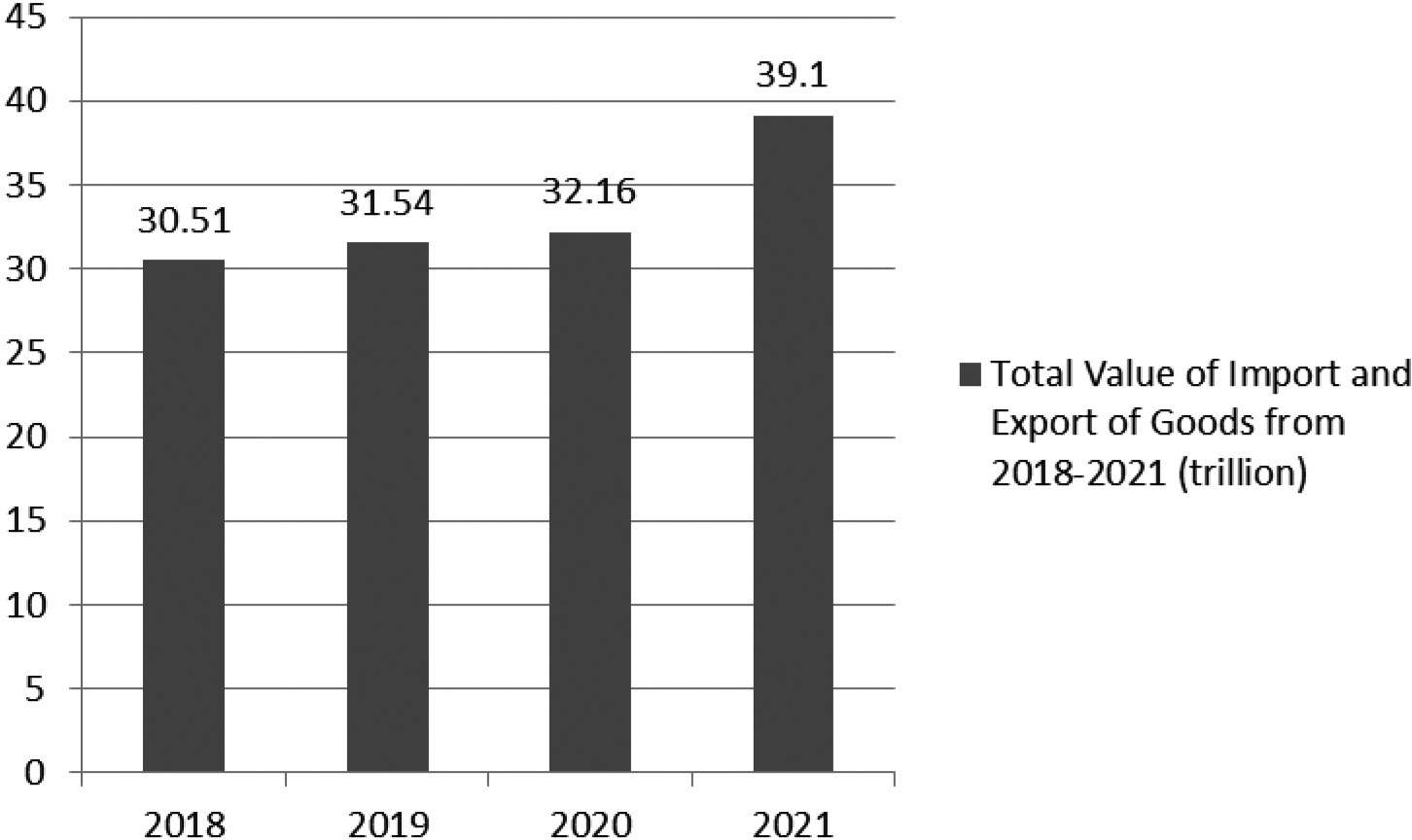
According to Customs statistics in Fig. 1, the total value of China’s import and export trade in 2019 reached 31.54 trillion yuan, an increase of 3.4% compared with 30.51 trillion yuan in 2018. Although severely affected by the epidemic in 2020, the total import and export value of China’s trade in goods continued to grow [2], and reached 32.16 trillion yuan, a year-on-year increase of 1.9%, making it the only economy in the world with positive growth in trade in goods. In 2021, the epidemic situation in China was basically stable, and it entered the stage of normalization of epidemic prevention and control [3]. The foreign trade import and export business has been improved in an orderly manner, with a rapid growth rate, and the total value of import and export of goods trade has reached 39.1 trillion yuan, a year-on-year increase of 21.4%.
2018–2021 China’s cross-border e-commerce import and export value. Note: The data comes from China Customs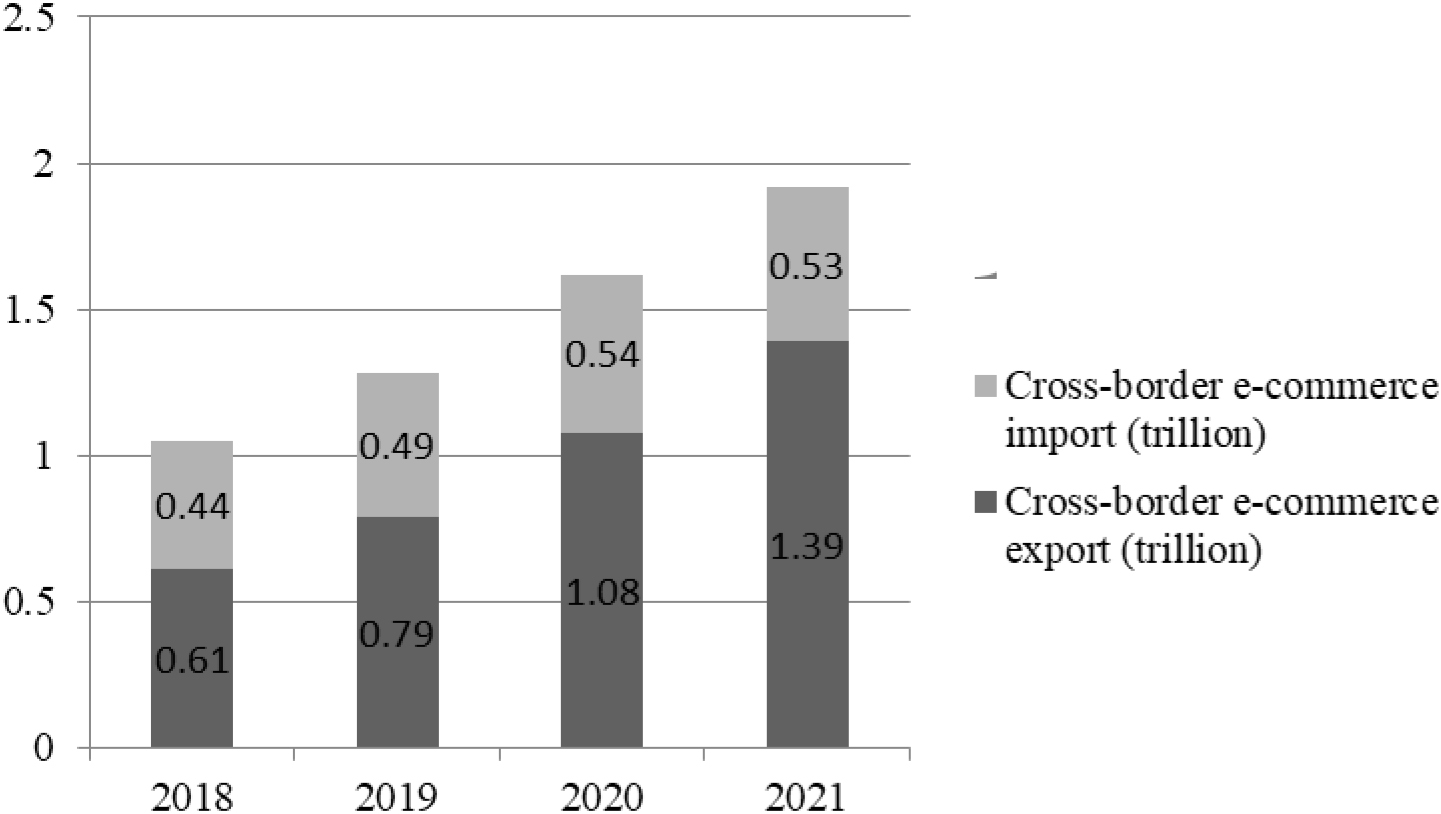
The sustained and stable development of import and export foreign trade business is inseparable from the driving effect of cross-border e-commerce [4]. As shown in Fig. 2, the total import and export volume of my country’s cross-border e-commerce n 2019 reached 1.29 trillion yuan, of which exports were 0.79 trillion yuan, an increase of 30.5%, and imports were 0.49 trillion yuan, an increase of 10.8%; The export scale reached 162 million yuan, a year-on-year increase of 25.7%. In 2021, my country’s cross-border e-commerce import and export scale continued to expand, reaching 190 million yuan, a year-on-year increase of 18.6%, of which exports amounted to 1.39 trillion yuan, increaseing by 28.3%, and imports amounted to 0.53 trillion yuan, which was a drop. From the perspective of structure, cross-border e-commerce export business is the main growth point of my country’s cross-border e-commerce industry.
At present, domestic scholars have carried out some researches on cross-border e-commerce logistics. Fu (2017) considered the evaluation criteria of cross-border e-commerce logistics service capabilities from the aspects of quality assurance, rapid response, cost control, value-added services, and information management, which provided a reference for the self-improvement of cross-border logistics enterprises [5]. Du (2019) starts from domestic e-commerce enterprises and foreign logistics enterprises, studies the interest factors and cooperation strategies between the two parties, obtains data through evolutionary game theory model, and provides effective suggestions for domestic enterprises to take effective measures [6]. Ke (2015) analyzed the impact of domestic cross-border e-commerce on the choice of logistics business in terms of economic and political system, logistics technology level, consumer preferences and transaction costs [7]. Zhang (2016) used the fuzzy comprehensive evaluation method to quantitatively evaluate the logistics service capability of cross-border e-commerce in order to obtain an accurate level of logistics service capability [8]. Wang and Xu (2019) used factor analysis and Logistic model to study the evaluation and influencing factors of logistics business efficiency [9].
The rapid development of cross-border e-commerce in China has put forward higher requirements for the logistics links. As an important part of the cross-border e-commerce industry, the development of cross-border e-commerce logistics in my country is relatively lagging [10], and the problems existing in the cross-border e-commerce logistics industry need to be solved urgently. From the perspective of the traditional cross-border e-commerce logistics model, the high logistics cost is currently a difficult problem to solve. Especially for small and medium-sized cross-border e-commerce companies, the logistics cost seriously affects the income of their main business [11]. From the perspective of emerging overseas warehouse models, the threshold for using overseas warehouses is high, and it is difficult for small and medium-sized cross-border e-commerce companies to get involved. The emergence of the sharing economy model may be able to alleviate some of the current problems in the cross-border e-commerce logistics industry. (The rest deleted)
Sharing economy model
Based on the “Annual Report on China’s Sharing Economy Development (2019)” released by the National Information Center, this article categorizes the sharing economy models into two categories, as shown in Fig. 3.
Two sharing economy models.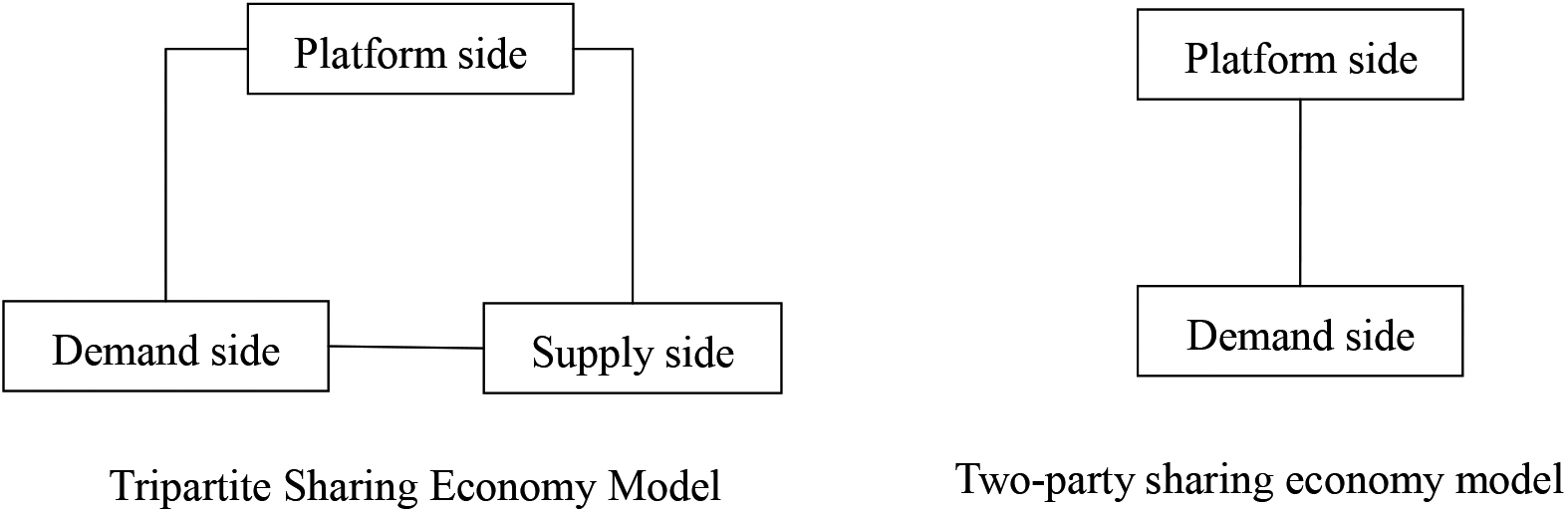
In the tripartite sharing economy model, the platform party, as the party of information integration, provides information technology support for the demand side and the supplier, and promotes the effective allocation of resources, while the most basic available resource in the model is provided by the supplier. Companies in this model include Airbnb and Didi Travel. In this model, the supplier of available resources, based on their own willingness to share, publishes the information on the available resources such as available houses and available seats in the ride on the information integration platform, through the efficient integration of the platform and the demand side. (in-between deleted) For the sharing economy model of the two parties, the platform party not only plays the role of information integration, but also provides available resources for the demand side. That is to say, in this mode, the platform party acts as the platform party for resource integration and provides available resources at the same time. Under the current sharing economy model, this type of platform is more to create available resources first than to integrate idle resources, and then provides them to the demand side of the resources. To a certain extent, it is contrary to the purpose of the sharing economy to improve the utilization rate of social idle resources. Companies in this model include Mobike and Ofo (shared bike). In this mode, the resources are managed by the platform side to provide standardized services to the demand side. The essence of this mode is to transform the traditional leasing economy into the Internet-based. In this article, this economic model is also regarded as a sharing economy model.
Cross-border e-commerce logistics models mainly include international postal parcels, domestic express delivery, international logistics dedicated lines, and overseas warehouses [12]. The specific logistics model content is analyzed as follows:
International postal parcel: The international postal parcel is built on the basis of Universal Post. When cross-border e-commerce companies use this logistics mode, the goods are delivered through personal parcels. International postal parcel is a cross-border logistics mode that is currently used by cross-border e-commerce companies in my country. At present, China Post, Hong Kong Post and Deutsche Post are the major cross-border e-commerce companies in my country that use more, and China Post is the most used. International postal parcels are cheap, have obvious advantages in logistics costs, and are more convenient in import and export customs clearance. However, the timeliness of international postal parcels is poor, the time spent in transportation is long, and the packet loss rate is high. In addition, when the volume of the goods to be transported is too large and the weight is too heavy, the international postal parcel cannot be used for transportation. At the same time, there are certain requirements for the shape of the goods.
Domestic express delivery: mainly includes SF Express and “Four Links and One Delivery”, which are currently relatively successful in the development of domestic express delivery in my country, as well as China Post’s EMS. Although these express companies have developed well in domestic business, they started late in cross-border business [13]. At present, SF Express and EMS are the main sources of domestic express internationalization in my country. SF Express’s SF International has opened an international e-commerce express service to my country’s cross-border e-commerce companies, which can send goods to the United States, Russia, Ukraine, Australia and 26 European countries. The international level of EMS is the highest among domestic express delivery in my country, and it can be delivered to more than 60 countries around the world. The current domestic express delivery costs are slightly lower than the four major international express delivery.
International express delivery: Similar to domestic express delivery, it is also a more frequently used logistics model in cross-border e-commerce. Under this logistics model, cross-border e-commerce goods are delivered to buyers through internationally renowned express companies. At present, UPS, TNT, FedEx and DHL are the main ones that use more international express delivery. Compared with domestic express, international express can provide customers with more transportation channels to meet the needs of different customers.
International logistics line: It is a logistics method that transports the goods of cross-border e-commerce companies to a certain country through multimodal transportation of land, sea and air [14]. Due to its stable transportation method, stable transportation time and route, the international logistics line makes the price of the international logistics line lower and the transportation time is short. At the same time, the use of the international logistics line for cargo transportation can be guaranteed to a certain extent in terms of customs clearance. However, the international logistics line also has certain limitations. Under this model, the goods are only responsible for delivery to the destination country, not for delivery to the buyer. Cross-border e-commerce companies still need to deliver the goods to the buyer through other logistics channels.
Overseas warehouse: It is an emerging cross-border e-commerce logistics model in recent years. It means that cross-border e-commerce sellers transport the goods that need to be sold to the warehouse in the destination country in advance through traditional shipping, land transportation and other methods [15]. When buyers in the destination country place an order, they can directly ship from the warehouse in the destination country [16]. The delivery of goods to consumers greatly reduces the overall delivery time and improves the consumer’s shopping experience. By stocking the goods to the warehouse in the destination country in advance, the logistics cost of the goods is diluted, making overseas warehouses have a higher cost advantage than other cross-border e-commerce logistics models. Compare the advantages and disadvantages of various overseas warehouse models, as shown in Table 1.
Comparison of advantages and disadvantages of different models of overseas warehouses
Comparison of advantages and disadvantages of different models of overseas warehouses
Reduce the cost of various entities in the logistics and warehousing links of cross-border e-commerce
From the perspective of the logistics cost generated by the logistics behavior itself, in the traditional cross-border e-commerce logistics model, for large-scale cross-border e-commerce companies, shipments are concentrated and large in quantity, and it is easier to form a scale effect to reduce logistics costs. For small and medium-sized cross-border e-commerce companies, it is difficult to produce scale effects due to relatively scattered shipments and small quantities, resulting in high logistics costs for small and medium-sized cross-border e-commerce companies; from the perspective of the cost of searching for logistics service information In the traditional cross-border e-commerce logistics model, cross-border e-commerce companies have been looking for high-quality and low-cost cross-border logistics services, but companies have a certain cost in searching for logistics and warehousing service information of logistics companies; from logistics and The operating cost of overseas warehouses seems to be that self-built logistics and overseas warehouses require a large amount of capital investment. The high fixed costs discourage small and medium-sized cross-border e-commerce companies. The operation and maintenance of warehouses also require a lot of manpower and material resources.
For small and medium-sized cross-border e-commerce companies that need cross-border logistics and overseas warehouse services, the platform in the “sharing economy
Improve resource utilization
The vast majority of logistics and overseas warehouse companies in my country lack sufficient information technology to meet the individual needs of customers in the new cross-border e-commerce business. At the same time, industry barriers are high, and they can hardly meet the data docking and information exchange conditions of foreign e-commerce platforms. These various reasons have led to the idleness of logistics and warehousing resources.
The emergence of the “sharing economy
Suggestions for the development of cross-border e-commerce logistics under the sharing economy model
Speed up the standardization of the logistics industry
Logistics standardization involves the standardization of logistics facilities, operations and information. Although my country has formulated and promulgated corresponding national and industry standards in the logistics industry, there are problems in promotion. At present, each industry in my country has its own logistics standards. It is difficult to unify logistics standards in a short period of time, resulting in the participation of existing logistics idle resources. The cost of the “sharing economy
Guide the establishment of a complete credit information system
The most important thing in the “sharing economy
Guide the formulation of industry norms
The development of the sharing economy model in China is relatively fast, and the introduction of relevant industry regulations is relatively lagging. At present, among the industries involved in the sharing economy model, only some industry regulations have been issued in the fields of travel and accommodation. Under the “sharing economy
Actively explore innovative regulatory models
The “sharing economy
Conclusion
Based on the development of the current cross-border e-commerce logistics model and the sharing economy model, it is believed that the emergence of the sharing economy model can provide certain solutions to the problems existing in the current cross-border e-commerce logistics industry. The “sharing economy
In summary, the analysis of cross-border e-commerce logistics from the perspective of sharing economy plays an important role in promoting the stable and sustainable development of China’s e-commerce trade, and can effectively strengthen the competitive advantage in the field of cross-border e-commerce. The dilemma faced by commercial logistics, the adoption of targeted and effective solutions has become the focus of the Chinese government and related enterprises, and it is also an inevitable trend of the modernization of the trade industry.