



Abstract
In the post-targeted poverty alleviation era, rural revitalization has become a common action of the whole society, strengthen the rural ecological environment governance, and the construction of beautiful countryside needs to be promoted urgently. Agricultural development, rural prosperity and farmers’ prosperity are inseparable from the support of a good ecological environment. From ecological, production, life and new energy four aspects of the rural ecological environment development evaluation index system, and then the principal component analysis screening important influence index, on the basis of the genetic algorithm and BP neural network improvement model, 31 provinces during much starker choices-and graver consequences-in rural ecological environment development, and the BP neural network and GA-BP neural network evaluation results. The results show that: (1) Generally speaking, during the 13th Five-Year Plan period, my country’s rural ecological environment development index has gradually improved, but the change range is small, the average value has risen from 0.2257 to 0.2431; The number of provinces with excellent development levels has risen from 5 to 7, and the development of rural ecological environment in Beijing, Tianjin and other provinces has risen to excellent; (2) The development of regional rural ecological environment has increased or decreased, and about three-quarters of the provinces have improved the development of rural ecological environment; (3) The development of rural ecological environment is uneven, and the difference gradually expands; (4) Compared with BP neural network, GA-BP neural network has fast convergence speed, small training, verification and overall errors, high fitting degree, and has a good evaluation effect. The research conclusions can provide a basis for the evaluation and improvement of rural ecological environment development.
Keywords
Introduction
Since the reform and opening up, China’s economy has achieved rapid and sustained development, but it has also paid a heavy price of the ecological environment, especially in rural areas. In recent years, China’s rural revitalization strategy has been implemented, and specific requirements for rural revitalization have been put forward, among which ecological livability is among them. Over the years, the ecological environment in rural areas has not been paid much attention to, and excessive development of resources and industrial pollution emissions can be seen everywhere. Dirty and messy is synonymous with the living environment of most farmers, which has seriously affected the normal production and life of the villagers, and become a restrictive factor hindering the high-quality development of China. At the beginning of 2021, after basically eliminating absolute poverty and completing the building of a moderately prosperous society in all respects, China has entered the era of post-targeted poverty alleviation and comprehensively put rural revitalization on the agenda. The focus of new rural development has shifted from agriculture, rural areas and farmers to rural revitalization. Rural ecological environment construction is related to food safety and urban and rural security. It is urgent to protect the ecological environment construction and strengthen the weak links in rural ecological and environmental governance.
In order to accurately grasp the development level of the regional rural ecological environment, understand the current situation and development characteristics of the regional rural ecological environment, and clarify the advantages and disadvantages of rural ecological environment in each province.
The objective understanding and evaluation of the past level of rural ecological environment development is the basis for scientifically grasping the situation of rural environmental pollution in China and issuing rural environmental governance programs. An objective and accurate evaluation of China’s rural ecological environment construction level is of great practical significance for building ecological civilization, actively building beautiful villages and realizing rural revitalization.
Ecological environment is an important part of ecological civilization, and a good ecological environment is the foundation and guarantee of rural revitalization. The concept of ecological civilization construction was first put forward by China, and China has also become a firm executor of this concept. Many experts and scholars have conducted research on the issues related to the ecological environment construction, and so far, the ecological environment construction is still one of the hot issues studied by the experts and scholars at home and abroad. At present, the research on ecological environment development mainly focuses on the evaluation indicators, the evaluation methods, and the evaluation indicators. The ecological environment was first evaluated by the selenium content in the environmental elements [1, 2]. For the first time, Zhao and Zhang [3] built a comprehensive ecological environment evaluation index system. Think that the regional rural ecological environment construction mainly includes agricultural ecological environment, rural living environment, and rural environment management [4]. Rural ecological environment construction is inseparable from rural ecological resources, ecological agriculture, ecological livability and ecological governance [5]. Think that rural ecological environment is a complex system, ecological economy, ecological environment, ecological living, ecological protection are important factors restricting its development [6]. Based on the PSR (pressure-state-response) model framework, the rural ecological environment evaluation index system is constructed, objectively evaluating and predicting the development of rural ecological environment quality in China [7]. The AHP-DEA model was used to analyze the impact of farmers’ co-employment behavior on the rural ecological environment. The study found that the deeper the non-employment degree, the worse the rural ecological condition [8].
Regarding the evaluation methods, the genetic algorithm was first proposed in 1975, which is essentially an efficient, global search method, obtaining the best chromosome by imitating the natural biological evolution mechanism, through selection, variation and other steps [9]. Subsequently, scholars at home and abroad combined the genetic algorithm with the BP neural network, which has been applied to the cultivated land ecology [10]. Optimization of the denitration system of coal-fired units, healthy, small and medium-sized rivers, and land ecological security, other ecological and environmental fields [11, 12]. For example, the relative humidity of distribution network was analyzed by combining weight adjustment and GA-BP [13]; The environmental quality was assessed using the GA-BP algorithm.
The existing studies mainly involve local mountains and water environment in rural areas, and rarely involve comprehensive analysis of rural ecological environment development at the national level. There are many indicators involved in the study, but the importance of individual factors is relatively low, and there is no simplification. Traditional evaluation models have low accuracy and are difficult to describe complex relationships. Therefore, before constructing the evaluation model, the article need to screen out the main factors affecting the development of rural ecological environment PCA (principal components analysis) is used to reduce the dimension of indicators and use genetic algorithm to optimize BP neural network to evaluate the rural ecological environment development in various provinces during the 13th Five-Year Plan period [14, 15].
Flow chart of BP neural network.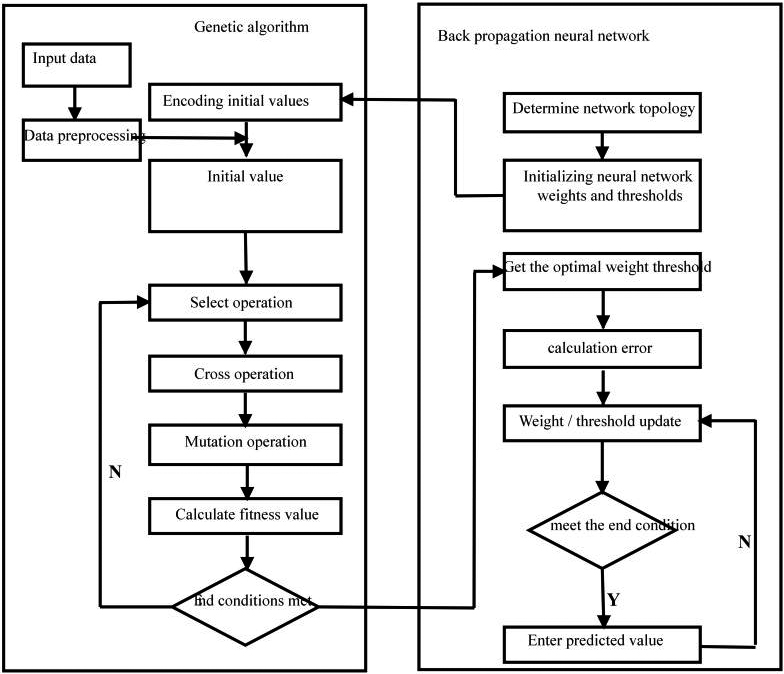
BP neural network
BP neural network is a widely used neural network model, which generally includes three layers: input layer, hidden layer, and output layer. The BP algorithm includes forward propagation and error backpropagation, turning to the latter stage by applying the signal to the output layer if the actual output is inconsistent with the desired output, and transferring the output error to the input layer, minimizing the average variance between the actual output value and the expected output value. The main steps of the BP neural network algorithm are as follows: (1) Initializes the network, determines various parameters such as threshold and connection weights in the model. The grant of the connection weight is (
Genetic algorithm optimizing BP neural network
The advantages of the BP neural network model lie in its strong self-learning ability and multi-dimensional function mapping ability, but its limitations are also obvious: it is easy to fall into a local extremal trap. Genetic algorithm is a method to search for the optimal solution, characterized by large coverage, not constrained by continuous differentiability, and conducive to global selection. Therefore, according to the characteristics of the genetic algorithm and the BP neural network, this paper uses the genetic algorithm to optimize the BP neural network to study the evaluation of the rural ecological environment status.
The basic steps of optimizing the BP neural network using the genetic algorithm are: (1) To determine the initialization population. Initial values were encoded and parameters such as population number, genetic algebra, number of iterations and crossover probability were determined. (2) Calculated the fitness for each chromosome in the population. The fitness function was used to evaluate each chromosome, and the degree was judged according to the evaluation results. (3) Inherits the previous generation of optimized chromosomes to the next generation according to the selection operator. The optimized chromosomes were inherited from the selection to the next generation. (4) Determines the cross operator and the variant operator, and the resulting random number reaches certain conditions, according to the cross operator and the variant operator act with the population, to obtain the next generation population. (5) Goes through multiple rounds of evolution until the optimal solution appears, where the maximum fitness chromosome appears, when the weight and threshold for the smallest error of the BP neural network error are obtained as the optimal solution for the output evaluation. The basic flow chart of the GA-BP neural network model is shown in Fig. 1.
Evaluation and application of rural ecological environment development in China
Construction of rural ecological environment index system and factor screening
Ecological environment refers to the environment composed of ecological relations, which is closely related to the survival and development of human beings themselves, and is related to the sustainable development of the economy and society. Rural ecological environment refers to the general term of the quantity and quality of all water, land, biological and climate resources related to human survival and development in rural areas, covering the three major environments of rural resources, life and production. Rural ecological environment has several basic characteristics: (1) Reflects the ecological conditions of residents; (2) Reflects human production activities; (3) Covers human survival and development; (4) Large regional differences; (5) Reflects the construction of new countryside. Combined with the reality of rural China, this paper draws from relevant literature [16, 17]. The rural ecological environment construction is measured from the four aspects of ecological conditions, production environment, living environment and new energy utilization, thus obtaining a relatively complete rural ecological environment evaluation index system, as shown in Table 1.
Evaluation index of rural ecological environment
Evaluation index of rural ecological environment
This paper takes 31 provinces and cities in China as the research object to study the rural ecological environment construction in the 13th Five-Year Plan period. The data are mainly derived from the China Rural Statistical Yearbook of the corresponding year.
Principal component analysis was performed using SPSS22.0 with a KMO statistic of 0.733, a Balit sphere test statistic of 4593.226, and a
Main component load matrix
The index of rural ecological environment development was selected as the input neurons of the GA-BP neural network model, with 12. A total of 12431 provinces and cities in China from 2016 to 2020 were used as training set data, the part of BP neural network was used for training, and the remaining samples were used as test data to calculate errors. The result of the entropy weight TOPSIS is calculated as the output layer, and the output layer is 1. BP neural network model and GA-BP neural network training are shown in Figs 2 and 3. The training error curves are shown in Figs 4 and 5, respectively. From Fig. 6, the BP neural network produces the best mean square error when training to step 5216, the training stops and GA-BP neural network training to 1079, the convergence rate increases by about 4 times, and the mean error is small. In comparison, the number of iterative steps of GA-BP neural network is smaller than that of BP neural network, reaching the expected target more quickly.
BP neural network training.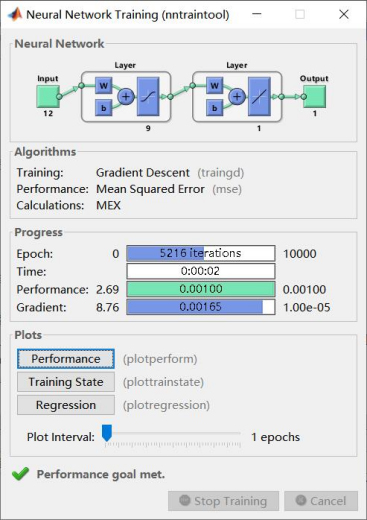
GA-BP neural network training.
BP neural network training error.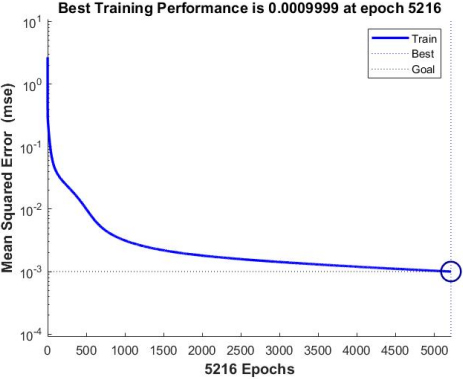
GA-BP neural network training error.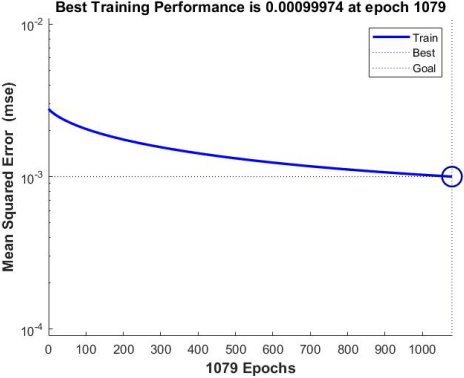
Further, the sample data from 2016 to 2020 were trained with 124 samples, GA-BP prediction model and BP prediction model respectively using sample data as input values, to compare the actual value and the predicted value, yielding the percent error between the actual sample and the predicted value, as shown in Figs 6 and 7, respectively. Compared with Figs 6 and 7, it can be found that the BP network has a large percent prediction error of the sample data, and the error of some sample data even exceeds 10%. The BP neural network optimized by the genetic algorithm can reduce the error to varying degrees and control it below 7%. In the evaluation of the rural ecological environment, the BP neural network optimized by the genetic algorithm has more advantages, which guarantees the stability of the network, and is conducive to the consistency of the prediction results.
Percentage of training error in GA-BP network training error.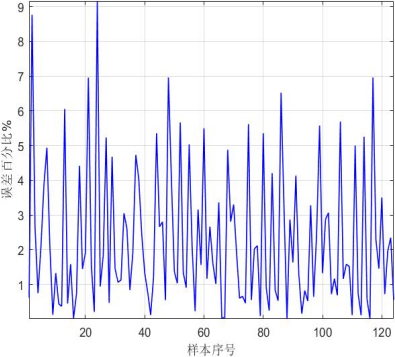
Percentage of training error in BP network training error.
The trained GA-BP evaluation model and the BP model were predicted for the 31 validation data separately, as shown in Figs 8 and 9. After comparison, it can be found that the percentage error of BP network prediction model is still high for the 31 prediction samples, while the percentage error of GA-BP network prediction model is controlled below 6%, partially close to 0.
Percentage G A-BP network validation error.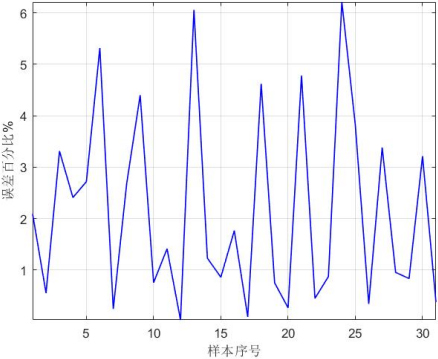
The GA-BP and BP prediction models were used to view the fit effect of each model from the goodness-of-fit. Among them, the GA-BP network prediction model trained the data for goodness-of-fit
The output value range of the rural ecological environment in each province is divided into three levels: A (excellent), B (good) and C (general), as shown in Table 3. According to the operation results of GA-BP, the rural ecological environment results of each province were obtained, limited to space, taking 2006 and 2020 as examples, and the specific results are shown in Table 4.
The level of rural ecological environment development
The level of rural ecological environment development
BP network validation error.
An analysis of the rural ecological environment development status
Combined with Tables 3 and 4, the following contents can be obtained:
Overall, China’s rural ecological environment development index in 2016 showed an upward trend from 2016 to 2020, but the change range is small. In 2016, China’s rural ecological environment development index was 0.2257, grade B, and in 2020, China’s rural ecological environment development index was 0.2431, grade B, and the development status is good. The development of regional rural ecological environment is increasing and decreasing. The development index of 23 provinces rose, accounting for about three-quarters of the total provinces, while 8 provinces decreased from 1% to 10%. In 2016, Tibet, Sichuan, Shandong, Beijing, Qinghai, Guangdong and 12 provinces including Guizhou, Zhejiang and Gansu, the development status was general. In 2020, seven provinces including Tibet, Beijing and Qinghai were grade A, with grade B, including 14 provinces including Henan, Guangdong and Yunnan, and 10 provinces with C, including Gansu and Zhejiang. Compared with 2016, the number of provinces with excellent rural ecological environment development in 2020 increased from 5 to 7, among which the development index of Beijing, Tianjin and other provinces grew rapidly, and rose to the excellent grade in 2020. During the 13th Five-Year Plan period, Beijing put forward 24 urban-rural integration indicators, including ecological civilization, promoting green ecological and harmonious and livable development, evaluating and regulating river and lake water systems, banning production pollution projects, and preventing agricultural land pollution prevention and control, and achieved great results. During the 13th Five-Year Plan period, Tianjin established 1,139 beautiful villages, achieved remarkable results in the project of “100 villages demonstration and one thousand villages renovation”, and the effective utilization of farmland irrigation water is at the leading level in China. The development of the rural ecological environment is extremely unbalanced, and the differences are gradually increasing. In 2016, the rural ecological and environmental development index of 16 provinces and cities was higher than the average. In 2020, only 13 provinces were higher than the average ecological development index, and the gap between the provinces with the highest and the lowest development index was getting bigger and bigger. Tibet autonomous region rural ecological environment development index ranked first, as an important ecological security barrier in China, liberation especially the much starker choices-choices-and graver consequences-in period, formulated dozens of regulations, firmly establish the ecological priority green development concept, protect green waters, the implementation of farmland to forest project, grassland green vegetation coverage, wildlife resources have created a record high [19, 20, 21].
Study conclusion
This paper constructs a rural ecological environment evaluation index system with 16 indicators, based on ecological status, production environment, living environment and new energy utilization. Combining principal component analysis and GA-BP neural network model to evaluate the regional rural ecological environment in 31 provinces in China from 2016 to 2020. The main conclusions are as follows:
Principal component analysis was used to screen out 12 influence factors from the rural ecological environment evaluation index system, which were used as the input variable of the evaluation model, which reduced the dimension of the research data space and increased the accuracy of the results. Using the results obtained from entropy power TOPSIS model as the output, comparing PCA-GA-BP and PCA-BP prediction model, it can be found that PCA-GA-BP prediction model has fast convergence rate, small prediction error, better fitting degree, and relatively stable network, indicating that PCA-GA-BP model is more suitable as a method to study the prediction of rural ecological environment development. On the whole, China’s rural ecological environment development index has shown an upward trend during the 13th Five-Year Plan period, but the change range is small. Specifically, the regional rural ecological environment development situation has increased and decreased, with about three-quarters of the provinces’ rural ecological environment development index has increased. Compared with the early stage of the 13th Five-Year Plan, the number of rural provinces with excellent ecological environment development status at the end of the 13th Five-Year Plan has increased from 5 to 7. However, the development between provinces is extremely unbalanced, and the difference is increasing year by year. At the beginning of the 13th Five-Year Plan, 16 provinces exceeded the national average, and the number of provinces that exceeded the national average at the end of the 13th Five-Year Plan decreased [22].
China’s rural revitalization takes the path of green development. The rural ecological environment is an important part of promoting the construction of a new countryside, and rural pollution control has been included in the scope of the central ecological and environmental protection supervision. According to the conclusions obtained, the following countermeasures and suggestions are put forward for how to improve the quality of rural ecological environment, and to ensure the stable development of rural areas on the premise of reducing the burden of rural ecological environment:
Develop green agricultural science and technology, and foster ecological agriculture. The development of ecological agriculture facing agricultural non-point source pollution and mechanical power, should adhere to the coordinated development of agricultural economy and ecological environment protection, deepen agricultural industry technology innovation, improve biological soil, develop clean energy, reduce fertilizer and pesticides, reduce agricultural consumption and emissions, build ecological agriculture base. Strictly control the boundaries of rural ecological protection. China, especially in rural areas with the general level of ecological environment development, should coordinate rural production, living, communication, ecological and other space. Based on the importance of ecological protection and giving priority, it is strictly prohibited to conduct productive business activities within the red line of ecological protection. In China, government agency will carry out assessment of the effectiveness of environmental protection in nature reserves, form a multi-tiered ecological protection system, and establish a mechanism for subsidies and compensation for protection and punishment measures for ecological protection. At the same time, adjust measures to local conditions, proceed from reality, and strictly prevent a one-size-fits-all approach and the rise of formalism. Break the “regional economy” segmentation pattern and narrow the gap in spatial integration. As the rural ecological environment is characterized by significant regional agglomeration, and the rural ecological environment among provinces is similar, the development of rural ecological environment is also common. The governance mode has changed from “linkage and coordination” to “co governance and sharing”, and multi agents have promoted cross regional ecological environment protection. Local governments should clarify their responsibilities, subordinate local ecological environment to the overall ecological environment, and accelerate the process of rural environmental improvement.
The rural ecological environment system is a complex system with complex influencing factors. However, due to the availability of data, the evaluation index system constructed in this paper needs to be further improved. In the next step, the evaluation index system will be adjusted by experts.