



Abstract
In order to improve the economic growth efficiency of industrial and commercial enterprises in coastal cities and realize the GDP growth of coastal cities, this paper studies the economic growth factors of industrial and commercial enterprises in coastal cities based on the unexpected super efficiency model. Based on the research and analysis of the previous economic growth theories, this paper finds out the main factors that affect the economic growth of industrial and commercial enterprises in coastal cities, and uses the advanced econometric method to establish the relevant test model to analyze the correlation between the time series of economic growth factors and the time series of coastal cities, so as to realize the economic growth factors of industrial and commercial enterprises in coastal cities Element study. The empirical results show that the main factors affecting the economic growth of industrial and commercial enterprises in coastal cities are capital and labor force, with labor force as the main body; Technical and institutional factors also contribute to the GDP of industrial and commercial enterprises in coastal cities, but the impact is not significant and needs further improvement. In general, these factors can promote the economic growth of industrial and commercial enterprises in coastal cities. The time series and time series of each factor variable are first-order non-stationary series with long-term cointegration relationship.
Keywords
Introduction
The economic growth of industrial and commercial enterprises in coastal cities of any country has an extremely important impact on the economic development of the country. Therefore, it is an important aspect to analyze the factors that affect the economic growth of industrial and commercial enterprises in coastal cities and find out the economic growth mode of industrial and commercial enterprises in coastal cities to improve the national GDP (Gross Domestic Product).
The so-called mode of economic growth refers to the mode of investment and combination of various factors of production to promote economic growth. Its essence is to rely on what factors, what means, what ways and how to achieve economic growth [1]. Under the background of the global financial crisis, the international economy has declined sharply, and the economic environment is not very ideal, which will inevitably affect the investment promotion of coastal cities. For example, if the investment attraction is not ideal, a batch of processing trade enterprises in the coastal areas will close down, causing a large number of migrant workers to return home, further increasing the employment pressure in the coastal cities, making the sharp decline of the real estate income of the government finance restrict the scale and sustainability of local government investment, and at the same time bringing challenges to the economic growth of the coastal cities [2], which will even have a negative impact on the national economic growth. Therefore, many governments and scholars clearly realize that it is urgent to change the mode of economic growth [3]. Only by effectively changing the mode of economic growth, increasing the role of scientific and technological progress in promoting economic growth, and increasing the contribution rate of domestic consumption to economic growth, can we effectively improve the wage level of workers at home, reduce the dependence of domestic economy on overseas markets at abroad, and form a complementary trend between domestic economic growth and the improvement of the living standards of ordinary domestic residents, so as to effectively solve the problem The bubble risk caused by scale economic stimulus measures will reduce the impact of uncertain factors in overseas markets on domestic market. It is precisely because the mode of economic growth plays an extremely critical role in economic growth that some countries have long proposed to change the mode of economic growth, to shift from focusing on economic quantity expansion to focusing on quality and efficiency improvement, and to shift from extensive economic growth to intensive economic growth. However, most countries have not taken too many substantive measures, and the focus has some errors makes that although the idea of changing the mode of economic growth has been put forward for many years, it still has little effect so far [4]. Because of the above reasons, it is particularly urgent to study the economic growth factors of industrial and commercial enterprises in coastal cities.
In the development of the theory of economic growth factors, many scholars have conducted empirical research on the factors that affect economic growth, and have made many achievements. For example, Wang H et al. [5] on this basis, put forward relevant strategies to improve the effect of talent training. Wang Y [6] used the finite element method to study the impact of industrial structure on the development of port enterprises. First, the influence finite element analysis model is constructed, and the industrial structure is taken as a variable to obtain the corresponding industrial structure characteristics. The dynamic model of port enterprise development is established, and the development cycle of the enterprise is analyzed. Select enterprise development indicators to determine the factors affecting the development of port enterprises. By observing the changes of enterprise development under different industrial structures, this paper qualitatively studies the impact of industrial structure on the development of port enterprises. Tang et al. [7] studied the dynamic relationship and driving factors between green development and economic growth in Shandong Peninsula urban agglomeration. Based on the panel data of 17 cities in Shandong Peninsula urban agglomeration from 2008 to 2018, it is concluded that the level of population aggregation and industrial structure can promote economic growth, but will inhibit the improvement of green development level, while technological innovation and opening-up can not only significantly promote economic growth, but also promote the improvement of green development level. In addition to the research of the above scholars on the factors affecting economic development, some scholars have made some research achievements, but it is not difficult to find that the current research on the factors affecting industrial and commercial economic development in coastal areas is too little and needs to be further supplemented.
At present, the research on economic growth factors of industrial and commercial enterprises in coastal cities can be generally divided into two aspects. On the one hand, from the perspective of sectors, i.e. consumption, investment, import and export are considered to be the factors affecting economic growth [8, 9]; on the other hand, from the perspective of factors, i.e. some or all of the factors such as capital, labor, technology and system are considered to be the factors influencing economic growth. Because the latter theory is more mature, intuitive and widely used, so this paper applies the unexpected super efficiency model to the study of economic growth factors of industrial and commercial enterprises in coastal cities, analyzes the source factors of economic growth of industrial and commercial enterprises in coastal cities, so as to achieve the improvement of economic efficiency of industrial and commercial enterprises in coastal cities, and thus increase the GDP of coastal cities.
Research on economic growth factors of industrial and commercial enterprises in coastal cities
Econometric analysis of economic growth factors of industrial and commercial enterprises in coastal cities
The samples used in this paper are taken from the annual data of 2005–2019 for a total of 15 years. Determine the economic growth factors of industrial and commercial enterprises in coastal cities from the actual survey. Among them, the import and export value is in RMB. GDP is the economic growth level of coastal cities,
Indexation results
Indexation results
Based on the extended Cobb Douglas production function and Solow production function, the paper takes the relevant factors of material capital, labor force, technology, system and economic growth of industrial and commercial enterprises in coastal cities into the extended production function [11], namely:
Where, GDP represents the economy of industrial and commercial enterprises in coastal cities,
Since the production function is non-linear, the common logarithm on both sides of the function is taken to get the equation:
Figure 1 shows the trend chart of variables
Change trend of each variable.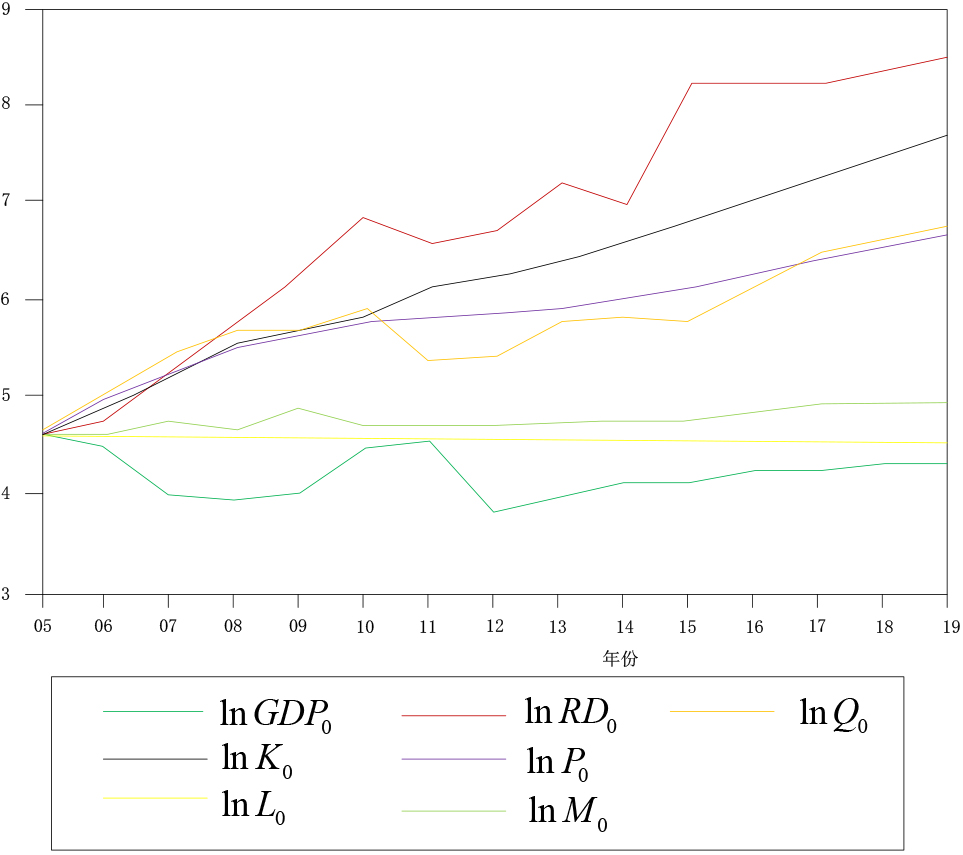
It can be seen from Fig. 1 that although all variables fluctuate in individual years, they show a growing trend as a whole, and the direction and pace of change are relatively consistent, which shows that there is a strong correlation between them [12]. Secondly, Fig. 1 also shows that the growth rate of capital and labor factors of industrial and commercial enterprises in coastal cities is much higher than that of GDP in recent years, while the growth rate of R&D capital is relatively slow or even has a negative trend.
Figure 2 shows the first-order difference trend of each variable. It can be seen from the figure that except for the large fluctuation of R&D capital, all other variables have strong stability [13]. In other words, the first-order difference sequence of each variable shows the trend of stationary sequence.
At the same time, Table 2 shows the correlation coefficients between variables. It can be seen that there is a relatively strong correlation between the GDP of industrial and commercial enterprises in coastal cities and most of the variables. However, this does not mean that there must be causality between them. Therefore, we need to use cointegration technology and causality test to analyze the relationship between them.
Correlation coefficient between variables
Variation trend of first-order difference of each variable.
On the basis of selecting the economic data samples of industrial and commercial enterprises in coastal cities, the economic growth model of industrial and commercial enterprises in coastal cities is established and analyzed. By verifying the validity of the model, the econometric analysis is carried out on the economic growth factors of industrial and commercial enterprises in coastal cities. Finally, the analysis is carried out from two aspects of labor force factor and fixed asset investment factor to complete the economic growth model of industrial and commercial enterprises in coastal cities Research on economic growth factors.
Since the 21st century, the economy of industrial and commercial enterprises in coastal cities has maintained rapid growth, with an average annual growth rate of 10.74%. On the whole, capital investment, labor level, research funding, system and other factors have a great impact on the economic growth of industrial and commercial enterprises in coastal cities. In the short term, labor and capital are still the main reasons for the economic growth of industrial and commercial enterprises in coastal cities, but technology and institutional factors have no significant effect on the economic growth of industrial and commercial enterprises in coastal cities. Compared with the long-term and short-term, foreign trade is becoming an important factor to promote the economic growth of industrial and commercial enterprises in coastal cities in the long term.
Specifically, for every percentage point change in employment level, the GDP of industrial and commercial enterprises in coastal cities will change by about 4.92 percentage points in the long run and 3.13 percentage points in the short run; for every percentage point increase in fixed asset investment, the GDP of industrial and commercial enterprises in coastal cities will increase by 0.55 and 0.54 percentage points in the long run and the short run respectively; R&D In addition, when the foreign trade factor and the non-nationalization factor increase by 1%, the GDP growth rate will be 0.039% and 0.018% in the short term, 0.1760% and 0.164% in the long term.
Labor factors
From the regression model of economic growth of industrial and commercial enterprises in coastal cities, labor force is the main driving force of economic growth of industrial and commercial enterprises in coastal cities. In the long run, GDP will increase by 4.92% for every 1% increase in labor force. In the short term, the labor force will increase by 1 percentage point, and the GDP will increase by 3.13 percentage points. This shows the following points: first, the industrial structure of industrial and commercial enterprises in coastal cities is still labor-intensive, and labor factor is one of the resources for economic growth of industrial and commercial enterprises in coastal cities; second, the difference in the contribution of labor force to economic growth in the short and long term indicates that industrial and commercial enterprises in coastal cities are undergoing industrial restructuring, and the role of labor factor is weakening, Labor intensive industries are developing towards capital intensive industries; thirdly, with the steady progress of government labor transfer and the acceleration of rural labor transfer, the number of employment in the secondary and tertiary industries in coastal cities is gradually increasing, so as to promote the employment structure to develop in a more reasonable direction, which may be that the labor force is still active in the economic development of industrial and commercial enterprises in coastal cities One of the reasons for force [14].
Fixed asset investment factors
From the perspective of use, investment is the final use of coastal cities’ GDP, and the increase of investment will increase the social demand of coastal cities. Therefore, as the main part of investment, fixed asset investment is also an important factor to promote the economic growth of coastal cities, which can be reflected by the investment rate and investment contribution rate. Investment rate refers to the proportion of total capital formation in GDP, while investment contribution rate refers to the proportion of investment increment in current GDP increment. The former is the concept of stock, while the latter belongs to the category of increment.
Generally speaking, the continuous economic growth of industrial and commercial enterprises directly under the central government in coastal cities is accompanied by the increasing investment rate. In terms of time series, it can be roughly divided into two stages. From 2009 to 2019, the investment rate of industrial and commercial enterprises in coastal cities increased from 27.27% to 40.91%, with an average annual increase of 2.7 percentage points. After 2013, the rate of investment has increased significantly. From 40.91% in 2013 to 70.22% in 2019, an average annual increase of 4.2 percentage points. In 2019, the national investment rate is 42.6%, and industrial and commercial enterprises in coastal cities rank sixth in the country [15].
The investment contribution rate of industrial and commercial enterprises in coastal cities also shows an upward trend on the whole, but fluctuates greatly between the years. In 2010, the contribution rate of fixed asset investment of industrial and commercial enterprises in coastal cities to economic growth was 29.06%, the first peak was formed in 2011, with the investment contribution rate reaching 158.36%, and then dropped to 83.61% in 2013. After entering 2013, industrial and commercial enterprises in coastal cities have ushered in a new round of investment climax, and their investment contribution rate has increased rapidly, reaching 105.8% in 2019, a record high in many years. During the 11th Five Year Plan period, the average contribution rate of fixed asset investment of industrial and commercial enterprises in coastal cities to economic growth was 76.92%, which effectively promoted the sustained and rapid economic growth of industrial and commercial enterprises in coastal cities. The economic growth rate, investment rate and investment contribution rate of industrial and commercial enterprises in coastal cities in the past decade are shown in Table 3.
Economic growth rate, investment rate and investment contribution rate of industrial and commercial enterprises in coastal cities in the past decade
Economic growth rate, investment rate and investment contribution rate of industrial and commercial enterprises in coastal cities in the past decade
However, when we exclude the influence factors of time series, we can find that the investment of industrial and commercial enterprises in coastal cities is still in an unsatisfactory state. For each percentage point increase in fixed asset investment, the actual contribution rate to economic growth in the long term is only 0.55 percentage points, and in the short term is only 0.54 percentage points. As one of the driving forces of economic growth of industrial and commercial enterprises in coastal cities, this kind of high investment in capital is to some extent an important manifestation of low capital utilization rate. At the same time, the increasing trend of investment contribution rate also proves that the industrial and commercial enterprises in coastal cities are developing towards capital intensive industries.
From the perspective of industrial structure, it can also be proved that industrial and commercial enterprises in coastal cities are developing towards capital intensive industries. The industrial investment structure of industrial and commercial enterprises in coastal cities maintains the pattern of “three, two, one”. However, in terms of the intensity of capital demand, the first and second industries are higher than the third industry. The fixed asset investment of the first industry accounts for less than 2% of the total social investment of industrial and commercial enterprises in coastal cities, showing a trend of rapid growth due to the small base number; the investment of the third industry is large, but the efficiency is low, and the internal structure needs to be improved; the investment of the second industry contributes a lot and the capital demand is strong. Therefore, the reasonable allocation of investment in the first industry, the second industry and the third industry is not only related to the overall improvement of investment efficiency and the optimization of industrial structure of industrial and commercial enterprises in coastal cities, but also related to the contribution of capital to economic growth.
In this paper, we deal with the data of industrial and commercial enterprises in coastal cities by logarithm.
This paper analyzes the long-term stable relationship and causal relationship between the GDP of industrial and commercial enterprises and the factors of production and supply, as well as between the GDP of industrial and commercial enterprises and the factors of demand in coastal cities from the perspective of empirical research by using the vector autoregressive model.
When processing time series data, we need to consider the stationarity of the series. If the mean or auto covariance function of a time series changes with time, then the series is non-stationary. For non-stationary data, the traditional estimation method may lead to wrong inference (pseudo regression). If a nonstationary sequence is transformed into a stationary sequence by a first-order difference, then the sequence is a first-order simple integer sequence. For a group of non-stationary sequences with the same order, if their linear combination is a stationary sequence, the combination sequence is said to have a cointegration relationship. For the series with cointegration relationship, the error correction term can be calculated, and the lag period of the error correction term, together with other variables reflecting the short-term fluctuation relationship, is regarded as the explanatory variable. Vector auto regression is commonly used to predict the interconnected time series system and analyze the dynamic impact of random disturbance on the variable system. Methods each endogenous variable in the system was used as a function of the lag value of all endogenous variables in the system to construct the model, thus avoiding the need of structured model. The mathematical form of a VAR (
In the formula,
In this paper, we deal with the logarithm of the data in the regression, considering that the logarithm of the ordinal sequence will not change its time series property, and the logarithm of the data is easy to get the stationary sequence. The unit root test of time series is shown in Table 4.
Unit root test of time series
Unit root test of time series
Table 4 shows that: (1) in the test form, C and t represent constant terms and trend terms, and K represents lag order; (2) the selection criteria of lag period K is based on the minimum AIC and SC values; (3)
From the unit root test results of time series LNY, LNK, LNL, LNH and LNT in Table 4, it can be seen that the time series LNY, LNK, LNL, LNH and LNT are stable after first-order difference, so they are first-order single integer series. The single integral order of time series LNY, LNK, LNL, LNH and LNT is the same, and there may be cointegration relationship, that is, there is a long-term stable proportion relationship between variables. In this paper, multivariate cointegration test is used to test the time series, GDP, physical capital, labor force, human capital and expenditure. Cointegration test is a test method based on unexpected super efficiency model. Before cointegration test, the structure of the model must be determined. The model based on this method is sensitive to the selection of lag time, so AIC criterion is used to determine the best lag time. After determining the number of lag periods, we verify whether there is constant term and time trend in cointegration, and then test the data cointegration.
AIC (Akaike Information Criterion), based on the concept of entropy, can weigh the complexity of the estimated model and the goodness of the fitting data of this model, and is an effective standard to measure the goodness of the fitting of statistical models. Using AIC to select the maximum lag period K value, the principle of selecting K value is to minimize the AIC value or SC value in the process of increasing K value. Table 5 shows the basis for selecting the lag number k of the model [16].
K-number of the late lag period of the unexpected super efficiency model
On the basis of the unexpected super efficiency model, Eviews 5.0 is used to analyze the optimal lag order of 2, and only intercept term is selected in the cointegration equation and vector auto regression model. The specific results of cointegration test are obtained, as shown in Table 6.
Cointegration test results
According to the test results in Table 6, there is a long-term equilibrium relationship between the GDP of industrial and commercial enterprises in coastal cities and the physical capital (k), the number of labor force (L), the human capital (H), and the investment in funds (T). There is at most one cointegration relationship between these variables.
The cointegration relationship can only show that there is a long-term equilibrium and stable relationship among the five variables, and there is at least a single causal relationship between the variables, but this does not show what the causal relationship specifically represents, so it needs to be further verified. Firstly, the causality between variables is defined, and a test method is proposed for the existence of the causality, namely, the Granger causality test [17]. Because the annual data is used in this paper, it is very important to select the late lag period in the causality test of variables. According to AIC, the lag order of each variable is determined to be 2, and the causality test is conducted directly on the sequence object. According to the test results and the data sequence characteristics analyzed in this paper, the causality between each variable is determined.
The above results show that LNK, LNL, LNH and LNT are the causes of LNY at 5% significance level, LNY is not the causes of LNK, LNL, LNH and LNT, that is, there is a single causal relationship between LNY and LNK, LNL, LNH and LNT. The results of Granger causality test further prove the rationality of the above cointegration analysis. The GDP growth of industrial and commercial enterprises in coastal cities is indeed affected by K, l, h, t.
Vector error correction model
According to Granger theorem, a set of variables with cointegration relationship must have error correction model [18]. Granger points out that if there is cointegration among variables, there is Granger causality in at least one direction between these variables. If the coefficient joint test of lag difference is significant, then there is short-term causality. If the coefficient of error correction is significant, then there is long-term causality. Therefore, after determining the cointegration relationship between variables, we can construct a vector error correction model to determine the mutual adjustment rate and short-term interaction between them and observe the causal relationship between variables.
Error correction model is a short-term dynamic model including error correction term. It can not only reflect the long-term stable equilibrium relationship between different sequences, but also reflect the short-term deviation of this relationship and the short-term change relationship to long-term equilibrium correction.
Since the lag period of vector error correction model is the lag period of the first-order difference variable of unconstrained VAR model, the lag period of all unconstrained VaR models determined in the previous paper is 3, so the corresponding lag period should be 2, and the sequence is still in the form of cointegration equation with outcome but no definite trend.
The error correction model explains that the short-term fluctuation of dependent variable is determined by three factors: its early fluctuation, independent variable fluctuation and the degree of early deviation equilibrium between sequences.
Error correction model is an extension of cointegration analysis. Cointegration analysis reflects the long-term equilibrium between variables. If the deviation phenomenon appears in a short period of time for some reason, it is inevitable to make the variables return to equilibrium state by correcting the error. The error correction model combines short-term volatility and long-term equilibrium in a model. Its basic idea is that if there is a cointegration relationship between variables, it means that there is a long-term stable relationship between these variables, and this long-term stable relationship is maintained by the continuous dynamic adjustment of each variable in the short term.
Generalized impulse response function in unexpected super efficiency model
The data attribute, long-term equilibrium relationship and vector error correction mechanism of GDP and fixed asset investment, labor force, human capital, R&D investment in coastal cities have been discussed. The generalized impulse response function is used to test its dynamic characteristics.
Because this paper mainly studies the relationship between the economic growth of industrial and commercial enterprises in coastal cities and the investment in fixed assets, labor force, human capital and investment, the paper only gives the impulse response function curve of economic growth of industrial and commercial enterprises in coastal cities, as shown in Fig. 3.
Impulse influence function of economic growth of industrial and commercial enterprises in coastal cities.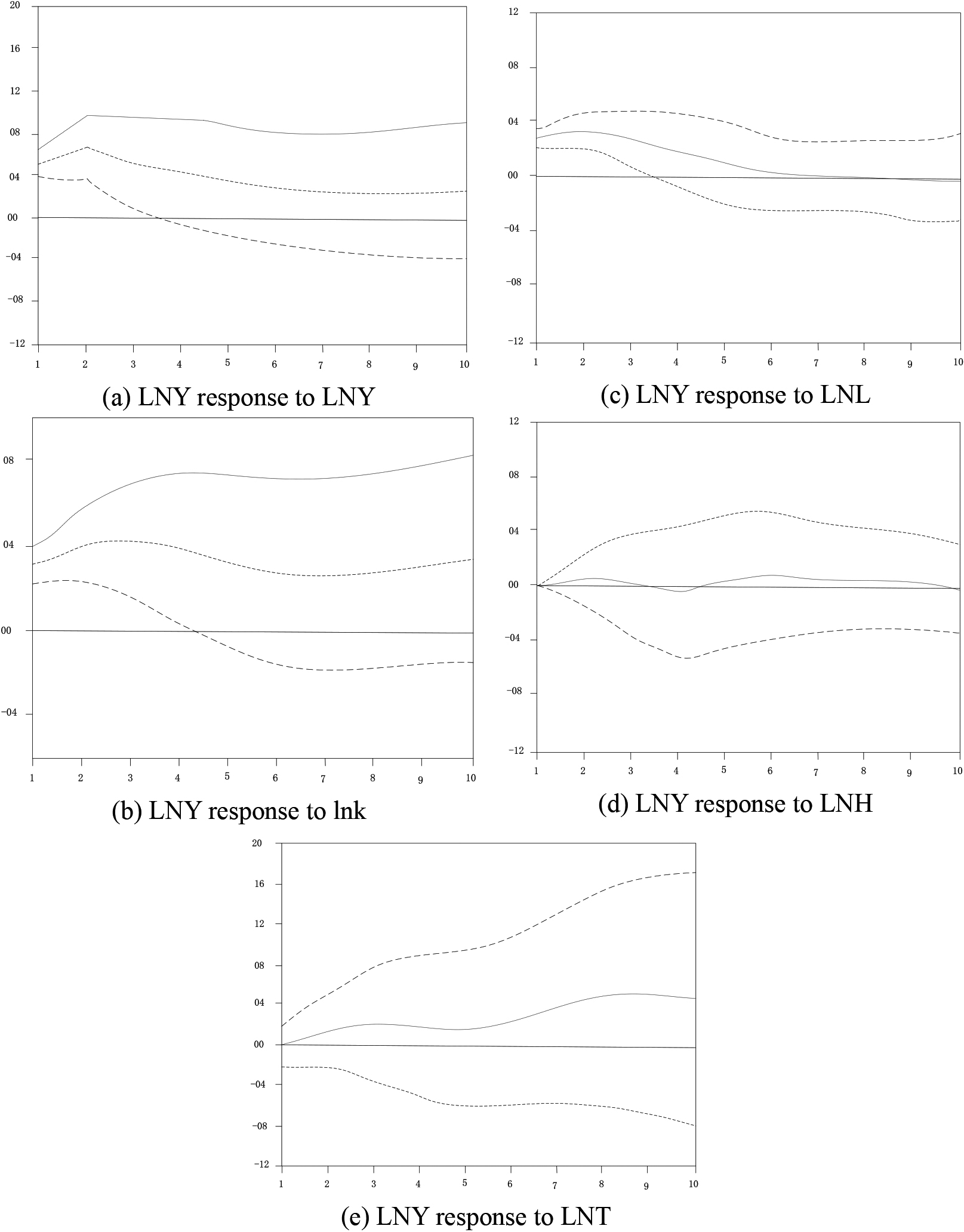
From Fig. 3, it can be seen that the GDP (economic growth) of industrial and commercial enterprises in coastal cities has a strong response to a standard deviation interest rate of their own immediately, and LNGDP rises immediately, reaching the peak in the second period, that is, the response of LNGDP is the largest in the second period, and then the fluctuation of LNGDP gradually decreases and tends to be stable. The input of fixed capital and labor factors has a positive impact on economic growth in general, and the fluctuation curve also reflects the input of capital and labor factors. First of all, because of the role of scale economy, the economy grows obviously. After a certain stage of growth, the role of factor input on economic growth is gradually weakened due to the law of diminishing marginal return. In comparison, capital investment plays a more significant role in economic growth than labor investment, which also confirms the important influence of large-scale capital investment of industrial and commercial enterprises in coastal cities on economic growth. A positive impact of unit standard deviation on human capital (LNH) may be due to the fact that the investment of human capital has not attracted enough attention of industrial and commercial enterprises in coastal cities for a long time. Once such investment is formed, the investment effect can be fully displayed in a generation or even several generations. Therefore, it will take a long time for human capital to promote economic growth. Give R&D (LNT) a positive impact of unit standard deviation. The fluctuation trend of the image shows that the improvement of R&D investment has no obvious effect on the economic growth at the beginning, but the effect on the economic growth has gradually increased since the sixth period, and the investment has reached the level that can promote the economic growth. The reason may be that after the increase of R&D investment, the achievements of technological innovation are transformed into actual production in order to promote economic growth, it is necessary to accumulate a certain amount of time for China to produce and obtain commercialization. Therefore, R&D investment should focus on the time from patent output to patent technology commercialization to productivity, which are the key steps for R&D investment to ultimately promote economic growth. Therefore, the whole society should attach great importance to the growth of total R&D input, the time efficiency of commercialized application of its output, and the output and transformation of patent achievements.
From the perspective of economic growth of industrial and commercial enterprises in coastal cities, the above econometric analysis technology is used to empirically analyze the internal connection between economic growth of industrial and commercial enterprises in coastal cities and investment in fixed assets, labor force, human capital, R&D investment, as well as information transmission mechanism. The main conclusions are as follows:
At the significant level of 5%, there is a significant cointegration relationship between economic growth and fixed asset investment, labor, human capital, R&D investment, that is, long-term equilibrium relationship. And the cointegration model is stable, which shows that there is a close structural dependency between economic growth and input factors, as well as between economic growth and input factors. The GDP of industrial and commercial enterprises in coastal cities has a long-term positive correlation with physical capital (K), labor force (L), human capital (H), R&D investment (T). For every 1% increase in fixed capital (K) investment, the GDP of industrial and commercial enterprises in coastal cities will increase by 0.371109%; for every 1% increase in labor force (L), the GDP will increase by 0.001107%; for every 1% increase in human capital (H), the GDP will increase by 0.749088%; for every 1% increase in R&D investment (T), the GDP will increase by 0.371109%. The GDP increased by 0.238943%.
From the above long-term equilibrium analysis results, we can see that:
The output elasticity coefficient of human capital is far greater than that of fixed assets, labor force and R&D investment. It shows that human capital is an important factor to promote the rapid economic growth of industrial and commercial enterprises in coastal cities. Therefore, we should take the development of human capital as the main content of promoting the rapid economic growth of industrial and commercial enterprises in coastal cities, take the education investment as an important part of the investment in the economic growth of industrial and commercial enterprises in coastal cities, strive to popularize and consolidate compulsory education, vigorously develop vocational education, and improve the quality of higher education. The output elasticity coefficient of capital is 0.371109, which shows that economic growth is sensitive to capital input, and further proves that capital accumulation is still the most important source of economic growth in coastal cities. However, for a long time, the extensive mode of economic growth has made the contradiction between resources, environment and economic growth more and more acute. Therefore, we must vigorously change the mode of economic growth, focus on improving the efficiency of resource utilization, reducing material consumption and speeding up the construction of a conservation oriented society. Therefore, the coastal cities should strengthen the policy of absorbing foreign capital, improve the structure of capital input, and improve the efficiency of capital output. The output elasticity coefficient of labor force is very small, which indicates that it has a certain promoting effect on GDP, but its effect on economic growth is not very significant. The reason is that the coastal cities are rich in labor resources, but the quality of labor is low, the content of human capital and high technology is low, the quality structure of labor has serious defects, a large number of low technology level, the old knowledge structure of labor cannot meet the requirements of economic development, resulting in low production efficiency, which directly affects the economic growth. Therefore, we should control the population, optimize the structure of labor force, pay attention to education to improve the quality of labor force (we can continuously train the on-the-job personnel, update the knowledge structure, so that it can meet the needs of economic development), and give preferential policies to high-tech enterprises to protect them. From the perspective of elasticity coefficient, the impact of R&D funds on GDP is still less than that of fixed asset investment and human capital on GDP. There are two possible reasons: first, foreign investment and the number of patent applications are not taken into account when measuring technological progress; second, the annual growth rate of R&D funds in coastal cities is relatively high in recent years, but there is still a big gap compared with some countries To this end, the government and enterprises should increase investment in science and technology, expand and encourage investment in research and development, improve the ability of independent innovation, and realize the transformation of economic growth. Based on the short-term Granger causality among the variables of the unexpected super efficiency model, there is a significant two-way Granger causality between fixed assets investment and GDP. The increase of fixed asset investment promotes the economic growth of industrial and commercial enterprises in coastal cities, and the economic growth of industrial and commercial enterprises in coastal cities further stimulates domestic consumption, thus driving the increase of fixed asset investment. There is a two-way causal relationship between human capital and GDP, which is the Granger reason for each other’s growth. Therefore, enterprises should increase their investment in fixed assets and human capital to achieve the goal of economic growth. From the results of generalized impulse response function analysis, in the short term, GDP (economic growth) has a strong response to its own standard deviation new interest rate; the role of capital investment and labor investment in economic growth is more obvious in the early stage, but gradually weakened in the later stage; in the short term, the role of human capital in economic growth is not obvious; after the middle term, The role of R&D investment in promoting economic growth has gradually emerged. Therefore, the government and enterprises should set a long-term vision, attach importance to investment in research and development, promote development through innovation, and transform the development pattern of enterprises.
Analyzing the factors that affect the economic growth of industrial and commercial enterprises in coastal cities is conducive to improving the economic growth efficiency of industrial and commercial enterprises in coastal cities. In order to improve the economic growth efficiency of industrial and commercial enterprises in coastal cities and realize the GDP growth of coastal cities, this paper studies the economic growth factors of industrial and commercial enterprises in coastal cities based on the unexpected super-efficiency model. This paper uses the economic growth theory to analyze the economic status of industrial and commercial enterprises in coastal cities, and uses modern econometric theory and methods to analyze and test the factors that affect the economic growth of industrial and commercial enterprises in coastal cities. The empirical results show that the main factors affecting the economic growth of industrial and commercial enterprises in coastal cities are capital and labor force, with labor force as the main body; Technical and institutional factors also contribute to the gross domestic product of industrial and commercial enterprises in coastal cities, but the impact is not significant and needs further improvement, with a view to providing some theoretical support for achieving economic growth of industrial and commercial enterprises in coastal cities through this study. However, as there are many factors that affect the economic growth of industrial and commercial enterprises in coastal cities, this paper only analyzes the main factors. In the next study, more factors need to be analyzed to further improve the research effect of this paper.