




Abstract
In this paper, a scheme for image data security is designed by using Bifid cipher and Arnold map. The conventional 2D-Bifid cipher is changed to handle the encryption and decryption of color images. Further, a block-based method is realized using Arnold map to encrypt and decrypt the image data of square as well as non-square sizes. The proposed scheme is constructed on a widely adopted cryptographic framework, i.e., substitution-permutation design, where Bifid cipher-based scheme acts as a substitution layer and Arnold map-based scheme acts as a diffusion layer. The designed scheme has a huge key space with key sensitivity not only to accurate keys but also to their accurate orders. The practicability and performance of the designed scheme is validated by conducting a detailed analysis along with a comparative study. This paper contributes to a simple, efficient and secure image encryption method, which outperforms to the related works.
Introduction
In the present time of digital and internet technology, it is ever challenging and utmost required to keep the data safe from unauthorized entities. The encryption techniques, being evolved under the subject of Cryptography, provides the confidentiality of data assuming the presence of an eavesdropper. The techniques of encryption span a wide range, i.e., conventional to specialized, 2 depending on different data types, formats, security needs and applications etc. Due to huge growth in using the image data in digital communication, images are considered an important data type, and hence, their security becomes a topic of major concern, which is to be addressed actively.
The image encryption methods are being widely developed for various security requirements and applications. In the literature, various design strategies, obtained by combining different design primitives, are considered in determining the image encryption schemes. Arnold map 1 is one of the important primitives used commonly in design of several novel and robust methods for image data security. The image encryption methods3,5,7–12,14–17,19–23,27,28 have been developed using either Arnold map or Arnold map in conjunction with other design elements.
Liu et al. 10 presented an optical scheme by Arnold transform and Gyrator map, where Arnold transform is used to scramble several sub-images formed by separating the amplitude and phase of Gyrator transform. Further, Liu et al. 11 defined an another scheme where Arnold map is associated with discrete fractional angular transform to encrypt the image data. In their scheme, Arnold map is used for diffusion of data at local area of complex function having amplitude and phase treated as two separate images. In, 9 Li et al. considered Arnold map-based image encryption scheme for images of any size. Zhu et al. 28 designed a scheme for image data security by using Arnold map and Affine cipher. In their scheme, a bit-level scrambling is achieved where each pixel is first converted into 8-bits and then position of bits is changed by Arnold transform. Zhou et al. 27 presented an encryption scheme for image data by discrete fractional random transform and compressive sensing. In, 8 Kumar and Sharma presented a scheme for images by using Arnold map and Two-square cipher. They modified conventional Two-square cipher for images, and designed a block-based method for Arnold map. Rawat et al. 17 used compressed sensing approach to reduce the dimension of input image followed by encryption with double random phase encoding and Arnold transformation.
Vaish and Kumar 22 defined a secure scheme for images using three primitives, namely, Multi-resolution Singular Value Decomposition, Discrete Wavelet and Arnold transform, where encryption keys as well as arrangements matter for correct decryption. Mishra et al. 15 defined a method for image security after combining Arnold map with two dimensional discrete fractional Fourier transform. In, 7 Kang et al. homogenized the coupling of Chebyshev and Arnold map to introduce Homogenized Chebyshev-Arnold map (HCAM), which was further used to design a scheme for images along with hash algorithms and Random Chaotic Matrix Transform. Sneha et al. 19 determined a method for image security using Tent map and Arnold map ensuring permutation and diffusion of image pixels. Guleria and Mishra 5 designed an image encryption scheme by combining Arnold transform with Diffie-Hellman key exchange and fractional discrete cosine transform. Mansouri and Wang 14 considered to improve the generalized Arnold map by proposing shuffled Arnold map as obtained by divide and rotate, and pixels shuffling processes. The proposed Arnold map in single round provides confusion, which is followed by integer value manipulation for diffusion. Wu et al. 23 have used Arnold map for both confusion as well as diffusion of image pixels. In their scheme, first the positions corresponding to every input image pixel is computed using one Arnold map. Then, second Arnold map scrambles the pixels at two corresponding positions. Recently, Vaish 21 proposed a secure encryption scheme for images using confusion and permutation framework, where Sine-powered chaotic map confuses the pixels and Arnold transform in Stockwell domain is applied for diffusion.
This paper aims to construct a new image encryption scheme having good security against statistical and cryptanalytical attacks, and also withstanding to the simplicity and practical efficiency for real-time use. Further, the scheme is also aimed to have key sensitivity not only to accurate keys but also to their accurate orders. As identified by the Claude Shannon, confusion and diffusion are two important properties in operations of a secure encryption system. Confusion aims to dissipate the relationship between key and cipher, whereas diffusion is for dissipating the relationship between plain and cipher. Due to simplicity in operations, it is proposed to use a suitably modified classical cryptographic primitive for confusion and Arnold map for diffusion.
There are several simple and efficient primitives from the classical cryptography, which are worth to explore and suitably be modified for using in image data security. In this paper, Bifid cipher, a classical cryptography primitive, is explored for its use in image encryption. The traditional 2D-Bifid cipher is modified to work for image data and ensuring confusion with proper security. There are several methods which utilize Arnold map for defining the security of image data. However, in most of these methods, key sensitivity or correct decryption is limited to only accurate keys. Further, many methods have found limitation to the image size, i.e., square sized images only, and also lack in analyzing their scheme extensively against statistical and cryptanalytical attacks. Thus, in this paper, a block-based scheme using Arnold map is considered for ensuring the diffusion of image pixels without the said limitations.
The modified Bifid cipher is combined with Arnold map-based scheme to determine a new, simple, secure and efficient image encryption scheme. The proposed scheme is examined for its practicability and security by simulating and analyzing against statistical as well as cryptanalytical attacks. The designed scheme has a vast key space with key sensitivity both to accurate keys as well as to their accurate arrangements. The designed scheme demonstrates security against statistical as well as cryptanalytical attacks. Furthermore, the comparison of designed scheme with the related works shows its superiority.
This paper contributes to determine a novel image security method, which is simple, secure and efficient. Section 2 presents a brief description of the traditional 2D-Bifid cipher as well as Arnold map. Section 3 proposes the procedure for image encryption and decryption using Bifid cipher associated with Arnold map. The simulation results of the designed scheme are demonstrated in Section 4. Section 5 presents the results for performance and security of designed scheme. Section 6 discusses the comparative analysis with related works. Finally, the wind up remarks are brought in Section 7.
Bifid cipher and Arnold map
In this section, traditional 2D-Bifid cipher method is briefly discussed along with Arnold map.
2D-Bifid cipher
In 1901, Felix Delastelle invented the Bifid cipher,
6
a digraphic cipher belonging to the class of substitution cipher systems. Bifid cipher combines the Polyabus square with the transposition and uses fractionation. A square of size
An example of Bifid key square.

An example of Bifid key square.
The following procedure is adopted in Bifid cipher to encrypt a message using Bifid key square.
Message is broken into blocks as per the chosen fixed length, called period. Coordinates for each letter in each block are read from key square, and written underneath. A sequence of numbers is formed after reading the blocks from left to right (the fractionating step), where the top row of each block is followed by the bottom row. Sequence is enciphered from left to right after reading the numbers in pairs and substituting the corresponding letter from key square.
The message can be decrypted by adopting the reverse procedure. Figure 1 shows an example of text encryption using Bifid cipher with period 5.
For a fixed period, total possible Bifid ciphers are smaller than total possible distinct key squares, since the key square will yield the same cipher if same permutation operations are performed on both rows and columns. The distinct number of key squares and their corresponding Bifid ciphers
13
result to
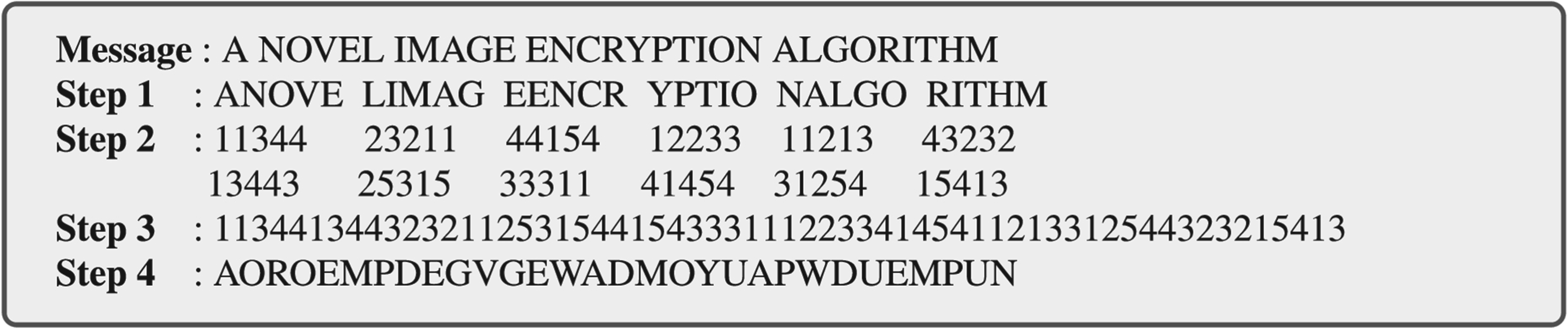
An illustration of text encryption using Bifid cipher.
Arnold map
1
has been extensively applied for encrypting and decrypting the image data. For an image having size 
Arnold map period (

The designed scheme has a substitution-permutation structure consisting of two phases, where each phase uses application of Bifid cipher as the substitution layer and Arnold map as the diffusion layer.

Procedure for updating Bifid key with plain image data.
To apply 2D-Bifid cipher for images, the traditional way of encrypting a plaintext in English is extended to function on the image pixels, which range from 0 to 255. Further, to strengthen the security of the Bifid ciphering process on images, and resistance against cryptanalytical attacks, the method is proposed to be implemented in cipher chaining mode so that it incorporates high sensitivity of keys and their arrangements.
A gray-level image or each color components (i.e., red, green and blue) of a color image can be represented using a 2D-matrix having values from 0 to 255. Thus, to extend the Bifid cipher for images, the Bifid key square or Bifid key (say 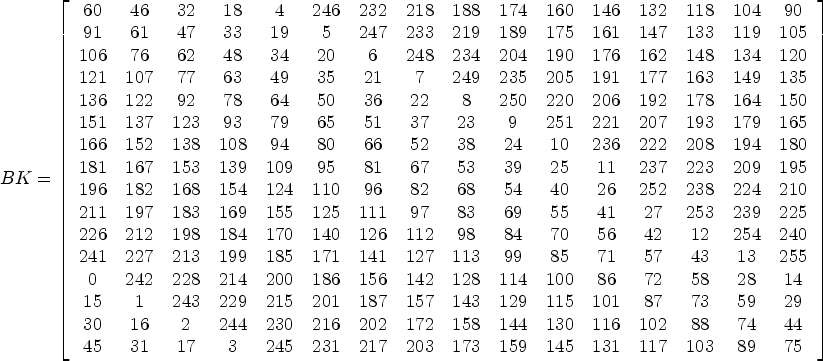
Further, to introduce the security against attack based on plaintext-ciphertext pairs, Bifid key is updated with values derived from the plain data, i.e., the hash of plain data. The procedure to update the Bifid key is depicted in Figure 2. First, the n-bytes hash digest of plain data (image) is calculated by a cryptographic hash method. The hash digest is used to update the Bifid key using substitution and permutation operations performed for each byte of the hash value. In substitution operation, each value of Bifid key is substituted with another value obtained by XORing it with the hash byte X. This is followed by permuting the values of Bifid key square using Arnold map with iteration number determined by three LSB bits of byte X added with some constant (added to avoid non-zero iteration number).
The updated Bifid key functions as secret key while encrypting and decrypting the data. The encryption and decryption procedure using Bifid cipher are termed as Bifid Cipher Image Encryption (BCIE) and Bifid Cipher Image Decryption (BCID), respectively. BCIE is proposed as follows.
Updated Bifid key
Encrypted image C.
Choose the first order to read pixels from input image P, i.e.,
Once
Choose an
Start reading row/ column from image matrix P depending upon order
For each read row/ column, say having pixel values
For each pixel 
Construct a sequence of numbers by reading the written coordinates (Eq. (2)) from left-to-right such that top row is followed by bottom row, i.e.,

From the sequence (Eq. (3)), read the numbers in non-overlapping pairs from left-to-right, and encrypt each pair of numbers 
Repeat Step 5 until all the rows/ columns are encrypted
Adopting the reverse procedure (BCID), the decrypted version of the image C can be obtained. The procedure can be detailed as below.
Decrypted image P.
Read row/ column from C depending upon order
For each read row/ column, say having pixel values
Obtain
For each 
From the sequence (Eq. (5)), obtain the decrypted value 
Repeat Step 3 until all the rows/ columns are decrypted
The encryption orders
For encrypting and decrypting the images of any size, a block-based approach is considered for encryption and decryption using Arnold map.
For an image (say of size
Let
Fig. 3(a) and Fig. 3(b) illustrate the proposed block-based method for encrypting and decrypting the images by Arnold map, called as AMIE and AMID, respectively. Decryption process can be performed assuming the inverse-Arnold map.
Combined scheme for images using Bifid cipher and Arnold map
The scheme is proposed to operate in two phases to have good confusion and diffusion of data using the procedure defined based on Bifid cipher and Arnold map. In each phase, the Bifid cipher operations are followed by the Arnold map processing. Fig. 4(a) and Fig. 4(b) depict proposed encryption and decryption method for images using Bifid cipher and Arnold map, termed as BCAMIE and BCAMID, respectively. In each phase, different set of key parameters for processing by Bifid cipher and Arnold map can be selected.
To encrypt any color image by the proposed scheme, first it is decomposed into different color channels (Red, Green and Blue). Further, each channel is encrypted or decrypted by applying the designed encryption (BCAMIE)/ decryption (BCAMID) procedure. Subsequently, encrypted/ decrypted color channels are merged together to arrive the encrypted/ decrypted image.
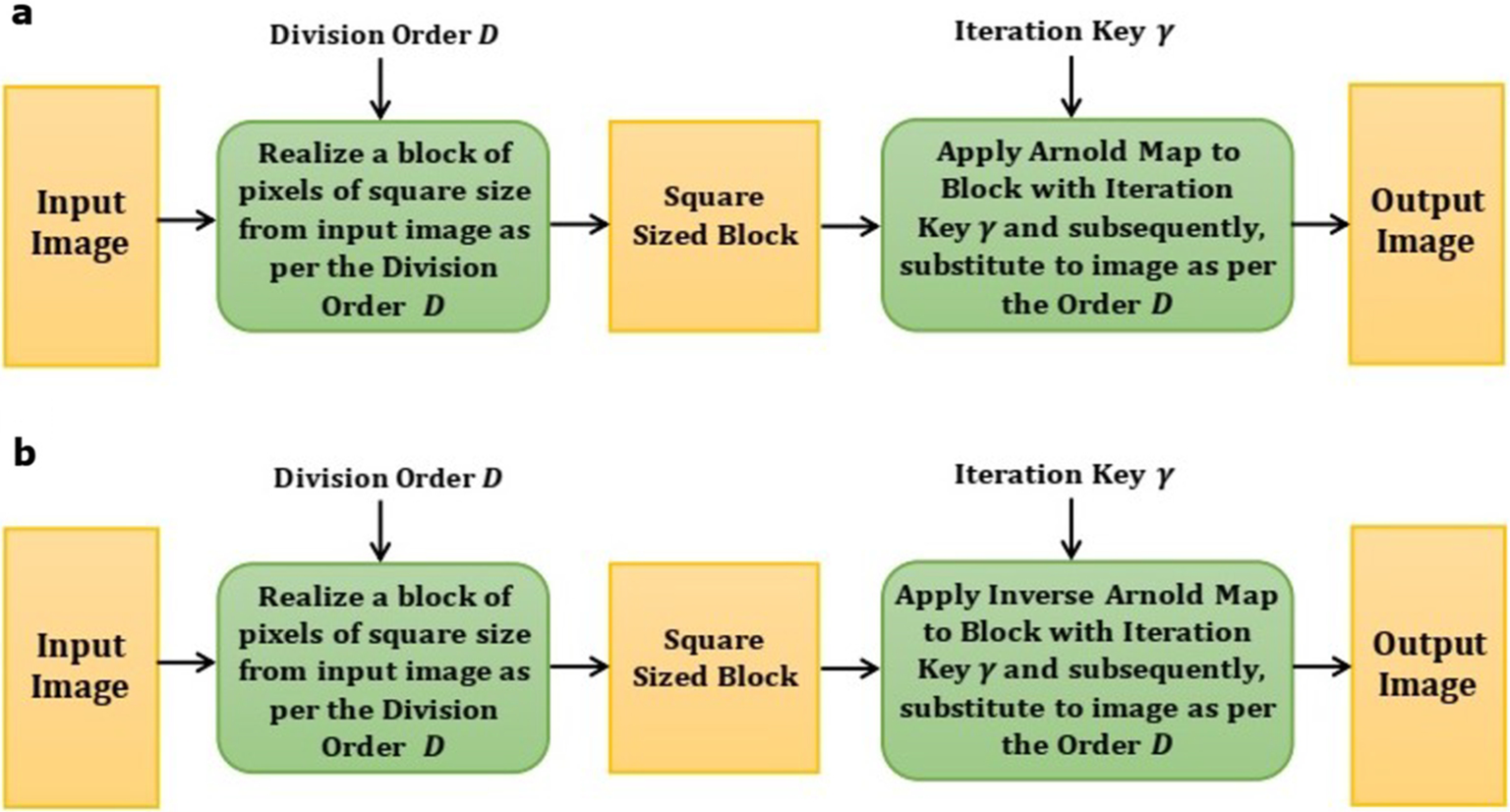
Block-based method for images with Arnold map:

Layout of the proposed method:

Simulation results: (a) original image; (b) ciphered image; (c) image decrypted using accurate keys and accurate orders; (d) image decrypted with inaccurate Bifid key (approximated) ; (e) image decrypted with inaccurate order
To verify and demonstrate the functional ability of the proposed scheme, the experiments are conducted, and results are obtained for an image of size
For the encryption and decryption by the Bifid cipher, same Bifid key is used in both phases 1 and 2. In phase 1, Bifid cipher is applied using
The encrypted image, obtained after applying the proposed method with the chosen key parameters, is presented in Fig. 5(b). Fig. 5(c) represents an image decrypted using all accurate keys and accurate orders in both phase 1 and 2. Figs. 5(d)–5(l) show the images obtained with all accurate keys and accurate orders except one, i.e., either wrong key or wrong order in either of phases. The given simulation results show that accurate keys with accurate orders during decryption enable the original image retrieval. Whenever, there is little change for accurate keys or accurate orders while decrypting, a totally meaningless and dissimilar image is obtained revealing no information about the original one.
To analyse the encryption results furthermore, the certain statistical measures such as Mean Square Error (MSE), Structural Similarity Index (SSIM), Peak Signal to Noise Ratio (PSNR) and correlation are calculated between the original image and its encrypted version. These results are obtained for 25 number of images from USC-SIPI database as shown in Table 3. The results indicate the higher MSE, low PSNR, low SSIM and negligible correlation with average values of MSE, PSNR, SSIM and correlation as 9388, 8.71, 0.036 and −0.0007, respectively. Whereas, the values of MSE, PSNR, SSIM and correlation are found as 0, ∞, 1 and 1, when calculated between any original image and its decrypted version. This evidents that the encrypted image largely dissimilars from the original image and the realization of statistical relationship between both is difficult, whereas the decrypted image is perfectly obtained without any loss of original information.
Simulation results for standard images.
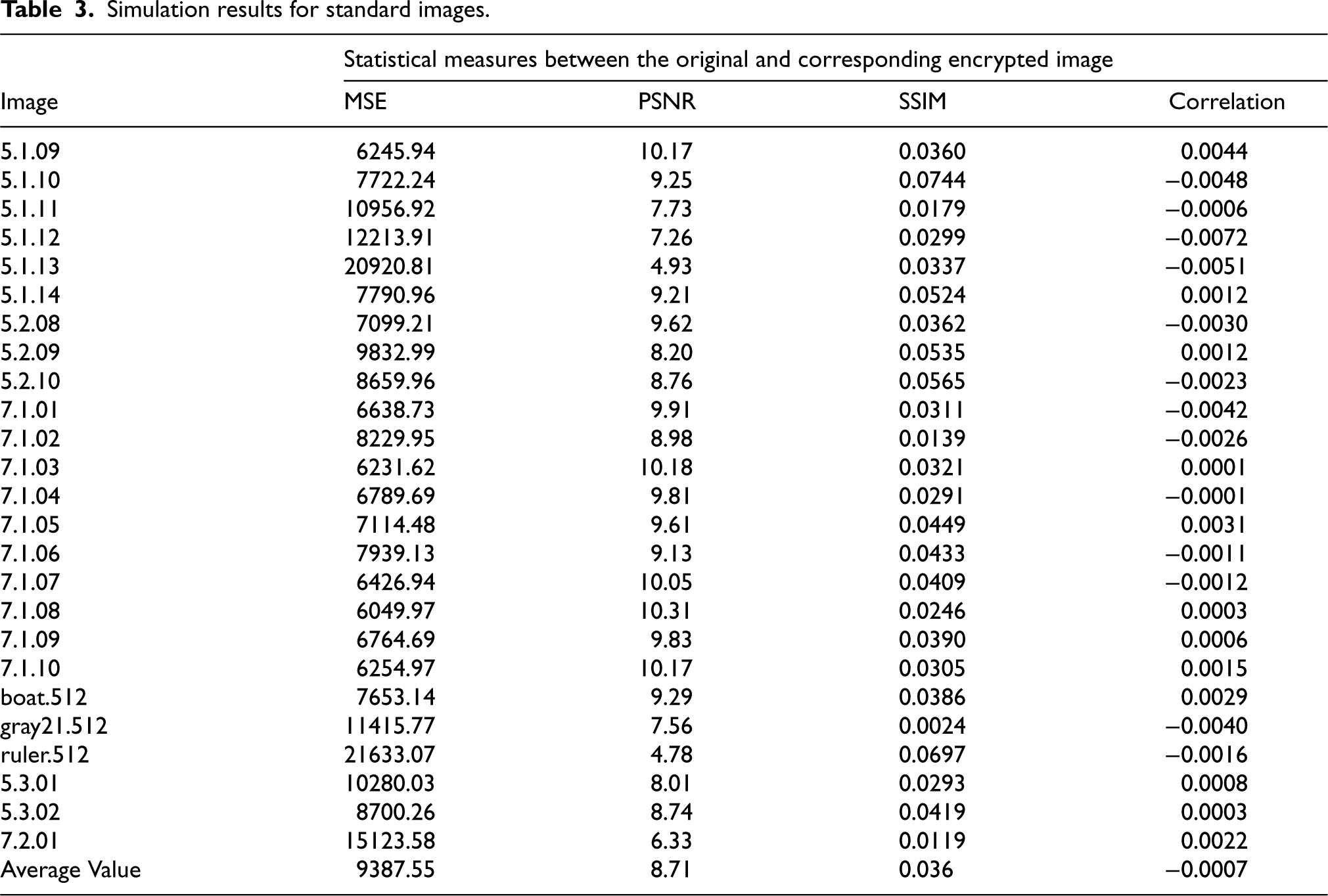
Simulation results for standard images.
In this section, the several results are presented as obtained while evaluating functionality and security of the designed scheme.
Histogram and correlation analysis.
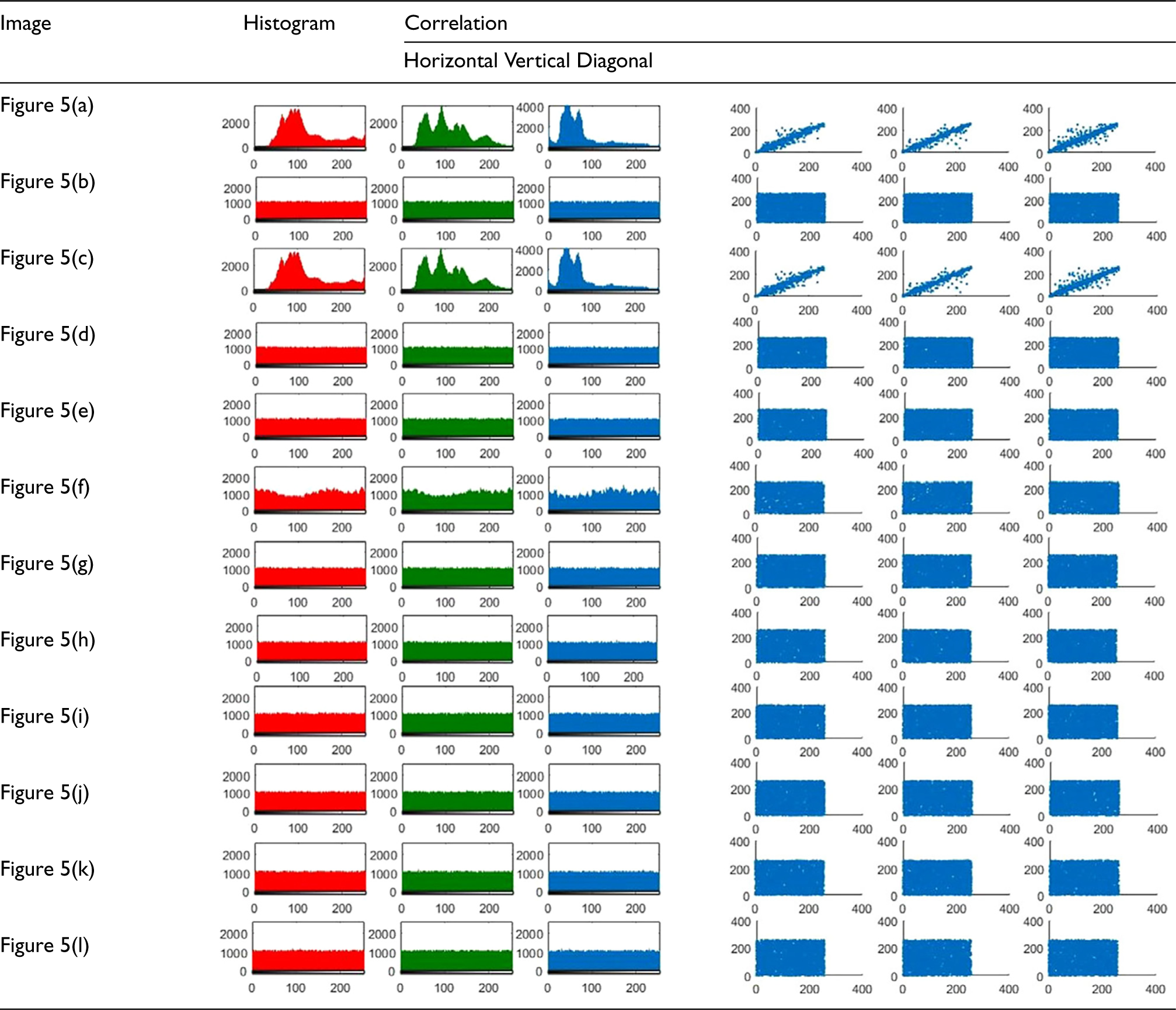
Histogram and correlation analysis.
For an ideal image encryption algorithm, it must have attribute to disseminate the statistical relationship of input image, and obtain the ciphertext image with uniformly distributed histograms. The capability of the designed scheme is first measured as regards to finding the histogram distribution. For color channels (Red, Green and Blue) of images shown in Fig. 5, histogram is shown in Table 4. Compared to the histogram of original image (Fig. 5(a)), histograms of the enciphered one (Fig. 5(b)) and the images decrypted with inaccurate keys or inaccurate orders (Figs. 5(d)–5(l)) appear uniformly distributed, thus, indicating the proposed scheme’s ability to uniformly disseminate the distribution of the original image pixels.
value, variance of histogram, and correlation coefficient in the proposed scheme.

Further, unilateral hypothesis
26
and variance
24
are adopted to quantitatively measure the histogram distribution. For a gray-level image of size 
Analyzing a scheme opposed to attacks based on correlation study is important as the scheme must have characteristics to effectively eliminate the correlation of adjoining pixels. The coefficient of correlation between two pixel sequences P and Q can be calculated as

In analysing the proposed scheme, 3000 random pairs of adjoining pixels in each, i.e., horizontal, diagonal and vertical directions, are selected to find correlation coefficient as well as to plot the distribution of adjacent pixels. Table 4 shows the pixel intensity distribution for the images in Fig. 5. The images decrypted without accurate keys or orders and the encrypted image attain the uniform distribution of adjoining pixels in horizontal, diagonal and vertical directions. Further, the correlation coefficient for the encrypted images, corresponding to 25 images from USC-SIPI database, are calculated as given in Table 5. These correlation coefficients are observed very close to 0 in all three directions. Thus, the designed scheme is extremely functional in dissipating redundancy and relationship of plain image pixels, and strongly secures against correlation-based analysis.
Entropy
18
is an efficient estimate for randomness of any encryption system, which is to be calculated as

Entropy analysis of the images in Fig. 5 is conducted and outcomes are presented in Table 11. It is found that the values of entropy in decrypted images (Figs. 5(d)–5(l)) without accurate keys or accurate orders and the encrypted image (Fig. 5(b)) are close to 8. Furthermore, to study the proposed scheme against entropy, 25 images from USC-SIPI database are selected and entropy values are calculated corresponding to their encrypted versions as listed in Table 7. These values are again found very close to 8. Thus, it indicates that the proposed scheme successfully provides a high global randomness in the cipher images. The comparison among entropy values in related schemes is given in Table 6.
Global entropy provides a good estimate for overall randomness of the data. In,
25
to better capture the randomness, a new measure known as local Shannon entropy (

Following recommendations,
25
the designed scheme is studied for
Comparison of entropy in related schemes.

Local entropy comparison between ref.[14] and the proposed scheme.

In differential analysis, an attacker attempts to break an encryption scheme by analyzing the different cipher images obtained by plain images which differ very slightly. A good image encryption scheme must have resistance to differential analysis, which can be measured typically by Unified Average Change Intensity (

In,
24
Wu recommended to evaluate the critical values of
Critical values of

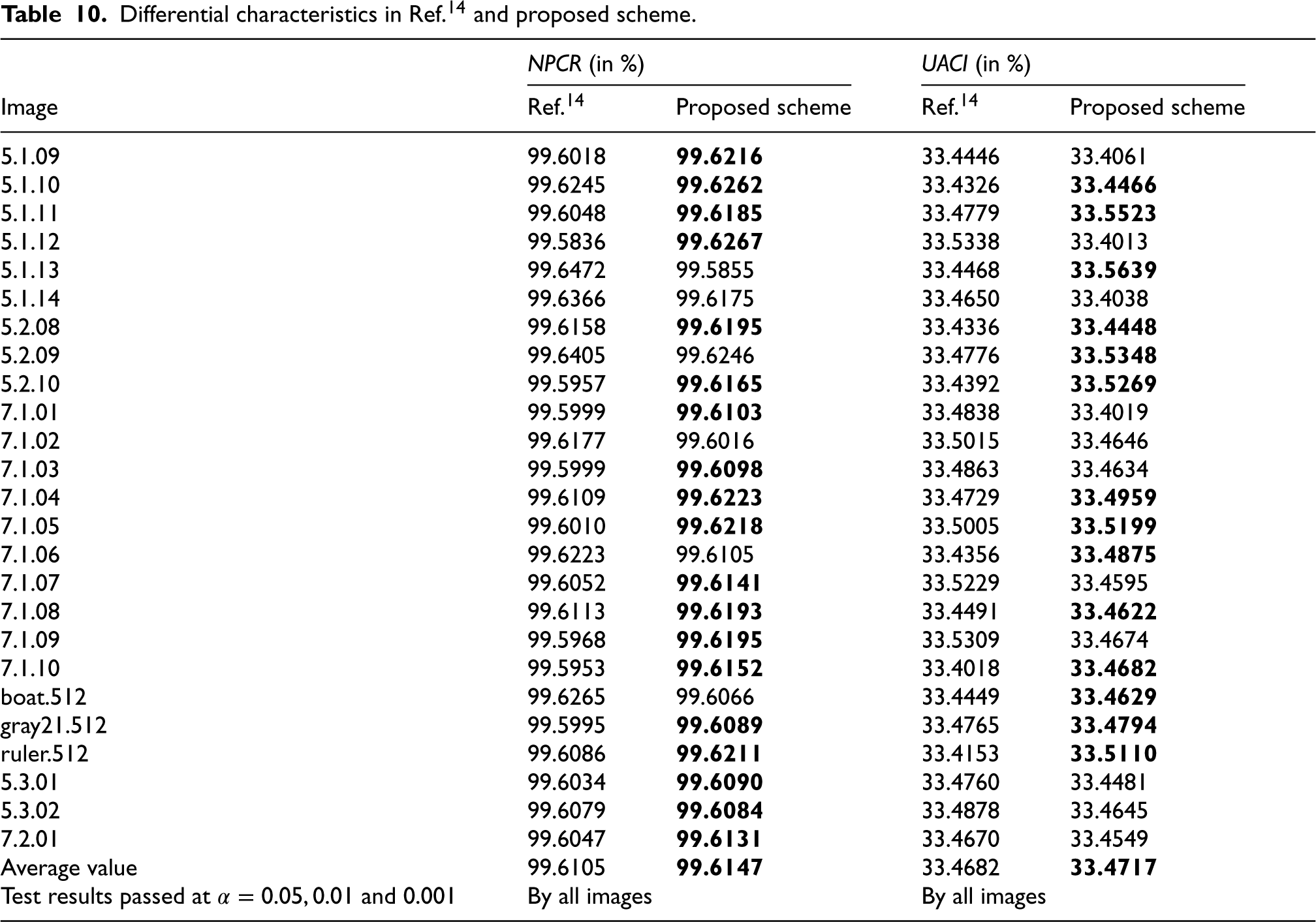
To evaluate the proposed scheme against differential analysis,

Differential characteristics in Ref. 14 and proposed scheme.

Noise and cropping analysis experiments: (a) input image; (b) cipher image; (c) image decrypted under 10% Salt and pepper noise; (d) image decrypted under 5% Salt and pepper noise; (e) image decrypted under 1% Salt and pepper noise; (f) encrypted image 25% cropped at top-left corner; (g) encrypted image 25% cropped at top-right corner; (h) encrypted image 25% cropped at bottom-right corner; (i) encrypted image 25% cropped at bottom-left corner; (j) encrypted image 25% cropped at center; (k) encrypted image 25% cropped at multiple places; (l) image decrypted for Fig. 6(f); (m) image decrypted for Fig. 6(g); (n) image decrypted for Fig. 6(h); (o) image decrypted for Fig. 6(i); (p) image decrypted for Fig. 6(j); (q) image decrypted for Fig. 6(k).
It is imperative to analyse an image encryption scheme against noise and data loss attacks as an attacker may crop or add some noise to the encrypted images during transmission of these over an insecure channel. Thus, the performance of designed scheme is tested against cropping and noise-based attacks.
First, in analysing for noise-based attack, the encrypted image (Fig. 6(b)) is incorporated with Salt and pepper noise for noise intensities 0.01, 0.05, and 0.1. The noise incorporated encrypted image is decrypted using accurate keys and accurate orders as shown in Fig. 6. The designed scheme well resists the noise-based attack as the plain image (Fig. 6(a)) is easily identifiable from the images (Figs. 6(c)–6(e)), thus, demonstrating the good security against noise-based attack.
Secondly, in experimenting for data loss analysis, the encrypted image is cropped with
For a cryptographic scheme, key sensitivity parts the most essential characteristics of the scheme. Statistical estimators such as entropy, correlation coefficient, MSE, histogram and PSNR are adopted to analyse key sensitivity in the designed scheme.
In the simulation results presented in Section 4, the different images (Figs. 5(d)–5(l)) are obtained by decrypting the encrypted images after choosing inaccurate keys or inaccurate orders, which are approximated very near to the accurate one. It can be easily noticed that these images appear meaningless and visually reveal no original information. In Table 4, uniform distribution of the histogram as well as intensity distribution of adjoining pixels confirm high key sensitivity in the designed scheme. Further, the results calculated for MSE, PSNR, correlation and entropy for the images (Figs. 5(d)–5(l)) are presented in Table 11. Decrypted versions with slightly approximation in keys orders have high MSE, low PSNR, entropy close to 8, and negligible correlation of adjacent pixels. The obtained results indicate negligible possibilities for statistical analysis. Thus, the designed scheme observes great sensitivity to the accurate keys as well as accurate orders making it more secure and computationally hard for an adversary to attack.
MSE, PSNR, correlation coefficient, and entropy for demonstration in Section 4.
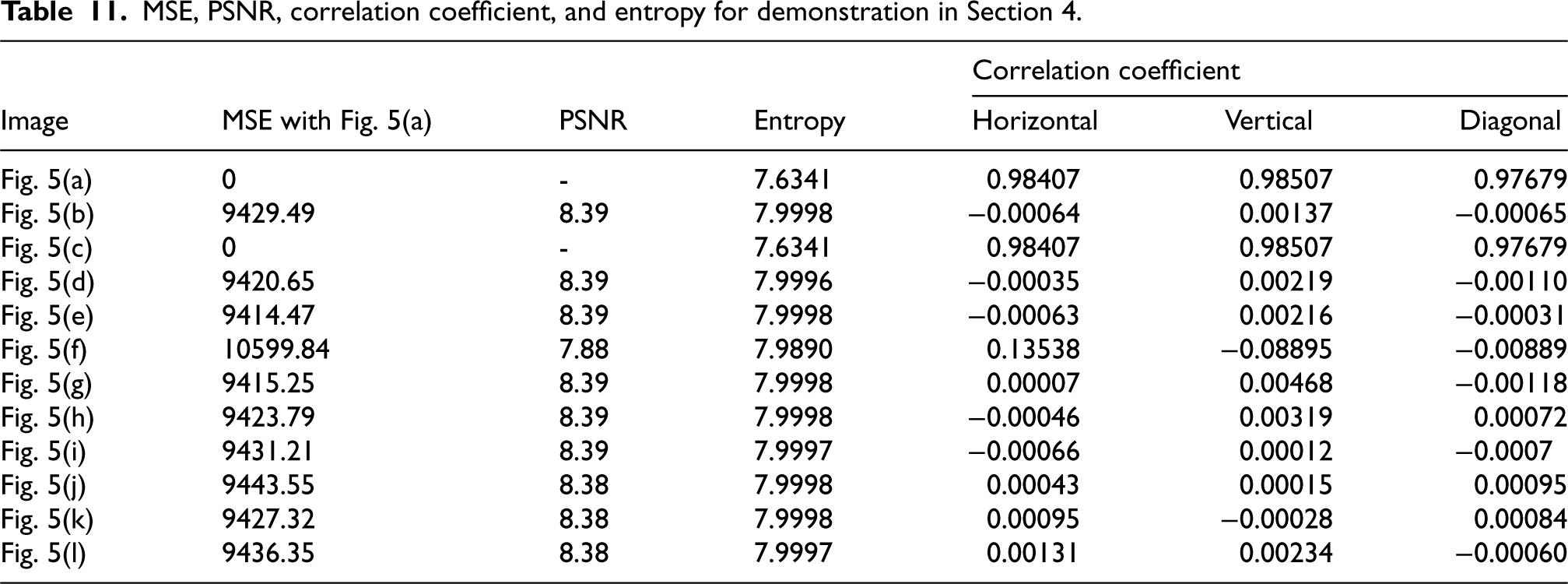
MSE, PSNR, correlation coefficient, and entropy for demonstration in Section 4.
The collection of all feasible keys in a cryptosystem, referred as key space, is expected to be sufficiently big so that brute force analysis could not be possible. The designed scheme is composed of two phases, where each phase has combination of operations based on Bifid cipher and Arnold map.
In Bifid cipher-based operations, the Bifid key of size
In Arnold map-based scheme, the iteration number
Accordingly in the designed scheme, the total possible keys can be approximated to
Time complexity
As the designed scheme is a combination of operations based on Bifid cipher and Arnold map, the time complexity of Bifid cipher and Arnold map-based encryption operations are to be first analyzed, individually for arriving the total time complexity of the designed scheme.
In the operations based on Bifid cipher, the encryption of pixels executes mainly subject to lookup operations performed twice. In the first occasion, a sequence of numbers is established by looking the positions (coordinates) of the image pixels (say, image size
In Arnold map-based encryption function, the pixels in a square block of size

Hence, determination of the transportation has complexity similar to the complexity of multiplication of a
Accordingly, the encryption process time complexity in the designed scheme computes to
Further, three standard color images, varying in sizes from USC-SIPI database, are chosen for computing the running speed of the encryption process. To obtain the results, the scheme is implemented using Java on a desktop PC having Core i5 processor and 4 GB RAM. The running speed corresponding to each chosen image is obtained for complete process, which involves first decomposition of the image into color channels (Red, Green and Blue), and then encrypting each channel followed by combining each encrypted channel into the final encrypted image. Table 12 lists the encryption running time (in seconds) for the selected images. The proposed scheme is found to have a good running speed, which grows linearly with image size.
The encryption process running time (unit: second).

In cryptanalyzing the ciphered data, the objective of adversary is to infer the secret key or plain data, generally, by working around either the brute force attack or common attack models like ciphertext only attack (COA), chosen plaintext attack (CPA), known plaintext attack (KPA), chosen ciphertext attack (CCA). COA assumes the most difficult one, where adversary has to look for algorithm level weakness or trying with brute force attack. In brute force attack, an enemy has to try for half of size of key space on average. The enormous sized key space in the designed scheme eliminates the possibilities of brute force attack and COA.
Under CPA, KPA and CCA, an enemy works with numerous pairs of plaintext and ciphertext to infer the secret key or to obtain plaintext for ciphertext generated with same key. The measures adopted in the design of the proposed scheme can confirm its security against CPA, KPA and CCA.
The Bifid key is updated with hash digest of the plain image prior to its use in the encryption function. Thus, choosing a collision resistant hash function, it is computationally infeasible to get the same updated Bifid key for two different plain images even varying very slightly. Size of block in Arnold map-based function, and further, iteration numbers depending upon the size of plain image. Bifid cipher-based function applied in Cipher chaining mode inducing the affect of pixels in encryption of each other. Accurate decryption process is designed to have sensitivity not only to accurate keys but to accurate orders also.
Thus, considering the aforesaid facts, the designed scheme can be considered secure enough withstanding to brute force and plaintext-ciphertext pairs-based attacks.
To furthermore verify the security against cryptanalytical attacks, four plain images are chosen as shown in Fig. 7. Each plain image has high data redundancy, i.e., consists almost similar pixels. Further, all plain images differ very slightly from each other. Second plain image differs from first image by one pixel, i.e., pixel value at location

Cryptanalytical attack simulations: (a) first plain image; (b) second plain image; (c) third plain image; (d) fourth plain image; (e) first encrypted image ; (f) second encrypted image ; (g) third encrypted image ; (h) fourth encrypted image.
Experimental results for cryptanalytical attacks.

The designed scheme comparison with the related works.
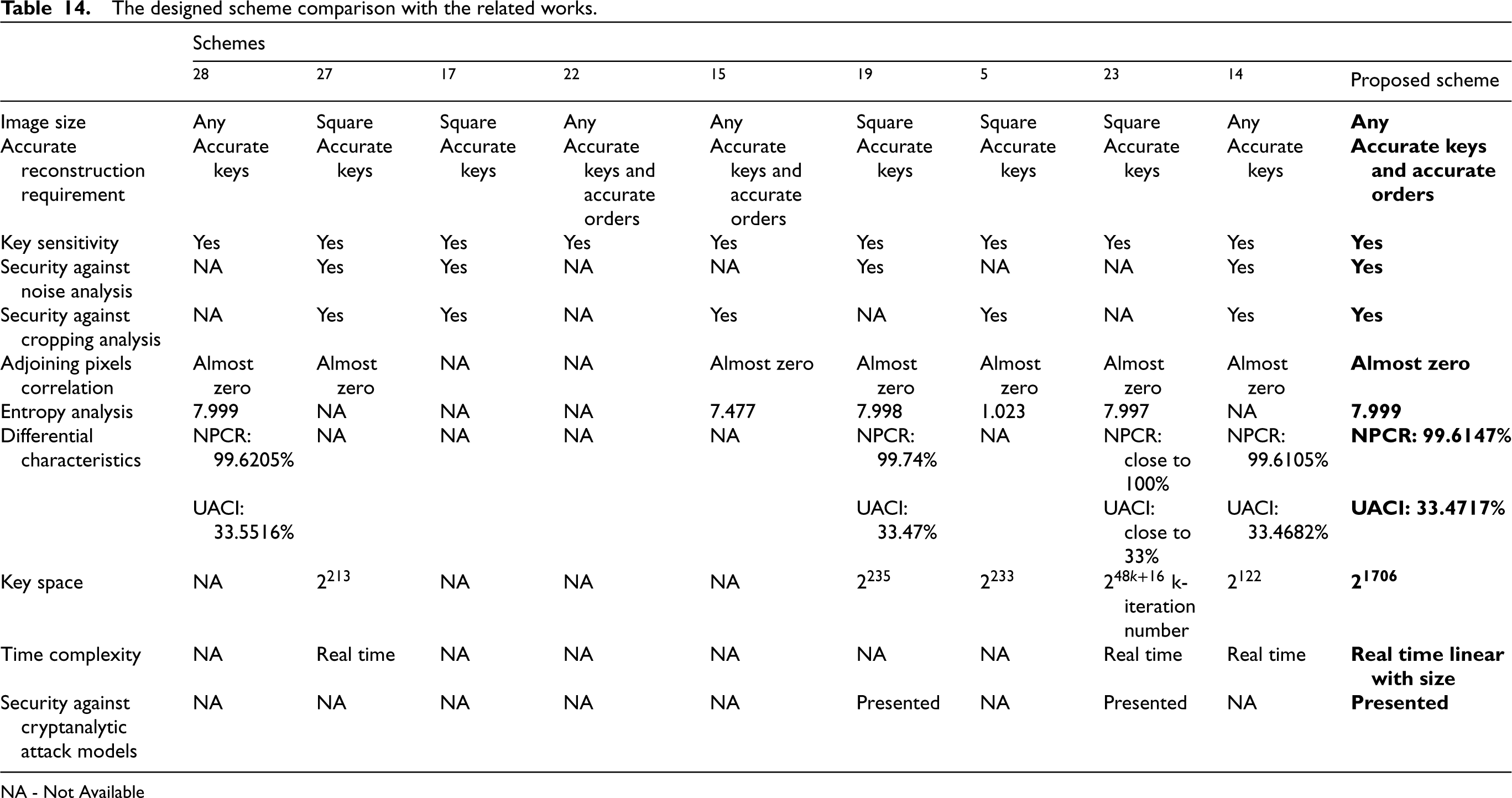
NA - Not Available
The efficacy of the designed scheme is further evaluated by conducting the comparative study5,14,15,17,19,22,23,27,28 for numerous functionality and security parameters. The results as listed for the corresponding schemes are considered and presented for comparative study.
The designed scheme has no limitation to image size, whereas the schemes5,17,19,23,27 are limited to only square-sized images. In comparison to,5,14,17,19,23,27,28 the proposed scheme improves for key sensitivity and accurate decryption requirements as not specific to accurate keys but also to accurate orders. The proposed scheme has good performance under the noise and cropping attacks, whereas the schemes5,15,22,23,28 and19,22,23,28 lack in providing the performance under noise and cropping attacks, respectively. The presented scheme effectively eliminates the adjoining pixels correlation and data redundancy while the schemes17,22 do not evaluate it.
The proposed scheme achieves ideal values of local as well as global entropy for enciphered data. The entropy values comparison among the related works is presented in Table 6. The schemes14,17,22,27 and5,15,17,19,22,23,27,28 do not evaluate for entropy and local entropy, respectively. Mansouri and Wang’s scheme
14
is found to have evaluation with respect to local entropy. The local entropy values in the presented scheme, and Mansouri and Wang’s scheme are compared in Table 7. The proposed scheme withstands to Mansouri and Wang’s scheme in passing all the tests for local entropy, and further achieving the better average value for local entropy. The proposed scheme also achieves good differential characteristics as evaluated against the
In,15,17,22,28 the schemes do not approximate and present their size of key space, i.e., number of all possible keys. Compared to the presented schemes,5,14,19,23,27 the designed scheme advantages in providing an enormous-sized key space. Further, the presented scheme gets its speed validation in both theoretical and practical sense, whereas none of the related schemes found to have analyzed their scheme for theoretical time complexity. Whereas, the schemes5,15,17,19,22,28 even do not evaluate and present the results for their running speed. Similar to the presented schemes, the designed scheme obtains a real-time encryption speed with linear dependency to size of input image. Further, the proposed scheme has security validation against the common cryptanalytical attacks, i.e., based on brute force and assumption of plaintext and ciphertext pairs. The schemes presented in,5,14,15,17,22,27,28 lack their security validation against the common cryptanalytical attacks.
The comparative study among the designed and related works is listed in Table 14. In the designed scheme, an extensive validation of its performance and security is provided. The proposed scheme achieves great performance and provides very good security. The proposed scheme is found greatly close as well as outperforming to the allied works.
Conclusion
In this study, two primitives, Bifid cipher and Arnold map, are combined together in substitution-permutation design to arrive an image data security method. Traditional 2D-Bifid cipher is extended to work on image data with additional security settings, and further, associated with block-based procedure using Arnold map. The scheme is designed to have higher sensitivity not only to keys but to their orders also. Several simulation results are conducted to confirm the functionality and security of the presented scheme. The designed scheme is found to have good randomness, local as well as global, strong differential characteristics, uniformly distributing encrypted pixels, negligible correlation of adjacent encrypted pixels, data loss and noise resistance, good running speed, and a huge key space with resistance against brute force and cryptanalytical attack models. Further, the proposed method positions well to the related works. The proposed scheme has application in securing the image data pertaining to areas such as medical science, aerospace network, secure web browsing, satellite communication, military communication, remote sensing, securing personal photos, wireless sensor network etc.