



Abstract
Call Admission Control (CAC) is one of the resource management functions which regulates network access to ensure QoS provisioning. However, the decision for CAC is very challenging issue due to user mobility, limited radio spectrum and multimedia traffic characteristics. Several schemes have been proposed for CAC in wireless cellular networks. However, during to the complexity of CAC in wireless environment, many simplified models and assumptions are made. Some schemes consider that each mobile node will make hand-over to neighbouring cells with equal probability, which may be not accurate in general. For this reason, the intelligent and heuristic methods are needed. We proposed a fuzzy-based CAC system by considering the priority of the on-going connections. We called this system FACS-P. In FACS-P, as priority parameter, we considered only one parameter (service request). We extended our work by adding different priorities. We call this system FACS-MP. In this paper, we evaluate by simulations the performance of the proposed system. From the simulation results, we conclude that the FACS-MP makes a good differentiation of different services and has better behaviour than FACS-P.
Introduction
As the demand for multimedia services over the air has been steadily increasing over the last few years, wireless multimedia networks have been a very active research area [10,19]. The Call Admission Control (CAC) is a good strategy to support various integrated services with certain Quality of Service (QoS) requirements. The CAC is a provisioning strategy that limits the number of connections into the network in order to reduce the network congestion and call dropping.
In cellular wireless networks when the mobile node moves from one cell to another one, the bandwidth must be requested in the new cell. During this process, the call may not be able to get a channel in the new cell due to the limited resource, which will lead to the call dropping. Thus, the new and handoff calls have to be treated differently in terms of resource allocation.
Since users are much more sensitive to call dropping than to call blocking, the handoff calls are assigned higher priority than new calls [23].
CAC techniques are required to guarantee QoS requirements for all traffic types. CAC is based on the knowledge of the statistical characteristics of on-going and arriving calls. The decision to accept an additional call involves the calculation or estimation of the consequences of the call acceptance on blocking and delay of itself and other incoming calls.
Several schemes have been proposed for CAC in wireless cellular networks. However, during the complexity of CAC in wireless environment, many simplified models and assumptions are made. Some schemes consider that each mobile node will make hand-over to neighbouring cells with equal probability, which may be not accurate in general. For this reason, the intelligent and heuristic methods are needed.
Use of intelligent methods based on Fuzzy Logic (FL), Neural Networks (NN) and Genetic Algorithms (GA) can prove to be efficient for traffic control in telecommunication networks [1,3–7,11,13,14,18,20–22].
In [2], in order to deal with CAC in wireless cellular networks, we proposed a CAC scheme based on FL. We implemented and evaluated the proposed system by comparing its performance with Shadow Cluster Concept (SCC) [15].
In [16,17], we proposed another FL-based CAC scheme by considering the priority of the on-going connections. However, as priority parameter, we considered only one parameter (service request). We called this system FACS-P. In [12], we extend our work by adding different priorities. We called this system: Fuzzy Admission Control System with Many Priorities (FACS-MP).
In this paper, we evaluate by simulations FACS-MP and compare its performance with FACS-P. From the simulation results, we found that the FACS-MP make a good differentiation of different services and has better performance than FACS-P.
The structure of this paper is as follows. In Section 2, we present the previous work. In Section 3, we introduce FACS-MP. In Section 4, we discuss the simulation results. Finally, some conclusions are given in Section 5.
Previous work
SCC
One of the previous work on CAC is SCC [15]. The fundamental idea of the SCC is that every mobile terminal with an active wireless connection exerts an influence upon the cells (and their BSs) in the vicinity of its current location and along its direction of travel. As an active mobile terminal travels to other cells, the region of influence also moves, following the active mobile terminal to its new location. The BSs (and their cells) currently being influenced are said to form a shadow cluster, because the region of influence follows the movements of the active mobile terminal like a shadow, as shown in Fig. 1.
The shadow is strongest near the active mobile terminal, and fades away depending on factors such as the distance to the mobile terminal, current call holding time and priority, bandwidth resources being used, and the mobile terminal’s trajectory and velocity. Because of these factors, the shape of a shadow cluster is usually not circular and can change over time. The center of a shadow cluster is not the geometric center of the area described by the shadow, but the cell where the mobile terminal is currently located. This cell is considered as the mobile terminal’s current home cell. A bordering neighbour is a cell that shares a common border with the shadow cluster’s center cell.
Conceptually, the number and “darkness” of the shadows covering a cell reflect the amount of resources that the cell’s BS needs to reserve in order to support the active mobile terminals currently in its own and in neighbouring cells. With the information provided by shadow clusters, BSs can determine, for each new call request, whether the request can be supported by the wireless network. In practice, a shadow cluster is a virtual message system where BSs share probabilistic information with their neighbours on the likelihood that their active mobile terminals will move to neighbour cells (while remaining active) in the near future. With the information provided by shadow clusters, BSs project future demands and reserve resources accordingly. BSs reserve resources by denying network access to new call requests, and by “waiting” for active users to end their calls.
The decision process for the acceptance of a new call request also involves a shadow cluster. Every new call request results in the implementation of a tentative shadow cluster. BSs exchange information on their new call requests, and decide, based on this and other information, which requests should be accepted and which requests should be denied.
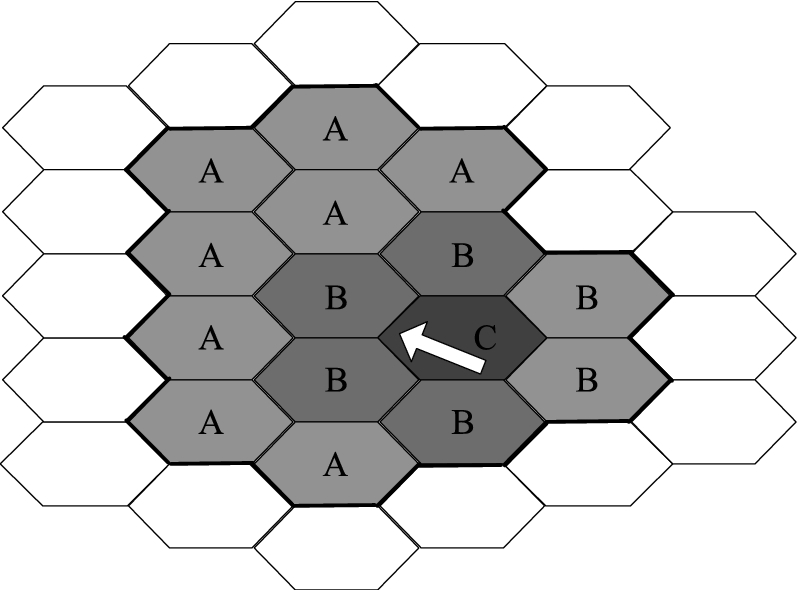
SCC.
In our previous work, in order to deal with CAC in wireless cellular networks, we proposed a CAC scheme based on FL [2]. Conventional CAC schemes for wireless networks must consider some measured parameters to make the decision. However, in wireless networks due to the user mobility and varying of channel condition the measurement obtained are not accurate. Also, it is very difficult to obtain the complete statistics of the input traffic. Therefore, the CAC decision must be made based on the uncertain or inaccurate information. This is why we use FL. We implemented and evaluated the proposed system by comparing its performance with Shadow Cluster Concept (SCC) [15]. We showed that the proposed scheme could achieve a better prediction of the user behavior and a good admission decision compared with SCC.
In [16,17], we proposed another FL-based CAC system called FACS-P, which considered the following parameters for acceptance decision: user Speed (
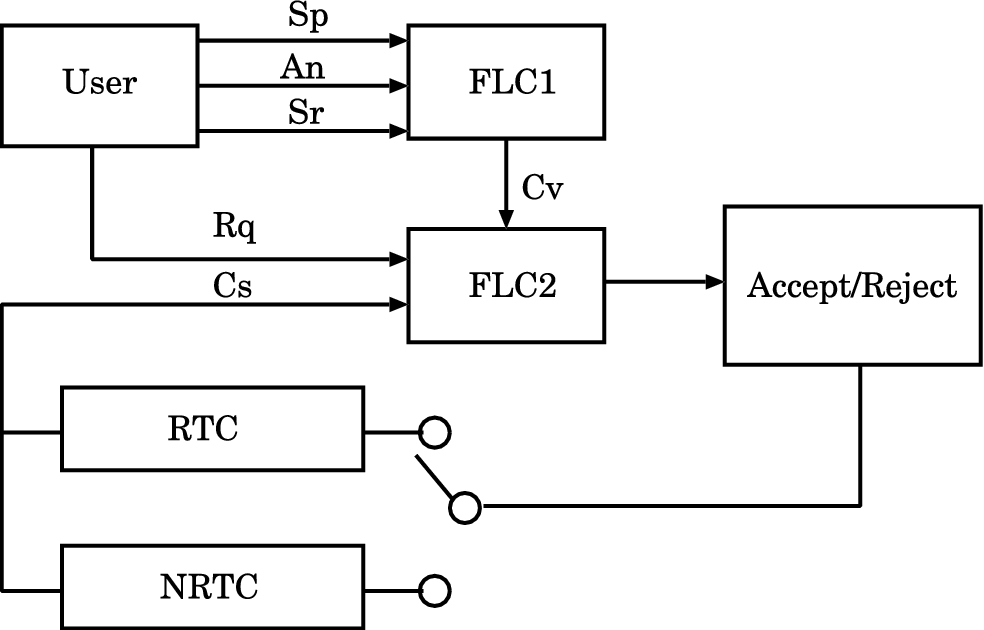
FACS-P model.
In our previous work, we found that when using only one parameter for the priority, the FCAC-P system did not differentiate well different services. For this reason, in the new implemented system FACS-MP, we consider different priorities during the CAC decision.
The Fuzzy Logic Controller (FLC) is the main part of FACS-MP and its basic elements are shown in Fig. 3. They are the fuzzifier, inference engine, Fuzzy Rule Base (FRB) and defuzzifier. As membership functions, we use triangular and trapezoidal membership functions because they are suitable for real-time operation [8,9]. The membership functions are shown in Fig. 4.

FLC structure.
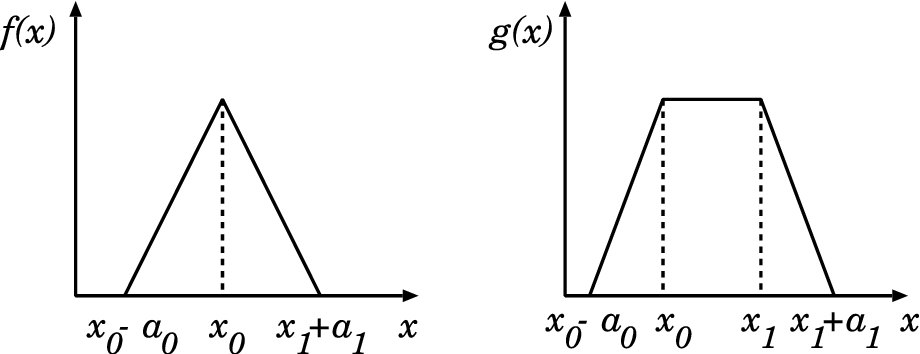
Triangular and trapezoidal membership functions.
The proposed FACS-MP considers the following parameters for acceptance decision: user Speed (S), user Angle (A), Correction value (

FACS-MP model.
The input parameters for FLC1 are: user Speed (S) and user Angle (A), while the output linguistic parameter is Correction value (
The membership functions for input parameters of FLC1 are defined as follows:
The term set of the output linguistic parameter
The membership functions for the output parameter
FRB1
FRB1

FLC1 membership functions.
The input parameters for FLC2 are: User priority (
The term set of the output linguistic parameter
The membership functions for the output parameter P are defined as follows:
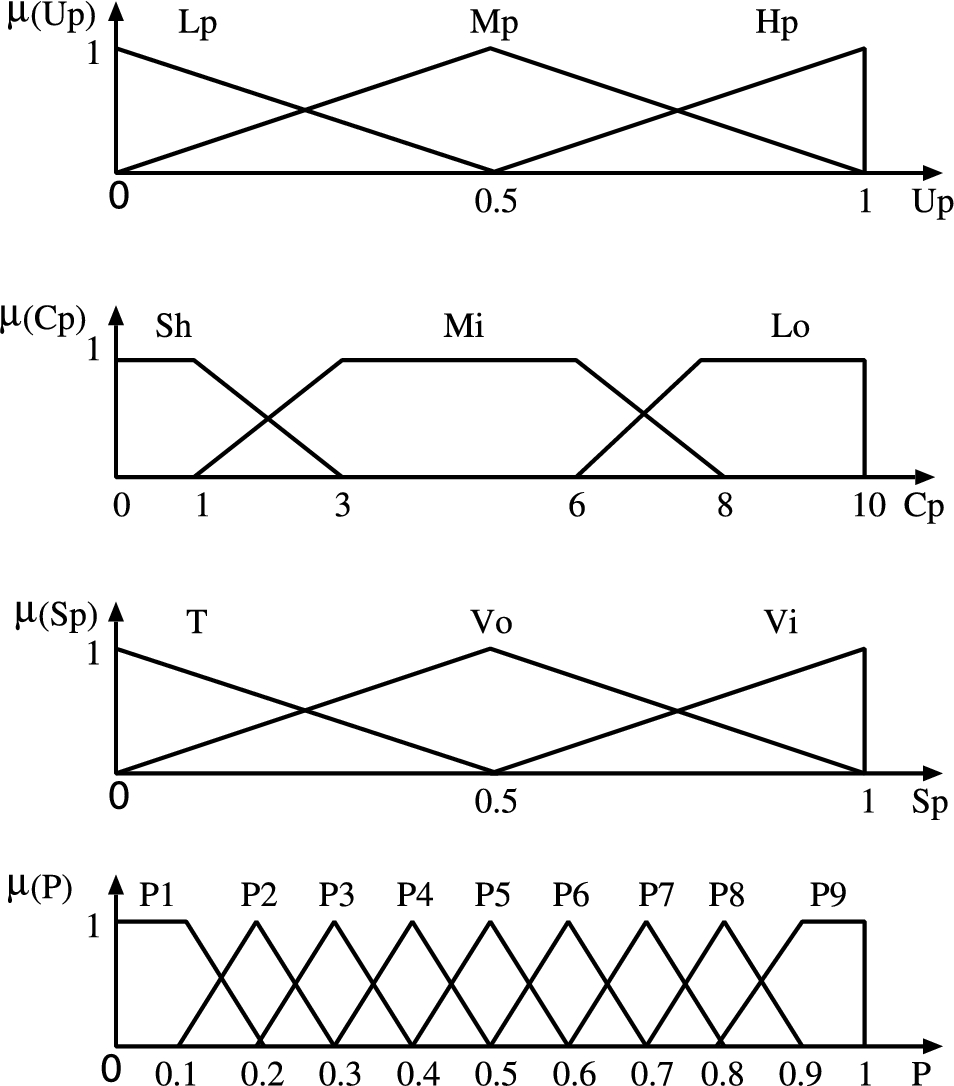
FLC2 membership functions.
The input parameters for FLC3 are: the output parameter of the FLC1 (
The term sets of
In order to have a soft admission decision, for the output linguistic parameter (
The membership functions for input parameters of FLC3 are defined as follows:
FRB3
FRB3
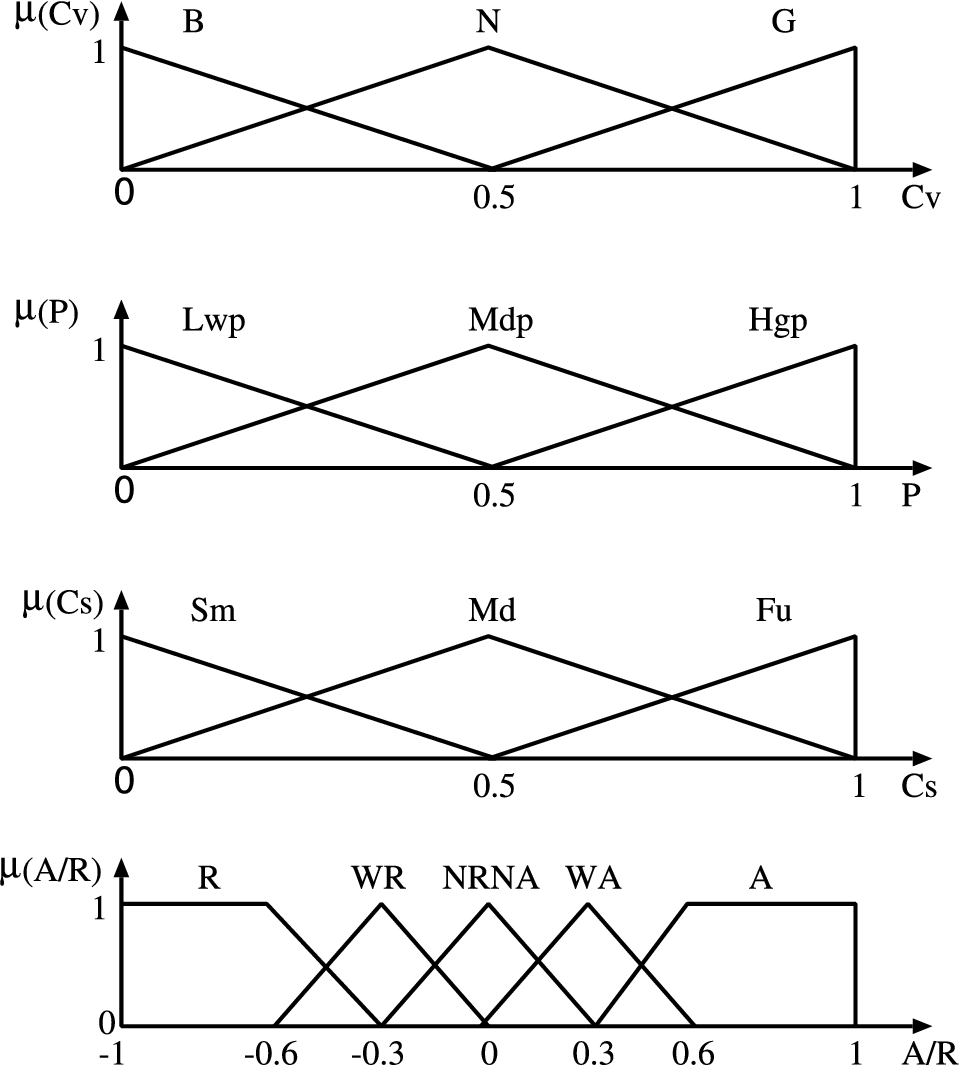
FLC3 membership functions.
We considered the following parameters for simulations:
the user speed was from 0 to 120 km/h,
the user direction was changed from −180 degree to +180 degree,
the requested size was 1, 5 and 10 Bandwidth Units (BU) for text, voice and video, respectively,
the bandwidth of the BS was considered 40 BU.
In our previous work, we presented the performance of the previous FL-based CAC systems. We have shown that FACS-P has better behaviour than previous FL-based systems. However, by using only one priority parameter, the FACS-P system cannot differentiate well different services as shown in Fig. 9.
In Figs 10 and 11, we show the performance of FACS-MP. As can be seen by these figures, the proposed system shows a good behaviour, by making a good differentiation for different services and different priorities.
In Fig. 12, we show the performance comparison between FACS-MP and FACS-P. When the number of requesting connections is small, the percentage of accepted calls for FACS-P and FACS-MP is almost the same. However, when the number of requesting connections is larger than 45, the FACS-MP system accepts more number of connections.
In Figs 13, 14 and 15, we show the performance of priority algorithm in FACS-MP. In Fig. 13 is shown the relation between the priority and
In Fig. 14, we increased the value of
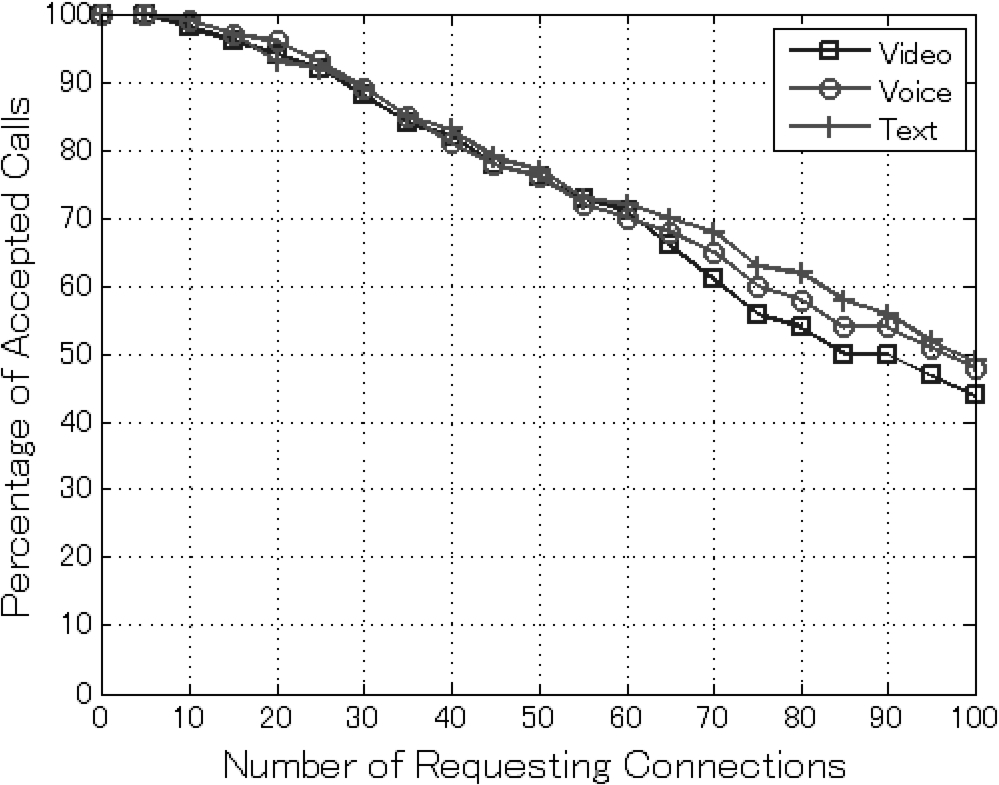
Performance of FACS-P for different services.
In this paper, we presented the FACS-MP system design and its performance evaluation, We evaluated the FACS-MP system performance for different services and priorities and compared with FACS-P.
From the simulations results, we conclude that the proposed FACS-MP makes a good differentiation for different services and priorities. Also, when the number of requesting connections is larger than 45, the FACS-MP system accepts more connections than FACS-P.
In the future, we would like to evaluate the proposed FACS-MP by extensive simulations.
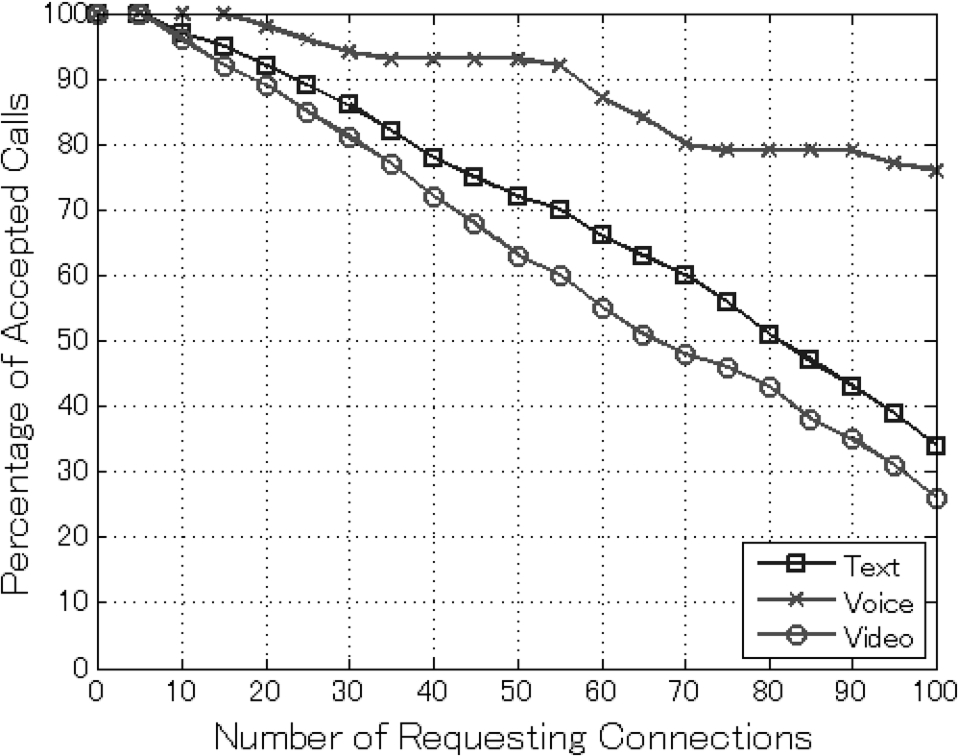
Performance of FACS-MP for different services.

Performance of FACS-MP for different priorities.

Performance comparison between FACS-MP and FACS-P.

Performance of priority algorithm when
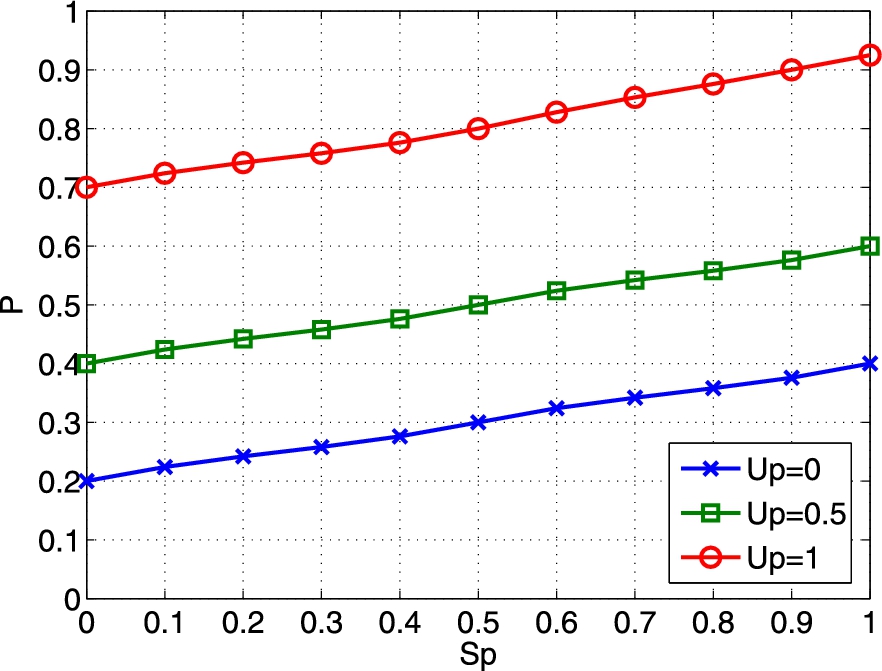
Performance of priority algorithm when

Performance of priority algorithm when