



Abstract
In recent years, the human-to-human and human-to-things relationships are becoming complicated and unreliable, which makes harder decisions in a variety of situations. As a result, trust computing is gaining interest in a number of research fields. The Logical Trust (LT) is one of trust computing concepts. In this paper, we design a Fuzzy-based System for Decision of Logical Trust (FSDLT). We implement two models: FSDLTM1 and FSDLTM2. The FSDLTM1 considers three input parameters: Belief (Be), Experience (Ep), Rationality (Ra) and the output parameter is LT. In FSDLTM2, we consider Reliability (Re) as a new parameter. We evaluated the implemented models by computer simulations. The simulation results show that when Be, Ep, Ra and Re are increasing, the LT is increased. For FSDLTM1, when Ep value is 0.9, all LT values are greater than 0.5. While for FSDLTM2, in case when Be is 0.9, for all values of Ra and Re, when Ep is 0.5 and 0.9, all LT values are higher than 0.5. This shows that the person or device is trustworthy. The FSDLTM2 is more complex than FSALTM1 but it makes a better decision for LT by considering four input parameters.
Introduction
The exponential growth of the digital social services has complicated the interrelations among individuals and communities, presenting both opportunities and challenges. The digital exchange of information has positively transformed social dynamics, enabling unprecedented levels of connectivity and access to information, but it has also negative implications. Users can readily share and access personal updates, fostering direct and instantaneous interactions in social networks. However, the lack of mandatory authentication protocols during registration processes on most social platforms presents a significant risk, as it allows entities to fabricate deceptive profiles [22].
The false accounts, engineered with malevolent intent, serve as gateways for unauthorized access to confidential information or as mediums for harassment, misinformation, and various other forms of cyber exploitation, which undermine the integrity of digital social interactions and jeopardize the security and privacy of individuals. Therefore are needed more robust verification systems and advanced protective mechanisms [24].
The people-people trust and people-thing trust are very important, without considering the trust lead to the attack of malicious users like faking their identities, harassing others, spreading misinformation, spamming, committing fraud, and leaking information. Therefore, secure systems or trust computing are needed to decide which users are reliable and which are weak in order to stop these problems and protect data communication in the digital world.
Trust computing is a decision-making technique that may be employed in a variety of real-world contexts, scenarios, and information systems in a wide variety of situations. In order to provide security and give the needed trust to maintain a particular level of performance, the trust concept is applied in 5G and beyond networks [3]. In [2,5,9,15,17,18,23], the trustworthy concept is implemented for reducing the risk of a transaction and preventing data and privacy leakage. In [19,25,29] is indicated that the trustworthy concept not only provide security problems solution, but also assess users in terms of proficiency or quality in various kinds of networks and systems.
While traditional social theories might not seamlessly translate into the digital world trust modeling, their insights into human interaction and societal structures are invaluable for improving trust-based frameworks. These theories underscore trust’s inherently qualitative, elusive, and multifaceted nature as perceived and practiced by humans, which presents a significant challenge in quantifying and systematizing trust in digital interactions. The trust complexity is further increased by increasing the decision-making parameters, making this an NP-Hard problem.
To deal with NP-Hard problems, the employment of intelligent and heuristic algorithms becomes imperative. Different approaches such as Fuzzy Logic (FL) can offer a way to navigate the uncertainties and subtleties of trust by considering the degrees of truth, the same as the human reasoning in real-life situations. While, Genetic Algorithms (GA) and Particle Swarm Optimization (PSO) consider the principles of natural selection and collective behavior to explore efficiently the solution space. These algorithms, through their adaptive, evolutionary, and iterative strategies, can approximate solutions to complex trust evaluation problems by bypassing the exhaustive computational demands of traditional methods [11,28].
In [21], the FL is used to construct mutual trust for securing resources within Grid sites. By utilizing FL capability of reasoning with uncertainty and vagueness, a trust evaluation mechanism is established. The proposed approach allows more flexible, adaptive, and robust trust assessment between entities in Grid environments.
In [26], the authors consider FL and Neural Networks (NNs) in C2C (Customer-to-Customer) e-commerce platforms for trust assessment, providing a reliable and a dynamic way to quantify and categorize trust among users. The FL transforms the subjective customer experiences into measurable trust values, while NNs leverage historical interaction data, learning and identifying patterns that predict future trustworthiness. This approach can deal with complexities and variances of personal experiences and seller behaviors in the marketplace [1,7,16].
In this paper, we design a Fuzzy-based System for Decision of Logical Trust (FSDLT). We implement two models: FSDLTM1 and FSDLTM2. The FSDLTM1 considers three input parameters: Belief (Be), Experience (Ep), Rationality (Ra) and the output parameter is Logical Trust (LT). In FSDLTM2, we consider Reliability (Re) as a new parameter. We evaluate the proposed system by simulations. The simulation results show that when Be, Ep, Ra and Re are increasing, the LT is increased. For FSDLTM1, when Ep value is 0.9, all LT values are greater than 0.5. While for FSDLTM2, in case when Be is 0.9, for all values of Ra and Re, when Ep is 0.5 and 0.9, all LT values are higher than 0.5. This shows that the person or device is trustworthy. The FSDLTM2 is more complex than FSALTM1 but it has a better decision for LT because considers four parameters for decision-making.
The contributions of this research work are as follows.
Investigation and proposal of different parameters for LT.
Design and implementation of FSDLT system for calculating and decision of LT.
Implementation of two FL-based Models for decison of LT.
Comparison of simulation results for these two FL-based models for different parameters.
The paper structure is as follows. In Section 2 is described Trust Computing. In Section 3, we introduce FL. In Section 4, we present the proposed Fuzzy-based system and its implemented models. In Section 5, we discuss simulation results. Finally, conclusions and future work are given in Section 6.
Trust computing
The trust computing considers a spectrum of variables that incentivize both the trustor and the trustee to maintain an ongoing and long-term relationship. The evaluation is multi-dimensional by considering elements of the individual and relational trust. Key factors include the rationality of the trustor, a logical assessment based on explicit reasoning, and the reliability of the trustee, which connect their consistency and dependability over the time. Furthermore, the social influence of the trustee within a network plays a significant role, as it can impact the trustor perception and their willingness to place trust in the trustee.
The interplay of these elements allows the trustor to formulate a comprehensive evaluation of the trustee’s overall trustworthiness. This is a dynamic assessment subject to evolution of the relational parameters between the trustor and trustee, which may change when there is a new information. Thus, the trust computing is an ongoing process that mirrors the complexities of human relationships, which is earned and maintained through continuous interaction and reassessment [12,30].

Communication with trust.
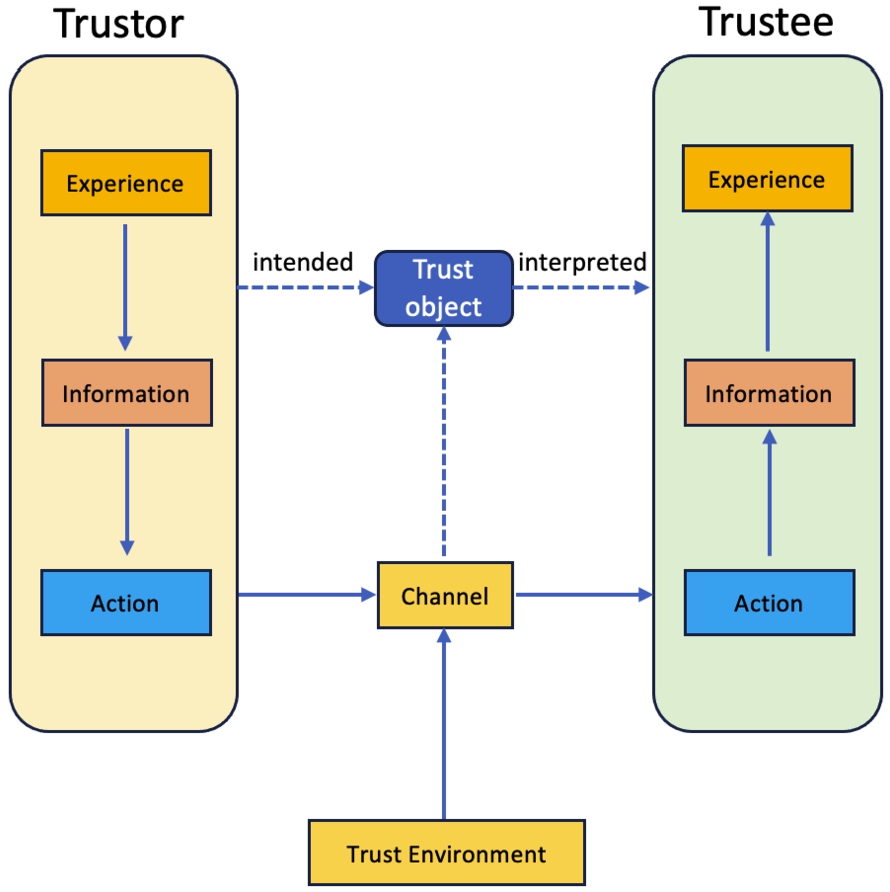
Trust framework model.
In case when a trustor and a trustee establish the communication, an initial level of mutual trust is already present before any direct interaction begins (see Fig. 1). This human-to-human trust is often influenced by their connection within a social network, where the trustor may gauge the reliability of the information based on the established trustee reputation. Similarly, the trustee will undertake a comparable assessment regarding the trustor before initiating communication. In Fig. 2 is shown the trust framework model [20]. The trustor intends to undertake actions or share specific information, creating a trust object for the trustee, based on experience and the trust environment. Similarly, the trustee decides whether to trust or not by decrypting the trust object, relying on their own experience and trust environment. The trust process can be risky, subject to interference from distorted messages or misunderstood actions.
The communication medium (channel) can be email, phone, text messages, various social networking services or broader media channels governed by human-to-machine trust elements. The decision should select a platform that embodies the utmost level of trust, often determined by factors like minimal risk and optimal Quality of Service (QoS). Thus, the medium that meets these stringent trust criteria, ensuring a secure and quality interaction, is preferred for facilitating the communication [4,8].
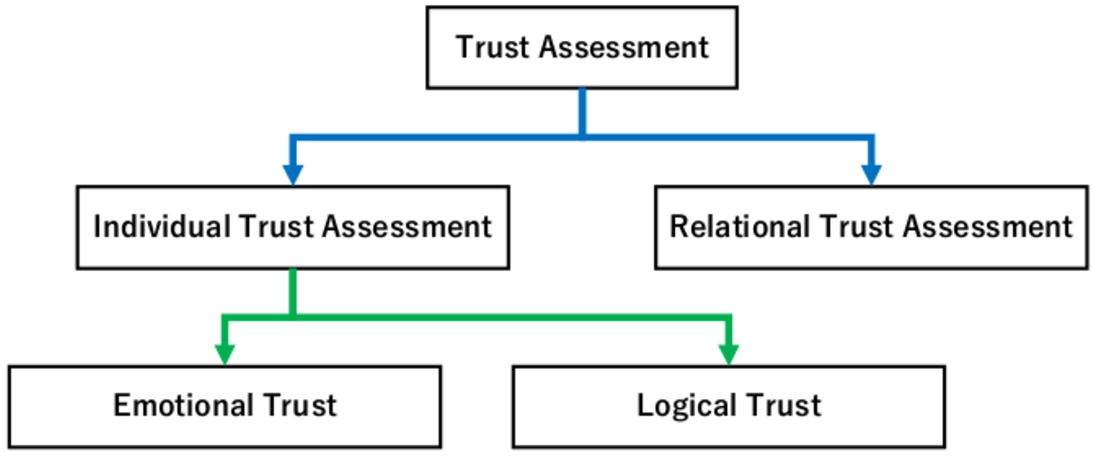
Trust assessment process.
The trust assessment can be divided into Individual and Relation Trust as shown in Fig. 3 [6].
The FL considers the human capacity for reasoning, which is approximate rather than fixed or exact. The FL mirrors the human ability to assess and interpret vague or uncertain information, allowing different values between “true” and “false”. Consequently, the FL offers a good approach that reflects real-world situations, which cannot be solely categorized as entirely true or entirely false. This approach can deal with complexities of practical scenarios where absolute values are rare and various degrees of truth are commonly encountered [10,27].
Boolean logic operates on binary values of “true” and “false.” In contrast, the FL consider a spectrum of values, capturing scenarios where a statement is not entirely true or completely false. The fuzzy control has a wide range of applications. They can range from small micro-controller-based devices in household appliances to expansive process control systems. The Fuzzy Logic Control (FLC) can enable an automatic process through expert knowledge, offering robust nonlinear control.
FLC structure
The main elements of FLC are a group of linguistic control rules connected by the dual ideas of fuzzy implication and compositional rule of inference. The FLC structure consists of four components (Fuzzifier, Inference Engine, Fuzzy Rules, Defuzzification) as shown in Fig. 4. The FLC offers a structured technique for representing, manipulating, and applying human heuristic knowledge to system control [13,14].

FLC structure.
Creating fuzzy inputs involves a multi-step process that begins with the Fuzzifier integrating crisp values with linguistic variables associated with fuzzy sets. This initial stage translates precise inputs into terms that can be processed by FL framework.
The Inference Engine considers fuzzy rules and fuzzified inputs to deduce a fuzzy output. These rules are pivotal and can be determined from expert knowledge within the field or derived from extensive numerical data, ensuring that the system response is well-founded and contextually relevant. Common methodologies employed for this purpose include Sugeno, Mamdani and Tsukamoto fuzzy inference systems. These techniques have their own strengths and applications in drawing conclusions from fuzzy information.
The final stage in this procedure is Defuzzification, which is a crucial step that converts the inferred fuzzy outputs back into crisp value, which is used for control. This transformation is vital for interfacing with non-fuzzy systems in order to be applied in practical and real-world scenarios. Thus, the FL can facilitate a sophisticated approach to handle the intricacies and uncertainties of real-world reasoning, often leading to more intuitive and human-like decision-making systems.
There are many different ways to express knowledge in the subject of machine intelligence or artificial intelligence. The human knowledge can be provided into natural language phrases such as:
These rules are known as IF-THEN rules. So, from the knowledge of one fact (a premise, hypothesis, or antecedent), we can infer, or deduce, the knowledge of another truth termed a conclusion (a consequence).
Proposed fuzzy-based system
In this section, we present our proposed system called Fuzzy-based System for Decision of Logical Trust (FSDLT). The structure of FSDLT is shown in Fig. 5. We implement two models: FSDLTM1 and FSDLTM2. The FSDLTM1 considers three input parameters: Belief (Be), Experience (Ep), Rationality (Ra) and the output parameter is Logical Trust (LT). In FSDLTM2, we consider Reliability (Re) as a new parameter. The considered parameters are explained in following.

Proposed system structure.
The membership functions are shown in Fig. 6. We use triangular and trapezoidal membership functions as shown in Fig. 7 because they are appropriate for real time operation.

Membership functions.
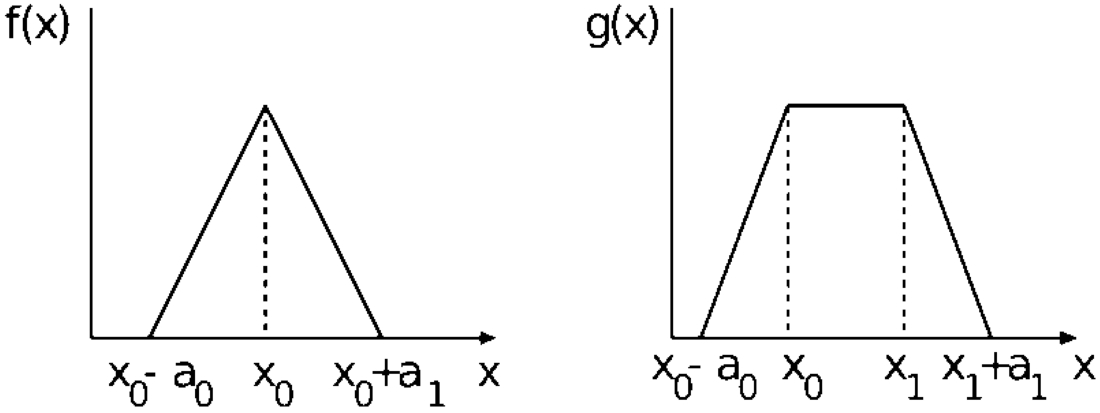
Triangular and trapezoidal membership functions.
We explain the design of FLC in following. The input parameters and their term sets are shown in Table 1.
Parameter and their term sets for FSDLTM1 and FSDLTM2
The membership function for input parameters are defined as follows.
The output linguistic parameter is Logical Trust (LT). The term set for LT is defined as follows.
The membership functions of LT for FSDLTM1 are defined as follows.
While, the membership functions of LT for FSDLTM2 are defined as follows.
FRB for FSDLTM1
FRB for FSDLTM2
The Fuzzy Rule Base (FRB) for FSDLTM1 and FSDLTM2 is shown in Table 2 and Table 3, respectively. The FRB is formed by a fuzzy set of dimensions (
In this section, we present the simulation results. The simulations are performed on a computer running Linux Ubuntu OS with the following specifications: 8 GB of RAM, an i5 (3.2 GHz
The simulation results for FSDLTM1 are shown in Fig. 8. They show the relation between LT and Ra for different Ep values considering Be as a constant parameter.
In Fig. 8a we consider the Be value 0.1. For Ep 0.5, when Ra is increased from 0.1 to 0.5 and from 0.5 to 0.9, the LT is increased by 13% and 15%, respectively. When Ra is increased, we see that LT is increased, which means that the trustee will have more confidence in trustor when he/she has a good and positive rationality.
We compare Fig. 8b with Fig. 8a to determine how Be has affected LT. We change Be value from 0.1 to 0.5. The LT is increased by 30% when the Ep value is 0.5 and Ra is 0.5. This indicates that when Be is higher, the LT is higher.
In Fig. 8c, we increase Be value to 0.9. We see that the LT values are increased significantly compared with the results of Fig. 8a and Fig. 8b. When Ep value is 0.9, all LT values are greater than 0.5, which indicates that dhe device or person is trustworthy.
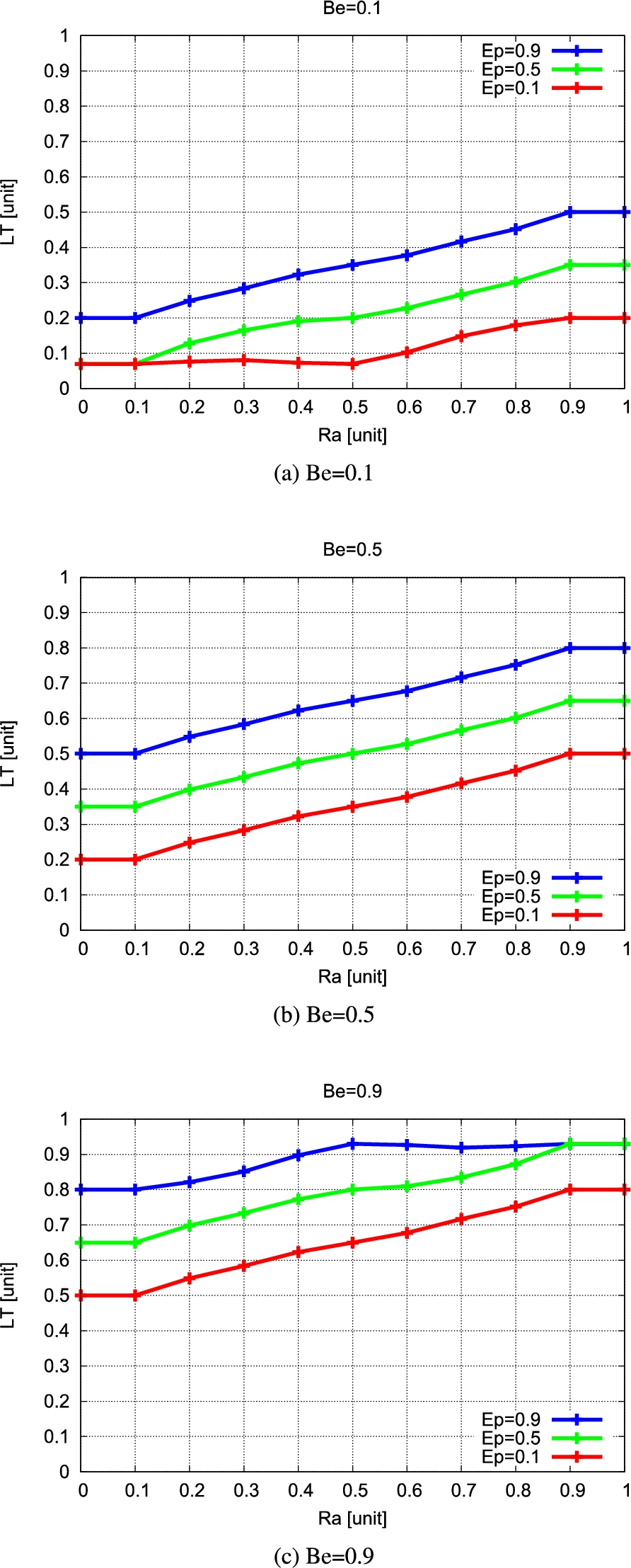
Simulation results of FSDLTM1.
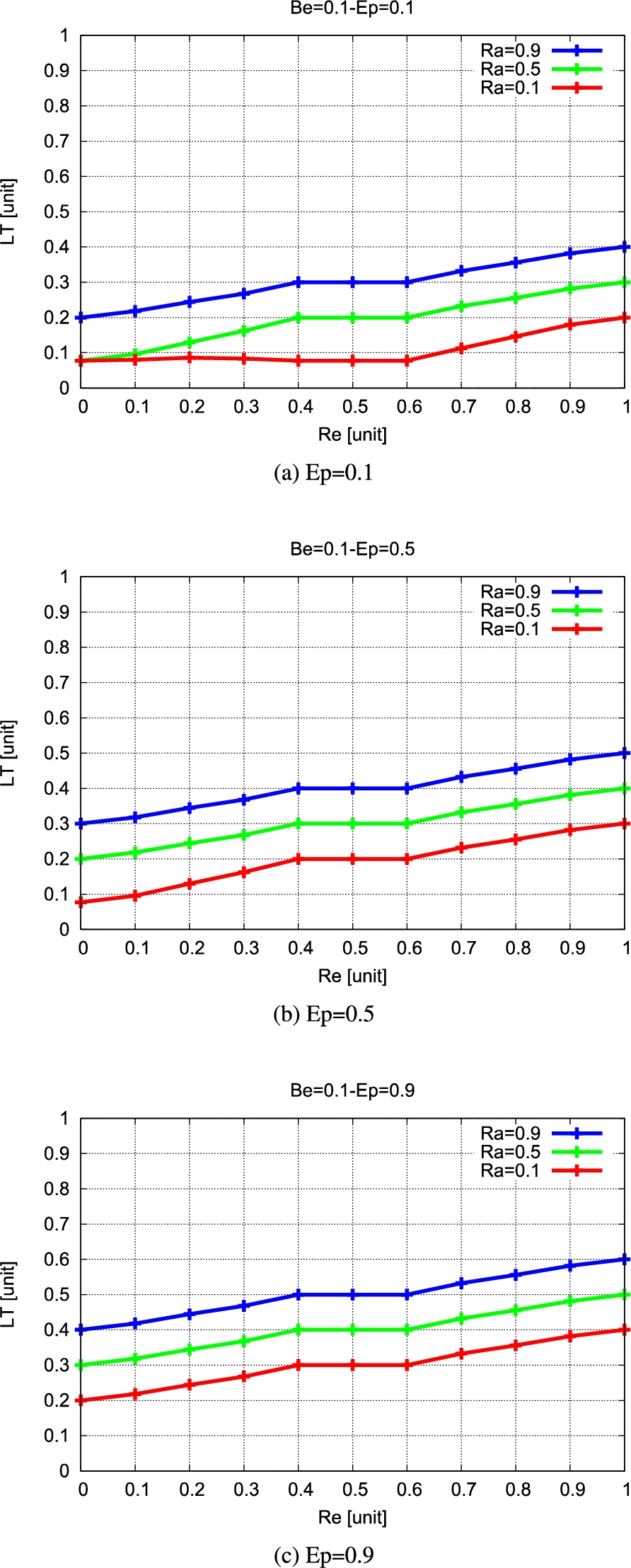
The simulation results for FSDLTM2 are presented in Fig. 9, Fig. 10 and Fig. 11. They show the relation between LT and Re for different Ra values considering Be, Ep as constant parameters.
In Fig. 9, we consider Be value 0.1. Then, we change Ra from 0.1 to 0.5 and 0.9. We see that for Ep 0.1 and Re 0.5, the LT is increased by 12% and 10%, respectively. If we change Re value from 0.5 to 0.9, we see that LT is increased by 11% and 10%, respectively. This means that when Ra is increased, the LT is higher. For determining how Ep affects LT, we change Ep value form 0.1 to 0.5 and from 0.5 to 0.9 (see Fig. 9a, Fig. 9b and Fig. 9c). The LT is increased by 10% when Ra is 0.5 and Re is 0.8. So, when Ep is increased, the LT value is increased.
By comparing Fig. 9 with Fig. 10, we see that by changing Be value from 0.1 to 0.5, when Ep value is 0.1, Ra is 0.5 and Re is 0.5, the LT value is increased by 20%. In Fig. 10a Ep value is 0.1. When we increase Ep value to 0.5 and 0.9 (see Fig. 10b and Fig. 10c), we can see that the LT values are increasing much more compared with Fig. 10a.
In Fig. 11, we increase the value of Be to 0.9. By comparing with other results, we see that LT values have increased significantly. When the trustor has high belief on trustee, the LT will be higher. In case when Be is 0.9, for all values of Ra and Re, for Ep 0.5 and 0.9, all LT values are higher than 0.5. This shows that the person or device is trustworthy.
Comparing FSALTM1 with FSALTM2, the FSDLTM2 is more complex than FSDLTM1 because its FRB has more membership functions. But it makes a better decision for LT by considering four input parameters. For instance, in case of FSALTM1, when Be is 0.1, for all values of Ep and Ra parameters (even when they are 0.9), the LT values are less than 0.5. This shows that a device or a person is not trusted. However, in case of FSALTM2, when Be is 0.1, Ep is 0.9 and Ra is 0.9, for values of Re more than 0.7, the LT values are more than 0.5.
In this paper, we proposed two models of FSDLT (FSDLTM1 and FSDLTM2), for decision of LT considering four parameters. From simulation results, we conclude as follows.
When Be, Ep, Ra and Re values are increasing, the LT value is increased.
For FSDLTM1, when Ep value is 0.9, all LT values are greater than 0.5. While for FSDLTM2, in case when Be is 0.9, for all values of Ra and Re, when Ep is 0.5 and 0.9, all LT values are higher than 0.5. In this scenarios, a person or device is trustworthy.
The FSDLTM2 is more complex than FSDLTM1 but it makes a better decision for LT by considering four input parameters.
In the future work, we will consider different parameters and perform extensive simulations to evaluate the proposed system. Also, by considering that the most common reason for leaving a job in companies is “Work Mismatch”, we would like to implement a system to evaluate the trust of applicants in order to support companies for a better decision-making process.
Simulation results for FSDLTM2 (

Simulation results for FSDLTM2 (

Simulation results for FSDLTM2 (
Conflict of interest
The authors have no conflict of interest to report.