



Abstract
In this paper, a reliable spectrum sensing (SS) scheme using dual detectors for IEEE 802.22 WRAN has been presented. In dual or double detectors, first one detector is energy detector (ED) with fixed threshold (FT), while second one is ED with adaptive double threshold (ADT). Numerical results shows that proposed reliable scheme improves detection performance and outperforms the cyclostationary based sensing method and adaptive SS by 12.9% and 15% at −8 dB signal-to-noise ratio (SNR), respectively. It also shows that the proposed scheme takes smaller detection time period than cyclostationary detection and adaptive SS scheme in the order of 5 ms and 0.8 ms at −20 dB SNR, respectively. Moreover, the scheme analyzes in conjunction with cooperative spectrum sensing (CSS) where each CRs work together in order to take final or global decision. It is observed that the proposed sensing scheme with CSS achieves spectrum detection performance in the order of 0.9 for SNR value of as low as −17.5 dB when numbers of CRs are ten.
Keywords
Introduction
Day-by-day the numbers of mobile users are increasing, which will certainly create bandwidth crises due to limited spectrum availability. Cognitive radio is future technology, which is capable of solving the spectrum scarcity problem. In CR network, Unlicensed CR users use the unused licensed band of primary users (PU) while PU is not active. There are several methods to sense the spectrum of PU signal, such as matched filter detection, energy detection and cyclostationary feature detection [2,3,17,20,25]. Matched filter and cyclostationary feature detection, both techniques provide better performing results under low SNR in wireless communication systems (WCS). But, they require the prior information of PU’s signal. At the other end, energy detectors are the most common way of spectrum sensing because it does not require the prior information of PU’s signal and has low computational complexity. Sometimes this technique is also known as Blind spectrum sensing technique. However, it is well known that such a method does not perform well under low SNR. In [5], authors have proposed two-stage CR system, which consists of coarse and fine detection stages. But this system is not applicable for low level SNR signals. In [27], authors proposed another two-stage sensing technique, where first stage consists energy detector while second stage consists one-order feature sensing to detect weak signals. Further in [18], authors have proposed Two-stage spectrum sensing technique to improve detection performance. This technique carries two detectors, first stage consists energy detector and second stage consists cyclostationary detector to give better sensing performance, however it is computationally more complex and requires longer sensing time. In [9], authors have proposed another adaptive spectrum sensing scheme. In this scheme, out of two stages only one of the detection stage runs at a time, which is based on the estimated SNR. Due to the use of cyclostationary detector in [9] its implementation is complicated. However, to the best of available sources none of these technique focused on spectrum sensing failure problem [15].
In this paper, focus is on spectrum sensing failure problem, improved detection performance, and measured sensing time, which has been proposed in a reliable spectrum sensing scheme in CRN. The proposed spectrum sensing scheme considers dual detectors, which shows two-stages, first stage detector implies ED with fixed threshold (ED_FT), whereas second stage detector implies ED with adaptive double-threshold (ED_ADT) to enhance the detection performance at a fixed decided probability of false alarm (
In the first stage, energy detector detects the PU signal and calculates signal energy (X). Then compares with certain FT (γ), if X is greater than or equal to γ, the channel is declared to be busy, otherwise, ED_ADT is performed sensing operation in the second stage. The adaptive threshold (λ) of second stage detector compares with signal energy (X), if X is greater than or equal to ADT (λ), shows channel is occupied else unoccupied and can be used by CU users.
The selections of ADTs (
We further propose CSS with proposes reliable SS scheme to further improve the reliability and detection performance of cooperative decision. Here, all the CRs perform local observation by using two-stage SS detectors. The thresholds are selected as per the value of the noise uncertainty at each CR user. If the collected energy value falls between or outside the two thresholds, the local decision will be made and reported to the fusion center (FC) in the form of binary bit i.e. either 0 or 1. The FC will make a final decision using hard decision OR rule. In the propose model we have used OR rule because it has better detection performance when the number of cooperating CR users is large [1], and provides slightly better performance at low
The novelty of this paper that under reliable SS scheme we consider two-stages for detecting the PU signal, first stage carries ED_FT which takes lesser sensing time and makes fast processing. While second stage based on ED_ADT which mitigates sensing failure problem. Final resultant of both stages provide well perform at low SNR levels, reduce computational complexity, and improve detection performance as well.
The rest of the paper is organized as follows: Section 2 presents system description. Section 3 describes proposed system model. Section 4 shows the numerical results and analysis. Finally, Section 5 concludes the paper.
System description
There is a mathematical expression to detect the PU signal by using following hypothesis for received signal [11,25],
Energy detector plays an important role in CRN in order to detect PU signal due to its simplicity and easy to implement [24]. It measures the energy of PU signal and compares it to a threshold (γ) in order to determine whether the PU signal is present or absent. To determine signal energy there is a mathematical formulation given as [6],
Most of the ED [28] are based on fixed single threshold scheme, in which detected PU signal compares with threshold in order to identify whether PU is present or not. These kind of EDs are appearance difficulty when noise uncertainty increases for a CR and thus degrades its sensing reliability, Moreover, this may not be optimum in case of low SNR where the performance of fixed single threshold (γ) based detector can vary from the targeted performance metrics substantially.
In [4], authors have shown the curve of PU signal and noise signal in which authors discussed that detection of PU signal from noise signal is easy if both signals do not overlap to each other. Suppose detector receives PU signal then it declares
Using single threshold, detection between noise and PU signal is difficult under confused region. To overcome this problem we considered adaptive two threshold scheme to define the local decision at the CR user as following logic function rule (LR),
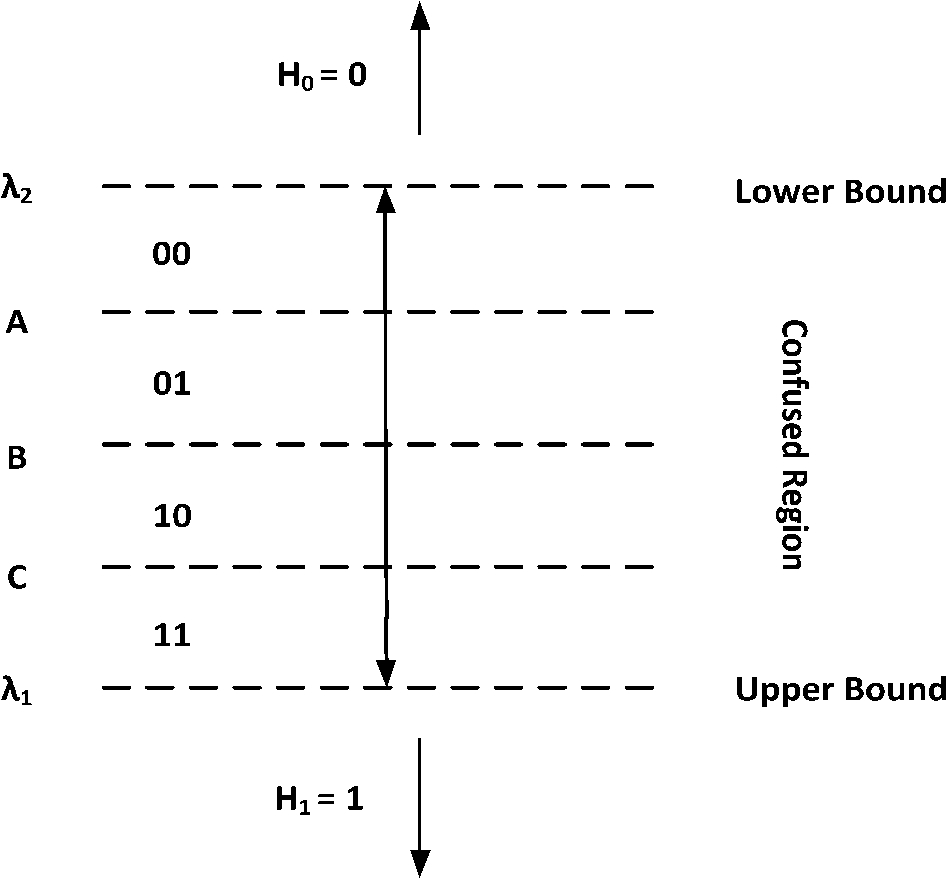
Confused region is divided into four equal parts using quantization method.
There is another double thresholds based scheme proposed by [22], to reduce the average number of sensing bits to the receiver. But, the deductions are achieved at the expense of some sensing performance loss which is sensing failure problem. In order to remove this problem successfully, two thresholds
Now, the false alarm probability (
Suppose that
In Eq. (14), p is an arbitrary constant, has value two. The zero-mean primary signal
Note that
Now the probability of false alarm for ED_ADT will be calculated as
Using Eqs (15) and (17), the probability distribution function (PDF) of the ED_ADT detector for
Now the probability of detection for ED_ADT can be obtained as
Similarly, the total error rate (
Equation (27) shows the decimal values (DV), which are compared with threshold (
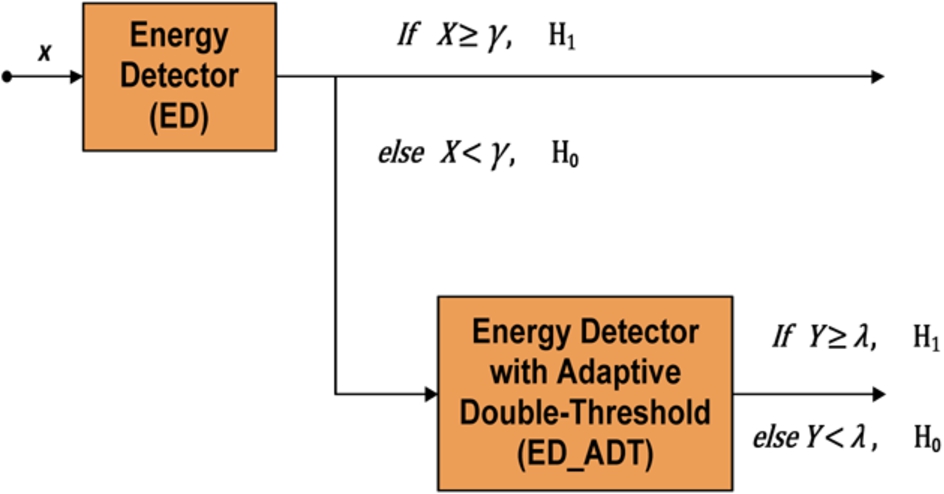
Proposed model: Dual detectors for spectrum sensing. (Colors are visible in the online version of the article;
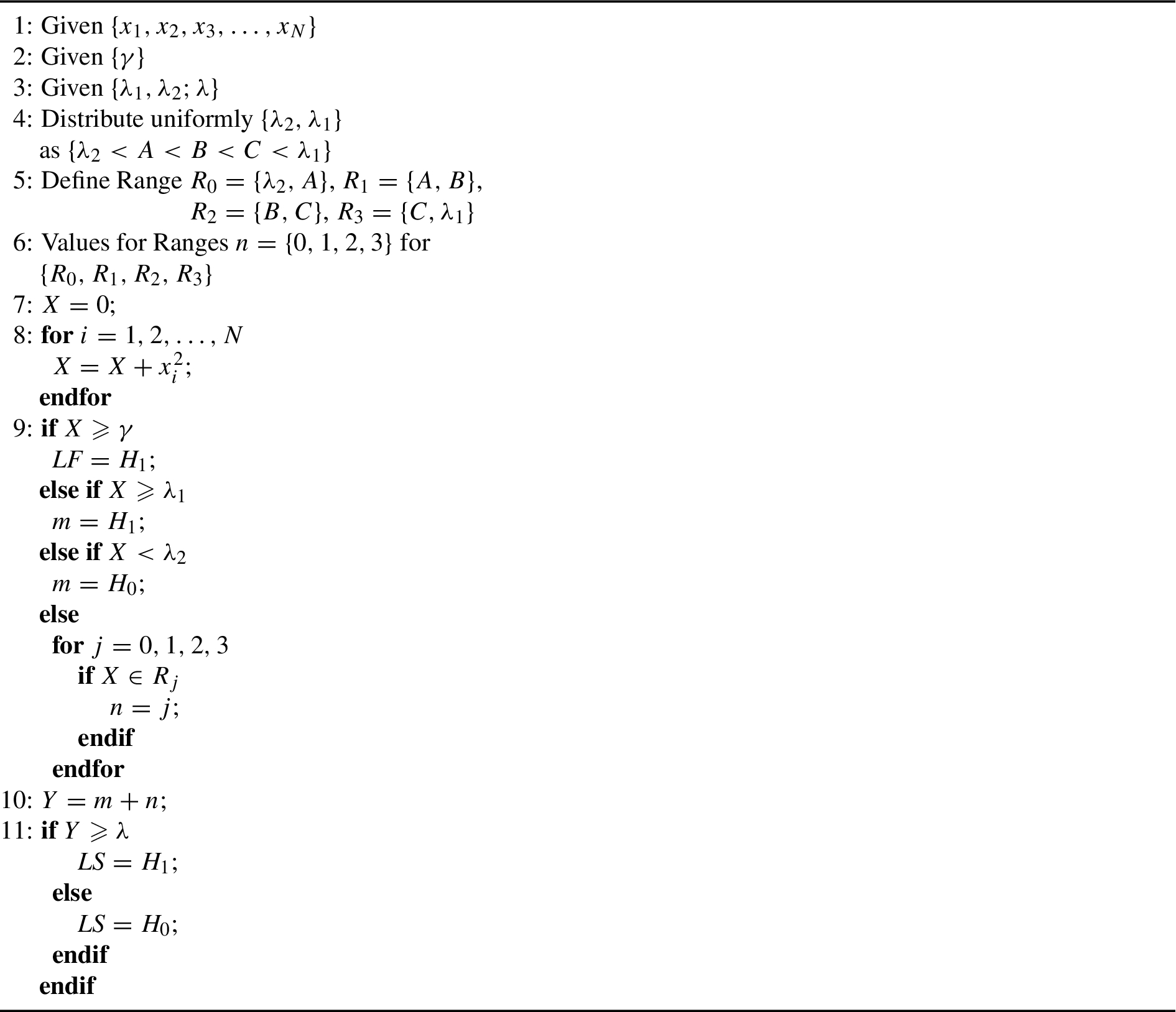
Propose reliable SS detector scheme
Figure 2 illustrates the proposed system model of dual detectors for SS scheme carries two detectors. First stage consists of energy detector (ED) with single threshold, and second stage consists of energy detector with adaptive double-threshold (ED_ADT) scheme. If ADT scheme is used in the first stage, it will take somewhat more time to sense PU signal, while ED takes lesser time to detect PU signal. But under spectrum sensing failure problem, it does not perform well. That’s why in second stage we have used ADT based ED. Algorithm 1 for reliable SS scheme.
Probability of false alarm of dual detectors will be
Probability of detection of dual detectors will be
First stage (ED_FT)
Figure 3 shows the internal architecture of ED with single threshold (γ). Here, input PU licensed signal received by square law device, which shows detected signal energy (X) and compared with single threshold to make a final decision to determine whether the PU is present or absent,
First stage local decision rule (LF) used by energy detector with single threshold is given by
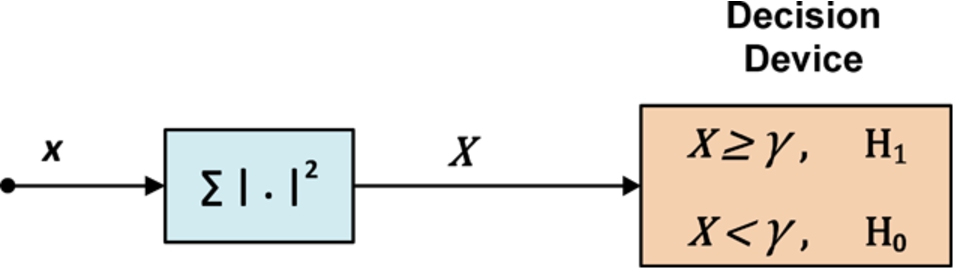
Internal architecture of energy detector with Single threshold (ED). (Colors are visible in the online version of the article;
This is a simple kind of a circuit of ED except threshold. In this model we used adaptive threshold instead of fixed threshold as used by first stage. Suppose PU signal is not detected by first stage then the second stage detector will try to detect PU signal. Figure 4 depicts internal model of ED with ADT in which firstly square law device (SLD) receives the sensed PU signal and computes signal energy (X). On the basis of value of X, ED_ADT choses appropriate threshold and compare with X to decide PU is present or absent. Further SLD, there are two parts, in upper part if detected energy values (X) are greater than or equal to
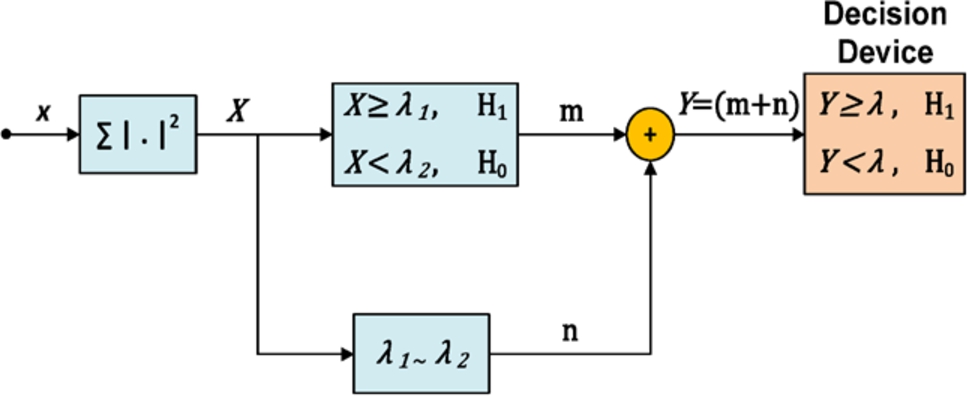
Internal architecture of energy detector with adaptive double-threshold (ED_ADT). (Colors are visible in the online version of the article;
If detected energy values (X) fall outside or between
Finally, using Eqs (34), (35) and (36) the local decision (LS) of second stage or ED_ADT is expressed as
Equation (37), equating the resultant value (Y) to threshold (λ) to maintain overall system probability of false alarm (
CSS technique is used to mitigate shadowing and fading in order to improve sensing performance of both local sensing performance and global sensing performance in a CRN [10,13,19,29]. Here all CRs are using two-stage spectrum sensing scheme to sense PU signal. Once all CRs have taken the local decision individually, they send their local decisions in the form of binary bit i.e. 0 or 1 to the FC over error free orthogonal channels to take final decision. In Fig. 5, let there are k numbers of CRs, all of them transmit local decision
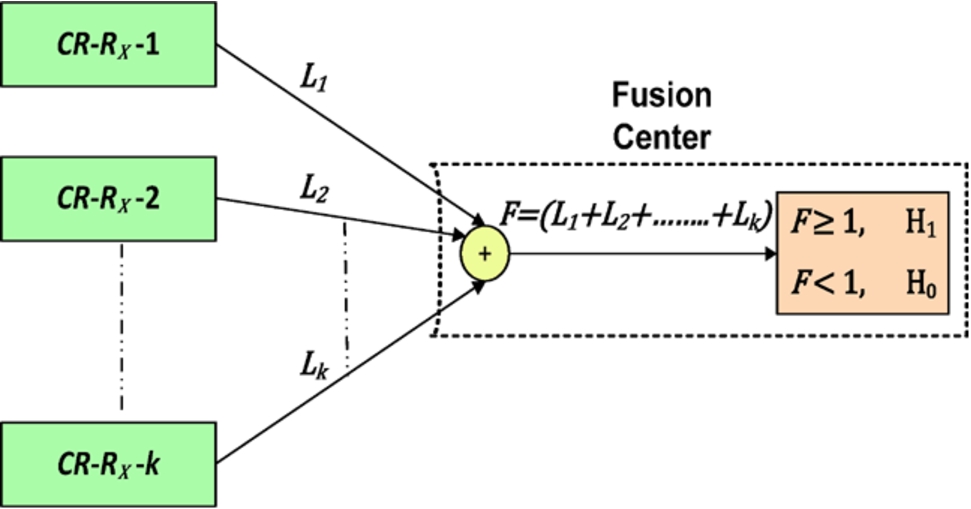
CSS technique with proposed reliable SS detector scheme. (Colors are visible in the online version of the article;
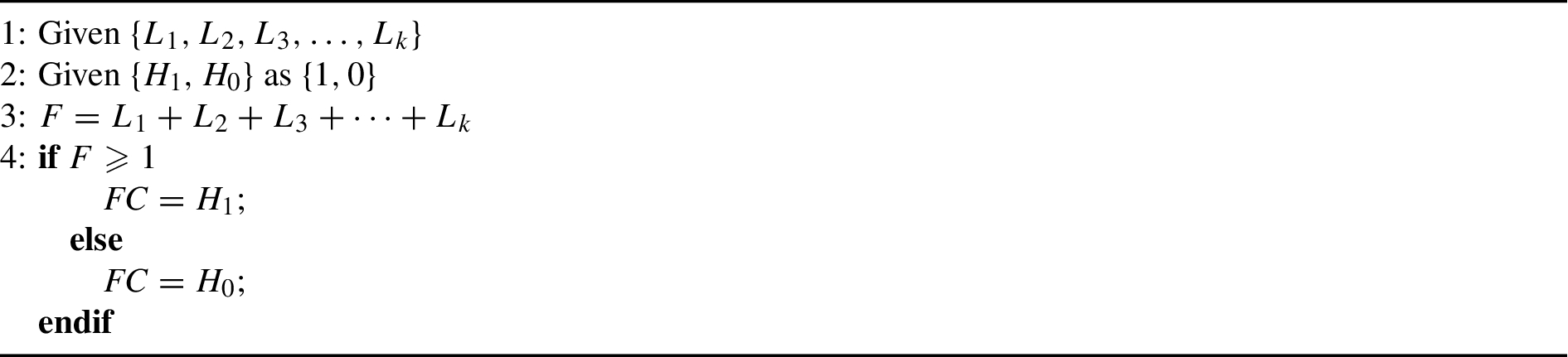
Finally, FC combines the binary bit decisions of all CRs where each CR have proposed scheme i.e. two-stage detectors, and makes global decision to show presence or absence of PU signal as follows
In Eq. (39), F is the sum of the all local decisions
Finally, Eq. (41) shows the global or final result of FC. Now, the performance of overall proposed system can be analyzed via
Similarly, using hard decision OR rule in CSS, the total probability of detection alarm (
CSS using proposed reliable SS detector scheme
In the proposed system model, we are assuming total number of samples (N) are 1000,
The probability of detection describes how often PU is susceptible to potential interference from the CR. In CRN,
Figure 6 exhibits the graph between
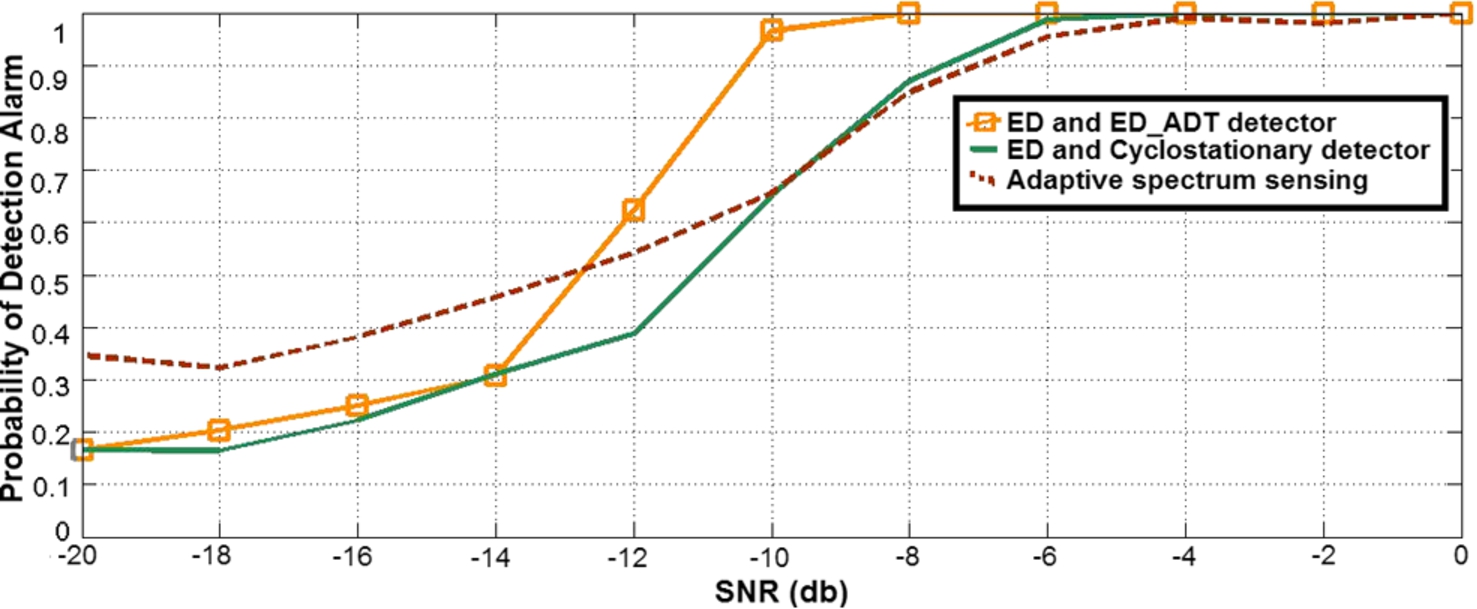
Probability of detection vs. SNR at
Figure 7 shows that the proposed scheme has minimum error rate as compared to other two existing schemes, i.e. 0.1 at −8 dB SNR.
Receiver Operating Characteristics (ROC) curve is illustrates in Fig. 8. ROC curve shows the relationship between probability of false alarm and probability of detection alarm [26] of a SS method under several SNR values for propose scheme. For
The SS time defines the total time taken by CR user to detect PU signal. Suppose SS time is increased then PU can utilize its spectrum in a better manner and the limit is decided that CR cannot interfere throughout that much of time. More PUs will be detected if more the SS, due to this the level of interference will be less. The SS time is directly related to the number of samples received by the CR user. The more sensing time is devoted to detecting, the less sensing time is available for transmissions and hence degrading the CR throughput. This is known as the sensing efficiency problem [12] or the sensing-throughput trade-off [14] in SS.
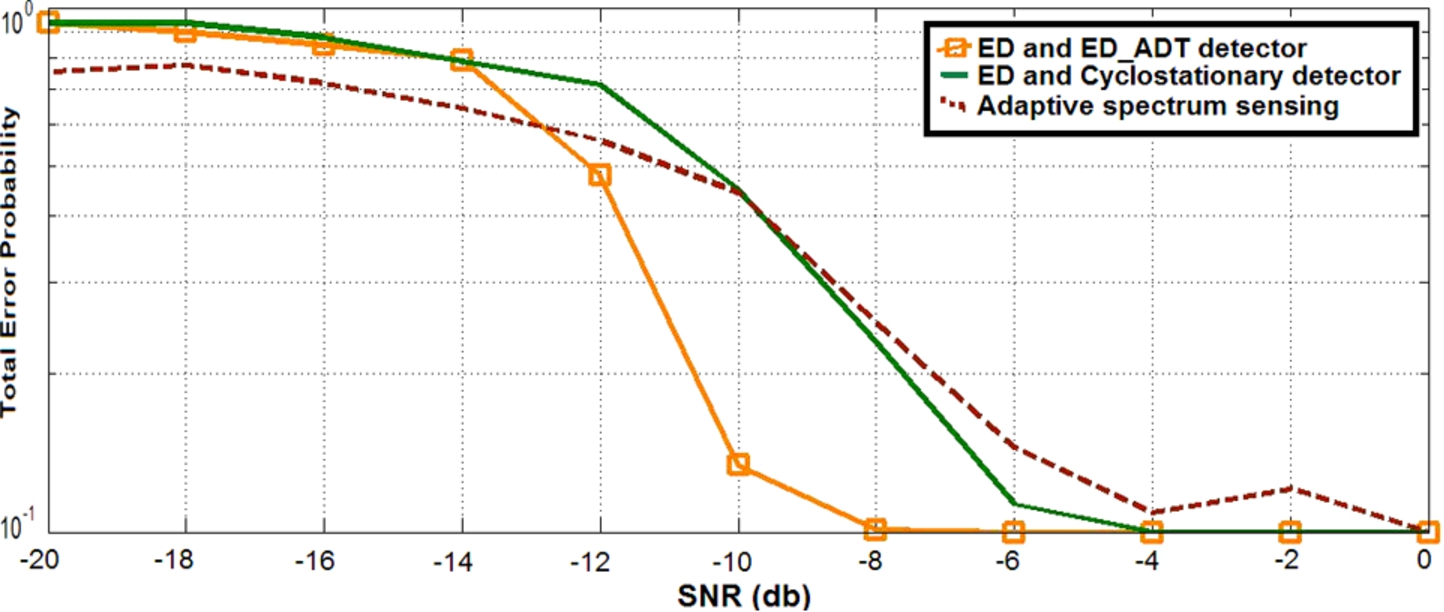
Total error probability vs. SNR at
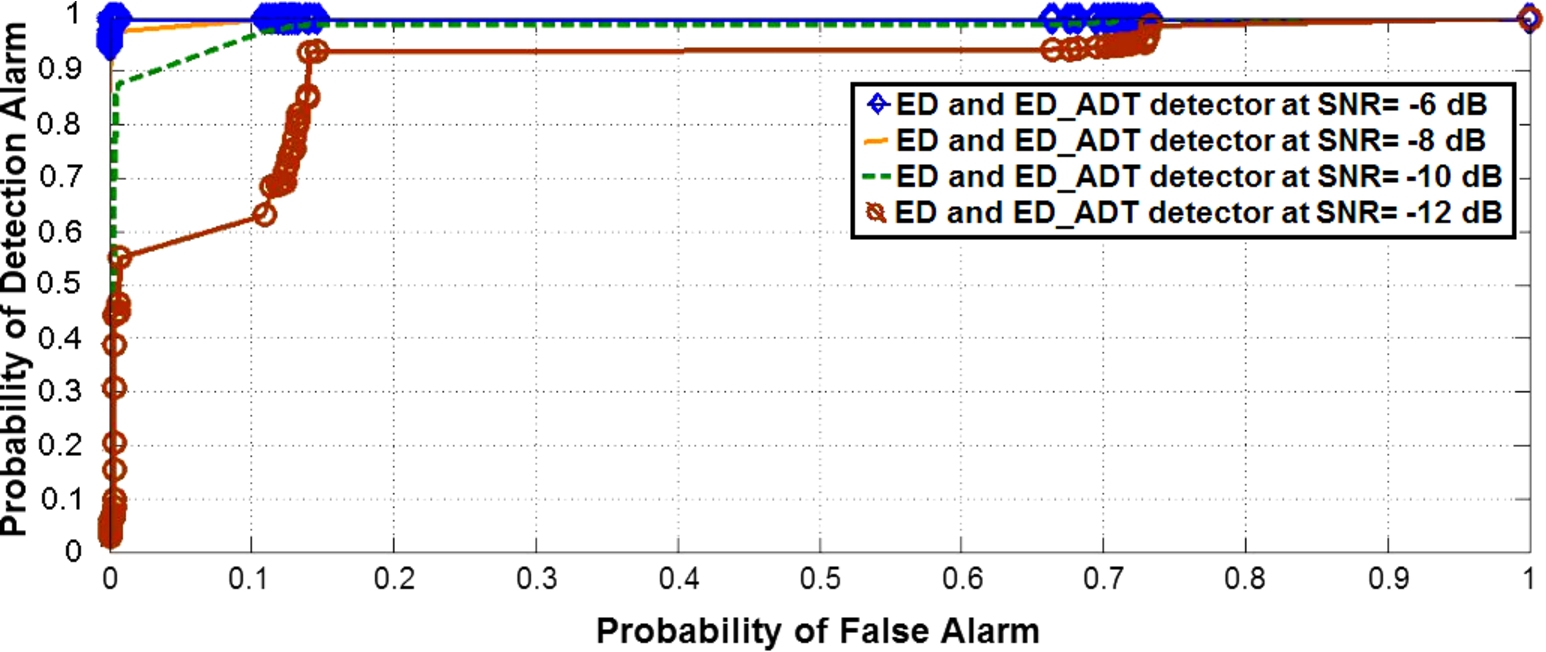
ROC Curves for energy detector and ED_ADT based spectrum sensing detector under different SNR values. (Colors are visible in the online version of the article;
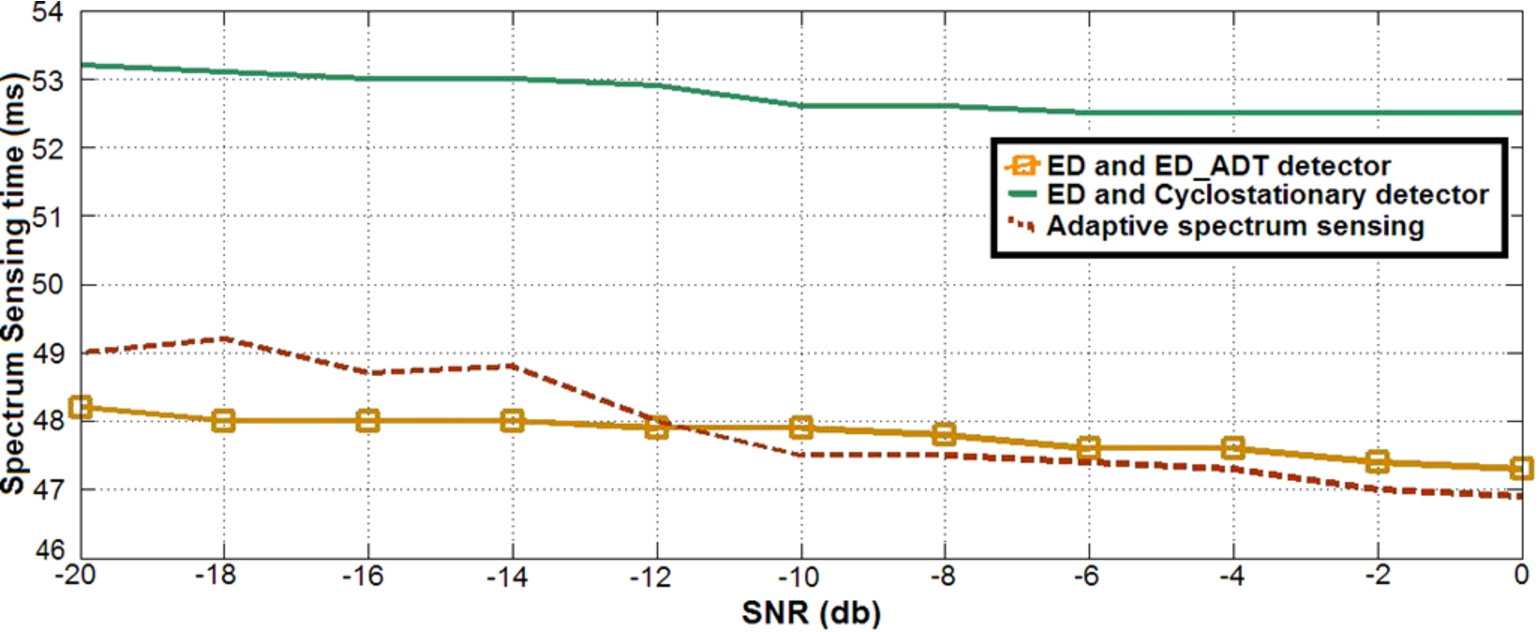
Spectrum sensing time vs. SNR with
Figure 9 shows the graph of spectrum sensing time versus SNR. The proposed scheme requires lesser sensing time than the existing proposed schemes. It is observed that there is an inverse relation between SS time and SNR. As SNR increases, sensing time decreases. At −20 dB SNR, proposed scheme requires sensing time around 48.2 ms whereas cyclostationary and adaptive SS based sensing methods require around 53.2 ms and 49.0 ms, respectively,
Similarly, the ED_ADT detector sensing time can be calculated as
Thus, the overall spectrum sensing time is calculated by substituting Eqs (51) and (54) in Eq. (48) as
Equation (56) shows the final mathematical expression of overall spectrum sensing time for dual defectors.
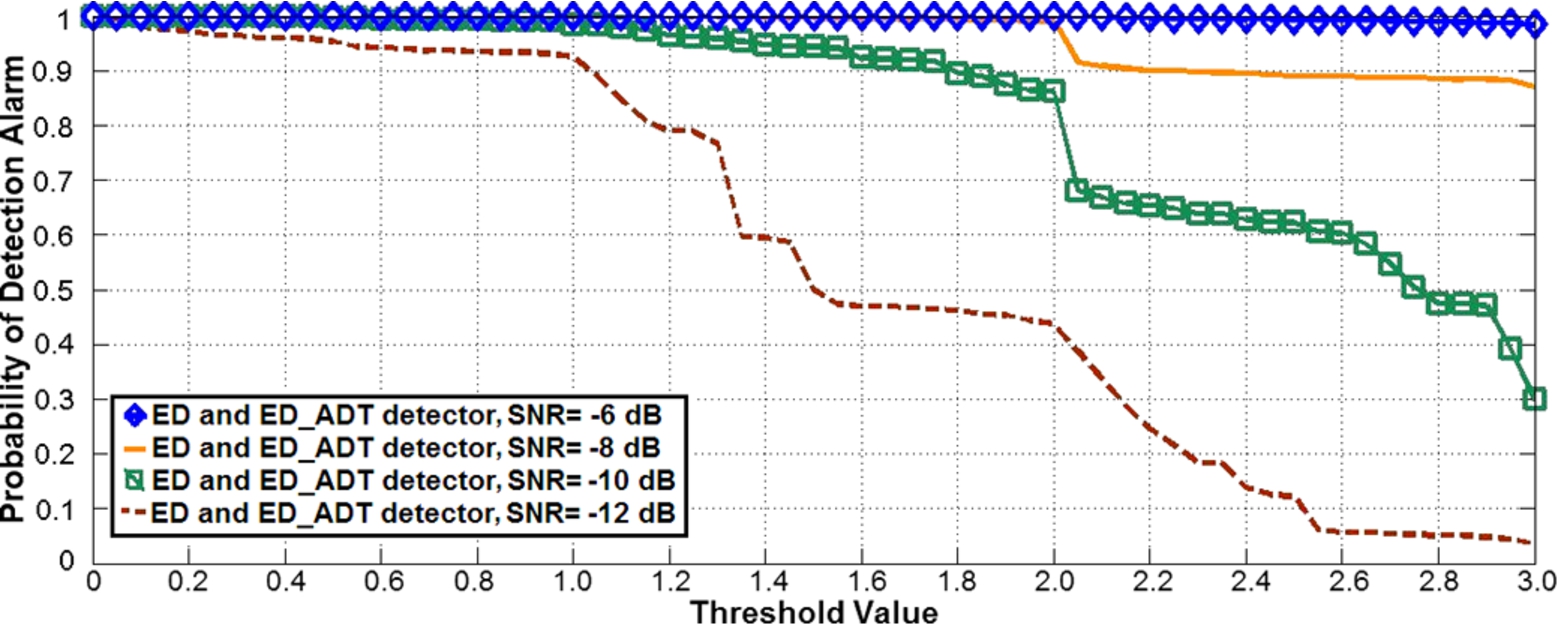
Probability of detection vs. threshold values at
In Fig. 10, we have plotted the probability of detection (
In Fig. 11, we have plotted the probability of detection (
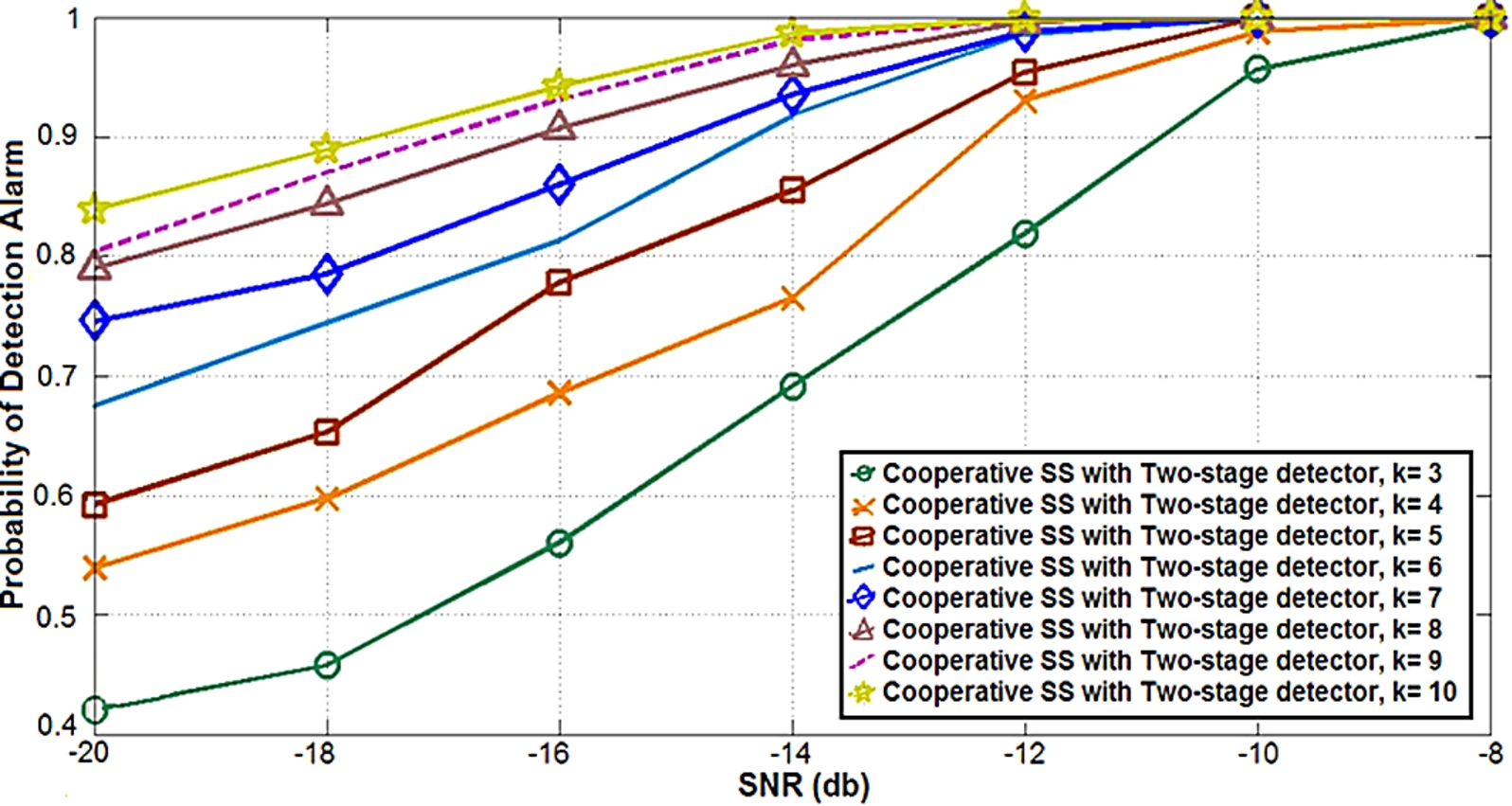
Probability of detection vs. SNR at
In this paper, a dual detector for spectrum sensing in CRN has been proposed. This scheme reduces computational complexity as well as longer sensing time and overcomes sensing failure problem. Numerical results show that proposed reliable SS based two-stage detectors scheme outperforms other two existing schemes, by 12.9% and 15% at −8 dB SNR. It is also shown that the proposed scheme has lesser sensing time than cyclostationary detection and adaptive SS scheme in the order of 5 ms and 0.8 ms at −20 dB SNR respectively and it has also been implemented with CSS scheme, it further shows that when
Footnotes
Acknowledgements
The authors wish to thank their parents for supporting and motivating for this work because without their blessings and God’s grace this was not possible. This paper is a tribute to all peoples who lost their life in Uttarakhand disaster in July 2013.