



Abstract
In cognitive radio (CR) networks, it is crucial for secondary users to quickly detect spectrum holes when prior information of primary users is unknown. This paper proposes a new cooperative spectrum sensing (CSS) scheme based on nonparametric cumulative sum (NCUSUM) to reduce the mean detection delay under the condition of unknown prior information. The proposed scheme consists of secondary users and fusion center. Secondary users preprocess the observation data of spectrum to get positive drifts and negative drifts and only transmit positive drifts to fusion center. Fusion center uses the NCUSUM to accumulate positive drifts to make a fast decision about whether the primary signal is present or not. To ensure the false alarm probability low enough, this scheme notes that the decision can be made in certain time interval. The simulation results show that the proposed cooperative spectrum sensing scheme has better performance in reducing mean detection delay with respect to conventional soft combination schemes.
Keywords
Introduction
With the advent of mobile communications fifth generation (5G) and Internet of things (IoT), the increased demand of wireless services has brought about the global scarcity of wireless spectrum [22]. Cognitive radio (CR) has provided the possibility of higher spectrum efficiency by dynamic spectrum access [9,15,29], for which it is acknowledged as an important technique for future wireless communication to mitigate the spectrum scarcity problem. In cognitive radio, a class of terminals is acquired to sense the radio environment reliably and quickly to change their transmission parameters in time so that CR operators (unlicensed) can utilize the spectral resources without causing interference to the primary (licensed) users [13,39].
According to the amount of priori information about the primary user, the current single node spectrum sensing techniques have developed into several representative categories [11,33]: energy detection, matched filtering [6] and cyclo-stationary feature detection [44]. Among them, energy detection, provided by IEEE 802.22 for spectrum sensing, has been widely applied because of its less requirement for priori information and lower calculation complexity [30,37,40,43]. Therefore, it is considered for spectrum sensing in local CR users throughout this paper.
The single node spectrum sensing will be a tough task in consideration of wireless channel transmission problems (e.g. shadowing, fading and time-varying natures) which can be largely solved by cooperative spectrum sensing [4,14,18,41,42]. Cooperative spectrum sensing (CSS) takes advantage of spatial diversity among local CR users working together effectively. It is centralized if a fusion center collects spectrum sensing information from local CR users and identifies spectrum holes that the primary user is not using authorized spectrum band. The CSS can be distributed when local CR users exploit the observations to decide initially and share decisions with other users to get a final one [17,21]. In centralized CSS, local CR users need to transmit a hard decision or a soft decision (summary statistics) [16]. With hard decisions, binary decision symbols generated by local CR users are transmitted to fusion center in which received signals or corresponding symbols are combined to form the decision statistics [7,32]. Soft decisions increase the bandwidth consumption between local CR users and fusion center but provide better spectrum sensing performance with full information. With soft decisions, metric values computed by local CR users can also be delivered to the fusion center and their weighted sum is used as the decision statistics [12,28,36], which requires the lower bandwidth of feedback channels.
Spectrum sensing algorithms in local CR users can adopt either sequential detection or block-based detection [5]. Sequential detection, which is well studied in [34] and [24], has the better performance of the mean detection delay but requires higher decision frequency. In some cases of spectrum sensing, as noise power is the only given knowledge, the block-based energy detection is usually the approximately optimal solution to spectrum sensing. To get better performance, it is worthwhile to reduce the mean detection delay of energy detection in local spectrum sensing. But if the energy block length is too long, the mean detection delay will be unbearable because the decision tends to be made at the end of energy block. On the other hand, when the block length is too short, the sum of energy value of received signal in an energy block may not be high enough to exceed threshold and make an explicit decision.
Considering the uncertainty of energy block length, the NCUSUM algorithm can be adopted to optimize the detection delay by accumulating the energy value of block continuously so that the length issue of block can be overcome. In [31], E. Page first propose CUSUM which takes full advantage of observation statistics by accumulating past useful detection information to improve the probability of detection. In [25] and [23], the parametric CUSUM is applied in single-node spectrum sensing in CR. In [8], an energy efficient scheme called DualCUSUM is proposed. The DualCUSUM uses parametric CUSUM both in cognitive nodes and fusion center but needs the priori information of primary signal.
In this paper, we adopt the NCUSUM algorithm without the priori information of primary signal in soft combination framework [27]. The improved soft combination algorithm uses NCUSUM in fusion center to handle spectrum sensing information, which is sent from cognitive users, and accumulate the positive drift of observation statistics to decrease the detection delay. In softened NCUSUM combination algorithm, the NCUSUM is used at both CR users and fusion center. The CR users only transmit the positive drift of their observation statistics of local spectrum sensing to fusion center to reduce the mean detection delay.
The rest of the article is represented as follows. The primary signal model is introduced in Section 2. Specifically, the procedure of NCUSUM algorithm is described in detail in Section 3. On this basis, both the improved soft combination scheme and the softened NCUSUM combination algorithm are discussed exhaustively in Section 4. Then, in the Section 5, experimental results are given. Finally, some discussions and the conclusions of our work are given in Section 6.
Primary signal model
According to the IEEE 802.22 WRAN scenario, a CR network with N cooperative users and one primary user is considered in Fig. 1. The N local CR users sense the channel and send observations to fusion center to detect the spectrum holes which indicates the spectrum is free. The N local CR users are stochastically distributed within the signal coverage of the fusion center [35].
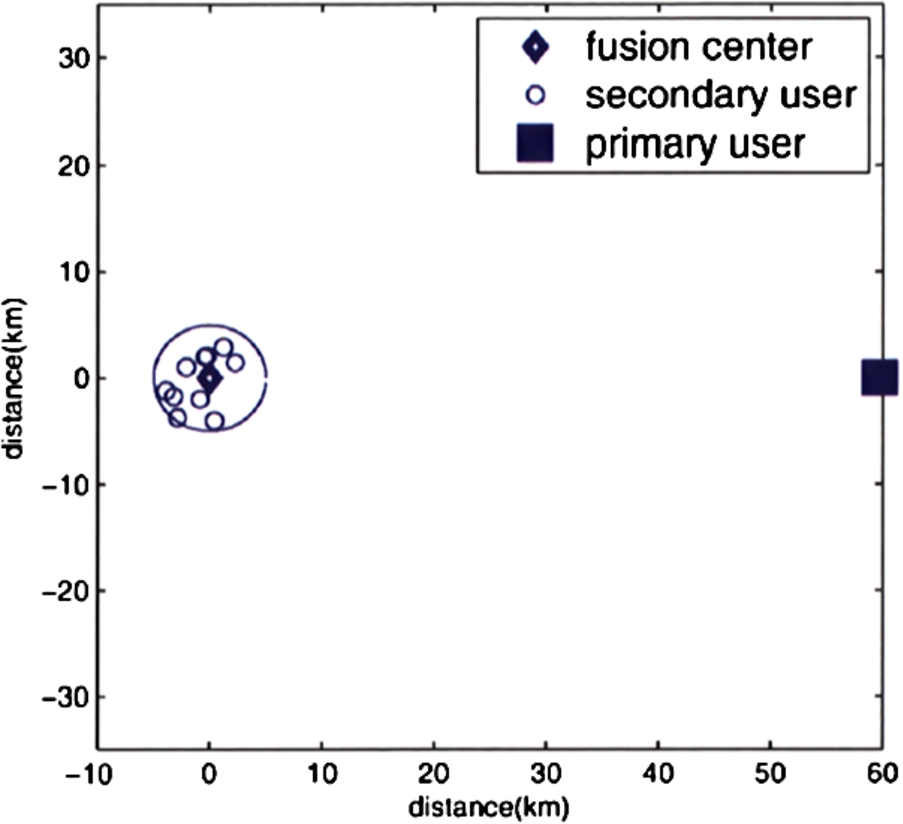
A CR network system consisting of a primary user, N cooperative CR users and a fusion center.
The fusion center is required to detect the status change of the channel authorized to the primary user [19]. If the spectrum holes are not found, it judges that the primary user is present, occupying the spectrum band, and cooperative users stop transmission where a small detection delay will interfere with the primary user to the minimal extent. Otherwise, it decides that the primary user is absent and cooperative users continues using the channel where a short detection delay will provide more spectrum utilization chances for local CR users. It is assumed that cooperative users stop intermittently between their transmissions and sense the channel to see if the primary user is present [2,26]. Cooperative users can also achieve the simultaneous spectrum sensing and data transmission in [1,3,20].
Suppose T samples are utilized when CR user is in the frequency band of concern. As is described in [34], the received signal of the jth CR user,
The detection of the entrance of the primary signal to the band of concern is discussed in this paper while the detection of the absence of primary signal can be analyzed similarly. Initially, the observations follow a distribution
As is described in [24], the mean detection delay is given by
The correlation research around NCUSUM algorithm of change-point detection began in the 1950s and formed a complete theory system in the 1990s [10]. Among current several nonparametric detection algorithms, the NCUSUM detection algorithm has the most popular influence and are most widely applied. It can be applied in spectrum sensing to decide between the entrance and the disappearance of the primary signal quickly. The decision statistics of NCUSUM algorithm is given by
Thus,
Then
Hence,
Because
The performance of the NCUSUM algorithm is mostly determined by the two parameters
The NCUSUM in soft combination
The soft combination improved by NCUSUM
The NCUSUM algorithm is adopted to decrease the detection delay of fusion center in the conventional soft combination of spectrum sensing. In fusion center, there is the desirable feature that the NCUSUM uses past observations to make a decision.
Throughout this letter, energy detection is applied at each CR user. It is known that the energy detector is the simplest detector for the detection of the unknown PU signals. According to Eq. (1), the observed energy at the jth CR user is given by
It is assumed that
The drift constant B is given by
With relation to the
Without loss of generality, to maximize the positive drift of observation statistics, the drift constant can be set as
The relationship between threshold h of NCUSUM and the pre-specified requirement on the probability of false alarm
The procedure of the improved soft combination algorithm, which is showed in Fig. 2, is as follows:
Cooperative users start detecting the channel that is authorized to primary user.
Cooperative users send the observations to the fusion center through transmission channel.
Fusion center deal with the observations and compute the statistics.
Fusion center runs NCUSUM algorithm to decide if the primary user has been using the channel or not.
Fusion center declares a change when
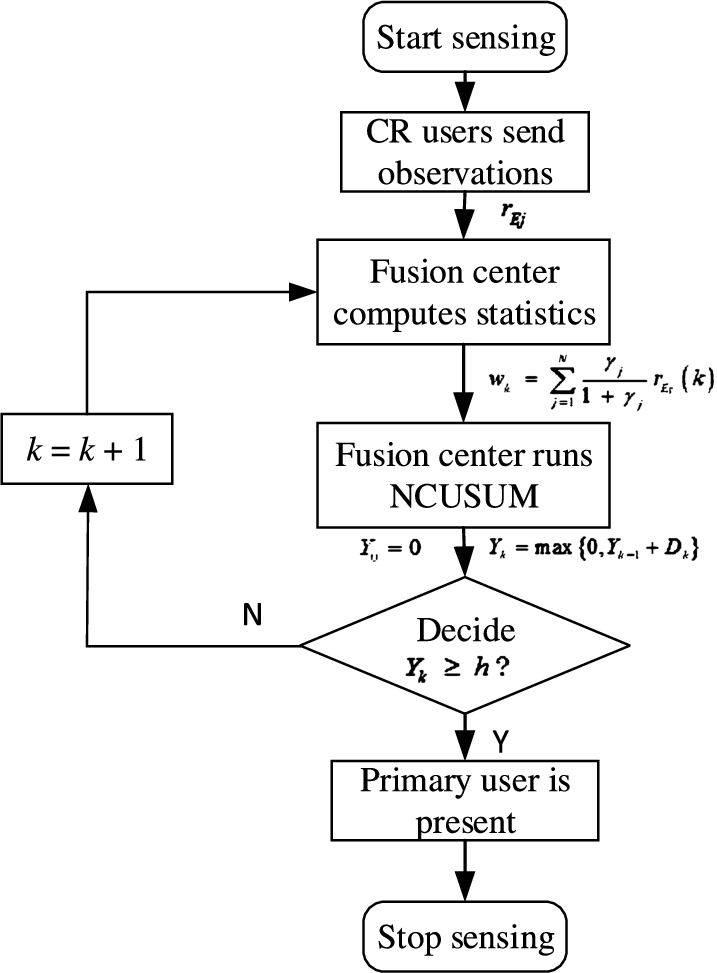
Flow chart of the proposed improved soft combination spectrum sensing method.
Although the soft combination improved by NCUSUM has quick detection of the entrance of primary signal, the mean detection delay will be more lessened if CR users only transmit the positive drift of the original sensing information processed by NCUSUM to the fusion center, which is motivated by the DualCUSUM algorithm in [8]. According to detection statistics
By comparison, the negative drift in CUSUM is present if
Similarly, to maximize the positive drift,
The mean value of positive drift of energy observation statistics received by CR users can be computed as
The variance of
According to central limit theorem,
Thus, in fusion center, the energy observation’s PDF is given by
With the PDF of observation statistics, the drift constant can be computed according to Eq. (15) and fusion center will also use NCUSUM algorithm to handle observations send from CR users.
It is known in Eq. (19) that the spectrum sensing information, which is transmitted to the fusion center in the soft combination scheme, include both the negative drift and the positive drift over the drift constant
The NCUSUM is applied in the CR users to adjust the negative drift of local spectrum sensing observation statistics to zero and then get a set of zero and positive drift, for which the data transmission pressure of soft combination in wireless channel can be put down to some extent.
The procedure of the softened NCUSUM combination, which is showed in Fig. 3, is as follows:
Cooperative users start detecting the channel authorized to primary user.
Cooperative users run NCUSUM algorithm to deal with the observations and get the positive drifts and negative drifts.
Cooperative users send the positive drifts of observations to fusion center through transmission channel.
Fusion center runs NCUSUM algorithm to decide if the primary user has been using the channel or not.
Fusion center declares the primary user is using the channel if
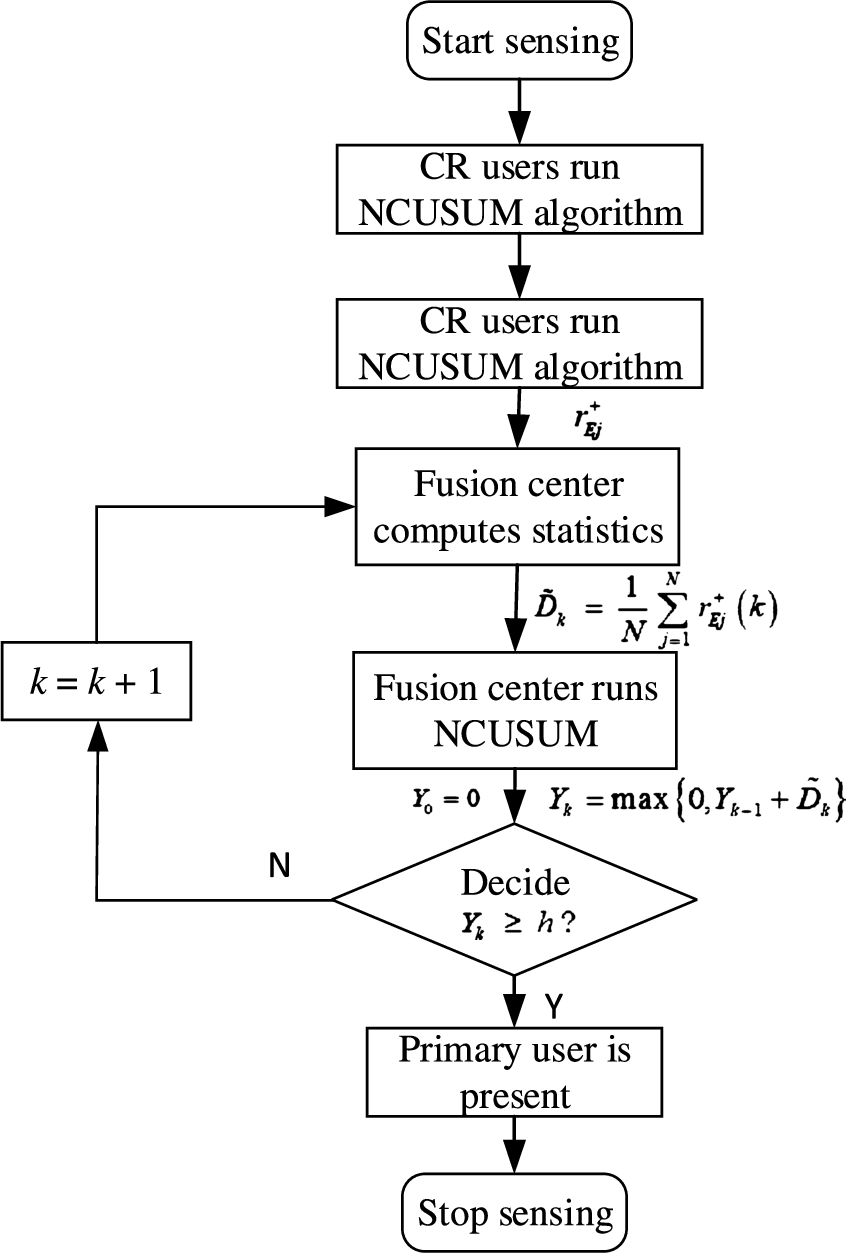
Flow chart of the softened NCUSUM combination algorithm.
In the softened NCUSUM algorithm, CR users only transmit the positive drift of local observation statistics. Although the mean detection delay is lessened, in practical detection process, the threshold h will be surpassed when fusion center accumulates the positive drift from CR users if detection time before τ is longer than
It is assumed that, after the observation statistics
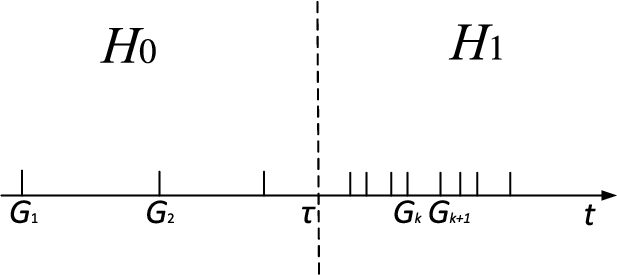
The time when h is exceeded.
Let
After the presence of primary signal, it is obvious that
The interval constant is given by
In practical detection process, the fusion center will not decide immediately when the energy observation
In this section simulation results are presented to illustrate softened NCUSUM combination algorithm and compare its spectrum sensing performance with conventional soft combination scheme, improved soft combination scheme and softened NCUSUM combination. The simulation also shows the corresponding performance of softened NCUSUM combination algorithm when the length of energy block changes and the mean detection delay is related to drift constant B and threshold h.
In simulation, it is assumed that the pre-change distribution
Figure 5 shows that the softened NCUSUM combination algorithm has the least mean detection delay and improved soft combination scheme has better performance in mean detection delay than conventional soft combination scheme. When the SNR is lower than −10 dB, the conventional soft combination scheme is not reliable and quick enough due to the SNR wall, a level below which spectrum sensing fails to be robust to modeling uncertainties. It is also indicated that the delay gap among these three algorithms reduces as SNR increases and inclines to zero when SNR is greater than 4 dB because the interference to primary signal decreases as well, which means that the soft combination scheme based on NCUSUM algorithm perform better in low SNR radio environment.
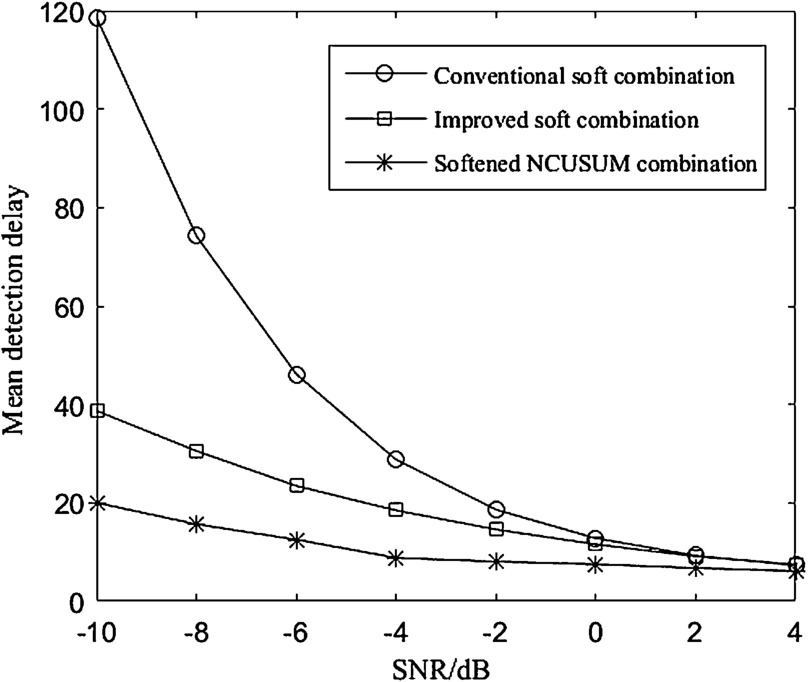
The performance comparison among spectrum sensing algorithms.
Figure 6 shows the contrastive detection delay curves of softened NCUSUM algorithm with different numbers of segment M. It indicates that the mean detection delay will increase when M varies. As the energy block length increases, it will take relatively more time to cumulate the positive drift of observation statistics to exceed the threshold h. According to the inherent disadvantage of energy detection, the selection of energy block length will affect the performance of spectrum sensing schemes based on NCUSUM algorithm.
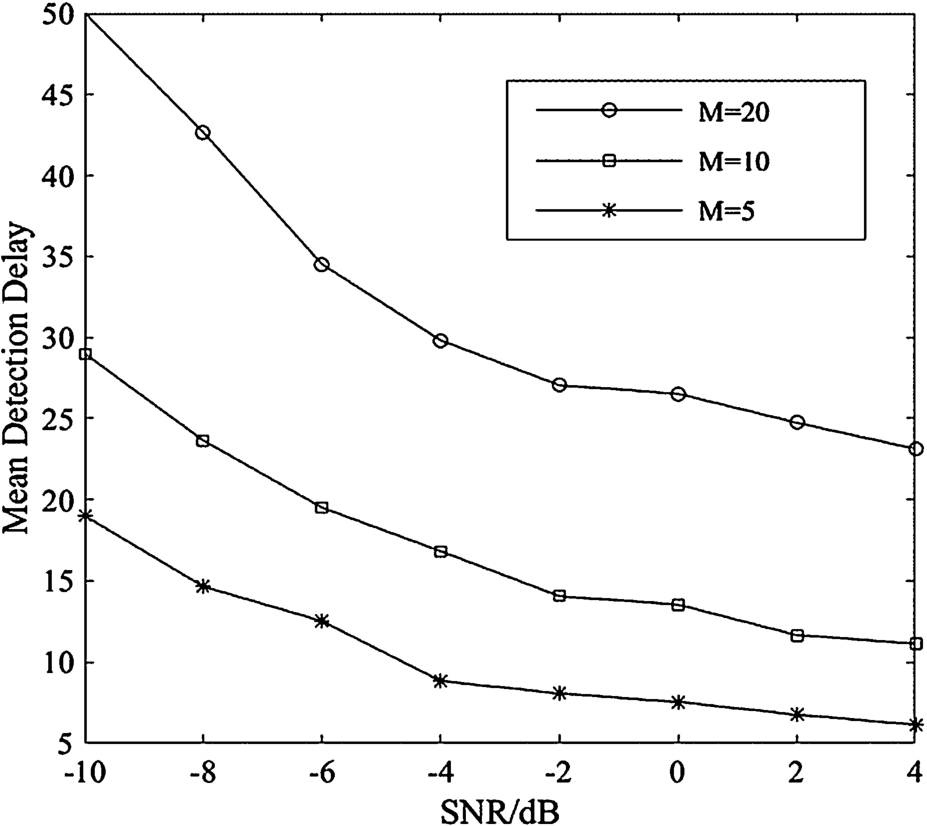
Softened CUSUM algorithm with Ms.
Figure 7 shows, with
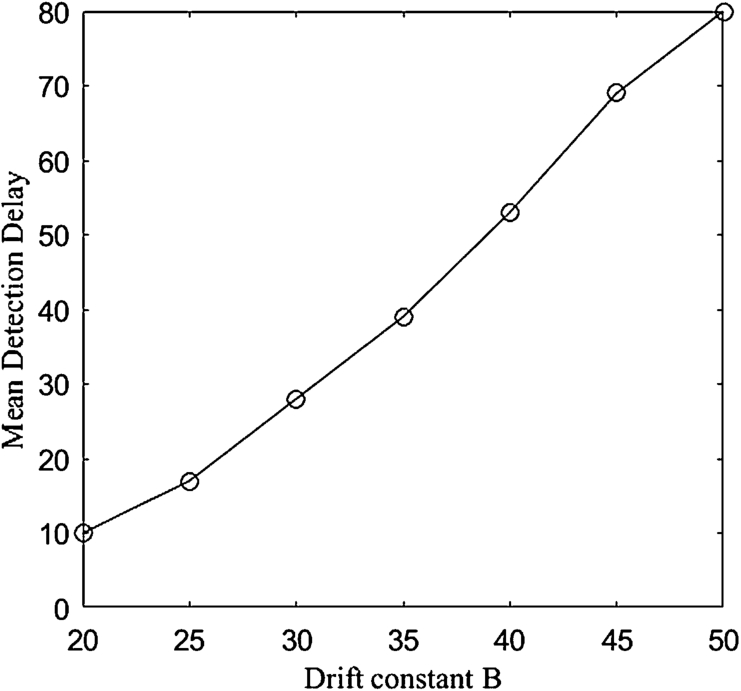
Softened CUSUM algorithm with different drift constant B.
Figure 8(a) shows that the false alarm probability of the improved softened NCUSUM combination algorithm is decreased because fusion center makes a decision with interval constant V. But Fig. 8(b) shows that the detection delay of improved softened NCUSUM combination is also increased due to interval constant V. Therefore, there is a tradeoff between false alarm probability and mean delay detection.
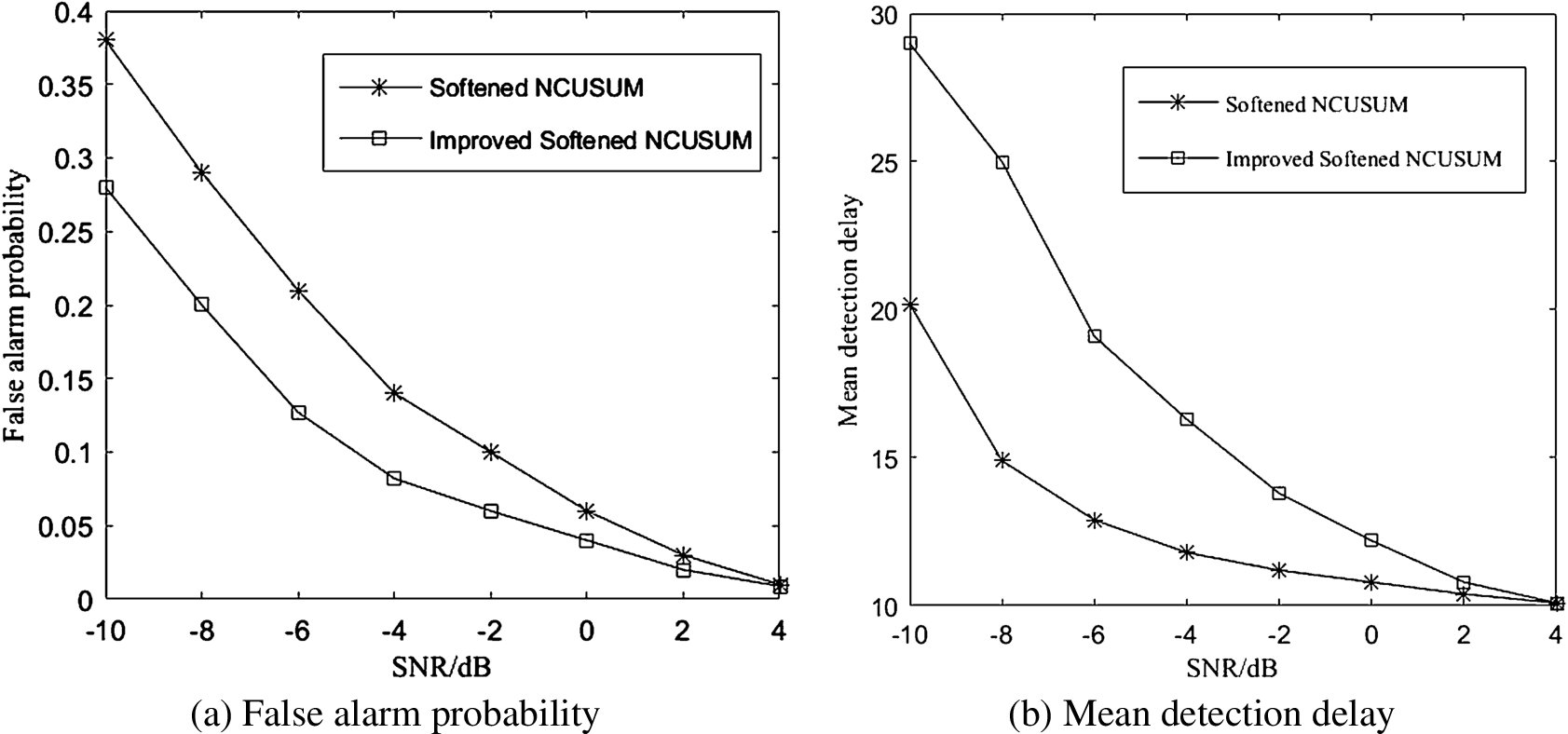
Performance Comparison with interval constant V.
In this paper, we consider the cooperative spectrum sensing based on energy detection and NCUSUM algorithm in CR networks. We provide the improved soft combination algorithm and softened NCUSUM combination over the conventional OC algorithm. The simulation results show that these algorithms have advantages of shorter conditional mean detection delay. We also found that the detection delay will be longer while the segment M increases. It will be our future work to improve the softened NCUSUM combination by specifying the drift constant B and threshold h. The signals will have non-identical fading statistics and signal strengths through different propagation paths to the destination in realistic environments (i.e., independent non-identical distributed).
In the future work, we are planning to take the channel with fading into consideration to be more practical.