



Abstract
In the wireless sensor network (WSN), wireless communication is said to be the dominant power-consuming operation and it is a challenging one. Virtual Multiple-Input–Multiple-Output (V-MIMO) technology is considered to be the energy-saving method in the WSN. In this paper, a novel multihop virtual MIMO communication protocol is designed in the WSN via cross-layer design to enhance the energy efficiency, reliability, and end-to-end (ETE) and Quality of Service (QoS) provisioning. On the basis of the proposed protocol, the optimal set of parameters concerning the transmission and the overall consumed energy by each of the packets is found. Furthermore, the modeling of ETE latency and throughput of the protocol takes place with respect to the bit-error-rate (BER). A novel hybrid optimization algorithm referred as Flight Straight Moth Updated Particle Swarm Optimization (FS-MUP) is introduced to find the optimal BER that meets the QoS, ETE requirements of each link with lower power consumption. Finally, the performance of the proposed model is evaluated over the extant models in terms of Energy Consumption and BER as well.
Introduction
In the wireless sensor network (WSN), the significant power-consuming operation is the wireless communication that considers energy efficiency as a fundamental element [2,5,17,39]. There was a greater challenge with WSN, while employing it to real-life applications. The reason behind this is the presence of “spatially distributed sensor nodes” that are powered by miniature batteries. Therefore, during the design of WSN, the prolonging of a network lifetime and the energy consumptions are the two major problems that need to be considered. In a large-scale WSN, the energy consumption can be minimized by means of transmitting the data from source to destination in multiple hops [25]. A far-off communication technology with reasonable power is the Multiple-Input–Multiple-Output (MIMO) as it brings more than a unit antenna in the receiver as well as transmitter side [6,23,29,41,42].
On the other hand, the “channel fading, interference, and radio irregularity” in complex working environments is more challenging to design the energy-efficient WSN design. The WSN being utilized in diverse applications like fire detection, target tracking is in thirst of ETE, reliability, Quality Of Service (QoS) in terms of “latency and throughput”. Further, the energy efficiency, reliability, and QoS provisioning are the different problems that are mostly influenced by the Medium Access Control (MAC), physical layer, network layer, and transport layers. To achieve the maximal performance in the WSN, it is essential to jointly consider the routing schemes, energy-efficient wireless-communication schemes, power conservation schemes, and reliable transportation schemes. The sensor nodes energy can be economized by integrating the Space–Time Block Codes into MIMO [12,18,28,30]. It is unrealistic to integrate the MIMO concept in the WSN as the WSN utilizes its single antenna for both data transmission as well as the reception [4,37]. The nodes that are near the source node cooperate and coordinate to transmit data, and at the receiving end, the nearby nodes that are closer to the destination node cooperate and coordinate to get the data. Thus, a Virtual Multiple-Input–Multiple-Output (V-MIMO) is established by cooperative communication. Here, the selection of Cooperative Node (CN) needs to be more appropriate [8,15,16,32,40]. In the recent years, there is an expanding interest in the field of the Artificial Intelligence and their strategies for resolving WSNs constrains [1,27].
The multihop virtual MIMO-communication protocol can be designed in the WSN in a cross-layer fashion in order to enhance the “energy efficiency, reliability, and provide the ETE QoS guarantee”. Along with the V-MIMO scheme, the radio irregularity, “hop-by-hop recovery”, multihop routing of wireless communications, and ETE QoS provisioning can be considered together. During the data transfer, the nodes can be arranged into clusters and the CH form a multihop backbone. To attain better performance, the average energy consumption per successful “packet transmission” can be modeled with an optimal set of transmission parameters, which can be fine-tuned by the optimization algorithms [14,32–35]. The major contribution of this research work is to achieve the optimal bit-error-rate (BER) performance is achieved with the proposed Flight Straight Moth Updated Particle Swarm Optimization (FS-MUP) algorithm for enhancing the end-to-end (E2E) reliability, Energy Efficiency (EE), and QoS provisioning in the WSN in a mutual manner.
The rest of the paper is organized as: Section 2 tells about the literature works undergone under the subject. Section 3 describes about the design of system architecture and the energy consumption and quality of service analysis of the protocol: system analysis is addressed in Section 4. Proposed optimization concept for ETE and QoS consideration: objective function and solution are portrayed in Section 5. The resultant acquired with the presented work is discussed in Section 6. This paper is concluded in Section 7.
Literature review
Related works
In 2019, Dey et al. [9] conducted an indoor-outdoor measurement campaign in a virtual MIMO WSN for capturing its propagation characteristics and to derive the definite realizable throughput. On the basis of different spatial transmit antennas arrangements in the measurement location, the Power Delay Profile (PDP) was taken into consideration. Each transmit antenna act as a sensor and based on the measured MIMO channel, the investigation of the achievable information rate and system capacity takes place. The resultant had exhibited higher signal-to-noise ratio.
In 2019, Dey et al. [10] investigated the suggestion that was provided practically for employing distributed MIMO-based WSN with distributed detection-based Decision Fusion (DF) rules. In the “8 × 8 virtual MIMO system”, the propagation characteristics were investigated by conducting an “indoor-to-outdoor” measurement campaign. Here, in different indoor environments, the transmit antennas were considered as the sensors and the DF center in the outside tower were represented as the receiver antennas.
In 2017, Rajeswari and Bhagyaveni [36] described the Posterior Estimation-based V-BLAST Transmission (PE-VBLAST) to enhance the “lifetime” of the “energy-constrained networks” of Virtual MIMO in the WSN. In this research work, the authors have distributed the sensors in a random manner and have utilized the V-BLAST method for data transmission. The cooperative nodes were chosen by the source node before transmitting the data at each hop. They have considered the prior and posterior probabilities for the appropriate selection of the cooperative nodes.
In 2020, Singh and Amin [44] utilized the “multihop V-MIMO technique” in the WSN for long range communication (LRC) with reduced energy consumption and higher data rates. In this research work, the “source-to-sink” route was split into diverse optimum hops, where the employment of the “2 × 2 V-MIMO technique” takes place. The results exhibited that the multihop MIMO technique for LRC in the WSN had satisfied the throughput and delay.
In 2016, Li et al. [22] presented a new virtual-MIMO communication strategy referred as GCMIMO on the basis of the Cooperative Group (CG). The WSN was clustered with GCMIMO and each cluster has two cluster heads namely, Master Cluster Head (MCH) and Vice Cluster Head (VCH) to manage them. It was observed that the proposed GCMIMO was good in improving the energy efficiency and lessening the source data transmission times as they doesn’t require the data collection from the source by the cluster heads.
In 2020, Wang et al. [46] investigated two classification methods in V-MIMO Wireless Body Area Network (WBAN), which was on the basis of the fairness and significance of sensors. The path loss model was utilized for characterizing the RF broadcasting channel in a better way and the log-normal distribution was utilized for modelling the link fading. In the Wireless Power Transfer (WPT) phase, the Maximal Ratio Transmission (MRT) beamforming was adopted and in the Wireless Information Transfer (WIT) phase, the Zero-Forcing (ZF) decoding was utilized. The resultant had exhibited the reliability of the optimal solution.
In 2017, Kanthimathi et al. [20] examined the diverse cooperative USTM in a WSN that prolong its lifetime and neglects the channel estimation. In addition, a Differential Cooperative Energy Minimization Algorithm (DCEMA) was formulated by the authors to diminish the “energy consumption per bit in MIMO”. Here, the number of CN were selected optimally and the minimum energy consumption route was identified for data transfer.
In 2019, Kumar and Amutha [21] proposed an Extended Lifetime with Minimum Energy Consumption (ELMEC) in the WSN for reducing the energy consumption of Cooperative Communication (CC) as well as to increase the network lifetime. Here, the network lifetime was augmented by optimizing the “transmission distance, the number of cooperating nodes of the V-MIMO and the modulation order” simultaneously. As a result, there was an enhancement in the lifetime of the applications.
In 2014, Ciuonzo et al. [8] studied channel-aware DF with a “virtual” MIMO channel in the huge-array regime at the DF center (DFC). The main intention is to develop linear fusion rules, as opposed to the inadequate ideal Log-Likelihood Ratio (LLR). At last, to validate the performance simulation results are presented.
In 2017, Peng et al. [31] investigated a few CMIMO models for various scenarios which include multihop-based, data aggregated as well as clustered schemes. In addition, it examines the execution of CMIMO procedures, which are relied upon to be up-and-comer strategies for green correspondences in current applications.
In 2016, Shirazinia et al. [43] considered the decentralized multi-sensor evaluation hassle in which the sensor nodes detect the noisy adaptation of associated random source vectors. The main aim was to minimize the total power and Mean Square Error (MSE) expose to total power constraint Moreover, the betterment of the presented most beneficial power allocation methods over consistent power allocation was illustrated.
In 2016, Ciuonzo et al. [7] studied channel-aware binary-decision fusion over a mutual Rayleigh flat-fading channel with numerous antennas at the DFC. In addition, the impact of different radio antennas at the DFC for the introduced rules is examined, indicating relating advantages and impediments. Moreover, the impact on exhibitions as an element of the number of sensors is concentrated in a total power requirement.
In 2016, Jayaweera et al. [19] developed virtual MIMO on the basis of communication design for appropriated and distributed WSN. Moreover, the delay efficiencies, as well as the energy of the presented method, are inferred by utilizing semi-diagnostic strategies. The outcomes show that the virtual MIMO could be able to give huge delay and energy effectivenesses, even subsequent to taking into consideration extra training overheads.
In 2016, Rossi et al. [38] offered spectrum sensing for CR where the DFC accomplishes array processing. Moreover, they investigate the effect of client collaboration as well as symmetrical transmissions between Secondary Users (SUs) on the announcing channel. Finally, the analytical outcomes combined with Monte Carlo simulations are introduced.
Problem statement and motivation
In general, a single antenna is being utilized by the WSN that relies on multihop SISO configuration for transmitting data to a longer distance.
However, for long-distance communication, it is not energy efficient and provides a low data rate. Therefore, the V-MIMO technique can be introduced for LRC in the WSN, to lessen the energy consumption and to enhance the data rate. But, a large area is covered by WSN and this circumstance makes the multihop SISO or V-MIMO as a non-feasible one. On the other hand, the V-MIMO technique can find out the optimum hops among the sink and the source and hence result in lower energy consumption. Moreover, the energy efficiency highly depends on the path loss between “transmitter and receiver”. Therefore, it is more important to model the path loss in both multihop and single hop energy-efficient wireless sensor networks. Further, to the reliability of the model can be improved by utilizing the hop-by-hop recovery scheme, where the message will be decoded by the intermediate CH. In the WSN, the ETE QoS provisioning is considered more commonly in the real-time target tracking. Therefore, the QoS requirements need to be satisfied in terms of “ETE latency and throughput”. In every link, the “queuing latency and throughput for packet transmission” is highly dependent upon the “average transmission times per successful packet transmission” and in the hop-by-hop recovery scheme, it can be determined by the “BER performance”.
Accordingly, the determination of the ETE latency and throughput can also be made on the basis of BER performances. Then, for each link, it is essential to choose the optimal BER performance in order to satisfy the “ETE QoS requirements with a minimum energy consumption”. However, the literature lags in attending to the issues with the aid of optimization algorithms. Among optimization algorithms, meta-heuristics are promising. Nevertheless, they remain unexploited for the aforesaid issue though they can address it well. Moreover, meta-heuristics have exhibited remarkable performance on handling multiple objectives with large scale variables optimization. This paper intends to enhance the QoS parameters, ETE, Latency and BER by optimization process for which a sophisticated algorithm is developed to attain relatively better performance.
Design of system architecture
The system model for the proposed “multihop V-MIMO protocol” is manifested in Fig. 1. There are a number of source nodes for data bits collection and these data bits will be transmitted to the remote sink via “multiple hops”. Further, the arrangement of the sensor nodes into

Diagrammatic representation of the virtual MIMO model.
In single-hop communications between the cluster heads, the performance of energy-saving is enhanced by designing an appropriate approach to choose the CNs [47]. During each bit transmission, the average energy consumed by BPSK can be modeled as per Eq. (1). For jth the node, the average channel attenuation can be determined using Eq. (2). In this research work, the channel is assumed to be symmetric and t passes a signal with transmission power
In Eq. (2),
Therefore, Eq. (1) can be modelled as,
As per Eq. (4), jth the node’s transmission power for communication with tth CH is given by Eq. (5).
Then, from Eq. (4), the value of
Thus, the selection of the CNs to communicate with tth cluster head is by the node J with the highest
Protocol modelling
The overall cluster-based “multihop virtual MIMO protocol” is designed in this section and here a multihop backbone is formed by the CH. In each hop transmission, the integration of a cooperative MIMO scheme takes place. Here, for each node, there is a chance for transmitting power adjustment. The proposed protocol’s function is split into rounds and in each of round, there are three phases: cluster formation phase, routing phase, and transmission phase. The organization of clusters and selection of CNs takes place during the cluster formation phase [47]. The construction of the routing table takes place in the routing phase, and in the transmission phase, the data transmission from the nodes to the cluster head and to the sink takes place.
Energy consumption and quality of service analysis of the protocol: A system analysis
Energy consumption estimation
The reliability of the protocol is improved by using the hop-by-hop recovery scheme. Therefore, the intermediary CH decodes and corrects the bit errors in the packet, and then encodes and broadcast it all over again [47]. Thus, for each of the hop, the overall consumed energy is determined jointly by the “energy consumption per time transmission and the average transmission times”.
In the local cluster, the transmission distance is denoted as
Then, for the STBC code, the block size is supposed to be as F and here
On the basis of the aforementioned analysis, the total energy consumption per packet transmission in the jth hop is formulated as Eq. (9).
Therefore, for each hop, the average transmission interval is represented as
E2E QoS model of the protocol
During the data transmission, the minimum energy consumption-relaying route is selected by the CH among other CHs to the sink. Among CH, the multi-hop data transmission topology is treated in the form of a Shortest Path Tree (SPT). Further, in each link, the BER performance
The throughput is defined as per Eq. (13), due to the utilization of the stop-and-wait ARQ scheme.
From the network layer’s viewpoint, the throughput is modelled as the packet service rate and it is denoted in Eq. (14)
The mean E2E throughput and latency for the entire network are given by Eq. (18) and Eq. (19), correspondingly. Equation (20) shows the overall energy utilization of the entire CHs.
Optimization model
Optimization model
Solution encoding and objective function
A nonlinear constrained optimization model referred to as FS-MUP is introduced in this research work to meet the “ETE QoS requirements with a minimum energy consumption”. Since, the selection of optimal BER performance is crucial in each of the links for minimized energy consumption E and to achieve the desired latency

Solution encoding.
PSO [45] is a renowned swarm intelligence algorithm that is good at solving global optimization problems. It was developed on inspiration from the behavior of bird flocking. This algorithm is good in achieving the global best position with higher accuracy. However, it suffers from a slower convergence. On the other hand, the MS algorithm [13] was developed with the inspiration of Levy flights and photo-taxis of the moths. The phototaxis is nothing but the movement of the moths around the source of light and this is explained via several hypotheses. Among them, celestial navigation is a notable one. The celestial navigation is said to be a reason for phototaxis and it is utilized by the moths during the flight in the transverse orientation. In general, these moths maintain a straight line movement with the celestial light (e.g. moon). The MS algorithm is good at solving a complex optimization problem with higher convergence. But, it gets trapped into the local optimum. Therefore, the PSO and MS algorithm are blended together to form a new algorithm termed as FS-MUP. The steps followed in the proposed model are depicted below:
If
If
The pseudo-code of the proposed FS-MUP algorithm is depicted in Algorithm 1.
FS-MUP algorithm
Experimental setup
The virtual MIMO-based Cluster Head Selection (CHS) on the basis of the optimization tactics was implemented in MATLAB and the resultant acquired were noted. To exhibit the superiority of the presented work over the existing works, the evaluation was made in terms of BER, energy utilization and desired latency by varying the count of clusters. In this research, 16 CHs are selected for evaluation, and for each time, the BER is executed for 2000 rounds and here the energy, as well as latency, decreases for each round. The existing models like Lion Algorithm (LA) [3], PSO [45], DA [26], MS [13], and Lion Mutated Dragonfly Algorithm (LM-DA) [24] are taken for comparison. In addition, the evaluation was done by varying four leaf nodes (nodes that were at a maximum distance from sink). The correlation between the presented work (FS-MUP) over the existing works in terms of energy consumption and latency is shown in Table 2 and Table 3, respectively.
Correlation of the presented work over the existing works for energy consumption
Correlation of the presented work over the existing works for energy consumption
Correlation of the presented work over the existing works for latency
The objective function of this work is set as the minimization of energy consumption and achievement of desired latency with the proposed optimization algorithm. For virtual MIMO based CHS, the obtained performance in terms of energy consumption and latency are graphically exhibited in Fig. 3(a) and Fig. 3(b), respectively. This evaluation is made by varying the count of iterations from 0 to 50, respectively. In the graph, the X-axis denotes the count of iterations and Y-axis specifies the acquired concern values for specific measures. In general, the energy consumption is inversely proportional to the data transition efficiency. By having a glance at the graphical resultant in Fig. 3(a), it is clear that the “energy consumption” is very less for the presented work. Initially, the energy consumption of the presented work is found to be a bit higher than LM-DA and as the count of iterations increases the “energy consumption” gets decreased. At the 50th iteration, the energy consumed by the presented work is 4.2%, 3.3%, 2.5%, 5%, and 1.72% better than the existing optimization models like LA-based CHS, PSO based CHS, DA based CHS, MSO based CHS and LM-DA based CHS, respectively. In addition, Latency is the time it takes for a data packet to travel from the sender to the receiver and back to the sender. High latency can bottleneck a network, reducing its performance. In Fig. 3(b), the latency of the presented work is lower than the existing works. On a sudden glace, the presented work seems to be equivalent to the existing, but it is not. At the 50th iteration, the latency of the presented work is 1.45%, 1.32%, 3.5%, 4.9%, and 0.7% better than the existing models like LA-based CHS, PSO-based CHS, DA-based CHS, MSO based CHS and LM-DA based CHS, respectively. Thus, from the evaluation, a clear conclusion can be derived that the presented work has achieved the defined objective.
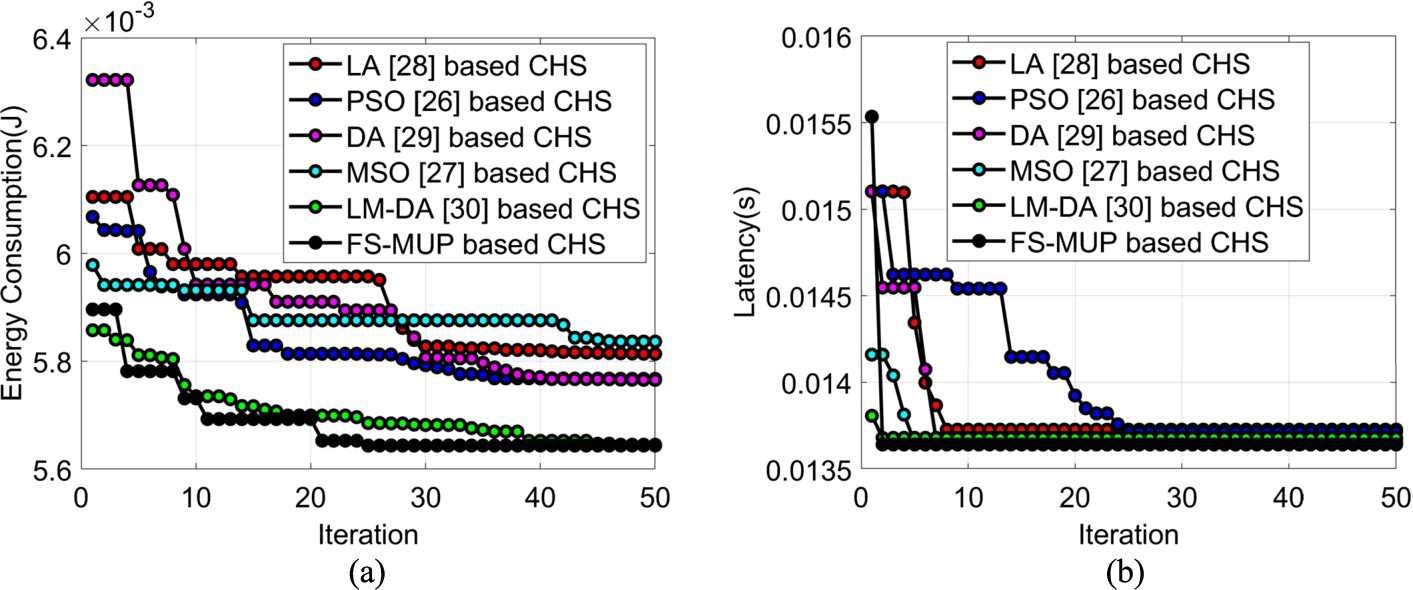
Evaluation on objective function: proposed model and the conventional optimization. (a) Energy consumption. (b) Latency.
This section shows the energy difference evaluation for different leaf nodes. Here, the X-axis denotes the count of rounds and Y-axis denotes the acquired energy difference for “Leaf node-1, Leaf node-2, Leaf node-3 and Leaf node −4” in Fig. 4, respectively. The long-range communication becomes infeasible with long network radii, as the energy consumed to transmit data towards the sink directly is higher. Hence, the network lifetime decreases. Therefore, the difference in energy levels between near-to-the-sink nodes needs to be minimal. As per this, there is a clear view that the presented work has the lowest Energy Difference for diverse Leaf Nodes. On observing “leaf node-1, Leaf node-2, Leaf node-3 and Leaf node −4”, in Fig. 4(a), Fig. 4(b), Fig. 4(c) and Fig. 4(d), respectively, the energy difference of the presented work is lower than the existing works. The energy difference between the presented and the existing works are analyzed. The acquired difference results with negative value mean that the energy consumption gets increased and hence the life span gets decreases. However, the obtained value is positive, which shows that the existing methods consume more energy for all the leaf nodes under varying rounds.

Energy difference analysis of proposed and existing models for (a) Leaf Node-1, (b) Leaf Node-2, (c) Leaf Node-3 and (d) Leaf Node-4.
In general, the box plot (also known as box and whisker plot) is a “type of chart often used in explanatory data analysis to visually show the distribution of numerical data and skewness through displaying the data quartiles (or percentiles) and averages. Box plots show the five-number summary of a set of data: including the minimum score, first (lower) quartile, median, third (upper) quartile, and maximum score”. The box plot of LA-based CHS, PSO based CHS, DA based CHS, MSO based CHS and LM-DA based CHS are shown in Fig. 5. Here, the X-axis denotes the count of the cluster and Y-axis shows the achieved BER rate. In Fig. 5(a), the median BER performance of DA, LA rises when the count nodes = 5 and count nodes = 4 after than it varies in smaller steps. The BER performance of the presented work is found to be more consistent than the existing one and hence proved that the extant approaches attain better performance with minimal data outliers.
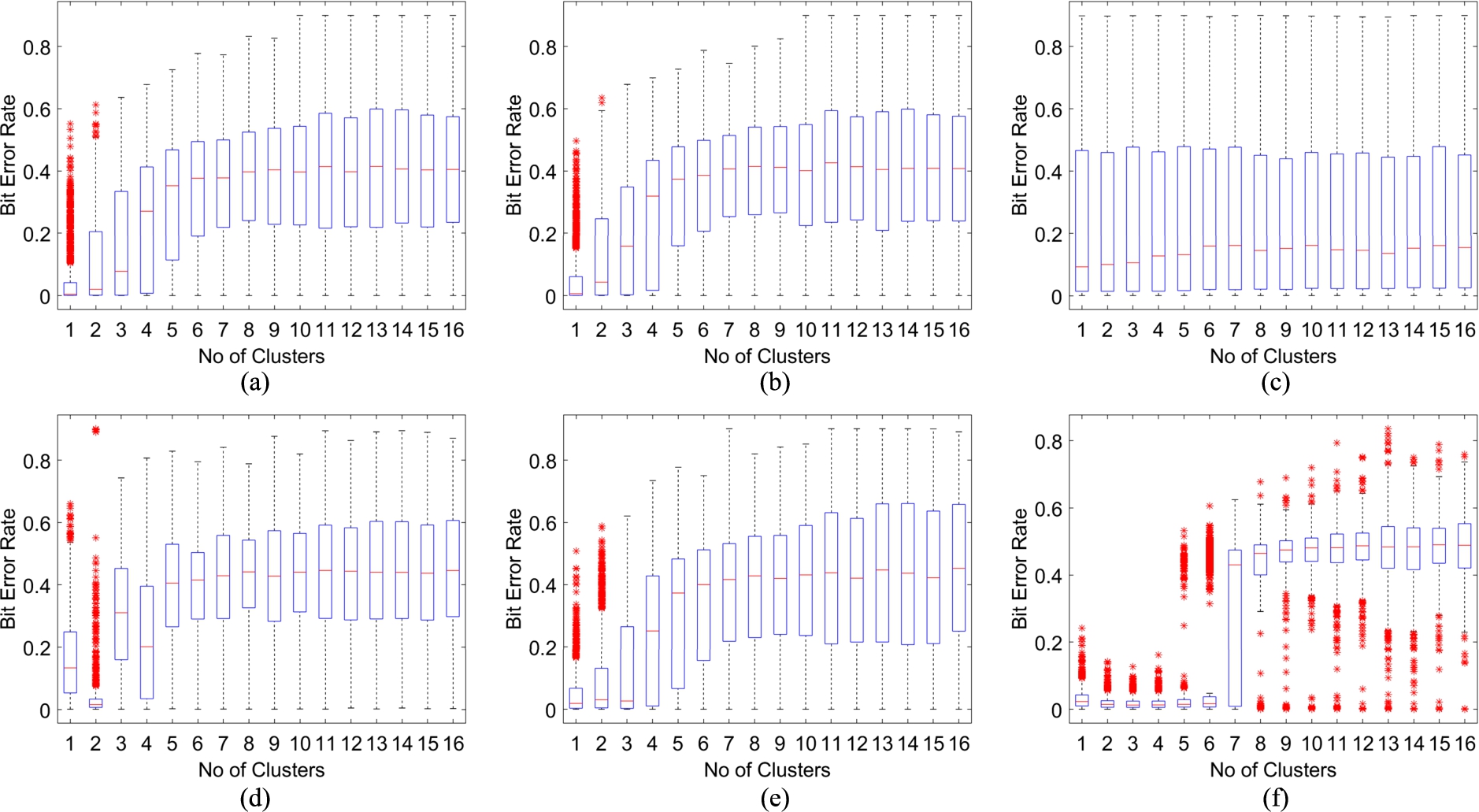
Bit error rate analysis of proposed model and conventional schemes. (a) DA based CHS, (b) LA-based CHS, (c) LM-DA based CHS, (d) MSO based CHS, (e) PSO based CHS, (f) proposed model based CHS.
This section discusses the computational time of the proposed and the conventional models, which is depicted in Table 4. The proposed FS-MUP model is 36.35%, 26.13%, 55.41%, 70.52%, and 26.64% better than LA, PSO, DA, MSO, and LM-DA algorithms. From the table, it can be seen that the proposed FS-MUP model takes less time to compute when compared over other conventional approaches.
Computational complexity of proposed and conventional schemes
Computational complexity of proposed and conventional schemes
A “novel multihop V-MIMO communication protocol” was designed in the WSN via “cross-layer design” to enhance the “energy efficiency, reliability, and end-to-end (ETE) and QoS provisioning”. In addition, the optimal set of parameters concerning the transmission and the overall consumed energy by each of the packets was focussed on the proposed protocol. On the basis of BER, the modeling of ETE latency and throughput of the protocol takes place. A novel hybrid optimization algorithm referred as FS-MUP was introduced for finding the optimal BER that meets the QoS. ETE requirements of each link with lower power consumption. Finally, the performance of the proposed model is evaluated over the extant models in terms of Energy Consumption and BER as well. At the 50th iteration, the energy consumed by the presented work is 4.2%, 3.3%, 2.5%, 5% and 1.72% better than the existing optimization models like LA-based CHS, PSO based CHS, DA based CHS, MSO based CHS and LM-DA based CHS, respectively. At the 50th iteration, the latency of the presented work is 1.45%, 1.32%, 3.5%, 4.9% and 0.7% better than the models like LA-based CHS, PSO based CHS, DA based CHS, MSO based CHS and LM-DA based CHS, respectively. Thus, from the evaluation, a clear conclusion can be derived that the presented work has achieved the defined objective. In future work, with an intention of saving more energy of the network and longer transmission distance, we may optimize the relay network and utilize the joint transmission.
Conflict of interest
None to report.