



Abstract
This paper aims to improve students’ learning performance by optimizing their mental stresses in learning through proposing a new course timetabling method. This new method is based on two hypotheses that formulate the link between course timetabling and learning experience: i) a student’s learning performance is superior when the student is subject to moderate stress; ii) an individual’s mental capacity varies during a day according to Circadian Rhythm. The student’s mental stress in taking a course is defined as a function of their mental capacity and the workload required by the course. The workload is determined by utilizing a multi-criteria prioritization technique—Analytic Hierarchy Process. As a result, the timetabling problem is formulated as a mixed-integer linear programming model, which is tested on an engineering program to produce a student-centered timetable for its scheduled courses. This new method differs from traditional course scheduling and timetabling approaches, which are usually tackled as a constrained optimization problem with an objective to optimize a given set of criteria, such as student and faculty preferences, walking distances between consecutive classes, classroom utilization and operating expenses.
Keywords
Introduction: Academic success, course scheduling and timetabling
The course scheduling problem at higher education institutions deals with the assignment of courses in predetermined timeslots and classrooms based on the availability of faculty members and classrooms. The quality of a course scheduling directly impacts the degree completion times. Furthermore, course scheduling is closely linked to the quality of the learning environment, through considering different criteria such as walking distances between consecutive courses, and break times for students and faculty members. The goal of traditional course timetabling methods is to generate a set of feasible options for students to complete their studies within a given timeline by considering the constraints such as optimal classroom usage, course instructor preferences, and walking distances between classrooms (Kwok et al. 1997).
In the present research work, we bring a new dimension to the course scheduling problem, which is the impact of mental stress on learning performance. Nguyen and Zeng (2012) showed that individuals are more creative when they are subject to a certain level of stress. When stress level is too low or too high, creativity and attention are reduced significantly. On the other hand, a moderate stress elevates the performance. This phenomenon is described by eustress (Selye, 1946). While several factors impact on stress, researchers formulated stress as a function of cognitive capacity (knowledge, skills and the environment) and the required workload to complete a task. From several cognitive science studies, we know that the cognitive capacity of an individual changes significantly depending on the time of the day and the day of the week (Kleitman, 1933; Randler and Frech, 2006; Blatter and Cajochen 2007, Razavi 2019). These well-established relationships between cognitive capacity, mental stress and require workload enable us to propose a new course scheduling and timetabling philosophy. Accordingly, we hypothesize that a course timetabling approach which considers the impact of mental stress on learning performance would lead to a superior learning environment (Razavi 2019). In this paper, we also provide the scientific evidences that student mental stress can be controlled by course timetabling. Consequently, through systematically blending the cognitive science and the operations research, a new course timetabling methodology is introduced.
The remainder of this paper is organized as follows. The second section presents methods and results of the related work. The third section discusses the research hypotheses, assumptions and presents the mathematical model. Section 4 presents a case study of the new course scheduling model, and finally in Section 5, conclusions and future work are discussed.
Literature review
In this section, we provide a brief background on mental capacity, mental stress, creativity and learning performance and course scheduling areas. We summarize the literature in three sub-sections. First, we provide a background for topics such as cognition, mental stress and learning capability. Next, we briefly summarize the literature on teaching environment and its impact on learning. Finally, in the third sub-section, we discuss the course scheduling and timetabling.
Review of literature on cognition and mental capacity
Historically, the cognitive science literature has studied the impact of mental stress on learning performance. Wilke et al. (1985) showed the existence of a relationship between mental stress and learning performance. Their studies indicated that when individuals are subject to either too low or too high mental stress, their performance will be significantly reduced. They further concluded that there exists an inverse U-shape relationship between mental stress and performance. Later, Nguyen and Zeng (2012, 2016) formulated mental stress as a function of workload and mental capacity, and they defined mental capacity as a function of knowledge, skill, and affect (see Fig. 1 for illustration). The relationship between mental stress and creativity is provided in Fig. 1(a); and an illustration of how mental stress is formed is provided in Fig. 1(b).

Creativity and mental stress relationship and mental capacity components (Nguyen and Zeng, 2012).
When it comes to learning, scientists have identified two types of responses against stress: distress and eustress (Selye, 1946). While stress is considered as bad in general for human health and performance, various studies show that if individuals can generate eustress in response to workload, the results may be positive. Studies on medical students (Ramesh Bhat, 2011) and nursing students (Gibbons, 2008) show that students who reacts with moderate stress before exams perform better. Nguyen and Zeng (2012) showed that eustress is only possible when an individual is exposed to a moderate workload. In another word, if the workload and the person’s cognitive capacity is compatible (difficult tasks require higher cognitive capacity, easy tasks require lower cognitive capacity), that the individual will be exposed to a moderate workload where eustress is possible. This behavior known as eustress in literature further supports the hypothesis proposed in this paper.
It is known from cognitive science that a person’s cognitive performance changes significantly during the day (Blatter and Cajochen 2007). Randler and Frech (2006) showed that morningness and eveningness influence school performance. Kleitman (1933) studied the relationship between the speed and the accuracy of cognitive performance and the time of day when a task was being completed. He studied subjects performing eight given qualitative and quantitative tasks to understand if their performances change depending on the time of the day. As illustrated in Fig. 2, Kleitman’s work concluded that the cognitive performances of individuals change significantly during the day for both quantitative and qualitative activities and follow a common pattern for the majority of the population. This study demonstrates that individuals perform best in the early afternoon and poorest during early mornings, late evening and night hours. Kleitman later explained that the variation in cognitive performance is due to variation in human body-temperature during a day (Kleitman et al. 1938). Kelitman’s findings are widely accepted in cognitive science and are frequently used in human performance studies (Randeler and Frech 2006, Blatter and Cajochen 2007, Goel et al. 2013).
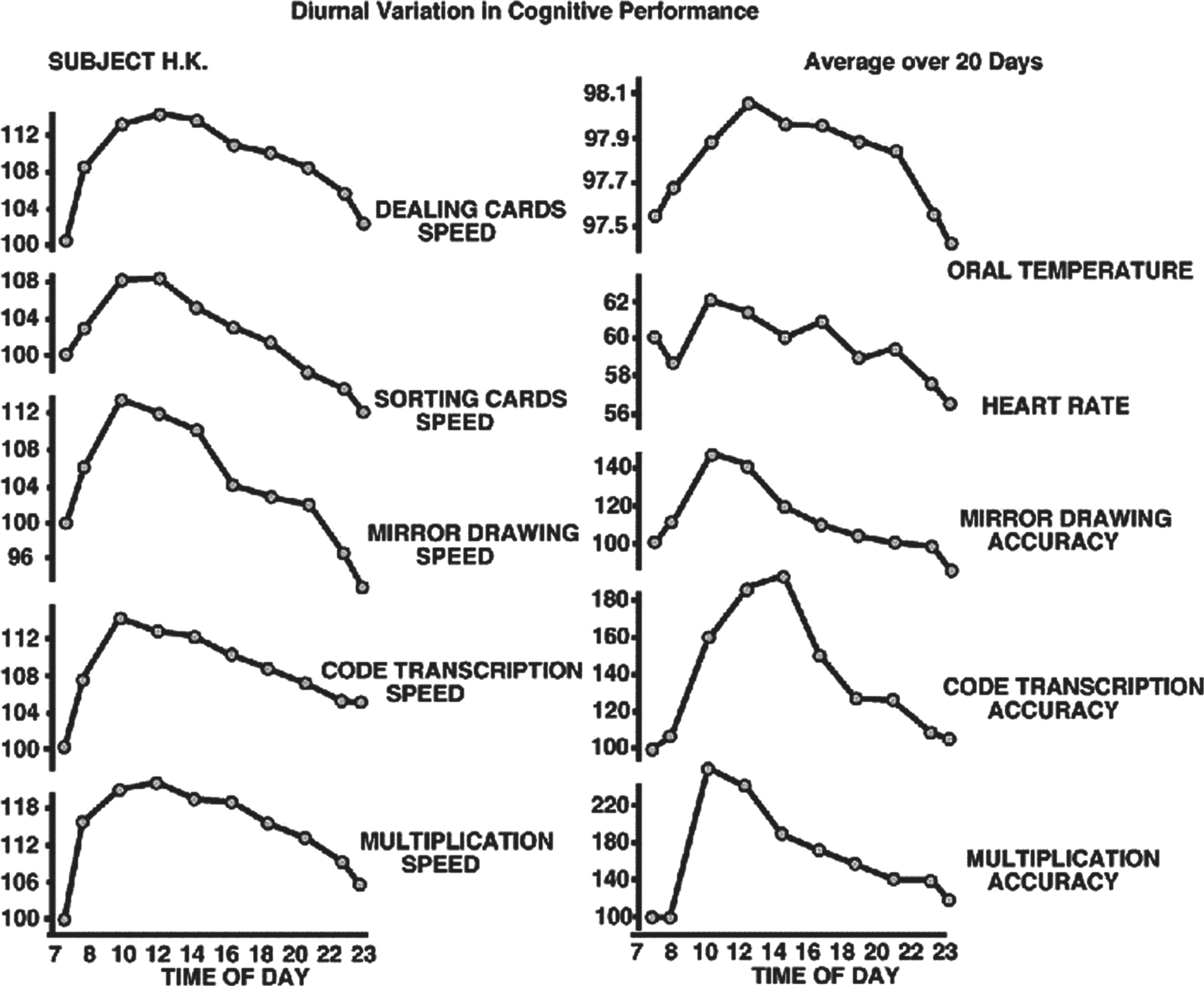
Effect of time of day in cognitive performance (Kleitman 1933).
As discussed above, the learning performance varies depending on several factors. While several research results have been reported in the literature concerning that affect and learning performance (Tatarinceva et al. 2017, Mohd et al. 2017), to the best of our knowledge, no academic study has considered timetabling as an influential factor for learning performance.
Learning is described as a multi-stage process in the literature: i) unconscious incompetence, when an individual does not know and does not recognize; ii) conscious incompetence, when awareness of the lack of skills is developed; iii) learning stages, when skills are developed and applied (Cannon et al. 2014). Environmental factors influence learning performance, and the effectiveness of the learning environment depends on several factors. The work of Chang and Beilock (2016) concludes that poor math performance at the global level is linked to two main factors: individual and environment. Cognitive and physiological state and the motivation are considered individual factors. On the other hand, social and contextual inputs are considered as environmental factors.
Frenzel et al. (2007) analyzed mathematics classrooms to understand the level of relationship between perceived learning environmental and students’ emotional experience. Authors selected four types of emotions (enjoyment, anxiety, anger, and boredom) as these emotions are found to be more influential on learning and achievements. Their study showed the strong relationship between learning environment and students’ emotional experience. Moreover, authors concluded that there exists a close link between individual’s emotional experience and their performances in math assessments. Interestingly, at the classroom level the correlation between the academic performance and the emotional experience were still significant but weaker. Authors explained this difference through internal dynamics of the classrooms. Competition between students in high achieving groups, despite that they have high math scores, leads to the development of negative emotions such as anger and anxiety among some students. Yet, even with large variations among group levels, the study of Frenzel et al. (2007) showed strong correlations between the learning environment and students’ performances.
While Frenzel et al. (2007) focused on math classes only, Valsiner (1997) studied learning environment in more general terms but focusing on only a few criteria by defining intellectual capability as a function of knowledge, beliefs and interaction with the environment. Later, Geiger et al. (2017) utilized Valsiner’s zone theory to analyze how positive encouragement in class impacts the quality of learning. Anggrainingsih et al. (2018) further considered instructors’ perspectives (financial policy, regulatory policy, course quality, relevant content, and technical support) and students’ point of views (quality of course, relevance of content, completeness of content, attitudes toward peers, and flexibility in taking the course) as types of influential factors impacting learning quality. These studies also demonstrated a strong correlation between learning environment and students’ academic performances, and retention rate (Robert, 2010).
Al-Fraihat et al. (2017) reviewed the literature on factors impacting learning performance. Their main focus was online teaching. Their analysis concluded that from an over 100 different influential factors, 10 main groups can be established: planning, readiness, management, support, pedagogy, technology, faculty, institution, evaluation, and ethics. In their multifactor analysis, Frenzel et al. (2007) also considered several of these factors as part of the learning environment. Other studies also concluded that learners, instructors, types of courses, technology, design and environments are different dimensions, which impact on students learning quality (Sun et al. 2008).
Review of literature on course scheduling
Course scheduling and timetabling are treated as optimization problems, with an objective to optimize the usage of available facilities and to ensure the equitable consideration of students’ and course instructors’ expectations (Boland et al. 2008). A brief summary is provided below for the literature closely related to the proposed course timetabling problem.
Li and Li (2015) considered course characteristics (e.g., logical, experimental, analytical, etc.) as the foremost important factor in a course scheduling problem. Moreover, course duration (shorter duration has higher priority) and classroom sizes (larger class has higher priority) are incorporated in their course timetabling model as the secondary level influential factors. Köksal (1998) applied Quality Function Deployment to identify important criteria with an objective to improve industrial engineering education. Ismayilova et al. (2007) proposed a timetabling formulation that optimizes overall preferences of both administration and course instructors. In their study, desired working conditions of course instructors are evaluated by utilizing the Analytic Hierarchy Process (AHP) and Analytic Network Process (ANP), so that course instructors’ preferences are fully incorporated in the decision-making process. Several other researchers have also considered course instructor preferences in the modeling of course timetabling problems (Shiau, 2011, Hakim et al., 2016, Boland et al., 2008, Gunawan et al., 2007M). Morrow (2017), on the other hand, analyzed the course timetabling problem from students’ point of view with an objective to minimize the graduation time and the incurred costs. Chi (2009) proposed an ontology-based system to sequence courses according to their semantic relationships.
In a different line of study Zmunda and Hatch (2007) evaluated the impact of multi-block teaching on students; comprehensions of recursion concept. In their work, they compare the performance of students when their courses are scheduled in single-blocks and two-blocks timeslots. Their study concludes that students from single-block classrooms solves problems faster. While authors did not comment on the environmental impact, according to aforementioned literature on emotion-environment and learning relationship, we can argue that changes on environmental factors may lead to different quality of learning.
The course timetabling problem has also been considered as a computational complex operations research problem (Pongcharoen, 2008, Juang, 2007). As the problem size increases (number of courses, classrooms, students and course instructors), converging to an optimum solution in linear time becomes highly unlikely. Consequently, a number of solution strategies have been proposed for solving timetabling problems in the literature. Heuristic methods have been utilized widely for optimizing the courses’ timetables through considering different criteria such as pre-assignment of classes, provision of lunch and dinner breaks, reservation or blocking of certain periods (Loo et al. 1986). It is noteworthy to mention that heuristic methods are helpful in different problem solution models including Graph theory methods and linear optimization models (White and Wong 1988). Yazdani et al. (2017) proposed three meta-heuristics (artificial immune, genetic algorithm, and simulated annealing algorithm) to solve a course timetabling problem. Their objective is to maximize instructor preferences while minimizing the number of classrooms used. Saptarini et al. (2017) and Aycan and Ayav (2009) utilized genetic and simulated annealing algorithms, respectively. Shiau (2011) also introduced a hybrid particle swarm optimization method to solve the course timetabling problem. Boland et al. (2008) proposed a blocking method where classes are partitioned according to their relevance so that the course timetabling problem can be solved in linear time. Finally, Babaei (2015) presents an extensive coverage of course scheduling and timetabling methods in their literature review paper.
As discussed in the aforementioned literature review, a large body of proposed mathematical models for course timetabling aims at addressing the expectations of administration and course instructors. Only a handful of studies are found to be studying course scheduling from the student point of view (Morrow et al. 2017). On the other hand, the cognitive science literature on learning quality considers student needs more closely in their models (Sastry et al. 2016, Geiger et al. 2016, Anggrainngsih et al. 2018). Degrees offered by universities consist of various courses with varying difficulty levels, which determine the required mental (cognitive) efforts to study those courses. Accordingly, it can be hypothesized that the course difficulty level is a good measure of the required mental capacity. It is suggested by Kelitman (1933), Randeler and Frech (2006), and Blatter and Cajochen (2007) that the cognitive capacity of individuals changes during the day according to Circadian Rhythm (see Fig. 2 for illustration). Furthermore, Nguyen and Zeng (2012) showed that people produce their best performances when they are subject to moderate stress, which can be achieved when the mental capacity and required workload are at similar levels (Fig. 1). Considering that Circadian Rhythm is a biological phenomenon and may not be controlled easily without medical intervention, the workload of courses should be matched with students’ mental capacities to sustain the desired stress level that is optimum for learning performance.
Hence, the objective of this paper is to introduce the findings concerning learning quality from cognitive science into the traditional course timetabling problem. The ultimate goal of this timetabling model is to design a superior learning environment for students. In order to achieve this goal, the relationship between learning environment and learning quality is firstly established. Next, students’ mental stresses are described as a function of their mental capacities and the course workload demands. Moreover, the controllable factors to regulate mental stresses are identified. Finally, a new course scheduling method based on learning capabilities is introduced. A mathematical model is formulated to produce a timetable for a set of scheduled courses with an objective to stimulate learning by keeping students’ mental stresses at an optimum level (Razavi 2019).
Impact of learning environment on learning quality: Methodology and formulation
The course timetabling method discussed in this paper requires a good understanding of the notion of course workload demands (difficulty levels of courses) and cognitive capacity of students. In order to incorporate these two attributes into a course timetabling formulation, the quantifiable measures that represent them must be defined. In the neuroscience literature, cognitive capacity is well defined as a function of a person’s reaction speed and the accuracy (Kleitman et al. 1938, Randler et al. 2006, Blatter et al. 2007, Kleitman 1933). The literature further suggests that a person’s cognitive capacity varies significantly during a 24-hour cycle which is known as Circadian Rhythm (Kleitman 1933). As seen in Fig. 2, for a person performing various tasks, his/her performance during a day can be measured accurately. On the other hand, we hypothesize that the average GPA of a course is a good quantitative measure of the course workload demands.
As discussed earlier, mental stress (σ) is a function of required Workload (W) to perform a task and a person’s cognitive capacity (C) (Nguyen and Zeng 2012, Nguyen and Zeng 2016). Hence we depict mental stress as:
Mental capacity, on the other hand, is defined as a function of knowledge (K), skill (S) and the emotion (affect, A). Hence:
Consequently, we can measure mental stress as:
It must be noted that Eq. (3) is a qualitative representation of the causal relationships between mental stress and workload, knowledge, skill, and affect. From the literature, we further know that the quality of work (performance) (P) and mental stress has a U-shaped relationship. When σ is too low or too high, P tends to be lower (Wilke et al. 1985). The literature suggests that people require a moderate level of stress in order to perform at their best (Yerkes-Dodson, 1908 and Nguyen and Zeng 2016).
Based on the aforementioned discussions, it can be concluded that academic institutions have the potential to stimulate students’ learning performances by optimizing students’ mental stresses through an optimal course scheduling. Factors impacting stresses are the course difficulty level (W) and mental capacity (C). The difficulty level of a course (W) is inherently coupled with the materials covered in the course and may not be easily modified. Hence, as part of this study, we assume that W is constant for a given course. Cognitive capacity, on the other hand, depends on three different factors: K, S and A. Students’ competency at K and S are directly linked to the student’s academic background. In this study we assume that institutions have already established a good curriculum map to ensure that their students develop the necessary knowledge and skills. The affect (A) varies depending on the environment. Therefore, through controlling the environmental factors, there is a potential to maximize the cognitive capacity of students and consequently their performances.
Let us now assume that A is defined as environmental factors impacting the learning performance. In most cases, environmental factors—such as the location of the campus, traffic conditions, pollution, and age of the infrastructure—may not be easily controlled by the university authorities. The objective of the decision makers should be to provide the best learning conditions by adjusting the controllable factors. In the context of the overall course scheduling problem, the controllable factor which is part of the environment (A) is the timeslots when courses are offered. Therefore, the objective of course timetabling should be to identify timeslots for course offerings based on their expected workloads (course difficulty levels, in our case) and the students’ cognitive capacity, in such a way that the student’s stress level is sustained at an optimal level for learning. From the literature, we know that Circadian Rhythm provides a good benchmark for the mental capacity (see Fig. 2). Hence, we hypothesize that the Circadian Rhythm is a good estimator for A. Therefore, based on the work of Nguyen and Zeng (2012), timetabling courses according to their difficulty levels (workload demands) in coordination with the Circadian Rhythm (less demanding courses are scheduled when mental capacity is low and high demanding courses are scheduled when mental capacity is high) has the potential to deliver a more favourable learning condition. Figure 3 illustrates how the students’ stress level changes due to Circadian Rhythm for a given course. Since the workload of a given course (W) is constant regardless of the time of the day when it is offered, stress level, which impacts learning quality, changes significantly due to Circadian Rhythm. In Fig. 3(a), the best timeslots to schedule this course would be Zones 2 and 4 where the moderate stress levels are observed. In Zone 3, the stress level is too low to stimulate students’ attention. In Zones 1 and 5, students’ stress levels are too high to cope with the course demands. Based on this analysis, we propose that academic institutions should develop course scheduling strategies to keep students’ stress at an optimal level for learning. As seen in Fig. 3(b), such an objective can be obtained by assigning less demanding courses in timeslots when cognitive performance is low, and more difficult courses in timeslots when cognitive performance is high (Razavi 2019).

Stress level variation based on Circadian Rhythm and constant workload (Razavi 2019).
As discussed earlier, mental stress (σ) is a function of required Workload (W) to perform a task and a person’s cognitive capacity (C) (Nguyen and Zeng 2012, Nguyen and Zeng 2016). Hence we depict mental stress as:
In order to achieve our objectives in this study, we introduced the following two hypotheses.
Hypothesis 1:
H0: Student stress level can be controlled using Circadian Rhythm in course timetabling.
H1: Student stress level cannot be controlled using Circadian Rhythm in course timetabling.
Hypothesis 2:
H0: Average course GPA is a good measure of the course difficulty level.
H1: Average course GPA is not a good measure of the course difficulty level.
There is an abundance of literature available related to the relationship between time of day and learning performance. A large body of the relevant literature finds a similar pattern called circadian rhythm where learning capacity is higher during late morning and early afternoon (Blatter et al. 2007, Kleitman 1993, Kleitman et al. 1938). Based on the current literature, we conclude that Hypotheses 1 is valid.
In order to validate the accuracy of Hypothesis 2, we propose an Analytic Hierarchy Process (AHP)-based ranking methodology for measuring a course difficulty level. We developed a two-phase approach. First, expert feedback is consolidated to rank courses according to their difficulty levels, following the AHP as described in Akgunduz et al. (2002). Next, the correlation between AHP rankings (course difficulty levels) and class averages (average GPAs) are calculated using regression analysis to test the validity of Hypothesis 2. In order to perform the AHP analysis, the following assumptions were considered: Assumption 1: Instructors can compare courses on the basis of their difficulty levels. Assumption 2: Based on the findings of Engineers Canada (2015), knowledge, problem analysis and design are selected as the most important criteria contributing to perceived difficulty levels (Razavi 2019).
Average course GPA is a good measure of the course difficulty level
In this section, we investigate the validity of the Hypothesis 2. Below, the details of the proposed two-step process are provided.
AHP-based ranking of course difficulty levels
Since 1977, AHP has been applied successfully as a multi-criteria decision-making tool to problems from healthcare to finance (Saaty 1977). The objective of the AHP is to rank different alternatives based on a number of criteria. Alternatives are compared against each other in pairwise groups. Based on the importance levels of criteria, the collected data are consolidated through AHP mathematics so that an unbiased ranking of alternatives can be obtained. AHP is an effective alternative comparison method particularly when the qualitative values are the only options for describing the criteria. Furthermore, AHP’s capability for comparing a large number of alternatives with respect to a large number of criteria makes it a popular choice in decision science (Saaty 1977, Akgunduz et al. 2002, Chen et al. 2015).
Engineers are generally expected to excel in several technical and non-technical attributes. For example, 12 attributes are considered to be mandatory for an undergraduate engineering curriculum in Canada (CEAB, 2015), in which students must successfully complete a set of prerequisite courses where the necessary background knowledge is taught and critical skills are developed. It was found that students’ GPAs for a course are closely related to the three attributes targeted by the course –knowledge base for engineering, problem analysis, and design. Knowledge base engineering attribute demonstrates the quantitative aspect of course such as level of mathematics, natural science and engineering fundamental. Problem analysis attribute considers the qualitative aspects of a course such as problem-solving strategies and design attribute considers escalated level of both aspects required for design proecss. When a course includes all of the three attributes, the course GPA tends to be lower (see Table 1). Consequently, the graduate attributes, knowledgebase for engineering, problem analysis, and design are selected as a set of criteria in the AHP to study the course difficulty level.
Impact of different attributes on course GPAs
Impact of different attributes on course GPAs
A survey was developed to interview course instructors for verifying the observations made in Table 1 with the application of the traditional 5-level AHP ranking scheme (Chen et al. 2015, Aurup 2012, Saaty 1977, 1980). A total of five full-time faculty members with at least 10 years or more teaching experience were invited to participate in the AHP study. The objective of the AHP study was to compare courses against each other so they could be ranked according to their difficulty levels. The following three-step approach was implemented: Course instructors were asked to compare courses according to a given set of criteria in terms of their relevance to course difficulty level. Course instructors were asked to perform a series of pairwise comparisons between courses with respect to the first, second and third criterion independently. Responses from all faculty members and for all three criteria were consolidated using the AHP method, and the course difficulty levels were obtained in terms of AHP weight vectors.
Following the well-documented AHP based multi-level and multi-criteria evaluation technique Saaty (1980), the six-step approach below was adopted to evaluate the collected data from course instructors. The objective of the AHP analysis is to rank courses according to their workload requirements, which is a normalized measure of course workload requirements.
Step 1: Analyze each criterion evaluation matrix, similar to the one provided in Table 2, to obtain the relative weight of a criterion according to a single course instructor’s opinion. This process generates a weight vector for each faculty member as:
Comparison matrix of criteria (which criteria has more impact on the difficulty level of a course?)
Step 2: Consolidate the weights obtained from individual faculty members. Given that faculty members are equally qualified to evaluate a given set of criteria, the weight for each criterion can be consolidated by the simple average.
Comparison Matrix of Courses with Respect to “Knowledgebase in Engineering” Criterion: Is Course A more difficult than Course B due to their engineering knowledge contents?
Step 4: Given that all faculty members are equally qualified to evaluate course difficulty levels, the weight for each individual course can be consolidated by the simple average.
Consequently, a vector S c = [s1,c s2,c … sn,c] T , which is independent from course instructors, is obtained.
Step 5: Scoring matrix S = [S1 S2 … S m ] is established, where again m is the number of criteria.
Step 6: The relative difficulty ranking (R) of courses, according to all criteria based on the feedback from all faculty members, is calculated using Equation (6)
Step 7: The consistency of criteria and alternative matrices must be calculated to check if the inconsistencies are tolerable, and a reliable result may be expected from the AHP. For Consistency Index (CI)
In the present case, after evaluating the selected three criteria and seven courses with five faculty members, the following relative ranking of courses is obtained based on their difficulty levels (Razavi 2019).
In this section, we provide the detail of the statistical analysis in order to validate the statistical relevance between AHP results and course GPAs. Hypothesis 2 suggests that GPAs are good measures of course difficulty levels. Accordingly, a regression analysis on AHP results and GPAs from the past three years is conducted. Given that the AHP ranking is associated with the course difficulty levels, there must be a statistically significant negative correlation between course GPAs and AHP rankings (course difficulty levels in our context) to validate Hypothesis 2.
The calculated correlation coefficient (r) between these two data-sets is found to be
Comparison table between AHP ranking weights and GPA
Comparison table between AHP ranking weights and GPA
Next, the Analysis of Variance (ANOVA) is performed to measure the level of variability between the two data sets (GPAs and AHP results) to determine if the difference is statistically significant. The following five-step approach is utilized: Calculate sum of squared deviation from the mean (Sxx, Syy) and sum of the cross products of deviations from the means (Sxy) Calculate total sum of squares: SST = Syy Calculate regression sum of squares: Calculate error sum of squares: SSE = SST - SSR Calculate mean square regression and mean square error: Next, calculate the test statistics: Finally, compare the test statistics (F0) against the theoretical F-distribution value for the given confidence level (α). For F0 > F2`, f,v, it can be concluded that the evidence is insufficient to reject the NULL hypothesis.
The regression analysis, conducted on this study, where input data are the course difficulty levels and course average GPAs, results in the following sum of squared deviation from the mean (Sxx, Syy) and sum of the cross products of deviations from means (Sxy): Sxx = 0318; Syy=0. 05; and Sxy =-0.092.
Consequently, the test statistics for ANOVA is calculated (F0 = 5.664). For 95% confidence level (1 - α = 95 %), the corresponding F-distribution value is F2α,k,v = F0.1, 1, 5 = 4.06 Considering that F0 > F0.1, 1, 5, it is concluded that the NULL hypothesis cannot be rejected. As a result, we claim that there exists a significant linear and negative relationship between average GPAs and course difficulty levels. Figure 4 presents the regression line and the test statistics for the samples.
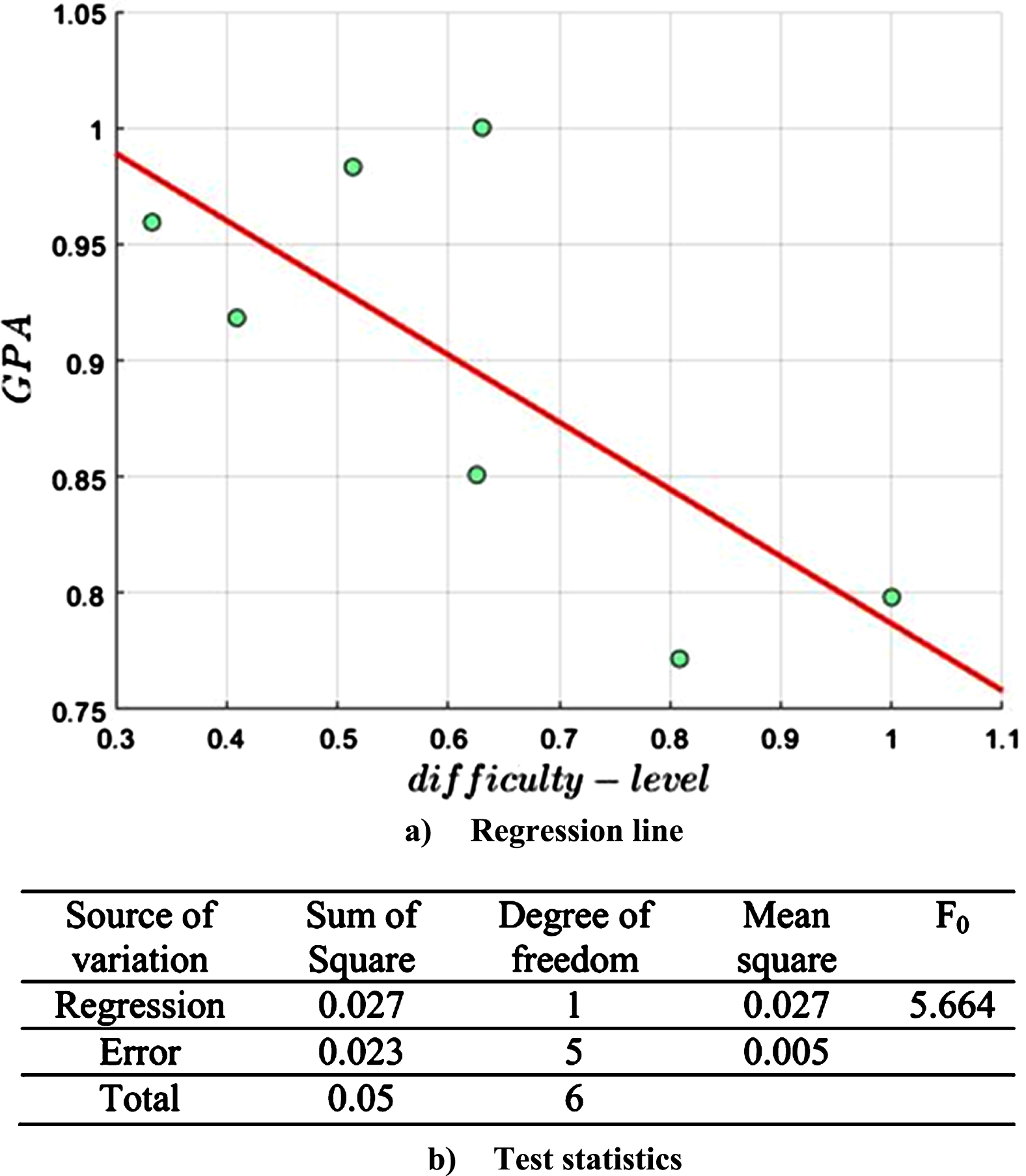
Regression analysis and variance analysis results (Razavi 2019).
According to the results of AHP, we are able to rank courses according to their difficulty levels. Given that an average engineering school offers several hundred different undergraduate courses in a given term, it may not be realistic to work with course instructors and students and conduct a survey to perform an AHP study. In order to find a practical solution to measure course difficulty levels, we conducted the aforementioned hypothesis test to explore if GPA is a credible measure of the course difficulty level. The regression analysis and ANOVA results support our hypothesis. Accordingly, we conclude that GPA is a reliable measure of course difficulty level (course workload in our context) (Razavi 2019).
Mixed integer programming model
A Mixed Integer Programming (MIP) model is formulated to solve the aforementioned course timetabling problem. In our case, we aim at designing a course schedule that maximizes the opportunities for improving the student learning performance. We hypothesized that by aligning the course schedule based on the Circadian Rhythm and course difficulty levels, a near constant student stress level can be achieved. As mentioned earlier, people learn/perform better when they are moderately stressed and the stress can be defined as a function of mental capacity and the workload (Razavi 2019). As depicted in Fig. 3, the stress level is controlled by assigning individuals tasks according to their mental capacity. Since the mental capacity changes during a day according to the Circadian Rhythm, the only way to control stress level is by aligning the course workload requirements with the student’s mental capacity. This is achieved by assigning difficult courses to the time slot when the mental capacity is higher and less challenging courses when the mental capacity is lower. Accordingly, an objective function that minimizes the difference between the mental capacity and the course difficulty level is formulated. In other words, the objective is defined as the difference between standardized course difficulty levels (d
n
) and the standardized mental capacity measures (Cl), which are non-dimensional quantities. The objective of the MIP models is to schedule N courses in M different classrooms during L timeslots available in a given day (D) where the total difference between course difficulty levels and mental capacity is minimized. Considering that both difficulty level and mental capacity are formulated based on combination of qualitative and quantitative measures, we can conclude that the scheduling model is valid for all type of courses. The objective function is presented in Equation 7.
The decision variable x nmdl = 1 if the course n is scheduled in the classroom m, at the l th timeslot of the day d.
In order to objectively compare the course difficulty levels (extracted as GPAs) and mental capacity (established from circadian rhythms), both data were first normalized. Results from Kletman (1933) for five different tasks are used to normalize the mental capacity (Cl). For the course difficulty level (d n ), the average GPAs from the past 3 years are utilized. We consider eight time slots based on Concordia University course scheduling practices, which starts at 8 : 45 AM, and finishes at 18 : 45 PM for most undergraduate courses. Figure 5 illustrates the mental capacity (Cl) of students at each timeslot during a day.
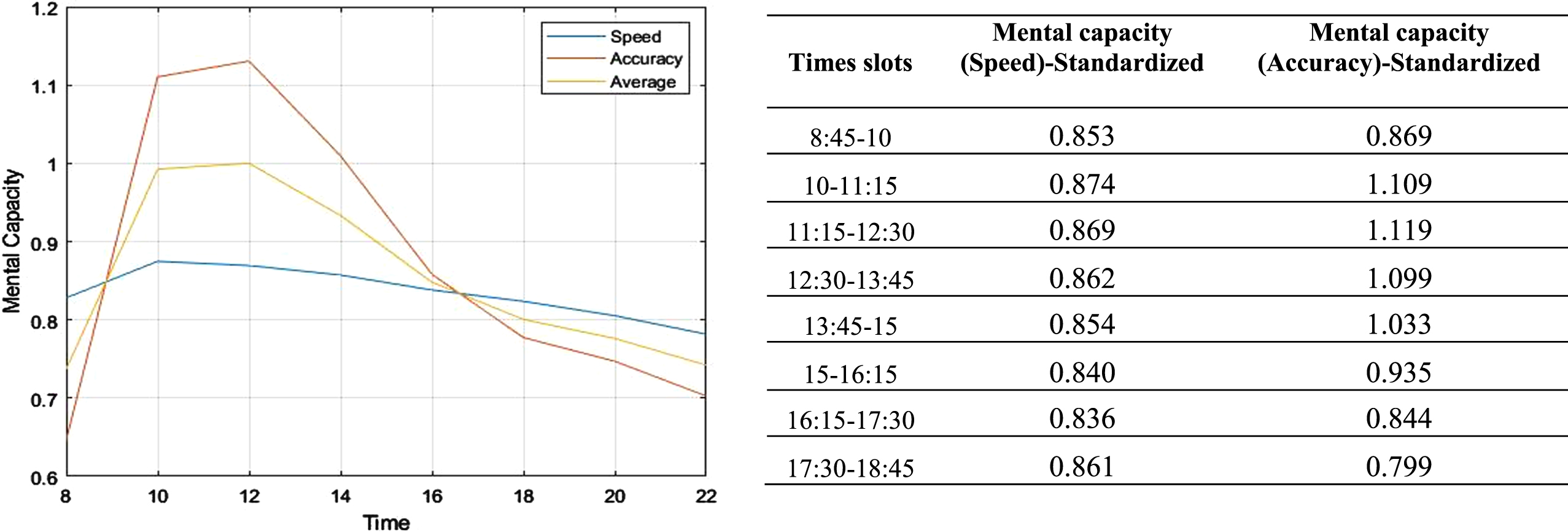
Table and charts of mental capacity from Kletman (1933).
The optimization model includes three general constraints and two additional constraints specific to Concordia University. Equation (8) guarantees that each class is scheduled twice a week. Equation (9) ensures that there is no double booking in a classroom. Finally, Equation (10) ensures the assigning of a course at the same timeslot in two different days and in the same classroom.
In addition to the constraints defined above, two additional constraints (11 and 12) are introduced to handle Concordia University’s course scheduling practices: those courses offered twice a week must have a one-day gap in between two offerings (e.g., a course scheduled on Monday should be scheduled again on Wednesday).
It should be noted that the course timetabling model introduced above is the most basic formulation. The main focus of this paper is to introduce the learning performance in the objective function. More complete models that include constraints such as availability of faculty members, student course sequences, classroom sizes, and travelling times between classrooms are available in the literature (Morrow et al. 2017, Shiau 2011, Hakim and et al. 2016, Boland et al. 2008, Gunawan 2007, Carter and Laporte 1997, Dimopoulou and Millioti 2004). In this paper, such details are intentionally omitted in order to provide a better coverage of the relationship between course scheduling and the learning environment.
The corresponding mathematical model is solved using IBM ILOG CPLEX Optimization Studio 12.2, using Optimization Programming Language (OPL) on a personal computer with 64-bit operating system, 3.40 GHz Intel Core i7-2600 CPU and 16.0 GB RAM. CPLEX provides a number of alternative solution methodologies for the MILP models. We utilized the Branch and Cut (BC) algorithm to solve the sample cases. For defining the boundary of the problem, the following conditions are considered: Courses can be scheduled from Monday to Friday. There are a total of eight timeslots per day for undergraduate courses to be scheduled. All courses require 1 hour and 15 minutes of class time, twice a week: Monday courses are offered again on Wednesdays at the same time, in the same classroom Tuesday courses are offered again on Thursday at the same time, in the same classroom Wednesday courses are offered again on Friday (if not offered on Monday) at the same time, in the same classroom. Classroom sizes are not considered as a constraint.
Since the university has more classrooms than what engineering programs need (classrooms are shared among all faculties), first the optimization problem is solved with an objective to schedule all courses with a minimum number of classrooms. It was identified that a minimum of five classrooms is needed to schedule 80 undergraduate courses. Given that each course requires two timeslots per week, a total of 160 teaching slots are needed. With the available eight timeslots per day, five classrooms provide a total of 200 teaching slots per week.
Next, the main model is solved to maximize the learning performance. In order to measure the improvement opportunities, the problem is solved with a different number of available classrooms (5, 10 and 15 classrooms). Finally, the results are compared with actual schedules from previous years (2013, 2014, 1015 and 2016) to demonstrate the improvement opportunities in the learning system. In Table 5, results for three different classroom capacities for each academic year are compared according to the objective function and the computation times. The number of classes scheduled in each academic year varies between 71 and 80. As expected, when the number of available classrooms is increased, the objective function, which measures the students’ learning experience improves.
Comparing current schedules with proposed schedules
Comparing current schedules with proposed schedules
In order to demonstrate the differences between the mental capacity and difficulty levels for all courses before (using the current schedule-dash lines in Fig. 6) and after applying the proposed timetabling method (solid lines in Fig. 6), we plot the objective function for all courses (new schedule is generated with 15 classrooms). All four sub-figures in Fig. 6 clearly demonstrate the improvement opportunities in the current timetabling methods.

Differences between mental capacity and difficulty level for all courses for four years (2013 (a), 2014 (b), 2015 (c) and 2016 (d)).
This paper introduced a novel course timetabling model that has potentials to improve student learning experience in higher education institutions. Previously, several different course timetabling models have been proposed, with consideration of different criteria such as faculty member preferences, administration objectives, course sequences for the degree, and financial expectations. To the best of our knowledge, the impact of course scheduling on student learning performance has not been studied previously. In this paper, we formulated student success as a function of mental stress. Furthermore, we demonstrated that, through course scheduling, a student’s mental stress can be maintained at a level which is more desirable to stimulate learning performance. After defining mental stress as a function of “required workload to perform a task” and “available mental capacity,” we provided an AHP-based technique to define the “course workload” in terms of average course GPA. Given that a student’s mental capacity changes according to their circadian rhythm during a day, an integer programming model is formulated for timetabling courses in such a way that students are stimulated optimally due to the maintenance of their optimum level of mental stresses. The proposed integer programming model has been applied for timetabling of engineering courses at Concordia University in Montreal. Results indicate that there are significant opportunities to improve current course scheduling practices to provide better learning environments for students. On the other hand, one must recognize that several other factors impact on the mental stress. In this study, we only worked with factors that are controllable within the education institutions. Further research may be carried to understand the impact of other factors such as students’ socioeconomic, health and lifestyle conditions on mental stress and incorporate them in the aforementioned course scheduling and timetabling method. Also, experimental studies should be performed to validate the higher performance of students in their studies when difficulty level of courses and mental capacity of students are considered in the course scheduling.