In this paper, regular graphs are studied in the context of a single valued neutrosophic environment, where for each element the truth-membership degree, indeterminacy-membership degree and falsity-membership degree are independently assigned in [0, 1]. Firstly, the novel concepts of regular, edge regular, partially edge regular and full edge regular single valued neutrosophic graphs (SVNGs) are proposed and some of their properties are investigated. Then strongly regular SVNGs and biregular SVNGs are defined. The notion of single valued neutrosophic digraphs (SVNDGs) is introduced along with its application in multi-attribute decision making (MADM).
Atanassov [3] introduced the concept of intuitionistic fuzzy set (IFS), as a generalization of Zadeh’s fuzzy set [30]. Its characteristic is that a membership degree and a non-membership degree are assigned to each element in the set. Since its inception, it has been investigated by many researchers and applied in several areas, such as pattern recognition [23], decision making [13, 31], medical diagnosis [11], cluster analysis [25] and market prediction [16]. Later on, Smarandache [21] proposed neutrosophic set theory from philosophical point of view. Its prominent characteristic is that a truth-membership degree, an indeterminacy-membership degree and a falsity-membership degree, in non-standard unit interval ] 0-, 1+ [, are independently assigned to each element in the set. Gradually, it has been discovered that without a specific description, neutrosophic sets are difficult to apply in the real applications. After analyzing this difficulty, Wang et al. [24] initiated the concept of a single valued neutrosophic set (SVNS) from scientific or engineering point of view, as an instance of the neutrosophic set and an extension of IFS, and provided its various properties. SVNSs represent uncertainty, incomplete, imprecise, indeterminate and inconsistent information which exist in real world. Neutrosophic set, particularly SVNS has attracted significant interest from researchers in recent years. It has been widely applied in various fields, such as information fusion in which data are combined from different sensors [6], control theory [1], image processing [12], medical diagnosis [29], decision making [28], and graph theory [8, 22], etc.
Graph representations are widely used for dealing with structural information, in different domains such as operations research, networks, systems analysis, pattern recognition, economics and image interpretation. Fuzzy graphs are designed to represent structures of relationships between objects such that the existence of a concrete object (vertex) and relationship between two objects (edge) are matters of degree. Obtaining analogs of several basic graph theoretical concepts, Rosenfeld [20] considered fuzzy relations on fuzzy sets and developed the structure of fuzzy graphs, using max and min operations. Some remarks on fuzzy graphs were given by Bhattacharya [5]. Edge regular fuzzy graphs were studied in [18] by Radha and Kumaravel. Intuitionistic fuzzy graphs with vertex sets and edge sets as IFS were first introduced by Atanassov [4] and further discussed by Akram [2]. Karunambigai et al. [15] defined the concept of edge regular intuitionistic fuzzy graphs. Recently, Borzooei et al. [7] generalized the concept of regularity of fuzzy graph to the regularity of vague graph. Mishra and Pal [17] initiated the notion of interval-valued intuitionistic fuzzy graphs. When description of the objects or their relations or both is indeterminate and inconsistent, it cannot be handled by fuzzy, intuitionistic fuzzy, vague and interval valued intuitionistic fuzzy graphs. Therefore some new theories are required. That is why, Kandasamy et al. [22] put forward the concept of neutrosophic graphs. Furthermore, Broumi et al. [8–10] discussed several properties of SVNGs and their extensions. However, to the best of our knowledge, no work addressing the regular graphs in single valued neutrosophic setting is in literature. Therefore, the main purpose of this paper is to introduce single valued neutrosophic regular graphs and apply the concept of SVNDGs in MADM.
This paper is structured as follows: Section 2 contains a brief background about SVNSs and SVNGs. Section 3 introduces the concepts of regular, edge regular, partially edge regular, full edge regular, strongly regular and biregular SVNGs, and investigates their properties. Section 4 is devoted to the application of SVNDGs in MADM and finally we draw conclusions in Section 5.
Throughout this paper, V represents a crisp universe of generic elements, G stands for the crisp graph and is the SVNG.
Preliminaries
In the following, some basic concepts on SVNSs and SVNGs are reviewed to facilitate next sections.
Definition 2.1. [20, 30] Let V be a space of points (objects) with a generic element in V denoted by x. A fuzzy set X in V is defined as
which is characterized by a membership function ξX : V → [0, 1] or simply ξ : V → [0, 1]. A fuzzy relation on a set V is a mapping μ : V × V → [0, 1] such that μ (x, y) ≤ ξ (x) ∧ ξ (y) for all x, y ∈ V. A fuzzy relation μ is symmetric if μ (x, y) = μ (y, x) for all x, y ∈ V. A fuzzy graph is a non-empty set V together with a pair of functions ξ : V → [0, 1] and μ : V × V → [0, 1] such that μ (xy) ≤ min {ξ (x) , ξ (y)} for all x, y ∈ V. Here μ is a symmetric fuzzy relation on ξ.
Definition 2.2. [26] A fuzzy digraph is a non-empty set V together with a pair of functions ξ : V → [0, 1] and such that for all x, y ∈ V. Here denotes the membership value of the directed edge .
Definition 2.3. [3] An IFS X in V is an object having the form
where the functions μX : V → [0, 1] , x ∈ V, μX (x) ∈ [0, 1] and νX : V → [0, 1] , x ∈ V, νX (x) ∈ [0, 1] satisfy the condition 0 ≤ μX (x) + νX (x) ≤1 for all x ∈ V. μX (x) and νX (x) represent the degree of membership and degree of non-membership of the element x ∈ V to set X, respectively.
For each IFS X in V, πX (x) =1 - μX (x) - νX (x) is called the intuitionistic fuzzy index of x ∈ X, representing the degree of hesitation of x to X.
Definition 2.4. [21] Let V be a space of points (objects), with a generic element in V denoted by x. A neutrosophic set X in V is characterized by a truth-membership function TX, an indeterminacy-membership function IX and a falsity-membership function FX. TX (x) , IX (x) and FX (x) are real standard or non-standard subsets of ] 0-, 1+ [. That is, TX : V →]0-, 1+ [, IX : V →]0-, 1+ [ and FX : V →]0-, 1+ [.
There is no restriction on the sum of TX (x) , IX (x) and FX (x), therefore 0- ≤ sup TX (x) + sup IX (x) + sup FX (x) ≤3+ .
Definition 2.5. [24] Let V be a space of points (objects), with a generic element in V denoted by x. A SVNS X in V is characterized by a truth-membership function TX, an indeterminacy-membership function IX and a falsity-membership function FX. For each point x ∈ X, TX (x) , IX (x) , FX (x) ∈ [0, 1]. Therefore, a SVNS X in V can be written as
Definition 2.6. [24] Let X, X1 and X2 be three SVNSs. Then their relations and operations are defined as follows:
X1 ⊆ X2 if and only if TX1 (x) ≤ TX2 (x) , IX1 (x) ≥ IX2 (x) and FX1 (x) ≥ FX2 (x) for all x ∈ V;
X1 = X2 if and only if X1 ⊆ X2 and X2 ⊆ X1;
;
X1 ∪ X2 = {〈x, max {TX1 (x) , TX2 (x)} , min {IX1 (x) , IX2 (x)} , min {FX1 (x) , FX2 (x)} 〉 |x ∈ V};
X1 ∩ X2 = {〈x, min {TX1 (x) , TX2 (x)} , max {IX1 (x) , IX2 (x)} , max {FX1 (x) , FX2 (x)} 〉 | x ∈ V}.
Definition 2.7. [27] A SVNS Y in V × V is said to be a single valued neutrosophic relation in V, denoted by
where TY : V × V → [0, 1], IY : V × V → [0, 1] and FY : V × V → [0, 1] represent the truth-membership, indeterminacy-membership and falsity-membership function of Y, respectively.
Definition 2.8. [8] A SVNG of a (crisp) graph G = (V, E) is defined to be a pair , where
the functions TX : V → [0, 1], IX : V → [0, 1] and FX : V → [0, 1] denote the degree of truth-membership, indeterminacy-membership and falsity-membership of the element x ∈ V, respectively. There is no restriction on the sum of TX (x) , IX (x) and FX (x), therefore 0 ≤ TX (x) + IX (x) + FX (x) ≤3 for all x ∈ V,
the functions TY : E ⊆ V × V → [0, 1] , IY : E ⊆ V × V → [0, 1] and FY : E ⊆ V × V → [0, 1] are defined by
There is no restriction on the sum of TY (xy) , IY (xy) and FY (xy), therefore 0 ≤ TY (xy) + IY (xy) + FY (xy) ≤3 for all xy ∈ E .
We call X the single valued neutrosophic vertex set of and Y the single valued neutrosophic edge set of .
Definition 2.9. [8] The degree of a vertex ui ∈ V in a SVNG is defined as where
Regularity of graphs in single valued neutrosophic environment
In this section, based on the extension of the regularity of intuitionistic fuzzy graphs [15], we define the concepts of regularity of SVNGs, which can be used in real scientific and engineering applications.
Definition 3.1. A SVNG on G, in which each vertex has the same degree is called a regular SVNG. If each vertex has degree 〈g1, g2, g3〉, i.e., for all ui ∈ V, is called 〈g1, g2, g3〉-regular.
Example 3.2. Consider a graph G = (V, E), where V = {u1, u2, u3, u4} and E = {u1u2, u2u3, u3u4, u4u1}. Let be a SVNG of a graph G defined by
Clearly, So, is 〈0.3, 0.8, 1.0〉-regular SVNG. The regular SVNG is given in Fig. 1. Tabular representation of a regular SVNG is given in Table 1.
〈0.3, 0.8, 1.0〉-regular
SVNG.
Tabular representation of a 〈0.3, 0.8, 1.0〉-regular SVNG
u1
u2
u3
u4
TX
0.3
0.6
0.4
0.5
IX
0.2
0.1
0.3
0.1
FX
0.1
0.3
0.2
0.3
u1u2
u2u3
u3u4
u4u1
TY
0.1
0.2
0.1
0.2
IY
0.5
0.3
0.5
0.3
FY
0.3
0.7
0.3
0.7
Definition 3.3. Let be a SVNG. The degree of an edge uiuj ∈ E is defined as where
Definition 3.4. Let be a SVNG.
The minimum edge degree of is , where , and .
The maximum edge degree of is , where , and .
Definition 3.5. The total edge degree of an edge uiuj ∈ E in a SVNG is defined as where
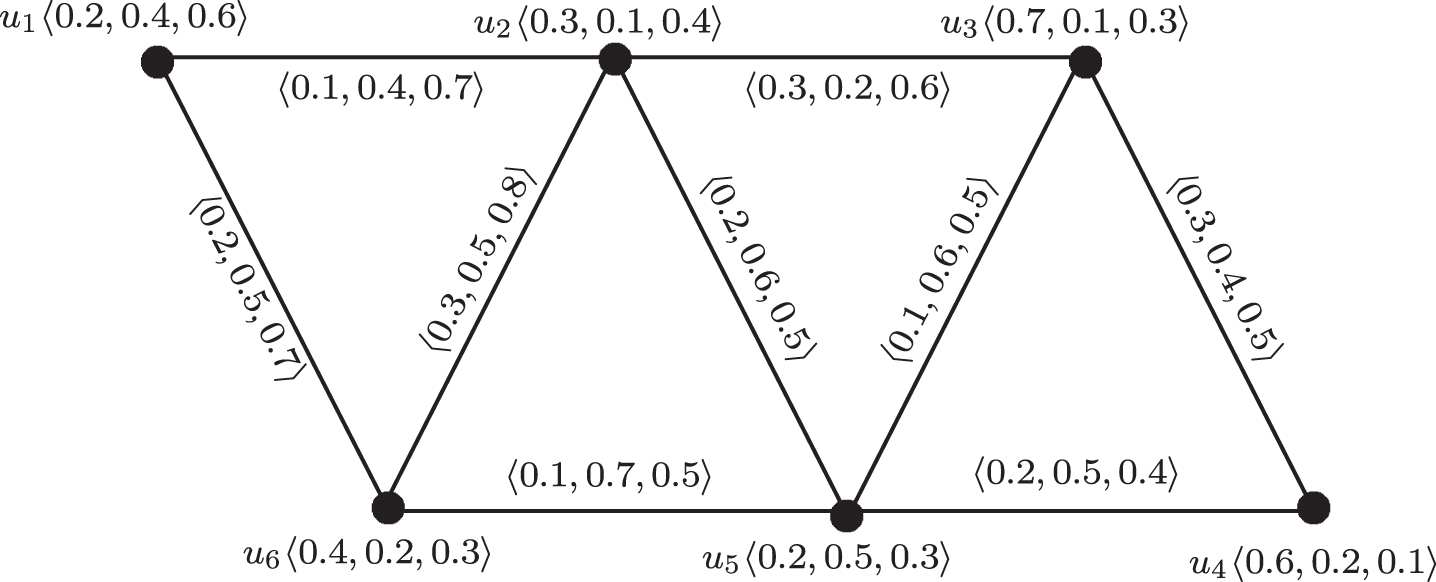
Example 3.6. Consider a SVNG on V = {u1, u2, u3, u4, u5, u6}, as shown in Fig. 2.
SVNG.
Then the degree of an edge u1u2 is as dT (u1u2) =1.0, dI (u1u2) =1.8, dF (u1u2) =2.6, and the total degree of an edge u1u2 is as tdT (u1u2) =1.0 + 0.1 = 1.1, tdI (u1u2) =1.8 + 0.4 = 2.2, tdF (u1u2) =2.6 + 0.7 = 3.3.
Definition 3.7. A SVNG on G, in which each edge has the same degree is called an edge regular SVNG. If each edge has degree 〈f1, f2, f3〉, i.e., for all uiuj ∈ E, is called 〈f1, f2, f3〉-edge regular.
Definition 3.8. A SVNG on G, in which each edge has the same total degree 〈t1, t2, t3〉 is called a totally edge regular SVNG.
Example 3.9. Consider a SVNG on V = {u1, u2, u3, u4}, as shown in Fig. 3.
〈1.0, 1.4, 1.2〉-edge regular
SVNG.
Clearly, So, is 〈1.0, 1.4, 1.2〉-edge regular SVNG.
Theorem 3.10.Let be a SVNG on a cycle G. Then
Proof. Let be a SVNG and let G be a cycle u1u2u3 … unu1 . Then
Consider
Analogously, we can show that and
Hence □
Theorem 3.11.Letbe a SVNG on a regular crisp graph G. Thenwhere dG (uiuj) = dG (ui) + dG (uj) -2 for all uiuj ∈ E.
Proof. Suppose that is a SVNG on a regular crisp graph G. Since where dT (uiuj) , dI (uiuj) and dF (uiuj) is the sum of the truth-membership, indeterminacy-membership and falsity-membership values of their adjacent edges, respectively. In ∑uiuj∈EdT (uiuj), therefore every edge contributes its truth-membership values exactly degree of that edge in corresponding crisp graph times. So, ∑uiuj∈EdT (uiuj) = ∑uiuj∈EdG (uiuj) TY (uiuj) . Analogously, ∑uiuj∈EdI (uiuj) = ∑uiuj∈EdG (uiuj) IY (uiuj) and ∑uiuj∈EdF (uiuj) = ∑uiuj∈EdG (uiuj) FY (uiuj) . Hence □
Proposition 3.12.Let be a SVNG on a k-regular crisp graph G. Then
Proof. Suppose that is a SVNG on a k-regular crisp graph G. From Theorem 3.11, we have
Since G is a k-regular crisp graph, dG (ui) = k, for all ui ∈ V, therefore
Proposition 3.13.Let be a SVNG on a regular crisp graph G. Then
Theorem 3.14.Let be a SVNG. Then 〈TY, IY, FY〉 is a constant function if and only if the following statements are equivalent:
is an edge regular SVNG;
is a totally edge regular SVNG.
Proof. Suppose that 〈TY, IY, FY〉 is a constant function. Then TY (uiuj) = c1, IY (uiuj) = c2 and FY (uiuj) = c3 for every uiuj ∈ E, where c1, c2 and c3 are constants.
(i) ⇒ (ii). Assume that is 〈f1, f2, f3〉-edge regular SVNG. Then for all uiuj ∈ E.
Consider
Therefore, SVNG is a totally edge regular.
(ii) ⇒ (i). Let be a 〈t1, t2, t3〉-totally edge regular SVNG. Then for all uiuj ∈ E.
Now,
Therefore, is a 〈t1 - c1, t2 - c2, t3 - c3〉-edge regular SVNG.
Conversely, suppose that (i) and (ii) are equivalent. We have to prove that 〈TY, IY, FY〉 is a constant function. Suppose that 〈TY, IY, FY〉 is not a constant function. Then TY (uiuj) ≠ TY (upuq), IY (uiuj) ≠ IY (upuq) and FY (uiuj) ≠ FY (upuq) for at least one pair of uiuj, upuq ∈ E. Assume that is a 〈f1, f2, f3〉-edge regular SVNG. Then Hence
As TY (uiuj) ≠ TY (upuq), IY (uiuj) ≠ IY (upuq) and FY (uiuj) ≠ FY (upuq) , so . Hence is not a totally edge regular, a contradiction. Therefore, 〈TY, IY, FY〉 is a constant function. Analogously, we can show that 〈TY, IY, FY〉 is a constant function, if is a totally edge regular SVNG. □
Theorem 3.15.If a SVNG is both edge regular and totally edge regular, then 〈TY, IY, FY〉 is a constant function.
Proof. Obvious, therefore omitted. □
Theorem 3.16.Let be a SVNG on a k-regular crisp graph G. Then 〈TY, IY, FY〉 is a constant function if and only if is both regular and totally edge regular SVNG.
Proof. Let be a SVNG on a k-regular graph G. Assume that 〈TY, IY, FY〉 is a constant function, that is, TY (uiuj) = c1, IY (uiuj) = c2 and FY (uiuj) = c3 for all uiuj ∈ E, where c1, c2 and c3 are constants.
By definition of vertex degree, we have
Therefore, is regular SVNG.
Now, , where for all uiuj ∈ E . Similarly, it is easy to show that tdI (uiuj) = c2 (2k - 1) and tdF (uiuj) = c3 (2k - 1) for all uiuj ∈ E . Hence is a totally edge regular SVNG.
Conversely, suppose that is both regular and totally edge regular SVNG. We have to prove that 〈TY, IY, FY〉 is a constant function. Since SVNG is regular, for all ui ∈ V. Also, is a totally edge regular, for all uiuj ∈ E . By definition of total edge degree, we have where
Similarly, we can show that IY (uiuj) =2g2 - t2 and FY (uiuj) =2g3 - t3 for all uiuj ∈ E . Hence 〈TY, IY, FY〉 is a constant function. □
Theorem 3.17.Let be a SVNG on a crisp graph G. If 〈TY, IY, FY〉 is a constant function, then is an edge regular SVNG if and only if G is an edge regular.
Proof. Assume that 〈TY, IY, FY〉 is a constant function, i.e., TY (uiuj) = c1, IY (uiuj) = c2 and FY (uiuj) = c3 for all uiuj ∈ E, where c1, c2 and c3 are constants. Suppose that is an edge regular SVNG. We have to show that G is an edge regular. Suppose on contrary that G is not an edge regular. i.e., dG (uiuj) ≠ dG (ulum) for at least on pair of uiuj, ulum ∈ E. According to the definition of edge degree of a SVNG,
where
Analogously, we can show that dI (uiuj) = c2dG (uiuj) and dF (uiuj) = c3dG (uiuj) for all uiuj ∈ E . Therefore Since dG (uiuj) neqdG (ulum), so . Thus is not an edge regular, a contradiction. Hence G is an edge regular.
Conversely, suppose that G is an edge regular graph. To prove that is an edge regular SVNG. Consider is not an edge regular SVNG. i.e., for at least one pair of uiuj, upuq ∈ E, 〈dT (uiuj) , dI (uiuj) , dF (uiuj) 〉 ≠ 〈dT (upuq) , dI (upuq) , dF (upuq) 〉 . Now dT (uiuj) ≠ dT (upuq) implies ,since TY is a constant function, so dG (uiuj) ≠ dG (upuq), a contradiction. Hence is an edge regular SVNG. □
Theorem 3.18.Let be a regular SVNG. Then is an edge regular SVNG if and only if 〈TY, IY, FY〉 is a constant function.
Proof. Let be a 〈g1, g2, g3〉-regular SVNG i.e., for all ui ∈ V. Suppose that 〈TY, IY, FY〉 is a constant function. Then TY (uiuj) = c1, IY (uiuj) = c2 and FY (uiuj) = c3 for all uiuj ∈ E, where c1, c2 and c3 are constants. According to the definition of edge degree of a SVNG,
where
Similarly, we can show that, dI (uiuj) =2 (g2 - c2) and dF (uiuj) =2 (g3 - c3) for all uiuj ∈ E. Hence is an edge regular SVNG.
Conversely, suppose that is an edge regular SVNG, i.e., for all uiuj ∈ E . we have to show that 〈TY, IY, FY〉 is a constant function. Since , where
Similarly, it is easy to show that and for all uiuj ∈ E. Hence 〈TY, IY, FY〉 is a constant function. □
Definition 3.19. A SVNG is said to be a
partially regular, if the underlying graph G is regular.
full regular, if is both regular and partially regular.
partially edge regular, if the underlying graph G is an edge regular.
full edge regular, if is both edge regular and partially edge regular.
Theorem 3.20.Let be a SVNG on G such that (TY, IY, FY) is a constant function. If is full regular SVNG, then is full edge regular SVNG.
Proof. Suppose that 〈TY, IY, FY〉 is a constant function. Then TY (uiuj) = c1, IY (uiuj) = c2 and FY (uiuj) = c3 for all uiuj ∈ E, where c1, c2 and c3 are constants. Let be a full regular SVNG, then dG (ui) = k and for all ui ∈ V, where k, g1, g2 and g3 are constants. Therefore dG (uiuj) = dG (ui) + dG (uj) -2 = 2k - 2 = constant. Hence G is an edge regular graph.
Now, for all uiuj ∈ E, where
Similarly, it is easy to show that dI (uiuj) =2g2 - 2c2 = constant and dF (uiuj) =2g3 - 2c3 =constant, for all uiuj ∈ E . Hence is an edge regular SVNG. Thus is full edge regular SVNG. □
Theorem 3.21.Let be a t-totally edge regular and -partially edge regular SVNG. Then , where r = |E|.
Proof. The size of SVNG is
Since is t-totally edge regular and -partially edge regular SVNG, i.e., and dG (uiuj)=t′, respectively. Therefore,
Definition 3.22. A SVNG on n vertices which is regular of degree g = 〈g1, g2, g3〉 is said to be a strongly regular SVNG, if it satisfies the following properties:
The sum of truth-membership values, indeterminacy-membership values and falsity-membership values of the common neighbourhood vertices of any two adjacent vertices of have exactly λ = 〈λ1, λ2, λ3〉 weight;
The sum of truth-membership values, indeterminacy-membership values and falsity-membership values of the common neighbourhood vertices of any two non-adjacent vertices of have exactly χ = 〈χ1, χ2, χ3〉 weight.
A strongly regular SVNG is denoted by
Example 3.23. Consider a SVNG on V = {u1, u2, u3, u4, u5, u6}, as given in Fig. 4.
Strongly regular SVNG.
Here n = 6, g = 〈g1, g2, g3〉 = 〈0.6, 2.4, 2.6〉, λ = 〈λ1, λ2, λ3〉 = 〈0.9, 0.7, 0.3〉, χ = 〈χ1, χ2, χ3〉 = 〈1.8, 1.4, 0.6〉. Therefore is a strongly regular SVNG.
Theorem 3.24.Let be a complete SVNG with 〈TX, IX, FX〉 and 〈TY, IY, FY〉 as constant functions. Then is a strongly regular SVNG.
Proof. Suppose that is a complete SVNG on n vertices. Since 〈TX, IX, FX〉 and 〈TY, IY, FY〉 are constant functions, so , and for all ui ∈ V, TY (uiuj) = c1, IY (uiuj) = c2 and FY (uiuj) = c3 for all uiuj ∈ E, where , c1, c2 and c3 are constants. To prove that is a strongly regular SVNG, we have to show that is g = 〈g1, g2, g3〉-regular SVNG and the adjacent vertices have the same common neighborhood λ = 〈λ1, λ2, λ3〉 and non-adjacent vertices have the same common neighborhood χ = 〈χ1, χ2, χ3〉. Now, since is complete SVNG
Hence is a 〈 (n - 1) c1, (n - 1) c2, (n - 1) c3〉-regular SVNG. Also, the sum of truth-membership values, indeterminacy-membership values and falsity-membership values of common neighborhood vertices of any two adjacent vertices are the same and the sum of truth-membership values, indeterminacy-membership values and falsity-membership values of common neighborhood vertices of any two non-adjacent vertices χ = 〈0, 0, 0〉 are the same. □
Definition 3.25. A SVNG is said to be bipartite if the vertex set V can be partitioned into two nonempty sets V1 and V2 such that TY (uiuj) =0, IY (uiuj) =0 and FY (uiuj) =0if ui, uj ∈ V1 or ui, uj ∈ V2 . Further if TY (uiuj) = min {TX (ui) , TX (uj)} , IY (uiuj) = max {IX (ui) , IX (uj)} and FY (uiuj) = max {FX (ui) , FX (uj)} for all ui ∈ V1 and uj ∈ V2, then is called a complete bipartite SVNG, denoted by KX1,X2, where X1 and X2 are, respectively, the restrictions of X to V1 and V2.
Definition 3.26. A bipartite SVNG is said to be a biregular SVNG if every vertex in V1 has same degree φ = 〈φ1, φ2, φ3〉 and every vertex in V2 has same degree ψ = 〈ψ1, ψ2, ψ3〉, where φ and ψ are constants.
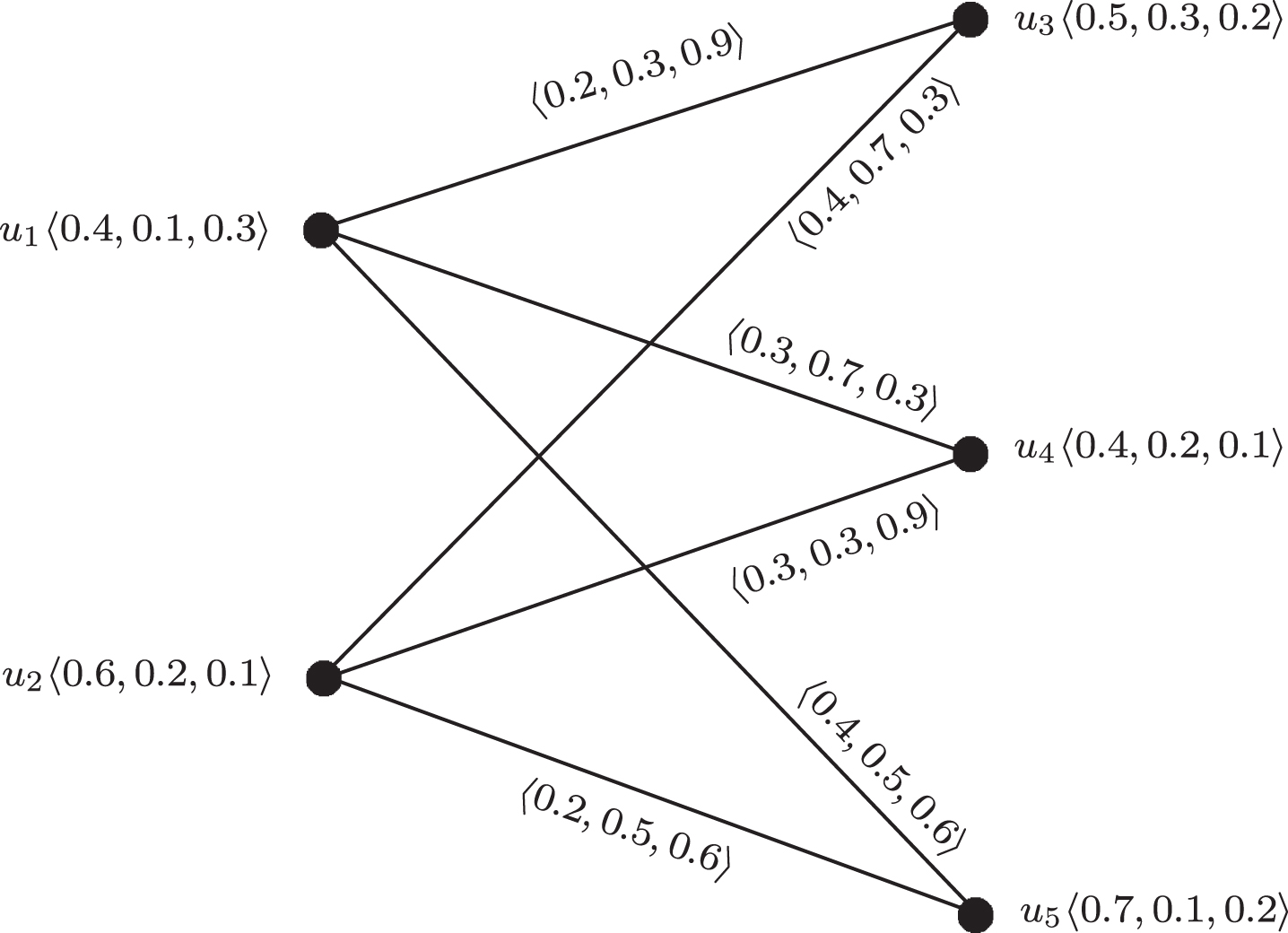
Example 3.27. Consider a SVNG on V = {u1, u2, u3, u4, u5, u6}, as given in Fig. 5.
Biregular SVNG.
Clearly, SVNG is bipartite and degree of vertices and . SVNG is therefore biregular.
Single valued neutrosophic digraphs and its application in MADM
In this section, we introduce the concept of SVNDGs along with its application inMADM.
Definition 4.1. A SVNDG of a (crisp) digraph is a pair , where
the functions TX : V → [0, 1], IX : V → [0, 1] and FX : V → [0, 1] denote the degree of truth-membership, indeterminacy-membership and falsity-membership of the element x ∈ V, respectively. There is no restriction on the sum of TX (x) , IX (x) and FX (x), therefore 0 ≤ TX (x) + IX (x) + FX (x) ≤3 for allx ∈ V,
the functions and are defined by
There is no restriction on the sum of and , therefore for all xy ∈ E .
Where X is a single valued neutrosophic vertex set of and is a single valued neutrosophic directed edge set of . Also , and represent, respectively, the truth-membership, indeterminacy-membership and falsity-membership values of the directededge .
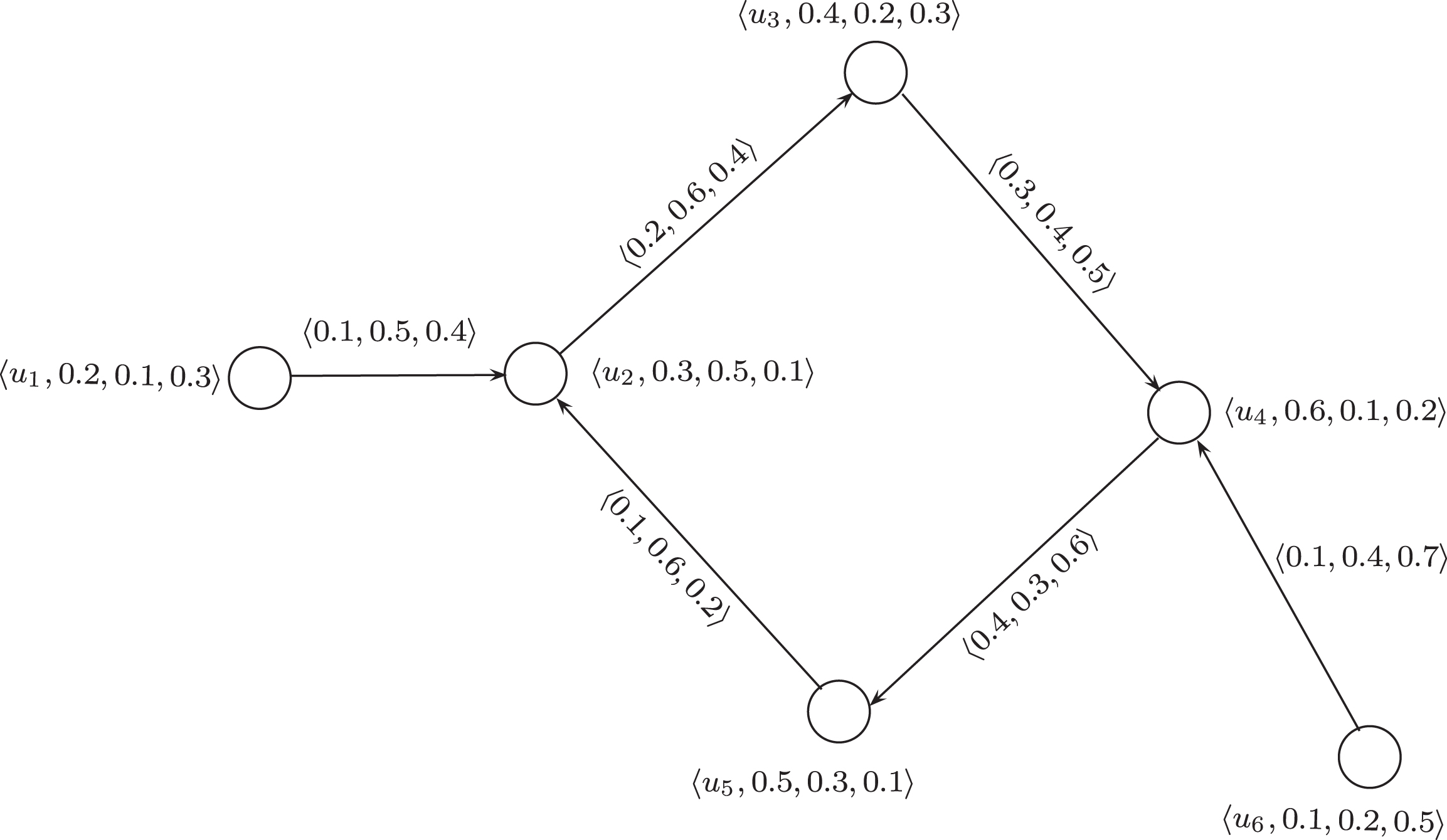
Example 4.2. Consider a digraph , where V = {u1, u2, u3, u4, u5, u6} and . Let be a SVNDG of (crisp) digraph D, as given in Fig. 6.
SVNDG.
The corresponding adjacent matrix R is asfollows:
Since in decision making problems, there is a number of uncertainties and in some situations, there exist some relations among attribute in a MADM problems. So, it is an interesting area of applications in neutrosophic graph theory. A MADM problem is solved under the general framework of SVNDGs.
A military unit is planning to purchase new artillery weapons and there are six feasible artillery weapons (alternatives) xi (i = 1, 2, 3, 4, 5, 6) to be selected. When making a decision, the attributes considered are as follows: (1) a1- assault fire capability indices; (2) a2- reaction capability indices; (3) a3- mobility indices; and (4) a4- survival ability indices. Among these four attributes, a1, a2, a4 are of benefit type (beneficial); and a3 is of cost type (non-beneficial) given in Table 2.
Single valued neutrosophic decision matrix
Weapons
a1
a2
a3
a4
x1
〈0.5, 0.3, 0.6〉
〈0.6, 0.3, 0.2〉
〈0.4, 0.5, 0.1〉
〈0.1, 0.7, 0.5〉
x2
〈0.6, 0.1, 0.2〉
〈0.2, 0.1, 0.4〉
〈0.2, 0.3, 0.4〉
〈0.3, 0.4, 0.1〉
x3
〈0.1, 0.5, 0.3〉
〈0.3, 0.2, 0.5〉
〈0.7, 0.2, 0.1〉
〈0.5, 0.1, 0.2〉
x4
〈0.3, 0.4, 0.2〉
〈0.4, 0.5, 0.1〉
〈0.3, 0.1, 0.4〉
〈0.5, 0.3, 0.4〉
x5
〈0.1, 0.2, 0.4〉
〈0.2, 0.7, 0.3〉
〈0.1, 0.3, 0.5〉
〈0.2, 0.1, 0.5〉
x6
〈0.5, 0.1, 0.7〉
〈0.5, 0.1, 0.4〉
〈0.3, 0.2, 0.6〉
〈0.4, 0.2, 0.6〉
Normalized values of an attribute assigned to the alternatives (see Table 3) are calculated by using the following:
i = 1, 2, …, n ; j = 1, 2, …, m. Where is the complement of , such that .
Single valued neutrosophic decision matrix R = (rij) 6×4 of normalized data
Weapons
a1
a2
a3
a4
x1
〈0.5, 0.3, 0.6〉
〈0.6, 0.3, 0.2〉
〈0.1, 0.5, 0.4〉
〈0.1, 0.7, 0.5〉
x2
〈0.6, 0.1, 0.2〉
〈0.2, 0.1, 0.4〉
〈0.4, 0.7, 0.2〉
〈0.3, 0.4, 0.1〉
x3
〈0.1, 0.5, 0.3〉
〈0.3, 0.2, 0.5〉
〈0.1, 0.8, 0.7〉
〈0.5, 0.1, 0.2〉
x4
〈0.3, 0.4, 0.2〉
〈0.4, 0.5, 0.1〉
〈0.4, 0.9, 0.3〉
〈0.5, 0.3, 0.4〉
x5
〈0.1, 0.2, 0.4〉
〈0.2, 0.7, 0.3〉
〈0.5, 0.7, 0.1〉
〈0.2, 0.1, 0.5〉
x6
〈0.5, 0.1, 0.7〉
〈0.5, 0.1, 0.4〉
〈0.6, 0.8, 0.3〉
〈0.4, 0.2, 0.6〉
Relative importance of attributes is also assigned (see Table 2 in [19]). Let the decision maker select the following assignments:
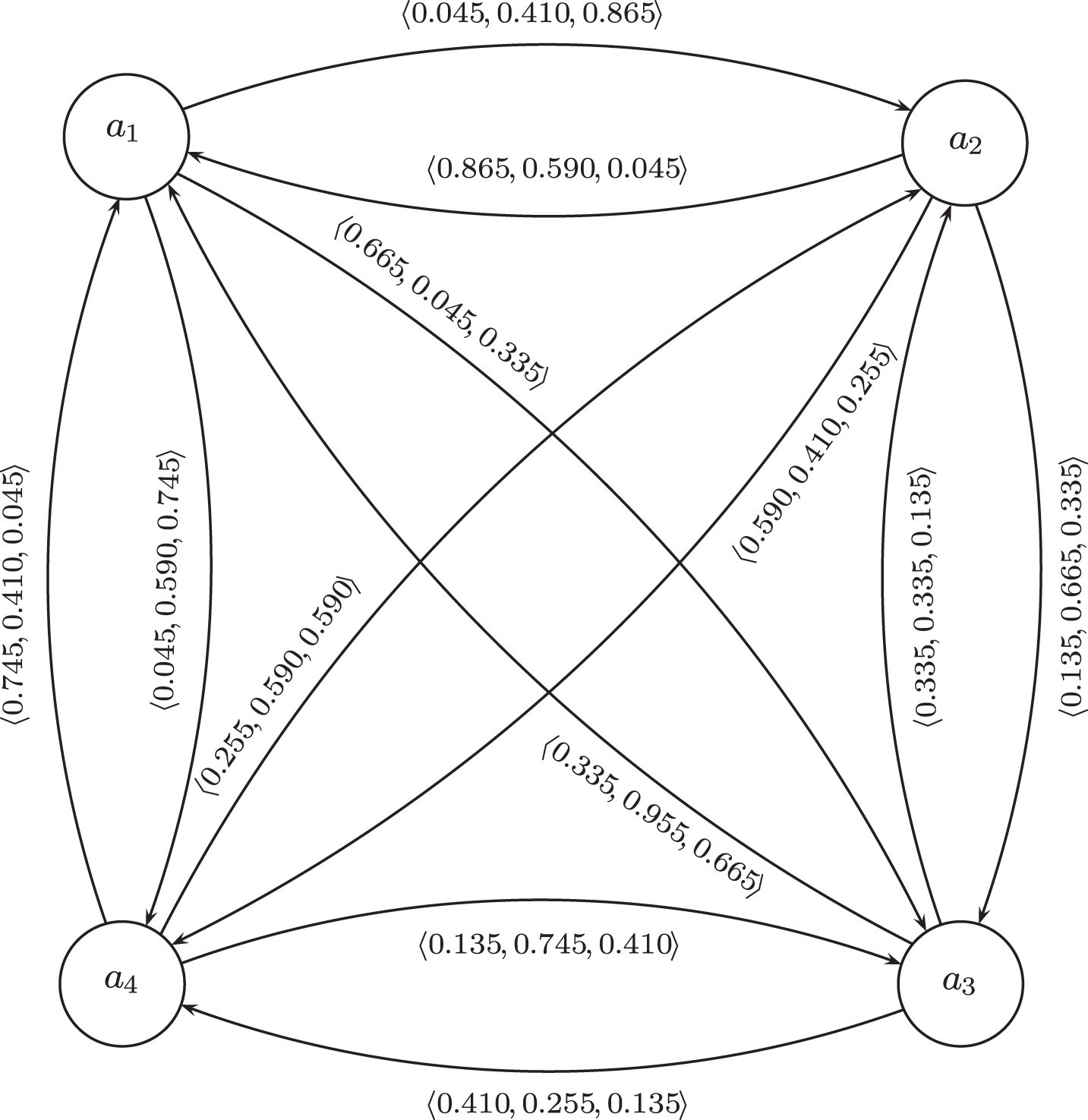
The weapon selection attributes SVNDG given in Fig. 7, represents the presence as well as relative importance of four attributes a1, a2, a3 and a4 which are the vertices of the digraph. The weapon selection index is calculated using the values of Ai and aij for each alternative weapon, where Ai is the value of i-th attribute represented by the weapon xi and aij is the relative importance of the i-th attribute over j-th atribute.
Weapon selection attributes SVNDG.
For first weapon x1, substituting values of A1, A2, A3 and A4 in above matrix R, we get
Now we calculate the permanent function value of above matrix using computer program, that is, per(R1) = 〈0.4117, 1.3482, 0.4884〉. The permanent function is nothing but the determinant of a matrix but considering all the determinant terms as positive terms [14]. So, the weapon selection index values of different weapons are:
Calculate the score function s (xi) = Ti + 1 - Ii + 1 - Fi [32] of the weapons xi (i = 1, 2, 3, 4, 5, 6), respectively: s (x1) = 0.5751, s (x2) = 1.0287, s (x3) = 0.7325, s (x4) = 0.5904, s (x5) = 0.5417, s (x6) =0.9984 . Thus, we can rank the weapons:
Therefore, the best choice is the second weapon (x2).
Conclusion
SVNS as an instance of a neutrosophic set provide an additional possibility to represent imprecise, uncertainty, inconsistent and incomplete information which exist in real situations. Single valued neutrosophic models are more flexible and practical than fuzzy and intuitionistic fuzzy models. Hence, we have introduced the concepts of regular, edge regular, partially edge regular, full edge regular, strongly regular and biregular graphs under single valued neutrosophic environment and investigated their properties. We have also introduced the notion of SVNDGs and presented its application in MADM. In further work, it is necessary and meaningful to extend the regularity of SVNGs to interval neutrosophic regular graphs and their applications, such as decision making, pattern recognition, and medical diagnosis.
References
1.
AggarwalS., BiswasR. and AnsariA.Q., Neutrosophic modeling and control, Computer and Communication Technology (2010), 718–723.
2.
AkramM. and DavvazB., Strong intuitionistic fuzzy graphs, Filomat26 (2012), 177–196.
3.
AtanassovK.T., Intuitionistic fuzzy sets, Fuzzy Sets and Systems20(1) (1986), 87–96.
4.
AtanassovK.T., Intuitionistic Fuzzy Sets, Physica-Verlag, Heidelberg, New York, 1999.
5.
BhattacharyaP., Some remarks on fuzzy graphs, Pattern Recognition Letters6(5) (1987), 297–302.
6.
BhattacharyaS., Neutrosophic information fusion applied to the options market, Investment Management and Financial Innovations1 (2005), 139–145.
7.
BorzooeiR.A., RashmanlouH., SamantaS. and PalM., Regularity of vague graphs, Journal of Intelligent and Fuzzy Systems30 (2016), 3681–3689.
8.
BroumiS., TaleaM., BakaliA. and SmarandacheF., Single valued neutrosophic graphs, Journal of New Theory10 (2016), 86–101.
9.
BroumiS., TaleaM., BakaliA. and SmarandacheF., On bipolar single valued neutrosophic graphs, Journal of New Theory11 (2016), 84–102.
DeS.K., BiswasR. and RoyA.R., An application of intuitionistic fuzzy sets in medical diagnosis, Fuzzy Sets and Systems117 (2001), 209–213.
12.
GuoY. and ChengH.D., New neutrosophic approach to image segmentation, Pattern Recognition42 (2009), 587–595.
13.
HeX., WuY. and YuD., Intuitionistic fuzzy multi-criteria decision making with application to job hunting: A comparative perspective, Journal of Intelligent and Fuzzy Systems30(4) (2016), 1935–1946.
14.
JurkatW.B. and RyserH.J., Matrix factorizations of determinants and permanents, Journal of Algebra3(1) (1966), 1–27.
15.
KarunambigaiM.G., PalanivelK. and SivasankarS., Edge regular intuitionistic fuzzy graph, Advances in Fuzzy Sets and Systems20(1) (2015), 25–46.
16.
LiangZ.Z. and ShiP.F., Similarity measures on intuitionistic fuzzy sets, Pattern Recognition Letters24 (2003), 2687–2693.
17.
MishraS.N. and PalA., Product of interval-valued intuitionistic fuzzy graph, Annals of Pure and Applied Mathematics5(1) (2013), 37–46.
18.
RadhaK. and KumaravelN., On edge regular fuzzy graphs, International Journal of Mathematical Archive (IJMA)5(9) (2014), 100–112.
19.
RaoR.V., A decision-making framework model for evaluating flexible manufacturing systems using digraph and matrix methods, International Journal of Advanced Manufacturing Technology30 (2006), 1101–1110.
20.
RosenfeldA., Fuzzy graphs, Fuzzy Sets and their Applications (ZadehL.A., FuK.S. and ShimuraM., Eds.) Academic Press, New York, 1975, pp. 77–95.
21.
SmarandacheF., A Unifying Field in Logics. Neutrosophy: Neutrosophic probability, set and logic, American Research Press, Rehoboth, 1999.
22.
Vasantha KandasamyW.B., IlanthenralK. and SmarandacheF., Neutrosophic Graphs: A New Dimension to Graph Theory, kindle Edition, 2015.
23.
VlachosK.I. and SergiadisG.D., Intuitionistic fuzzy information-applications to pattern recognition, Pattern Recognition Letters28 (2007), 197–206.
24.
WangH., SmarandacheF., ZhangY.Q. and SunderramanR., Single valued neutrosophic sets, Multispace and Multistructure4 (2010), 410–413.
25.
WangZ., XuZ., LiuS. and TangJ., A netting clustering analysis method under intuitionistic fuzzy environment, Applied Soft Computing11(8) (2011), 5558–5564.
26.
WuS.Y. andKaoY.M., The compositions of fuzzy digraphs, Journal of Research in Education Sciences31 (1986), 603–628.
27.
YangH.L., GuoZ.L., SheY. and LiaoX., On single valued neutrosophic relations, Journal of Intelligent and Fuzzy Systems30 (2016), 1045–1056.
28.
YeJ., Multicriteria decision-making method using the correlation coefficient under single valued neutrosophic environment, International Journal of General Systems42(4) (2013), 386–394.
29.
YeJ. and FuJ., Multi-period medical diagnosis method using a single valued neutrosophic similarity measure based on tangent function, Computer methods and programs in biomedicine123 (2016), 142–149.
30.
ZadehL.A., Fuzzy sets, Information and Control8(3) (1965), 338–353.
31.
ZengS. and XiaoY., TOPSIS method for intuitionistic fuzzy multiple-criteria decision making and its application to investment selection, Kybernetes45(2) (2016), 282–296.
32.
ZhangH.Y., WangJ.Q. and ChenX.H., Interval neutrosophic sets and their application in multicriteria decision making problems, The Scientific World Journal2014 (2014), DOI: 10.1155/2014/645953