The main aim of this article is to present neutrosophic folding and neutrosophic retractions on a single-valued neutrosophic graph Ğ from the viewpoint of geometry and topology. For this reason, we use a sequence of neutrosophic transformations on Ğ to obtain a new single-valued neutrosophic graph which contains different parameters under new conditions. We deduce the isometric neutrosophic folding on neutrosophic spheres and neutrosophic torii. Also, we determine the relationship between the limit neutrosophic folding and the limit of neutrosophic retraction on Ğ. Theorems regulating these relations are attained.
The concept of a fuzzy set is a generalized idea of a crisp set theory. In the crisp set theory, we are just ready to determine whether the statement is true or false, that is, we are constrained in the set {0, 1}. Nevertheless, we imagine that there are several statements in the Real World that have not exact solutions. Such types of problems with uncertainties can be treated more correctly and effectively by applying a fuzzy set theory [17, 18]. A fuzzy graph was first formed by [36]. However, the advancement of fuzzy graph theory is due to the base setting papers in [32, 35]. Fundamental operational and connectivity concepts were produced in [26], but numerous connectivity factors with applications are debated in [35]. Applications of fuzzy graph theory can be found in cluster analysis, pattern classification, database theory, group structure, and many other areas [19, 24]. The extended type of fuzzy set theory by adding up a new factor, called, intuitionistic fuzzy sets. The truth-membership degree and the falsity-membership degree are more or less independent from each other, the only condition is that the sum of these two degrees is not greater than one [9, 17]. According to the theory of neutrosophic set, the membership value is related to three factors: truth-membership, indeterminacy-membership, and falsity-membership, in which each membership value is a real standard or nonstandard subset of the non-standard unit interval ] -0, 1+ [ [7, 27]. To apply neutrosophic sets in real-life problems more conveniently, Wang defined single-valued neutrosophic sets [32]. In single-valued neutrosophic (SVN) sets, three components are independent and their values are taken from the standard unit interval [0, 1] [17]. An application of neutrosophic sets were discussed in [30]. A novel group decision making centered on neutrosophic sets for heart disease diagnosis, linguistic approaches to interval complex neutrosophic sets, data analytic hierarchy procedure, and dynamic multi-criteria on dynamic interval-valued neutrosophic set were introduced in [1, 29]. The impact functions for modeling games in soft sets, neutrosophic image segmentation, and granular calculus were established in [13, 28]. The theory of neutrosophic graph was created in [31]. Additional properties of a single-valued neutrosophic graph (SVN-graph) and m-polar neutrosophic graph are reviewed in [10, 25]. Important applications of graph theory were discussed in [11, 34]. Various types of foldings were considered in [2–6, 14]. The motivation of this paper is to use some geometric transformation in the neutrosophic theory of a topological graph in order to describe some interesting properties of (SVN-graph). For this purpose, we introduce the new concepts of neutrosophic folding, a neutrosophic homomorphism, a neutrosophic retraction, a minimal neutrosophic retraction. The paper is arranged as follows: Section 2 includes the abbreviated background of (SVN-graph). In section 3 we create new concepts related to neutrosophic folding on (SVN-graph) and attain some elementary results. Section 4 is dedicated to isometric neutrosophic folding on neutrosophic spheres and neutrosophic torii and lastly, we get conclusions in Section 5.
A graph and a single-valued neutrosophic graph
In this section, we will initiate a variety of essential definitions and notations associated with a graph and (SVN-graph).
Definition 2.1. A graph G consists of a finite nonempty set V of vertices and a set X of edges, each of which joins two distinct vertices [33]. A subgraph of G consists of subsets of V and X which themselves form a graph [11]. A graph in which every pair of distinct vertices is adjacent is called a complete graph. A complete graph with n vertices is symbolized by Kn [34]. A cycle graph is a graph comprising of one cycle, the cycle graph with n-vertices is denoted by Cn [34]. The path graph is a graph consisting of a single path, the path graph with n-vertices is denoted by Pn [20, 34].
Definition 2.2. Let be a space of objects, a neutrosophic set in is an object having the form which is identified by truth membership function , an indeterminacy membership function and a falsity membership function , for which and -0≤
[21]. But in real life application in scientific and engineering problems it is hard to utilize a neutrosophic set with a value from real standard or non-standard subset of ] -0, 1+ [. The single-valued neutrosophic sets which take the value from the subset of [0, 1] is defined in [32]. For expediency, we shall use the symbol, ω =〈 γ, ϑ, ɛ 〉 and ω (y) =〈 γ (y) , ϑ (y) , ɛ (y) 〉, for which γ (y) , ϑ (y) , ɛ (y) ∈ [0, 1] for all [25].
Definition 2.3. A (SVN-graph) is , where →[0, 1] is SVN-set in V and →[0, 1] is SVN-relation on V such that for all y, z∈V [27].
Neutrosophic folding and neutrosophic retraction on a (SVN-graph)
In this section, we define a neutrosophic folding, a neutrosophic homomorphism, and a neutrosophic retraction, minimal neutrosophic retraction, a neutrosophic bipartite graph, and a complete neutrosophic bipartite graph on a (SVN-graph). We obtain some results by using a chain of a finite sequence of neutrosophic folding. Also, we find different types of neutrosophic folding neutrosophic on a neutrosophic bipartite graph and a neutrosophic complete bipartite graph.
Definition 3.1. Let Ğ1 and Ğ2 be two (SVN-graphs). A function is a neutrosophic homomorphism from to if, for any neutrosophic edge of Ğ1, is a neutrosophic edge of .
Definition 3.2. A neutrosophic retract of a (SVN-graph) Ğ is a neutrosophic subgraph of Ğ such that there exists a neutrosophic homomorphism Ğ→Ğ with for any vertex of .
Definition 3.3. Let Ğ1 and Ğ2 be two (SVN-graphs) a map F– :Ğ1→Ğ2 is called a neutrosophic folding of Ğ1 into Ğ2 iff
F–V (Ğ2) whenever (Ğ1) and
Ğ2) whenever Ğ1). Also, if the neutrosophic edge neutrosophic retracts to or only, this kind of neutrosophic retraction is not a neutrosophic folding.
Definition 3.4. A minimal neutrosophic retraction is the definitive step of neutrosophic retractions on a (SVN-graphs).
Definition 3.5. a neutrosophic bipartite graph is a (SVN-graph) whose set of neutrosophic vertices can be separated into two subsets and . In such a form, that each neutrosophic edge of the (SVN-graph) merges a neutrosophic vertex in and a neutrosophic vertex in . A complete neutrosophic bipartite graph is a neutrosophic bipartite graph in which each neutrosophic vertex in is joined to each neutrosophic vertex in by only one neutrosophic edge.
Theorem 3.6.Let Ğ be a neutrosophic connected graph, then there is a finite sequence of neutrosophic folding 〈F–1, F–2, …, F–n〉 of Ğ into itself for which F–n (F–n - 1 (… (F–1) is only one neutrosophic edge graph
Proof. If Ğ=Ğ0 is a neutrosophic tree with a neutrosophic vertex n, then the number of neutrosophic edges is n - 1. Now, consider the sequence of neutrosophic folding 〈 for which F–i (Ği - 1) =Ği where Ği is a subgraph of Ği - 1, that is all F–i reduce the number of neutrosophic edges until the point that we find a single neutrosophic edge . Also if Ğ=Ğ0 is not a neutrosophic tree, then it includes at least one neutrosophic cycle, and the finite sequence of neutrosophic foldings reduce the number of neutrosophic cycles into a single neutrosophic cycle by continuing this process of neutrosophic folding on we obtain one neutrosophic edge graph . □
Theorem 3.7.The minimal neutrosophic retraction of a (SVN-graph) Ğ is a single neutrosophic vertex graph.
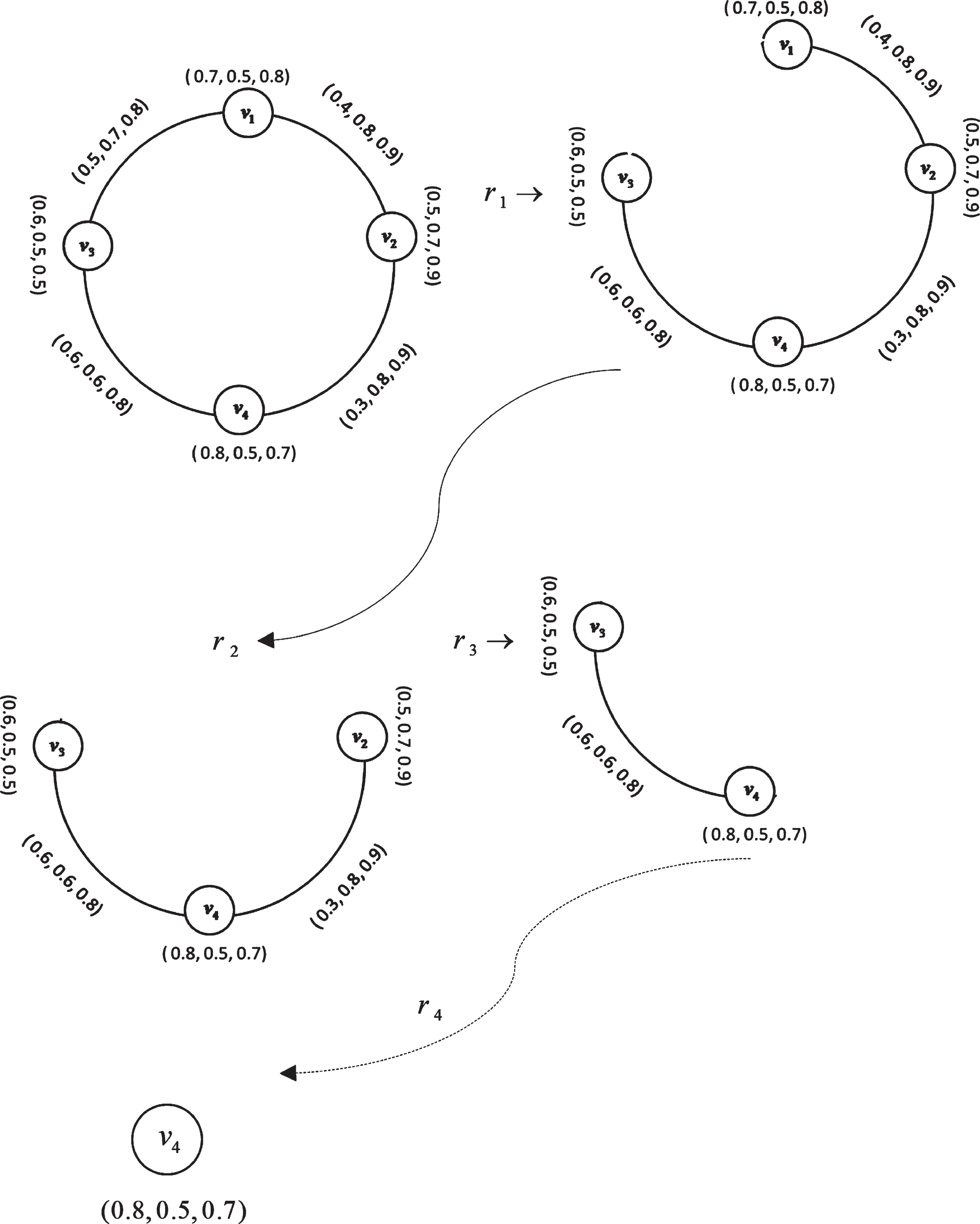
Proof. If Ğ=Ğ0 is a neutrosophic tree with a neutrosophic vertex n, then Ğ has no neutrosophic cycles and the number of neutrosophic edges is n - 1. Now, consider the sequence of neutrosophic retraction Ği - 1→Ği = 1, 2, … n for which Ği - 1) =Ği where Ği is subgraph of Ği - 1, where reduce the number of neutrosophic edges and neutrosophic vertices until the point that we get just a single neutrosophic vertex . Also if Ğ=Ğ0 is not a neutrosophic tree, then it contains at least one neutrosophic cycle, similarly, all reduce the number of neutrosophic cycles into a single neutrosophic vertex graph as in Fig. 1. □
Minimal neutrosophic retraction.
Theorem 3.8.There is a type of neutrosophic folding on a neutrosophic bipartite graph and neutrosophic complete bipartite graph.
Proof. Let ( be a neutrosophic vertex of a neutrosophic bipartite Ğ1. Then ( where, and and every where, and . Also, let Ğ2 be neutrosophic complete bipartite graph with neutrosophic vertex set ( Then ( where, , and every neutrosophic vertex of merged to every neutrosophic vertex of by only one neutrosophic edge. □
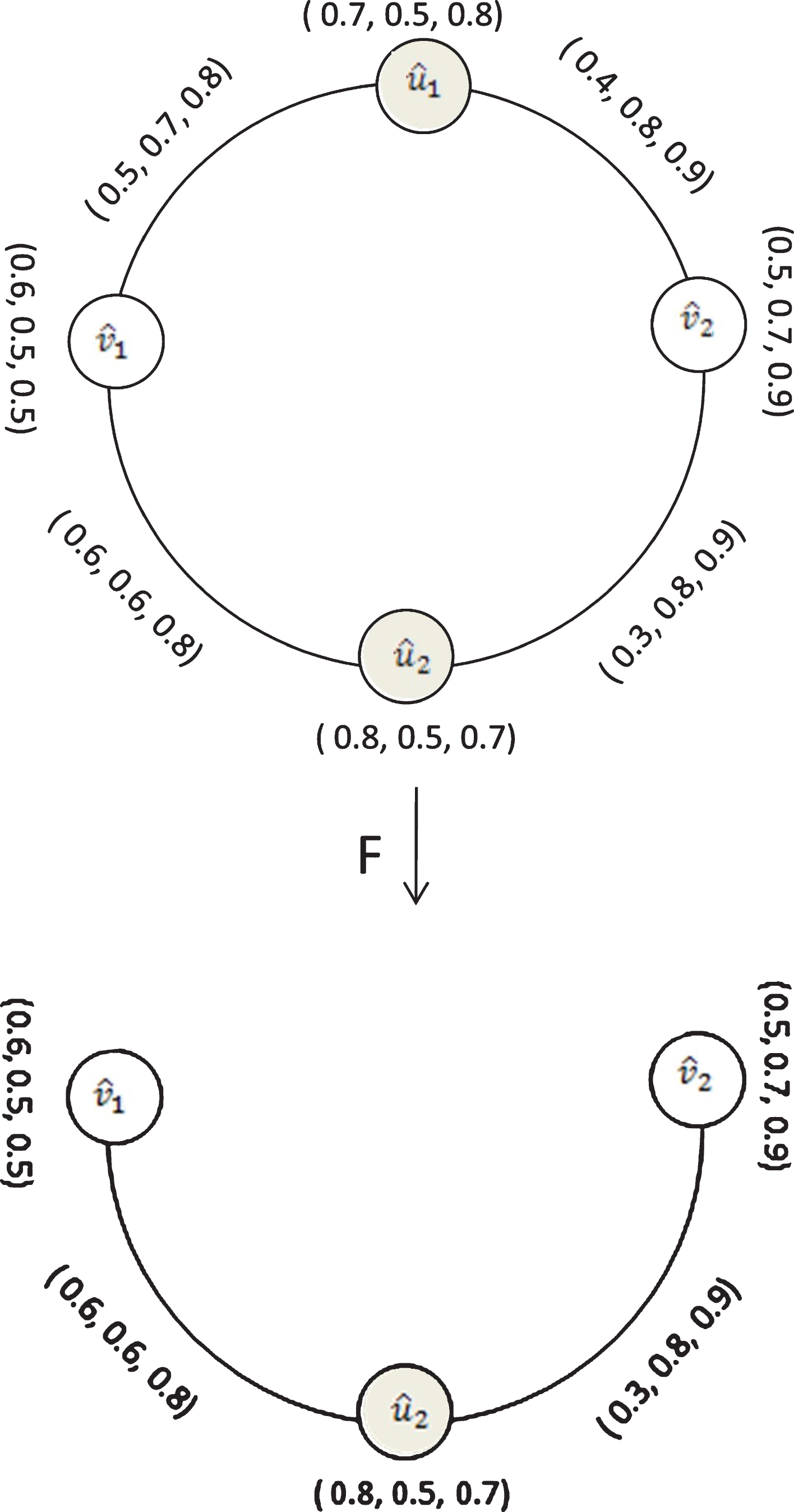
Example 3.9. Consider a neutrosophic bipartite graph Ğ with neutrosophic vertex sets, and .
Let F–:Ğ→Ğ be a neutrosophic folding be defined as and as in Fig. 2.
Neutrosophic folding on a neutrosophic bipartite graph.
The theory of neutrosophic folding on neutrosophic spheres and neutrosophic torii from a viewpoint of geometry
In this section, we define an isometric neutrosophic folding on a neutrosophic sphere and a neutrosophic torus, we deduce the relationship between the end limits of isometric neutrosophic folding and the minimal neutrosophic retraction. Also, we find the end limit of an isometric neutrosophic folding on a non-simple neutrosophic connected graph.
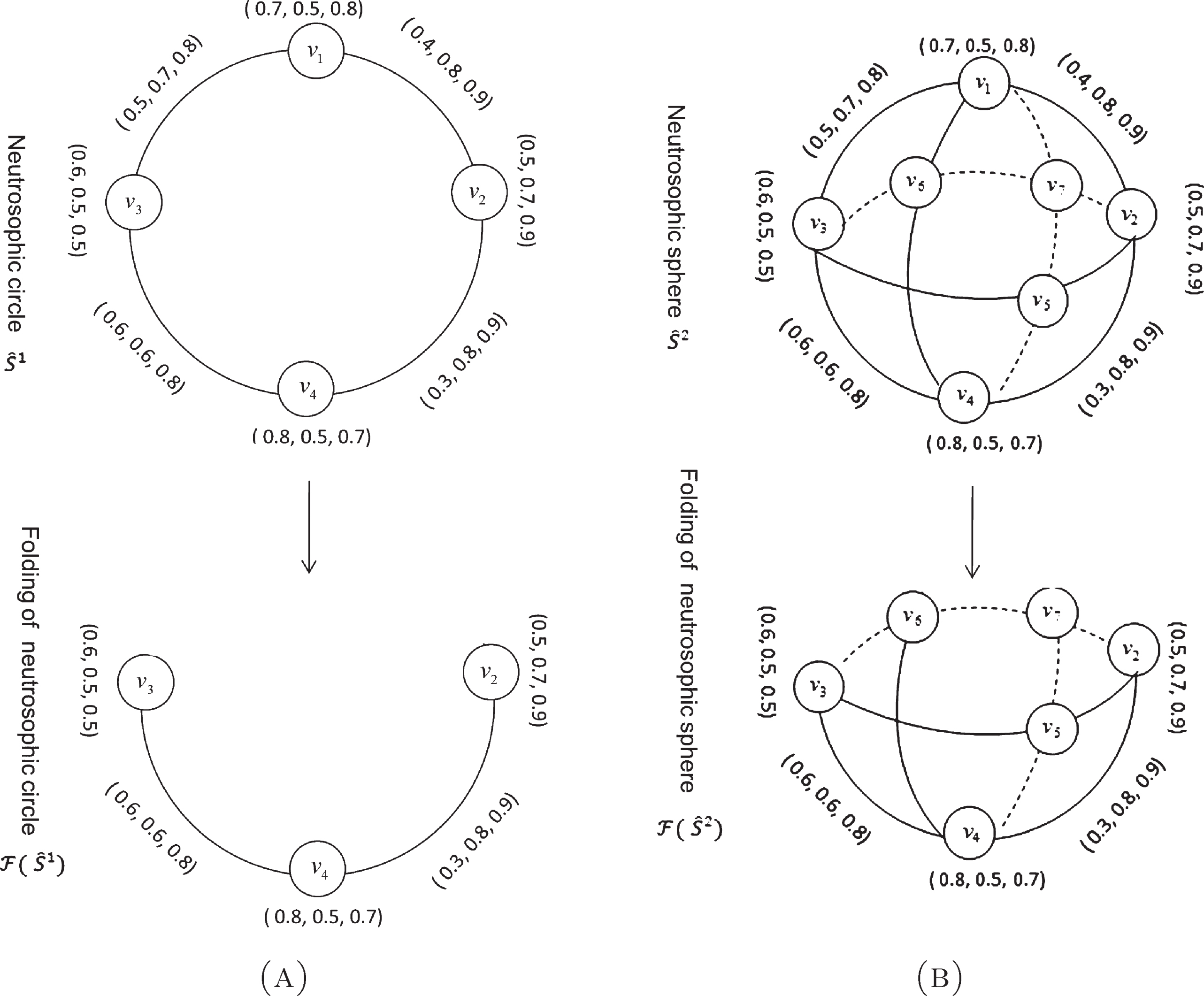
Definition 4.1. Let
is a neutrosophic sphere of dimension. A map , is said to be an isometric neutrosophic folding of into itself, iff for any piecewise neutrosophic geodesic path the induced neutrosophic path is a piecewise neutrosophic geodesic and of the same length as ξ as in Fig. 3.
Isometric neutrosophic folding.
Definition 4.2. Let Čm and Čn be two neutrosophic cycle graphs and Čm×Čn is homeomorphic to Ť= . Then Ť is a neutrosophic torus with neutrosophic generators and .
Theorem 4.3.The end limits of an isometric neutrosophic foldings of Ťn +1 = into itself is identical with the minimal neutrosophic retraction.
Proof. Let be a sequence of isometric neutrosophic folding and neutrosophic retraction respectively on Ťn +1. Then we obtain the following sequence:
replicating this technique on we get
After all, going on in a comparable way on
we obtain
where (Ťn +1 - (a neutrosophic one vertex graph). Hence, the end limit of an isometric neutrosophic folding and the limit of minimal neutrosophic retraction is a neutrosophic one vertex graph). □
Here and now, we can take a broad view of the relations among the isometric neutrosophic foldings, and retractions on the (SVN-graph) Ğ, and a neutrosophic subgraph of Ğ.
Theorem 4.4.Suppose that Ğ is a connected (SVN-graph), is a neutrosophic subgraph of Ğ and let is a sequence of isometric neutrosophic folding, and neutrosophic retraction map respectively. Then, there is a sequence of a commutative diagram on Ğ.
Proof. In order to introduce a commutative diagram, we use the sequence of an isometric neutrosophic folding on Ğ to introduce an induced sequence of an isometric neutrosophic folding on under neutrosophic retraction, so we get the following commutative diagram:
where is a neutrosophic one vertex graph. □
In the next theorem, we apply the sequences of limit isometric neutrosophic folding on the non-simple neutrosophic connected graph by eliminating neutrosophic cycles to create the simple neutrosophic connected graph and ongoing this procedure to get one neutrosophic edge graph.
Theorem 4.5.The end limits of isometric neutrosophic folding on a non-simple connected (SVN-graph) is neutrosophic one edge graph .
Proof. Given a sequence of an isometric neutrosophic folding on a non-simple connected (SVN-graph) Ğ:
, where, Ğn is a simple (SVN-graph) with n-edges
(neutrosophic one edge graph). □
Conclusion
The paper is dedicated to presenting some new transformations on the (SVN-graph), the neutrosophic folding on a (SVN-graph) is defined. The theory of neutrosophic folding on a (SVN-graph) from the viewpoint of geometry are discussed. We deduce the isometric neutrosophic folding on neutrosophic spheres and neutrosophic torii. The sequence of neutrosophic folding on the (SVN-graph) is deduced. The relationship between the limit neutrosophic folding and the limit of retraction on the (SVN-graph) are obtained. We proved that the end limits of isometric neutrosophic folding of the neutrosophic hyper torii Ťn +1 into itself is identical with the minimal neutrosophic retraction.
Acknowledgments
The author would like to thank the anonymous referees for the careful reading of the manuscript and for all
suggestions and comments which allowed us to improve both the quality and the clarity of the paper.
References
1.
Abdel-BassetM., GamalA., ManogaranG., SonL.H. and LongH.V., A novel group decision making model based on neutrosophic sets for heart disease diagnosis, Multimedia Tools and Applications79 (2020), 9977–10002.
2.
Abu-SaleemM., Some geometric transformations on manifolds and their algebraic structures, Ph.D. Thesis, Tanta University, Egypt (2007).
3.
Abu-SaleemM., Folding on the wedge sum of graphs and theirfundamental group, Applied Sciences12 (2010), 14–19.
4.
Abu-SaleemM., Homology group on manifolds and theirfoldings, Tamkang Journal of Mathematics41(1) (2010), 31–38.
5.
Abu-SaleemM., Conditional fractional folding of amanifold and their fundamental group, Advanced Studies in Contemporary Mathematics20(2) (2010), 271–277.
6.
Abu-SaleemM., The minimum deformation retract on thewormhole spacetime, International Journal of Geometric Methods in Modern Physics17(13) (2020), 2050198.
7.
AkramM., SiddiqueS. and DavvazB., New Concepts inneutrosophic graphs with application, Journal of Applied Mathematics and Computing57(2) (2017), 279–302.
8.
AkramM. and SiddiqueS., Neutrosophic competition graphswith applications, Journal of Intelligent & Fuzzy Systems33(2) (2017), 921–935.
BroumiS., TaleaM., BakaliA. and SmarandacheF., Singlevalued neutrosophic graphs, Journal of New Theory10 (2016), 86–101.
11.
ChartrandG. and ZhangP., Chromatic Graph Theory,Taylor & Francis Group (2009).
12.
DatL.Q., et al., Linguistic approaches to interval complexneutrosophic sets in decision making, IEEE Access7 (2019), 38902–38917.
13.
DeliI., LongH.V., SonL.H., KumarR. and DeyA., Newexpected impact functions and algorithms for modeling games under soft sets, Journal of Intelligent & Fuzzy Systems39(3) (2020), 4463–4472.
14.
El-GhoulM., El-AhmadyA.E. and Abu-SaleemM., Folding onthe Cartesian product of manifolds and their fundamental group, Applied Sciences9 (2007), 86–91.
15.
JhaS., SonL.H., KumarR., PriyadarshiniI., SmarandacheF. and LongH.V., Neutrosophic image segmentation with dice coefficients, Measurement134 (2018), 762–772.
16.
Jun Yi TeyD., GanY.F., SelvachandranG., QuekS.G., SmarandacheFl. and SonL.H., A Novel neutrosophic data analytic hierarchy process for multi-criteria decision making method: A Case study in kuala lumpur stock exchange, IEEE Access7 (2019), 53687–53697.
17.
KaraaslanaF. and DavvazbB., Properties of single-valuedneutrosophic graphs, Journal of Intelligent & Fuzzy Systems34 (2018), 57–79.
18.
KauffmannA., Introduction to the theory of fuzzy Sets, Vol. 1, Academic Press, Inc., Orlando, Florida (1973).
19.
LongH.V., AliM., SonL.H., KhanM. and TuD.N., A novelapproach for fuzzy clustering based on neutrosophic association matrix, Computers & Industrial Engineering127 (2018), 687–697.
20.
PirzadaS. and DharwadkerA., Applications of graph theory, J.KSIAM11(4) (2007), 19–38.
21.
SmarandacheF., A Unifying Field in Logics. Neutrosophy: Neutrosophic probability, set, and logic, American Research Press, Rehoboth, 1999.
22.
SmarandacheF., Neutrosophic set a generalization of the intuitionistic fuzzy set, Granular computing. In: 2006 IEEE International Conference (2006), 38–42.
23.
MohantaK., DeyA., PalA., LongH.V. and SonL.H., A studyof m-polar neutrosophic graph with applications, Journal of Intelligent & Fuzzy Systems38(4) (2020), 4809–4828.
24.
MordesonJ. N. and NairP.S., Fuzzy graphs and fuzzy hypergraphs, 46, Physica-Verlag (2000).
25.
NazS., RashmalouH. and Aslam MalikM., Operation on singlevalued neutrosophic graphs with application, Journal of Intelligent & Fuzzy Systems32 (2017), 2137–2151.
26.
RosenfeldA., Fuzzy graphs, In: ZadehL.A., FuK.S., ShimuraM., Eds., Fuzzy sets and their applications, Academic Press, New York (1975), 77–95.
27.
SinhaK. and MajumdarP., On single valued neutrosophicsigned digraph and its applications, Neutrosophic Sets and Systems22 (2018), 171–179.
28.
SonN.T.K., DongN.P., SonL.H. and LongH.V., Towards granular calculus of single-valued neutrosophic functions under granular computing, Multimedia Tools and Applications79 (2020), 16845–16881.
29.
ThongN.T., SmarandacheF., HoaN.D., SonL.H., LanL.T.H., GiapC.N., SonD.T. and LongH.V., A novel dynamic multi-criteria decision making method based on generalized dynamic interval-valued neutrosophic set, Symmetry12 (2020), 618.
30.
Van CanN., TuD.N., TuanT.A., LongH.V., SonL.H. and SonN.T.K., A new method to classify malicious domain name using neutrosophic sets in DGA botnet detection, Journal of Intelligent & Fuzzy Systems38(4) (2020), 4223–4236.
31.
Vasantha KandasamyW.B., IlanthenralK. and SmarandacheF., Neutrosophic Graphs: A new dimension to graph theory, Kindle Edition, 2015.
32.
WangH., SmarandacheF., ZhangY.Q. and SunderramanR., Single-valued neutrosophic sets, Multispace and Multistructure4 (2010), 410–413.
33.
WhiteA.T., Graphs, groups and surfaces, Amsterdam, North-Holl and Publishing Company (1973).
34.
WilsonR.J. and WatkinsJ.J., Graphs, An introductory approach, A first course in discrete mathematics, CanadaJohn Wiley & Sons, Inc (1990).
35.
YehR.T. and BangS.Y., Fuzzy graphs, fuzzy relations and their applications to cluster analysis, In: Zadeh,L. A., Fu,K. S., ShimuraM. Eds, Fuzzy Sets and Their Applications, Academic Press, New York (1975), 125–149.