



Abstract
The ever-changing demands lead to the challenge of designing a proper buyback contract of a reverse supply chain. In this paper, we propose a buyback contract model accounting for the fuzzy random demands with different risk attitudes, i.e., pessimistic, optimistic, or risk-neutral. We design the feasible set for coordination by adjusting buyback contract parameters according to the analysis of retailer profitability with multiple choices. Our models show that random demands may lead to the failure of original buyback contract, and dynamic modifications should be executed based on the proposed benefit models to remain the coordination. The results show that our model can allocate total benefits more fairly and keep the supply chain system stable by updating the buyback contract.
Introduction
Buyback contract is highly necessary in strategy design of reverse supply chain coordination. Generally, buyback contracts like repurchase contract, wholesale contract and quantity contract are common to be seen in supply chain coordination [1]. Based on the buyback contract, suppliers sell products to retailers with the wholesale price at the beginning of a sale season, while at the end, those unsold products will be bought back according to the unit-price defined before. Thus, the supply chain coordination is greatly supported by the buyback contract [2]. Hu et al. study the buyback contract of a newspaper company with the right of pricing power [3]. AI et al. research a case where suppliers try to take control of competitions of multiple retailers using buyback contracts [4]; Taylor et al. try to combine the buyback contract and sale discount contract to coordinate the issues between efforts and demands in a newsboy’s paper delivery problem [5].
Within the pre-order period, the market demands may fluctuate when retailers’ orders are sent out. That is to say, demands are ever-changing with time. This change of demands can greatly sabotage the coordination contract and even make the contract useless and meaningless. Xiangtong Qi et al. [6], Snyder et al. [7] and Modak N.M. et al. [22] study the response method of determining flexible quantity with the market demands changing. Among these existing researches, market demands under varied market size and price are assumed known a prior. As for the uncertainty of supply chains, different response methods of coordination contracts against ever-changing demands have been proposed. Generally, the uncertain demands are represented by random variables following a known distribution probability at each modeling phrase. Yang et al. use the income distribution contract to solve the dual marginalization effect issue [8]. Donohue et al. study the newsboy model in a unitary season with dual phrases and then put forward a regulation that the wholesale price should be made according to the real-time demands [9], and we can find [23] for the similar topic. Yan et al. point out that necessary modifications should be made when retailers are suffering from a changing demand distribution, because the supply chain coordination may be broken [10].
Apart from random variables, fuzzy variables and fuzzy random variables are also used to capture the demand uncertainty. In these cases, the demands are assumed to be obtained by managers’ or decision makers’ predictions and then expressed ambiguously by fuzzy variables. J.M. Merigó et al. present an overview of fuzzy research with bibliometric indicators in [20]. Dobrila Petrovic and Radivoj Petrvic et al. study the newsboy issues under the fuzzy demands [11]. A continuous inventory model is developed by Liang-Yuh Ouyang and Jing-Shing Yao [12]. Besides, Dash et al. and Li et al. both study the model of unitary cycled inventory under the fuzzy demands [13, 14]. We see that fuzzy random variables have been widely used to represent the uncertainty since Huibert Kwakernaak brought it to public [15]. We also refer readers to [16] for a comprehensive review of the concept, modeling and influence of fuzzy random variables [16].
Recently, many scholars have used the fuzzy random variables to denote uncertain market demands. Dash et al. use fuzzy random variables to compute expected maximum profits of unitary newsboy model [13]. Hung-Chi Chang et al. propose a mixed fuzzy model containing random pre-demands and random total demands, by confirming the quantity of pre-order and the total cost of pre-optimization [17]. In the unitary cycled inventory model, P. Dutta et al. assume demands and corresponse probabilities are fuzzy and trigonometric. And a gradient-mean method is proposed to compute the optimal ordering quantity of a company under uncertain environments [18]. J.M. Merigó et al. use aggregation systems that consider the attitudinal character of the consumers and their beliefs for representing the demand [21]. These researches provide optimal solutions for inventory problems, however, they still do not mention the supply chain coordination with multiple enterprises, nor consider the influences of information updating toward the coordination of multiple supply chains.
This paper consider the response method of supply chain buyback under fuzzy random demands, and our contributions are threefold: We represent the ever-changing demands by fuzzy random variables. As the sales approaching, retailers are capable of making fuzzy prediction based on historical data and experiences. And they can provide more customized services across the supply chain, therefore improve profits and avoid great losses; We propose a model of designing the buyback contract under fuzzy demands. By updating the buyback, we can judge whether the supply chain can be coordinated or not; We extend our research to pessimistic and optimistic decision makers. We propose corresponding response models of buyback contract to make it more extensively applicable.
Our paper is organized as follows. Section 2 describes the problem and presents a classic method of designing buyback contract. We then propose the risk neutral profits maximum model using fuzzy random variables under uncertain demands in Section 3. We analyze the modification of the feasible set of buyback contract in following Section 4, and extending pessimistic and optimistic models are also presented in this section. Section 5 reports a numerical case to illustrate the performance of the proposed method. We conclude this paper in Section 6.
Problem description and classic method of buyback contract
Problem description
We assume that there is a supply chain containing only one supplier and one retailer. the supplier produces a product series according to the retailer’s orders, and then the products will be sold to the market when the retailer acquire them, and the similar model can also be found in [24], as shown in Fig. 1. Currently, the retailer is going to embrace a warm sale season and in order to cater for it, there will be a second chance of order. In the first order, the retailer assumes a primary quantity of units based on the distribution of market demands and the buyback contract is provided by the supplier. Before the start of the sale season, the retailer takes further steps to collect information from the market and studies the historical experiences, then the retailer updates the new demand information into fuzzy random variables and send it to his supplier. The supplier amends the buyback contract immediately after getting the updating messages from the retailer. And then the retailer makes decisions on whether ordering more units or cutting down the quantity. When the sale season begins, there will be no more chances for the retailer to amend the order in term of quantity. At the end of the sale season, when demands exceed the ordered quantity, the shortage cost will be incurred. When there exist unsold units, the supplier will purchase them back with a certain price. The notations used throughout this paper are shown as follows.
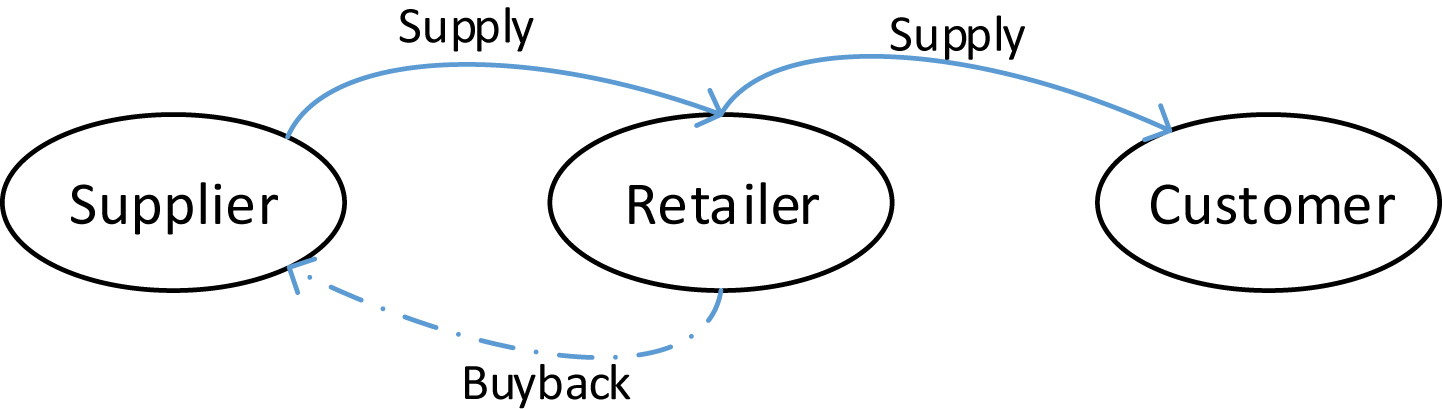
Diagram of the supply chain.
D: The market demands observed by the retailer at the first order.
F: The distribution of random demands D. F is a strictly increasing differential function. Let
p: A constant that denotes the sale price of the product in the market.
c: The total cost of per unit of the product, and c = cS + cR (cS represents the unit production cost from the supplier, cR represents the unit cost from the retailer).
g: Unit penalty cost, and g = g S + g R , where g S denotes the unit goodwill penalty cost of the supplier, and g R represents the unit goodwill penalty cost of the retailer. Both of them are triggered by stock-out of the retailer.
v: The salvage value of unit product.
w0: The wholesale buyback price of per unit product specified in the buyback contract of initial order.
b0: The unit buyback price of per unit product specified in the buyback contract of supplier at the first order.
q: Decision variable that denotes the order quantity of the retailer.
In this paper, we use
The profit function of retailer is
Then, we can obtain the profit function of supplier:
Obviously, the profit of retailer and supplier is affected by the transfer payment T. In this paper, we assume that the transfer payment is completed by a parameter set of buyback contract {w0, b0}. For any 0 ≤ λ ≤ 1, we have
Then, the profit function of the retailer can be adapted into
The buyback contract can coordinate the supply chain to promote the retailer to make order according to the optimal order quantity of system, of which the order quantity can be described as q * = arg max π (q), the optimal profit of supply chain system is πmax = π (q *), and the optimal profit of retailer is πRmax = λπmax + u (λg - g R ) according to Equation (4).
As the sale season approaching, there shall be more information available to the retailer. The demands may be updated to a number of fuzzy intervals accompanied by fuzzy random variables that are composited of subjective fuzzy probability. We denote the fuzzy random demands by
To continue, we define the following assumptions.
From the view of the whole supply chain, after demands changing, the response ways of the retailer can be divided into two categories: no change in order quantity and change the order quantity into
The profit of the supply chain under different counter measures
The expected profit is a triangular fuzzy number
Thus we have an optimistic value under level α (0 < α ≤ 1):
The α- optimistic value of
The decision should be made from the overall view of the supply chain considering the centralized leadership. The preferences of each decision-maker on the risk are quite different. Some of them are pessimistic while others are optimistic. Decision-makers can apply pessimistic, optimistic, or risk-neutral decision criterion as their will be.
The decision-maker chooses the decision criterion according to their preferences. We take the risk-neutral criteria for example. If the decision-making result is
Feasible set modification of buyback contract
In order to coordinate the supply chain, the supplier need to modify buyback contract appropriately to guide the retailer’s order in accordance with the optimal production and sales. We use {w, b} denote the updating parameters of the buyback contract, the retailer’s expected profit is represented by
To simplify the problem, we assume that both the retailer and supplier use risk-neutral criterion for decision making, we then have the following proposition.
It is easy to know that p - b > 0, c
R
+ w + c
RE
- b > 0, p - c
R
- w + c
RD
+ g
R
> 0, c
R
+ w - b > 0, p - c
R
- w + g
R
> 0 according to Equation (12). According to the positive and negative of Equation p - c
R
- w - c
RE
+ g
R
and p - c
R
- w - c
RD
- b, which can be divided into four cases. In this paper, we assume that both of them are positive. Equation (13) implicates this condition. For the other three cases, a similar analysis can be done.
Thus, the fuzzy expectation of the retailer’s expected fuzzy profit is the algebraic Equation of {w, b}:
The optimal decision of the supply chain system can be classified into three cases.
Analogously, {w, b} needs to satisfy more constraints shown in Equation (15) except (12), (13).
The retailer can make the decision in accordance with the optimal way of the supply chain through (14∼16). The key of coordinating supply chain is sharing gain and risk simultaneously. The increase or decrease of the expected profit of the supply chain before or after demand updating is calculated by the wholesale price and repurchase price. Then it can achieve the distribution between the retailer and supplier. Equation (17) denotes the constrains of {w, b}.
Equation (17) can determine the reasonable distribution of the expected profit increase or decrease in the transaction through the negotiation adjustment of the wholesale price and the repurchase price.
In this section, we present a numerical case extracted from actual production and management. The basic parameters of the supply chain are shown in Table 1. At the first stage, we assume that the demands of product follows q ∼ N (25, 10), and
Basic parameters of the supply chain
Basic parameters of the supply chain
The profit function of supply chain is
Using the buyback contract parameter set (3.8, 1.6), i.e., λ = 0.6, the retailer’s expected profit level is πRmax = λπmax + u (λg - gR) = 14.84. At the first stage, we update the demands to the same fuzzy random variables refer to [18]. It is shown in Table 2.
Fuzzy random demands after updating
If additional orders occur, the unit cost of supplier increases to 0.1, and that of retailer increases to 0.05. If it reduces the order, the unit cost of supplier decreases to 0.2, and the unit cost of retailer decreases to 0.3. Both the supplier and the retailer use risk-neutral criterion to make decision. The expected fuzzy profits of the supply chain are shown in Table 3.
Expectation of fuzzy number of the expected profit
It is easy to calculate that the optimal decision by adjusting the quantity around 40 for the supply chain system after demands information updating. If we do not use the buyback contract, the unit will remains to 33. The retailer’s decision-making doesn’t optimize the supply chain even that it leads to the disorder. According to Equations (12–14) and (17), the parameter set of buyback contract should satisfy the following constraints.
We notice that only Equation (18) plays an effective role of constraints, and there contains the number of 1, 8, 9, and 13 inequalities, respectively. We report this in Fig. 2 to show the feasible set of buyback contract more intuitively.

Feasible set of buyback contract.
In Fig. 2, the area enclosed by five straight lines is the feasible set. Point * is the original parameters of the buyback contract. At the first stage, the parameters of the buyback contract are outside the feasible region, which indicates that the contract cannot coordinate the supply chain after updating information. If we choose (3.6, 3.05) in the feasible area, the retailer can make the optimal decision according to the supply chain system with the modified buyback contract. In this condition, the retailer’s profit level corresponds to different decision–making. Details are shown in Table 4.
Expectations of fuzzy profit under modified buyback contract
In this paper, we studied the adjustment of buyback contract under the random demands. The optimistic, pessimistic and risk-neutral criteria were considered to propose the decision of supply chain and retailer. The feasible set of adjusted parameters of buyback contract was put forward. Studies have shown that the buyback contract must make an appropriate response in order to ensure supply chain coordination when demand information is updated from random variable to fuzzy random variable. A buyback contract with adjusted parameters can achieve the arbitrary distribute of profit gap between the supplier and retailer. We determine the contract parameters through negotiations, which can determine the distribution proportion of profit, and demonstrate the supply chain management idea of sharing gain and risk simultaneously.
Our results show that the original contract may fails when information updates, thus the real-time contract is necessary for keeping the system coordinated. Besides, for pessimistic decision makers, product sales under uncertain demands will be lower than that by optimistic one, but with lower costs.
It is worth noting that if the supplier modifies the buyback contract after the demand information updating by retailer, the retailer’s profit level could be decreased, then they may stop their demand information updating. This kind of moral risk may lead to the supply chain imbalance, consequently, the study of effective incentive mechanism is quite needed in order to ensure the retailer pursuing demand forecast cooperation.
Our future work will consider some specific risk functions like VaR and CvaR to analyze the profit and cost under fuzzy demands. Besides, we’re also interested in the new approach for representing the fuzzy demands.
Footnotes
Acknowledgments
The first author wishes to acknowledge the financial support of the National Natural Science Foundation of China (Project No. 71471143), and Hubei Key Laboratory for Efficient Utilization and Agglomeration of Metallurgic Mineral Resources (Wuhan University of Science and Technology) Opening Foundation (Project No. 2016zy013). Thanks for all the authors of the references who gives us inspirations and helps. The authors are grateful to the editors and anonymous reviewers for their valuables comments that improved the quality of this paper.