



Abstract
An efficient reverse logistics structure plays an important role in improving market competitiveness. The complexity of reverse logistics operations, customer service improvement, and costs elimination highlight the necessity of reverse operations outsourcing to the third-party reverse logistics providers (3PRLPs). Investigating and selecting an appropriate 3PRLP is recognized as a significant issue by manufacturers. This problem is affected by uncertainty, basically due to the vagueness intrinsic to the assessment of qualitative factors. This paper aims to propose a structured approach to prioritizing 3PRLPs based on sustainability criteria under fuzzy environment which accommodate the uncertainty associated with the vagueness of qualitative criteria. The proposed approach is composed of two main steps in which the first step employed the fuzzy Decision-Making Trial and Evaluation Laboratory (DEMATEL) to select the effective criteria and the second step used Mamdani Fuzzy Inference System (FIS) model to cope with the vagueness that exists in the 3PRLPs evaluation process. If-then scenarios are employed to design rules of a FIS model which are devised by experts. The Experts’ knowledge about the problem is incorporated into the FIS system. This is a significant benefit of the proposed approach, in comparison with approaches which incorporate fuzzy set theory with multi-criteria decision-making models. An industrial case study is conducted to highlight the real-life applicability of the proposed approach. In addition, a sensitivity analysis is performed to confirm the robustness.
Introduction
Improving the Supply Chain Management (SCM) performance has been changed into a crucial issue for most companies which want to stay competitive in the global marketplace. Several approaches and strategies have been identified and applied to reach this aim. In recent years, the importance of reverse logistic to improve SCM has been highlighted by people and companies due to environmental and social responsibilities and the economic benefits of used products [25]. In a Reverse Logistics (RL) process, returned products are collected and their quality and usability is inspected for classification into different categories, and send the used products to suitable centers for recycling, remanufacturing, reuse, or final disposal [34]. Hence, enhancing efficiency in RL operations is recognized as a significant factor in promoting competitiveness.
An RL processes could be adopted by outsourcing partial or overall RL operations to third-party reverse logistics providers (3PRLPs) with most of the manufacturers. Utilizing 3PRLPs can decrease the overall costs, uncertainty that results from some parameters such as return rates, increase flexibility, improve customer responsiveness, and satisfaction enables focusing on core competency, and release more capitals for manufacturers to invest in other sections [40]. The 3PRLPs also assist companies to enhance profit margins, to increase customer satisfaction, to improve status in the global supply chain network. Hence, 3PRLPs play an important role to improve RL networks in the recent years. Here, there are challenging issues for manufacturers, whether the company has access to a reliable 3PRLP and which providers can be useful for the type of RL network required. Hence, evaluating and selecting the best 3PRLP is recognized as a significant subject that can either jeopardize or improve the success of companies.
Several studies investigated and prioritized 3PRLPs. Senthil et al. [42] proposed an integrated approach using analytic hierarchy process (AHP) and fuzzy Technique for Order of Preference by Similarity to Ideal Solution (TOPSIS) for prioritizing the optimum 3PRLP in the case of plastic recycling. Khodaverdi and Hashemi [35] developed a multi-criteria decision making (MCDM) model for ranking the third-party reverse logistics service providers based on financial and environmental criteria. They combined AHP and gray relational analysis model for proposed approach. An integrated approach of analytical network process (ANP) and balanced score card (BSC) model was developed by Tjader et al. [46] for selecting outsourcing strategies. Wang and Zhu [19] adopted a fuzzy clustering analysis method in order to evaluate third- party providers based on oil consumption, cleaning materials/clean energy use, and carbon emissions criteria. They employed this model to evaluate a 3PRLP to whom the transportation of an electronic product company was to be outsourced. A fuzzy AHP-PROMETHEE (Preference Ranking Organization Method for Enrichment Evaluations) approach was proposed by Kafa et al. [33] to evaluate 3PRPs according to sustainability criteria.
Efendigil et al. [43] employed artificial neural network and fuzzy AHP to prioritize the third party logistics provider in the presence of vagueness. Identification of the potential recovery facilities for a reverse supply chain was done by Pochampally and Gupta [23] using fuzzy AHP. Ravi et al. [44] presented ANP and BSC to evaluate alternatives for the end of life computers. They employed financial, non-financial criteria and tangible, intangible criteria for evaluation. Kannan and Murugesan [15] applied fuzzy extent analysis for prioritizing third-party reverse logistics providers for the battery industry. Zhi-Hong and Qiang [45] suggested a grey comprehensive model based on AHP for the evaluation of reverse logistic provider’s evaluation. The ANP model was employed by Meade and Sarkis [28] for the selection of reverse logistics provider selection.
The above literature indicates that MCDM models used to evaluate and select 3PRLPs are based on quantitative criteria, as well as vague or imprecisely defined qualitative criteria; requiring a comprehensive approach that handles both types of criteria. To accommodate the uncertainty associated with the vagueness of qualitative criteria, fuzzy logic is integrated with MCDM models. High volume of calculations required in order to perform pair comparisons is recognized as the main disadvantage for Fuzzy Multi-criteria Decision-making (MCDM) methods.
In this paper, an approach based on Mamdani Fuzzy Inference System (FIS) is presented to prioritize 3PRLPs which is less computationally demanding than MCDM methods. If-then scenarios are employed to design rules of a FIS model. These scenarios are devised by experts, and such depend on modeling human reasoning and experience. The Experts’ knowledge about the problem is incorporated into the FIS system. This is a significant benefit of the proposed approach, in comparison with approaches which incorporate fuzzy set theory with multi-criteria decision-making models, such as Fuzzy AHP, Fuzzy ANP, and Fuzzy TOPSIS. The proposed approach also relieves decision makers from the high volume of necessary calculations to perform pair comparisons for Fuzzy MCDM models. In addition, the FIS model gives this opportunity to experts to choose different operators such as t-norms, s-norms, and defuzzification operators, which bring flexibility to the system.
The main goal of the present study is to develop a systematic approach to evaluate and select the best 3PRLP in a reverse logistics network which includes two main steps. First, the Fuzzy Decision-Making Trial and Evaluation Laboratory (DEMATEL) method is applied to identify the crucial criteria for 3PRLP evaluation. In this study, thirty eight criteria were recognized for sustainability dimensions, derive from existing literature. All criteria for evaluations are not equally influential. Therefore, a fuzzy DEMATEL method is employed to avoid criteria of low influence. The adopted Mamdani FIS model is then used to evaluate and prioritize 3PRLPs based on the sustainability criteria. Three fuzzy inference systems are designed to calculate the sustainability dimensions scores, FIS 1 for Cost, FIS 2 for Environmental, and FIS 3 for Social dimensions, respectively. Finally, the summation of obtained scores from sustainability dimensions is considered as the final score of 3PRLPs. The providers are prioritized based on these scores.
The main contributions of proposed approach of this study include (i) identifying significant sustainability criteria to evaluate 3PRLPs performance; (ii) capability of approach for ranking any number of 3PRLPs; (iii) considering both quantitative data and vague or imprecisely defined qualitative information for evaluation process; (iv) investigating the influence of sustainability criteria in ranking 3PRLPs.
The rest of paper is organized as; the required sustainable criteria for 3PRLPs evaluation in a reverse logistic network are introduced in section two. Then, some fundamental concepts regarding Mamdani FIS are presented. Based on the theoretical concepts, a new approach is proposed based on Fuzzy DEMATEL and FIS model for prioritizing 3PRLPs. A case study is also conducted to validate the proposed approach. Finally, a sensitivity analysis is performed on the results, followed by conclusions.
Sustainable reverse logistics criteria
Rogers and Tibben-Lembke [8] define RL as: “is the process of planning, implementing, and controlling the efficient, cost-effective flow of raw materials, in-process inventory, finished goods and related information from the point of consumption to the point of origin for the purpose of recapturing value or proper disposal”. The RL strategy is implemented by most manufacturers for economic advantages and corporate social image [14]. It is also recognized as a competitive advantage for companies and a valuable tool to promote customer satisfaction [20]. The main processes of RL network include: collecting returned products from customer centers and retailers, recovering, recycling, repairing programs, and disposition of obsolete products and asset recovery. One of the most efficient methods to successfully accomplish the RL operations is outsourcing these activities to 3PRLPs which specializes in these activities. Hence, the necessity of 3PRLPs evaluation to efficiently outsourcing is recognized by manufacturers.
In this regard, most researchers have employed the economic criteria like cost, economies of scale; processing parameters like flexibility, capacity, capability; resource capacity; quality of service, and other strategic, operational and tactical criteria for this problem. For instance, Xiangru [30] applied five criteria and fifteen sub-criteria to evaluate the third party reverse logistics providers. The resource capacity, technical indicators, quality of service, experience index, and costs are criteria that he used. Govindan and Murugesan [22] suggested seven criteria namely third party logistic services, reverse logistics function, organizational role, user satisfaction, the impact of use of 3PL, organizational performance criteria, and IT applications and thirty-four sub-criteria for 3PRLP evaluation. But, there are tremendous pressures on companies to decrease the environmental impact of their supply chain systems, which results in increasing awareness of sustainability context. Hence, in this paper, triple bottom line aspects of sustainability are taken for 3PRLPs evaluation into account. The triple bottom line aspects of sustainability are economic, environment, and social dimensions. The utilized criteria to this evaluation are extracted from the literature review and point views of supply chain managers (Tables 1–3).
Cost criteria
Cost criteria
Environmental criteria
Social criteria
Fuzzy set theory is recognized as an efficient method to process data by allowing partial set membership rather than crisp set membership or non-membership [26]. This method is implemented in the representation of human reasoning [41]. It is also recognized as a problem-solving methodology which enables decision makers to reach definite conclusions from imprecise, vague and uncertain information [13]. The fuzzy inference system is one of the most practical tools proposed within the context of fuzzy set theory to employ nonlinear, but ill-defined, mapping of input variables to some output ones. The FIS model has been implemented in a wide variety of industrial and management problems which could not be solved using purely mathematical and purely logic-based approaches in system design. For example, Lin and Chen [30] employed FIS model to monitor ecologically sensitive ecosystems in a dynamic semi-arid landscape from satellite imagery. Chen et al. [6] recommended FIS as a powerful applicant for analysis of structural systems under external excitations. Lin et al. [18] used FIS model to potential hazard analysis and risk assessment of debris flows. Amindoust et al. [1] presented a method based on fuzzy inference for ranking suppliers based on sustainable criteria. An integrated approach of FIS and life cycle assessment techniques has been presented to estimate environmental aspects in environmental management system by Liu et al. [24]. Pourjavad and Mayorga [11] proposed a new approach based on FIS model to investigate manufacturing systems.
The basis of FIS is described as output fuzzy variables are inferred from input fuzzy variables according to a set of logic inference rules in linguistic terms, which these rules are extracted from the knowledge base of a fuzzy system [10, 37]. Consider an FIS, where U = U1 × U2 × … × Un ⊂ R n is the input space and V ⊂ R is the output space. A fuzzy rule base contains a set of fuzzy IF-THEN rules. The If-Then rules are recognized as the core of the FIS and all other components such as membership functions have been applied to implement these rules in a reasonable, realistic and efficient manner.
These fuzzy If-Then rules are used by the FIS to describe a mapping from fuzzy sets in the input universe of discourse U ⊂ R
n
to fuzzy sets in the output universe of discourse V ⊂ R, based on fuzzy logic principles. The fuzzy IF-THEN rules are presented as following: [9]
The rules also allow quantitative, qualitative and judgmental data to be integrated in a uniform manner [4]. A fuzzifier to the input and a defuzzifier to the output of the FIS system are added to use the FIS in engineering systems. The fuzzifier maps crisp points in U to fuzzy sets in U, and the defuzzifier maps fuzzy sets in V to crisp points in V.
The most popular fuzzy logic modeling techniques can be divided into three types of the linguistic models (Mamdani-type) [23]; the relational equation models; and the Takagi– Sugeno– Kang models. In linguistic models, both the antecedent and the consequence are fuzzy sets while in the Takagi– Sugeno– Kang models the antecedent consists of fuzzy sets but the consequence is comprised of linear equations. In 1975, Mamdani represented one of the first fuzzy systems which applied a set of fuzzy rules supplied by experienced human operators to control a steam engine and boiler combination [36].
In the Mamdani FIS model, the consequents in the base of rules are obtained by the specialist idea [27]. The t-norm ∧ (minimum) is usually adopted for the logic connective “and”, as expressed by the following equation
For the logic connective “or” s-norm V (maximum) is usually represented.
For each activated rule, the inference machine applies an implication relation R between the fuzzy number resulting from the logic operations, and the consequent,
Alternative operators are the Max– Min (Zadeh) and the Multiplication (Larsen), respectively in following equations [5].
The output fuzzy number of each rule is explained by the composition between a fuzzy singleton and the implication relation. Composition operators of fuzzy relations commonly used are Max– Min, Max-prod, and Max-Media, respectively in following equations [2].
The final step in the inference process is an aggregation of the resulting composition operations for each rule. It should be mentioned that aggregation could be done by different operators, such as arithmetic, geometric or harmonic means, Min and Max [2, 27]. The Max operator is preferred when compensation between input variables is desirable [5]. The Max operator is given by:
In the defuzzification interface, output fuzzy numbers are changed to a crisp number. A defuzzification technique commonly used is Center of Area (CoA), where n is the number of discrete points of the fuzzy set and μ
A
(z) is the aggregated output MF.
In this section, the proposed approach for prioritizing the third party reverse logistic providers is described. Figure 1 displays an overall schematic of the proposed approach in this study. This approach is composed of two main steps. In the first step, a Fuzzy DEMATEL method is implemented to identify the important criteria for 3PRLPs evaluation. In the second step, an adopted Mamdani FIS model is proposed to evaluate and prioritize 3PRLPs based on sustainability criteria. In the second step, three fuzzy inference systems are modeled in order to obtain dimensions scores of sustainability. As it can be seen from Fig. 1, FIS 1, 2, and 3 are designed for cost, environmental, social dimensions, respectively. For each of these FISs, four criteria are taken as inputs into consideration. Finally, the summation of calculated scores from sustainability dimensions is considered as final scores (performance) of 3PRLPs. The providers are ranked according to these scores.
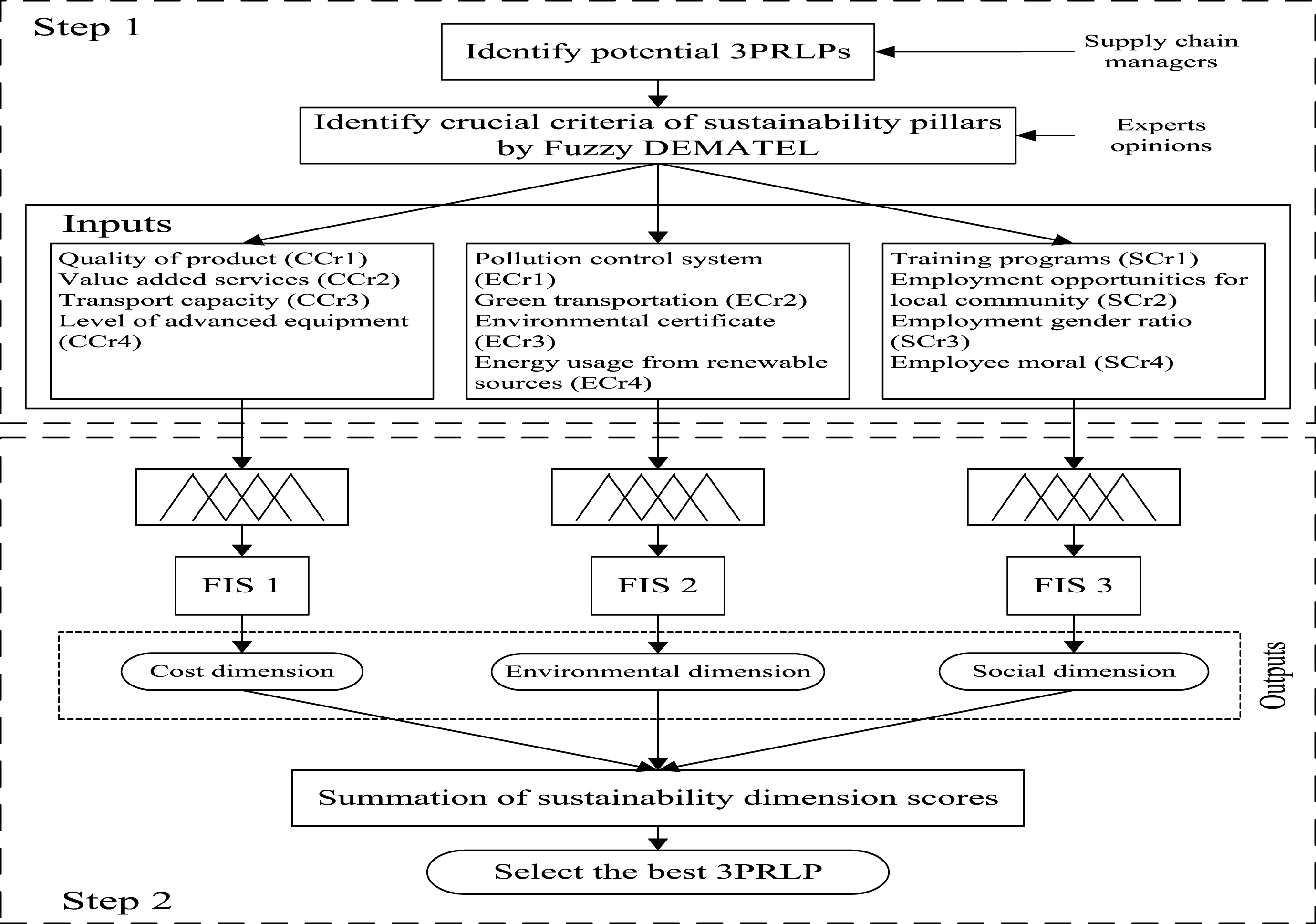
The framework of proposed approach.
The evaluation process of 3PRLPs is complicated with respects to this point that several sustainability criteria should be taken into account. As it can be mentioned earlier, three sustainability dimensions are chosen for this evaluation. Based on studies literature, 38 criteria are recognized for these dimensions. There is an inevitable reality that all these criteria are not effective to prioritize 3PRLPs. Hence, the fuzzy DEMATEL method is employed to identify effective criteria for ranking 3PRLPs.
The original DEMATEL method is integrated by fuzzy logic in order to enable it to solve problems with imprecise values and high uncertainty. In this study, a modified fuzzy DEMATEL approach which is adapted from Dalalah et al. [7] is used for problem-solving. Fuzzy DEMATEL approach uses linguistic variables for pair-wise comparison of sustainability criteria. The shortage of traditional quantification methods in describing complex situations, underlines the usefulness of linguistic variables. The value of a linguistic variable is a natural or artificial language expression and can be in form of a word or a sentence. The use of linguistic variables facilitates the judgments for decision makers. Representing the value of linguistic variables with fuzzy numbers, instead of crisp numbers, is more appropriate due to the innate ambiguity in linguistic expressions [15].
First,
Linguistic terms for criteria ratings [12]
Linguistic terms for criteria ratings [12]
Where
The total-relationship fuzzy matrix
Therefore,
Where
In the next step, the defuzzification of
The final criteria weights can be calculated by the following normalized values [7]:
These steps are done to evaluate criteria of sustainability dimensions. Table 5 shows the prominence, relationship and respective criteria weights of cost dimension.
Total relationship matrix of cost criteria
The obtained results from evaluation cost criteria by Fuzzy DEMATEL method shows four criteria of “quality of product” (CCr1), “value added services” (CCr2), “transport capacity” (CCr3), and “level of advanced equipment” (CCr4) have the highest effects on 3PRLPs evaluation according to experts’ opinions. This procedure is done for environmental and social criteria. Based on achieved results, “pollution control system” (ECr1), “green transportation” (ECr2), “environmental certificate” (ECr3), and “energy usage from renewable sources” (ECr4) were selected among criteria of environmental dimension. As well, for social dimension, “training programs” (SCr1), “employment opportunities for local community” (SCr2), “employment gender ratio” (SCr3), and “employee moral” (SCr4) were recognized as crucial criteria for prioritizing 3PRLPs.
In the second step of proposed approach, Mamdani’s compositional rule of inference is implemented to form the FIS 1, 2, and 3. The operational steps of Mamdani FIS model to prioritize 3PRLPs are explained in the following.
Fuzzification
In fact, due to this fact that the fuzzy inputs should be implemented for FIS model, the membership functions are defined for fuzzification of inputs. Several functional forms of the membership functions are recognized to display different situations of fuzziness; for example, linear shape, concave shape, and exponential shape. In this study, the linear triangular and linear trapezoidal membership functions which are generally used in most studies [11] are employed for fuzzification of inputs. It should be noted that the membership functions in this study are established based on the experts’ knowledge, data, and information extracted from previous assessments and existing documentation.
As it can be seen from Fig. 1 three fuzzy inference systems (FIS 1, FIS 2, FIS 3) are designed for the proposed approach. These FISs are allotted to sustainability dimensions. Four fuzzy sets of membership functions are taken for fuzzification of inputs of these FISs into account. The linguistic rating variables assigned to each of these input fuzzy sets are “very low”, “low”, “moderate” and “high” as shown in Table 6. Also, the linguistic rating variables assigned to output fuzzy sets of FISs are defined as “Worst”, “Very Poor”, “Poor”, “Fair”, “Good”, “Very Good”, and “Excellent” which are tabulated in Table 7.
The linguistic terms for FISs inputs of the first phase
The linguistic terms for FISs inputs of the first phase
The linguistic terms for SSCM performance
Fuzzy rules are defined after the input variables membership functions are constructed based on experts’ knowledge. Such rules are usually more conveniently formulated in linguistic terms than in numerical terms and they are often expressed as ‘If-Then’ rules, which are easily implemented by fuzzy conditional statements. The If-Then fuzzy rules have two sections, the phrases following the If statements are named premises, while the Then section of the rule is named the conclusion. The fuzzy AND operator is implemented to combine the premise variables. The combined premises generate the degree of membership and are named the adaptability of the premises to the conclusion of the rule [29]. The conclusion of rules is a distinct numerical value that is a fuzzy singleton [29]. All the rules that have any truth in their premises will contribute to the fuzzy conclusion set. Each rule is contributed to a degree that is a function of the degree to which its antecedent matches the input. This imprecise matching makes a basis for interpolation between possible input states and serves to minimize the number of the rules required to define the input-output relation [11]. The number of rules in the FIS model is calculated according to x n in which x is the number of the input variables membership functions and n is the number of input variables [2].
The importance of If-Then rules is highlighted because human expertise and knowledge can often be modeled in the form of fuzzy rules. There are several ways to extract the fuzzy rules. Expert knowledge and expertise, and fuzzy model of the process are commonly used applied methods to derive If-Then rules. In this study, fuzzy linguistic rules are defined based on expert knowledge. It should be noted that the rules are adopted on the preference of decision makers to have the appropriate ranking for 3PRLPs. The rules are defined based on averaging concept for each FIS [11].
Based on the fuzzy sets of membership functions and input numbers of FISs, 256 rules are defined for each FIS of the proposed model. Some of the defined rules for FIS 1 (Cost dimension) are represented in Table 8. For example, if CCr1(quality of product) of a 3PRLP is “Very Low”, CCr2(Value-added services) is “Moderate”, CCr3 (Transport capacity) is “Moderate” and CCr4 is “Low”, then, the performance of this 3PRLP will be “Fair” based on Cost dimension.
The inference rules of FIS 1
The inference rules of FIS 1
In this step, the fuzzy interface engine is employed to integrate the identified fuzzy sets considering the fuzzy rule and the related fuzzy area individually. The proposed FIS model implements the ‘min-max inference’ process to compute the rule conclusions according to the system input values. The obtained results from inference process are called ‘fuzzy conclusion’. Conjunction of rules can be defined as minimum or maximum. The minimum definition consists of detecting the smallest rule antecedent, while the maximum consists of detecting the biggest. The applicability or truth value is determined from these definitions and is applied to all consequents of the rule. In a situation where a fuzzy output is a consequent of several rules, the maximum definition is applied on associated rules. The result of the rule evaluation is a set of fuzzy conclusions that reflect the effects of all the rules whose truth-values are greater than zero.
Defuzzification
The defuzzification process is implemented to convert the fuzzy output into the crisp output. The center of area method (COA), bisector of area method (BOA), mean of maximum method (MOM), smallest of maximum method (SOM) and the largest of maximum method (LOM) are methods which are employed for defuzzification process. In this paper, the COA method is used for all FISs due to its simplicity. The COA method is mostly used for defuzzification process [1, 18]. This technique is displayed as following:
In this section, the proposed approach to evaluate 3PRLPs based on sustainability criteria is validated through a case study in pipe & fitting industry. Kooshan Etesal Company was established in 1986 in the city of Isfahan. It produces propylene piping and fittings products to convey water. Due to water shortage problems in IRAN, the products of this company have been increasingly used. The result of this subject was extensiveness and complexity of company’s supply chain in forward and reverse logistics. Also, following sustainability rules and legislations has been recognized as a success factor for this company due to increasing environmental concerns and pressures raised by customers. For this reason, this company decided to outsource some RL activities to 3PRLPs that meet sustainably criteria. Ten third-party reverse logistics providers (P1, ... ,P10) were chosen by supply chain managers of this company to be evaluated based on sustainability criteria. First of all, three academic experts and five senior industrial supply managers are asked to investigate these 3PRLPs according to cost criteria (FIS 1), environmental criteria (FIS 2), and social criteria (FIS 3). The obtained results are displayed in Table 9. This Table demonstrates the inputs of FIS 1, 2, and 3. It should be noted the arithmetic mean is applied to aggregate all collected data from decision makers.
Sustainability criteria scores of 3PRLPs
Sustainability criteria scores of 3PRLPs
The obtained results from conducted evaluation by experts show provider 3 has the best performance based on “quality of product”, “ value added services”, and “level of advanced equipment” criteria from cost dimension of sustainability and “green transportation”, “environmental certificate”, and “energy usage from renewable sources” criteria from environmental dimension. These results also reveal that for “quality of product”, “transport capacity”, and “level of advanced equipment” criteria, providers 7 and 1 got the second and third scores, respectively. But for “value added services” criterion, these two providers have a reverse ranking. In fact, the providers 7 and 1 have the third and second scores for this criterion. It should be noted that provider 4 has the worst performance for this criterion based on experts’ opinion. For criteria of “green transportation”, “environmental certificate” from the environmental dimension, providers 7 and 1 earned ranks of second and third, respectively. As can be inferred from Table 8 provider 9 has the worst performance for “pollution control system”, “green transportation”, and “environmental certificate” criteria of environmental dimension. According to experts’ opinions providers, 4 and 5 obtained highest and lowest scores for “pollution control system”, “energy usage from renewable sources”, respectively. Also, the achieved results from evaluating providers based on social criteria show provider 10 got the best performance for “employment gender ratio” and “employee moral” criteria. The highest scores for “training programs” and “employment opportunities for local community” criteria are allocated to providers 1 and 8, respectively. Also, the lowest scores for “training programs” and “employment gender ratio” are devoted to provider 9. These results also disclose that providers 2 and 6 have the worst performance for “employment opportunities for local community” and “employee moral” according to experts’ opinions.
As seen from Fig. 1. the obtained values from sustainability criteria (Table 9) are used as inputs of FISs. Then, the scores of sustainability dimensions are calculated based on designed FIS 1, 2, and 3. In fact, these scores display performance of 3PRLPs based on cost, environmental and social dimensions (Table 9).
Finally, the overall score of 3PRLPs is calculated using the summation of sustainability dimensions scores. It should be noted the obtained values for each FIS will be between 0 and 1 based on defined membership functions for outputs of FISs (Table 7). Consequently, summation these three values will be between 0 and 3. For example for provider #1, the calculated values for FIS 1 (Cost dimension), FIS 2 (Environmental dimension), and FIS 3 (Social dimension) are 0.482, 0.502, and 0.470 respectively. The final score (performance) of this provider is 1.545. The prioritizing 3PRLPs are done based on the overall scores. Table 10 shows the final score of 3PRLPs and achieved ranks. It is suggested to normalize the obtained values for each FIS before summation. The normalization helps to mitigate the flaws of averages.
Final scores of sustainability dimensions for 3PRLPs
Table 10 and Fig. 2 display the obtained outputs of FIS 1, 2, and 3 which present performance of 3PRLPs based on cost, environmental, social dimensions. The achieved results from the summation of these scores show provider 3 has the highest score among providers. In fact, this provider got the first rank among providers. The good performance of this provider based on cost and environmental dimensions are main reasons of this rank. These results also disclose providers 7 and 1 ranked second and third, respectively. Based on obtained results, provider 7 got the highest rank for environmental dimension. The worst performance is assigned to provider 9. These results show this provider got the lowest scores from environmental and social dimensions. These results also disclose the provider 10 got the highest score for social dimension.
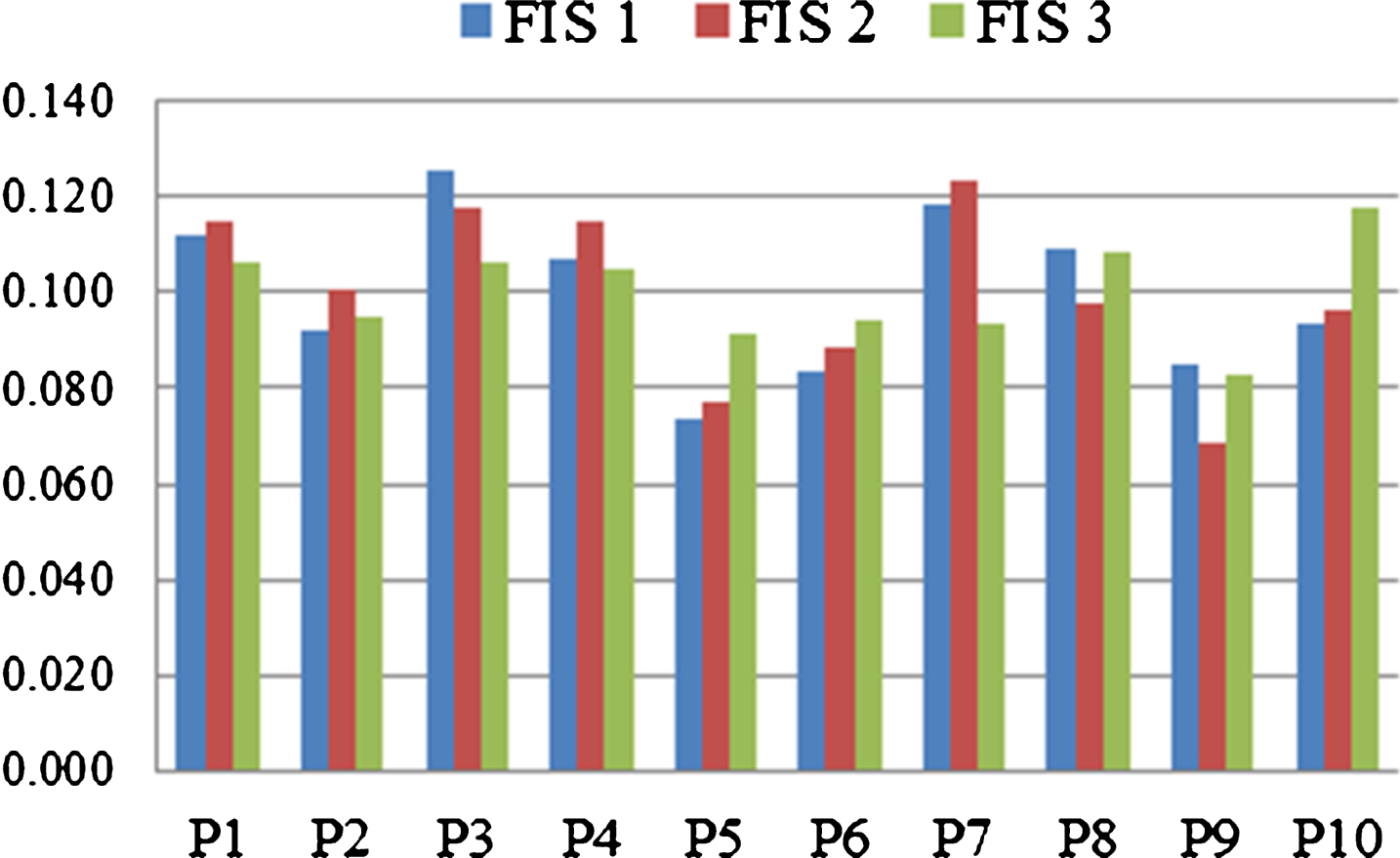
Outputs of FISs for each 3PRLP.
One of the main advantages of the proposed approach is its high capacity for analyzing the results. In fact, a sensitivity analysis can be easily performed by changing input values of FISs. As seen Fig. 1, twelve criteria are defined for input of FISs (four inputs for each FIS). In this section, the effect of these inputs (sustainability criteria) on the 3PRLPs performance is analyzed. It is investigated which criterion plays the most important role in ranking 3PRLPs. The outputs of this sensitivity analysis help managers to focus on strategies that improve effective criteria. The input values of FISs (Table 9) are changed and performance of 3PRLPs is evaluated in order to analyze importance of criteria on 3PRLPs ranking. These values (Table 9) are extracted based on decision makers (experts) opinions. The criteria values (Table 9) of the three pillars of sustainability, cost (FIS 1), environmental (FIS 2), and social (FIS 3) are increased twice with a 15%. It should be noted, these values (Table 9) shows the performance of 3PRLPs based on each criterion. This analysis shows if performance of one criterion is improved by 15% what will happen for final ranking of 3PRLPs. Twenty four experiments are carried out for this sensitivity analysis. For instance, in experiment 3, the value of CCr3 “transport capacity” is increased by 15% and the remaining criteria are not affected. Likewise, in experiment 18, the value of ECr2 “green transportation” is increased by 30%, while other criteria were unchanged. Table 11 and Fig. 3 demonstrate the details of these experiments.
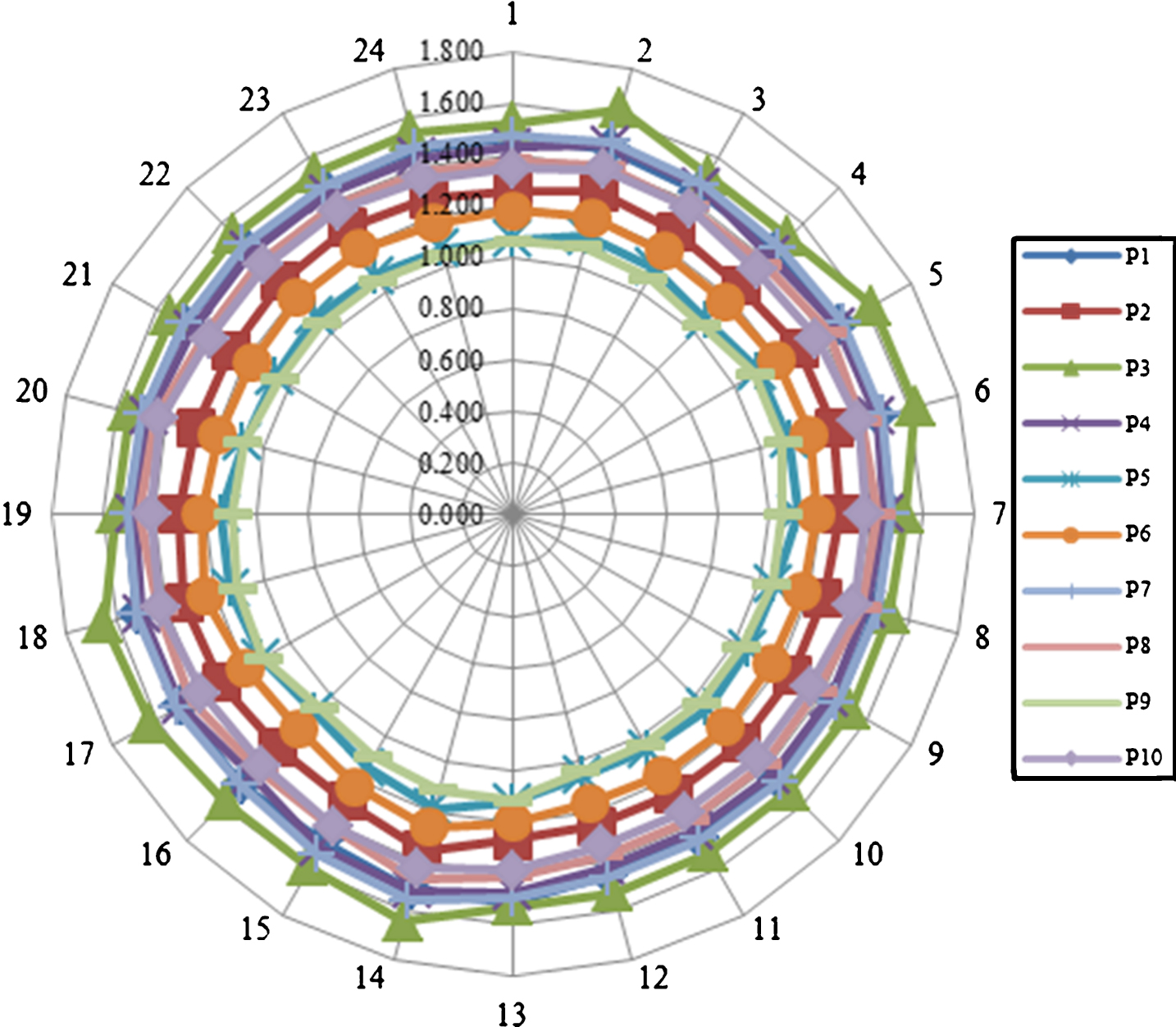
Sensitivity analysis results of sustainability criteria for ranking 3PRLPs.
Sensitivity analysis of sustainability criteria for ranking 3PRLPs
In Fig. 3, the 3PRLPs (P1, ... ,P10) performance are shown by different color. Experiments #1–4 and #13–16 are related to cost criteria, #5–8 and #17–20 environmental criteria, #9–12 and #21–24 for social criteria. As can be inferred from Table 11 and Fig. 3, cost and environmental criteria have more effect on ranking 3PRLPs. Increasing values of these criteria will improve the performance of 3PRLPs more than social criteria. The obtained results from this sensitivity analysis also detail criteria importance of each dimension. Among cost criteria, “value added service” (CCr2) criterion has the highest effect on 3PRLPs ranking among cost criteria. Experiments #2 and #14 in Fig. 3, are related to analysis of this criterion. The performance of all 3PRLPs (P1, ... P10) is significantly improved by increasing value of this criterion. In addition, “level of advanced equipment” (CCr4) has the lowest effect on ranking 3PRLPs. Experiments #4 and #16 show effect of this criterion on performance of 3PRLPs (Fig. 3).
For environmental dimension, “green transportation” (ECr2) and “energy usage from renewable sources” (ECr4) have the highest and lowest effects on 3PRLPs performance. Experiments #6 and #18 in Fig. 3 show the performance of 3PRLPs based on increasing ECr2 by 15% and 30%. As seen Fig. 3, increasing this criterion will considerably improve the performance of 3PRLPs. Also, the experiments #8 and #20 are related to ECr4 criterion. As seen Fig. 3, “employment opportunities for local community” (SCr2) and “employment moral” (SCr4) criteria from social dimension cause the highest and lowest change on 3PRLP performance. Experiments #10 and #22 are for analysis of SCr2 criterion and #12 and #24 for SCr4 criterion. Experiments #9–12 and #21–24 are related to criteria of social dimension. As seen Fig. 3, the obtained values for performance of 3PRLPs from these experiments have the lowest values among experiments.
Several managerial implications for supply chain managers can be extracted from the proposed approach in this study. The collaboration among 3PRLPs can be beneficial in the following ways: first, the best practices of the successful unit can be shared in between providers. Then by sharing the experience of most efficient firms, the 3PRPLs can improve their success rates. The proposed approach provides decision-makers with opportunity evaluating the impact of sustainability criteria on ranking 3PRLPs. In fact, the obtained results of sensitivity analysis exhibit insight into which criteria have the most crucial role in 3PRLPs investigation. The proposed approach is capable of taking uncertainties into account. There is an inevitable reality that uncertainty exists in the employed qualitative criteria of sustainability for evaluating 3PRLPs and also in the managerial perceptions associated with the criteria and their relationships. The achieved results are discussed with the considered manufacturer and they found it meaningful based on the applied criteria and considering the sensitivity analysis. It is strongly suggested supply chain managers to keep this information for both applications of this approach and for the general future management of its company.
Conclusions
In this study, an integrated approach was proposed for prioritizing 3PRLPs based on sustainability criteria using fuzzy DEMATEL and Mamdani FIS model. The fuzzy DEMATEL method was applied first to select the most important sustainability criteria. Then, an adopted Mamdani FIS model was performed to rank 3PRLPs. Three fuzzy inference systems were modeled to calculate dimensions scores of sustainability. In fact, FIS 1, 2, and 3 were applied for cost, environmental, social dimensions, respectively. For each FIS, four criteria were taken as inputs of the model into account. Finally, the summation of obtained scores from sustainability dimensions was assigned as final scores of 3PRLPs. The providers were ranked based on these scores. The proposed approach was validated by a case study in which ten providers were evaluated for the reverse chain operations of a pipe and fitting manufacturerr. Also, a sensitivity analysis was performed to discuss and explain the proposed approach results. The achieved results revealed that cost and environmental criteria have more effect on 3PRLPs ranking than social criteria.
The main contributions and advantages of this paper are summarized as; the proposed approach, not only helps the decision makers for the efficient conduct of reverse logistics operations but also provide a chance for them to visualize the effect sustainability criteria on 3PRLPs prioritizing. This approach can be performed for evaluation of any number of 3PRLPs. The specialist’s judgments are captured in the knowledge base by this approach. It also reduces the required time for calculation and involves both quantitative data and vague or imprecisely defined qualitative information in the evaluation process. Another important feature which can be mentioned for this approach is, taking into consideration the imprecise or vague judgments which lead to ambiguity in the evaluation process.
While the proposed approach includes significant practical and theoretical advantages, it has some limitations. With respect to this point that the proposed approach is rule-based and adding the number of inputs or evaluation criteria increasingly changes the quantities of the rules, defining rules is taken as the main limitation into account. In this study, 4 inputs were considered for each FIS which resulted in 256 rules. The numbers of rules will increase to 1024 rules if only one input is added to each model. In fact, the number of rules increases exponentially if the number of inputs increases for each model. Also, determining these rules is done by experts with respect to the fact that using knowledgeable individuals is vital in achieving appropriate results. Twelve criteria and three dimensions of sustainability were employed for prioritizing 3PRLPs, while it might be other criteria which can effect on results. It is recommended to develop membership functions in an effective, efficient and consistent manner with the help of data-driven models such as artificial neural networks. In this paper, a fuzzy DEMATEL method was employed to find important criteria while other multi-criteria decision-making methods could be applied for this aim.
Footnotes
ACKNOWLEDGMENTS
This paper research has been supported by a grant (No: 155147-2013) from the Natural Sciences and Engineering Research Council of Canada (NSERC).