



Abstract
Intelligent interference communication technology is an important direction for the development of a new generation of anti-jamming communication system through the recognition of complex electromagnetic interference environment and the use of learning and intelligent decision-making methods to achieve efficient and reliable information transmission. A channel prediction algorithm based on intelligent interference communication technology is proposed, and only a small-scale fading channel model is considered. Under the background of rapid development of information technology, the level of anti-interference of electronic communication is further improved, and the reliability of information transmission is effectively guaranteed. Under the background of fully expounding the physical layer security technology, the anti-interference scheme in large-scale multi-antenna system in electronic communication is designed. Based on the physical layer security communication model in the full-duplex network, a channel prediction scheme is innovatively proposed to reduce the impact of imperfect CSI. Through this measure to improve network security performance, the proposed anti-interference scheme was tested. The test results show that because Massive MIMO can direct the transmit beam and energy to the user direction, in the physical layer security scenario, for malicious eavesdroppers in the network, it cannot steal information and is difficult to interfere with electronic communication.
Introduction
With the development of technology, the continuous development of electronic communication technology has led to the advancement of many fields. The emergence and application of electronic information technology has achieved new breakthroughs in many fields. Electronic communication technology is widely used in aerospace, production, science and technology in China. In daily life, Bluetooth, WIFI, etc. all belong to electronic communication technology, and electronic communication technology cannot be separated from life. However, due to the spread and use of computer hardware and wireless information numbers, there are also many interference factors. Interference can be divided into repressive interference and deceptive interference from the level of interference generated. Repressive interference is the use of co-frequency and high power to make it difficult for enemy electronic systems to detect useful signals. Deceptive interference is to make the enemy electronic equipment or operators difficult to distinguish the received signal, and can-not be used normally in a short time. This has caused great danger to the information security of our country, especially in recent years, the field of wireless network security has gradually become one of the research hotspots. Study how to use the characteristics of the physical layer channel in the wireless network to achieve secure communication in an absolute sense, and still provide effective secure communication without high-level encryption or theft of the key by the eavesdropper. The aim is to study the physical layer security problem in–massive MIMO scene, which is an important scene in the future 5G communication system.
Based on massive MIMO technology, the energy beam can be concentrated on the characteristics of the user, which has natural advantages in the field of physical layer security. The legal user gets a large receiving power, while the eavesdropping user gets less receiving power, which increases the system secrecy rate. For the physical layer security problem in the Massive MIMO scenario, the full channel state information is considered in the research work (perfect CSI). Considering imperfect channel state information (imperfect CSI) in the actual communication scenario, the negative impact on network security performance is analyzed. Then, under the key application scenarios of the Internet of vehicles in the future 5G communication, the security of the physical layer will be further studied. In summary, the electronic communication anti-jamming technology based on the improved intelligent algorithm is studied by using Massive MIMO technology.
The research is divided into three parts: The first part, the current research is elaborated and summarized, laying a theoretical foundation for writing. In the second part, the anti-jamming scheme in large-scale multi-antenna system in electronic communication is designed. Based on the description of the physical layer anti-jamming technology, the Imperfect CSI is introduced, and the current electronic communication interference factors are analyzed. In the third part, according to the design of anti-jamming scheme in large-scale multi-antenna system in electronic communication, the verification and analysis are carried out, and the solution is put forward.
Related work
At present, many scholars have studied the application of intelligent algorithms in the communication industry. Hanawal M et al. studied the problem of single cell multi-user secure communication in Massive MIMO scenarios. The Markov algorithm is used in the judgment of the eavesdropper to find the eavesdropper with active attacks in the scene, and the corresponding measures are taken to maintain the security of the network [1]. Chen L W et al. proposed a fast communication algorithm for the case where the eavesdropper only transmits the interference signal to the downlink. A precoding algorithm that enables communication signals to be transmitted securely, quickly, and freely [2]. Balamurugan G et al. proposed a pilot encryption scheme for pilot interference, which used the intelligent key algorithm to hide the pilot information and improve the information security in the communication process [3]. Balamurugan G derived the progressive privacy capacity of the sender using matched filter precoding and artificial noise to combat eavesdroppers [4]. According Li D et al. based on dynamic programming algorithm, the power between jamming signal and normal signal was intelligently distributed to reduce the probability of system interruption [5]. Chien Y R et al. proposed a novel anti-jamming structure that combines wavelet packet signal analysis with adaptive filtering theory to suppress linear FM interference. The refined chirp signal is subtracted from the received signal. The simulation results show the effectiveness of the proposed method for suppressing chirped interference in Galileo receivers [6]. Liu L et al. proposed a signal-to-noise ratio guaranteed anti-jamming clustering (SA-AJCR) protocol for data transmission problems in high ambient noise and complex electromagnetic interference environments, which can effectively solve data transmission problems [7]. Sani S S et al. defined the safety interruption area and derived the outage probability, and designed the directional interference scheme [8]. Zhang X et al. studied the identification method of communication interference, established a communication interference recognition model based on SVM algorithm, and simulated the communication interference recognition model based on Matlab. The research results show that the performance of the established communication interference recognition model is better than that of the conventional SVM algorithm and BP algorithm [9]. Shengnan L I et al. proposed that the adaptive algorithm is applied to wavelet domain interference suppression, which enhances the adaptiveness of the algorithm, but there is also the problem that the wavelet domain adaptive algorithm decomposition error stops [10]. Jung H et al. carried out a detailed research on code assisted technology, adaptive code assisted technology and blind adaptive code assisted technology and proposed a series of improved algorithms. It is found that this algorithm further improves the interference suppression performance of code-assisted technology [11]. Xu Y et al. proposed an improved interference suppression method based on ATF (adaptive time-frequency) algorithm in DSSS communication. The original algorithm is optimized and the corresponding adaptive de-interference algorithm is given. The simulation analysis results show that the adaptive wavelet packet time-frequency interference suppression method based on ATF algorithm is superior to the traditional sub-band rejection method in terms of performance, interference location speed is fast, and interference suppression capability is strong [12]. Huang W et al. used adaptive filtering to replace sub-band culling to adaptively track narrowband interference. The study found that this method improves the discarding of useful signals and effectively suppresses narrowband interference [13]. Liu L et al. proposed the use of active and passive probing techniques to detect communication channels. It is found that the method of improving the performance of the system by means of adaptive real-time frequency selection improves the anti-jamming performance of the short-wave adaptive frequency hopping system [14]. Demeechai T et al. focused on the algorithm implementation of cognitive engine learning reasoning and decision-making available spectrum resources. Through the actual communication experiment, the results show that the proposed cognitive engine system has the ability to achieve reliable communication in the interference environment [15]. It can be seen from the related research on electronic communication jamming technology by scholars at home and abroad that most of the research focuses on using physical layer security technology, pilot jamming technology and so on. Therefore, the research of electronic communication anti-interference technology based on improved intelligent algorithm is of great significance [16, 17].
Design of anti-jamming scheme in large-scale multi-antenna system in electronic communication
Description of anti-jamming technology in physical layer
The intelligent anti-jamming communication technology is embodied in both the communication device and the entire communication network. According to the idea of intelligent anti-jamming, its communication equipment should have the following functions: First, the rapid detection and identification of interference is performed in real time. Secondly, aiming at interference, the optimal anti-interference transmission waveform is reconstructed by intelligent real-time decision. Third, both the receiver and receiver have reliable signaling mechanism, and based on the reconstructed waveform, the information can be transmitted quickly and robustly [18–20].
In intelligent anti-jamming communication, interference cognition is the premise, real-time decision-making is the core, and waveform reconfiguration and fast and reliable transmission are the means. Figure 1 provides a schematic diagram of wireless information transmission, revealing the basic principles of intelligent anti-jamming communication technology. Among them, the main channel is between Alice and Bob, and Eve exists in the network as the eavesdropper, whose purpose is to eavesdrop on the information from Alice to Bob. So the channel between Alice and Eve is eavesdropping.
Schematic diagram of wireless information transmission.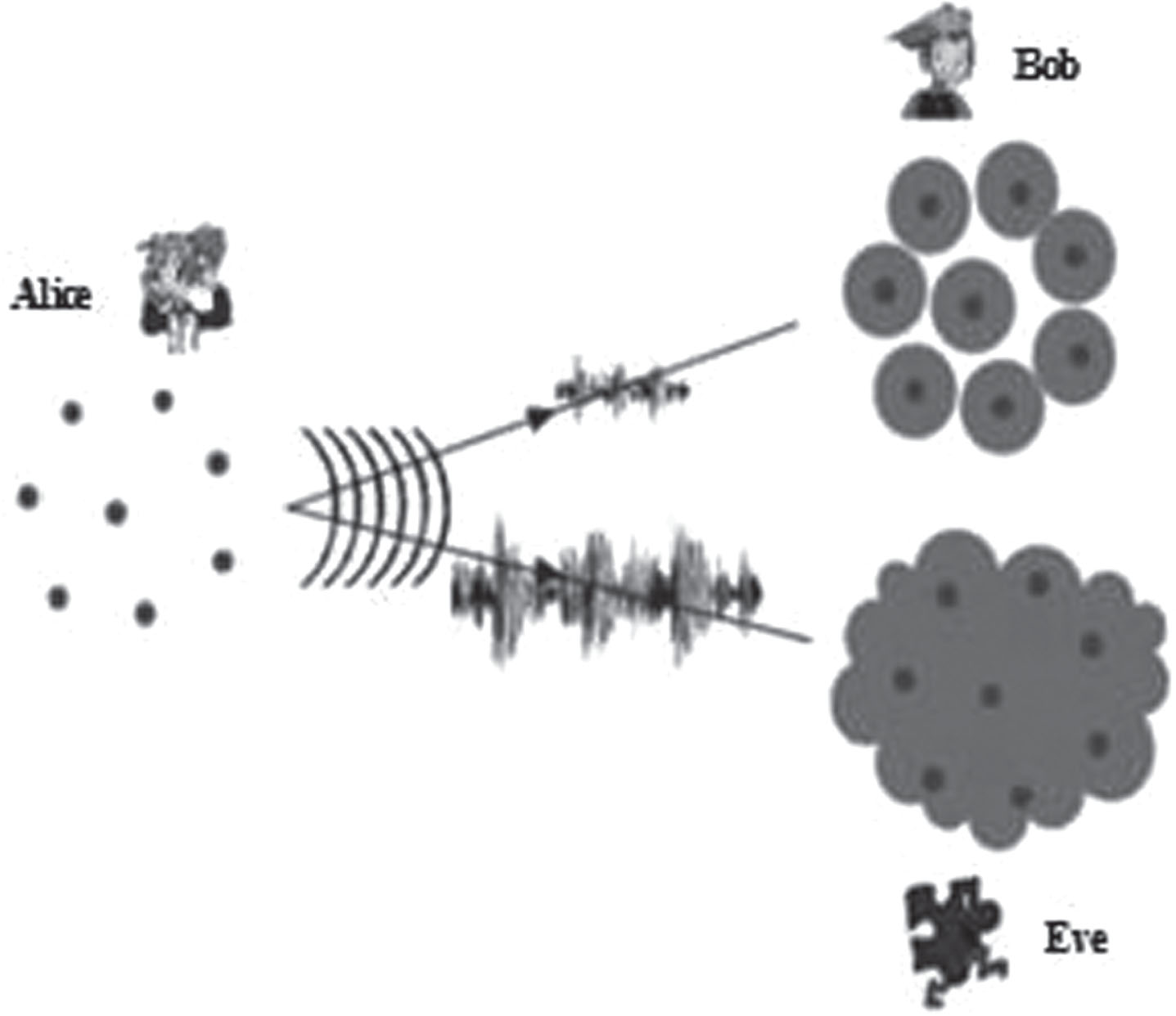
Secrecy Capacity is the most important performance indicator for measuring information security communications in physical layers, as defined in (1):
Where
The imperfect CSI model is described, which consists of two factors: channel estimation error and channel expiration, both of which have a negative impact on the security performance of the system. In the actual communication system, if the base station is to obtain the CSI of the downlink, the channel interoperability needs to be used for the pilot estimation. In the case of Hugh, K users first send orthogonal pilot sequences to the base station, and then the base station uses the received pilot sequences to estimate the response CSI. Θ = [θ1, θ2, … θ
K
] ∈ Cτ×K is defined as a set of pilot sequences transmitted by the user, where θ
k
∈ Cτ×1 represents the pilot sequence transmitted by user k and τ represents the length of each pilot sequence. The pilot sequence satisfies two constraints: the power of the pilot signal is normalized, and the different pilot sequences are orthogonal to each other. Therefore, there is
W (t) ∈ Cτ×N
t
represents additive white Gaussian noise at the CSI estimation stage. Each of these scenes obeys a Gaussian distribution with a mean of 0 and a variance of
For the kth user, there is:
Using the MMSE channel estimation method, the channel information between the base station and the kth user can be estimated as:
Therefore, the real channel information can be written as:
Where nk,MMSE (t) is the channel estimation error, which is independent of
Where E (t + T
d
) represents random vectors independently distributed with H (t), and each component of which obeys the complex Gauss distribution of (0, σ2 = 1). ρ
T
d
represents the correlation coefficient between two channels at different times, as follows:
Where
Where:
According to the above analysis, it can be known that
In this section, a detailed theoretical analysis of the reachable traversal capacity of the MassiveM1M0 system under imperfect CSI will be performed. First, Lemma 1 is given, and in the proof of the propositions and theorems that follow, the conclusion of Lemma 1 will be widely used. Lemma 1: considering two variables x, y ∈ C1×n, which satisfy
In existing papers, zero-forcing (ZF) and regularized channel inversion (RCI) pre-coding can achieve better system performance than matched filter pre-coded (MF). However, in a large-scale antenna scenario, the computational complexity of the matrix inversion operation increases dramatically, and it is too time consuming for the base station to apply ZF or RCI pre-coding. Therefore, MF precoding scheme is considered in the research scenario. In fact, because the study of precoding schemes is not the focus of discussion, the comparison of more options is left for future work. As mentioned in the previous section, the base station transmits a signal at time t + T
d
, while the pre-coding phase is performed at time t. Therefore, the MF pre-coding scheme used by the base station to transmit signals at time t + T
d
can be expressed as:
Next, using lemma 1, the power limitation of the pre-coding matrix can be expressed as:
Therefore, the signal that user k receives at time t + T
d
is:
The capacity of user k under imperfect CSI can be expressed as:
It is difficult to directly know the closed expression of (15), therefore, the lower bound of
The degree of compaction of the lower bound will be verified in the simulation. In this section, a tight upper bound on the traversal capacity of the eavesdropper channel is also derived. At moment t + T
d
, the signal received by the eavesdropper is:
The traversal capacity of the eavesdropping channel can be expressed as (22):
In the following part, theorem 2 is given to represent the tight upper bound of eavesdropper traversal capacity under imperfect CSI. Theorem 2: under definitions m = min(K, N
e
) and n = max(K, N
e
), the tight upper bound of the eavesdropper traversal capacity under imperfect CSI can be expressed as:
Where
Specifically, as T
d
increases, the correlation coefficient ρ
T
d
becomes smaller and smaller. Similarly, the reduction of
Here’s a simple proof: As can be seen from (19) and (22), with the growth of N
t
, the accessible user capacity always increases, while the eavesdropper’s capacity remains unchanged, because it has nothing to do with N
t
. With the growth of N
e
, the decoding ability of eavesdroppers is increasing, which will increase the capacity of eavesdropping channel and thus reduce the security capacity of the system. Two cases are discussed respectively: when K = 1, the system traversal security capacity can be simplified as follows:
According to Appendix B, there is
At low SNR, the formula is expressed as follows:
There is:
The relationship between the number of antennas and the ergodic security capacity of the system.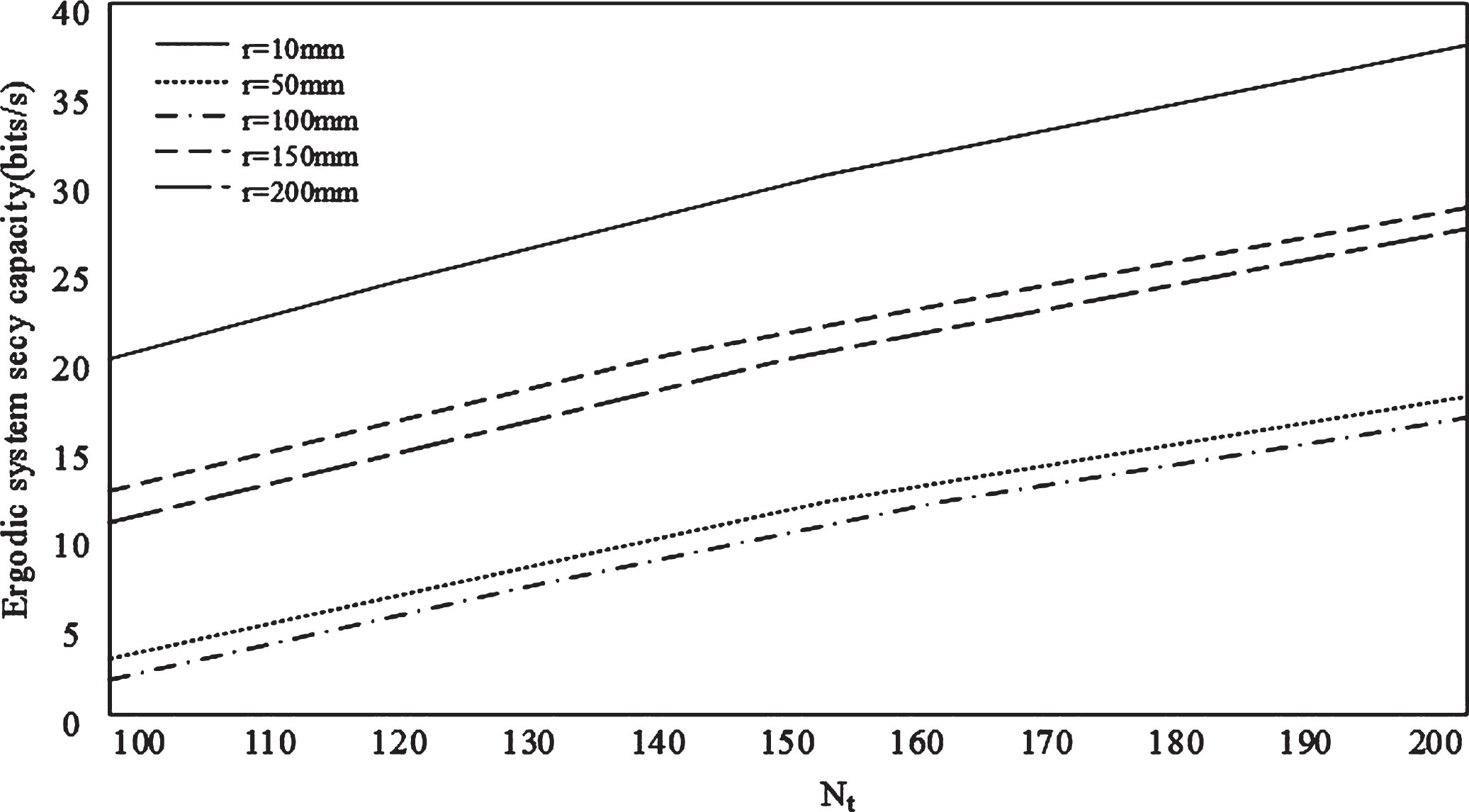
It indicates that the system traverses the secure capacity: it grows as the SNR increases. At high SNR, (27) can be expressed as:
It indicates that the system traversal safety capacity tends to be stable when the SNR is large. When K > 1, it is easy to observe that the user capacity tends to grow at a low SNR. Since the user’s received power and the down-interference power increase in proportion to the increase in SNR, when the SNR is high, the user capacity approaches a constant value. However, for the eavesdropper capacity, it always increases as the SNR increases. More specifically, when the SNR is higher than the SNR, the eavesdropper capacity increases by m = min(K, N e ) bits when the SNR increases by 3 dB.
Experimental thoughts
In this part, the physical layer security performance of the multi-user Massive MIMO system under perfect CSI is evaluated, and the proposed channel prediction algorithm is verified. First, an independent cellular communication system is considered, which includes a base station, K users and a malicious eavesdropper. For convenience, only small-scale fading channel models are considered, and large-scale fading factors can be considered as 1. The channel correlation within the small 1H frame is depicted by Jake’s model, where each frame is a length of T = 0.01s, the carrier center frequency is f
c
= 2GHZ, and the average moving speed of the user is v. {H (t) , H (t - T) , … , H (t - (L - 1) T) } is used to represent the real CSI of user channel in different frames. In order to ensure the correlation between CSI in different frames, when CSI is generated, H (t - (L - 1) T) is generated first, and then H (t - (L - 2) T) is generated according to the autoregressive model described in literature [95, 96]. By analogy, all channel information is generated according to the following formulas:
Since the goal is to predict H (t + T d ), in order not to lose generality, it is assumed that T d and T are equal. Therefore, the channel information at time t + T d can also be generated using the same model. In the following sections, the effect of several factors on the system traversal security capacity is evaluated by simulation.
Figures 3 and 4 show the relationship between system traversal capacity (including user traversal capacity, eavesdropper traversal capacity and system traversal security capacity). The real-time anti-interference communication intelligent decision-making module is based on the result of the local interference detection, the interference detection result of other nodes from the signaling transmission layer, and the link performance and other indicators. The best anti-interference transmission mode and corresponding parameter configuration (such as frequency, power and modulation and coding mode) should be adopted in real-time intelligent decision making. By signaling the transmission channel to the corresponding receiving node, each node reconstructs to produce anti-jamming waveform, and uses reliable waveform transmission mechanism to complete the transmission of information between the sending and receiving sides.
The relationship between antenna number and system ergodic capacity and eavesdropping capacity. Relationship between user number and traversal security capacity.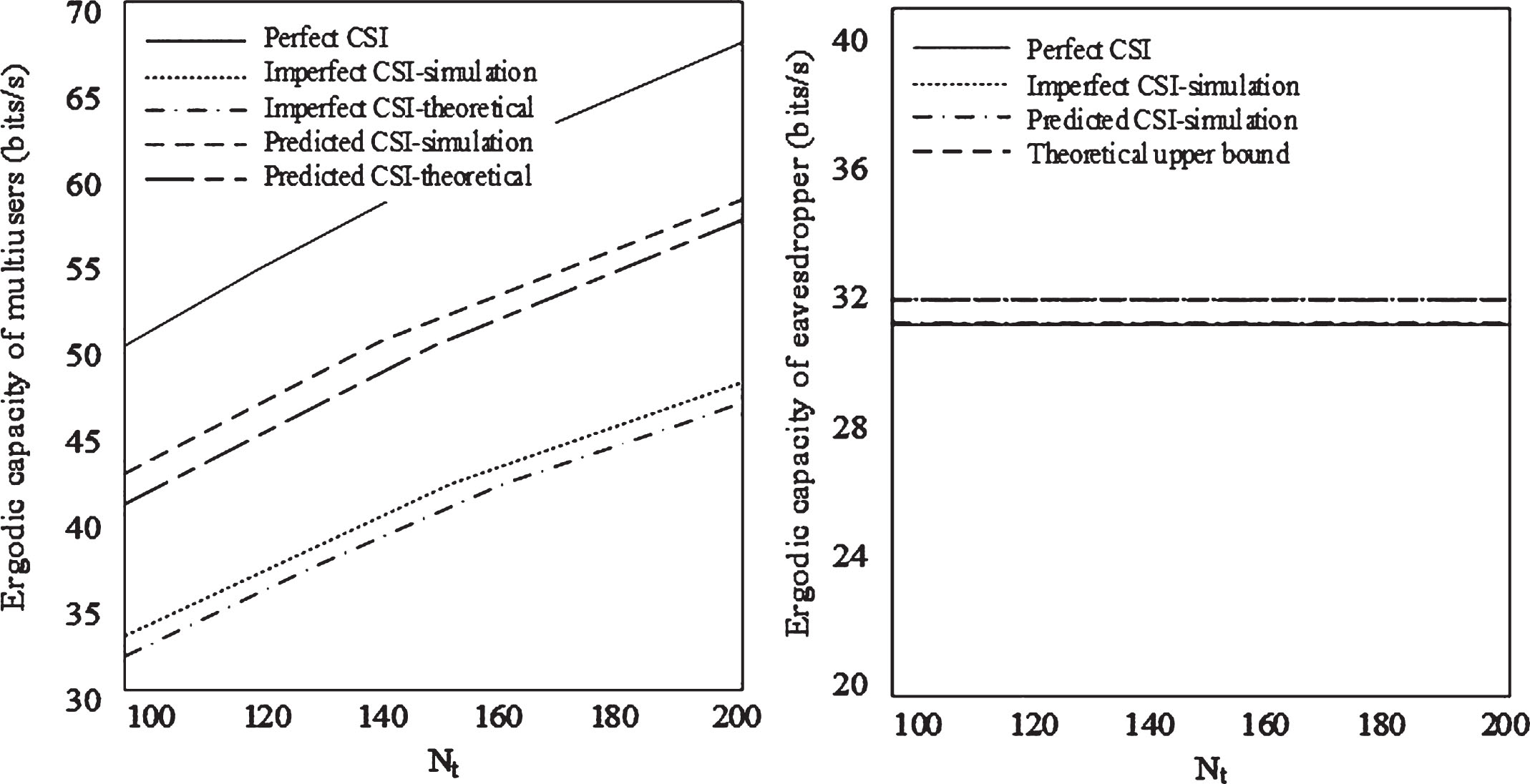
The system parameters are set as follows:
As can be seen from Fig. 4, under different scenarios of CSI (perfect CSI, non-perfect CSI, and predictive CSI), the system traverses the security capacity will increase with N t . This is because according to the conclusion in inference 1, with the increase of Nt, the user capacity increases, while the eavesdropper capacity remains unchanged. From the point of view of electromagnetics, with the increase of the number of base station antennas, base station can concentrate the transmitted energy more on the user’s direction, while eavesdropper’s direction will not receive excess energy. From Figs. 2 and 3, the following conclusion can be drawn: the system safety capacity under perfect CSI is much larger than the imperfect CSI. However, with our predictive solution, the negative impact of non-perfect CSI can be overcome to some extent to enhance the system’s safe capacity, but this negative impact cannot be completely eliminated. For eavesdroppers, whether the user channel CSI is perfect or not is irrelevant, and this result is also proved in Theorem 2, which is more accurate.
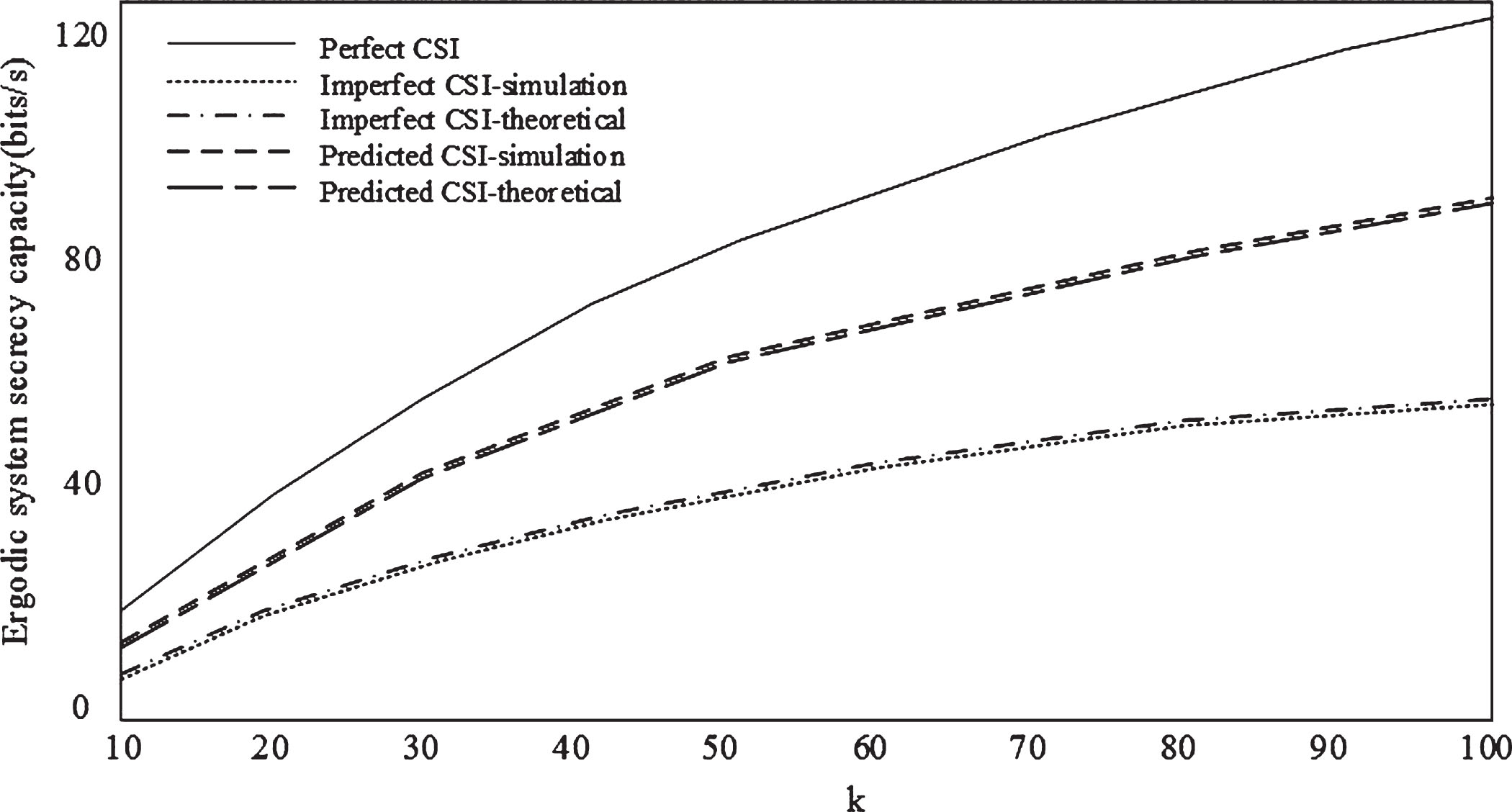
Figures 4 and 5 describe the relationship between channel security capacity and the number of users. The system parameters are set as follows:
Relationship between number of users, user capacity and eavesdropping capacity.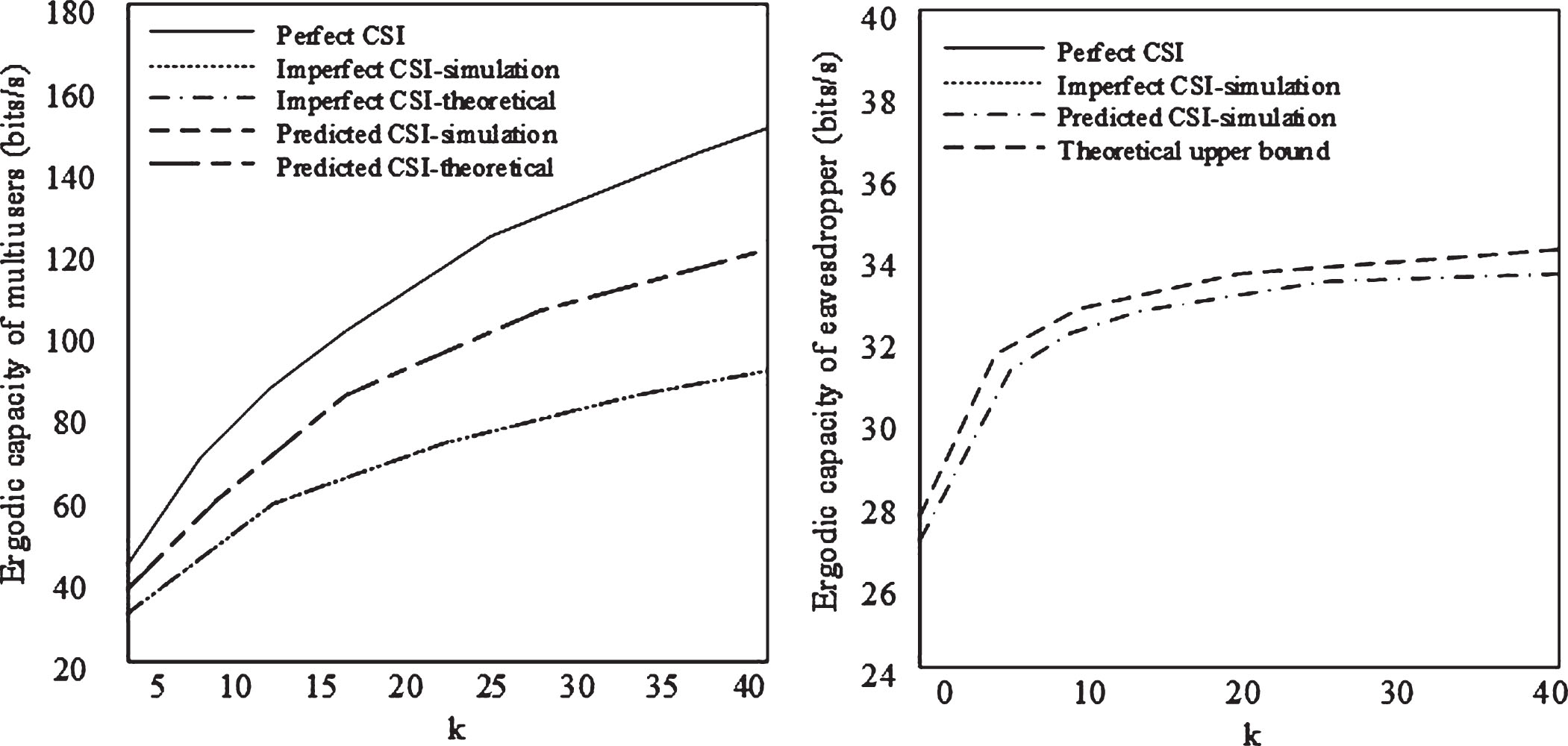
As the number of users K increases, the system security capacity increases. Intuitively, it can be explained as follows: For multi-user massive MIMO systems, because the channels between different users are orthogonal to each other, increasing the number of users 0 can better tap the advantages of freedom brought by large-scale antennas, serving more users to increase capacity. However, when the number of users increases to a certain extent, as the interference between users becomes more and more serious, the channel capacity of users increases more and more slowly. On the other hand, the number of given eavesdropping antennas is becoming increasingly difficult for eavesdroppers to investigate information about more users.
In Figs. 6 and 7, the relationship between eavesdropper capacity and the number of eavesdropper antennas N
e
is studied. The system parameters are set as follows:
The relationship between the number of eavesdropper antennas and the ergodic security capacity of the system. Relationship between number of antennas and user capacity and eavesdropping capacity.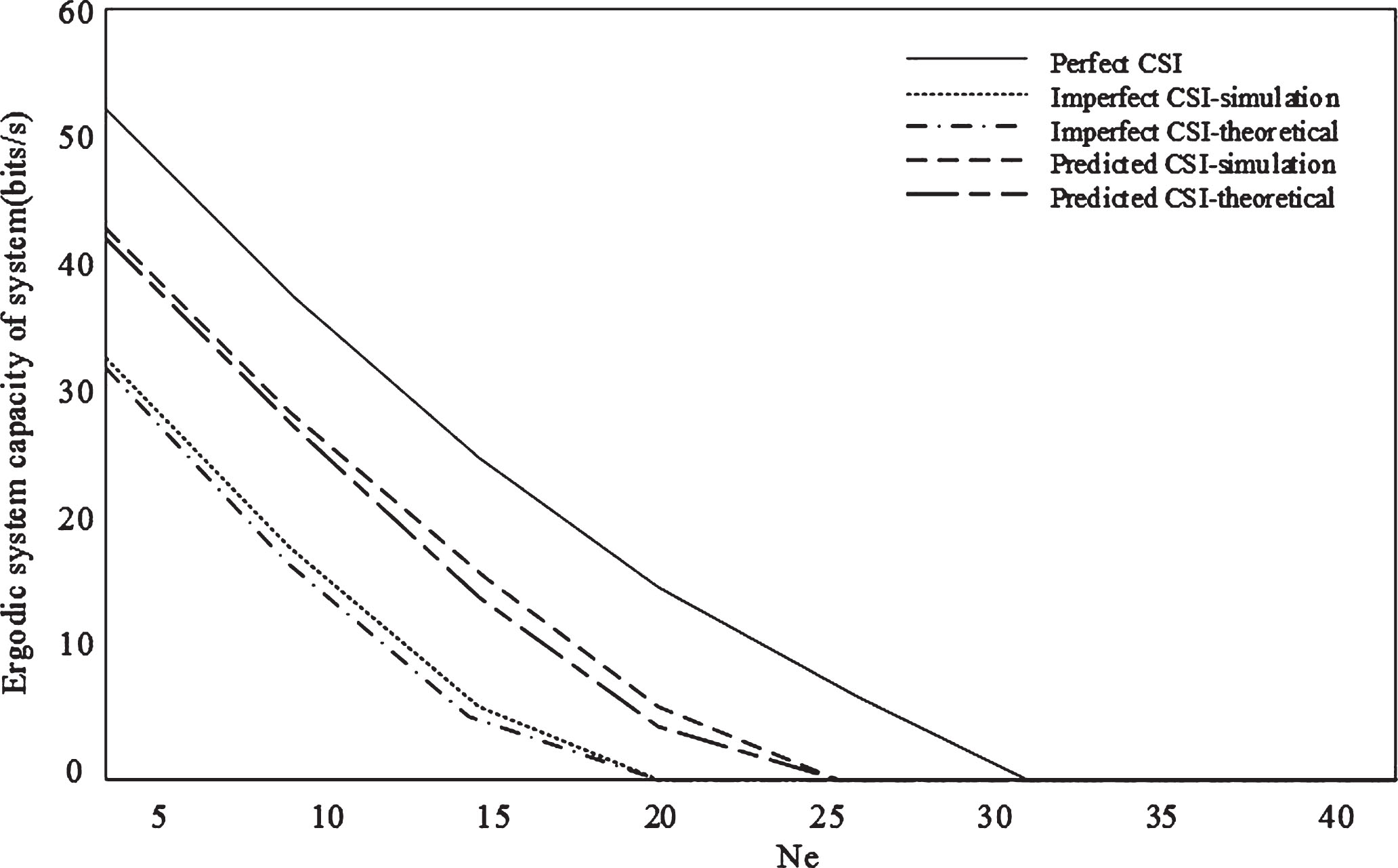
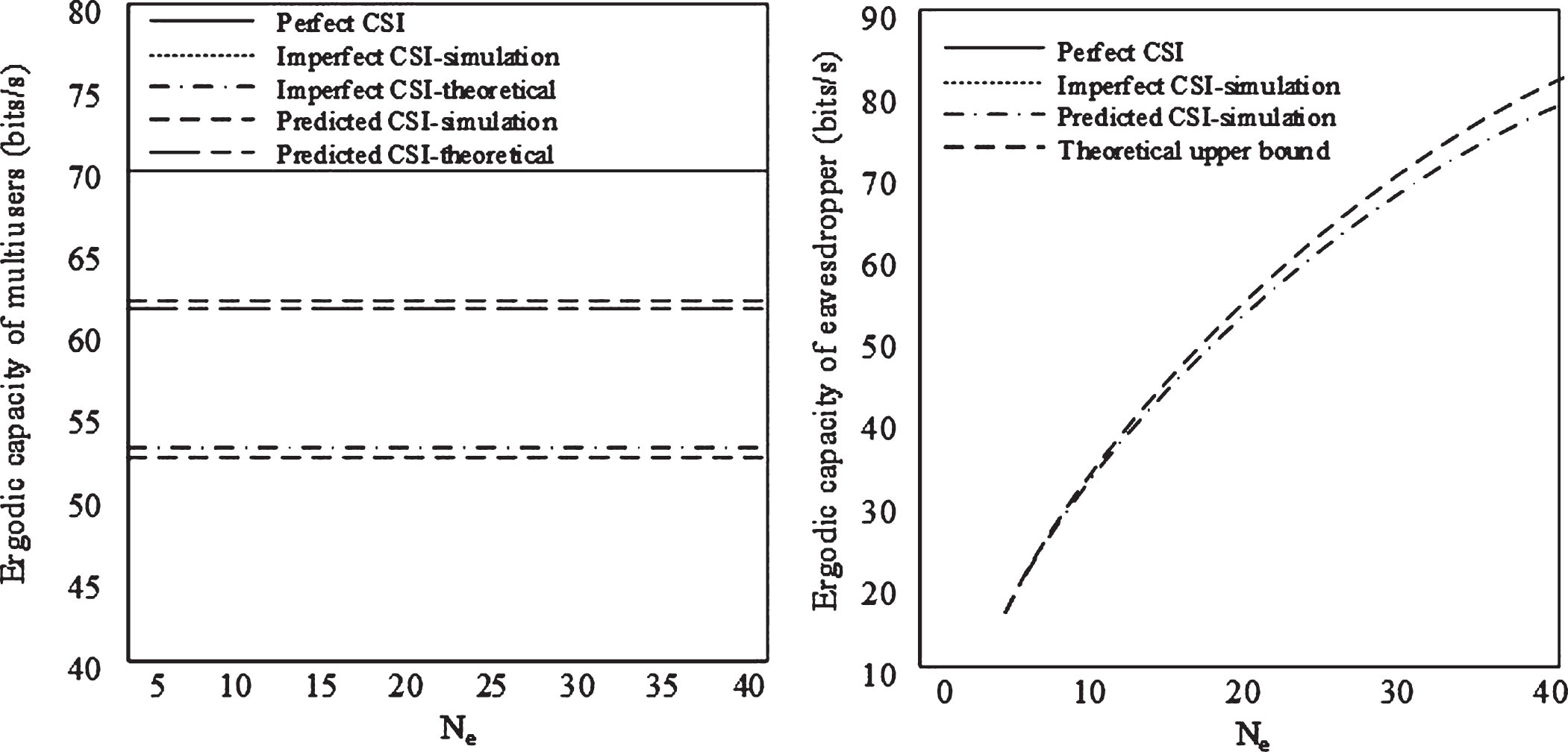
In fact, for a given number of base station antennas N t and the number of users K, the increase in the number of eavesdropper antennas does not increase the legitimate user capacity, but only allows the eavesdropper to enhance their eavesdropping ability. As can be seen from the figure, whether for perfect CSI, imperfect CSI or predicted CSI, the system security capacity will become 0 when the number of eavesdropper antennas grows to be large enough. In the face of multi-antenna eavesdropping by eavesdroppers, it is necessary to take some other means (such as artificial noise, etc.) in order to reduce the negative impact on system security.
The key technologies in intelligent anti-jamming communication mainly include: interference cognition technology, anti-jamming waveform reconstruction technology, reliable signaling transmission technology, fast and variable waveform transmission technology and real-time anti-jamming communication intelligent decision-making technology. Aiming at the future communication system, the anti-jamming problem in the full duplex scene and the large-scale multi-antenna scene is deeply studied, and the following conclusions are drawn: On the one hand, because Massive MIMO can direct the transmit beam and energy to the user direction, in the physical layer security scenario, it is difficult for malicious eavesdroppers in the network to steal useful information. Therefore, the integration of Massive MIMO technology and physical layer security technology can help electronic communication to resist interference and improve information security. On the other hand, the case of imperfect channel state information (imperfect CSI) in the actual communication scenario has been studied. The proposed optimized Massive MIMO technology can analyze its negative impact on network security capacity and prevent eavesdroppers and interferers from interfering with the communication process. It is increasingly difficult for an eavesdropper to demodulate more user information. However, when the number of interferers and eavesdroppers reaches a certain level, the security of the system will be destroyed. At this time, how to ensure communication security is a subject that needs to be further studied in the future.