



Abstract
Network virtualization technology releases human resources to some extent through network and cloud computing technology, reducing the workload of staff. The application of network virtualization technology in cloud computing data centers is based on this condition to improve work quality and efficiency. The purpose of this paper is to use the fuzzy algorithm to realize network virtualization of cloud computing data center. In this paper, we study the adaptive fuzzy control in depth, and conduct the practical application based on the basic knowledge of adaptive fuzzy control we learned, achieved “learn to use”. Apply the design of adaptive fuzzy control to the load balancing algorithm of the network virtual cloud computing data center, realized the load balancing algorithm of the network virtual cloud computing data center based on adaptive fuzzy control. According to the load balancing algorithm based on adaptive fuzzy control to achieve this algorithm by using Internet knowledge, and designed the load balancing system of the whole network virtual cloud computing data center. Test the whole load balancing system which has been achieved, and obtained the performance variance curve of the system under different algorithms. Then obtained advantages and disadvantages of the algorithm by analyzing the experimental data. The experimental results show that the proposed method can effectively improve the execution performance of communication-intensive applications and ensure the stable execution of the application. At the same time, the algorithm inherits the advantages of the general fuzzy control load balancing algorithm. The stability is strong and the variance curve does not appear pulsed fluctuation. There is also no divergence phenomenon with time increased.
Introduction
China’s science and technology is moving towards a more and more mature stage. With the rapid development of the economy, China ushered in the information age. In the era of network information, network virtualization technology and cloud computing data are integrated and developed together, which are inseparable from all walks of life. Moreover, the application of network virtualization technology in every industry has achieved remarkable results, thus improving the overall efficiency and quality of the industry. The application of network virtualization technology has made more enterprises improve their own resources. Utilization rate, cloud computing data center is also frequently established, so the application of network virtualization technology in cloud computing data center has great significance [1-3]. Cloud computing technology has attracted much attention in today’s network information era. Through modern information technology and network technology, network storage, load balancing, virtualization technology and distributed computing technology are reasonably connected to multiple devices in the virtual space, so as to maximize the computing power of the system and meet the high efficiency of computing effect. And reliability requirements, so that users are satisfied [4]. The establishment of cloud computing data center requires higher computing power and reduces user’s capital cost [5-7]. With the rapid development of cloud computing technology, the new network virtual information storage mode will gradually replace the individual network terminal storage and computing mode under the traditional technology. On the one hand, the computing and storage of information can be realized by cloud computing data center, on the other hand, we can base on cloud computing. Improve the operation efficiency and quality of the system [8].
The so-called virtualization technology is to enable users to run several or more commercial applications on the same host independently. It first appeared in IBM mainframe partitioning technology, based on the development of X86 architecture server. When virtualization technology came into the market, it began to gradually guide Microsoft and other companies to open virtual servers [9, 10]. However, at the beginning, the development of virtualization technology was relatively slow, mainly because the performance of X86 processor was not enough to support its development [11]; secondly, because the X86 architecture was relatively uncomfortable with virtualization technology. With the continuous development of Intel and AMD, the problems encountered by virtualization technology have been effectively solved, thus improving the performance of X86 processors. It should be noted that server virtualization results in a higher application density in the same physical space of the data center, and its logical server data is increasing [12]. In this way, the external throughput of the server is greatly increased, and the overall business processing capacity of the server is also showing a very obvious upward trend [13]. Virtualization technology has become the key technology of cloud computing at this stage, especially in cloud computing capacity leasing and cloud computing scheduling, which has played an obvious advantage [14, 15].
In this paper, the design of adaptive fuzzy control is applied to load balancing algorithm of network virtual cloud computing data center, and the load balancing algorithm of network virtual cloud computing data center based on adaptive fuzzy control is realized. According to the load balancing algorithm based on adaptive fuzzy control, the algorithm is implemented by using Internet knowledge, and a whole set of load balancing system of network virtual cloud computing data center is designed. The whole load balancing system is tested, and the performance variance curves of the system under different algorithms are obtained. The advantages and disadvantages of the algorithm are obtained by analyzing the experimental data.
In the first part, this paper introduces the research background and significance of the network virtual cloud computing data center, as well as the characteristics of this paper and the organization structure of the article. In the second part, it introduces the related research of predecessors, three types of service modes under cloud computing technology, virtualization technology and the related content of fuzzy algorithm. In the fourth part, the efficiency of virtualization and the performance of fuzzy control load balancing algorithm are discussed respectively.
Proposed method
Related work
Cloud computing data centers have many host and application requests. It needs to dynamically allocate resources according to different needs of users. It should not only provide QoS with short response time and high throughput, but also achieve effective power consumption. Liang proposes a reconfiguration framework based on request prediction, which predicts the amount of application requests in advance. In order to determine the objective of relative optimal allocation, a distribution scheme can be formulated to improve resource utilization and reduce energy consumption. In addition, Liang proposed the concept of utility matrix (URM) to represent the allocation of host and virtual machine (VM), and proposed a reconfiguration algorithm based on request prediction. The algorithm predicts application requests so that the allocation scheme can be calculated in advance. The algorithm can separate the reconfiguration calculation from the actual configuration, thus avoiding the time delay between reconfiguration results and changing requirements, and also reducing the energy consumption of data center [16]. Zhang proposed ANTELOPE, a scalable distributed data center scheme, which systematically considers the attributes of network architecture and the optimization of data placement in cloud data centers. The basic idea behind ANTELOPE is to support online cloud services using data cubes based on predictions. Because the construction of data cubes is affected by the high cost of full implementation, Zhang used a semantically aware partial implementation solution to significantly reduce operational and spatial overhead [17]. Cloud data center applications usually follow a partition/aggregation traffic pattern based on tree logical topology, where aggregator nodes can collect response data from thousands of working nodes. However, one of the key challenges of these applications is to meet soft real-time constraints. Hwang introduced the design and implementation of DIAT-CP. DIAT-CP is a new transmission protocol. For cloud data center applications, it has both Deadline-Aware functions and can be completely avoided. Previous work has achieved deadline recognition through host-based or network-based approaches, but they are either imperfect within the deadline or defective in actual deployment. In contrast, DIATCP is only deployed on aggregators, which directly controls the sending rate of peers to avoid convergence, and more importantly, meets the application deadline [18]. Jing proposed a new method to optimize VCDC profit based on Service Level Agreement (SLA) between service providers and customers. Jing proposed an accurate model for the arrival rate of external and internal requests for different types of virtual machines. Then a probabilistic model is developed for the analysis of unstable VCDC states. In addition, an intelligent controller is developed for fine-grained resource allocation and sharing among multiple applications. In addition, based on simulated annealing and particle swarm optimization, Jing also proposed a new dynamic hybrid meta-heuristic algorithm for profit maximization. The proposed algorithm can provide differentiated quality of service with higher overall performance and lower energy cost. Cloud data centers usually lack network resource isolation. At the same time, it is easy to deploy and terminate a large number of malicious virtual machines in a few seconds, and administrators may find it difficult to identify these malicious virtual machines immediately. These features open the door for attackers to launch denial of service (DoS) attacks with the goal of reducing the quality of cloud services. Cao studied the attack scenario of malicious tenants using cloud resources to launch DoS attacks on data center subnet. Unlike traditional data flow-based detection methods, which depend heavily on data flow patterns, Cao proposes a method to identify attacks using virtual machine state (including CPU usage and network usage). He found that malicious virtual machines display similar state patterns when attacking. On this basis, the information entropy is applied to the state monitoring of virtual machine to identify the attack behavior [20].
Cloud computing
Cloud computing accesses servers, storage space and various application services through the Internet in a simple way. Users can get the resources they need in real time according to their needs. Cloud computing has been recognized as a revolutionary technology that has a significant impact on social production and life. It allows developers and IT departments to devote themselves wholeheartedly to R&D, avoiding trivial tasks such as procurement and maintenance. Cloud computing is not a sudden emergence of new things, it is the integration of traditional computer technology and network technology, and gradually developed. To the current stage, cloud computing has mainly experienced grid computing, public computing, software as a service stage, as shown in Fig. 1.

Evolution of cloud computing.
With the popularity of cloud computing, in order to meet the personalized needs of different users, there are many different service models and deployment modes in the market. Each type of cloud service and deployment method has different levels of management and control capabilities and flexibility. Therefore, an accurate understanding of the differences between various service models and the deployment model adapted to local conditions is conducive to the selection of appropriate service composition. At present, Cloud Computing mainly provides three types of service modes, namely:
At present, cloud computing deployment patterns in the market can be roughly divided into three categories:
(1) Public Cloud: Cloud infrastructure is provided by cloud service providers to the general public. There are no special restrictions on service objects, which can directly provide a variety of IT resources for end users. This model is also the initial form of cloud computing. However, security and reliability are issues that need to be addressed in public clouds.
(2) Private Cloud: Enterprises or organizations have their own data centers. Infrastructure and hardware and software resources are deployed in the firewall and operated by their own owners. It is built for customers to use alone, generally only for internal personnel, not open to the outside world, can provide users with safe and high-quality services. However, operation and maintenance costs are relatively high.
(3) Hybrid Cloud: A model that combines public and private clouds, which combines public clouds with local IT resources. Enterprises can store internal data on private clouds and use computing resources from public clouds. Hybrid cloud combines the advantages of two kinds of cloud and is the main mode and development direction of cloud computing in recent years. Cloud computing is the product of the integration of traditional computer and network technologies, such as distributed computing, parallel computing, utility computing, network storage, virtualization, load balancing and so on. In the current typical cloud computing mode, users access the Internet through terminal devices, and make service requests to “cloud”, “cloud” organizes resources from the resource pool, and then provides corresponding services for user terminals through the network.
Virtualization is changing the way storage, networks, management systems, operating systems and applications are used. In cloud data center, virtualization technology is indispensable, and it is also the key technology to realize resource management in data center. In computer, virtualization is a resource management technology. It abstracts and transforms all kinds of entity resources of computer, such as servers, networks, memory and storage, and breaks the barrier of non-cutting between entity structures, so that users can use these resources in a better way than the original configuration. These virtualized resources are not limited by the way existing resources are set up, geographical or physical configurations. Virtualization technology has a wide range of meanings. It can be called virtualization to abstract any form of resources into another form. At present, virtualization technology is widely used in data centers, which can be applied to many levels of data centers, such as network virtualization, server virtualization, etc. Among them, server virtualization is an effective means of information management, which abstracts server physical resources into logical resources, effectively improving the utilization of hardware resources. The virtualization of servers can be divided into two main categories: one virtual and one virtual. In this paper, we mainly introduce the form of “one empty many”. “One virtual multi” refers to dividing physical servers into several independent and non-influential virtual environments. Server virtualization technology is the key technology to ensure that multiple virtual machines run on one physical node at the same time. Running multiple virtual machines at the same time can not only give full play to the computing potential of physical servers, but also quickly respond to the changing needs of data centers. An effective way to improve resource utilization is resource sharing, and server virtualization provides technical support for resource sharing in data center. With this technology, every virtual machine on the underlying physical machine is like a real PC with an operating system. Therefore, resources can be fine-grained allocation, fully improve the resource utilization of data centers. At the same time, although virtual machines share physical resources, each virtual machine is an isolated individual with its own proprietary resources, which makes it possible to ensure the quality of service of applications.
Virtualization technology can easily implement applications based on different operating systems running on the same physical host at the same time, improve the utilization of physical servers, reduce the complexity of system management, and also provide users with safe and reliable services. One of the core business of cloud computing is to provide flexible services for consumers, and virtualization technology provides strong technical support for flexible computing. Virtualization technology is used to encapsulate the underlying physical resources of data center and provide various services to cloud users in the form of virtual machines. The most popular virtualization software on the market today is Hypervisor, which establishes an abstraction layer between the virtual server and the underlying hardware as shown in Fig. 2. Hypervisor is a software layer running between a physical server and an operating system. It enables multiple operating systems and applications to share a set of basic hardware facilities. Therefore, it can also be regarded as a “meta” operating system in a virtual environment. It can coordinate access to all physical devices and virtual machines on the server, also known as virtual machines. Hypervisor is the core of all virtualization technologies. Supporting multiple workload migration uninterruptedly is one of the basic functions of Hypervisor. When the server starts up and executes Hypervisor, it allocates appropriate amount of memory, CPU, network and disk to each virtual machine, and loads the client operating system of all virtual machines.
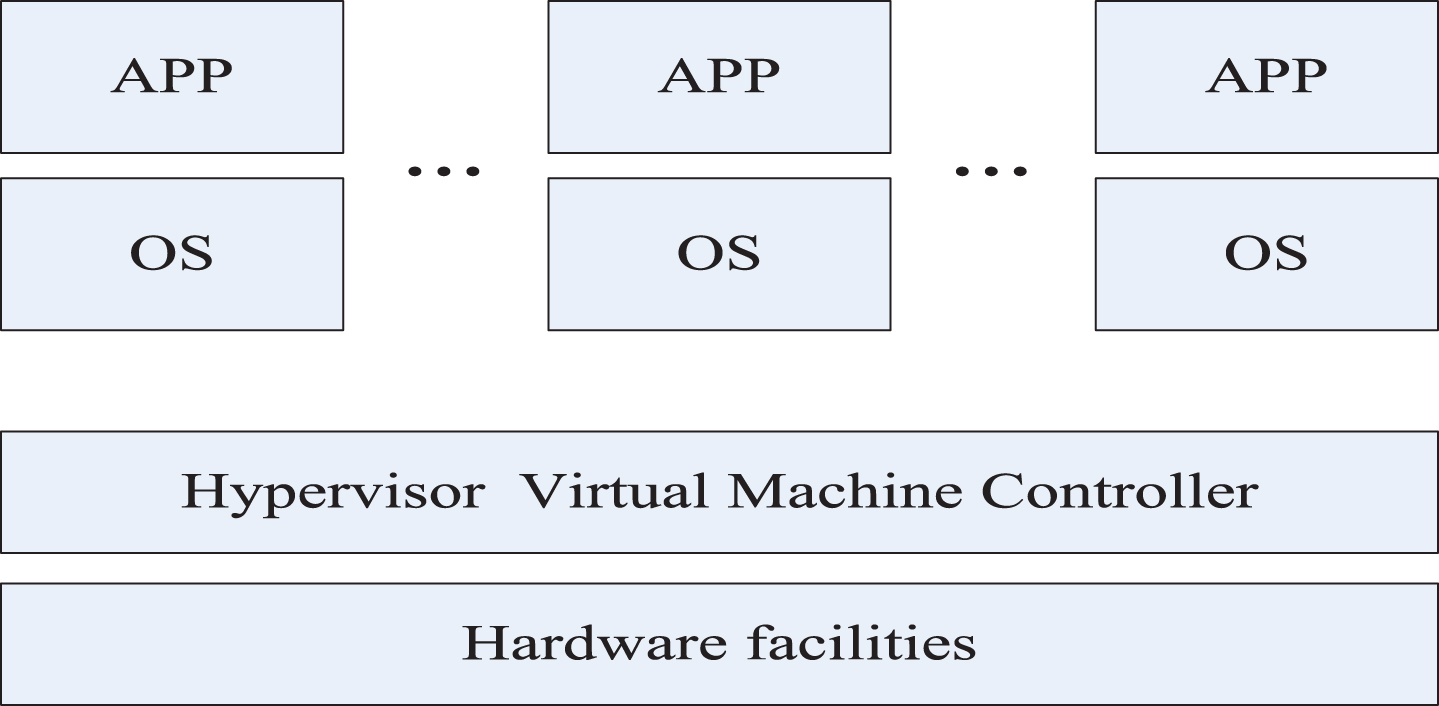
Hypervisor virtualization.
1) Fuzzy Mathematics
Fuzzy mathematics is the mathematical basis of fuzzy control. In fuzzy mathematics, the more important basic knowledge is: fuzzy sets, fuzzy logic reasoning, fuzzy language and so on. The following is an introduction in turn:
2) Fuzzy sets
Fuzzy set is a set without definite range, which is quite different from traditional set. Let U be the universe and A be one of the fuzzy subsets, then A is uniquely determined by its membership function μ A (u). The value of μ A (u) is used to illustrate the degree of U belonging to A. The closer μ A (u) is to 1, the greater the degree of U belonging to A.
For the fuzzy set A, there are the following representations:
Zad’s notation:
In formula (1),
Ordered pair representation:
Formula (2) is described in the form of data pairs.
Fuzzy sets are described by membership functions. The operation of fuzzy sets is the operation of membership functions, including union, intersection and complement operations. The specific operations are shown in formula (3), formula (4) and formula (5):
2) Fuzzy Matrix
If the finite universe U ={ u1, u2, . . . , u
n
} , V = { v1, v2, . . . , v
n
}, suppose R ∈ F (U × V), for i = 1, 2, . . . , n ; j = 1, 2, . . . m ; r
ij
= R (u
i
, v
j
), then:
R is called a fuzzy matrix.
3) Fuzzy Language
Fuzzy sentences, similar to human languages, have their own grammar. According to grammar, they can be classified as declarative sentences, judgment sentences, reasoning sentences and so on. The following is mainly about fuzzy reasoning:
When the condition is satisfied, the conclusion after then can be drawn. There are three kinds of fuzzy reasoning sentences:
If A then B:
In domain X and Y, there is R = X → Y, then the membership function can be expressed by formula (7):
In formula (7): A ∈ X, B ∈ Y. Therefore, the fuzzy relation is shown in Formula (8):
If A then B else C:
In fields X and Y, the membership functions of A ∈ X, B ∈ Y, C ∈ Y and R = (A → B) ∨ (A c → C) are shown in equation (9):
The fuzzy relation consisting of A, B and C is shown in Equation (10):
If A then B else C:
The ternary fuzzy relation R is shown in Equation (11):
Its membership function is shown in Equation (12):
Operating environment and parameter settings
In order to verify the effectiveness of the virtual resource allocation mechanism proposed in this section in the real cloud computing environment, the system is deployed on the data center SEU CIoud platform to verify the effectiveness under the real load. This chapter deploys the system on 16 nodes of the data center; each computing node has 24GB of memory and 12 CPUs. The network of the data center is configured with a typical tree structure. The core switch has 10 Gbps bandwidth, and the edge switch uses 1 Gbps bandwidth to connect all the physical machines. A non-blocking network topology is constructed. Each virtual machine in the experiment is equipped with 2 GB-4 GB memory, 100 GB.200 GB hard disk and 1.2 exclusive CPU cores. The overload ratio of the system is set to 1.
Virtual machine mirror allocation and data set
(1) Data sets
Using the data set of real virtual machine request load, the historical load log of SEU Cloud is the user access record of cloud computing center from July to August 2019, from which we intercepted 72 hours of data. During the acquisition process, 16 computing nodes were used, involving 284 virtual machines, including 344 virtual machine image access requests and 25563 image access records.
(2) Evaluation indicators
One of the optimization objectives of resource allocation is the response time of resource allocation requests. Therefore, the response time of resource allocation requests is defined as the time that the system receives the application resource requests until the virtual machine instance starts and completes. This time is consistent with the resource allocation time defined in the model, including queuing waiting time, delay, and so on. At the same time, the transmission rate of mirror image is also considered in the experiment. In addition, the image failure rate is measured in the experiment, which is defined as the ratio of failure time to total allocation time.
Discussion
Discussion on virtualization efficiency
(1) Mirror transmission rate comparison
The experimental results are shown in Tables 1 and Fig. 3. In this experiment, the sampling interval was set to 8 minutes, and more than 72 hours of data were collected. From the experimental results, it can be seen that under the management of the fuzzy algorithm, the transmission rate of the mirror image is the highest, reaching about 90 MB/s on average, which is 3.5 times faster than that under the static placement, and 28% higher than that under the dynamic strategy. This fully demonstrates that increasing the number of mirror copies and transmission parallelism can greatly improve the efficiency of resource allocation. At the same time, when compared with Baseline+LL, it can be found that if the number of mirror copies is statically configured, the transmission performance of mirror image fluctuates greatly, and the transmission rate fluctuates even up to 50%. When RID algorithm is adopted, the transmission rate fluctuates within 10%. This is because dynamically configuring the number of replicas can effectively alleviate the bottleneck of image transmission when large data applications start virtual machines in batches.
Mirror transmission rate comparison
Mirror transmission rate comparison
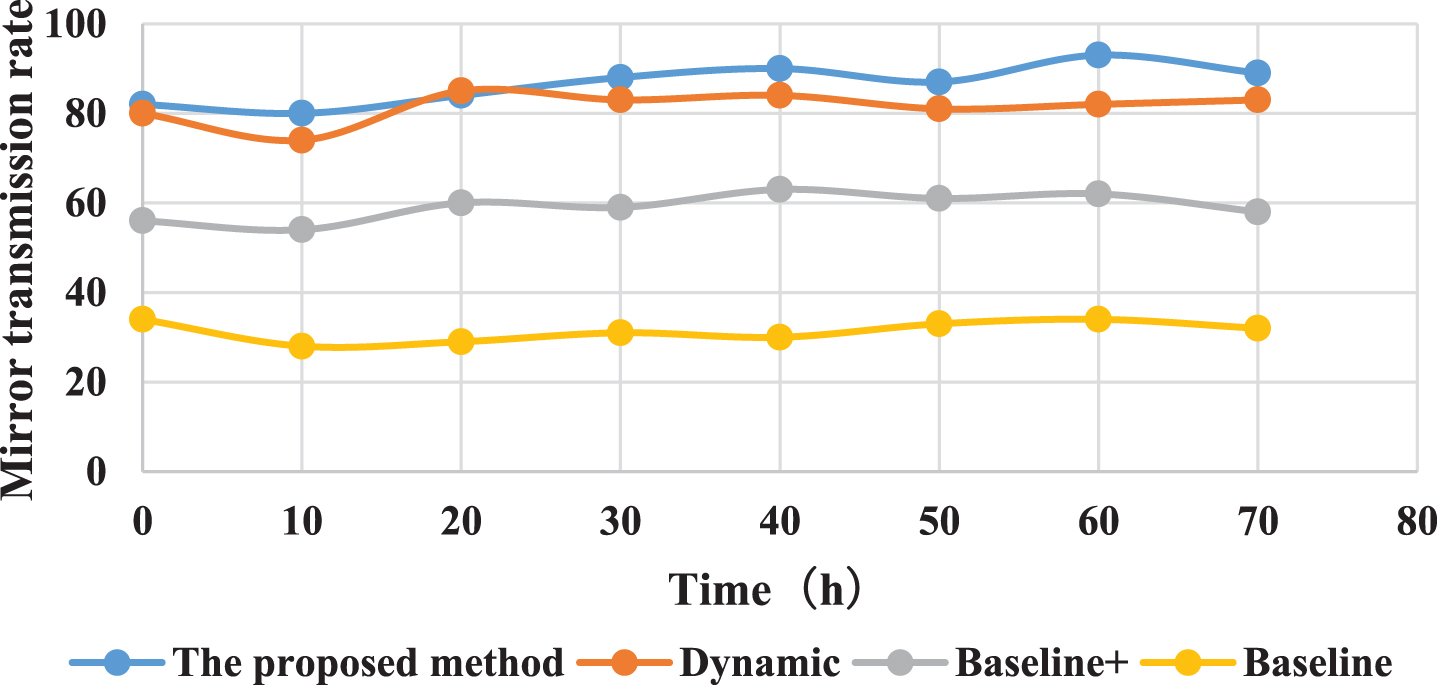
Mirror transmission rate.
(2) Comparing execution time of virtualized applications
As shown in Fig. 4, the performance of all applications in this framework is better than that in other frameworks. Bandwidth competition in the framework of Baseline and TIVC is the main reason for low and unstable application performance. On average, compared with TIVC, this method can improve the performance of RECOMM applications by 42.3% and reduce the execution time of PAGER applications by 47.3%. The experimental results of application request response time show that the application performance of the proposed method is still stable under high data center load. Under this method, the average response time of the application is 38.2% less than that of TIVC. This experiment case fully illustrates that in the current cloud environment, this method can effectively improve the execution performance of communication-intensive applications and ensure the stable execution of applications.
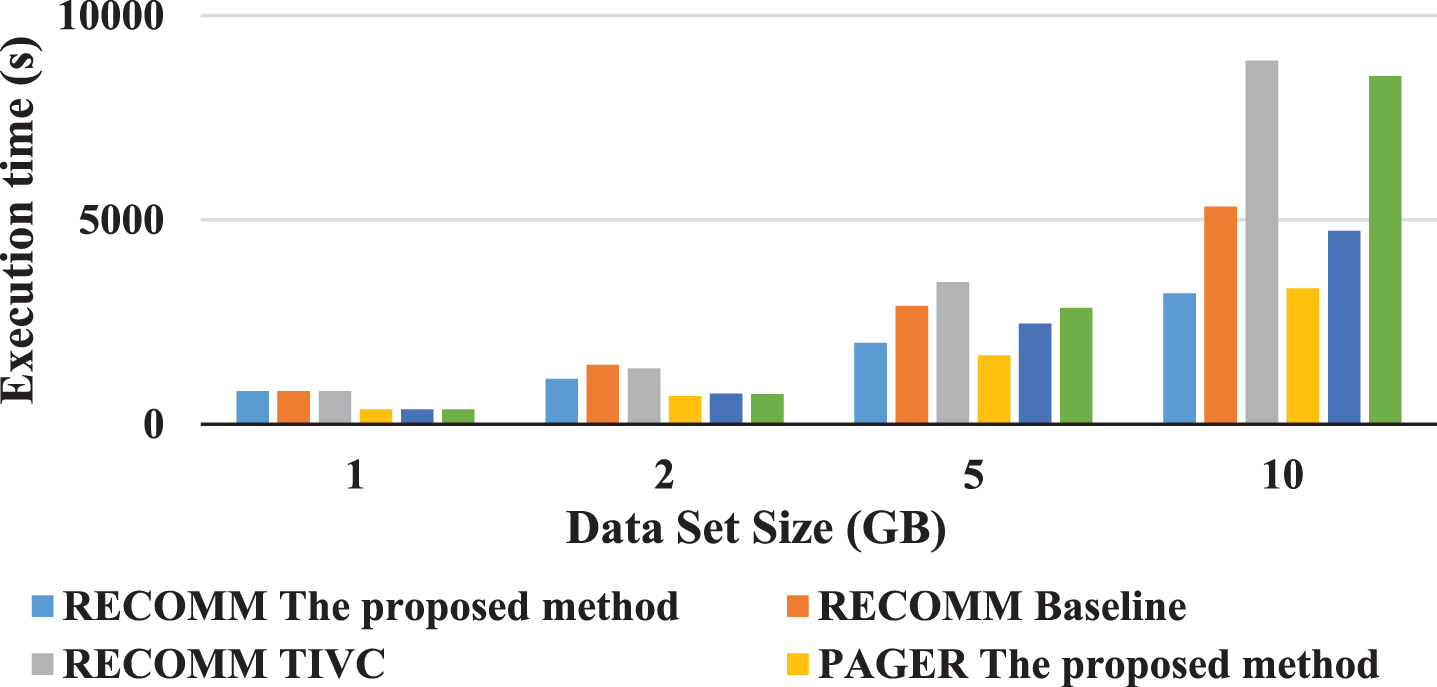
Comparisons of execution time for different applications.
(1) Analysis of Load Balancing Algorithms Based on General Fuzzy Control
The performance of three web servers every 5 seconds is obtained by using ordinary fuzzy control algorithm. The performance variance of the server is calculated every 5 seconds. The graph is drawn as shown in Fig. 5.
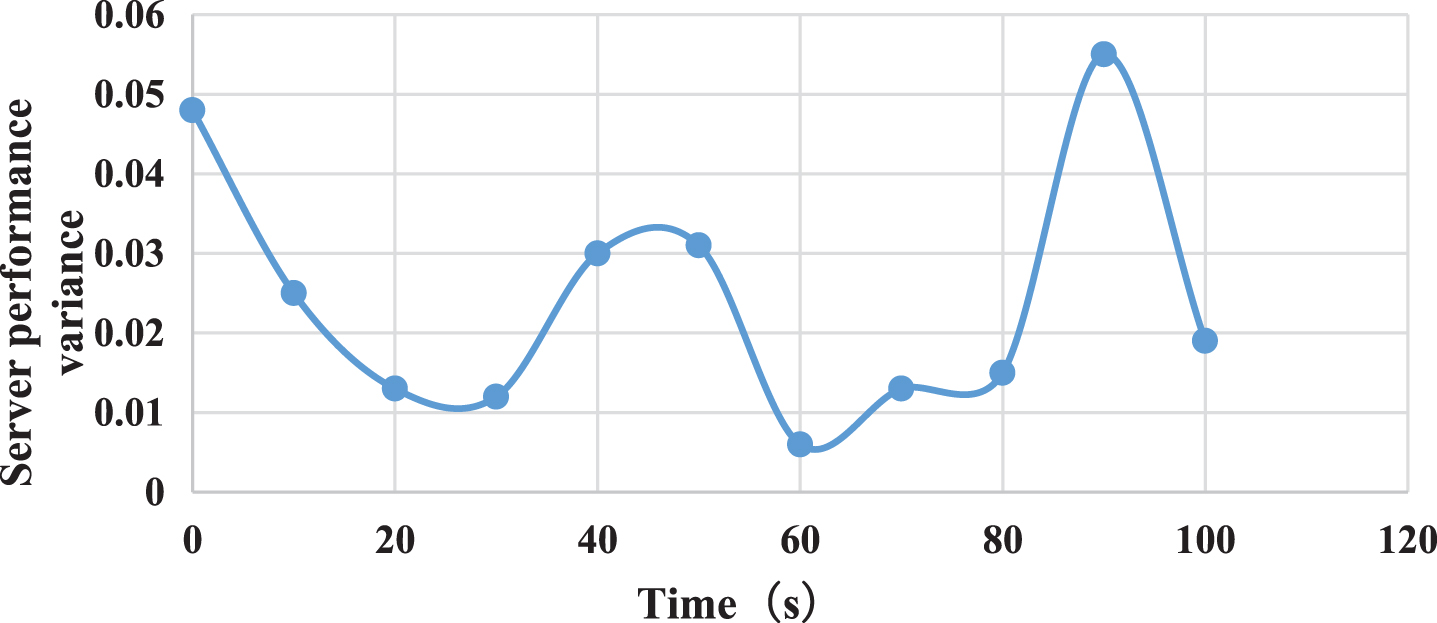
Server performance variance under general fuzzy control.
It can be seen from the graph that the variance of the three web servers’ performance is approximately stable at 0.03, but there is no impulse fluctuation. This shows that the performance of the three servers is close to each other, and their variance is stable near 0.03. The algorithm is stable, and there is no serious overload of one server at a certain time while other servers are idle. However, the average variance is slightly higher than the average variance of static load balancing algorithm, which is the result of inaccurate fuzzy control rules, indicating that the initial design of the fuzzy rules may be biased or erroneous. Generally speaking, the algorithm has better stability than the static load balancing algorithm, and can distribute load to the background server more reasonably. However, the accuracy of the algorithm is greatly affected by the fuzzy control rules, so the accuracy of the control rules needs to be improved.
(2) Analysis of load balancing algorithm of fuzzy control in this paper
The performance of three web servers every 5 seconds is obtained by using the adaptive fuzzy control algorithm. The performance variance of the servers every 5 seconds is calculated and the graph is drawn as shown in Figure 6.

Experimental curve of adaptive fuzzy control.
As can be seen from the figure, the variance of the performance of the three web servers is about 0.015. After adding the adaptive algorithm, the controller can distribute the load more accurately, which makes the performance variance of the server smaller. The small variance is because the performance of the three web servers is closer and more balanced, which shows that the fuzzy control rules are more accurate after being revised. At the same time, the algorithm also inherits the advantages of ordinary fuzzy control load balancing algorithm, and has strong stability. The variance curve does not appear impulsive fluctuation, nor does it diverge with the increase of time.
When building cloud computing data center, Internet and communication operators can mainly introduce virtualization technology through the following three methods. The first is to implement the business platform opening and technology transformation by itself; the second is to operate the business platform and technology transformation services by virtualization technology providers; and the last is to outsource to the system integrator. Technology transformation and business platform development need to be implemented by the system integrator organization resources. Because the Internet and telecommunication operators in many cases will require relatively absolute management and control business platform metaphor technology transformation, in addition to self-implementation of business platform development metaphor technology transformation has a higher difficulty, all the last way selected is more operable.
The application of network service virtualization technology can improve the quality of network service management. It is based on the actual needs of users and applied to network services. At the same time, it expands network services and improves the effective utilization of network resources. The application of virtualization technology in network service layer covers many aspects and levels. Network virtualization is applied in core layer, access layer and exchange layer. There are clear structure and function allocation among different levels in the application process. At present, the scale of cloud computing users is becoming larger and larger, and the distribution is more dispersed. It needs to adopt a variety of access methods. Therefore, in order to ensure the security, adaptability and scalability of network access, some technical measures can be taken to achieve this goal.
In this paper, adaptive fuzzy control is studied in depth, and applied in practice on the basis of learning the basic knowledge of adaptive fuzzy control. The design of adaptive fuzzy control is applied to load balancing algorithm of network virtual cloud computing data center, and the load balancing algorithm of network virtual cloud computing data center based on adaptive fuzzy control is realized. According to the load balancing algorithm based on adaptive fuzzy control, the algorithm is implemented by using Internet knowledge, and a whole set of load balancing system of network virtual cloud computing data center is designed. The whole load balancing system is tested, and the performance variance curves of the system under different algorithms are obtained. The advantages and disadvantages of the algorithm are obtained by analyzing the experimental data.
Footnotes
Acknowledgments
This work was supported by Henan Science and Technology Research Program (172102210390) and Henan Institutions of higher learning Young Key Teachers Training Program (2017GGJS268).