



Abstract
In order to overcome the problems of long encrypting time, low information availability, low information integrity and low encrypting efficiency when using the current method to encrypt the communication information in the network without constructing the sequence of communication information. This paper proposes a network communication information encryption algorithm based on binary logistic regression, analyses the development of computer architecture, builds a network communication model, layers the main body of information exchange, and realizes the information synchronization of device objects at all levels. Based on the binary Logistic regression model, network communication information sequence is generated, and the fusion tree is constructed by network communication information sequence. The network communication information is encrypted through system initialization stage, data preparation stage, data fusion stage and data validation stage. The experimental results show that the information availability of the proposed algorithm is high, and the maximum usability can reach 97.7%. The encryption efficiency is high, and the shortest encryption time is only 1.9 s, which fully shows that the proposed algorithm has high encryption performance.
Introduction
With the continuous development of information network technology, communication information security technology has become an important technical field, which has been widely concerned by the society, the army and the government [1]. China’s financial, government and other important areas have entered the era of information network. Following the important areas of airspace, territorial sea and territory, information network has become the focus of national attention [2]. At present, the security of network system is low, which can not effectively prevent the information from being illegally modified and stolen in the process of network communication, and restricts the application of computer network technology in daily work [3]. Under the above background, information encryption technology has been developed and applied in network communication information encryption, which improves the security of network information communication [4]. The current encryption algorithm for network communication information has the problems of low information integrity, low information availability and low encryption efficiency. It is necessary to analyze and study the encryption algorithm for network communication information [5].
Reference [6] proposes an encryption algorithm for network communication information based on attribute encryption, which obtains the private key of communication information through Hash function. On the basis of the corresponding access privileges of different communication information, the access control tree is obtained by using attribute encryption algorithm, and the access privileges of different user attributes are calculated. According to the calculation results, the matching of user attributes and information privileges is realized by combining the access control tree, and the encryption of network communication information is completed. The difference between the encrypted communication information and the original communication information achieved by the algorithm is large, and there is a problem of low availability of information. Reference [7] proposes an encryption algorithm for network communication information based on SM4 rounds of function design. Combining generalized Feistel structure and molecular cipher SM4 standard, a general structure design is obtained. Using mixed integer programming method, collision-resistant attacks are taken as security objectives to obtain different structures with different efficiency and size. Using the above structure, authentication encryption algorithm and message authentication code are constructed. and the authentication code is constructed, and the network communication information is encrypted by constructing authentication encryption algorithm. In the process of encrypting the communication information, the data is easy to be tampered with and stolen, and the integrity of the information is low. Reference [8] proposes an encryption algorithm for network communication information based on improved genetic algorithm, which processes communication information by segmental encoding. On the basis of association rules, feature quantities of communication information are extracted. Data hiding of encoding information is designed by vector quantization fusion method. The improved genetic algorithm is used to construct the encryption key of network communication information, and the communication information is quantified and encrypted to complete the encryption of network communication information. This algorithm takes a long time to quantify the encoding of communication information and has the problem of low encrypting efficiency. Reference [9] proposes an encryption algorithm for network communication information based on block cipher synchronization information. Random number is randomly acquired as synchronization information. Synchronization information is encrypted and protected by block cipher algorithm. Random number is used as key seed in sequence cipher algorithm, which is sequentially encrypted to obtain ciphertext. Synchronization information and ciphertext after encryption are transmitted to each other. The synchronization information and ciphertext after encryption are transmitted to the receiving end to complete the encryption of network communication information. This algorithm encrypts the sequence more complex. It takes a long time to encrypt communication information and has the problem of low encryption efficiency.
In order to solve the problems in the above methods, an encryption algorithm for network communication information based on binary logistic regression is proposed. The specific steps are as follows:
(1) The network communication model is constructed. The main body of information exchange is stratified to realize the information synchronization of equipment objects in each layer.
(2) Considering passive attack and active attack, network communication information sequence is obtained on the basis of binary logistic regression model.
(3) Network communication information is encrypted through system initialization stage, data preparation stage, data fusion stage and data validation stage.
(4) Experiments and discussions. The overall effectiveness of the encryption algorithm for network communication information based on binary logistic regression is verified through three aspects: information availability, information integrity and encryption efficiency.
(5) Conclusions.
Network communication model
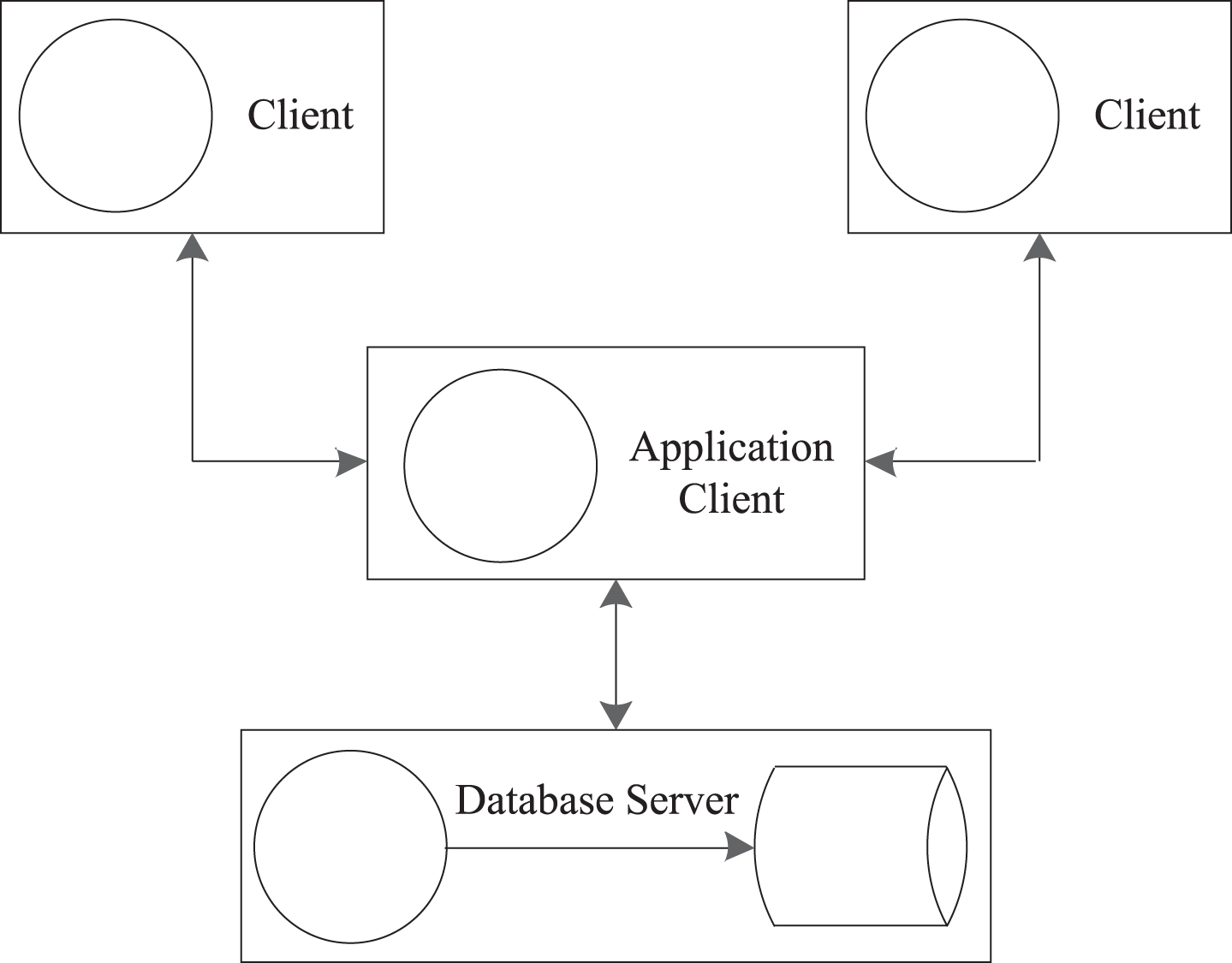
The continuous improvement of computer hardware and software and network technology has promoted the development of computer architecture. At present, the main architecture adopted in the Internet era is three-tier client/server architecture, as shown in Fig. 1.
Three-tier C/S structure.
Server and client have the technology of dividing application function in three-tier architecture. The system divides user-defined interface system by application in business processing logic [10]. Centralized business processing logic in middleware server simplifies the orientation control of sensitive data in the system and reduces the workload of client. Data between server and client are changed and isolated, i.e. changing the client’s user interface does not affect business processing logic.
In the above network structure, the communication model can abstractly describe the transfer of information and communication entities in the process of network communication, and build a hierarchical model according to the location of information and communication entities in the network [11].
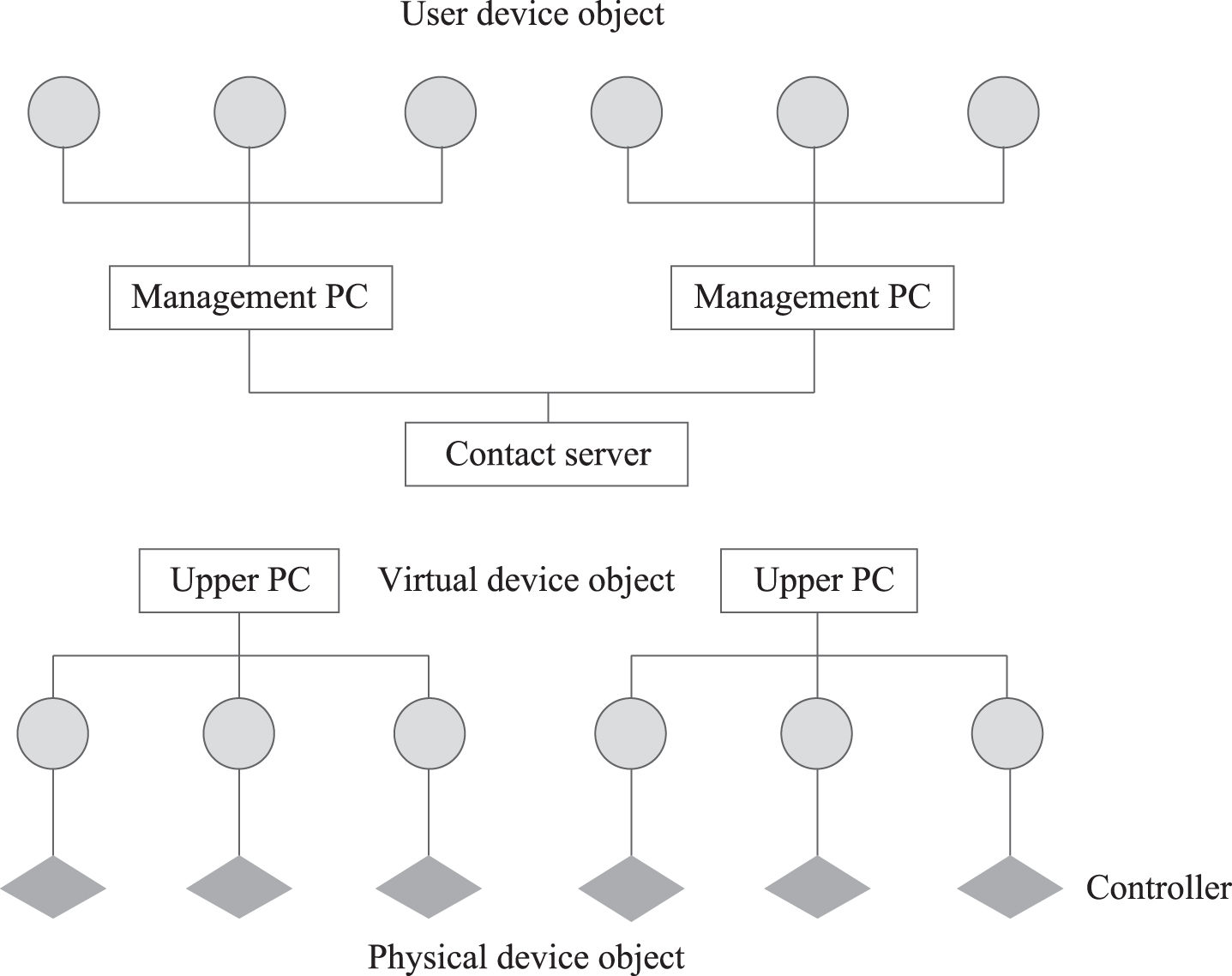
The main body of communication mainly includes the monitoring program in the high-level management PC, the monitoring program in the PC of host computer’s monitoring layer and the control program in the device controller [12].
The most important problem in the process of information communication is to keep the consistency of the state information of controlled devices at all levels. Therefore, it is necessary to classify and process the device objects according to the location of the device objects in the system. The devices described by the physical device objects is that existing in the field device layer; the devices described by the virtual device objects is that in the host monitoring layer; and the devices described by the user device objects is that in the management layer. In the communication model, the above three kinds of device objects have different hierarchies. The logical organization relationship between device objects is shown in Fig. 2.
Logical organization of device objects.
Communication model.
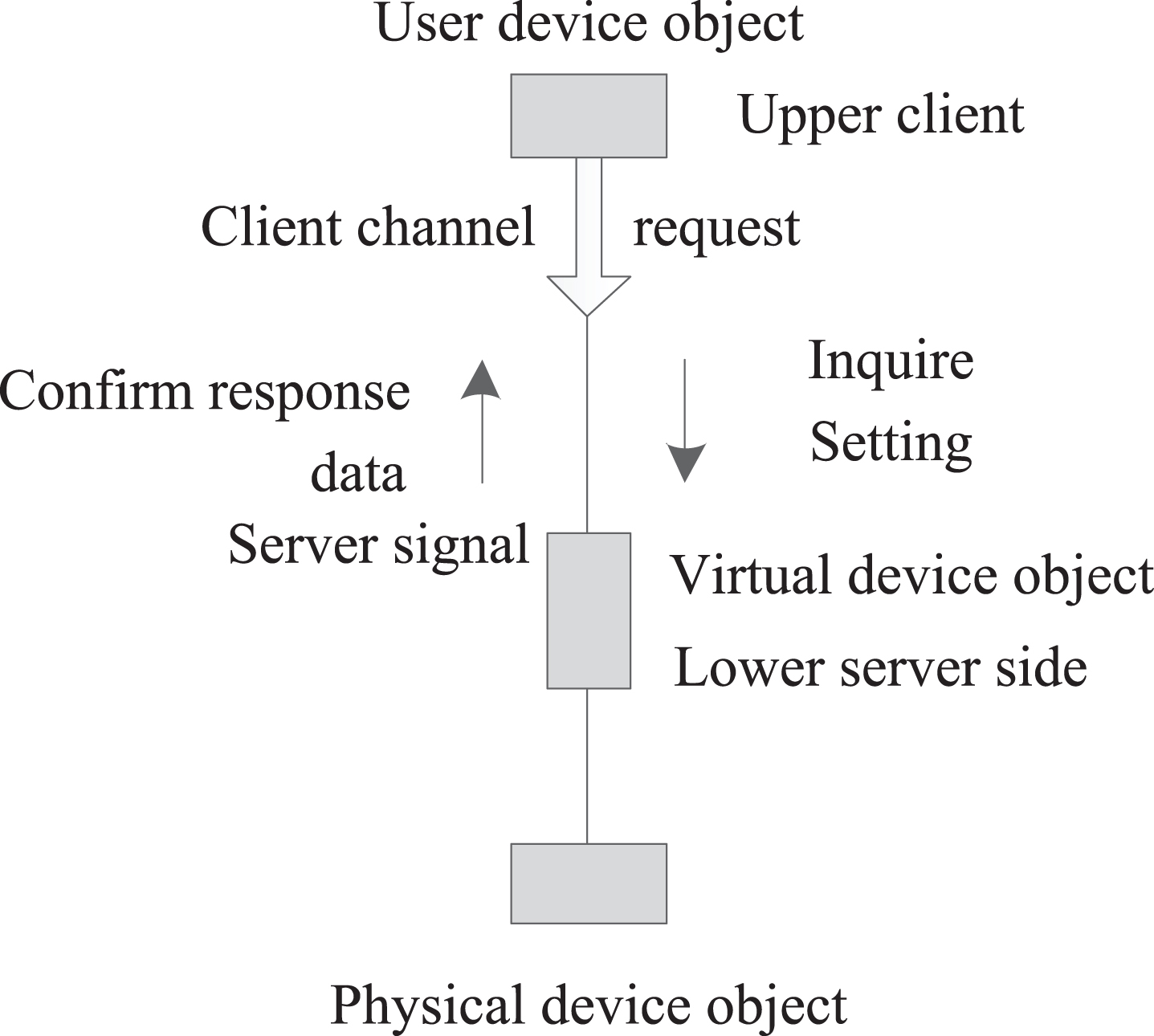
In order to ensure the synchronous processing of equipment status information among different layers, the channel classes of equipment are used to define the channels of information exchange between different layers of equipment objects. Meanwhile, the mode of channel usage is specified. The communication model is simplified according to the flow mode of information in the system.
Communication between adjacent devices is realized by C/S mode. The information transmission between the object and the device is realized through the device channel. When the device channel is located in the upper layer, it transfers information with the client, and when the device channel is located in the lower layer, it transfers information with the server [13]. Upper device objects send state query requests periodically and actively to lower device objects to sense their state changes. The lower device object senses its change by responding to the setting request of the upper device object. The above request response method solves the locking problem in the process of information oscillation and spontaneous transmission, and ensures the orderly and clear flow of information.
Encryption algorithm for network communication information based on binary logistic regression
Programme overview
Network model
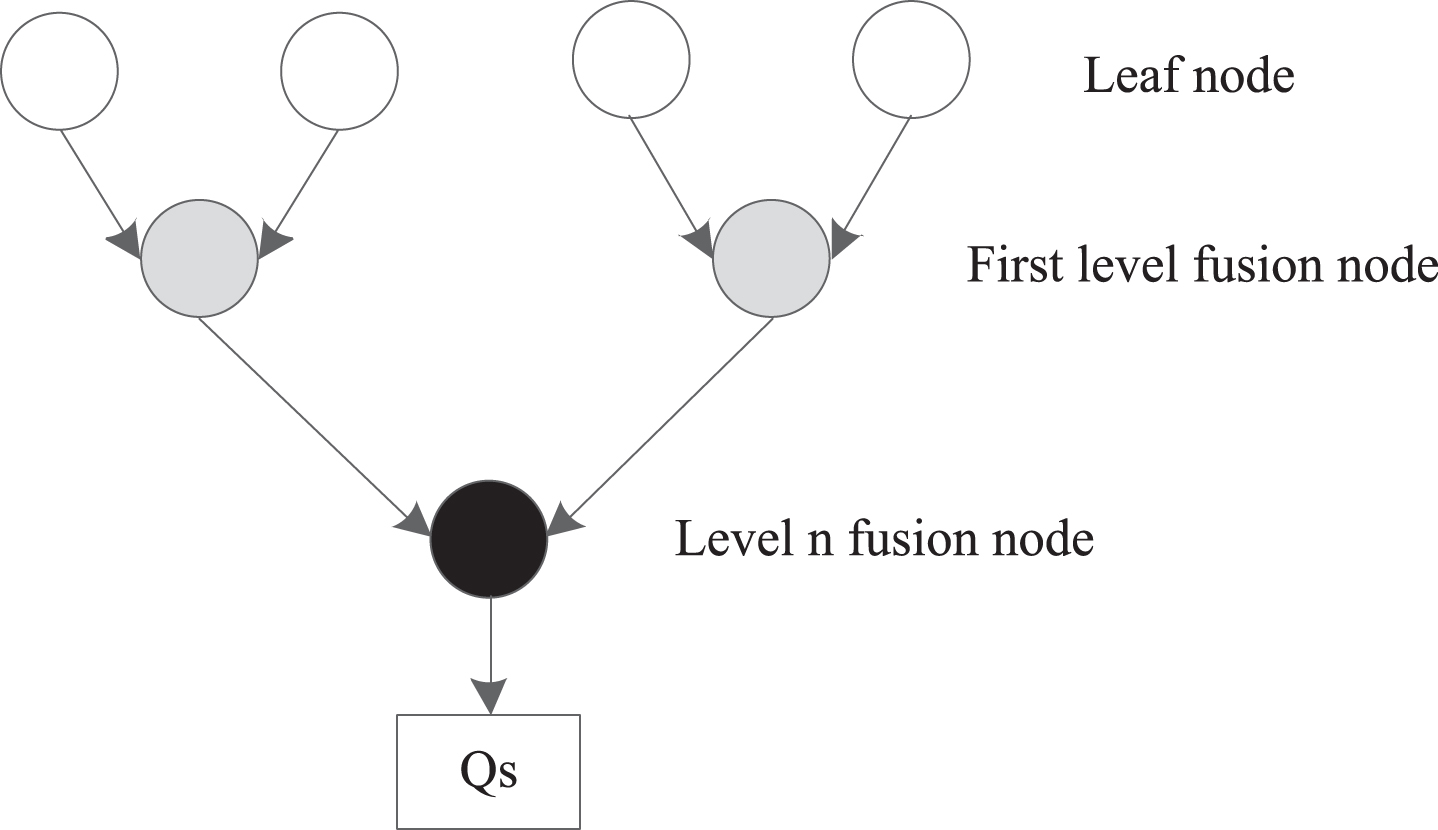
The encryption algorithm for network communication information based on binary logistic regression describes the network by connected graph G (V, E). Let vertex v (v ∈ V) describe the nodes existing in the network; edge e (e ∈ E) between vertices is used to describe the communication path between nodes in the network; N = |V| represents the total number of sensor nodes in the network.
In Fig. 4, Qs represents the base station node, which consists of base station node Qs, intermediate fusion node and leaf node. Among them, the base station node Qs describes the root node in the data fusion tree. Its main task is to judge the integrity of communication information, decrypt and process the fusion results, and respond to query requests [14]. The main task of the leaf node is to collect the communication information in the network and transmit it to the upper sensor node. The main task of the intermediate sensor node is to fuse and process the Hash message verification code and communication information collected by the sub-node, and send the result of information fusion to the upper sensor node.
Network model.
In the network model, the data query request is transmitted to the sensor through the base station node Qs. The sensor monitors the monitored area according to the received request, and transmits the communication information acquired by the sensor to the base station node Qs [15].
Let y (t) represent the information propagation function, and its expression is as follows:
In the formula, mN (t) represents the data collected by the sensor node N at time t.
An example diagram of the transfer function of network communication information is shown in Fig. 5.
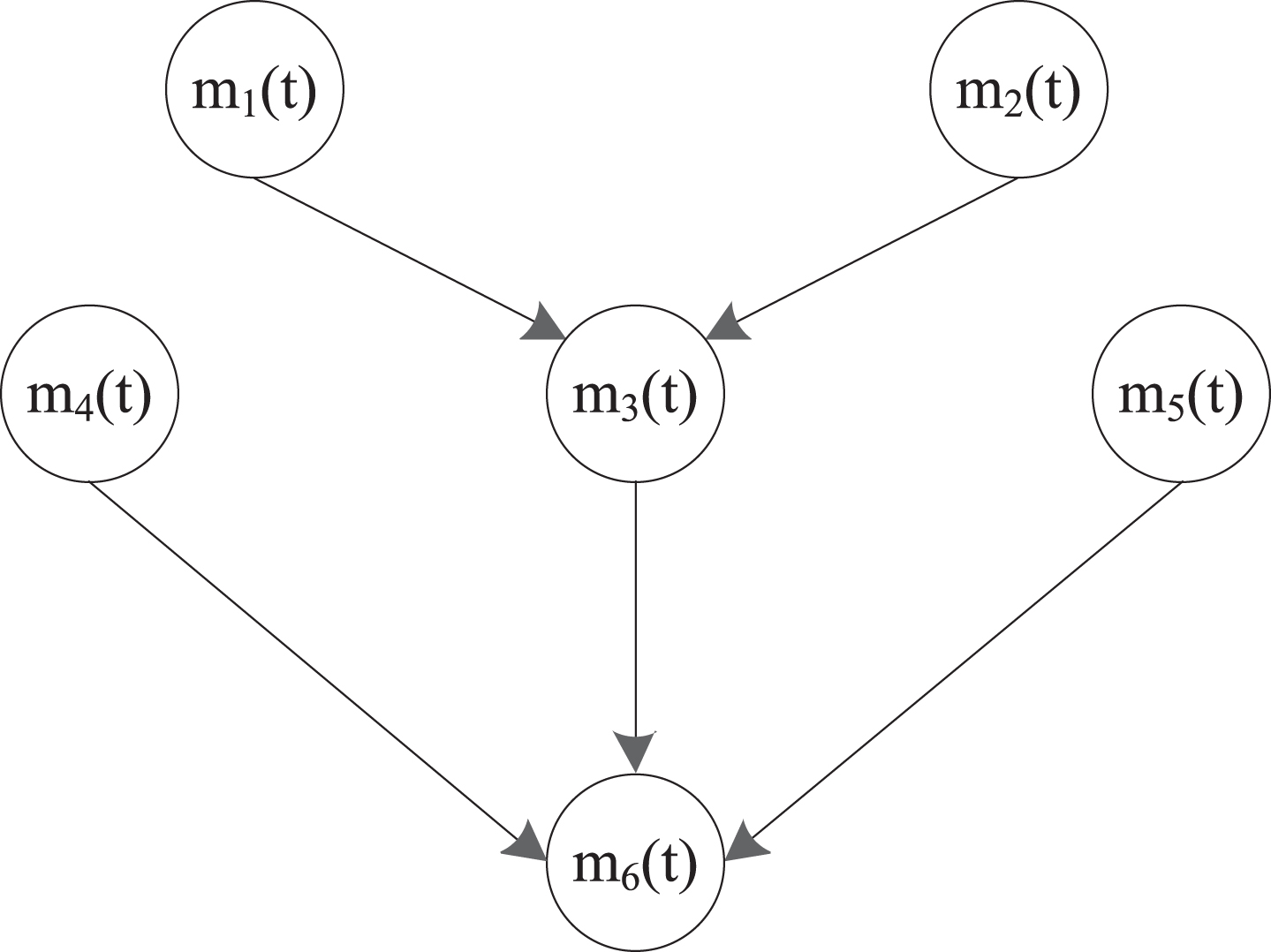
Diagram of information transfer function.
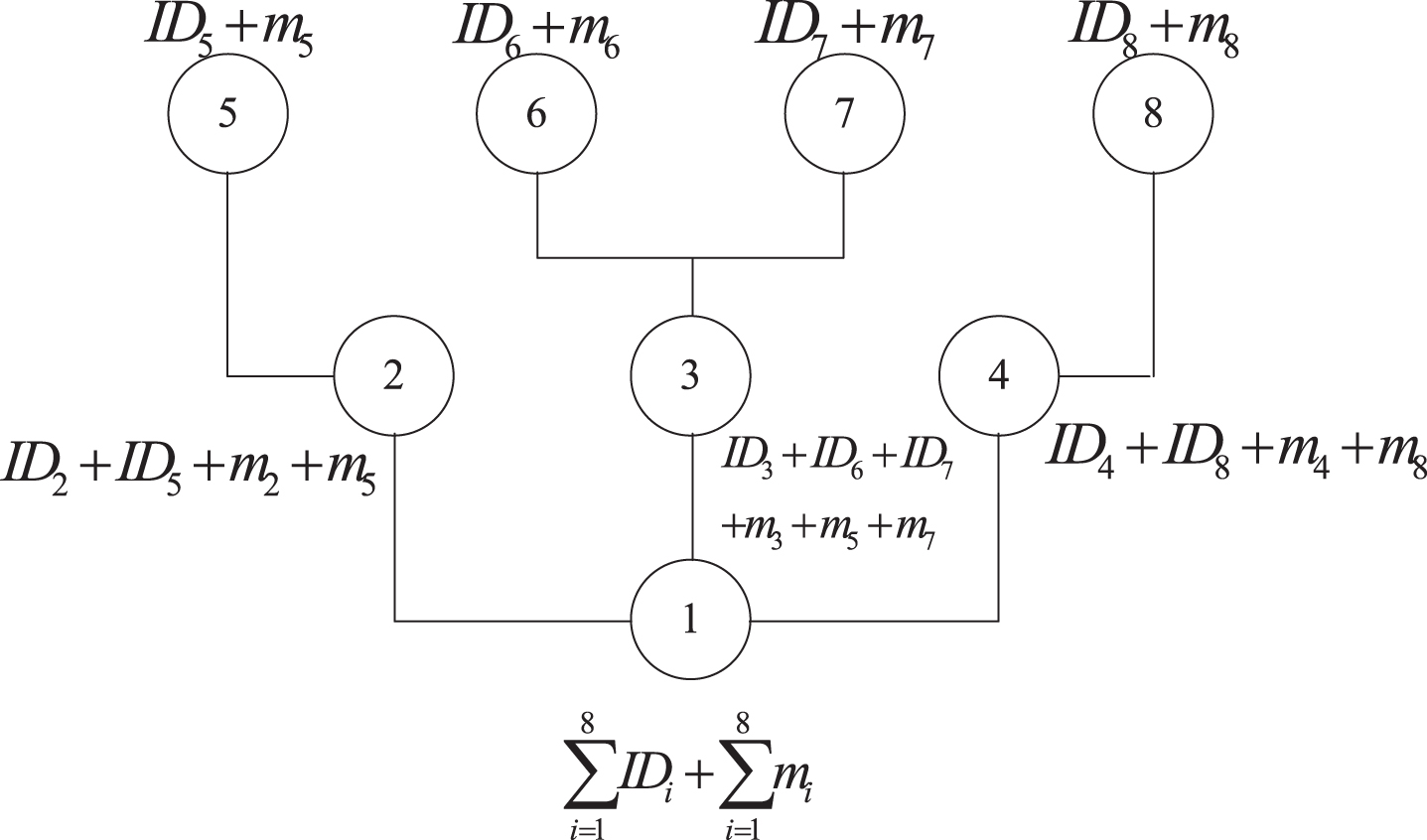
Structure of additive homomorphism mechanism.
In the process of communication in the network, the main factor to be considered is the confidentiality of information, so it is necessary to encrypt the network communication information [16].
With the development of network technology, the security of information has attracted extensive attention. Attackers will destroy the security of communication information in different ways. Attacks can be divided into two types from the perspective of attack: passive attack and active attack [17].
(1) Passive attack monitors and eavesdrops communication information in the network. The content of communication information is the target of passive attack. Passive attack does not tamper with communication data, so it is not easy to be found [18].
(2) Active attacks include disguising and modifying communication information data, mainly including denial of service, disguising, replaying and tampering. Because of the weakness of the network itself and the physical communication equipment itself, active attack is very difficult to prevent.
The encryption algorithm for network communication information based on binary logistic regression considers passive attack and active attack to encrypt network communication information.
Generation of network communication information sequence
The encryption algorithm for network communication information based on binary logistic regression generates network communication information sequence through binary logistic regression model. The specific steps are as follows:
Chaotic orbits are obtained by logistic mapping:
Among them, τ (t) denotes chaotic orbit of information sequence, μ denotes chaotic coefficient of mapping, I denotes set of information sequence, and x denotes information sequence.
Binary form is used to describe the points existing in the orbit:
Among them, the calculation formula of bi (x) is as follows:
In the formula, r represents orbital coefficient, Θ represents a threshold function, and its expression is as follows:
Combining formula (2) with formula (5), the expression of random sequence
In the formula, n represents the corresponding length of the binary sequence, and τn (x) is the random sequence obtained by the binary logistic regression model.
The encryption algorithm for network communication information based on binary logistic regression combines additive homomorphism mechanism and verification code of homomorphic Hash message to realize the encryption of network communication information.
(1) The authentication code mechanism of homomorphic Hash message
Homomorphic functions have the characteristics of anti-collision and unidirectionality in general, and are widely used in judging whether information has been tampered with [19].
When the sub-nodes are captured by malicious nodes and the data in the nodes are tampered with by malicious nodes, the authentication code mechanism of homomorphic Hash message is introduced. It can judge whether the communication information is tampered with in the process of uploading and whether the communication information is discarded according to the result of judgment [20].
Let F = gx represent an exponential function. For exponential x1 and x2, there are the following expressions:
According to formula (7), the following formula conforms to the homomorphic property:
The authentication code of homomorphic Hash message for privacy data mi are designed on the basis of formula (8):
Privacy data mi is acquired by sensor nodes, and there are the following expressions:
Based on homomorphic Hash functions, the obtained verification codes usually satisfy multiplicative homomorphism.
Assuming that the information acquired by sensor node i in the network is mi, the corresponding authentication code of homomorphic Hash message is H (mi). The fusion node processes the homomorphic message authentication code in the sensor node during data transmission.
Let H (agg) represent the fusion values of authentication codes obtained by base station nodes when there are N sensor nodes in the network. The expressions are as follows:
The base station node decrypts the acquired communication information and obtains the corresponding fusion value SUMm. The expression of the fusion value SUMm is as follows:
H (agg) is recalculated in the base station node. When H (agg) satisfies the following formula, the information is not tampered with in the process of information transmission:
Otherwise, the information is tampered with in the process of information transmission.
(2) Additive homomorphism
In some applications of sensor networks, it is necessary to transmit the ID of the node together with the acquired sensing data to the base station [21, 22]. The encryption algorithm for network communication information based on binary logistic regression protects communication data on the basis of additive homomorphism mechanism.
Node ID is safe and effective in additive homomorphism mechanism, so node ID can be used as the key in the process of network communication information encryption.
The additive homomorphic function F (xi) is designed based on the sensor node’s sensing data and node ID. The expression of the additive homomorphic function F (xi) is as follows:
For any two x1 and x2 that exist in the network, there are the following expressions:
The above formula conforms to additive homomorphism.
Node ID participates in the encryption process in the above process, so it is not necessary to upload the ID information of the node itself to the base station together with the sensing data, which reduces the communication overhead of the node in the network [23]. The structure of additive homomorphism mechanism is as follows:
The encryption algorithm for network communication information based on binary logistic regression is confidentiality of complete network communication information through system initialization stage, data preparation stage, data fusion stage and data verification stage.
System initialization
(1) Construction of fusion tree
The network communication information sequence is used to construct the fusion tree. The query request is transmitted to the nearest sensor node n0 by the base station node. For the received query request, the node n0 transmits it to all the nodes in the network. The node n0 is used as the base station node to construct the data fusion tree by TAG [24].
(2) Publishing parameter g
g represents a large prime number. In the network, the base station broadcasts the parameter g corresponding to the Hash function to all sensors.
(3) Allocation of ID numbers
Base station node transmits the corresponding ID of each node to each sensor.
Data preparation
(1) Acquisition of communication information
When the query request sent by the base station node is transmitted to the sub-node, the sensor nodes in the network monitor their respective monitoring areas, and store the collected network communication information mi in the database [25].
(2) Data encryption
Encryption is used to process the communication information mi acquired by sensor nodes in the network to ensure the privacy of communication information in the process of uploading. The specific encryption process is as follows:
Malicious nodes can not get the ID value corresponding to sensor nodes in the network, that is, if the communication information is captured by malicious nodes in the process of uploading, malicious nodes can not judge the original value of communication information, which improves the security of communication in the network.
(3) Authentication code of homomorphic message
The sensor calculates the authentication code of homomorphic message corresponding to the communication information. The base station node judges the integrity of the communication information based on the calculated authentication code of homomorphic message. The expression of the authentication code function of homomorphic Hash is as follows:
(4) Fusion of verification code of homomorphic hash message and ciphertext information
[Ci, H (mi)] is transmitted to the upper fusion node through the sub-node.
(1) Ciphertext fusion
The intermediate fusion node fuses the received communication information and reduces the transmission cost of the communication information in the network. In the process of fusing network communication information, the transmission mechanism corresponding to ID of sensor node is improved. By fusing ID, the amount of data uploaded by fusion node is reduced, the time of information uploading is shortened, and the encryption efficiency of the algorithm is improved.
Let CAGG represent the fusion function, and its expression is as follows:
(2) Fusion of authentication code of hash function message
The upper fusion node fuses the message authentication code acquired by processing, and fuses multiple message authentication codes into one. The fusion function is as follows:
(3) The fusion results are transferred to the upper sensor nodes
Nodes transmit data [CAGG, H (agg)] to the upper nodes.
The above steps are iterated. And when the final fusion data is obtained, stop the iteration.
(1) Data decryption
The fusion data acquired by the decryption process of base station node is decoded with the following decryption functions:
(2) Data validation
The homomorphic message authentication code corresponding to the communication information obtained by decryption of base station node is recalculated:
Comparing the values of H (SUMm) and H (agg), if the values of H (SUMm) and H (agg) are equal, the communication information is not tampered with in the process of uploading; if the values of H (SUMm) and H (agg) are not equal, the communication information is tampered with in the process of uploading.
The encryption algorithm for network communication information based on binary logistic regression completes the encryption processing of network communication information through the above process.
In order to verify the overall effectiveness of network communication information encryption algorithm based on binary logistic regression, a comparative experiment was carried out. In the environment of Fig. 7, the network communication information encryption algorithm based on binary logistic regression is tested. The operating system tested was Windows 7.0. The comparative indicators of the experiment are information integrity, information availability and encryption efficiency. The experimental comparison algorithm has reference [7], reference [8], reference [9]. The experimental data were collected from the network-related data in MySQL database, and the size of communication information data was 10 Gb.
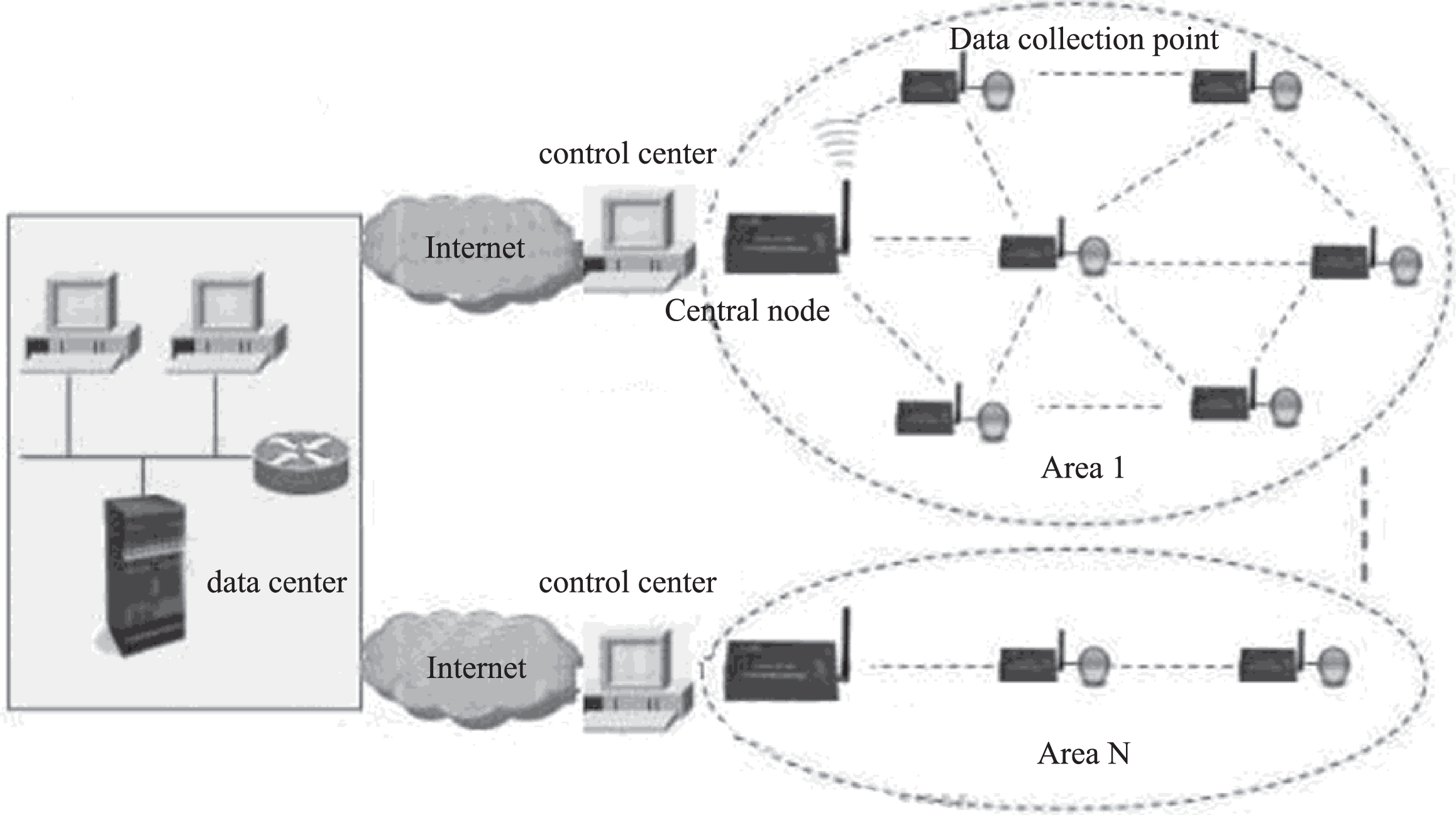
Experimental environment.
Comparing the information integrity of four different algorithms, the test results of four different algorithms are shown in Fig. 8.
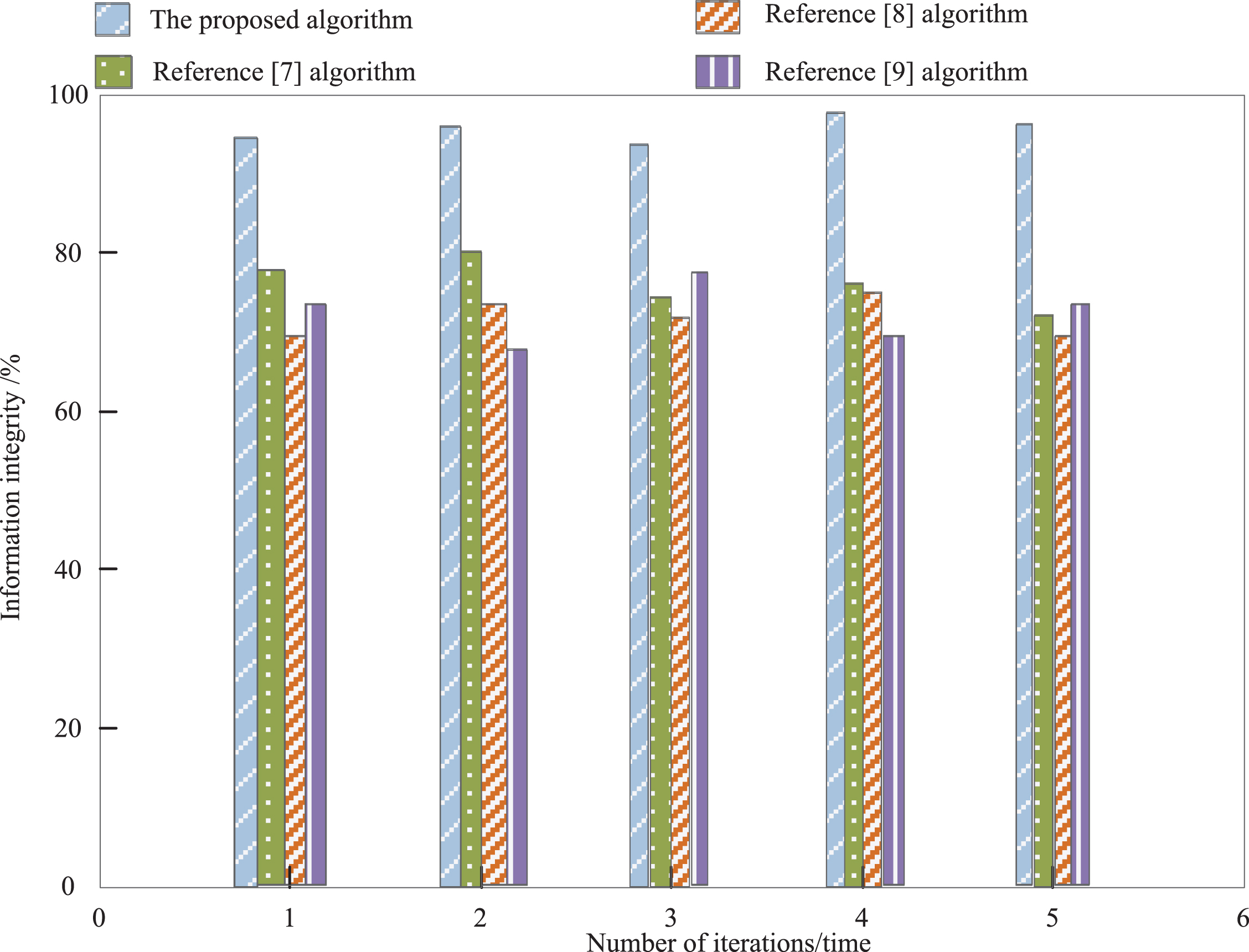
Information integrity of four different algorithm.
Analysis of Fig. 8 shows that with the increasing number of experiments, the information integrity of network communication information encryption algorithm based on binary logistic regression in multiple iterations is higher than that of reference [7], reference [8] and reference [9]. The average integrality of network communication information encryption algorithm based on binary logistic regression is 97%, while the average integrality scores of reference [7], reference [8] and reference [9] are 77%, 75% and 74%, which are lower than those based on binary logistic regression. Because the network communication information encryption algorithm based on binary logistic regression stipulates information exchange mode and channel usage mode between different levels on the basis of network communication model, which ensures the synchronous processing of equipment. Different levels of atus information improve the integrity of information encryption processing, and verify that the network communication information encryption algorithm based on binary logistic regression has high information integrity.
Comparing the information availability of four different algorithms, the test results of four different algorithms are shown in Fig. 9.
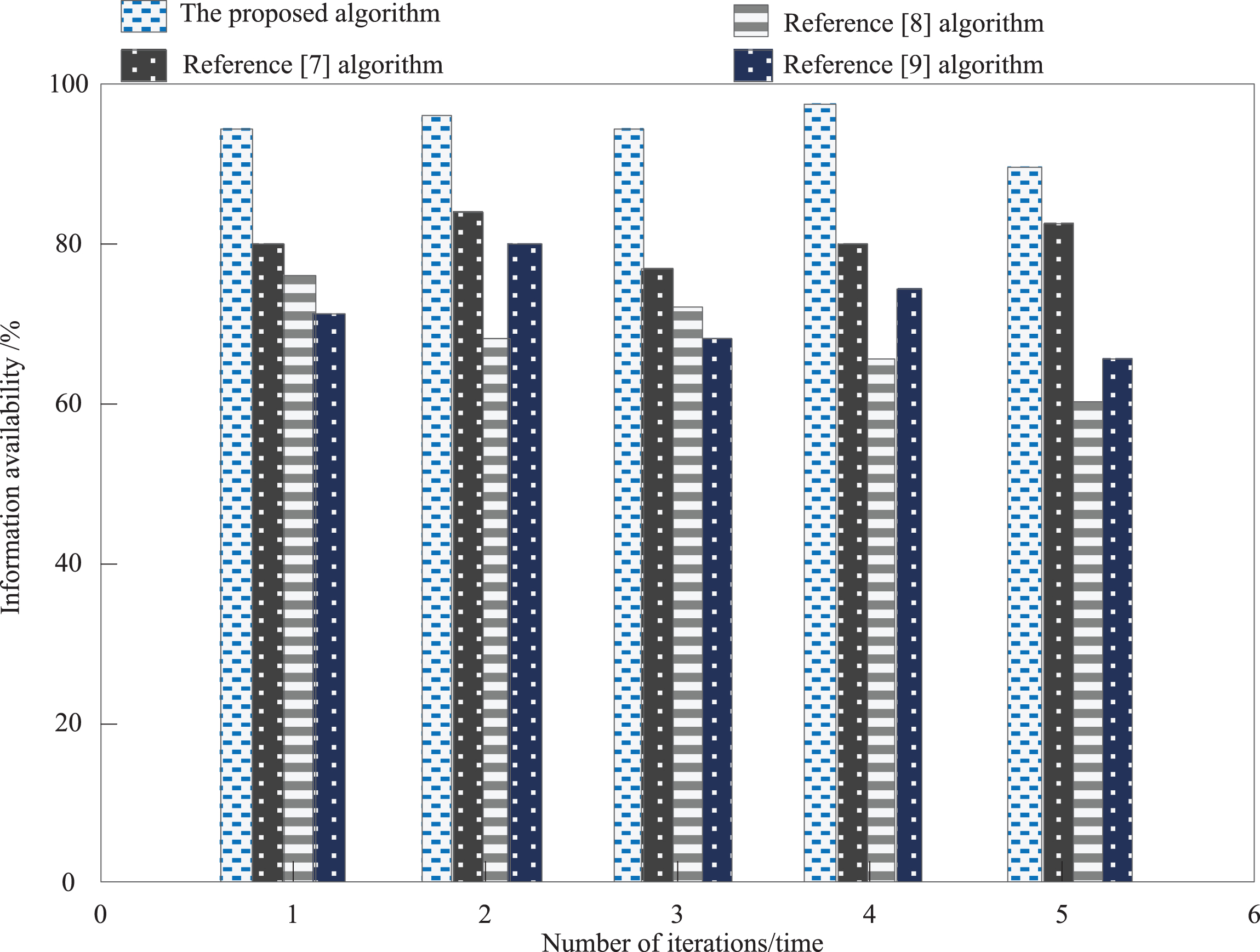
Information availability of four different algorithms.
As can be seen from Fig. 9, the information availability of network communication information encryption algorithm based on binary logistic regression in multiple iterations is higher than that of reference [7], reference [8] and reference [9]. The information availability of encryption algorithm based on binary logistic regression is the lowest at 89%, while that of reference [7], reference [8] and reference [9] is the lowest at 78%, 61% and 64%, which is much lower than that of encryption algorithm based on binary logistic regression. Because the network communication information encryption algorithm based on binary logistic regression studies the hierarchical structure of the information exchange subject on the basis of the network communication model, and analyses the logical organization relationship between device objects, which improves the security of the system. The availability of information encryption processing verifies the information availability of network communication information encryption algorithm based on binary logistic regression.
Comparing the time taken to encrypt information by four different algorithms, the test results are shown in Fig. 10.

Information encryption time of four different algorithms.
Analysis of Fig. 10 shows that the encryption time of network communication information encryption algorithm based on binary logistic regression is lower than that of reference [7], reference [8] and reference [9] under different experimental times. The maximum encryption time of binary logistic regression-based encryption algorithm is only 3.9 s, while that of reference [7], reference [8] and reference [9] is 10.2 s, 9.8 s and 8.1 s respectively, which is much higher than that of binary logistic regression-based encryption algorithm. Because the network communication information encryption algorithm based on binary logistic regression improves the transmission mechanism corresponding to the ID of sensor nodes in the process of communication information encryption, and reduces the amount of data uploaded by the fusion ID. It shortens the time of information upload, decreases the time of information encryption, and improves the encryption efficiency of network communication information encryption algorithm based on binary logistic regression.
The wide application and rapid development of network technology have increased the dependence of human beings on information in life, learning and work. The network contains a large amount of user information, so it is necessary to study the encryption algorithm of network communication information. Therefore, this paper proposes a network communication information encryption algorithm based on binary logistic regression. The following conclusions are proved by theory and experiment. This algorithm has good information completeness and encryption efficiency when encrypting network communication information. Specifically, compared with the algorithm based on SM4 rounds function, the information availability is greatly improved, and the maximum information utilization rate can reach 97.7%. Compared with the algorithm based on block cipher synchronization information, the encryption efficiency is significantly improved, and the shortest encryption time is only 1.9 s. Therefore, the proposed encryption algorithm based on binary logistic regression can better meet the needs of network communication information encryption. The application of binary logistic regression encryption algorithm in network communication is an important way to protect network communication. In the future research, we should improve the encryption effect of encryption algorithm and protect the security of network communication.
Footnotes
Acknowledgment
This work was supported by Shaanxi Provincial Xi’an Municipal Government Foundation under grant no.90812180015.