



Abstract
Linear Programming (LP) is an optimization problem, which deals with finding optimal solutions under set of linear inequality or linear equality constraints. Fuzzy Linear Programming (FLP) and Fuzzy Linear Programming problems (FFLP) have gained great importance in recent years due to the uncertainties that may arise in the parameters and variables of the problems. In this paper we provided an extension to Ozkok et al. [Ozkok, B. A., Albayrak, I., Kocken, H. G., & Ahlatcioglu, M. (2016). An approach for finding fuzzy optimal and approximate fuzzy optimal solution of fully fuzzy linear programming problems with mixed constraints. Journal of Intelligent & Fuzzy Systems, 31(1), 623-632.] to find fuzzy optimal and approximate fuzzy optimal solution of FFLP with trapezoidal fuzzy numbers.
Keywords
Introduction
Linear Programming (LP) is an optimization problem of very important area of mathematics called “optimization theory” which deals with finding optimal solutions under set of linear inequality or linear equality constraints. Wide range of real world applications in many areas are using LP for modeling and solving their respective problems. For many problems, the estimation of the system parameters are imprecise because of the lack of exact information so the uncertainty of the parameters are often presented by fuzzy numbers.
LP is called as fuzzy linear programming (FLP) which has at least one fuzzy parameter. Fully Fuzzy Linear Programming (FFLP) is defined in which all parameters i.e. coefficients as well as variables in the objective function and constraints are taken as fuzzy numbers. Therefore, FFLP seem to be more realistic and reliable than the crisp case.
Kumar and Kaur [27] declared that the FFLP problem with mixed constraints in which decision variables are represented by nonnegative triangular fuzzy numbers and the remaining parameters are represented by any type of triangular fuzzy numbers cannot be solved by any of the existing methods in the literature while their proposed method can be found the fuzzy optimal solution of this type of FFLP. Ozkok et al. [35] showed that the infeasibility case of the FFLP cannot be handled by the Kumar and Kaur’s method. They have provided an extension to the method of Kumar and Kaur [27] to find fuzzy optimal solution to the feasible case and approximate fuzzy optimal solution to the infeasible case of FFLP problem with mixed constraints. In this paper we provided an extension to Ozkok et al. [35] to find fuzzy optimal and approximate fuzzy optimal solution of FFLP with trapezoidal fuzzy numbers. In order to demonstrate the effectiveness of our methodology, we have worked on a well-known production planning problem which has been dealt with by the researchers in the literature. Thus, we had the opportunity to compare our results with other researchers. Compared to the other results, we have found that our method allows us to achieve very efficient results. In addition, we have examined the problems produced with random coefficients to show that our method can work even in large-scale FFLP problems and presented our results in Table 3 and Table 4. Our study differs from the FFLP problem literature in that it deals with infeasibility case of FFLP problem with trapezoidal fuzzy numbers which is more general than the class of triangular fuzzy numbers.
Results of the proposed algorithm
Results of the proposed algorithm
Results of the proposed algorithm
This paper is organized as follows. In Section 3, brief information about the trapezoidal fuzzy numbers and some basic definitions are presented. FFLP problem and related definitions are given in Section 4. Section 5 presents an extension to the method of Ozkok et al. [35] to find fuzzy optimal solution to the feasible case and approximate fuzzy optimal solution to the infeasible case of FFLP problem with mixed constraints. Numerical Experiments are given in Section 6 and the conclusion is given in Section 7.
In the last several years, FLP and FFLP problems has gained great importance and there is a vast literature on the investigation of optimal solutions of these problems. Zimmermann [42] presented the application of FLP approaches to the linear vector maximum problem. Werners [40] introduced an interactive system which supports a decision maker in solving programming models with crisp or fuzzy constraints and crisp or fuzzy goals. Campos and Verdegay [7] considered LP problems with fuzzy constraints and fuzzy coefficients in both matrix and right hand side of the constraint set. Inuiguchi et al. [19] proposed a technique to solve the FLP using a standard LP when membership functions are strictly quasiconcave and the minimum operator is adopted for aggregating fuzzy goals. Rommelfanger [37] presented a survey on methods for solving FLPs. Cadenas and Verdegay [6] considered a LP problem in which all its elements are defined as fuzzy sets. Fang et al. [11] presented a method for solving LP problems with fuzzy coefficients in constraints and showed that such problems can be reduced to a linear semi-infinite programming problem. Buckley and Feuring [5] presented a method to find solutions to the fully fuzzified LP where all the parameters and variables are fuzzy numbers and an evolutionary algorithm is designed to solve the fuzzy flexible program. Maleki et al. [30] proposed a new method for solving LP problems with fuzzy variables using the concept of comparison of fuzzy numbers. Zhang et al. [41] concerned the solution of FLP problems which involve fuzzy numbers in coefficients of objective functions and they converted the FLP to a multi-objective optimization problem with four-objective functions. Nehi et al. [33] introduced the lexicographic ranking function to order fuzzy numbers using the concepts of value, ambiguity and fuzziness for a fuzzy number and they applied the lexicographic ranking function method to solve fuzzy number LP problems. Ramik [36] introduced a class of FLP problems based on fuzzy relations and a concept of duality for FLP. Ganesan and Veeramani [12] dealed with a kind of FLP problem involving symmetric trapezoidal fuzzy numbers and they derived solution of FLP problems without converting them to crisp LP problems. Hashemi et al. [16] proposed a two-phase approach to find the optimal solutions of a FFLP. Mahdavi-Amiri and Nasseri [29] developed a dual algorithm for solving the LP problems with trapezoidal fuzzy variables by using linear ranking function to order trapezoidal fuzzy numbers. Jimenez et al. [20] proposed a method for solving LP problems where all the coefficients are, in general, fuzzy numbers. Allahviranloo et al. [2] proposed a method to solve the FFLP problem by using linear ranking function for defuzzifying it. Nasseri [32] proposed a new method for solving the FLP problems by solving the classical LP problems without using any ranking function. Lotfi et al. [28] discussed FFLP problems of which all parameters and variable are symmetric triangular fuzzy numbers. Kumar et al. [22] proposed a method to find the fuzzy optimal solution of FFLP problems with inequality constraints by transforming crisp LP form. Kumar et al. [23] proposed to find the fuzzy optimal solution of FFLP problems with inequality constraints by using trapezoidal fuzzy numbers. Kumar et al. [24] proposed to find the fuzzy optimal solution of FFLP problems with equality constraints. Kumar and Kaur [25] proposed Mehar’s method to find the fuzzy optimal solution of FLP problems. Kumar and Kaur [26] pointed out the shortcomings of existing general form of FFLP problems and proposed a new general form of FFLP problems. Kaur and Kumar [21] proposed the product of unrestricted L-R flat fuzzy numbers and Mehar’s method for solving FFLP problems by using their proposed product. Fan et al. [10] developed generalized fuzzy linear programming (GFLP) method to deal with uncertainties expressed as fuzzy sets and also investigated the feasibility of fuzzy solutions of the GFLP problem. Kumar and Kaur [27] proposed a method to find the fuzzy optimal solution of FFLP problems with mixed constraints where parameters are triangular fuzzy numbers. Otadi [34] presented a method to find the fuzzy optimal solution of FFLP problems. Hatami and Kazemipoor [17] adopted Mehar’s Method for solving FFLP problem involving symmetric trapezoidal fuzzy numbers including both equality and inequality constraints. Ezzati et al. [9] proposed a model based on a new lexicographic ordering on triangular fuzzy numbers to solve the FFLP problem by converting it to its equivalent multi-objective LP problem and solved by the lexicographic method. Bhardwaj and Kumar [4] proved that the FFLP problems with inequality constraints cannot be transformed into FFLP problems with equality constraints and hence, the algorithm, proposed by Ezzati et al. [9] cannot be used for finding the fuzzy optimal solution of FFLP problems with inequality constraints. Mottaghi et al. [31] presented a method for solving the FLP problems in which the coefficients of the objective function and the values of the right-hand side are represented by fuzzy numbers, while the elements of the coefficient matrix are represented by real numbers and developed Karush-Kuhn-Tucker (KKT) optimality conditions for FLP problems. Shamooshaki et al. [39] proposed a model by using the lexicography method to solve FFLP problem with L-R fuzzy number and find the fuzzy optimal solution of it. Baykasoglu and Subulan [3] claimed that their study is the first study in the literature which presents fuzzy efficient solutions and analysis for a fully fuzzy reverse logistics network design problem with fuzzy decision variables which is a type of FFLP. Gri et al. [14] proposed some approaches to solve the fully fuzzy fixed charge multi-item solid transportation problems (FFFCMISTPs), in which direct costs, fixed charges, supplies, demands, conveyance capacities and transported quantities(decision variables) are fuzzy in nature. Saati et al. [38] proposed a method for solving FLP problems in which the right-hand side parameters and the decision variables are represented by fuzzy numbers. A fuzzy ranking model and a supplementary variable are utilised in the proposed FLP method to obtain the fuzzy and crisp optimal solutions by solving one LP model and also they introduced an alternative model with deterministic variables and parameters derived from the proposed FLP model. Gupta et al. [15] pointed out that Giri et al. [14] have used some mathematical incorrect assumptions in their proposed approach and hence the claim of Giri et al. [14] is not valid. Hosseinzadeh and Edalatpanah [18] in their paper, by considering the L-R fuzzy numbers and the lexicography method in conjunction with crisp linear programming, they designed a new model for solving FFLP. The proposed scheme presented promising results from the aspects of performance and computing efficiency. Das et al. [8] introduced a method to solve fully fuzzy linear programming problems. Their proposed method is derived from the multi-objective linear programming problem and lexicographic ordering method. Ghodousian and Parvari [13] investigated the optimization of a linear objective function subject to a generalized fuzzy relational inequalities in which an arbitrary continuous t-norm is considered as fuzzy composition, and fuzzy inequality replaces ordinary inequality in the constraints. Abdel et al. [1] have introduced the neutrosophic LP models where their parameters are represented with a trapezoidal neutrosophic numbers and presented a technique for solving them and also presented approach has been illustrated with some numerical examples.
Our study contributes to the literature in terms of finding optimal and approximate optimal solutions to the FFLP with trapezoidal fuzzy numbers which is more general than the class of triangular fuzzy numbers.
Preliminaries
In this section, brief information about the trapezoidal fuzzy numbers and some basic definitions are presented.
Basic definitions
Arithmetic operations
Some algebraic operations on trapezoidal fuzzy numbers are defined as follows:
Let
The fuzzy multiplication based on the extension principle is performed via the following equation:
This property can be generalized for n fuzzy numbers
Fully fuzzy linear programming problems
In the real life problems, it is hard to estimate parameters of problems imprecisely. Fuzzy set theory is a powerful tool to estimate and describe the vagueness and ambiguity in these parameters.
Here, we handle FFLP problem with mixed constraints in which decision variables are represented by nonnegative trapezoidal fuzzy numbers and the remaining parameters are represented by any type of trapezoidal fuzzy numbers.
FFLP problems with m mixed constraints and n fuzzy variables can be formulated as follows:
Using matrix notation we get
A FFLP is infeasible if it has no feasible solutions, i.e. the feasible region is empty.
If there exist any non-negative
then
Here, the condition (i) implies that the fuzzy number obtained in the left hand side of at least one equality constraint is not equal to its right hand side fuzzy number.
A mathematical method for finding fuzzy optimal and approximate fuzzy optimal solution of FFLP problems with trapezoidal fuzzy numbers
Ozkok et al. in [35] proposed a method to solve FFLP problems with mixed constraints in which decision variables are represented by non-negative triangular fuzzy numbers and other parameters are represented by any type of triangular fuzzy numbers. They also focused on the infeasibility case of the FFLP cannot be handled by the existing methods. Therefore, In [35] they have provided an extension of this method to find fuzzy optimal solution to the feasible case and approximate fuzzy optimal solution to the infeasible case of FFLP problem with mixed constraints.
Here we introduce and extention in order to find fuzzy optimal and fuzzy approximate optimal solution of FFLP with trapezoidal fuzzy numbers which is more general than the class of triangular fuzzy numbers.
The steps of the our extended method are as follows:
Go to Step 8.
Go to Step 9.
Go to Step 10.
Numerical experiments
In this section, we present three numerical experiments to illustrate the extended solution procedure.
A company produces three products P1, P2 and P3. These products are processed on three different machines M1, M2 and M3. The time required to manufacture one unit of each product and the daily capacity of the machines are given below:
Note that the time availability can vary from day to day due to break down of machines, overtime work etc. Finally the profit for each product can also vary due to variations in price.
At the same time the company wants to keep the profit somewhat close to Rs.14 for P1, Rs.13 for P2 and Rs.16 for P3. The company wants to determine the range of each product to be produced per day to maximize its profit. It is assumed that all the amounts produced are consumed in the market.
Since the profit from each product and the time availability on each machine are uncertain, the number of units to be produced on each product will also be uncertain. So the problem is modeled in [12] as a fully fuzzy linear programming problem as follows:
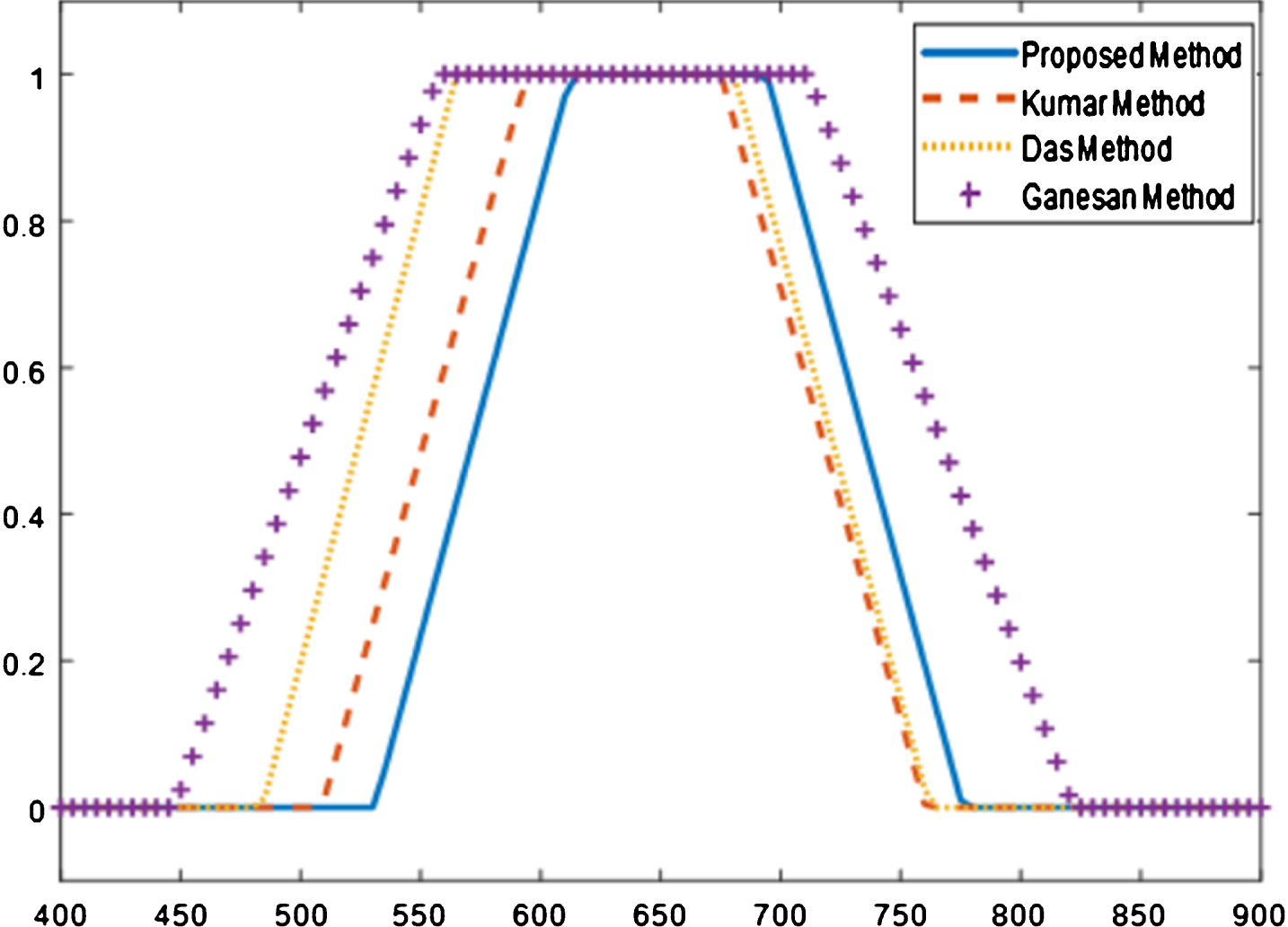
Table 2 and Figure 2 show that our method produces reasonable good results when compared to existing methods in the literature.
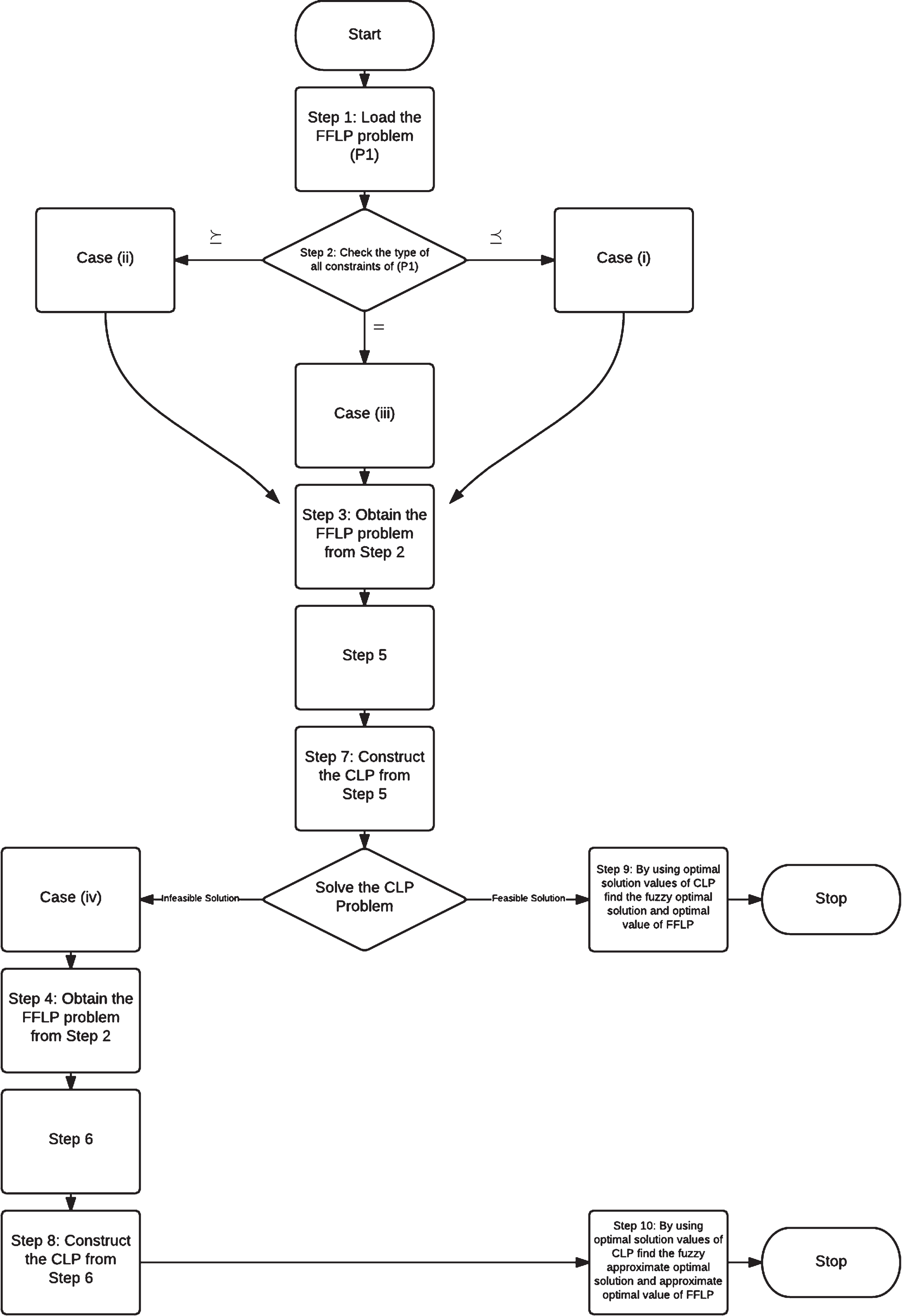
The flow chart of finding optimal and approximate optimal solution of fFLP.
By solving constructed Crisp LP problem in Step 7, the infeasible case is occurred. By using Step 2 Case (iv) the reconstructed Crisp LP problem is solved and the fuzzy approximate optimal solution of the FFLP problem is
Data of the production planning problem
Table 1 and Table 2 show that our algorithm can reach to the optimal solution in different sizes of the problem within a reasonable time and number of iterations for even the large-sized problem instances.
LP is an optimization problem which deals with finding optimal solutions under set of linear inequality or linear equality constraints. Wide range of real world applications in many areas are using LP for modeling and solving their respective problems. Here, we dealt with FFLP defined in which all parameters i.e coefficients as well as variables in the objective function and constraints are taken as arbitrary trapezoidal fuzzy numbers. In this paper, we have provided an extension to the method of Ozkok et al. [35] to find fuzzy optimal solution to the feasible case and approximate fuzzy optimal solution to the infeasible case of FFLP problem with mixed constraints by using more trapezoidal fuzzy numbers which is more general than the class of triangular fuzzy numbers. It is important to provide an approximate fuzzy optimal solution of FFLP which is the most acceptable solution under the limitation of the available resources in real life problems for the decision makers. We haved worked on a production planning problem and presented a comparison of results of our method and existing methods in the literature. Additionally we have generated FFLP test problems in a large scales to show our effectiveness. Consequently, our algorithm can reach to the optimal solution in different sizes of the problem within a reasonable time and number of iterations when even the large-sized problem instances. Our future direction is to expand our method in order to handle fully fuzzy multiobjective linear programming problems and fully fuzzy linear fractional programming problems.