



Abstract
In the field of Industry 4.0, various studies considered the engineering industries, however, the limitations of Internet of things (IoT) implementation is not discussed by these studies and literature missed the crucial challenges of IoT implementation, particularly in the Indonesian engineering companies. Therefore, the objective of the current study is to investigate the factors which limits the implementation of IoT. Additionally, the moderating role of employee innovative capabilities is also considered. A survey was carried out in the Indonesian engineering companies for data collection. Data collection was carried out form the employees of these companies. After data collection, structural equation modeling (SEM) was used to analyse the data with the help of Partial Least Square (PLS). Findings of the study demonstrated that there are five key factors which effect the IoT implementation. These factors include; willingness to use, hardware characteristics, replacement of existing technology, failure threat and implementation cost. All these factors have the ability to influence IoT implementation. Additionally, employee innovative capability also has the ability to encourage or discourage the IoT implementation. Therefore, this study is most significant for the engineering industry of Indonesia as it provides the influencing factors towards IoT implementation.
Introduction
The Internet of Things (IoT) aims to translate the physical world into digital signals, ripe for the advancement assured by faster communication as well as better analytics. It is the most important part of Industry 4.0 [1] which provides the latest technologies in the current era of industrialization. The term Industry 4.0 signifies at the same time: a paradigm shift in production industrial era, a generic description for groups of strategic creativities to improve industries, a one of the technical term to narrate to latest developing business assets, procedures as well as services, and a brand to mark a very specific historical and social period in which IoT has central role [2]. Therefore, the presence of IoT has central role in this era of industrialization.
However, the it is crucial to implement a complete IoT system. Implementation of IoT is one of the complicated process as the new technology is always tough to implement which needs to fulfil various requirements. Therefore, the focus of this study is also to examine different factors which effect on the implementation of IoT. The research question of this study is; what are the factors which limits the implementation of IoT? In line with the research question, the objective of the current study is to investigate the factors which limits the implementation of IoT. In the context of this study, Fig. 1 showing the relationship between various factors which limits the implementation of IoT.
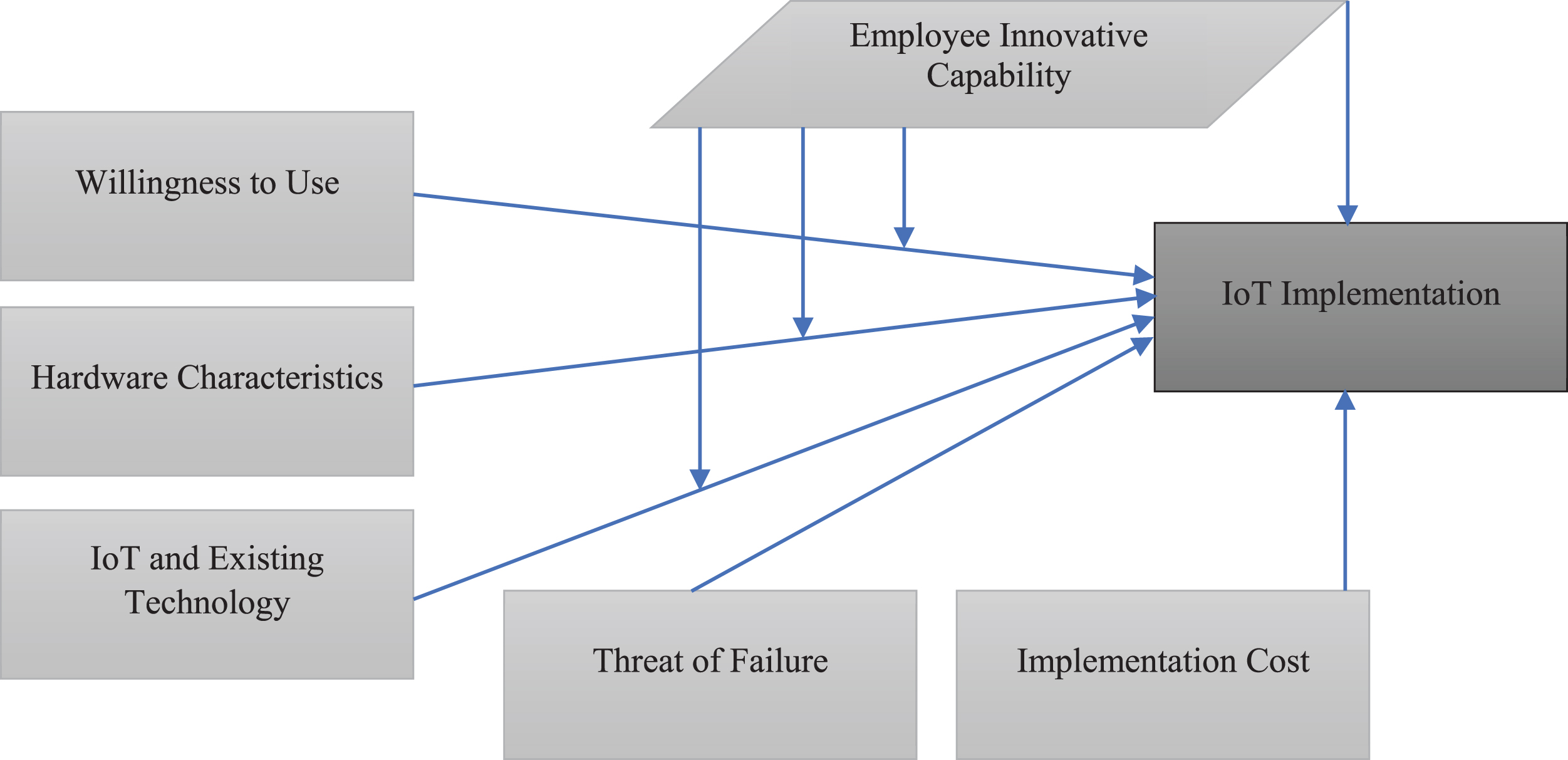
Theoretical framework of the study showing the relationship between various factors which limits the implementation of IoT.
With the extensive review of literature, it is revealed that there are many factors which effect the implementation of IoT in Indonesian engineering industry. The special focus of current study is Indonesian engineering companies. As the companies facing various challenges and issues while IoT implementation [3]. IoT system engineering needs formal analyses of the application in which market will experience diverse convergences to acquire more efficient and well-organized systems [4]. However, to arrange well-organized systems, it is needed to face different challenges such as willingness to use new technology, needed to install new hardware and replacement of existing technology for the implementation of IoT applications. It is important because the implementation of latest technology is always crucial [5].
Moreover, generally, while implementation of new technology, companies face hesitation because of the failure threat. As the new technology implementation is always one of the costly process, therefore, failure in new technology achievement cause in huge loss. That is the reason the fear of failure is always crucial challenges for the companies. Thus, the cost of technology implementation is a major concern of companies [6]. Additionally, significant skills of employees are also essential to implement the technology of IoT. The capabilities of employees are also important to run the latest technology. That is why the innovative capability of employees is an important concern while adopting IoT. It is also evident from the literature that employee innovative capability is important for organizations [7]. The capable employees always work positively and find new ways for technology implementation by using the internal as well as external knowledge from outside the boundaries of the firm.
The current study is most significant because it investigated the role of various factors which effect on the implementation of IoT. It is important because this study highlight various issues in engineering companies which is not previously discussed. In the field of Industry 4.0 and IoT, various studies considered the engineering technologies, however, the IoT implementation limitations are not discussed by these studies. Therefore, this is the first study which highlight the IoT implementation issues in the engineering companies of Indonesia.
The IoT term originated in 1999 along with the first view of how an IoT based environment might look like in the future. The IoT is a paradigm where objects could be prepared with recognizing, sensing, interacting as well as processing capabilities that will permit them to communicate or share knowledge with one another, devices as well as services. The IoT makes enough capable the smart objects to ultimate building blocks in the advancement of cyber-physical smart pervasive models. The IoT is one of the technologies which has a diversity of application domains which is important for companies. Now it becomes the most important element of companies [8, 9].
IoT signifies an essential infrastructure and set of methods that support innovative services in numerous application domains. Latest disruptive technologies in line with the technologies of IoT, particularly, are changing the means in which knowledge or information is handled within the boundaries of organizations, calling for a latest as well as inventive knowledge administration classification and an open technique to foster the performance. IoT is an evolving technological field that has strong future to convert both our understanding about the fundamental computer science philosophies and future living. Now a day, IoT contributing highly to the technological development [10]. Generally, IoT is based on four major elements which include; applications, platforms, connectivity, data from “things”. Applications include the maintenance for manufacturing plants, fuel savings for truck fleets, stolen vehicle recovery for a bike owner. Platform is based on the environment which connect, organize as well as analyse IoT data, for instance, Microsoft Azure IoT suite, IBM Watson and Cisco Kinetics. Connectivity involves the network that connect the devices (things) to each other. Data from “things” is based on extraction of data from various locations, temperature, humidity of moving truck using SIM-enabled sensors. These elements of IoT is shown in Fig. 2.
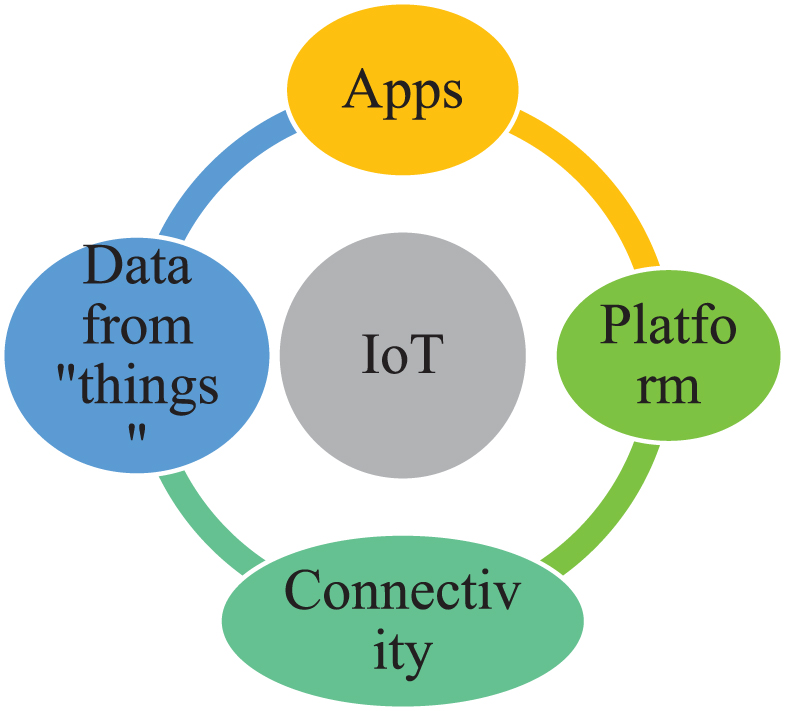
Internet of Things (IoT).
All of these elements of IoT are based on latest technologies which is tough to implement. Particularly for the small size companies these latest technologies are most crucial in implementations. All the limitations are interlinked with each other’s. That is why various factors have crucial role in the success of each IoT element. That is the reason most of engineering companies face various difficulties while implementation of IoT. These limitations of IoT implementation are given in Fig. 1.
First, the willingness to use is most important while adoption of any technology [11]. If the company employees are not willing to use new technology, then it is quite tough to implement IoT. As the employees are the major element which can performance dominant role in the success or failure of any technology. That is why the acceptance of technology is most crucial in the organizations [12]. Without the willingness to use, it is not possible to get maximum outcomes from the implemented technology. Therefore, willingness to use is the important concern of companies while implementation of IoT technology.
Second, the hardware characteristics are also important while implementation of IoT. There are various elements of hardware which are linked with the technology implementation. It has significant importance in the companies [13, 14]. Various studies are carried out on the relationship between hardware and technology implementation. While implementing new technology, installation of cost and time is important. More the installation cost and time of hardware, more will be the difficulty to implement IoT.
A study carried out by Suryanegara, et al. [15] found various interesting outcomes regarding hardware characteristics and IoT implementation. According to him, 52% of the people want the different physical device characteristics to be evidently beneficial for performance and experience of various user, that is, different IoT devices should be more lightweight as well as small. Furthermore, 38% of the people are those who are more concerned about the utilization costs of technology, for instance, electricity usage cost. It is an exciting finding associated with Indonesia’s electricity charges, which tends to be supposed as expensive. However, only 6% of the people are those who concerned with whether various IoT devices are based on local manufactured within Indonesia. In case of shape as well as colour of the devices, only 3% of the people are considered this point while purchasing the product. Hence, there are number of factors which effect on the IoT implementations. These factors can be internal as well as external related to the customers. Internal factors include; cost and time of hardware installation, however, external factors include; expense of device, weight of device, shape of device, colour of device etc.
Third, the replacement of old technology with new technology is always crucial for companies. It is one of the costly as well as time consuming process. It is also difficult because it also disturbs the operations of the company while installation of new technology. Therefore, replacement of old technology has many factors which effect the IoT implementation. It is one of the important step in the organizations [16] while new technology adoption. Particularly in the engineering companies, technology is the key to success, therefore, in these companies it is always needed to have latest technology for innovative developments. Customer satisfaction is an important part of every company and also requires employee satisfaction for success [17] which requires better implementation of new employee and customer friendly technology. Therefore, it is not easy to implement new technology because it is quite tough to replace old technology with latest one which requires training programs to teach employees regarding new technology use.
Fourth, indeed, technology has several advantages, however, it is also a threat for companies. There is always a threat while implementing new technology. Failure threat is one of the hindrances in the way IoT implementation. Because the failure in technology cause huge loss in form of resources such as finance, time, skills etc. That is why engineering companies hesitate to implement new technology and continue with old technology. According to the literature, failure threat is one of the challenge in organizations [18]. According to Rutherford [19], specific causes for failure may be more difficult to overcome. Therefore, while implementing new technology, causes of failure are always difficult to handle because of first time occurrence. More the threat of failure less will be technology adoption. Therefore, in a highly competitive environment IoT is also the threat for engineering companies which is one of the limitations in the way of IoT implementation.
Fifth, there is always a huge cost of new technology implementation. It requires a certain amount of finance. Financial cost is not only required for implementation, it can also be incurred after implementation of technology. For instance, it is also required to run the new technology which requires additional cost. Moreover, it is also discussed above, failure of technology is also huge financial loss. Literature also shows that technology requires high cost [20]. Hlaing, et al. [21] highlighted that IoT has implementation and maintenance cost. No doubt technology has several benefits [22], however, it is not easy to implement, particularly for small engineering companies. Therefore, a certain amount of capital always required for IoT implementation. Low cost encourages companies for IoT implementation, however, high cost discourages companies to implement IoT and stay with old technology.
Finally, there is an additional factor which effect on the implementation of IoT. This factor is employee’s innovative capability. As the employees are the key factor of every organization. The workforce of organization has vital support in the success [23, 32]. After the implementation of new technology, it is quite tough to run new technology without the certain skills and capabilities. In case of any issue in new technology, it is needed to have good employee capability to resolve the issue and confirm the smooth running of new technology. Certain innovative capabilities of company employees are vital for every organization to get success in their operations [24, 31]. Therefore, for IoT implementation, the employees of engineering companies must have capable employees to implement and run new technology. Employees having innovative capabilities can well manage the issues of IoT implementation.
This is one of the survey-based study in which a questionnaire was used to collect the primary data. By focusing on the engineering companies of Indonesian, data were collected from the employees of these companies. Generally, three types of research methods were used while conducting a research study. These methods include; quantitative, qualitative and mixed method approach. Mixed method approach is based on both quantitative and qualitative. However, the current study followed quantitative research approach in which a survey was carried out by using the survey questionnaires.
In general, the determination of study sample size is a balance between resource capability and adequate statistical requirement. According to Roscoe [25], simple rule of thumb suggested that a sample that is larger than 30 and less than 500 is appropriate for research. Comrey and Lee [26] provide sample by using inferential statistics. “Sample having less than 50 participants will observed to be a weaker sample; sample of 100 size will be weak; 200 will be adequate; sample of 300 will be considered as good; 500 very good whereas 1000 will be excellent. Most of the studies provide the sample based on total population.” Moreover, most of the studies follow total population to determine the sample size. However, in this study, the total number of employees were not known, that is why it is not possible to determine sample size with the help of number of employees. Therefore, this study followed Comrey and Lee [26] instructions and selected 300 sample size.
Thus, 300 questionnaires were distributed among the employees of engineering companies in Indonesia. All the questionnaires were distributed by using the area cluster sampling techniques in which various clusters were formulated and data were collected from each selected cluster. Total 220 questionnaires were received, and 215 valid responses were used to analyse the data. After data collection, it was analysed by using Partial Least Square (PLS) which is most suitable statistical tool in primary data analysis.
Findings
Findings of the study is based on structural equation modeling (SEM) with the help of Partial Least Square (PLS). This technique is based on two major steps, 1) measurement model, and 2) structural model. The current study followed these steps from the study of Hameed, et al. [27] and Hameed and Naveed [28]. However, before using SEM, the preliminary analysis was carried out to check the missing value and outlier. It is found that data is free from missing value and outlier. It is shown in Table 1. Additionally, normality is not an issue while using the PLS-SEM. PLS is suitable to analyse non-normal data.
Prilimaniry analysis
Prilimaniry analysis
Figure 3 shows the first step of PLS-SEM in which measurement model was examined. In this step, it is found that factor loading is above 0.5 which confirm the internal consistency. Composite reliability (CR) and average variance extracted (AVE) is also higher than 0.7 and 0.5 respectively [29]. All the results are demonstrated in Table 2.
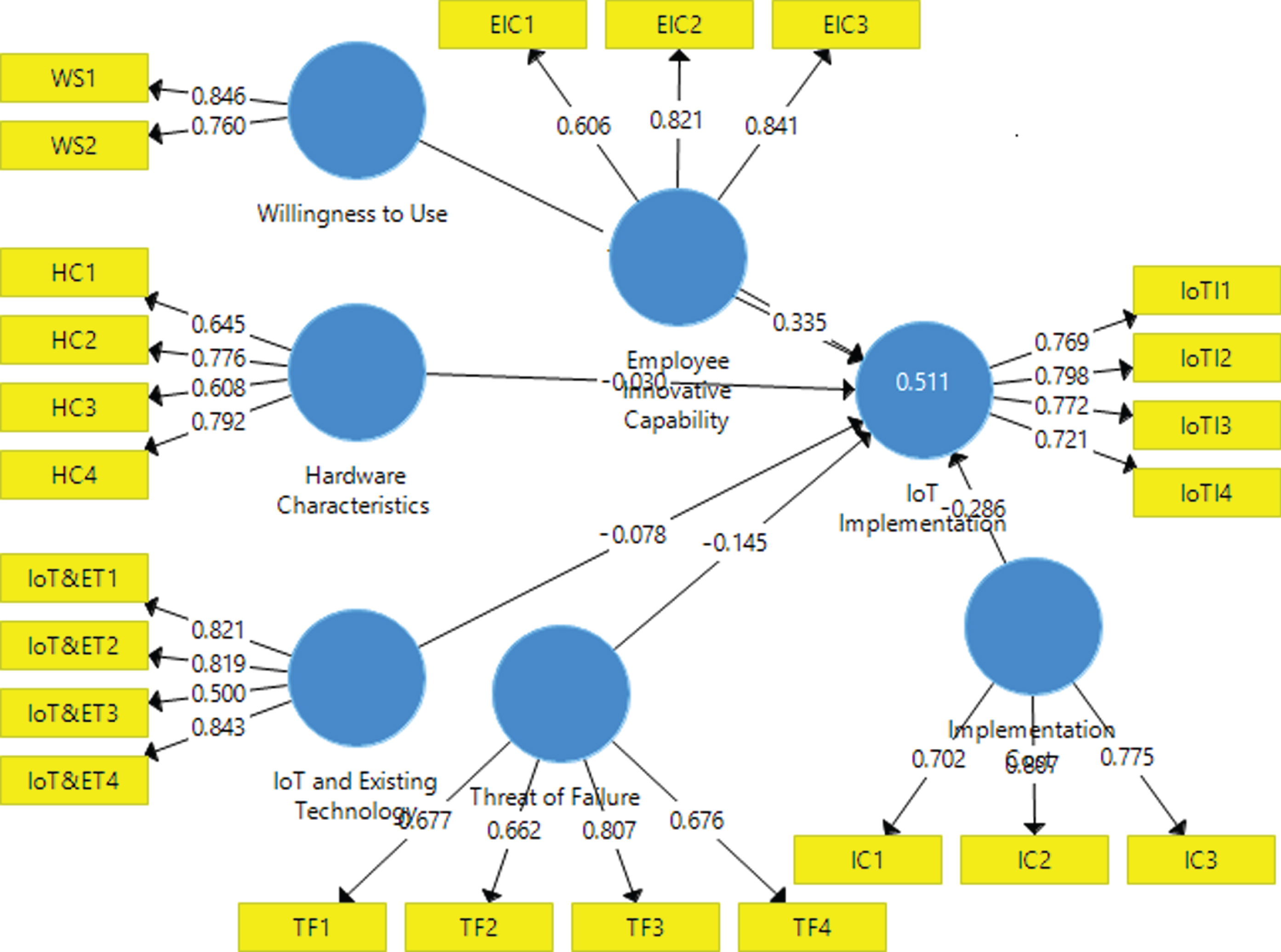
Measurement Model.
Constrcut Reliability and Valididty
Discriminant validity is given in Table 3 with the help of cross loadings. There are three methods to check the discriminant validity. This study used cross loadings method for this purpose. This study achieved discriminant validity which is given in Table 3, highlighted section for comparison of certain construct with other values.
Cross Loadings
Structural model is highlighted in Fig. 4 which is examined to test the relationship between variables. In this process, hypotheses were examined to check whether the hypotheses are supported or not. T-value was considered to test the hypotheses. The hypotheses having t-value above 1.96 were accepted and hypotheses having t-value below 1.96 were not supported. These results are available in Table 4. It is found that willingness to use has positive effect on IoT implementation which supported H1. The relationship between hardware characteristics and IoT implementation was found negative which supported H2. In the same direction, the effect of IoT and existing technology, threat of failure and implementation cost was found significant but negative which shows that IoT and existing technology, threat of failure and implementation cost decrease the IoT implementation in line with hardware characteristics. These results also supported H3, H4 and H5. However, the willingness to use has positive effect on IoT implementation. Increase in willingness to use promote IoT implementation.

Structural Model.
Hypotheses Testing results
Moreover, it is found that employee innovative capability has significant relationship with IoT implementation which supported H6. It highlighted that better the innovative capability of employees better will be the IoT implementation. Additionally, the moderating role of employee innovative capability was also examined which shows that employee innovative capability moderates the relationship between IoT and existing technology, and IoT implementation. Figure 5 shows that employee innovative capability as moderating variables decreases the negative relationship between IoT and existing technology, and IoT implementation. Thus, directly and indirectly, in both case, employee innovative capability effect positively on IoT implementation. However, in other two cases, the moderating effect is insignificant. Therefore, these results supported H9, however, did not support H7 and H8.
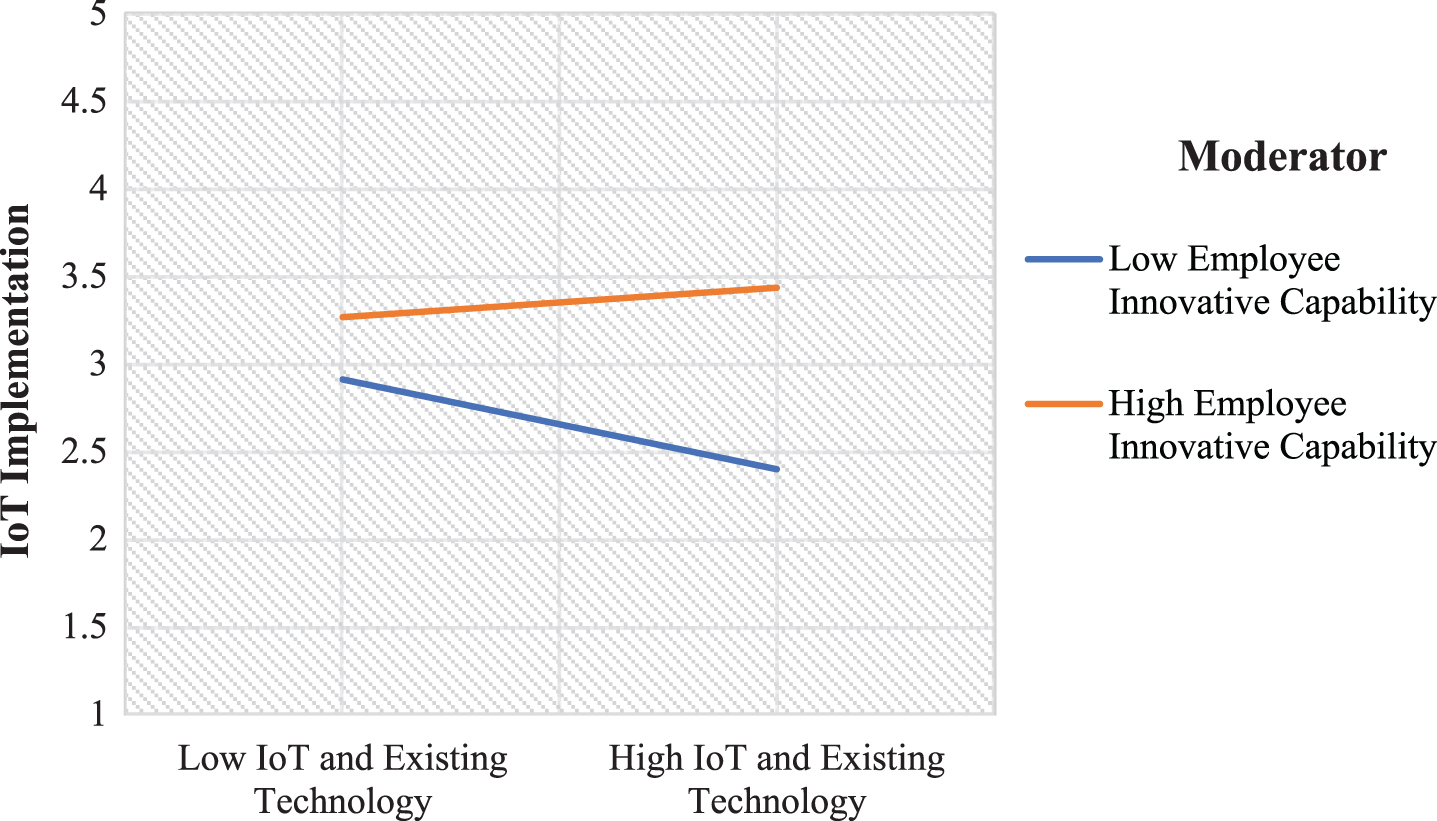
Moderation effect of employee innovative capability between IoT & existing technology and IoT implementation.
The current study focused on engineering companies of Indonesia. It provided the picture that how difficult to implement IoT technologies. Therefore, the objective of the current study is to investigate the factors which limits the implementation of IoT. For this objective, a survey was carried out in the Indonesian engineering companies for data collection. Collection of data was carried out form the employees of these companies. Finally, collected data were assessed by using the statistical software.
This study investigated five key factors which effect the implementation of IoT in engineering companies of Indonesia. First, it is found that willingness of company is the key for implementation. Sometimes companies hesitate to adopt new technology because of various reasons. Moreover, employees also hesitate to adopt new technologies because new technology has many compacities. Second, new technology always requires better hardware for implementation. Replacement of old hardware with new is costly and complex process which requires significant amount of capital. Therefore, it is also the challenge for engineering companies. Third, the replacement of outdated technology with IoT is also challenges. Because new technology requires new hiring in company. Fourth, to deal with failure threat is a crucial factor while implementation of new technology. As the new technology is difficult and time-consuming process, therefore, in case of new technology failure, the company has to pay high cost which may effect on the overall performance as well as profitability of the company. Fifth, cost of implementation is last factor which effect IoT. Particularly, the small companies could not manage to spend high cost on IoT. That is why they remain with the old technology due to financial constraint. Additionally, there is also another factor which effect on IoT implementation. As it is discussed earlier, that new technology always requires certain capability to operate. It also requires better skills for implementations. Therefore, employee’s innovative capability is also one of the factors which is most crucial for the success of IoT implementation. Thus, there are various factors which effect the implementation of IoT in the engineering companies of Indonesia. These factors include; willingness to use, hardware characteristics, replacement of od technology, threat of failure, implementation cost and employee innovative capability.