



Abstract
WSN plays a major role in the design of IoT system. In today’s internet era IoT integrates the digital devices, sensing equipment and computing devices for data sensing, gathering and communicate the data to the Base station via the optimal path. WSN, owing to the characteristics such as energy constrained and untrustworthy environment makes them to face many challenges which may affect the performance and QoS of the network. Thus, in WSN based IoT both security and energy efficiency are considered as herculean design challenges and requires important concern for the enhancement of network life time. Hence, to address these problems in this paper a novel secure energy aware cluster based routing algorithm named Trusted Energy Efficient Fuzzy logic based clustering Algorithm (TEEFCA) has been proposed. This algorithm consists of two major objectives. Firstly, the trustworthy nodes are identified, which may act as candidate nodes for cluster based routing. Secondly, the fuzzy inference system is employed under the two circumstances namely selection of optimal Cluster Leader (CL) and cluster formation process by considering the following three parameters such as (i) node’s Residual Energy level (ii) Cluster Density (iii) Distance Node BS. From, the experiment outcomes implemented using MATLAB it have been proved that TEEFCA shows significant improvement in terms of power conservation, network stability and lifetime when compared to the existing cluster aware routing approaches.
Introduction
In recent years, Internet of Things (IoT) [1] plays a vital role in the internet world to integrate the digital devices, sensing unit and computing device with ability to communicate the data through the network. The basic concept of the IoT is to interconnect things like internet object, sensor and mobile equipment in a common IoT environment. The data are transmitted across the network through the best identified path. IoT consists of tiny, energy constrained and inexpensive smart devices such as sensors, home devices, industry equipment. etc.
Nowadays, IoT is considered as one of the new paradigm in the WSN [2–6]. In WSN based IoT environment senor nodes are considered as important component. In recent years WSN gained tremendous growth and attraction with the massive development of MEMS. WSN-IoT [7, 8] has a wide range of application such as Industry, commercial, health care, environmental monitoring, vehicular communication and so forth. The major role of sensor is to sense the environment, gather and transmit the data to the BS. But the battery equipped sensor nodes holds only limited and non replaceable energy resources. Hence, the energy constrained sensor nodes are to be utilized effectively to prolong the network lifetime. Thus, it is required to design energy aware protocols in WSN with the primary objective to conserve energy and to improve the QoS and Network lifetime.
As the applications of IoT and sensor [9, 10] are growing more popular, researchers focus on security issues that act one of the major design challenge because providing secure date communication in WSN network is a very difficult and challenging task. So, far number of work has been proposed on security issues. Therefore, both trust aware and energy efficiency are considered as two important design goals in IoT based WSN network. Hence, it is necessary to propose cluster based energy aware and secure routing protocols that can address the security challenges by mitigating the malicious nodes and prolongs the network life time by efficient energy conservation.
Clustering approach is defined as more powerful design technique to minimize the energy utilization of sensor nodes and to improve the network and quality of network. Thus, clustering based routing enhances the energy conversation, increases the stability and minimizes the routing delay. The clustering process consists of two primary stages namely cluster leader election and data communication through the cluster leader. Thus, electing the energy aware CH can prolong the network lifetime [11]. Hence, many research work has been be carried out by considering energy as a vital factor for CH election, cluster formation process and routing. Moreover, due to the presence of the malicious nodes the security level of the CH should be considered as the data transmission occurs through the CHs. The malicious nodes have the tendency to drop and misroute the data which affects routing by degrading the data delivery rate and accuracy of the network. Therefore, in order to address the security issues trust management approaches have been proposed [12–14]. Thus, in IoT environment to develop energy efficient and trust aware secure cluster based routing algorithm is considered as primary design goal for enhancing the network lifetime and performance.
The major contributions of this paper are as follows: In this proposed work, security problems are addressed by considering only the trustworthy nodes as candidate member during the Cluster Leader election and cluster formation process. Thus, the malicious nodes are discarded from the network. Therefore, the performance improvement of the network in terms accuracy and reduction in transmission delay are obtained. A novel metric termed as Node Fitness Value (NFV) is developed in this paper with the objective of estimating a node trust score based on the behavior level of that node. Moreover, NFV is used to identify and isolate the malicious nodes. Hence, in this proposed work the probability of malicious node to be elected as a Cluster Leader is very much less. Therefore, the security level and stability of network will be enhanced. A novel Trusted Energy Aware Cluster Based Routing Using Fuzzy logic for WSN in IoT is proposed to prolong the network lifetime and enhance the security of the network. Fuzzy inference system is employed in the phenomenon to select the appropriate Cluster Leader’s and also for member nodes to join the Cluster Leader.
The rest of the paper has been presented as follows: In Section 2, related works in the areas of secure and energy aware cluster based routing has been discussed. Section 3 describes about the energy model. In Section 4, the proposed Trusted Energy Efficient Fuzzy logic based clustering Algorithm has been explained. Section 5, explain about time complexity analysis of the proposed work Section 6 illustrates the simulation based results and discussion. Section 7 finally concludes the paper with highlighting the achievements and future works.
Related works
Literature presents in detail about various secure and energy aware routing algorithms for Wireless Sensor Network environment to enhance the performance and prolong the network lifetime [1–8]. Both energy and security plays vital role in designing the WSN based IoT [9]. Since IoT consists of resource constrained sensor nodes which makes energy conservation as major design issues that is to be addressed to increase the performance of network. In this direction many cluster based routing algorithms have been proposed. Clustering plays a vital role in reducing the energy consumption by node’s in the network. Many work on cluster based routing algorithm for WSN are presented in the literature [10–16]. Clustering technique will prolong the network lifetime by minimizing the energy consumed by the nodes [17]. Moreover, the trust aware clustering approach is defined to be an appropriate solution for energy efficient and secure routing.
Most of the research works on Energy-aware cluster based routing techniques works with the assumption that all nodes are trustworthy [18–24]. Hence, election of a CH is primarily depends on the energy level of a nodes alone. But, in the real scenario compromised or malicious nodes have equal opportunity to act as CH which may cause poor network performance. Therefore, Trust management approach is identified as a powerful mechanism to defend against the security attacks caused by the malicious nodes in WSNs. Since the sensor nodes are resource constrained and low cost tiny devices hence it is highly difficult to embed the cryptography based mechanisms. Therefore, to ensure secure routing in WSNs communication, several research works on trust aware techniques have been proposed with an aim to enhance the network lifetime and performance [25–28].
Heinzelmam et al. [29] developed a traditional power aware clustering protocol (LEACH) that works in randomized rounds for CH election process.. Through this protocol better energy efficiency and enhance network lifetime is achieved. Younis and Fahmy [30] presented a Hybrid Energy Efficient and Distributed (HEED) energy efficient clustering approach, a probabilistic model to estimate the network performance. The cluster head are elected by considering the parameter namely node residual energy and node proximity. Handy et al. [31] presented modified LEACH with an objective to improve the network lifetime. In this research work the authors measured the network lifetime by considering the factors such as First Node Die (FND), Half of the Nodes Alive (HNA) and Last Node Dies (LND). Through the proposed method the network lifetime is improved by 30%. But, energy consumption is increased with increase in the transmission distance between the nodes. MO Farooq et al. [32] presented a Multi hop Routing with Low Energy Adaptive Clustering Hierarchy (MR-LEACH) protocol. To prolong the lifetime in this work the network is divided into numerous clusters. Cluster head adopts to Time Division Multiple Access (TDMA) access techniques for data transmission controlled by Base Station. Thus, MR-LEACH is energy efficient protocol and enhances the network performance.
In WSNs environment, to defend against various security threats caused by the malicious nodes and to enhance the security level in data communication, numerous trust based clustering approaches are being developed. Yan et al. have presented a detail study on trust Management for IoT [33]. Bao et al. [34] proposed a novel hierarchical trust protocol for Wireless Sensor Networks with an objective to effectively detect the malicious nodes. Moreover, in this work both subjective trust and objective trust are estimated. The proposed work have been applied for trust based routing and trust based intrusion detection for evaluating the network efficiency.
Song et al. [35] proposed TLEACH, a trust management approach integrated traditional LEACH for secure data transmission to sink node. In this work, the trust based relationships are established among the nodes. It consists of two phase, namely trust management phase and trust based routing phase. But, in this routing mechanism the most important factor energy is not considered during clustering process.
Guo & Looi [36] developed model by considering both trust and energy balance framework for clustered WSN. In this work, energy efficient and trustworthy node is elected as a CH. But here, during the clustering process load of the CH are not considered which may leads to energy depletion and lower the network performance. Nimbalkar et al. [37] proposed trust aware energy efficient Genetic Algorithm based clustering technique for WSN. During the cluster head election process the following metrics namely remaining energy level, distance, count of sensor nodes and trust score. Trust value of node is measured by considering the transmission behavior of the node. Kim et al. [38] proposed CHEF, fuzzy based CH election mechanism with an aim to improve the network lifetime. Taheri et al. [39] developed an energy aware CH election by using fuzzy logic. The author used residual energy of the nodes as metric for selecting the CH and the non-CH joins the CH by using the Fuzzy logic.
Mhemed et al. [40] developed FLCFP, a fuzzy inference based clustering algorithm. Depending on the following parameters such as Residual Energy Level, Distance Node to the BS. Logambigai and kannan [41] proposed fuzzy rule based energy efficient unequal clustering algorithm for WSNs. Rajeswari et al. [42] developed fuzzy based stable and secure routing algorithm to enhance the effective communication and prolong the performance of the network. Palettela et al. [43] discussed in detail about the IoT in 5 G era and it’s important towards the development in the field of consumer IoT and Industrial IoT.
In spite of the availability of all such related works on cluster aware routing algorithms for WSN, but most of the approaches are developed by considering energy alone as major design metric. But, at present to reliability and security of the networks are other metrics to be addressed. Thus, it became a wise challenge and necessary platform to develop an integrated approach to address both energy and security issues under the roof of single algorithm. Hence, a novel Trusted Energy Efficient Fuzzy logic based clustering Algorithm (TEEFCA) have been proposed. In this work, trust management approach is utilized to measure the nodes trust factor termed as Node Fitness Value (NFV) by which more secure, reliable and stable data communication is possible from node to the Base station. Thus, Node Fitness Value (NFV) is adapted as a backbone of this proposed work TEEFCA. Therefore, both energy conservation and trust management are considered in the proposed work. Moreover, in this work Fuzzy inference system is employed under the following two scenarios such as Cluster Leader and the member to join with Cluster Leader. The cluster based routing algorithm proposed in this work gives improved Packet delivery ratio and accuracy in the data transmission process since the malicious nodes are removed from the network. Finally, the proposed work provides prolonged network lifetime and enhanced secure data transmission.
TEEFCA - Node power model
The power model considered in this proposed work TEEFCA is similar to the work developed in [29]. According to the first order radio model, the amount of energy consumed during the transmission of a packet with 1-bit over d distance is given by the eq. (1). The Eelec indicates the amount of energy consumed per bit to run the transmitter or receiver circuitry. Efs and Emp the amplifier energy in free space and multipath respectively.
The Energy ERX (l) indicates the amount of energy consumed in receiving a packet with 1-bit is measured as follows given by eq. (2)
Since, Secure and energy efficient cluster based routing are the most sensational design challenges in IoT environment. Thus, to address these challenges in this work Trusted Energy Efficient Fuzzy logic based clustering Algorithm (TEEFCA) is developed. The major goal of the proposed work is to enhance the network lifetime and to increase the security level of the IoT Based WSN. Thus, this section elaborates in detail about the proposed work TEEFCA. Figure 1 shows the schematic representation of TEEFCA.
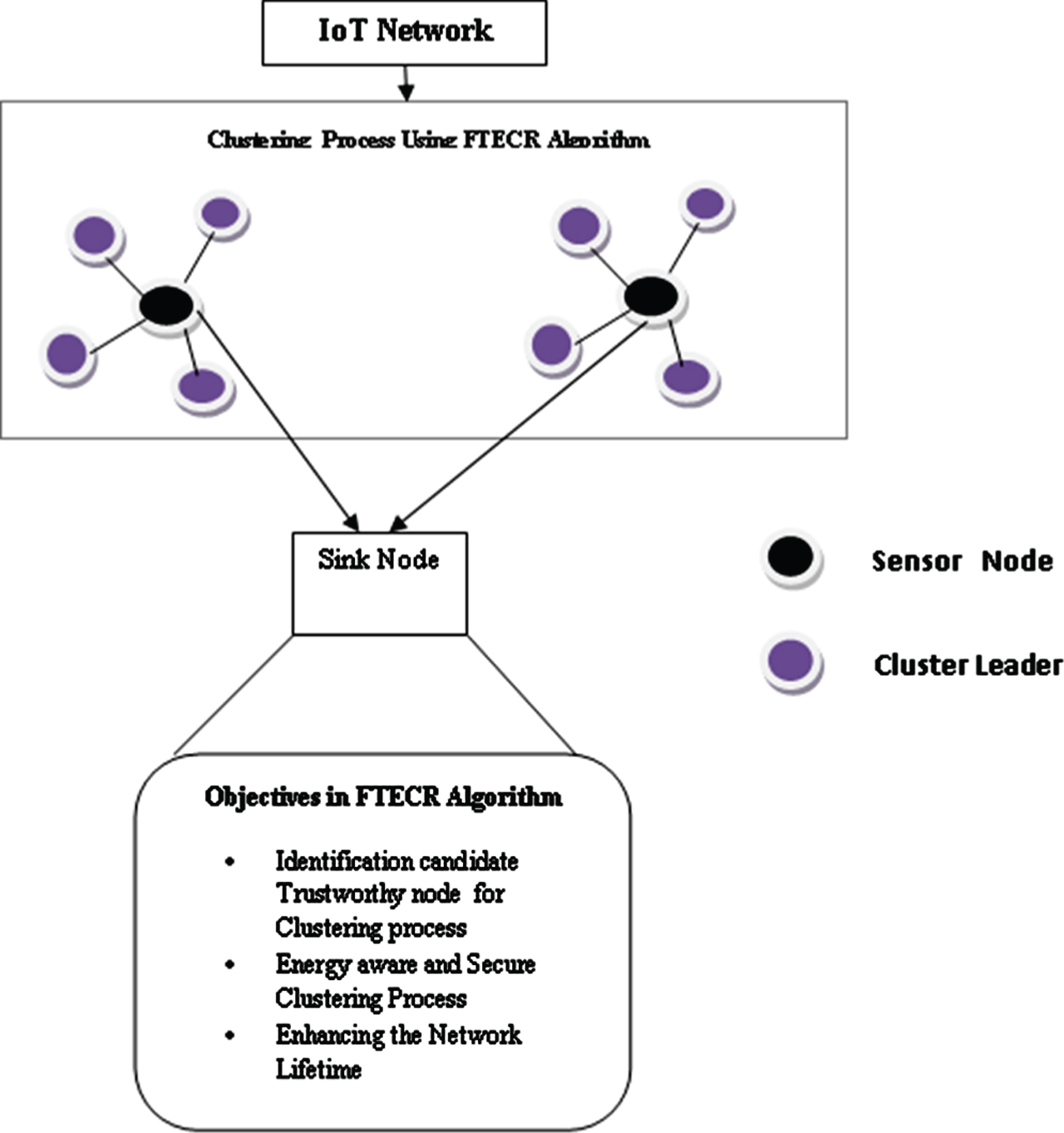
Schematic Representation of TEEFCA.
The TEEFCA consists of the following two major objectives. Trust aware approach to mitigate the malicious nodes and to discover the trustworthy candidate member nodes for fuzzy based clustering process. Fuzzy based secure, Energy aware cluster based routing. The TEEFCA consists of the following three phases namely: Identification of trustworthy candidate nodes Phase Design of Fuzzy Inference System for clustering process phase Route establishment Phase
The following subsection describes about each of the phases in detail.
In TEEFCA, a new metric namely Node Fitness Value (NFV) has been proposed with an objective to measure the trust level of node and to isolate the malicious nodes form the network. Thus, Base station / sink node by using the NFV identifies the trustworthy candidate node for the clustering process. Thus, only the trusted nodes are given a chance to participate in the Cluster Leader election process.
Node fitness value (NFV) evaluation
Trust is a level of subjective likelihood hold by a trustor believing a trustee [42] and it is a relationship between two neighbor nodes. It is evaluated by a trust degree that one node expects another node to offer certain services. In this proposed work, a novel Node Fitness Value metrics has been defined with primary aim to measure the node’s trust level by considering the following two metrics.
Thus, if the measured Node Fitness Value (NFV) is greater than the NFVThreshold value then the node will be considered as candidate for the Cluster Leader election or else the node will be detected as untrustworthy node and isolated from the cluster based routing process. The NFV and NFVThreshold are estimated by using the Equations (3) and (4) respectively.
In this proposed work, under the following two scenarios the FIS are defined. Firstly, for electing the appropriate CL and secondly, in the process of member nodes joining with the CL. The Fuzzy Inference System (FIS) employed in this work, consists of the following 4 main components namely Fuzzifier, Fuzzy Inference Engine (FIE), Fuzzy Rule Base and Defuzzifier. Figure 2 illustrate about the Architecture of the proposed Fuzzy Inference System

Fuzzy Inference System.
In this section we have discussed about three fuzzy variables such as (i) node’s Residual Energy level (ii) Cluster Density (iii) Distance Between Node & BS that are used in TEEFCA for secure and stable cluster formation process. After electing the CL the member nodes applies the FIS to join with the suitable CL by computing the member choice of each CL.
4.2.1.1. Residual Energy Level (REL). The Cluster Leader election strategy must consider the energy level of nodes while choosing the CL for a cluster, since if a random node is elected as Cluster Leader without considering the remaining energy level of nodes, it may lead to faster switch off of the nodes with low energy levels. If the Residual Energy Level (REL) of any node ‘n’ is less than the threshold energy required for carrying out the role of Cluster Leader as given by the Equation (5), then the node ‘n’ cannot be chosen as a Cluster Leader. Thus the measured threshold energy act as important parameter, during the Cluster Leader selection as well as in the cluster formation phase.
Where, REL (n) is the Residual Energy Level of the node n. EThres is the threshold energy. The threshold energy (EThres) is calculated by the using the Equation (6).
Where, REL is the Residual Energy Level and N is the Number of nodes in the network.
4.2.1.2. Cluster density. Cluster density is defined as the number of cluster member’s nodes that can be handled by a Cluster Leader at a particular instant of time. In order to enhance the network lifetime the cluster density of the Cluster Leader must be balanced. Thus, in this proposed work, the cluster density is considered as one of the very important factor for the member node to join the cluster. Since, the cluster members play a vital role for balancing the load in a cluster. Therefore the members will join into any clusters by taking into count of the cluster density.
Thus, if the cluster density of a Cluster Leader is low then the possibility for a node to join that particular Cluster Leader as a cluster member is very high. Cluster density is measured using the given Equation (7)
4.2.1.3. Distance between node & BS. The distance between the node (N) and Base station (BS) is estimated by considering the Euclidian Distance formula as shown in the Equation (8)
Where (Bx, By) and (Nx,Ny) indicates the position of Base Station and Node respectively.
For measuring the fitness value of Cluster Leader node, the following two criteria are taken into consideration. They are (i) REL (ii) Distance Between Node & BS. Residual Energy Level (REL) is the amount of remaining energy level of node and the Distance Between Node & BS is the distant between node to BS. Thus, the two fuzzy input variables and its corresponding linguistics variables required for CL Fitness are shown below. REL has the following linguistic variables namely low, medium and high Whereas Distance Between Node & BS holds linguistics variables near, medium and far. The output variables CL Fitness has the linguistics variables such as low, medium and high. Thus, based on two inputs fuzzy mapping rules are defined as shown in Table 1.
Fuzzy Mapping Rules for CL Fitness
Fuzzy Mapping Rules for CL Fitness
The “IF-THEN” rules to select the CL Fitness are given below IF REL is Medium and Distance Between Node & BS is Far THEN CL Fitness is Low. IF REL is High and Distance Between Node & BS is Far THEN CL Fitness is Medium. IF REL is Medium and Distance Between Node & BS is Far THEN CL Fitness is Medium. IF REL is High and Distance Between Node & BS is Fair THEN CL Fitness is High.
Thus, once after the CL Fitness for each node is evaluated, the node with high REL and low Distance Node BS will act as CL.
Once the Cluster Leader nodes are selected, cluster formation process is carried out for effective data routing. Thus the sink nodes will broadcast the list of selected trustworthy candidate Cluster Leader list to all the nodes. Cluster formation process is done by considering the following three metrics namely REL, Cluster Density and Distance Between Node & BS. Hence each node evaluates the CL Member Choice by using the fuzzy logic to determine the nodes probability to join with Cluster Leader as member. Therefore, the three fuzzy input variables and its corresponding linguistics variables required for CL Member Choice are shown below.
REL has the following linguistic variables namely low, medium and high Whereas CL Density holds linguistics variables low, medium and high. The output variables CL Member Choice has the linguistics variables such as low, medium and high.
The “IF- THEN” rules to select the CL Member Choice are given below IF REL is Low and CL Density is High and Distance Between Node & BS is Near THEN CL Member Choice is Weak. IF REL is Low and CL Density is Low and Distance Between Node & BS is Near THEN CL Member Choice is Medium. IF REL is High and CL Density is High and Distance Between Node & BS is Near THEN CL Member Choice is Strong. IF REL is Medium and CL Density is Medium and Distance Between Node & BS is Near THEN CL Member Choice is Medium.
Fuzzy rules for CL Member Choice are shown in the Table 2
Fuzzy Mapping Rules for CL Member Choice
Fuzzy Mapping Rules for CL Member Choice
In this our fuzzy inference system, the CL Fitness and CL Member Choice are determined using both the triangular and trapezoidal membership functions. The triangular membership functions are used to represent the intermediate variables whereas for boundary variables the trapezoidal membership functions is used. The triangular membership functions and trapezoidal membership functions [44] are calculated using the Equations (9) and (10) respectively.
The finale step in FIS is the defuzzification. The primary objective of this step is used to obtain the crisp output equivalent to the fuzzy output. Moreover, in this work we have used for defuzzification the Center of Area COA method. This measured by using the Equation (11).
where μA (x) denotes the fuzzy values for the membership functions. The main flow of the proposed TEEFCA is shown below in the Algorithm 1.
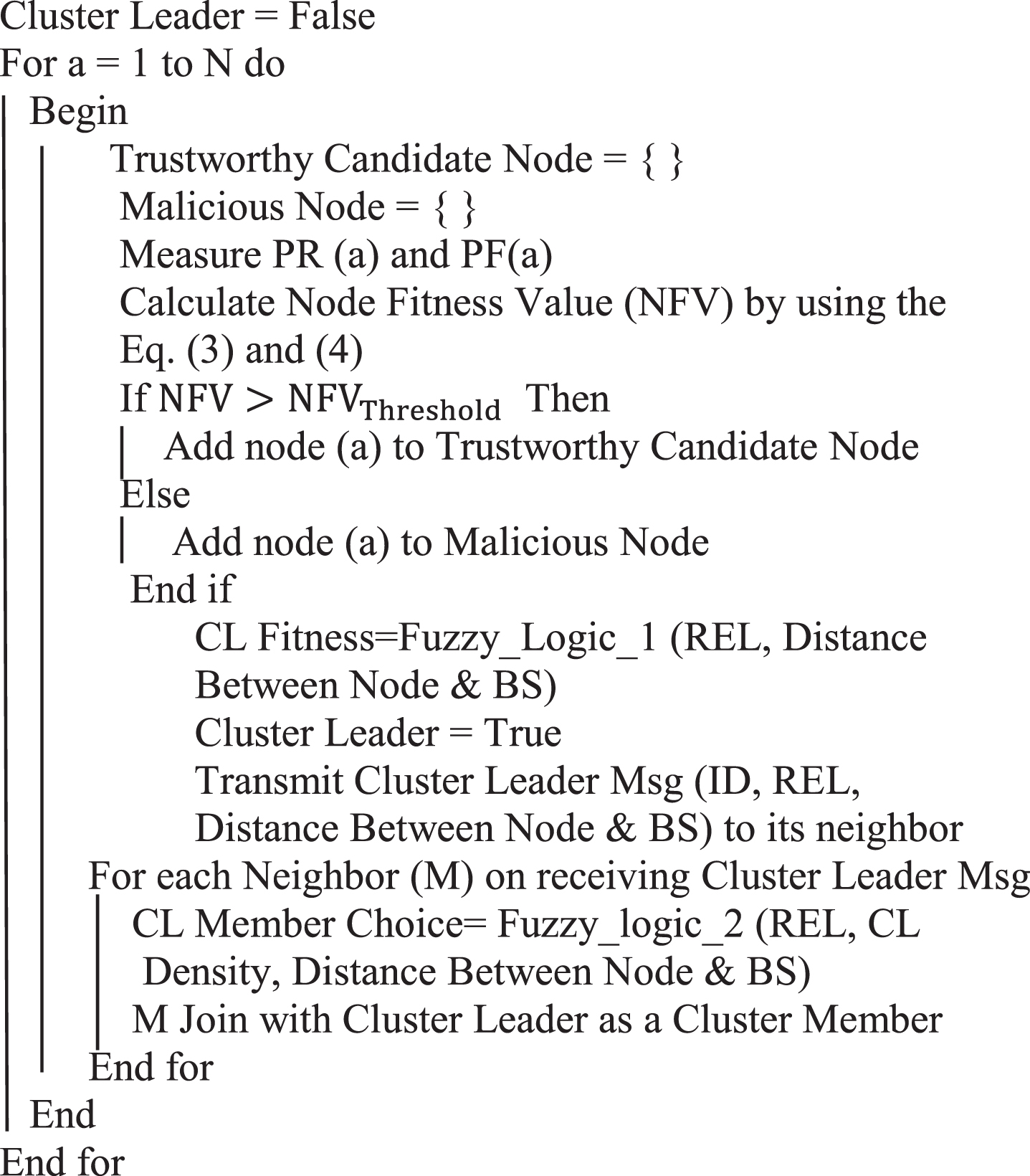
This section elaborates in detail about the cluster based routing phase. In this proposed work, the source finds the shortest route to the sink node through their respective cluster leader. The proposed Cluster Based Route Establishment Phase includes the following steps: The source node transmit Route Discovery packet to Cluster Leader to discover the route to the Destination node. The Route Discovery packet holds the following information: <Src ID, Dest ID> Upon receiving g the Route Discovery packet the Cluster Leader checks its routing table to find whether a route exists to the destination address(Dest ID).If the route exists, then the Cluster Leader will transmit the “Route Success” message, an acknowledge message for the availability of route to source node. Then, the source node will transmit the actual data to destination through the Cluster Leader. If the Cluster Leader does not have the route to the destination.Cluster Leader circulated the “Route Discovery “ packet that holds <Src_ID, Dest ID, Hop Count, Cluster Leader ID, Cluster ID > to all the nodes within its transmission range. Where, Src ID is the source node ID, Dest ID is the destination node ID, Cluster Leader ID is the cluster leader ID, Cluster ID is unique identifier of the cluster. The cluster leader will maintain a Routing Table as show in the Table 3. The table is periodically updated whenever the route establishment process is initialized by the sensor nodes. The Cluster Leader maintains the routing table as shown in the Table 3. Upon receiving the “Route Discovery” each nodes holding the route to the Destination will acknowledge the Cluster Leader node by an “ACK” message. This message will be holding the node ID alone. Cluster Leader will maintain a shortest path detection table as shown in Table.4 by considering the routing table. In this table, all the possible routes are updated and among them the shortest path is selected by Cluster Leader. Finally, the Cluster Leader transmit the selected shortest path message to the source node through the “route“ message and it holds the completed route details. In this way, now source node transmits the collected data to the destination node. Since through the shortest path the data transmission is performed the network lifetime will be enhanced.
Routing Table
Routing Table
Example: Nodes from two different clusters are intended to transmit the data. Say for example if node with Src ID = 3 needs to transmitted the data to node with Dest ID = 7. In this scenario, by following the Cluster Based Route Establishment process the three different routes are identified such as Route1 with Hop Count < 4>, route with Hop Count < 3 > and route3 with Hop Count < 1 > . Among, these three routes the Cluster Leader of source node will select shortest route, the Route3 with Hop Count < 1 > . Through this route the Source node will transmit the data to the destination node.
In this section, with suitable example we have illustrated in detail about the fuzzy based Cluster_Leader election and clustering process. For example, Consider Distance Between Node & BS is 162 and REL is 0.9. By using the input range, corresponding Minimum and Maximum values shown in Tables 5 and 6 and fuzzy if – then rules, the probability output value CL Fitness is measured.
Path Detection Table
Path Detection Table
Fuzzy variables and its Input Range
The input value Z = 162 indicates the far distance between the node and base station. Thus by applying the trapezoidal member function to far, we get
when Z = 40 indicates the distance between node and base station is fair. By applying the Triangular member function we get,
Similarly, by applying the triangular and trapezoidal member function for residual energy level medium and high we get, Z = 0.9 (Medium)
Applying the obtained values in fuzzy rule 1 to rule 4 min(1.4, 0.2) = 0.2 min(1.4, 1) = 1 min(0.33, 0.2) = 0.2 min(0.33, 1) = 0.33
The maximum value from the Rule 1 to Rule 4 is given as 1. The rule2 corresponding to the Maximum value represents the medium probability of the node to act as Cluster Leader. The crisp value ranges from 40 to 60. During the defuzzification process, the corresponding values are substitute to obtain the value CL Fitness as 52.71.
Time complexity of proposed work is measured based on the time complexities of three phases of the algorithm namely: Identification of Trustworthy Candidate Node Phase. Clustering Phase. Routing Phase.
Time complexity for the identification of trustworthy candidate node phase (τ1)
In the proposed work, the trustworthy nodes are identified as candidate node to take part in cluster based routing. Hence, in this work trust level of nodes are estimate by considering Node Fitness Vale (NFV). NFV is measured for each of the node ‘n’ in the network n ɛ N, where N denotes Number of nodes in the network. Therefore a trust aware secure routing is constructed by eliminating the malicious nodes. During this process linear search algorithm is used to eliminate the malicious nodes by considering all N nodes from the network according to the NFV. Therefore the time complexity involved in Identification of trustworthy candidate node (τ1) for clustering process is shown in Equation (12)
In this work, Fuzzy inference system is employed for Cluster Leader election process and clustering process. In general, for ‘K’ number of fuzzy input variables with ‘L’ number of ordinal scale value we need to perform LK linguistics comparison for effective clustering process. Therefore the time complexity of clustering process is shown in the Equation (13)
Thus, time complexity of clustering Process is exponent time with linear exponent.
During the data transmission phase, Cluster Leader choose the next hop neighbor for the successful data delivery to the base station. Hence, the distance of every Cluster Leader from the base station is calculated.
Thus, totally (N-1) Cluster Leader distance from the base station is required to be estimated for efficient data transmission. Therefore, the time complexity of the data routing phase (τ3) is given in Equation (14)
The proposed work has been tested using MATLAB software because the MATLAB fuzzy toolbox consists of all the fuzzy membership functions. Hence, MATLAB is more efficient and convenient software to carry out the experiments of the proposed work TEEFCA. The experiments were carried out with different nodes starting from 100 nodes up to 200 deployed over an network area of (500X500) m2. The simulation parameters are listed in Table 7.
Minimum and Maximum value for Fuzzy Variables
Minimum and Maximum value for Fuzzy Variables
Simulation parameters
The proposed work is tested extensively and obtained the results along with discussion are presented. In our simulation, two different set of network scenarios are considered such as WSN_Scenario#1 and WSN_Scenario#2. For WSN_Scenario#1, the sink was located at (150,150) and for WSN_Scenario#2, the sink was located at (150,300). The performance of TEEFCA is compared with existing works HEED and LEACH. From, the obtained experimental result it is observed that proposed work performs better than HEED and LEACH.
Number of alive nodes: Figure 3(a) and (b), shows the number of alive nodes for different number of rounds. The figure proves that in TEEFCA the number of alive nodes is more when compared to other existing approaches. The reason for this is, in the proposed work TEEFCA during the clustering process member nodes join the Cluster Leader by considering the following metrics namely Cluster Density, Residual Energy Level and Distance between Node & BS. Thus, in the proposed work only limited number of nodes will join the Cluster Leader as member. Therefore, the load of the Cluster Leader will be balanced and energy level will be conserved. So, this may prolong the time at which the first node to may die. Hence, TEEFCA shows more number of alive nodes.

Analysis of Number of Alive nodes in (a) WSN_Scenario #1 and (b) WSN_Scenario #2.
Network Lifetime: Figure 4(a) and (b) illustrate about the prolong in network lifetime of the TEEFCA for both scenarios with the existing algorithms. It is observed from the figure that the proposed work performs better than the existing work. This is achieved because in proposed work during the clustering process more stable energy aware node is selected as Cluster Leader. Moreover, each member node will join with Cluster Leader by considering Cluster Density, Residual Energy Level and Distance between Node & BS. Therefore, in the proposed work the Network performance and Lifetime are improved.
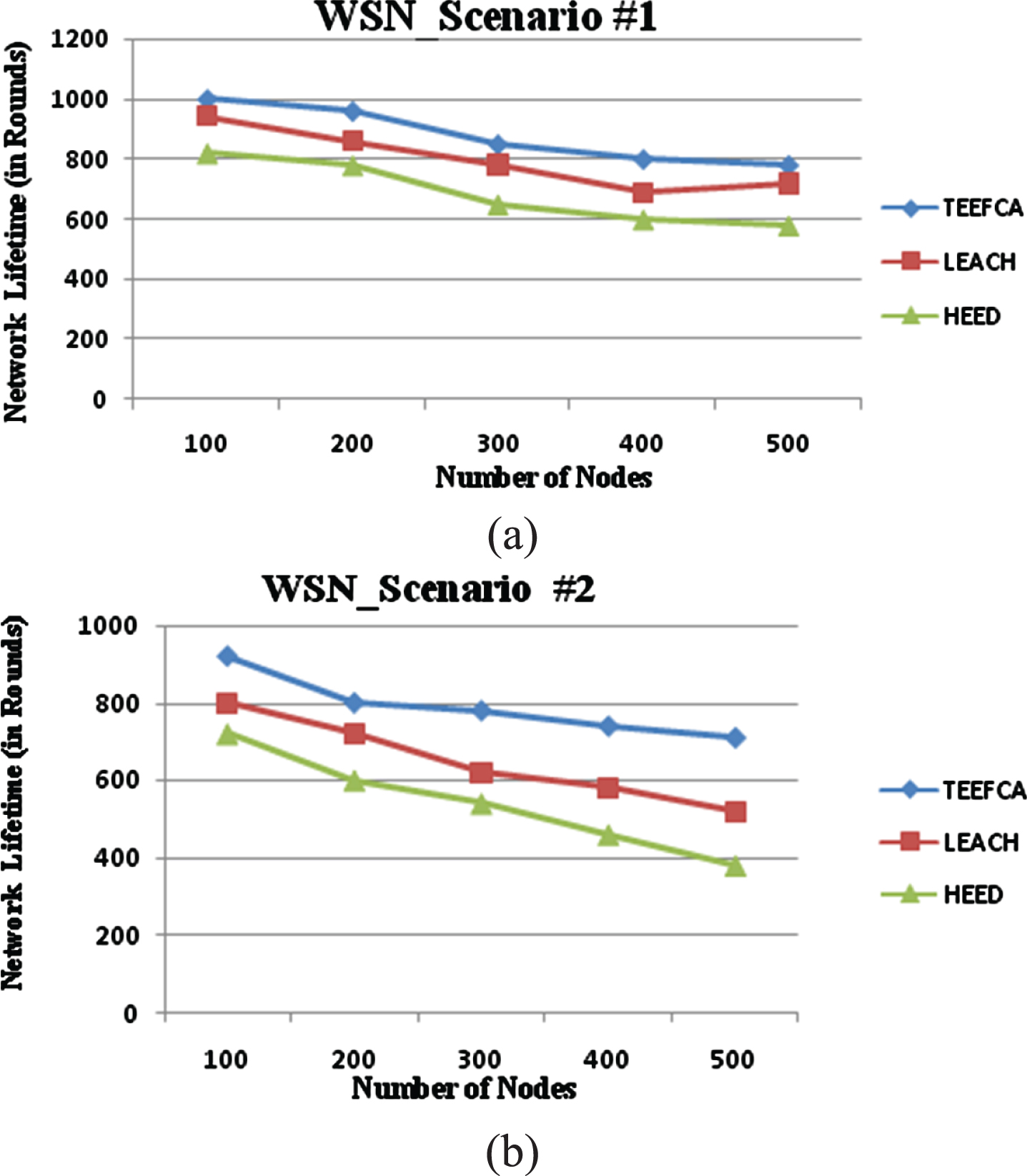
Comparative Analysis on Network Lifetime in (a) WSN_Scenario #1 and (b) WSN_Scenario #2.
Average Residual Energy Level: Figure 5(a) and (b), depicts the average REL of all the nodes in the network with respect to the number of rounds. From the figure it can be observed that REL of the proposed work is more than in the existing work. The reason is because in the proposed work, REL is taken as factor metrics for Cluster Leader election process. This leads, to formation of clusters with distributed energy and balanced load among the Cluster Leader. Hence, high REL in the proposed work when compared to the existing works.

Residual Energy Level of Nodes in (a) WSN_Scenario #1 and (b) WSN_Scenario #2.
Average Energy Consumed: Figure 6(a) and (b) depicts about the average energy consumed by 200 nodes in the network with respect to variable number of rounds in WSN_Scenario #1 and WSN_Scenario #2. From the figure, it is observed that the proposed work yields better energy optimization when compared to the existing works. This is due to the fact that in TEEFCA, energy efficient optimal nodes are given a chance to act as Cluster Leader. Thus, more balance and energy optimized cluster’s are formed and results in improvement in energy conservation.
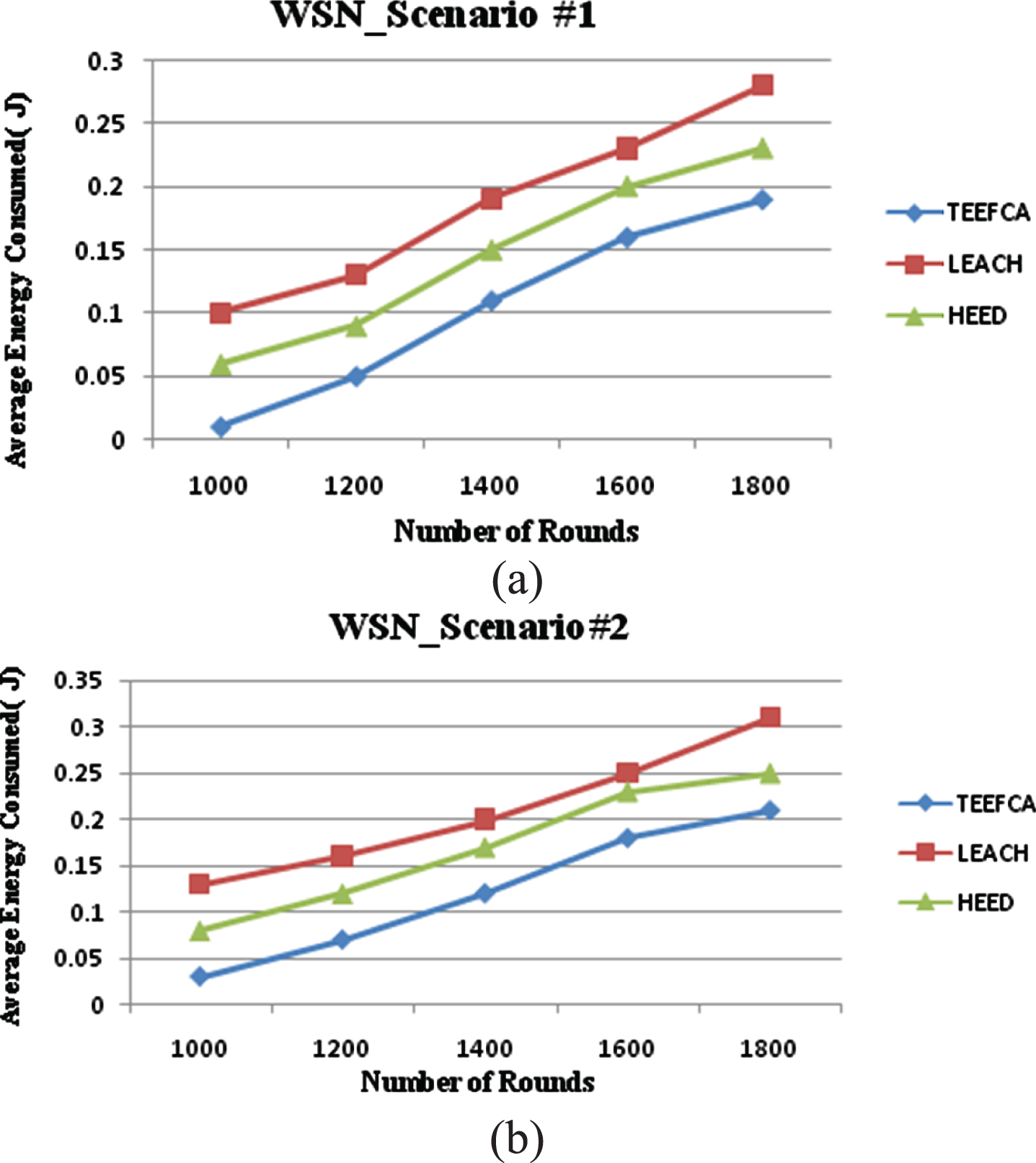
Average Energy Consumed in (a) WSN_Scenario #1 and (b) WSN_Scenario #2.
Comparative analysis of malicious nodes election as Cluster Leader: Fig. 7, illustrates how effectively the proposed algorithm expels the malicious nodes from being elected as Cluster Leader. To investigate about this scenario, it has been deployed 100 malicious nodes randomly in the network environment to measure isolation rate of the malicious node. In the proposed TEEFCA chance of the malicious node to act as Cluster Leader is very low when compared to ALM and TCM. This significant result by TEEFCA is due to reason that only the trustworthy nodes are given chance to take part in the clustering process.

Analysis of Cluster_Leader Election Process.
Analysis of FND and LND: Figure 8(a) and (b), depicts the First Node Die(FND) and Last Node Die(LND) in both the network scenario. FND is defined as time period at first node run out of its energy and LND is when the last node exhaust without energy. From the figure in the WSN_Scenario #1, it is observed for the proposed work in FND at 650 round and LND at 800 round. And in WSN_Scenario #2 it is observed for the proposed work in FND at 420 round and LND at 700 round.
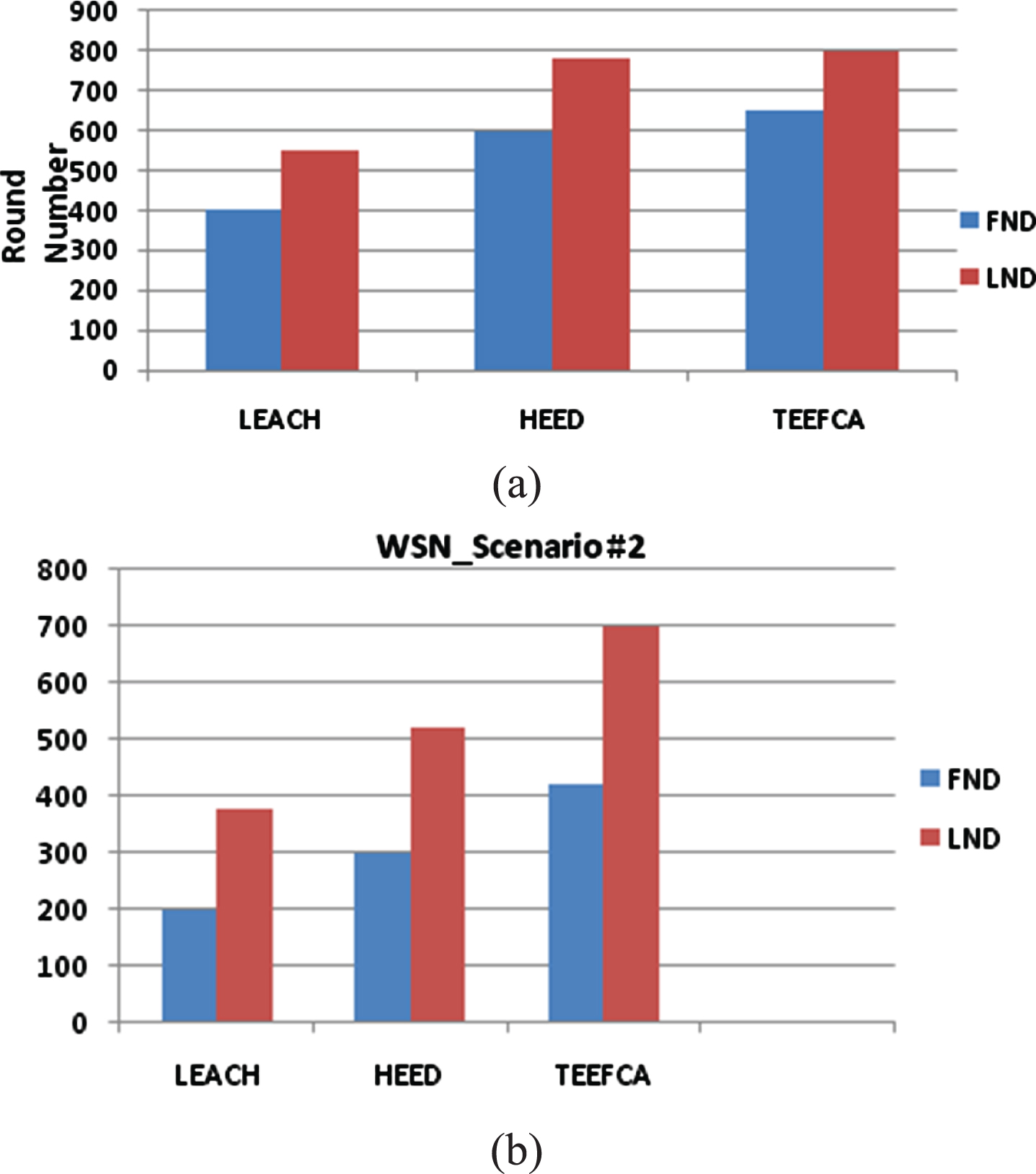
FND and LND in (a) WSN_Scenario #1 and (b) WSN_Scenario #2.
False Positive Rate Analysis: The comparative analysis of false positive rate of TEEFCA, ALM [45] and TCM [46] are shown in the Fig. 9. From the figure it is observed that the proposed work TEEFCA gives low false positive rate when compared to ALM and TCM. This is achieved because Node Fitness Value (NFV) metrics is used to detect and isolate the malicious nodes. NFV identifies trustworthy node by considering its behavior level during the communication process.
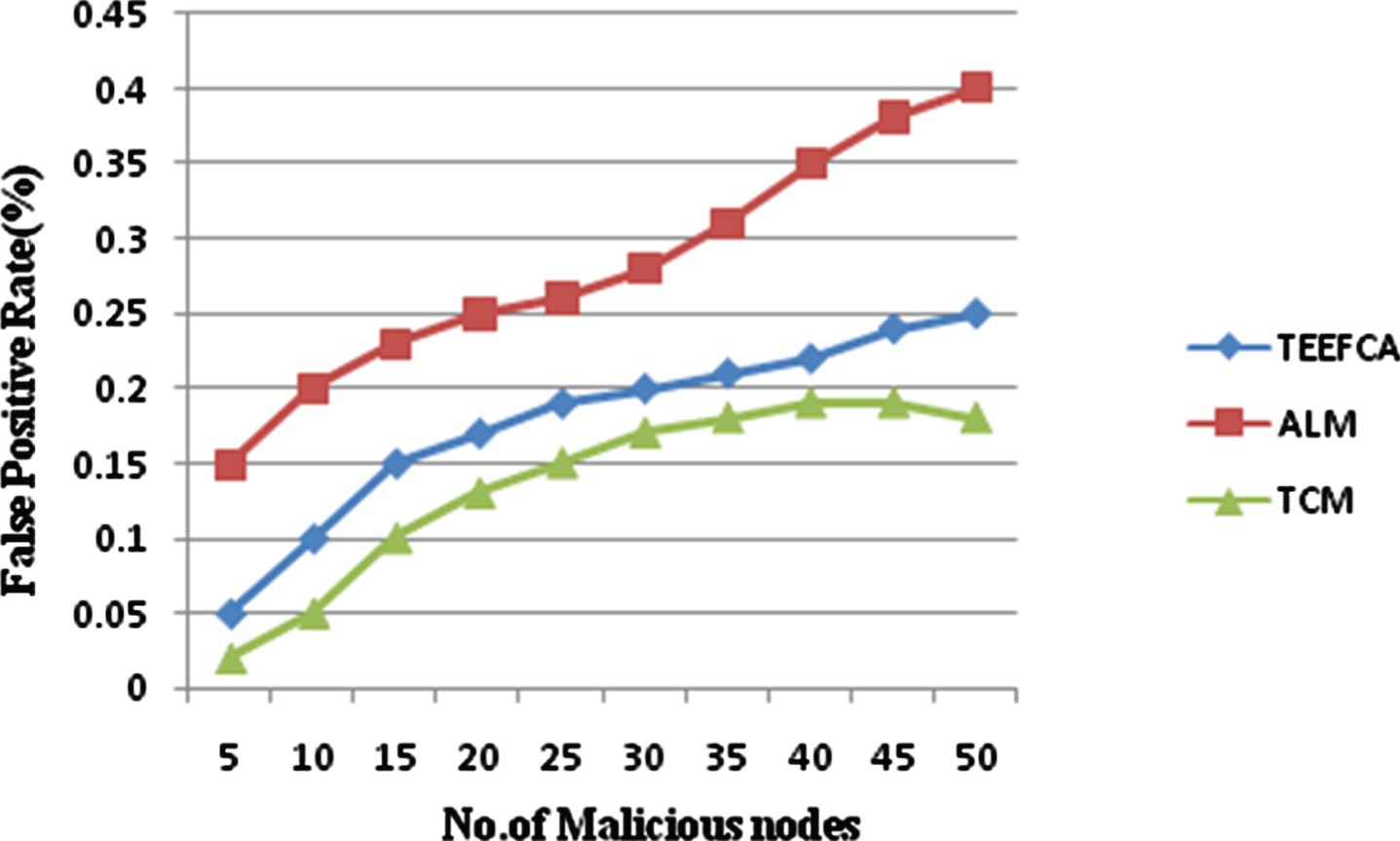
False Positive Rate Analysis.
Detection Accuracy: Figure 10, illustrates the detection accuracy comparison of the TEEFCA and other existing work. Five experiments have been carried out with varying number of packets. From the figure is has been observed that the proposed work yields higher detection rate when compared to other existing work. This is because TEEFCA uses fuzzy rules, trust modeling to detect and isolate the malicious nodes from the network.
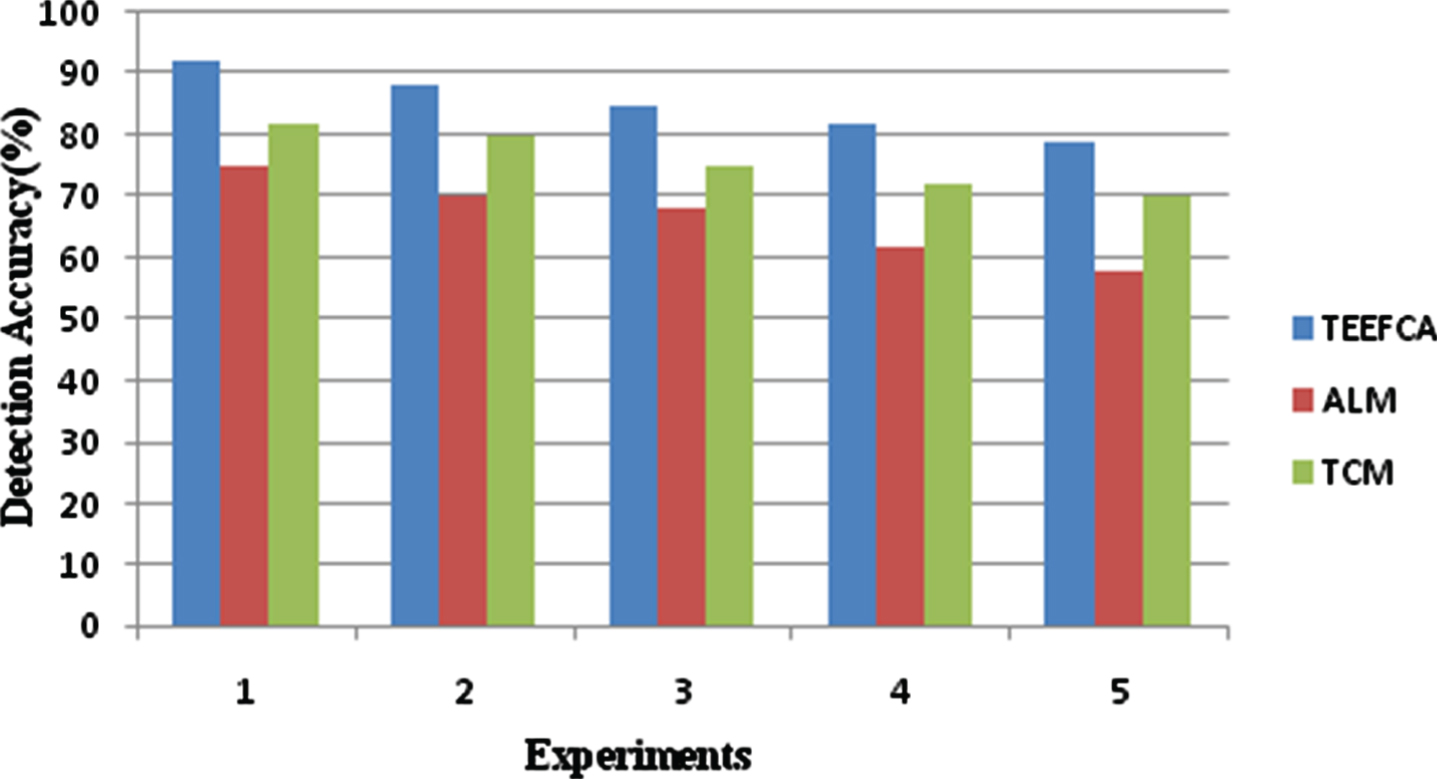
Detection Accuracy Rate.
Packet Delivery Rate: Figure 11, shows the packet delivery rate analysis between the TEEFCA and the existing routing algorithm.
From the Fig. 11, it is proved that packet deliver rate is enhanced by TEEFCA when compared to the existing work. This is because data communication is carried through the energy aware and trustworthy nodes. Thus, in TEEFCA the overall network performance is improved since the packet drop level is reduced.
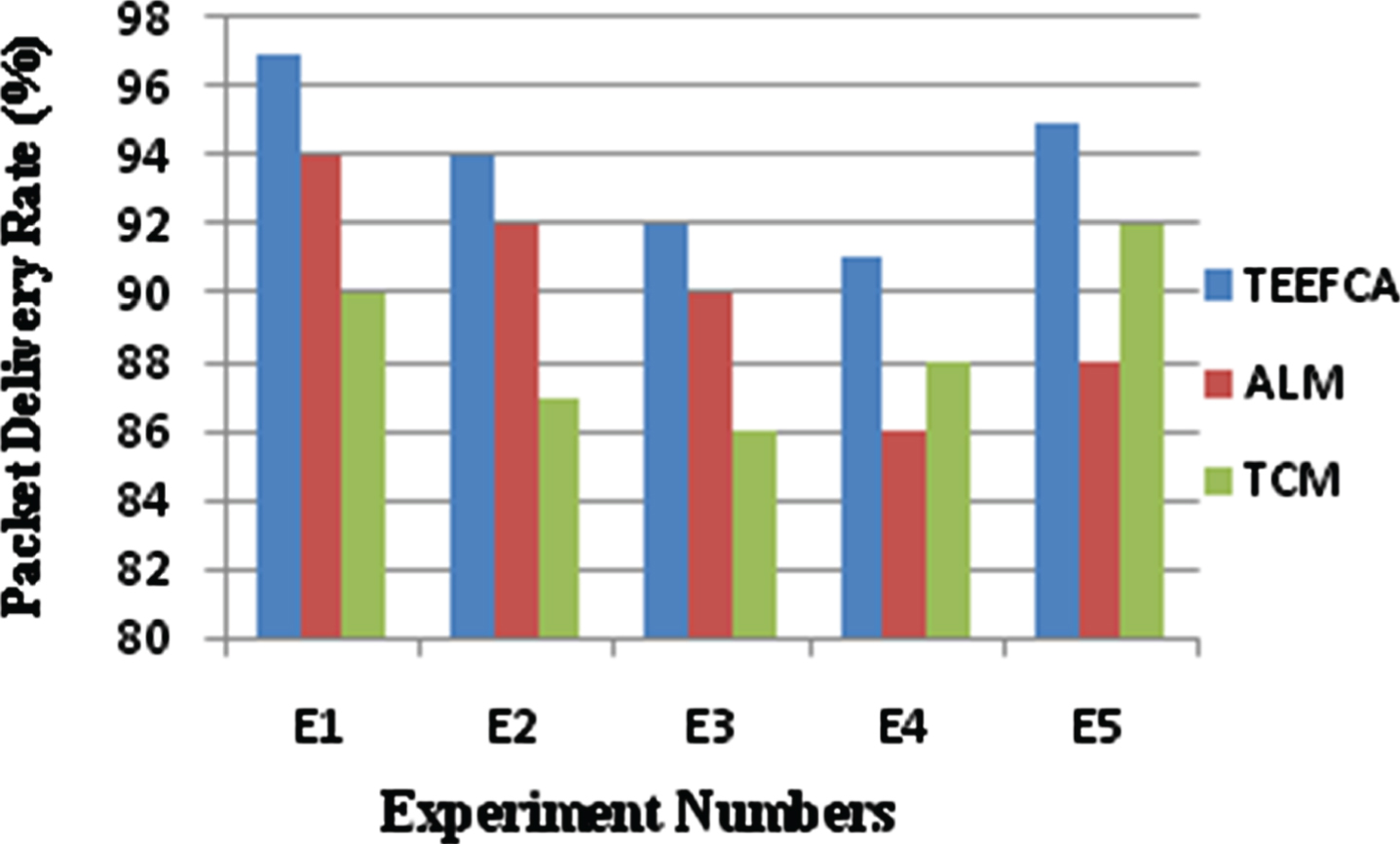
Packet Delivery Rate.
In this paper, a novel Trusted Energy Efficient Fuzzy logic based clustering Algorithm (TEEFCA) has been developed with an objective to enhance the network lifetime and security. In this approach the security and reliability can be improved by utilizing the Node Fitness Value (NFV). NFV evaluated by considering factors such as (i) Successful packet transmission Rate and (ii) Residual energy level of node. Thus, the trustworthy candidate nodes will take part in the clustering process. The proposed algorithm have been evaluated using MATLAB and it has been proved that TEEFCA shows better results when compared to the existing traditional work such as LEECH and HEED in terms of network lifetime, stability and overall performance. Moreover, from the results obtained from TEEFCA it has been observed significant improvement in electing of trustworthy as Cluster Leader when compared to existing work ALM and TCM. Moreover, the future work on this can be the development of intelligent based secure and energy efficient routing protocol to improve the network performance and lifetime