



Abstract
In the era of big data transformation, with the emergence of COVID-19, tourism has been given more social responsibilities. Tourism construction in the Yellow River Basin is an indispensable part of tourism construction in China. This paper analyzes the existing eco-tourism resources in Kaifeng City and Shandong Province, as well as the necessity and construction conditions of developing tourism. In this paper, principal component analysis is used to analyze the resource conditions, regional conditions and environmental conditions of the Yellow River tourism resources. The comprehensive evaluation model and index system of tourism resources are constructed. Big data transformation has been realized. The purpose of this paper is to clarify the current situation and potential of tourism in the Yellow River Basin, and to provide reference for the development of tourism in the Yellow River Basin during COVID-19.
Introduction
The crisis created an environment for rapid innovation. Before the novel coronavirus pneumonia spread around the world, big data transformation in all industries is in progress. This sudden virus crisis has greatly accelerated the transformation of big data in the industry. COVID-19 Big data transformation is the process of using digital technology to create new or modify existing business processes and customer experience to meet the changing business and market demand. In the digital age, this re conception is big data transformation.
China’s reform and opening up has pushed the tourism industry to the road of vigorous development, and tourism has also become a new driving force for China’s economic and social development. As an important component, tourism resources cannot be ignored in regional development planning. However, the characteristics, quantity, quality and spatial pattern of tourism resources are of great significance to the planning and development of tourism destinations and the sustainable development of tourism industry [1–5].
Therefore, the evaluation of tourism resources is particularly important. In the evaluation of regional tourism resources, scholars at home and abroad have carried out a wide range of research, including the use of AHP, CVM, WIP, ANP and so on [6–11]. Among them, analytic hierarchy process is the most widely used. However, in the evaluation of tourism resources along the Yellow River, the research efforts need to be further strengthened, and the research methods also need to reflect diversification and innovation. In the early stage, Luo Shiwei and others used the combination of Delphi and AHP, and Jiang Yongjun and others used the combination of AHP and GIS technology to comprehensively evaluate the tourism resources, as well as analyze their structure and spatial distribution characteristics. The corresponding foreign scholars, meliha aklibasinda and others, also analyzed the nature of GIS in the planning of tourism terrain And the effectiveness of the overall evaluation of cultural resources; Chen Dong used AHP, Delphi and three major benefit evaluation methods to carry out the research on the evaluation and development of military tourism resources [12–15].
However, in the research mode of “subjective and objective evaluation + development planning", the existing research has not achieved good practice, and also lacks the linkage of “evaluation + planning". Foreign scholars Gabriela E. Yates. The thought of planning to management is inspired by the idea of considering participatory planning factors, focusing on the concept of human text and public will [16–20]. This paper focuses on the balance of subjective and objective weights, pays attention to obtaining the real situation, selects the way of interview and investigation, uses the combination of qualitative (AHP) and quantitative (PCA), and uses tows matrix method to make a comprehensive evaluation of tourism resources along the Yellow River. On this basis, it puts forward countermeasures and suggestions for the sustainable development of tourism resources along the Yellow River.
Kaifeng, the ancient capital of the seven dynasties, is a pearl in the Yellow River Basin. Kaifeng was selected as one of China’s excellent tourist cities, one of the first 24 famous historical and cultural cities announced by the State Council. It has the remarkable characteristics of “rich cultural relics, long urban pattern, rich ancient city style and unique northern water city". There are 237 cultural relics and historic sites in the city, including 13 national cultural relics protection units and 24 provincial cultural relics protection units. There are six ancient cities buried 13 meters deep under Kaifeng City, which has great archaeological value. Kaifeng is rich in water resources, known as the “northern water city". Many lakes, such as Baogong lake and Yangjia lake, have left behind moving legends with rich cultural atmosphere. The upright and outspoken family members, Yang Yue Fei, the hero of the national hero, the Wang Anshi of the Qing Dynasty, the Wang Anshi of the destructed opium of the Tu Qiang, the Zhang Bohang of the Qing Dynasty and the Lin Zexu of the tobacco sold to the world. In modern times, Fan Wenlan, Feng Youlan, Yin Da, Deng Tuo, Yao xueyin, Mu Qing and other cultural celebrities were nurtured and admired. Kaifeng, especially in the Northern Song Dynasty, is the most prosperous city in China and even in the world. Therefore, it also left a strong cultural feature of Song Dynasty to Kaifeng. Kaifeng City will be evaluated by principal component analysis with typical cities.
In recent years, although its tourism heat has only increased, there is still a certain space for progress compared with other tourism cities, and also gradually exposed some shortcomings, so we should take precautions. The main performance is: first, lack of real-time evaluation and positioning of tourism resources, so that it is unable to carry out flexible development planning to adapt to the new era of tourism trends, that is, “people-oriented” tourism concept. Secondly, there is a lack of linkage among the tourist attractions, and the potential of the tourist attractions in the marginal areas of the area has not been well explored, which not only wastes the driving ability of mature tourist resources, but also misses the growth potential of development-oriented tourist resources.
Research method
Tourism resource evaluation is to measure the position of a certain tourism resource in the same or all tourism resources by some indicators, so as to determine the development value and importance of the tourism resources. Therefore, the evaluation of tourism resources should be based on the evaluation of the overall value, but a single evaluation method cannot take into account the scientific and reasonable [22, 23].
In order to solve this dilemma, based on the average score model, this paper mainly combines the AHP and PCA, taking into account the subjective weight and objective weight, to evaluate tourism resources qualitatively and quantitatively.
Construction of comprehensive evaluation system of tourism resources
The selection of evaluation factors is very important for the evaluation of tourism resources. Therefore, we should pay attention to the reasonable combination of subjective and objective indicators in the selection. By consulting relevant literature and pre investigation, this paper determines the total objective evaluation layer a, criteria layer B (resource conditions, regional conditions and environmental conditions), project layer C and factor layer D (33 items in total) of the evaluation system (see Fig. 1).

Comprehensive evaluation system of tourism resources in Kaifeng.
In order to realize the quantification of fuzzy evaluation factors, this paper divides the evaluation criteria into five levels, that is, level 1 to level 5, and sets the corresponding evaluation set {very high, high, general, low, very low}. In the process of quantitative processing of interview survey results, we know that the probability of occurrence of each level is not equal. Considering the existence of random probability, this paper uses the mean method to calculate the factor score to realize the big data transformation, that is to establish the average score model
Among them, P ij is the probability of the j-th grade in the i-th index, X ij is the number of people who choose the j-th grade in the i-th index, X i is the total number of people who participate in the i-th index evaluation, m ij is the standard score of the j-th grade in the i-th index, and MI is the evaluation score of the i-th index. Finally, the evaluation scores of each evaluation index in Kaifeng are calculated (see Table 1).
Random consistency index
Random consistency index
The principle of principal component analysis is to reduce dimensions, that is, to transform multiple indicators into fewer comprehensive indicators (i.e. principal components), and then simplify the problem. The evaluation score standard used in this paper is 5, 4,3,2,1 from the first level to the fifth level.
First, determine the basic weight model as follows:
Where, F1, F2, ⋯ , F
m
is the m principal components and U
ij
is the coefficient in the decision matrix. Because SPSS software is used in principal component analysis, the decision matrix coefficient U
ij
cannot be obtained, only the initial factor load F
ij
can be obtained. The relationship between them is as follows:
On this basis, a comprehensive evaluation function is constructed.
In the formula, α1, α2, …, α
i
is the comprehensive importance of the index w1, w2, …, w
i
in the principal component. Combined with the actual score, the comprehensive value of the original index score can be calculated:
Among them, 60 is the number of effective interviews and 33 is the total number of evaluation factors. Y
ij
is the score of the j-th person for the i-th index. The formula for calculating the weight of each index is as follows:
The weight of each index can be obtained by substituting the results of 60 interviews into the above calculation formula (see Table 2).
Evaluation score and weight of each index
Evaluation score and weight of each index
Considering the advantages and disadvantages of both subjective and objective, this paper combines the objective and subjective evaluation methods to improve the scientific and practical weight. According to the background and object of this paper, the combination weight can be obtained by setting the combination weight = AHP weight×0.7 + PCA weight×0.3. By summing the product of the evaluation score of each factor and the corresponding combination weight, the comprehensive score of Kaifeng tourism resources is 3.0176.
Evaluation results of tourism resources
According to the above comprehensive evaluation index system, the comprehensive score of Kaifeng tourism resources is 3.0176. The results show that in the combination weight, the number of scenic spots factor accounts for the largest proportion and has the greatest impact on tourism resources. However, the two factors of tourism investment environment and tourism consumption cost account for a very small proportion, and the impact on tourism resources can be ignored. Therefore, in the planning of tourism development, we should grasp the number and location of existing tourist attractions, conform to the contemporary development concept, and constantly tap the potential incremental tourism resources to “activate the stock and create the increment".
In each project level C, the highest score factors are: number of scenic spots (0.5210), cultural value (0.1945), accommodation conditions (0.0922), traffic convenience (0.0746), city friendliness (0.0937), economic development level (0.0614), resource richness (0.0756), and environmental stability (0.1276). This shows that some of the influencing factors of Kaifeng tourism resources are better than other factors of the same level, and have certain advantages and potential. Therefore, when planning the development of tourism destinations, we need to focus on the influence of various factors and give full play to the effectiveness of the evaluation results, which also conforms to the public will to a certain extent and embodies the concept of sustainable development of “human text".
An analysis of tourism competitiveness of Yellow River cities
Shandong Province, as one of the many provinces flowing through the Yellow River, is located in the East China region. Except for the northern part, Shandong Province is relatively flat, surrounded by mountains on three sides in the east-west and south, with rolling hills in the middle. Shandong Province has become a large basin inclining to the Bohai Sea and opening to the north. Shandong Province has a relatively complete geomorphic type, which is roughly distributed in an irregular ring structure, The normal geomorphic types are mainly mountains and hills, including 60101 square kilometers (including mountains and low mountains), accounting for 36% of the total area of the province; 70117 square kilometers (including high hills and low hills), accounting for 42%; 20022 square kilometers (including hills and plains), accounting for 12%, and 16667 square kilometers (including water surface), accounting for 10%. In addition to the normal geomorphic types, there are also karst, Danxia, glacier and other special geomorphic types, which are representative of the analysis. Finally, the tourism competitiveness of the major cities in Shandong Province will be analyzed. Classify Shandong’s major cities according to their tourism competitiveness.
Building index system
The purpose of quantitative measurement of urban tourism competitiveness is to quantitatively show the main factors affecting urban tourism competitiveness by selecting representative index data, so as to analyze and compare the changes and influencing factors of different cities’ tourism competitiveness. However, in order to analyze, measure and compare the system engineering of urban tourism competitiveness with quantitative methods, it requires systematic theoretical explanation and abstract theoretical basis for the development process and laws of urban tourism, so as to find the indicators that can truly reflect the essence of urban tourism for quantitative analysis, It is also necessary to obtain meaningful data so that the theoretical system can be truly applied and the model can be established. Therefore, this paper follows the principles of scientificity, feasibility, comparability, systematization and pertinence in the selection of indicators, and adopts multiple statistical indicators based on the current situation of tourism development in Shandong Province and the availability of data, The evaluation index system of urban tourism competitiveness in Shandong Province is established based on the comprehensive consideration of 20 specific index data from four system levels: urban tourism attraction, urban tourism performance support, urban tourism network information support, and urban tourism competitive environment support. The specific framework is shown in Table 3.
Evaluation index system of urban tourism competitiveness in Shandong Province
Evaluation index system of urban tourism competitiveness in Shandong Province
In Table 3, the attraction of urban tourism refers to the regional endowment and quality support of urban tourism resources. See Table 4 for the quantification of tourism resource grade degree; tourism resource monopoly degree: 4A scenic spots / provincial A-level scenic spots + 10% Y (y is the city with 5A scenic spots, take 1, otherwise take 0); tourism resource abundance: take the total number of world natural and cultural heritage, historical and cultural cities, national key scenic spots, national natural reserves, and national forest parks owned by the city area (only one in case of repetition, If it is not only a national scenic spot but also a National Forest Park, it is only one when calculating the abundance).
Quantitative table of tourism resource grade
Quantitative table of tourism resource grade
The performance supporting power of urban tourism business performance reflects the results and performance of urban tourism competition; the supporting power of urban tourism network information, namely, the structure, accessibility, quality and speed of communication of urban tourism information, in which the density of postal routes is the number of post offices at the end of the year; the supporting power of urban tourism competitive environment, That is to say, the competitiveness of natural environment, economic environment and social environment of urban tourism, in which the total amount of import and export of foreign economic ties is customs. In the above index data, except that the annual average statistical release of tourism news is the network statistics of 2008-2009, other index data can be obtained directly or indirectly from Shandong statistical Yearbook-2009 and the statistical yearbooks of 11 prefecture level cities in Shandong Province in 2009.
In the quantitative index data, due to the different orders of magnitude and units, in order to make the data analysis under more equal conditions, it is necessary to carry out standardized processing, and use the normalization method to make the processed data between 0-1. Taking K city as an example, the big data transformation calculation formula is as follows:
In this paper, except for C14, the other indicators are all positive indicators.
The determination of index weight directly affects the rationality of evaluation results. In order to avoid the randomness of determining the weight of human factors, first standardize the original data of the evaluation index, then use the statistical software SPSS17.0 to carry out factor analysis using the principal component analysis (PCA) method, and extract the principal component according to the principle that the characteristic root is greater than 1, as shown in Table 3. The determination of index weight directly affects the rationality of evaluation results. In order to avoid the randomness of determining the weight of human factors, first standardize the original data of the evaluation index, then use the statistical software SPSS17.0 to carry out factor analysis using the principal component analysis (PCA) method, and extract the principal component according to the principle that the characteristic root is greater than 1, as shown in Table 5.
Eigenvalue, contribution rate and cumulative contribution rate
Eigenvalue, contribution rate and cumulative contribution rate
The cumulative contribution rate is 90.057% > 85%, so these five principal components basically represent the information of the original data. Thus, the principal component load matrix, which is the correlation coefficient between principal component and variables, is further obtained. As the initial factor load matrix coefficient is not obvious, in order to make the principal component factor more practical, the initial factor load matrix is rotated by Variax orthogonal to obtain a new factor load matrix, as shown in Table 6.
Varimax orthogonal rotation factor load matrix
The weight of the variance contribution rate of each principal component to the total variance contribution rate of the five principal components is taken as the weight to sum. Finally, a comprehensive evaluation model is constructed:
The comprehensive scores of tourism competitiveness of cities in Shandong Province are obtained, and the final ranking results are shown in Table 7.
The styles defined in the IOSPressDoubleColumnJournal.dot file
According to Table 6, the number of domestic tourists, the proportion of employment in the tertiary industry, the number of Internet users per 10000 people, the density of mail routes, and the number of taxis per 10000 people have a large load on the first principal component, reflecting the performance of urban tourism operation and urban tourism network information; Tourism resource grade, tourism resource monopoly, number of inbound tourists and tourism foreign exchange income have a large load on the second principal component, reflecting the attraction and international influence of urban tourism; the green coverage rate and per capita green area of urban built-up areas have a large load on the third principal component, reflecting the urban tourism green environment; The annual average statistical release of tourism news has a large load on the fourth principal component, reflecting the news and publicity of urban tourism; the sulfur dioxide emission per square kilometer has a large load on the fifth principal component, reflecting the air environment of urban tourism.
The variance contribution rates of the first and second principal components are 36.588% and 21.901% respectively, which are dominant among all factors, indicating that the performance of urban tourism operation, urban tourism network information, urban tourism attraction and its international influence are decisive factors of urban tourism competitiveness; the third principal component’s dominant factor, urban tourism greening environment, is the overall image of urban tourism, It is an important factor in the development of urban tourism; the publicity of urban tourism, the leading factor of the fourth principal component, is also an indispensable part of the competitiveness of urban tourism; the impact on the air environment, the leading factor of the fifth principal component, can be properly controlled as long as the low-carbon economic development of the city is focused.
Based on the analysis, 11 cities in Shandong Province can be divided into four categories: Jinan City, Qingdao, Zibo City, Zaozhuang City, Dongying City, Yantai City, Weifang City, Jining City, Taian City, Weihai City, Rizhao City. The classification of types is basically consistent with the results of principal component analysis and the actual situation.
The results of principal component and cluster analysis show that Nanchang, the first type of tourism competitive city, is the most competitive city. Jinan is the capital of Shandong Province. It has a long history, rich natural and cultural landscape, convenient transportation, and is the largest tourist destination and source of Shandong Province. Qingdao, Zibo City, the second category of tourism competitive cities, are more competitive cities. Qingdao is a famous cultural city in the south of the Yellow River and an excellent tourist city in China with a history of more than 2200 years. Zibo city, the capital of porcelain, is a famous historical and cultural city in China. The two cities have a good location for developing economy and tourism, with outstanding capacity of urban construction and reception. Zaozhuang city, the third type of tourism competitiveness City, is a new tourism city, with relatively weak competitiveness, but it is called “Tongdu city of China” and “daodu city of China", It is bound to become the rising star of urban tourism in Shandong Province; the fourth type of tourism competitiveness cities Dongying, Yantai, Weibai, Jining, Tai’an, Weihai and Rizhao, due to the relatively backward economy, cause the incomplete scale of tourism industry, the development of tourism industry is still in the exploration stage, and its tourism competitiveness is the worst. The final comprehensive evaluation results of urban tourism competitiveness of Shandong Province are shown in Fig. 2.
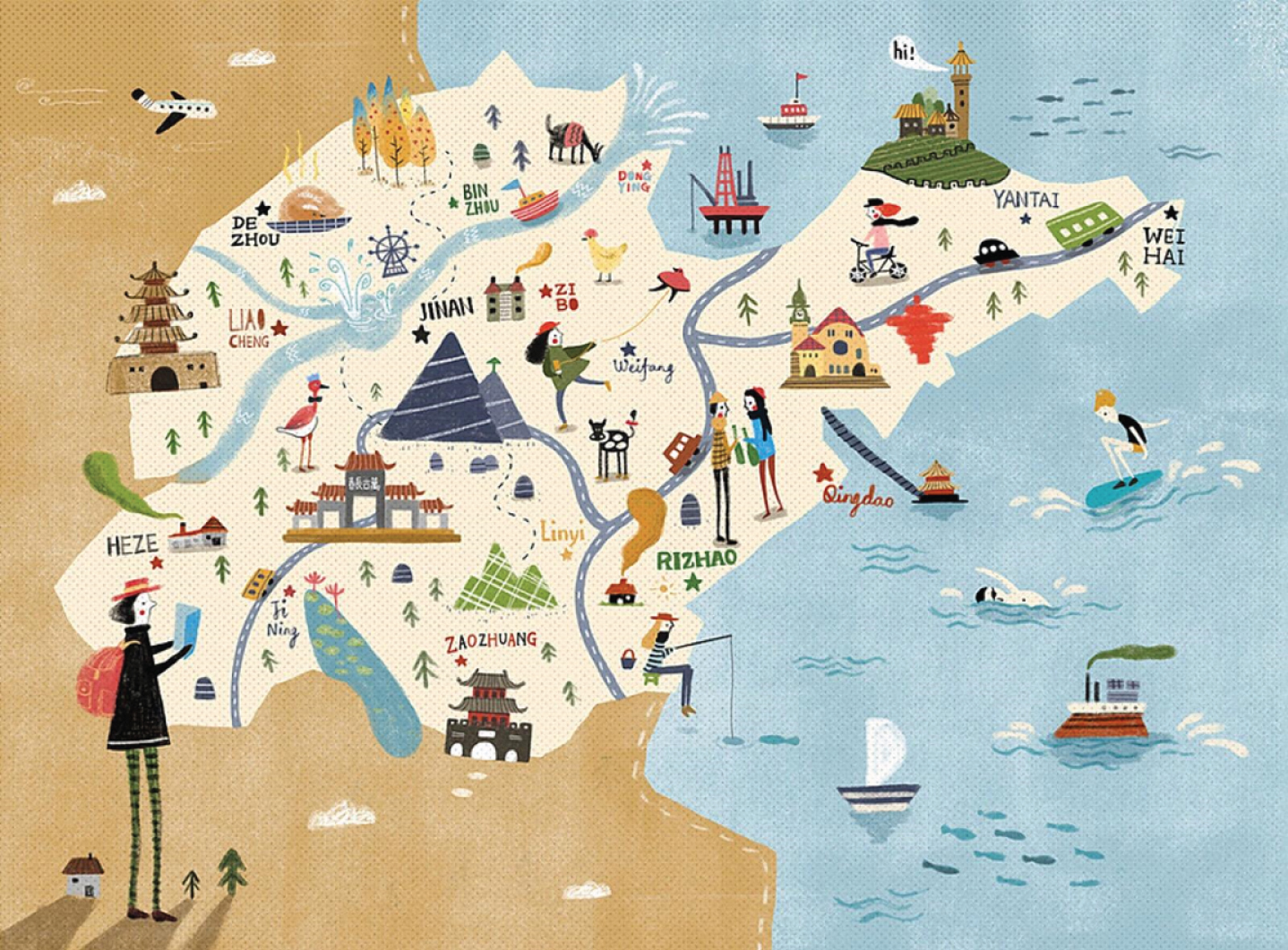
Sketch map of comprehensive evaluation of urban tourism competitiveness in Shandong Province.
In this paper, two principal component analysis methods are used to analyze the representative cities of Kaifeng and Shandong Province along the Yellow River. These two schemes can analyze the tourism resources and tourism value of the provinces and cities along the Yellow River, and get the current situation and potential of tourism development in the provinces and cities along the Yellow River. During covid-19, big data transformation was realized through the analysis of Kaifeng City and Shandong Province, hoping to provide a reference for ecotourism along the Yellow River, and demonstrate the demonstration role of other provinces and cities, so as to improve the efficiency of eco-tourism of the Yellow River.
Footnotes
Acknowledgments
This paper is supported by the Kaifeng Yellow River Basin ecological protection and high-quality development innovation special plan “Tourism Project research of Yellow River Culture Research Institute in Kaifeng” (Project No: 2019002).