



Abstract
In this paper, an intelligent approach for short-term wind speed forecasting (STWSF) is proposed. The STWSF models are developed to forecast the wind speed into a multi-step ahead forecasting, which is used to demonstrate the daily forecast results in One-Step-Ahead (OSA), Two-Step-Ahead (TSA), and Three-Step-Ahead (ThSA) based forecasting manner. To demonstrate the performance and results of the proposed approach, the real-site logged dataset is used for training and testing phase of the year 2015 to 2017. The STWSF is achieved recursively by utilizing the forecasted data in step-1 (OSA) as an input to generate the next forecasting data (in step-2 TSA) and the process is achieved upto level of step-3 (ThSA) forecasting. In order to results demonstration of fair adoptability of the proposed approach, different neural networks (NNs) models are developed for the same dataset, which shows that the proposed STWSF approach is outperformed and can be utilized for other locations for future applications.
Introduction
Wind energy potential is a great resource of renewable energy (RE), which is the alternative resources of possible fuel as well as shows the great sign for reducing adverse environmental effects. Renewable energy sources (RES) increasing day-by-day, which shared around 65% contribution of the total global power generation in 2018 [1]. In which wind energy source plays an important role.
The RES generation is growing day-by-day, in which the generated wind power was around zero in 1965 but now 1429.62 TWh in the year of 2019 [2] (Fig. 1), which shows the great sign of decrease in traditional energy consumption throughout the world. This great sign shows the rapidly shifting of the world towards the renewable energy, and among of all countries, India is one of the leaders in this domain.
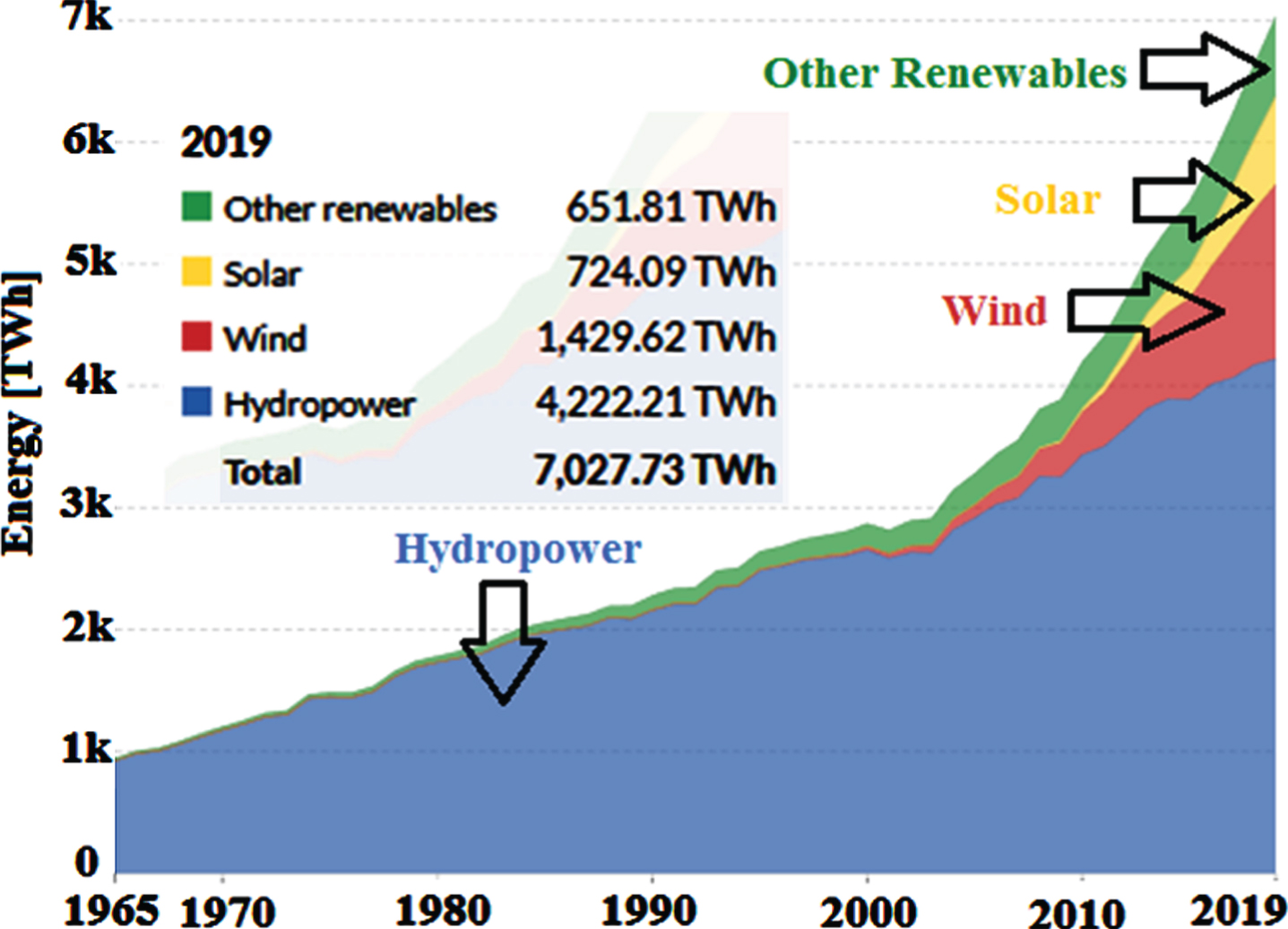
Renewable energy generation in world [2].
According to the Our World in Data [2] and MNRE (Ministry of New and Renewable Energy Resources), the current wind energy generation in India is 63.31 TWh (in 2019) and targeted the future goal of 175GW of renewable energy generation by 2022 [3], which is very large amount than the cited wind power potential of about 302GW in 2018 in a survey conducted by NIWE (National Institute of Wind Energy) [4].
The WS forecasting (WSF) and prediction (WSP) play an important role in power system planning and maintenance to meet the un-interrupted demand. Generally WSF and/or WSP are performed based on the time-scale, which is categorized into 4-types: 1) VST-WSF: very-short term, 2) ST-WSF: short-term, 3) MT-WSF: medium-term and 4) LT-WSF: Long-term [5–6]. The VST-WSF, ST-WSF, MT-WSF and LT-WSF are based on the time interval in order of “seconds to few minutes”, “(30 minutes to 24 hours)”, “(1 day to 1 week)”, and “(1 week to years)” respectively. Moreover, there are several methods and approaches of SWF/WSP are reported in the literature, which are mainly classified into: 1) Physical methods (PM), 2) Statistical methods (SM), 3) Artificial Intelligence based methods (AIM) and 4) Hybrid methods (HM).
According to the literature survey as mentioned in [7–21], the wind energy (WE) generation is increasing resource in the world, which is the function of WS. The accurate WE/power prediction of wind farm output requires accurate prediction of WS. Therefore, prediction of WS is important for wind farms units’ maintenance, optimal power flow between conventional units and wind farms, electricity marketing bidding, power system generators scheduling, energy reserve, storages planning and scheduling. Hence, predictions of WS performed by various researchers are discussed in several published articles [5–21].
The main contribution of this paper is to develop a novel NN approach based on a real-time logged historical dataset of 2015–2017 for STWF, which is further applicable to forecast the WS for those locations where no metrological station is available. The forecasted WS is used for wind resource assessment of wind turbines size matching to generate the optimal level of power potential.
The formulation of this manuscript is presented into six sub-sections, which includes the introduction in section-1 and study area and dataset collection for daily STWSF in section-2. The Section 3 represents the proposed framework, which includes the design of NNs and its performance measure indices are represented in section-4. Results demonstration and its discussion are represented in section-5 and finally conclusion is shown in section-6.
The Nainital (latitude [ºN] 29°23’31”N and longitude [ºE] 79°27’15”E and altitude [m] 1938 (6358 ft)) site in the Kumaon foothills of the outer Himalayas, is considered for the study in this chapter as shown in the Fig. 2. Nainital is covered by the Himalayas and it has huge potential of wind energy throughout the year. Here mean value of WS varies from o.768–1.294, 0.685–1.187 and 1.06–1.366 m/s for the year of 2015, 2016 and 2017 respectively throughout the year. Moreover, it is surrounded by Himalaya’s hills, so, the average air-temperature, average humidity, and average pressure are 16.44 °C (varies through the year: –0.8 to 34), 74.61% (varies through the year: 9 to 100) and 864.2 hPa (varies through the year: 851 to 874) for the year 2015. Similarly for year 2016, the average air-temperature, average humidity, and average pressure are 17.16 °C (varies through the year: –49.8 to 58.4), 71.34% (varies through the year: 5 to 100) and 863.14 hPa (varies through the year: 853 to 874). According to historical record, the maximum and minimum WS varies from 9.8 to 0 (m/s), 9.6 to 0 (m/s) and 10.9 to 0 (m/s) for the year of 2015, 2016, and 2017 respectively throughout the year as shown in Table 1 (for 2015) and Fig. 3 (for 2016).

Location of Nainital city of Uttrakhand, India.
Statistical analysis of recorded 2015 dataset’s variable of wind speed (ws) (in m/s)

Statistical analysis of recorded 2016 dataset’s variable of wind speed (ws) (in m/s).
The historical data from meteorological data recording station, has been collected for the academic use. The several variables (i.e., WS: wind speed, WD: wind direction, Temp.: temperature, RH: relative humidity, P: pressure, Pre: precipitation) were collected at the one minute interval of the time. The recorded data from 1st Jan 2015 to 31st Dec. 2017 were used for the study. The further statistical analysis of the recorded data sets are represented in Tables 1 5 and Figs. 3 7, which are minimum value, maximum value, mean, standard deviation (STD) and variance (VAR) for the year of 2015 and 2016 respectively.
Statistical analysis of recorded 2015 dataset’s variable of max. Horizontal wind speed (maxws) (in m/s)
Statistical analysis of recorded 2015 dataset’s variable of wind direction (wd) (in degree)
Statistical analysis of recorded 2015 dataset’s variable of relative humidity (RH) (in %)
Statistical analysis of recorded 2015 dataset’s variable of Air Temperature (°C)
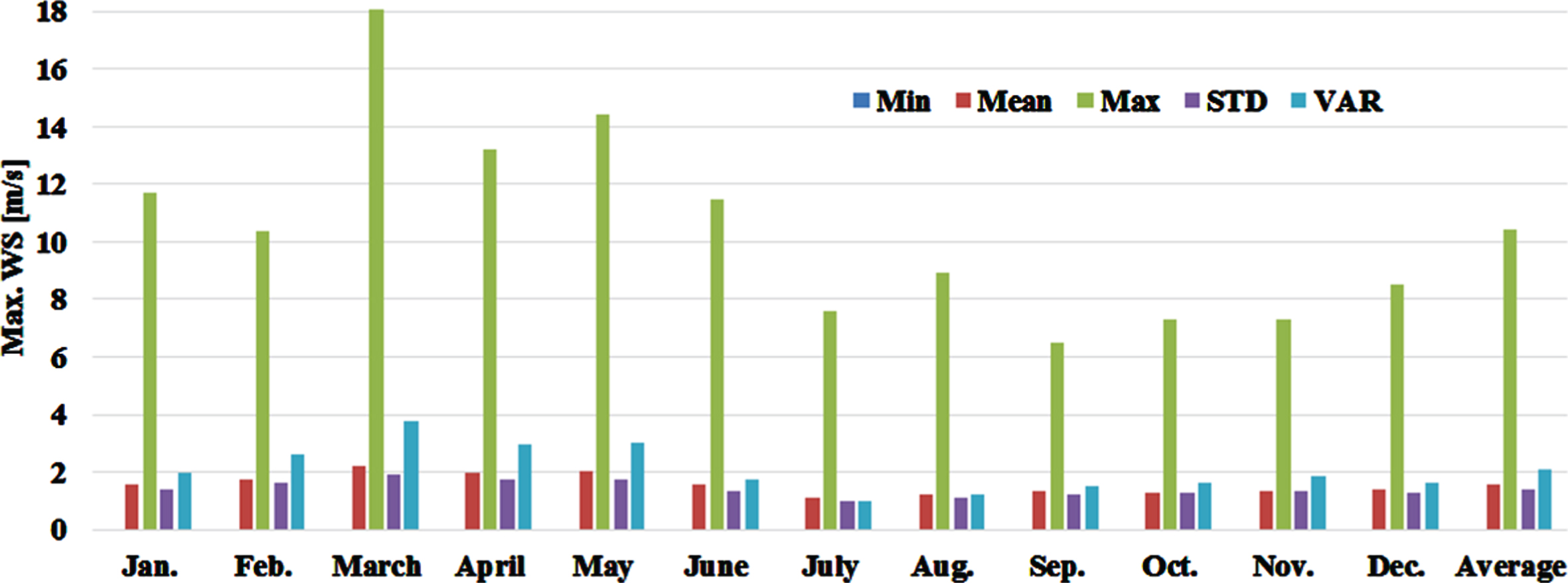
Statistical analysis of recorded 2016 dataset’s variable of max. Horizontal wind speed (maxws) (in m/s).
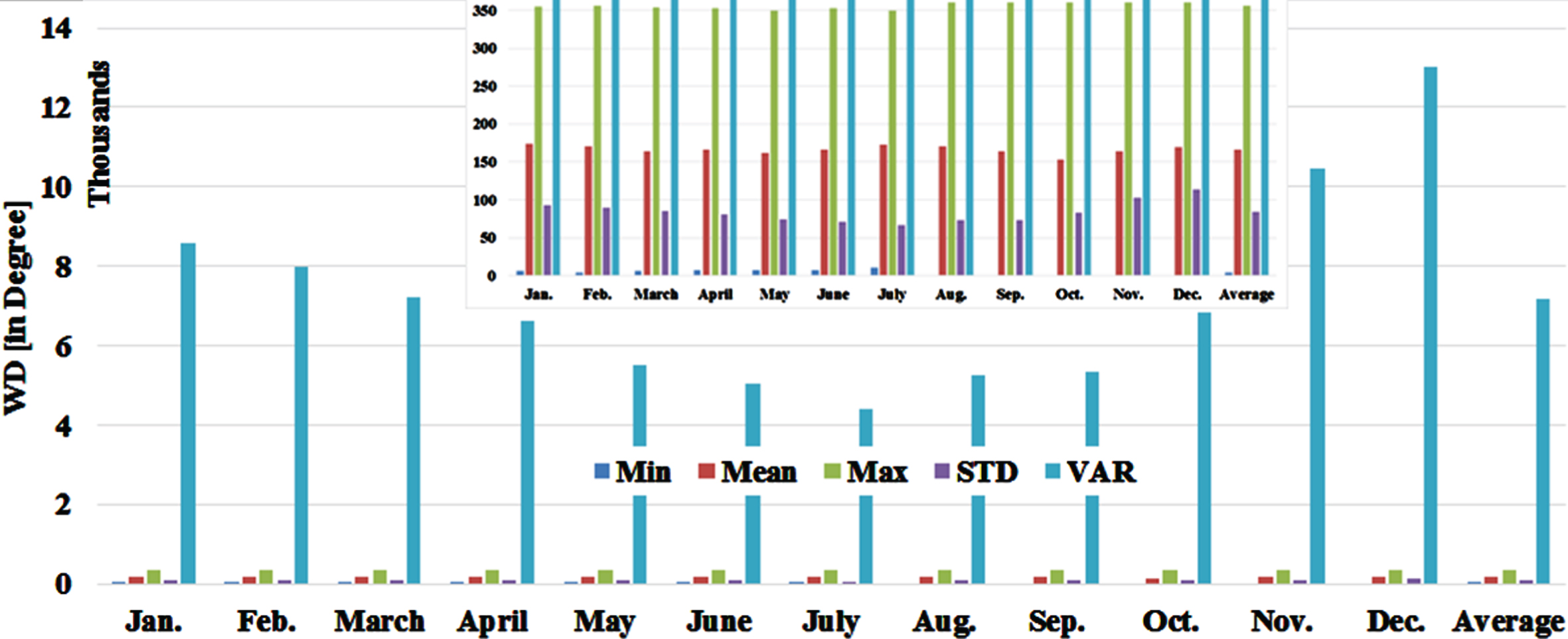
Statistical analysis of recorded 2016 dataset’s variable of wind direction (WD) (in degree).
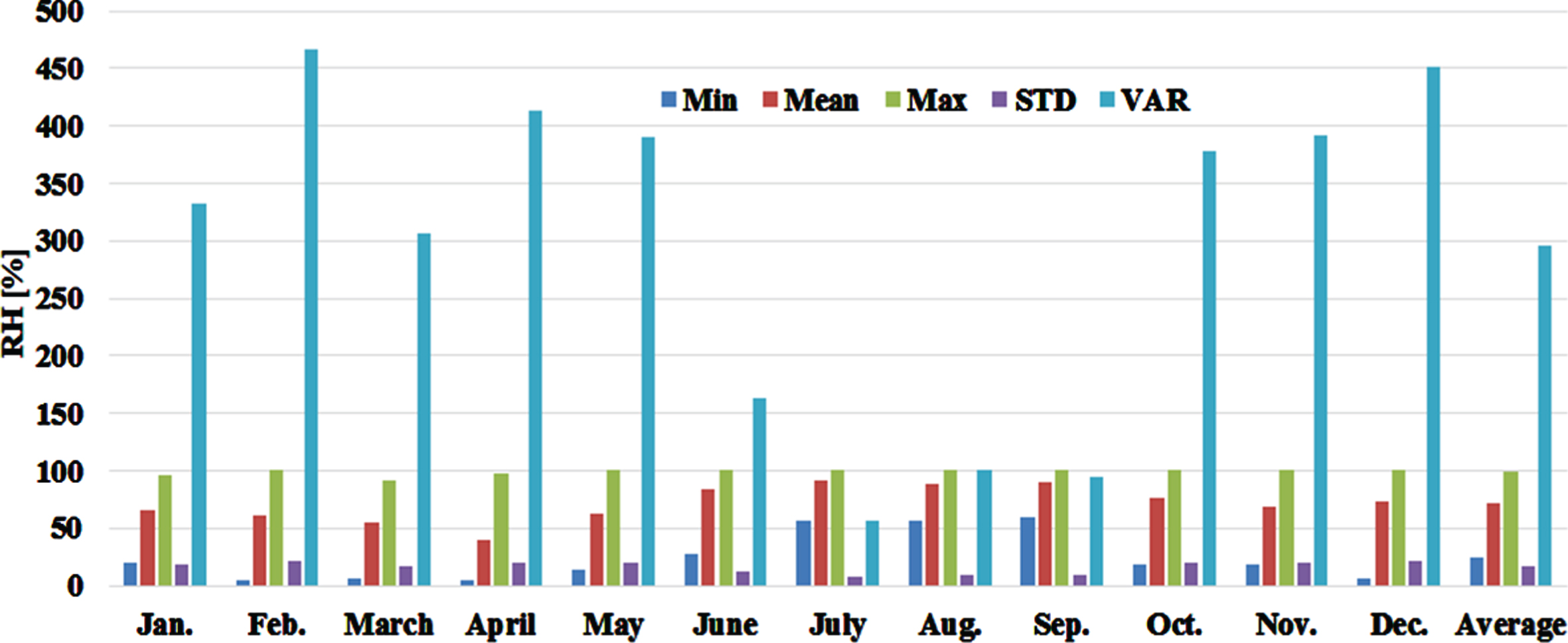
Statistical analysis of recorded 2016 dataset’s variable of relative humidity (RH) (in %).
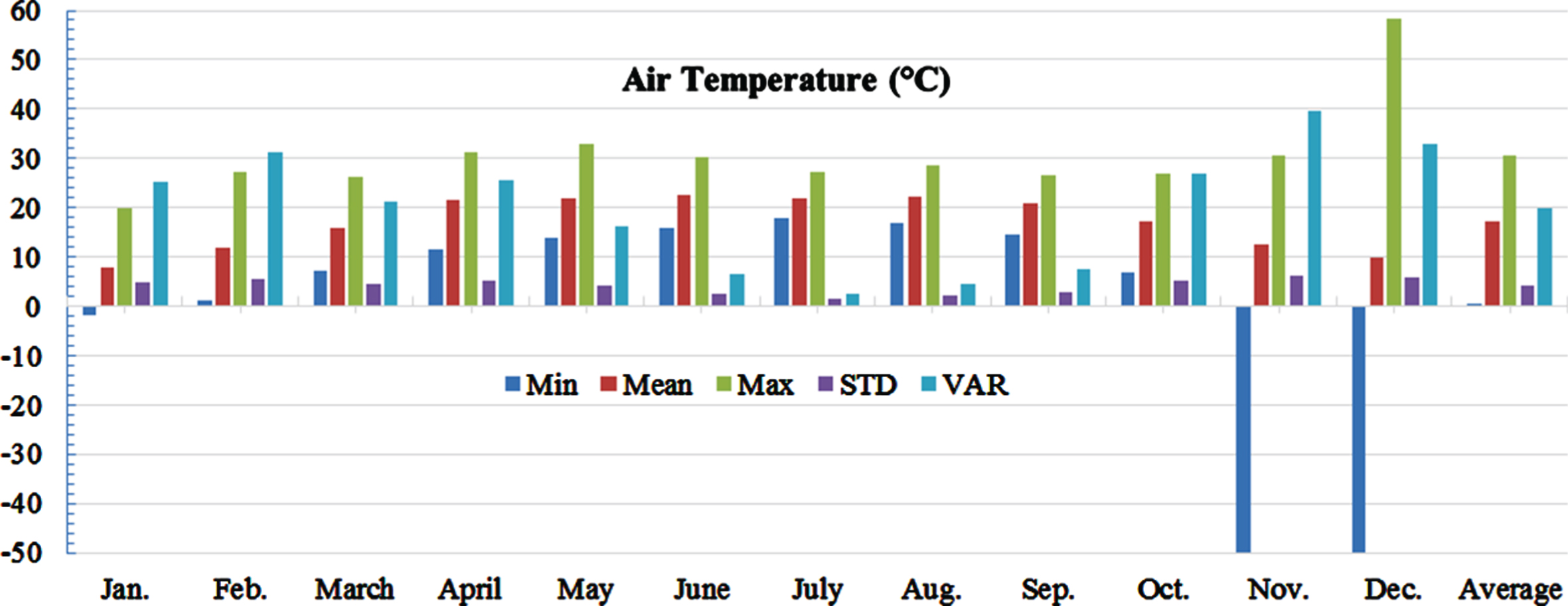
Statistical analysis of recorded 2016 dataset’s variable of Air Temperature (°C).
The historical data of WS is logged per minute basis, which is started at [00 : 01 : 00] to [23 : 59 : 00] for each day throughout the year. Due to some unwanted weather condition and/or instrumental/ operational/ technical and human errors, there are some missing values and/or spikes in the logged time series WS data Therefore, in this study, data pre-processing technique is employed to rectify the logged data by filling the appropriate missing values and removing the spikes (if any). The rectified data for the year 2015 is shown in Fig. 8 for better understanding. In Fig. 8(a) to Fig. 8(l), the historical and processed data are represented for each month starting from January to December, which is represented by dark black colour and gray colour for logged and processed (after filling missing value and/or spikes removal) data set respectively.
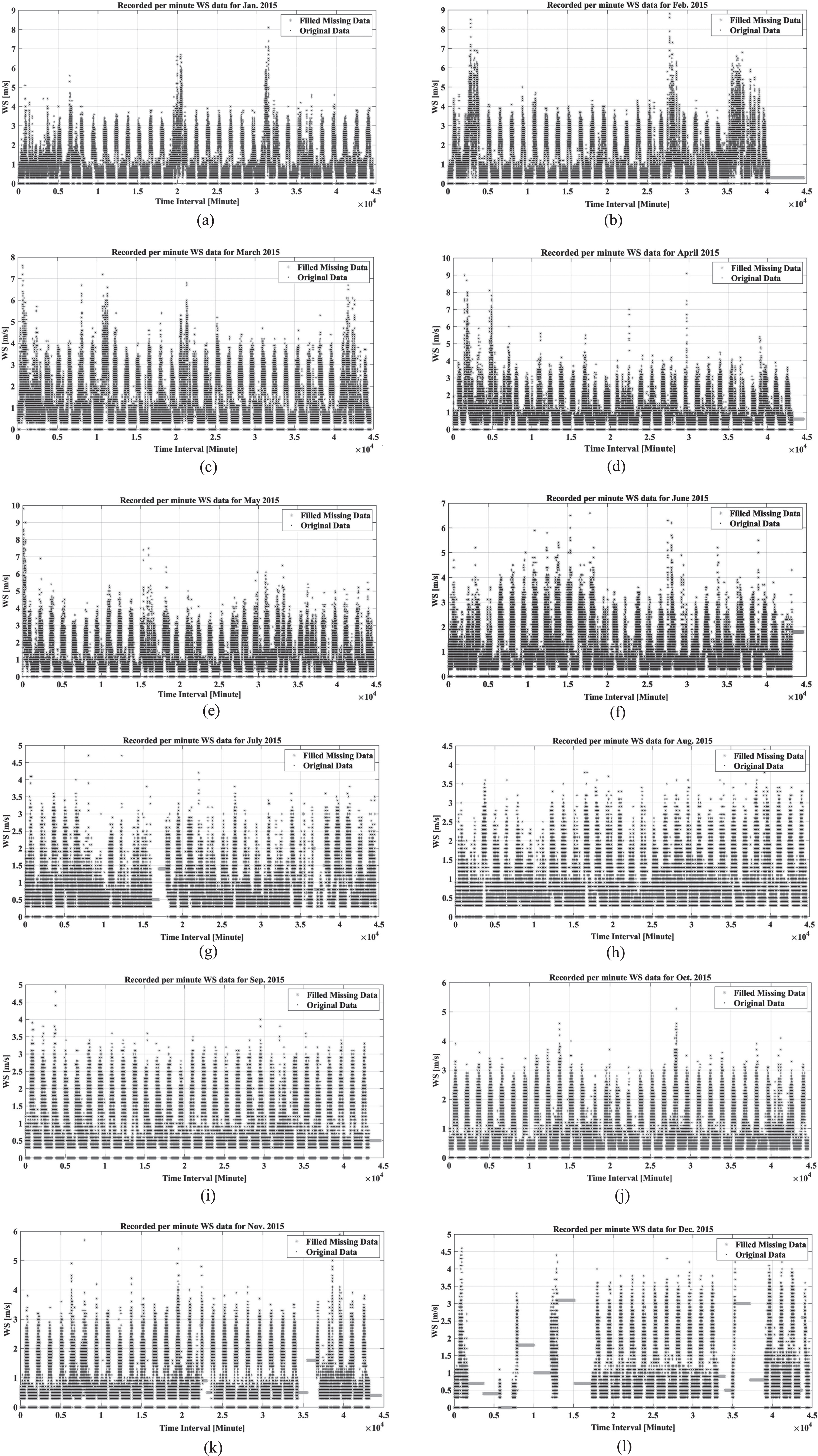
Per minute WS representation for original historical data and filled missing value data.
For the further analysis of WS using ANN, the per minute dataset is converted into the daily prediction, which is divided into two sub-data set (training data 70% and testing data 30%) and testing dataset is divided into multiple file for further use.
The developed approach, which is proposed in this study is formulated into three parts, is represented in Fig. 9. These three main parts such as: 1) Data processing part, 2) ANN model design and training part, and 3) Multi-step testing and adaptability verification of the approach. First two parts (PART-1 and PART-2) include the several steps, which are represented as follows: Part-1 includes four steps and Part-2 includes two steps. The dataset collection, data pre-processing, and four different data files (i.e., training, testing, validation, and forecasting) formation are included in the Part-1. In the first step, a recorded meteorological logged dataset from the sites has been collected with different variables. The developed all four data files are not similar to each other. The training data file is used for ANN models design and developed ANN models learns the WS forecasting property based on evaluated per day dataset of Nainital city. After training phase, testing phase is performed to test the trained model performance. If testing phase performance is acceptable then validation data file is used to test the model again. Therefore, trained model is tested multiple time to cross check the model performance by using different datasets (i.e., testing, validation and forecasting dataset).
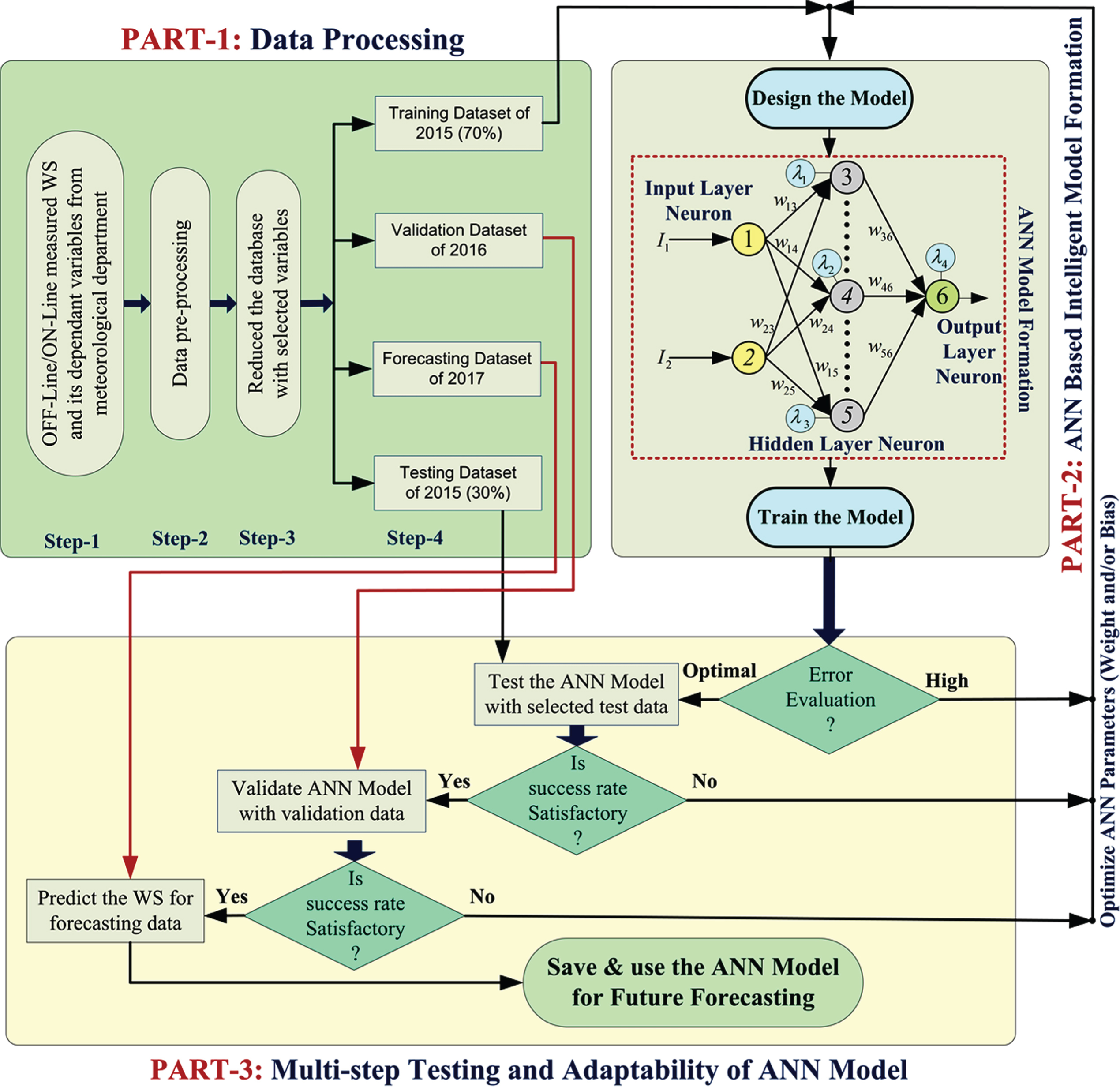
Proposed approach for WSFP.
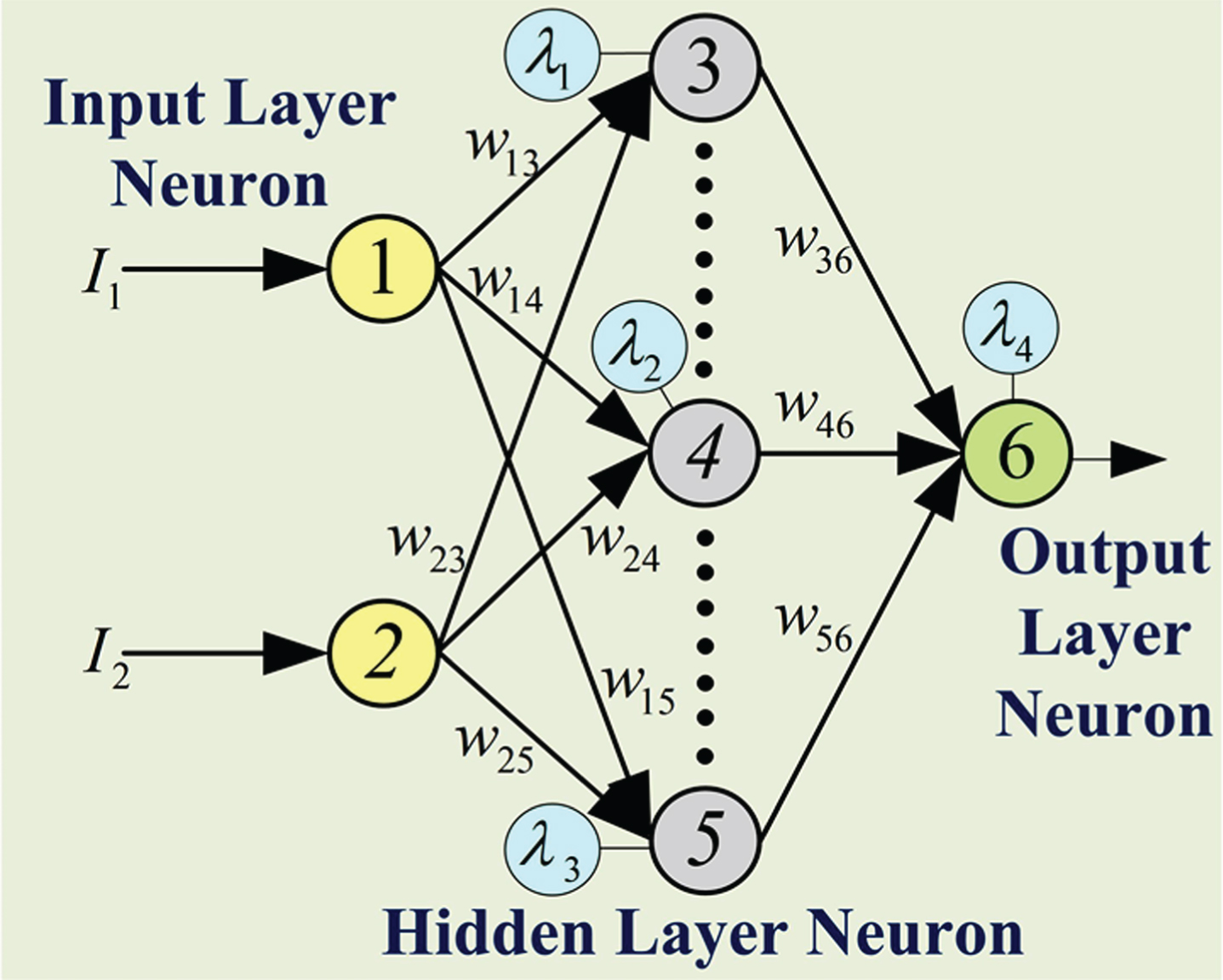
The BP (back propagation) algorithm based MLP (multilayer perceptron) type of NN’s architecture is used in this study as represented in Fig. 10 [22–26]. The I1 and I2 are the assumed input variables which are connected to input neuron of 1 and 2 respectively. Neuron number 1 and 2 are further connected with hidden layer neurons of 2,4,5 through the weight vector of w ih (w13, w14, w15, w23, w24, and w25). The output of the neuron 3,4,5 are connected to the output neuron number 6 though the weight vector of w ho (w36, w46, and w56) as shown in the Fig. 10. The mathematical model for developed NN is mentioned in Eq. 1 to 7 which includes weight value w ih and w ho .
At input Layer: the computation at the ith neuron:
At hidden Layer: The computation at the hth neuron is:
At output Layer: The computation at the jth neuron is:
The model performance computation is the procedure to calculate the characteristics in form of its performance, which shows the model’s capability to WS forecasting which are MAE (Mean Absolute Error), MAPE (Mean Absolute Percentage Error) and RMSE (Root Mean Square Error) used in this study. These performance indices are calculated for the NN models as given below:
Where,
The experimental results demo for daily WS forecasting is signified into two categories: 1) One-Step Ahead (OSA) forecasting and 2) Multi-Step Ahead (MSA) forecasting. The MSA forecasting is performed upto two more step-ahead based forecasting (TSA: two-step ahead and ThSA: three-step ahead). The information of the used dataset is tabulated in Table 6 and obtained best optimal results from each case study have been demonstrated in Table 8. Table 7 tabulates the total number of developed NN models in this study.
Dataset used for NNs model formation for ELF
Dataset used for NNs model formation for ELF
Developed NNs models for multi-step forecasting
NNs performance for ELF: MAPE value
These three case studies (i.e., OSA, TSA, and ThSA forecasting) are developed and analyzed with consideration of it distinct and valuable application in the power system such as power system planning, power system maintenance, power system scheduling, power system unit commandment, economic load dispatch management, OPF (optimal power flow) analysis, automatic generation control etc.
Here, one day-ahead forecasting demonstration of the results for testing phase are represented tabulated in Table 9 and its detailed representation is represented in Fig 11 and Fig. 12 for the tested dataset of year 2016 and 2017 respectively. From the test result analysis, it is shown that the average value of MAPE for Monday to Sunday are 3.23, 4.99, 5.15, 6.57, 4.23, 5.92, and 4.69 respectively for the January of year of 2016. And for the January of year 2017, the testing results are 9.47, 3.98, 9.59, 8.21, 9.85, 3.09, and 10.5 for the day of Monday to Sunday respectively. In the both cases (2016 and 2017), the weekly average value of MAPE are 4.966 and 7.813 respectively in January, which are highly acceptable for the forecasting problems. For the detail analysis of each day of each month is demonstrated in the Tables 10 and 11 for the year of 2016 and 2017 dataset.
Daily WS forecasting error for Nainital
Daily WS forecasting error for Nainital
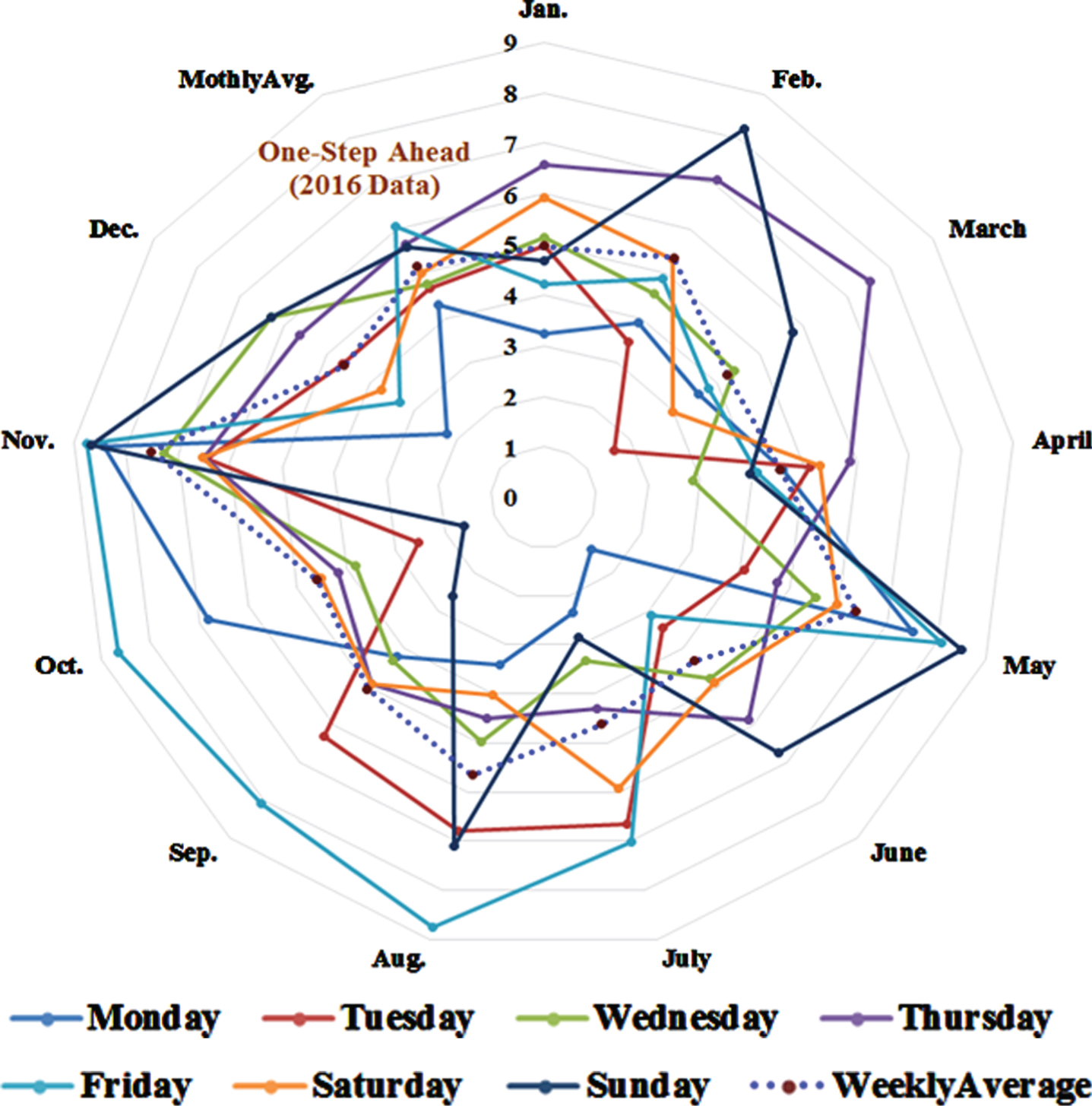
MAPE analysis for OSA daily WS forecasting (Test#1 : 2016 dataset).
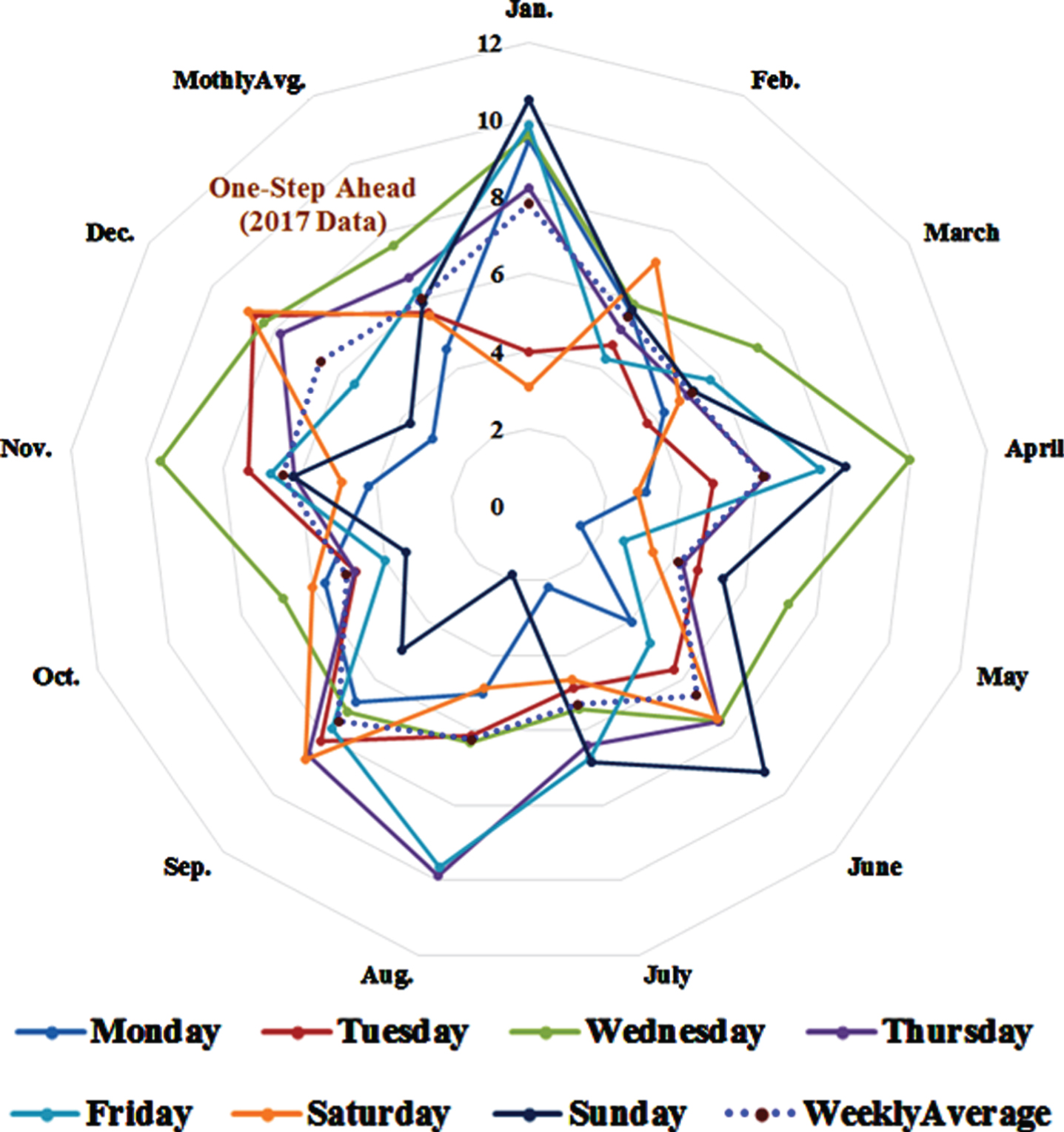
MAPE analysis for OSA daily WS forecasting (Test#2 : 2017 dataset).
The OSA MAPE for Daily WS Forecasting (Test#1 : 2016 Dataset)
The OSA MAPE for Daily WS Forecasting (Test#2 : 2017 Dataset)
In this section, the results demonstration of daily-ahead WS forecasting for TSA ahead and ThSA forecasting, which are represented in Figs. 13 16. The Figs. 13 and 14 show the TSA performance demonstration for testing dataset of year 2016 and 2017 respectively. Whereas, Figs. 15 and 16 represent the ThSA performance demonstration for testing dataset of year 2016 and 2017 respectively. The detailed analysis of the performance for each model is tabulated in the Tables 12 13 (for TSA) and Tables 14 15 (for ThSA). Tables 12 and 14 represents the testing phase results for the logged dataset of the year 2016 for TSA and ThSA forecasting respectively. Similarly, Tables 13 and 15 represents the testing phase results for the logged dataset of the year 2017 for TSA and ThSA forecasting respectively.

MAPE analysis for TSA daily WS forecasting (Test#1 : 2016 dataset).
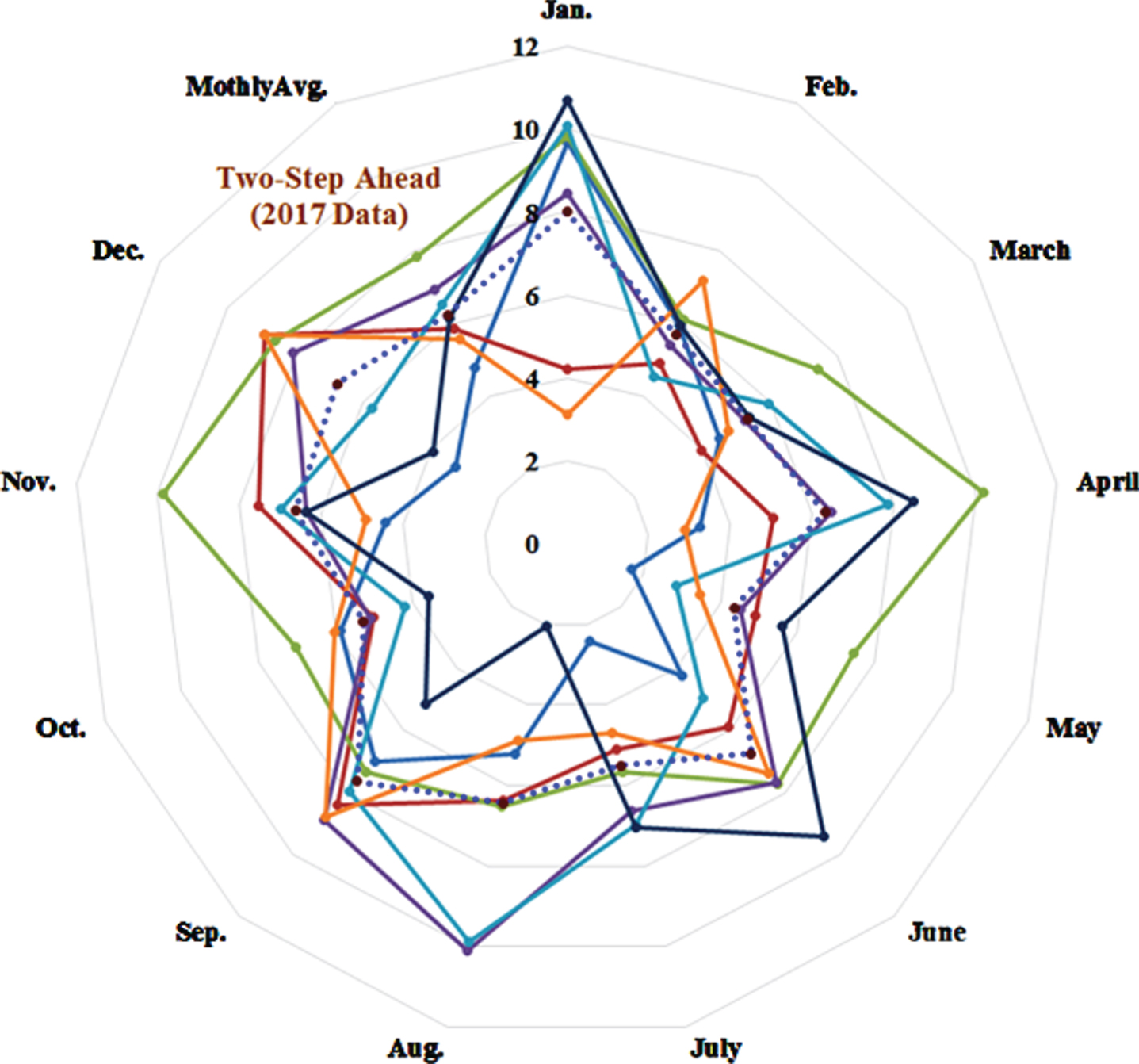
MAPE analysis for TSA daily WS forecasting (Test#2 : 2017 dataset).

MAPE analysis for ThSA daily WS forecasting (Test#1 : 2016 dataset).
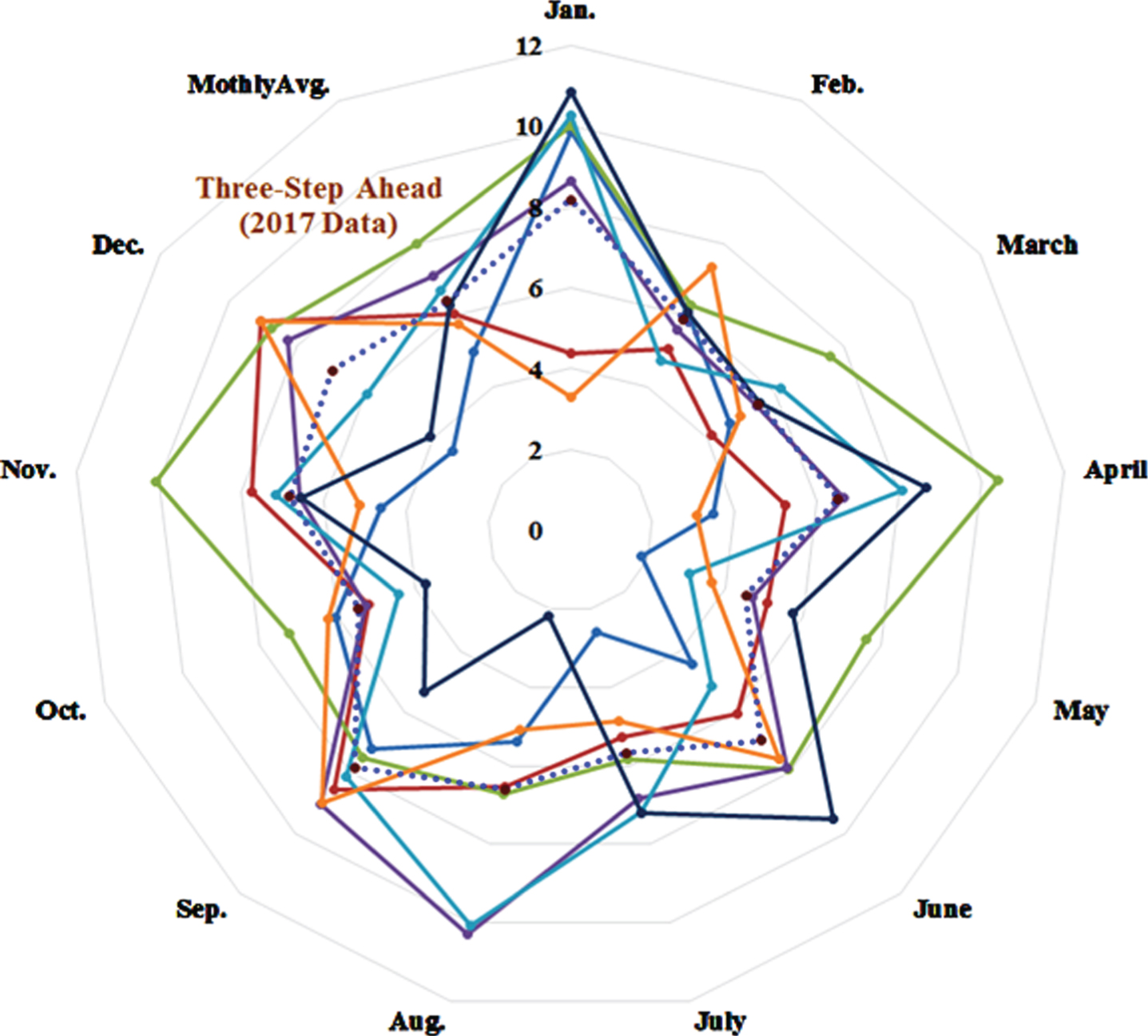
MAPE analysis for ThSA daily WS forecasting (Test#2 : 2017 dataset).
The TSA MAPE for Daily WS Forecasting (Test#1 : 2016 Dataset)
The TSA MAPE for Daily WS Forecasting (Test#2 : 2017 Dataset)
In the TSA daily-WS forecasting case study, the average maximum and minimum MAPE for testing phase is 4.46–7.727 (for 2016 test dataset) and 4.34–8.01 (for 2017 test dataset), and the overall-average MAPE for all days of the months is 5.44 (for 2016 test dataset) and 6.23 (for 2017 test dataset).
Similarly, in the ThSA daily-WS forecasting case study, the average maximum and minimum MAPE for testing phase is 4.64–7.91 (for 2016 test dataset) and 4.53–8.19 (for 2017 test dataset), and the overall-average MAPE for all days of the months is 5.66 (for 2016 test dataset) and 6.41 (for 2017 test dataset).
Therefore, after analyzing Tables 12 to Table 15, it is summarized that designed NN models for TSA and ThSA forecasting for daily WS forecast are more acceptable and it can be implemented for future applications.
The ThSA MAPE for Daily WS Forecasting (Test#1 : 2016 Dataset)
The ThSA MAPE for Daily WS Forecasting (Test#2 : 2017 Dataset)
In this study, a multi-step-ahead time-series wind speed forecasting model for smart-grid application has been proposed and its performance has been demonstrated, and validated by using real-time logged dataset of the year 2015 to 2017, which has been collected from an Indian city of Nainital. The multi-step ahead forecasting has been executed recursively using different NNs for daily wind speed forecasting based on OSA (1 day), TSA (2 days), and ThSA (3 days) forecasting, and this procedure is repeated until a time step of 3 days. The proposed models are competent to solve the linear and/or non-linear problems such as STWSF, which is a highly non-linear problem, which has been handled by proposed method in an efficient way with less computational burden.
Footnotes
Acknowledgments
“The authors extend their appreciation to the Researchers Supporting Project at King Saud University, Riyadh, Saudi Arabia, for funding this research work through the project number RSP-2020/278”.