



Abstract
In this study, a multi-criteria group decision making (MCGDM) framework is constructed for electric vehicle fast-charging station (EVFCS) selection using a proportional hesitant fuzzy set (PHFS) that can describe two aspects of information: the possible membership degrees in the hesitant fuzzy elements and associated proportion representing statistical information from different groups. A newly extended distance measure for PHFSs is introduced and an extended maximizing deviation method is constructed to obtain criteria weights objectively. Accordingly, an integrated PHFS-VIKOR (VlseKriterijum-ska Optimizacija I Kompromisno Resenje) method embedded with a new distance measure and extended maximizing deviation method is presented. With increasing concerns about range anxiety, it is essential to seek an optimal location for EVFCS considering efficient utilization of resources and long-term development of socio-economy under proportional hesitant fuzzy environment. Lastly, an illustration with sensitivity analysis and comparative analyses is provided to demonstrate the validity and robustness of our proposal.
Keywords
Introduction
Compared with conventional internal combustion engine vehicles, electric vehicles (EVs) have many advantages such as energy security, economic growth and environment protection. The vigorous promotion of EVs can facilitate a country’s sustainable development. However, users have to face the practical problem whether EVs is running out of power before reaching its destination or finding a charging station. The basic and strong construction of electric vehicle fast-charging stations (EVFCSs) can handle with it.
Many literatures have investigated the distribution of electric vehicle charging stations (EVCSs), which are divided into three categories. The first category examines strategic planning aspects regarding the layout of EVCSs such as location, network design and the capacity of stations for strategic planning [1–3]. The second category aims to construct a well-functioning operational system that, at least, ensures a minimum quality of service and satisfies the maximum of users’ demands to reduce the operational costs based on network data analysis [4] and statistics for operational planning including EVCS availability [5] and the forecasting user demands [6]. Note that the above studies related to the site selection of EVCS are theoretical rather than practical. In practice, aspects such as convenience of transportation or possibility of further capability expansion shall be concerned for EVCS selection problem, which is an essential multi-criteria decision making (MCDM) problem. In recent related studies, some researchers have proposed many MCDM methods [7–12] from the perspective of decision management.
Taking the hesitation during the process of decision making into account, hesitant fuzzy set (HFS) [13] was introduced to model the uncertainty and hesitation by assigning the degree of membership of an element. Although HFSs serve as successful information representation models for individuals, they largely fail to model group assessments where the assessments are collected from the subset of individual HFS inputs. Information loss or distortion is inevitable, since the objective proportions of expert subgroups with the same individual assessment cannot be reflected well. To enhance the modelling ability of high order uncertainties, with probability interpretations of HFS, probabilistic hesitant fuzzy set [14] has been proposed. The probability information for each membership degree is subjectively determined by the experts themselves. Moreover, probabilistic hesitant fuzzy set only reflects the certainty of individual decision maker (DM) for hesitation. A new challenge emerges in relation to ensuring the accuracy and reliability of the proportional information provided. To deal with this issue, in group decision making (GDM), weighted hesitant fuzzy set [15] and proportional hesitant fuzzy set [16], focused on the process of obtaining proportional information objectively and statistically. The collective proportional information indicates the decision making group has a high preference for the associated membership degree while the meaning for a small one is just converse. Analogously, in combination with the fuzzy linguistic approach, modelling a group assessment set objectively, the proportional hesitant fuzzy linguistic term set (PHFLTS) [17] is proposed, which clearly indicates that for a group of experts, their individual opinions can be dealt in the use of two approaches: treating them individually by hesitant fuzzy linguistic term set (HFLTS) possibility distributions [18] or treating them as a whole by PHFLTS [19–21]. Further, the approach of the probabilistic hesitant linguistic term set [22–31] and that of linguistic assessment distribution are subjective ways of obtaining the importance of each element in a hesitant linguistic term set.
In this paper, we focus on GDM problem and allow DMs to provide their evaluation information anonymously. The proportional information is collected statistically from a group of experts opinions in terms of proportional hesitant fuzzy set. PHFSs offer a brand new perspective for understanding the collective decision matrix construction paradigm, for which not only improve the quality of evaluations by including objective statistical information but also provide a simple solution to the gathering of individual opinions. Different stakeholders, such as EV manufacturers, charging station infrastructure, charging station operators and the central government, shall cooperate and foster the development of the EV market in a group manner to reinforce the democracy and rationality of the decision making result, which can extract the real case scenarios [32] to highlight competitive advantages for location selection. For instance, three groups provide their evaluation values between 0 and 1 on the alternation over certain criteria. Suppose that five professionals provide the value 0.6, ten professionals provide the value 0.7 and five professionals provide the value 0.9, which can be denoted by {0.6, 0.7, 0.9} using hesitant fuzzy element. Note that the proportional information elaborating on the characteristic of group DMs are loss. HFS can be viewed as a special case of PHFS as it is embedded with the same probabilities for each element in it. Precisely and statically, the above instance can be expressed by {0.6 (0.25) , 0.7 (0.5) , 0.9 (0.25)} utilizing the proportional hesitant fuzzy element (PHFE). Recently, a series of MCGDM methods based on PHFS were investigated, such as the operation rule and aggregation operator-based MCGDM methods [33, 34], measure-based MCGDM methods [35, 36], consensus-based MCGDM methods [37–39], TOPSIS (Technique for Ordering Preference Similarity)-based interactive MCGDM method [40, 41] and outranking-based MCGDM method [42]. Existing research has paid increasing attentions to address these two critical issues simultaneously.
The VIKOR [43] (VIsekriterijumska optimizacija i KOmpromisno Resenje) method is a new well-known developed MCGDM technique, which introduces the multi-criteria ranking index based on the particular measure of “closeness” to the ideal solution. For ranking and selecting from a set of alternatives, the VIKOR method shall determine compromise options by maximizing group utility for the “majority” and minimizing individual regret for the “opponent”. Some researchers have extended the VIKOR method to various uncertain environment such as Pythagorean fuzzy environment [44], intuitionistic fuzzy environment [45], q-rung orthopair fuzzy environment [46]. Ş. Emeç and G. Akkaya [47] combined the stochastic analytic hierarchy process and fuzzy VIKOR approach for the warehouse location selection problem. Several useful applications have been reported for the VIKOR methods [48–51] to manage other real-life problems in recent years. Note that there is no literature investigating the extension of VIKOR to accommodate the circumstance of PHFSs. Most of the decision-making methods with respect to PHFS are based on various aggregation operators so that the discrepancy of alternatives is almost neglected. Determining an optimal option that simultaneously satisfies all the criteria is difficult. Thus, obtaining a good compromise solution using the VIKOR method is preferred. Some major difficulties and challenges exist to extend the VIKOR method to the MCGDM method with PHFSs: (1) The distance of PHFSs must be defined to measure the closeness of two PHFSs; (2) To avoid subjective randomness, the criteria weights should be determined objectively for MCGDM with PHFSs. (3) It is impractical that the above research is based on the hypothesis that an optimal solution must exist. The solution is usually a set of non-inferior solutions, or a compromise solution, which is the closest to the ideal and an agreement established by mutual concessions because there may be no solution satisfying all criteria simultaneously when criteria are non-commensurable and conflicting.
Hence, from the above analysis, MCGDM method based on the distance measure and compromise solution should be explored. Additionally, motivated by the VIKOR method, this study proposes an integrated PHFS-VIKOR approach based on the new distance measure with proportional hesitant fuzzy information to manage MCGDM problems with unknown weight information on the criteria.
The main motivation and contributions of this study are summarized as follows.
(1) The fuzzy and random information is considered and integrated into the VIKOR method to render all information from different groups.
(2) Maximizing the deviation method makes full use of the objective proportional hesitant fuzzy information of each characteristic established to determine the optimal criteria weights where information on criteria weights is incompletely unknown.
(3) The proposed PHFS-VIKOR method involves the parameter ν, which can be regarded as a behaviour preference measure to help the DMs obtain the compromise solution by taking an appropriate value of ν based on his/her preference.
(4) The proposed PHFS-VIKOR method focuses on the compromise solution, which is the closest to the ideal solution that realizes an agreement established by mutual concessions in addressing the location selection for EVFCSs, which can reach a compromise proposal when criteria are non-comparable or conflicting.
The remainder of this paper is organized as follows. Section 2 contains the concept of PHFSs and the ideal variable and nadir variable of discrete stochastic variables. Additionally, a brief introduction to the classic VIKOR method is given. In Section 3, a novel distance and maximum deviation method for PHFSs are given. Subsequently, an integrated PHFS-VIKOR method is proposed. In Section 4, a case study and together with sensitivity analysis about selecting an optimal EVFCS location is given. In Section 5, comparisons and discussion in three aspects are conducted to demonstrate the advantage of the proposed method. Finally, Section 6 presents the conclusion.
Preliminary
PHFS concept
(1) H (x) = {h1, h2, . . . , h v , . . . , h ϕ } is a set of values [0,1] that h v (v = 1, 2, . . . , ϕ) denotes the whole possible membership degrees of the element x ∈ X to the set E.
(2) P (x) = {p1, p2, . . . , p
v
, . . . , p
ϕ
} is a set of values [0,1] where p
v
(v = 1, 2, . . . , ϕ) denotes the proportion of membership degree and
For convenience, given x ∈ X, H (x) |P (x) is called a proportional hesitant fuzzy element (PHFE), indicated by
Possibility distribution of PHFE
(1) The whole underlying values h
v
(x) of PHFE comprise the basic event. For x ∈ X, the proportion of h
v
(x) satisfies
(2) Given a PHFE of H|P, its term h v |p v are lined up based on the value of h v in an ascending order, specifically, h1 < . . . < h v < . . . < h ϕ ;
(3) The number of underlying membership degrees of the element x ∈ X is equal to a constant ϕ, and arbitrary PHFEs share the same domain H = (h1, . . . , h v , . . . , h ϕ ).
(4) Let p
v
(ξ) denote the possibility when PHFE ξ takes the value h
v
with p
v
(x) ⩾0 for any h
v
∈ H. If
such that
such that
Possibility distributions of PHFEs ξ1 ξ2 and ξ3, as well as those of ξ+ and ξ-

Possibility distributions of ξ1 ξ2 and ξ3, as well as those of ξ+ and ξ-.
To solve the MCGDM problems, Opricovic and Tzeng [53, 54] introduced the VIKOR method. {A1, A2, . . . , A
m
} is the set of m alternatives, and {C1, C2, . . . , C
n
} is the set of n conflicting criteria. Let (w1, w2, . . . , w
n
)
T
be the weight vector of the criteria, which can express the interactive importance of criteria w
j
, which are derived by the maximizing deviation method in this paper. Let f
ij
be the rating functions, which provide the evaluation value of the alternative A
i
with respect to the criterion C
j
. The VIKOR method uses the following Lp-metric:
(1) The compromise solution comprises the alternatives A1 and A2 if the alternative A1 cannot satisfy Condition 2.
(2) The compromise solution comprises the alternatives A1, A2, . . . , A m if the alternative A1 cannot satisfy Condition 1, and the alternative A m is determined by the relation Q (A m ) - Q (A1) < DQ.
The resulting compromise solution provides a balance between the maximum group utility of the “majority” (represented by min S i ) and the minimum individual regret of the “opponent” (represented by min R i ). It should be mentioned that, although the VIKOR method has numerous advantages, the performance ratings f ij are generally quantified using crisp values. However, under many circumstances, such as those where DMs cannot express their preferences accurately, crisp data are inadequate to model real-life situations. That is, given that human judgements including preferences are often vague, it is both difficult and inaccurate to rate them as exact numerical values. Therefore, we employ the PHFE capturing the DM evaluation values and define the Manhattan Lp- metric of PHFE as well as present the extended VIKOR method.
Identification of the ideal and nadir solutions
Because the ideal and nadir solutions are used as reference points in ranking the alternatives, appropriately defining them and identifying them are important steps in the proposed method. Let
and
∀j = 1, 2, . . . , n, be the ideal and nadir verities under all criteria, respectively. Let p
v
(ξ+) and p
v
(ξ-), ∀v = 1, 2, . . . , ϕ, denote the probabilities that PHFE
A metric measuring the distance between two PHFSs
The VIKOR method is a distance-based decision method. Therefore, the definition of the distance between PHFSs is vital. Inspired by the above distance formulae, we define the distance between two PHFSs as follows.
Obviously, B is a symmetric, positive definite matrix and satisfies 0 ⩽ b
ij
⩽ (hσ(ϕ)) 2; b
ij
= b
ji
; b
ii
= (hσ(ϕ)) 2 = max {b
ij
|i, j = 1, 2, . . . , ϕ}; b
i
1
j
1
> b
i
2
j
2
, if j2 < j1 < i1, j2 > j1 > i1, i2 < i1 < j1 or i2 > i1 > j1.
The distance measure d (ξ1, ξ2) between PHFE ξ1 and ξ2 has all the properties of a metric such as non-negativity, symmetry and triangle inequality. These properties are stated formally below.
According to
Accordingly, the distance between two PHFSs is d (E1, E2)= 0.045.
Maximizing the deviation method has been widely applied to determine the criteria weights in MCGDM problems. For a criterion, if the deviation degree among the evaluation values of all alternatives is relatively large, then the criterion is relatively important in the group decision-making problem; otherwise, the criterion is relatively unimportant. In this paper, evaluation values in a group decision making problem are in the form of PHFEs, which is difficult to measure the deviation degree directly. Hence, we here construct an optimization model based on the maximizing deviation method to determine the optimal relative criteria weights under proportional hesitant fuzzy environment. For the criterion C j ∈ C, the deviation of the alternative A i to the other alternative can be expressed as follows:
where i = 1, 2, . . . , m, j = 1, 2, . . . , n, k = 1, 2, . . . , m, k ≠ I. By summing all the deviations of the alternative A i with respect to the criterion C j , we can obtain the deviation with respect to the criterion C j
where i = 1, 2, . . . , m, j = 1, 2, . . . , n, k = 1, 2, . . . , m, k ≠ I.
The importance of a criterion is determined by the deviation degree. The larger the deviation is, the more important the criterion is. Thus, the sum of the deviation of all criteria should be as large as possible, and we have the following programming model:
where i = 1, 2, . . . , m, j = 1, 2, . . . , n, k = 1, 2, . . . , m, k ≠ I.
Based on the above analysis, we can construct a non-linear programming model to select the weight vector w, which maximizes all deviation values for all the criteria as follows:
To solve the above model, we let
which indicates the Lagrange function of the constrained optimization problem (M-1) where λ is a real number denoting the Lagrange multiplier variable. The partial derivatives of L are then computed as follows:
We obtain the exact solution as follows:
For convenience, we denote
In the 21st century, we are facing dual energy and environmental issues; thus, exploring a new frame of sustainable transport development is extremely urgent. Experts in the automobile industry field have been actively trying to replace gasoline power with battery power for engines to solve the urgent problem. It turns out that EVs are a new type of clean, efficient and eco-friendly energy vehicle. Hence, improving the electric vehicle charging facility network construction, convenience for users, cost of user charging and EVFCS construction, will directly affect the adoption of EVs. Therefore, studies on the optimal location of electric vehicle chargers are of great importance.
To highlight the effectiveness of the integrated PHFS-VIKOR method, an application of the optimal selection of EVFCS is given. Because the PHFSs are considered a useful tool to manage the hesitation and indeterminacy in the decision data, we use PHFEs to collect information from different groups of DMs considering various parameters.
Implementation of the proposed approach
For investments in charging stations, a reasonable location will increase the utilization rate and reduce the costs of construction and operation. Based on previous analyses [55, 56], an evaluation index system comprising 6 criteria based on the literature review was constructed in Fig. 2. Assume that a company would like to select an optimal location to build a new electric vehicle charger. The committee includes 5 stakeholders from different fields such as nearby residents, EV manufacturers, the charging station infrastructure, charging station operators and the central government. Additionally, the evaluation is collected as PHFEs shown as Tables 3, 4, 5 and 6.
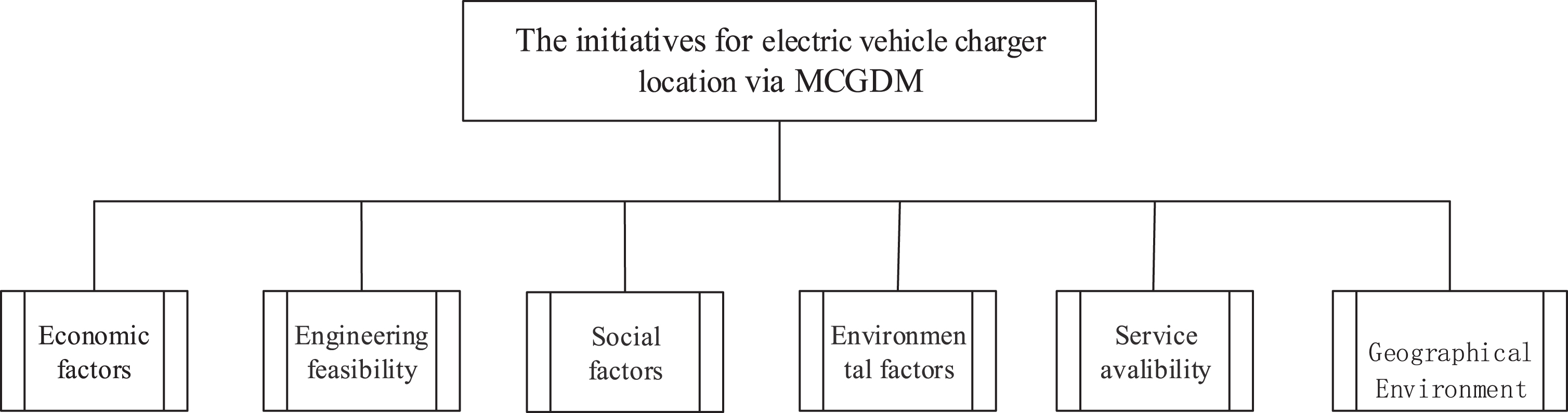
Evaluation index system in a MCGDM problem in selecting an optimal site for Evs.
Ratings of the location A1 by DMs under all criteria
Ratings of the location A2 by DMs under all criteria
Ratings of the location A3 by DMs under all criteria
Ratings of the location A4 by DMs under all criteria
According to subsection 3.1, possibility distributions of the components of the ideal solution ξ+ and nadir solution ξ- are identified and are shown as Tables 7 and 8.
Possibility distributions of the components of the ideal solution ξ+
Possibility distributions of the components of the nadir solution ξ-
Thereafter, we obtained the deviation of alternative A i based on the criterion C j by formula (14), shown as Table 9.
Deviation values
To obtain the weight vector of the criteria, we solve the model (M-1) (15) and the weight vector of the criteria is derived as w = (0.4208, 0.4441, 0.2980, 0.3857, 0.5026, 0.3681) T by MATLAB.
The performances of four locations are ranked using combination weights and the integrated PHFS-VIKOR method. Based on the values of Q i , the ranking of all alternatives in descending order are A2 ≻ A4 ≻ A3 ≻ A1 when v = 0.5. The best alternative is found to be A2, and the compromise solution is A4, because Q4 - Q2 = 0.1262 < 1/(4 - 1) =0.33. Based on the above results, this proposed model can easily evaluate and select a best alternative given a v value. In the next subsection, to examine the rationality and stability of the proposed framework and analysis results, the discriminatory ability and sensitivity analysis of the Q i value are presented.
In the extended decision making framework, there are some modelling parameters. To determine whether the modelling parameters (the weight for the strategy of the maximum group utility in this study) will have an observable effect on the final results of the decision-making process, sensitivity analysis must be executed.
Given the feature of the maximum group utility on the rankings of the alternatives, one experiment is conducted to observe how the parameter v validates the obtained results. Generally, the maximum group utility value of v is taken as 0.5. Actually, v can fetch any value from 0 to 1. The related results according to the value of v are illustrated in Table 10, which shows that the ranking of four alternatives are not influenced by the v value, indicating that the priorities of these alternatives are the same in terms of both maximum group utility and minimum individual regret so that the obtained results of the proposed approach are robust and reliable. In detail, the ranking of A4 increases with the increase of v, revealing that A4 has a higher level of risk when one DM focuses on maximum group utility. It was reported that the ranking of A2 is in the top when the v value is small, indicating that the ranking will rise as the importance of the minimum individual regret increases. Therefore, the proposed method can obtain various rankings when taking different values depending on the specific applications in the optimal selection problem.
S
i
, R
i
and Q(v)
i
values obtained by the weight v and compromise solutions
S i , R i and Q(v) i values obtained by the weight v and compromise solutions
This section aims to verify the feasibility of the proposed methods compared with several relevant methods.
Comparison analysis between HFSs and PHFSs
To demonstrate the capability of PHFSs, a numerical example [57] assumed with the equal possibility distribution is conducted using the proposed method.
Proportional hesitant fuzzy decision matrix adapted previously [57] with the identical proportion
Proportional hesitant fuzzy decision matrix adapted previously [57] with the identical proportion
S i , R i and Q(v) i values and ranking order using the proposed VIKOR method
As described previously [57], Trans Asia (B2) is the best alternative whose service quality has the highest satisfaction degree without compromise solutions. In this paper, we utilized the proposed approach and obtained the consistent result that Trans Asia (B2) is one of the best airlines in terms of service quality. Along with the change in the weight v, however, it appears to be a compromise alternative to UNI Air (B1). The primary reason for the slight difference between the two results is the information collection method. In the former method, the evaluation values from a group of DMs are collected by HFEs, leading to proportional information loss. Additionally, the new metric measuring the distance between the collective evaluations and ideal/nadir solution not only considers the possibility distribution, but also the values of the stochastic variables.
Proportional hesitant fuzzy decision matrix with the assumed possibility distribution
S i , R i and Q(v) i values and ranking order using the proposed VIKOR method
From the Table 14, the best airline is Mandarin (B3) with the compromise solution UNI Air (B1), a finding that is evidently different from the solution result in
In the context of electric vehicle charging station selection using the same data, we demonstrate the advantages of the proposed methodology over TOPSIS. On the other hand, to illustrate the advantage of PHFSs, we utilized PHFSs and HFSs (a special case of PHFSs) to cope with one example where every membership in each PHFE is distributed with equal proportion while the other is distributed randomly. The comparative results indicate that loss of information can cause large differences in ranking, adversely impacting decision making.
Considering that the aggregation operator is one of the most widely used tools in MCGDM methods, the second comparative method is an aggregation operator, namely, the proportional hesitant fuzzy weighted averaging (PHFWA) operator proposed by Zhang et al. [34] using the same data as in our case study. The score and deviation degree results of all alternatives are demonstrated in Table 15.
Score and deviation degree based on Zhang et al. [34]
Score and deviation degree based on Zhang et al. [34]
Based on the proposed comparison method [34], the ranking order is A4 ≻ A2 ≻ A3 ≻ A1, which is aligned with our proposed method when parameter v is increased. However, the calculation of aggregation is complicated. Additionally, the discrimination among the alternatives is not obvious. Furthermore, the DM behaviour is not considered. The results validate the feasibility of the proposed VIKOR method. The results can also prove the robustness of the proposed methods to some extent.
To demonstrate the effectiveness of the proposed extended VIKOR, it was compared to the extended TOPSIS method. Computational results for the extended TOPSIS based on the proportional hesitant fuzzy information with the same data from Tables 3, 4, 5, and 6 are given in Table 16, according to the relative closeness coefficient of each alternative.
Closeness degree of the alternative A
i
Closeness degree of the alternative A i
Clearly, the larger is the distance
By comparing Tables 10 and 16, it can be seen that the ranking of four alternatives solved from the extended VIKOR method was not in accordance with the extended TOPSIS completely. After using the extend VIKOR method, the ranking results vary with the parameter v, in which A2 is the first rank and A1 or A3 is the fourth rank when v ∈ [0, 0.6] while A4 is the first rank and A1 is the fourth rank when v ∈ [0.7, 1] with respect to six selected criteria in the optimal location selection problem. After using the extended TOPSIS method, the ranking is A4 ≻ A2 ≻ A3 ≻ A1. The result obtained via the TOPSIS technique always satisfies the closest to the ideal variety and the farthest from the nadir variety. By contrast, the proposed VIKOR method sets the weight v and 1-v to justify all possible combinations. The slight difference between the two extended methods based on proportional hesitant fuzzy information is that TOPSIS does not consider the minority bias but represents the majority opinions.
In this paper, a VIKOR-based framework to optimize the location of fast-charging stations has been developed using proportional hesitant fuzzy information. PHFSs have been utilized to describe the random and fuzziness information in MCGDM. A new distance measure has been proposed to overcome the limitations of the extant proportional hesitant fuzzy distance measure. Moreover, the maximum deviation method has been proposed based on the defined proportional hesitant fuzzy distance to calculate the objective criteria weights. Finally, the PHFS-VIKOR method has been developed to determine the ranking order of locations. Additionally, a case study, sensitivity analysis and comparative analyses have been conducted to prove the practicality, feasibility and robustness of the proposed framework. In the future, we will focus on the operation of PHFS to alleviate the information loss and investigate the nature of PHFS in the form of continuous randomness. Based on the above, we will construct new MCGDM methods to satisfy the various realistic scenarios.
Conflict of interest
All authors declare that there is no conflict of interests regarding the publication of this paper.
Footnotes
Acknowledgments
The authors thank the editors and anonymous reviewers for their helpful comments and suggestions. This work is supported by the National Natural Science Foundation of China (No. 71901226), and the Scientific Research Project of Hunan Provincial Department of Education of China (No. 17B289).