



Abstract
This manuscript provides an advanced mathematical model for the censuses process to reduce the drawbacks of the existing methods. From the living ideas of m-polar fuzzy set (MPFS) and Pythagorean fuzzy set (PFS), we establish a novel concept of Pythagorean m-polar fuzzy set (PMPFS). We introduce some fundamental operations on Pythagorean m-polar fuzzy sets and explain these concepts with the help of illustrations. With this novel perspective, we build up modified forms of Dombi’s aggregation operators named as Pythagorean m-polar fuzzy Dombi weighted arithmetic average (PMPFDWAA) operator and Pythagorean m-polar fuzzy Dombi weighted geometric average (PMPFDWGA) operator. We discuss certain properties of the proposed operators based on Pythagorean m-polar fuzzy numbers (PMPFNs). Mathematical modeling on real world problems often implicate multi-factors, multi-attributes and multi-polar information. We discuss a case study for the censuses process to elaborate the proposed algorithm for multi-criteria decision-making (MCDM). We also discuss how the drawbacks of existing methods can be handled by applying this novel perspective. Lastly, we present a comparative analysis, validity of proposed algorithm, influence of operational parameter, convergence and sensitivity analysis to indicate the flexibility and advantages of the proposed method.
Keywords
Introduction
The genuine ability of fuzzy logic is in its power to treat and manipulate verbally-stated information based on perceptions rather than equations. Zadeh [1] initiated the idea of fuzzy sets as an extension of the traditional crisp set. A fuzzy set is a significant mathematical model to characterize an assembling of objects whose boundary is obscure. The classical logic has been extended to fuzzy logic, which is characterized by a membership function ranging in [0, 1] and provides a powerful alternative to probability theory to characterize imprecision, uncertainty, and obscureness in various fields. The concept of linguistic variable was also introduced by Zadeh [2] with its applications on approximate reasoning. Atanassov [3] proposed the idea of intuitionistic fuzzy set (IFS) as an extension of fuzzy set by introducing the concepts of membership grades and non-membership grades along with the restriction that sum of both grades must not exceed unity. To eradicate this drawback an extension of IFS was introduced by Yager [5, 6] named as Pythagorean fuzzy set (PFS). Recently, many researchers have been introduced aggregation operators based on PFS for the information fusion. The ideas of score function and accuracy function play an important role in the ranking methodology of the alternatives in the decision analysis. Score function was established by Tversky and Kahneman [8] and further developed by Chen and Tan [7]. Dombi [9] presented the concept of Dombi’s operators with the contribution of t-norm and t-conorm. Ali and Shabir [45] brought out the ideas of logic connectives for soft set and fuzzy soft set (FSS). Feng et al. [10] introduced an adjustable approach to fuzzy soft set based decision-making. Feng et al. [11] presented another view of generalized intuitionistic fuzzy soft sets (GIFSSs) and its application in multi-attribute decision making (MADM). Feng et al. [12] presented Lexicographic orders for intuitionistic fuzzy numbers (IFNs) and their relationships.
Jose and Kuriaskose [13] investigated aggregation operators with the corresponding score function for MCDM based on IFNs. Kaur and Garg [14] established aggregation operators based on cubic intuitionistic fuzzy numbers (CIFNs) and used these operators in decision-making approach for job selection. Lu and Ye [16] established Dombi’s aggregation operators for the linguistic cubic variables and developed its application with the proposed algorithm. Maji et al. [19] introduced some new results on FSSs. Mahmood et al. [20] presented some generalized aggregation operators for cubic hesitant fuzzy numbers (CHFNs) and used them in MCDM. Riaz and Hashmi [21–25] introduced cubic m-polar fuzzy sets, m-polar neutrosophic sets, soft rough Pythagorean m-polar fuzzy sets, Pythagorean m-polar soft rough fuzzy sets, m-polar neutrosophic topology and clustering analysis. They established different aggregation operators and algorithms for solving MCDM and MAGDM problems. They introduced the novel idea of linear Diophantine fuzzy set as an extension of IFSs and PFSs and presented its application in MADM problems. They developed fixed point theorems based on fuzzy neutrosophic soft (FNS)-mapping. Riaz and Tehrim [26] established MAGDM based on cubic bipolar fuzzy information using averaging aggregation operators. Naeem et al. [27] presented Pythagorean fuzzy soft MCGDM methods based on TOPSIS and VIKOR.
Shi and Ye [30] established some Dombi’s operators for neutrosophic cubic set (NCS) and presented its applications in MADM problems. Xu [31, 32] presented aggregation operations for intuitionistic fuzzy sets and hesitant fuzzy sets and utilized them in the decision analysis. Yager [33] initiated MCDM with ordinal linguistic IFS and used this idea in the mobile application. Ye [35, 36] introduced prioritized aggregation operators in the context of interval-valued hesitant fuzzy set (IVHFS) and presented its application in multi-attribute group decision-making (MAGDM). Lui et al. [17] developed the centroid transformations of intuitionistic fuzzy values with the help of some aggregation operators. Liang and Xu [18] established TOPSIS method for MCDM by using the hesitant Pythagorean fuzzy sets (HPFSs). Yu et al. [34] used unbalanced hesitant fuzzy linguistic term sets and used in the multi-criteria group decision-making (MCGDM) problems. Zhang et al. [40–42] introduced the idea of deriving priority weights from intuitionistic multiplicative preference relations in the group decision-making. They introduced additive consistency analysis and used this idea for the improvement of hesitant fuzzy preference relations. They established priority weights and consistency for incomplete hesitant fuzzy preference relations. Zhang et al. [43, 44] introduced consensus efficiency in the group decision-making problem and discussed its optimal design with a comprehensive comparative study. They presented consensus-based MAGDM technique on failure mode and effect analysis with the help of linguistic terms. Brown et al. [4] gave his perception in his book named as Envisioning the 2020 census. Killick et al. [15] introduced some results on censuses process as an information source in public policy-making. Many researchers have studied fuzzy set theory, soft set theory, rough set theory and used these set theoretic models in the solving many real world problems (see [11, 45–47]).
PFS is a mathematical tool to deal with vagueness considering the membership grade
The first objective of the proposed model is to provide more flexible and practical technique to deal with uncertainties and vagueness in the field of decision analysis. The proposed technique gives us best ranking methodology by using Pythagorean m-polar fuzzy numbers (PMPFNs).
The second objective of this research is to develop Dombi’s aggregation operators based on PMPFNs with the help of T-norm and T-conorm. Mathematical modeling on real world problems often involve multi-factors, multi-attributes and multi-polar information. The proposed technique is suitable for solving such real world problems. We establish an algorithm for the censuses process based on PMPFNs.
The layout of this paper is systematized as follows. Section 2 briefly recalls some basic concepts of fuzzy sets, IFSs, PFSs and MPFSs. Section 3 introduces the novel concept of PMPFS. Certain properties and operations on PMPFSs are presented. The ideas of score function, accuracy function and certainty functions based on PMPFNs are presented. In section 4 and 5, we establish Dombi’s aggregation operators in the context of PMPFNs. We present Pythagorean m-polar fuzzy Dombi weighted arithmetic average (PMPFDWAA) operator and Pythagorean m-polar fuzzy Dombi weighted geometric average (PMPFDWGA) operator. In section 6, we present a novel approach conducting the census by using proposed operators based on PMPFNs. In section 7, we give a brief comparison of the proposed model. Finally, the conclusion of this research is summarized in section 8.
Background
In this section, we review some basic concepts of fuzzy set, IFS, PFS and MPFS. In the whole paper, we use
Only membership evaluations or truth values of alternatives were not sufficient for the complete scrutiny of decision-making problems. To get rid of this ambiguity, Atanassov [3] suggested that non-membership grades should be taken with some appropriate conditions.

Graphical representation of membership and non-membership of IFS.
In some real life problems, IFS fails when σ (ς) + ρ (ς) >1. To eradicate this drawback an extension of IFS was familiarized by Yager [5, 6] named as PFS.
Let

Graphical representation of membership grades and non-membership grades of PFS.
In this section, we introduce the novel concept of PMPFS by combining the ideas of PFS and MPFS. The proposed technique is suitable for solving the real world problems that involve multi-polar (paired) information. It gives us membership and non-membership grades of the form
The tabular form of PMPFS can be written either by Tables 1 or 2.
Tabular representation of PMPFS
Tabular representation of PMPFS
Tabular representation of PMPFS
A PMPFN can be written as
A PMPFS of the form
(i) Complement:
(ii) Equality:
(iii) Subset:
(iv) Union:
(iii) Intersection:
P5PFSs
Union and intersection of
For the comparative analysis in MCDM of PMPFNs we describe score function, accuracy function and certainty function. The notion of score function was initiated by Chen and Tan [7] for IFSs. Similar concept was proposed by Tversky and Kahneman [8]. That concept can be stretched out for hybrid models of FSs and for PMPFNs defined as:
(i) If £ (ℑ 1) ≻ £ (ℑ 2), then ℑ1 ≻ ℑ 2.
(ii) If £ (ℑ 1) = £ (ℑ 2) and
(iii) If
(iv) If
Pythagorean 4-polar fuzzy numbers
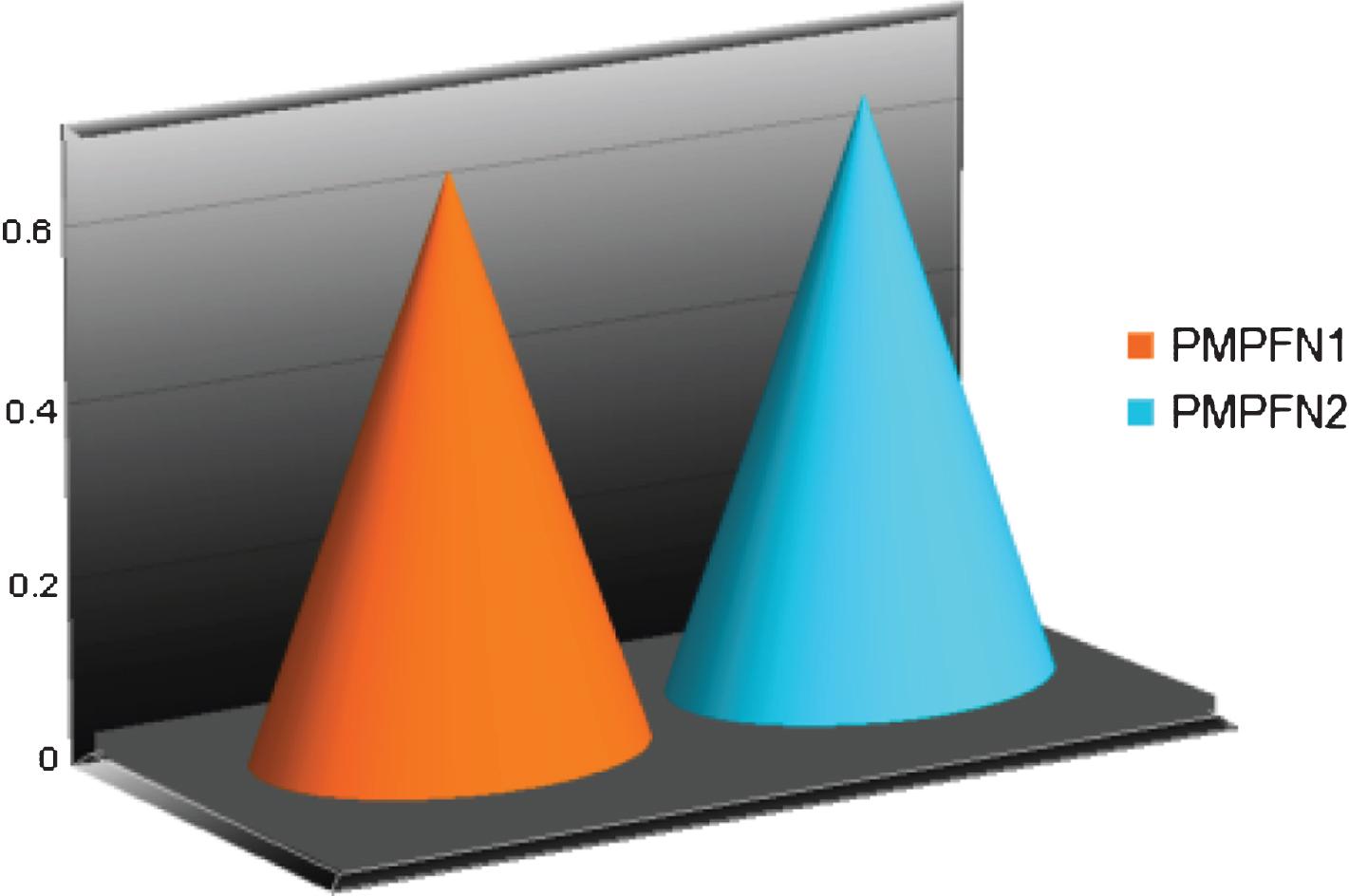
Score values of ℑ1 and ℑ2 .
In this section, we introduce the idea of Dombi operators and we discuss some fundamental properties and operations on Dombi operators in the framework of PMPFNs.
Dombi operator
Dombi operator
ℑ1 ⊕ ℑ 2 = (〈0.8223, 0.1770〉, 〈0.8086, 0.1838〉, 〈0.9439, 0.1580〉). ℑ1 ⊗ ℑ 2 = (〈0.4535, 0.5821〉, 〈0.5073, 0.5069〉, 〈0.7367, 0.4750〉). Let η = 0.9 and ϖ = 1 then we obtain η ℑ 1 = (〈0.4936, 0.5561〉, 〈0.6153, 0.2702〉, 〈0.7613, 0.4153〉). η ℑ 1 = (〈0.5462, 0.5036〉, 〈0.6639, 0.2307〉, 〈0.7975, 0.3652〉).
Pythagorean 3-polar fuzzy numbers
In this section, we utilize above idea to construct the PMPFDWAA and PMPFDWGA operators, which can be applied to the MCDM problems. We discuss some properties of these operators in the context of PMPFNs.
PMPFDWAA operator
Pythagorean 3-polar fuzzy numbers
Now we will explore some properties of PMPFDWAA operator.
□
Now we will explore some properties of PMPFDWGA operator.
In this segment, we propose the idea of MCDM under the influence of assembled PMPFD operators. A case study concerning to a census process is presented and can be improved by using the novel methodology under PMPF rules and its associated operators.
Case study
The word "census" is deduced from a Latin word "cansere" which intends "to estimate". The census is an imaginative count of some country’s population. Fundamentally, this is an authorized count or survey of the population and for property assessment. Generally, a census takes place after every 10 years, but sometimes due to some specific motives and several governmental issues this time duration increases.
The account of conducting census is prehistoric and gigantic. Mostly all the states of the world conduct census on decimal basis. A population census has both virtues and faults. Now, we are going to demonstrate a new approach for census process via PMPFDWAA and PMPFDWGA operators by applying fuzzy logic.
Significance of census process
Census process of a nation holds many exercises and benefits for the development of that nation. More or less significant tips are listed below: It detentions a extensive variety of a country’s population data and physiognomies. It has a broader coverage of a country’s population with the other variables such as housing, salary, hygiene etc. This worldwide action plan aims to attain anti-poverty goals and utilize this material in many ways for the improvement of the country such as, For eradicate extreme poverty and hunger. Achieve general primary education. Encourage gender equivalence and empower women. Diminish child mortality. Improve maternal health. Guarantee environmental health. Develop a worldwide corporation of development. Make country economically strong.
Disadvantages of existence approach
It is not guaranteed, i.e. It requires time to take the census, usually a solid month or more than that and during this time period the authentic data on the land is constantly fluctuating. Domestic heads do something give fabricated feedbacks thus compromising the data. Inaccuracies may result if the persons conducting census are not correctly prepared to avoid double counting or skipping some household.
It receives many other demerits such as, It is very expensive, •Time consuming. Labor consuming, •More arithmetical error. Held after a long time, •training issues. It has a short set of physiognomies for persons and it is very problematic to summarized and classified all the evaluated data after completing the process.
Fuzzy logic model for software construction
To reduce disadvantages we are starting to demonstrate a new approach for census process. We construct a mathematical model under fuzzy logic based on PMPFNs which will be helpful to collect the data by using a software instead of manual procedure. A software can be constructed by using fuzzy rules like a biometric systematic technique for census process. This should be an online application and every mortal receives an easy entree to it through their android mobiles or through NADRA (National database and registration authority).
The updated census form issued by the government should be available for this application and having all the necessary features for data aggregation. At that place must be a process of a sign in (login) account for every head of a family. All the people who have easy access to this application through their internet sources can fill the contour for their family with identity card numbers of all the members of the household. The masses who cannot afford all this, they can visit to NADRA to register their family’s information free of monetary value. Government should give notice to the public that they should finish this operation within ten to fifteen days, otherwise after the deadline the people who do not fill their data for census should be fined by the government. After finishing the process government can be found the unregistered identity cards easily by comparing the accumulated data and already existing data from NADRA. Due to this caution every individual gets census process seriously and register themselves before the deadline. The constructed software works on fuzzy logics as given in the Fig. 4.

Fuzzy logic model for software construction.
We use PMPFNs for data input and PMPFDWAA and PMPFDWGA operators for fuzzification and assortment of input data. We choose some particular alternatives and some specific criteria to show the modeling and this algorithm can be extendable to
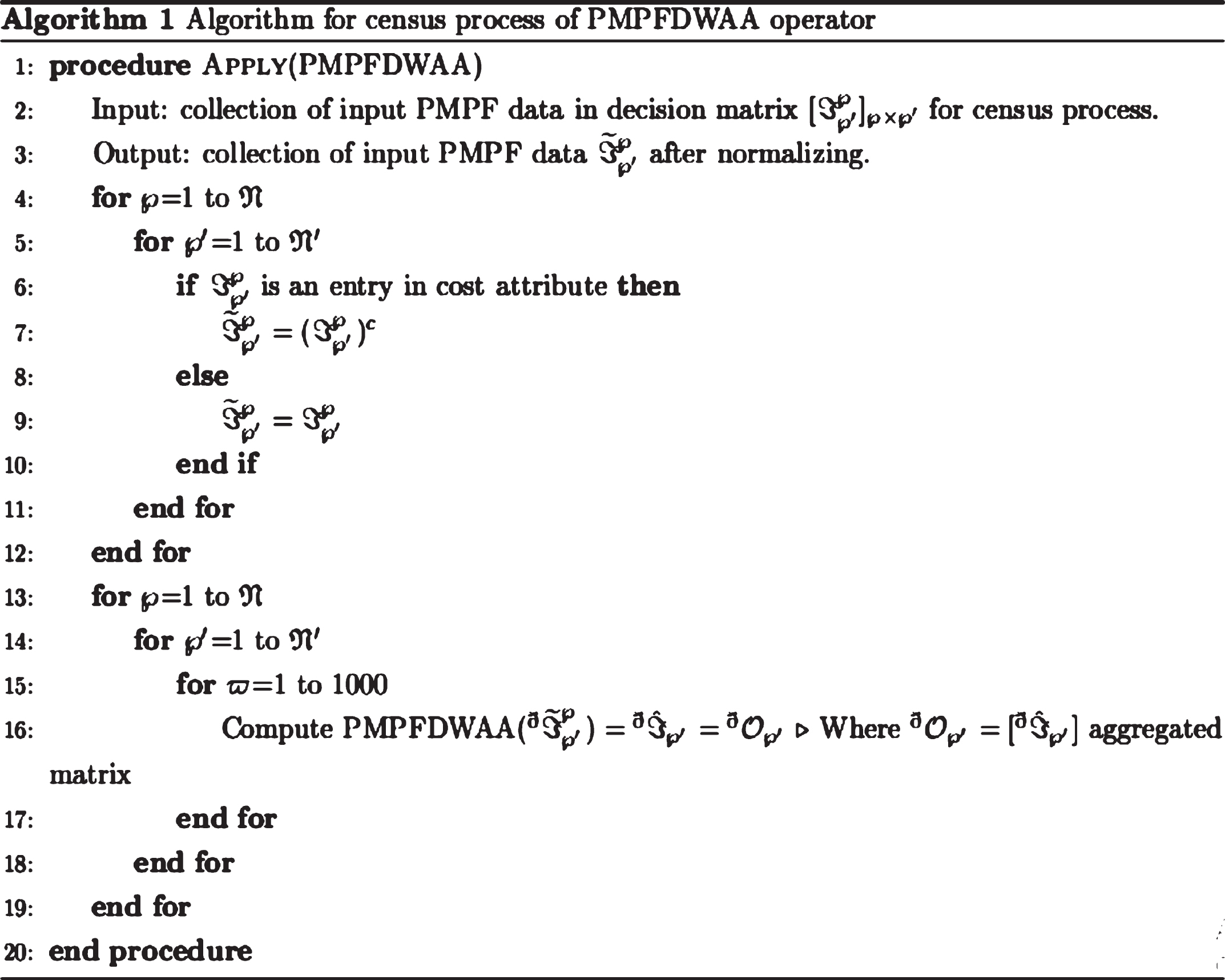
Pseudocode of proposed algorithm 1 for census process by using PMPFDWAA operator.
Suppose that a country desires to start census process in the broad spectrum of its population and other characteristics for the evolution. Initially, we choose only the economic measure for three cities
The characteristic chosen here is the economic measure of the people related to the corresponding cities. This contains the information about educational attributes, literacy, occupation, place of work, employment related information and labor force participation. The weighted vector is given as ζ = (0.6, 0.3, 0.1) such that
Input for census based on PMPFNs
•Rich
•Merely adequate
•Poor. Measure evaluation form for census consists different type of data like,
•Economical measure
•Literacy,
•Marital status
•Languages,
•Religion
•Age factor,
•Occupation
•Educational attributes.
•Information about buildings,
•Geographic and migration information,
•Information about births and deaths,
•Living quarters and related facilities,
•Employment related information,
On the same pattern for different characteristics different input tables can be constructed for the data collection and this data can be saved easily by using constructed online application for census process.
■
•For ℑ1: We take the operational parameter ϖ = 1. Then by using equation (A) we get
Similarly we can calculate
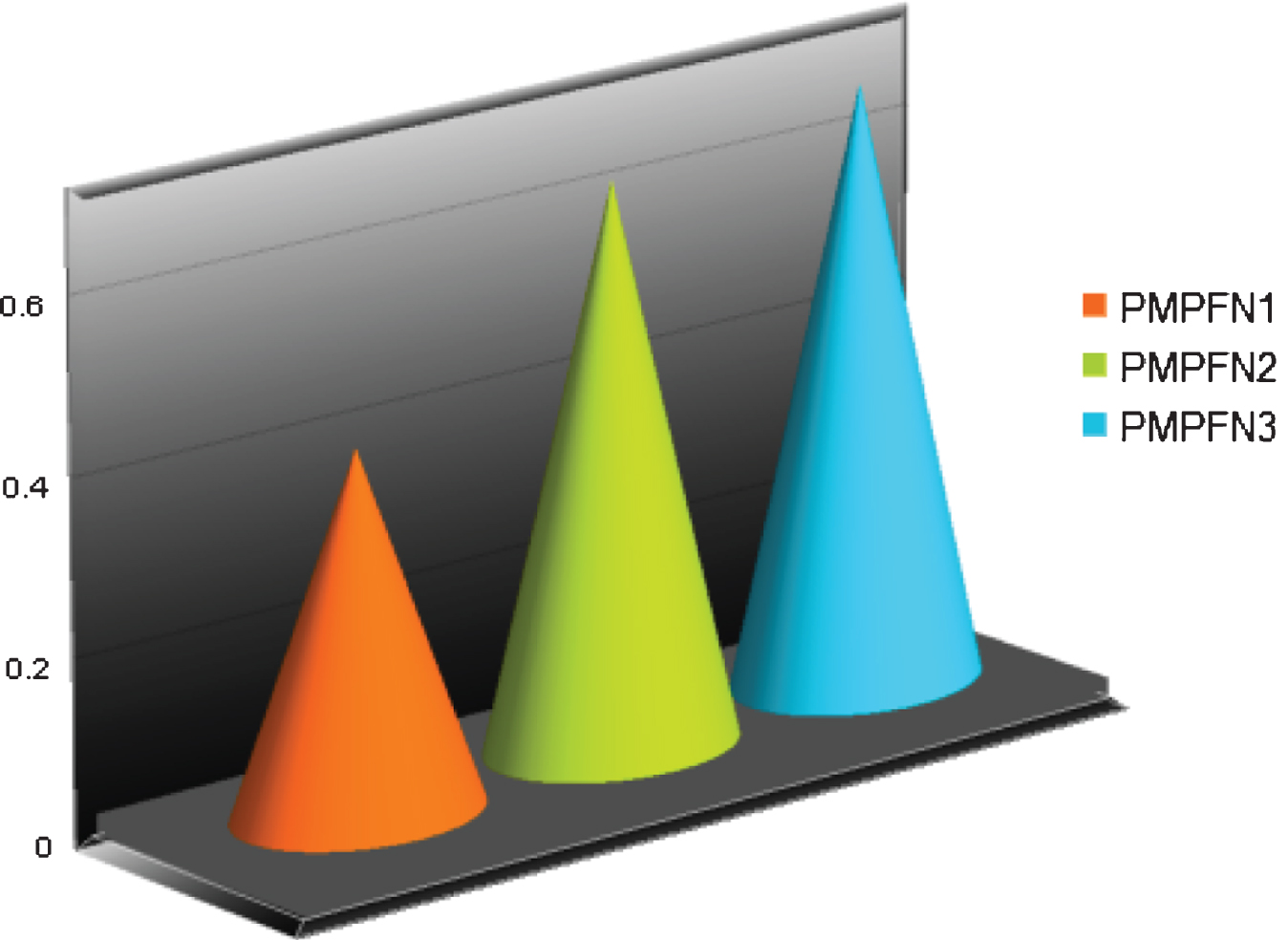
Score values for PMPFDWAA operator.
■
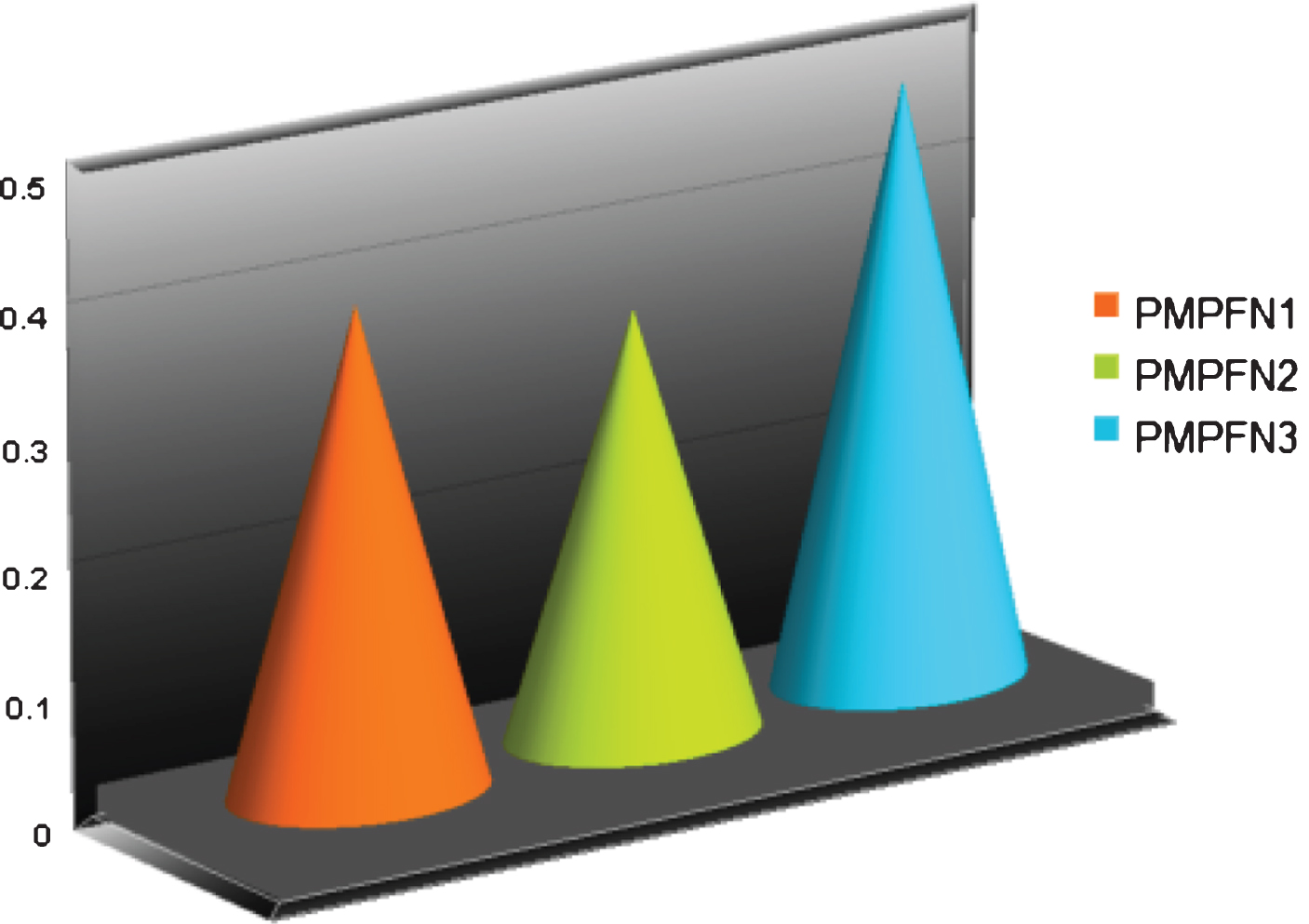
Score values for PMPFDWGA operator.
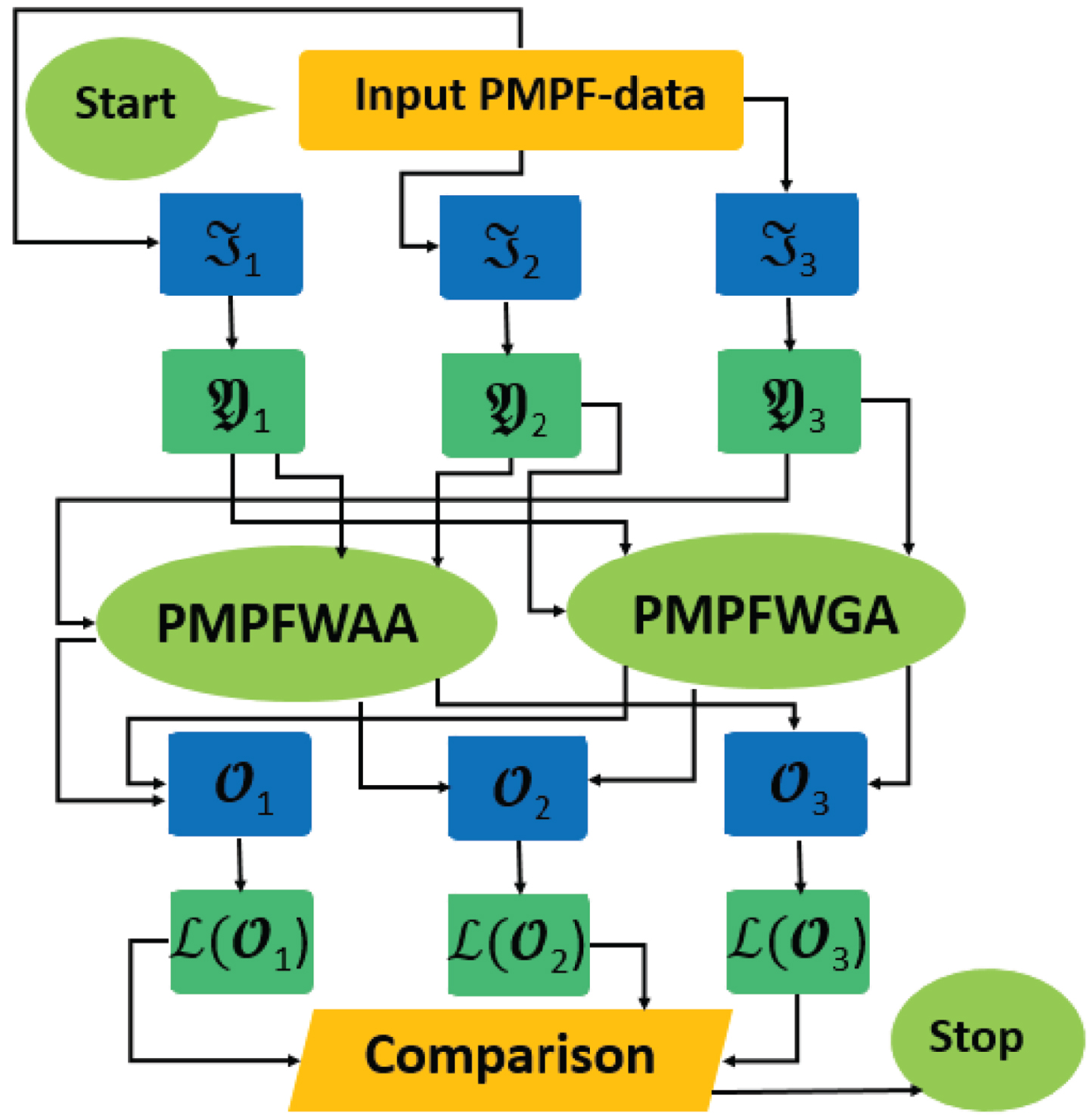
Flow chart diagram of proposed algorithm.
In this segment, we present a brief comparison between the suggested operators and see the influence of operational parameter in the aggregated outcomes. We will observe that by the convergence of the proposed approach the arithmetical error can be minimized by the given algorithm. We discuss and observe that how the staged approach is more flexible and efficient than the old method. The comparability of the previous and proposed attack is presented in tabular form as Table 10.
Validity of the method
The suggested method is valid and desirable for the census process because this approach covers many disadvantages of old method. In this approach, we can discuss about various properties and alternatives with the corresponding criteria at the same time. The data aggregation can be summed as a specific PMPF data input and this hybrid model can be employed to compile the information on a large scale. It can be used to define multivalued relations and multivalued social networks.
Comparison analysis
The proposed technique is more flexible and practical technique to deal with uncertainties and vagueness in the field of decision analysis. The proposed technique gives us best ranking methodology by using PMPFNs. Table 10 shows that the existing methodologies have some drawbacks and limitations, which can be handled by using the proposed technique for the census process. From Table 11, it is clear that PMPFS is suitable technique when the input data is available in the form of multi-polar (paired) information.
Comparison analysis
Comparison analysis
Comparison of PMPFS with existing structures
We calculate the aggregated PMPFNs for different values of operational parameter ϖ from the input PMPF-data and will see the behavior of the operator by analyzing their score values. The values are given in tabular form as Tables 12 and 13. The parameter ϖ has no consequence on the ranking results of PMPFDWGA. This signifies that the obtained ranking results from PMPFDWGA operator are not sensitive to the parameter ϖ. While, the ranking results are sensitive to ϖ for the PMPFDWAA operator. When the value of ϖ increases, then ranking of the city changes and after that for a very large value all the ranking becomes similar. The answers show that PMPFDWGA is more elastic and desirable for the MCDM problems. The combined ranking results of both operators for different values of parameter ϖ can be seen from Figs. 11 and 12.
Ranking order of PMPFDWAA for ϖ
Ranking order of PMPFDWAA for ϖ
Ranking order of PMPFDWGA for ϖ
It is observed from the Table 13 that when the value of the operational parameter ϖ increases, then score values converges to some specific point. This demonstrates that due to increase in ϖ our approximations converges to the actual values and to a very large value of ϖ all approximated values approaches to real values and statistical error approaches to zero. At some time for very large values of ϖ we get no effect on score values and all the obtained values remains constant. Thus by applying this novel technique we can manage and solve the disadvantages and uncertainties of manual data aggregation. (Actualvalue - Approximatedvalue) →0 when

Ranking results for PMPFDWAA operator.
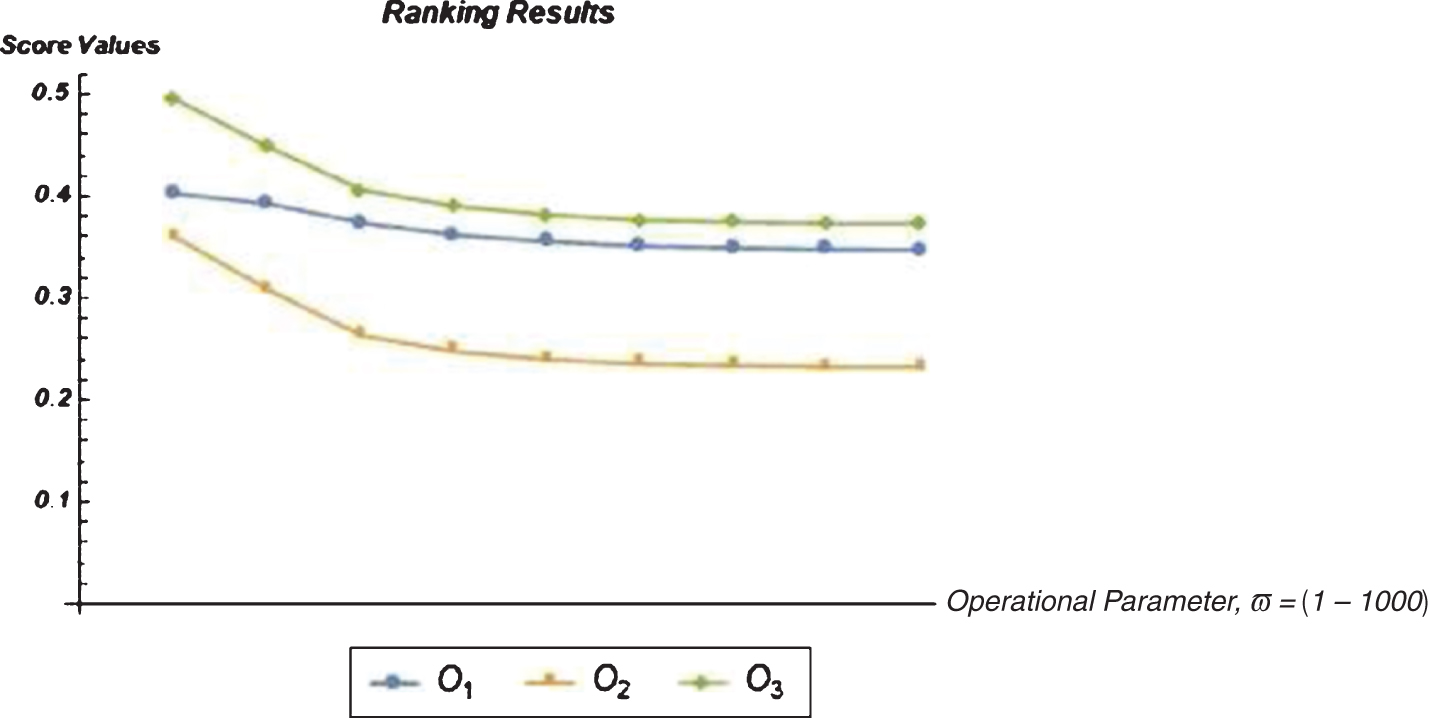
Ranking results for PMPFDWGA operator.
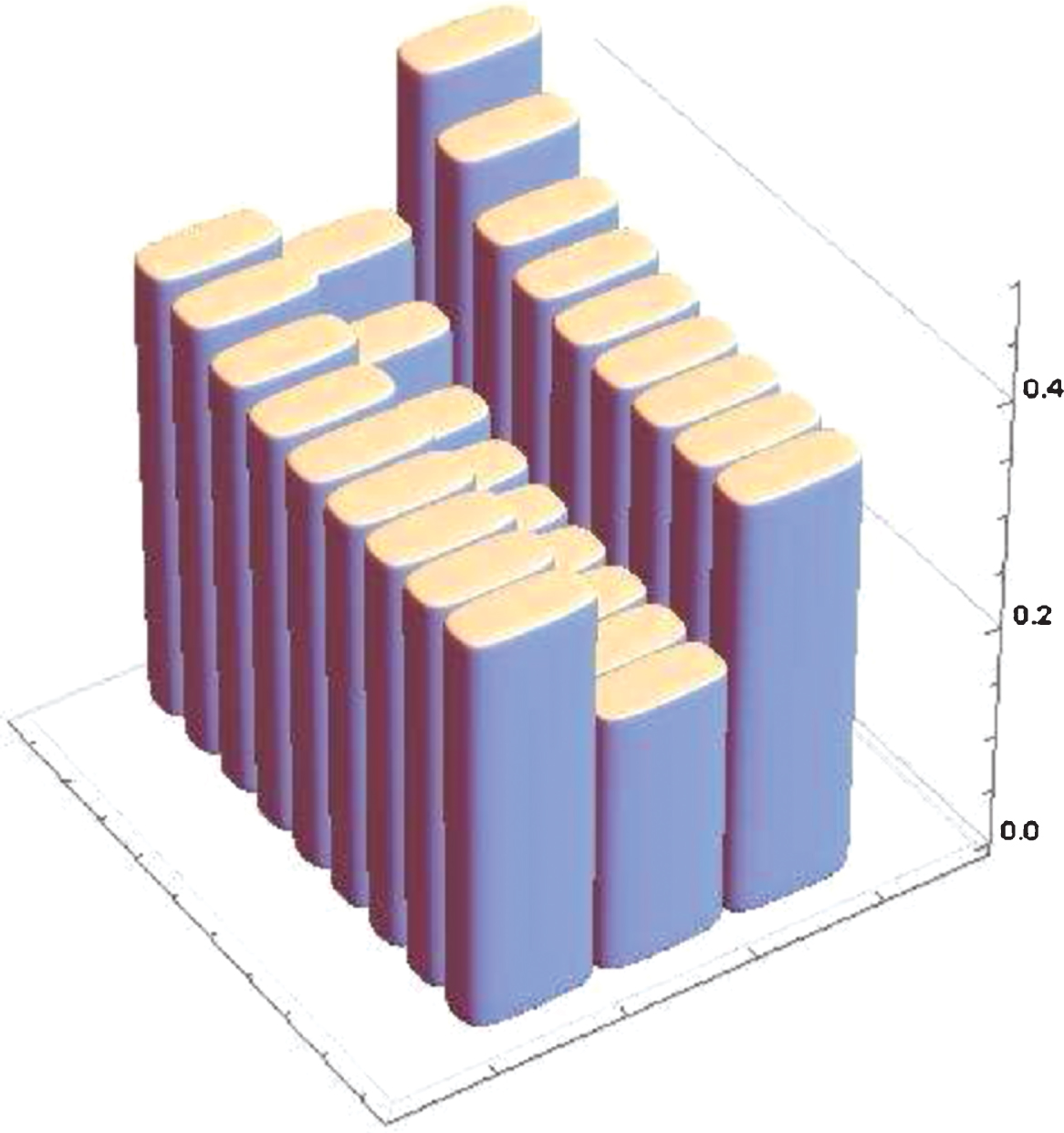
Ranking results for PMPFDWGA operator.
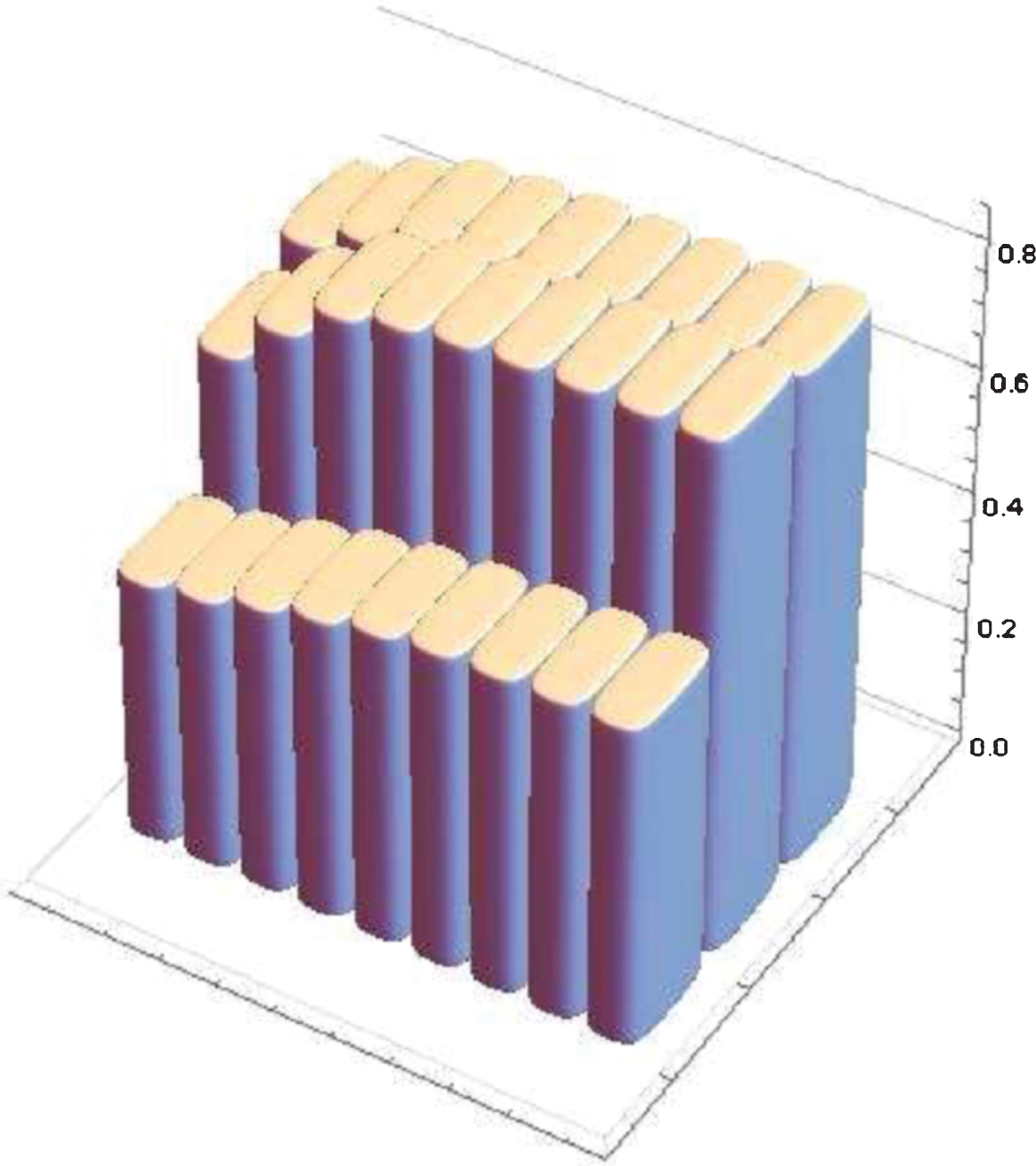
Ranking results for PMPFDWAA operator.
Finally, we will discuss about the sensitivity of the proposed operators and can be seen from Table 14. The PMPFDWAA operator is more flexible to its related attributes and specially for operational parameter ϖ for the information fusion. We observe that the previous calculations that changing the values of ϖ affects the aggregated result of PMPFDWAA operator. On the other side, PMPFDWGA operator is not sensitive to ϖ because by varying the values of ϖ results remains same from ϖ = (1 - 1000). This operator only converge to the actual conditions and remove ambiguities. The graphs are broken to ensure the changing in aggregated score values of all the attributes for different ϖ.
Sensitivity of operators to parametric values
Sensitivity of operators to parametric values
From the prevailing ideas of MPFS and PFS, we have introduced a novel concept of PMPFS. We have introduced some fundamental operations on PMPFSs and explained these concepts with the help of illustrations. With this novel perspective, we have developed modified forms of Dombi’s aggregation operators named as Pythagorean m-polar fuzzy Dombi weighted arithmetic average (PMPFDWAA) operator and Pythagorean m-polar fuzzy Dombi weighted geometric average (PMPFDWGA) operator. We have discussed certain properties of the proposed operators based on PMPFSs. For the best ranking of alternatives in the multi-criteria decision analysis based PMPFNs, we have introduced score function, accuracy function and certainty function. A case study concerning to a census process have been presented with the help of proposed PMPFDWAA and PMPFDWGA operators. We have presented a brief comparison analysis between the existing and proposed technique. We have explained the influence of operational parameter to obtain aggregated outcomes. In future, this work can be gone for different type of hybrid structures and decision-making problems.
Footnotes
Appendix A:
Appendix B:
. We substitute ℑ℘ =ℑ