



Abstract
The advance of “One Belt One Road” initiative and “Internet+” strategy have greatly promoted the development of cross-border e-commerce in the past several years. To gain global competition, the small-and-medium-sized enterprises(SMEs) have focused on the revenues and risk. However, most previous studies have focused on consumer perceived risk, while neglecting the importance of sellers’ risk. It is the aim of this article to address the following question: With growing customer requirement in global marketing competition, customer requirement plays an important role in the successful design of SMEs risk mitigation solution as SMEs’s performance is highly determined by customer satisfaction in the customer-oriented market. How to identify the most important risk factor of cross-border e-commerce SMEs based on influence of consumer requirements? Therefore, to balance the mutual interests in cross-border e-commerce online transactions. In order to achieve these objectives. We analyse cross-border e-commerce SMEs’ risk factor and develop a hybrid method for risk evaluation and ranking, named Kano-fuzzy-DEMATEL. This new method offers a more accurate way to calculate the degree of relation among each risk factor considering the influence of consumer requirements and deal with uncertain information on risk evaluation, as to determine the risk priority for cross-border e-commerce SMEs. The ranking of risk factors can provide basis for decision-making and improve the accuracy of prediction. We supplement existing e-commerce research to assess the overall risk factors from the seller’s perspective based on the customer requirement. The study can provide comprehensive insights to mitigate risk.
Keywords
Introduction
Cross-border e-commerce as a burgeoning model has rapid development in the past few years. According to Accenture’s predictive report, the global market share of cross-border e-commerce will increase to $1trillion by 2020. There will be more than 900 million online consumers all over the word. In additon, cross-border e-commerce is already a new online market for SMEs. A PayPal-commissioned report revealed more than 130 million customers all over the world spend $300 billion during the cross-border online transaction in 2018. China has become the largest cross-border e-commerce market and online export volume will up to $245 billion in 2020. The most important problem restricting the development of cross-border e-commerce is that the risk can lead to a huge loss. This risk is affected by many factors. For example, US-China Trade Friction was a shock to cross-border e-commerce SMEs. It have created enormous tariffs risks to cross-border e-commerce SMEs. In addition, legal institutions on e-commerce intellectual property are not complet. The virtual network and remote transaction increase the intellectual property risk. It’s the leading cause of cross-border e-commerce SMEs losses in US-China Trade Friction.
Cross-border online transaction have a higher risk than the domestic e-commerce, because of the highly asymmetrical information between international buyers and sellers that can result from legal enforcement inefficient, culture difference, and high transport costs in cross-border trade [1]. However, it is notable that most of the previous studies have paid attention to consumer perceived risk, the buyers were assumed at a relative disadvantaged position relative. Only a few studies explored fraud risk from e-commerce seller’s perspective, which assume the consumer has opportunistic behavior [2, 3]. There are complex correlations among the seller’s risk factors, which may have impact on risk factors’ priority decision making. The ignorance of the correlations among risk factors will lead to miscalculations of risk factors’ priorities. In addition, with increasing customer requirement in global marketing competition, customer requirement plays an important role in the successful design of SMEs risk mitigation solution. Because SMEs’s performance ultimately depends on customer satisfaction [4]. The overall risk factors’ priority is determined by each customer requirement’s satisfaction level. We can divide customer requirements into different Kano categories and customer requirements in different categories contribute to risk differently [5]. Kano categories of customer requirements are introduced to the design of risk factors evaluation to maximize the customer satisfaction and improve the accuracy of risk evaluation. There has been a lot of research on risk assessment. The detail of existing researches is described in Section 2. Present risk identification and assessment methods can be divided into three categories. First of all, the qualitative method is important in this field, e.g., Facilitated Risk Analyze Process, Hazard Impact Analysis. Second, quantitative method, e.g., MCDM, fuzzy logic [6], TOPSIS [7], Single-time Loss Algorithm. The third type is hybrid (semi-quantitative) risk assessment method, e.g., AHP, FMEA, DEMATEL. With the advance of One Belt One Road initiative, the number of risk factors will increase. The hybrid method should be applied to cross-border e-commerce SMEs risk assessment. In additon, most of the methods assume that the factors are independent, but this assumption is not suitable for the practical problems [8]. Because risk factors of cross-border e-commerce SMEs are very complex which are not independent, they constraint and interact mutually. The customer satisfaction affects the SMEs’ risk who have less resistance to risk than large enterprises [9].
To bridge the research gap mentioned above, we need to build a method that can identify the importance of the risk factors considering interconnections among the seller’s risk factors and external impact of customer requirements. Decision-Making Trial and Evaluation Laboratory (DEMATEL) is one of the semi-quantitative methods that can solve the dependence and causal relation among the factors. We analyze the internal relationship between risk factors using DEMATEL. However, traditional DEMATEL method require experts to give precise values to determine the level of influences. There is a certain fuzziness and subjectivity in expert thinking. It is difficult to judge the interaction between influences accurately. To overcome the above defects. We propose fuzzy method. The experts don’t have to assess the objective by exact values, they can give a range to the assessment result. Fuzzy language variables is quantified by using triangular fuzzy numbers. Therefore, we use Kano-fuzzy-DEMATEL model to identify the important risk factors of cross-border e-commerce SMEs. The motivation of the Kano-fuzzy-DEMATEL method can be explained as three aspects: Adapting triangular fuzzy number to quantify the uncertain information in risk assessment; Calculating degree of relation among the risk factors by DEMATEL; Kano model is used to discover the weight of customer requirement and improve final rankings. This new method offers a more objective and accurate way to determine the risk priority for cross-border e-commerce SMEs. The ranking of risk factors can provide basis for decision-making.
The paper is organised as follows: First, we made literature review about cross-border e-commerce risk assessment; The related concepts in our article were presented in Section 3; Section 4 provided an introduction of hybrid Kano-fuzzy-DEMATEL model and its calculation process; Section 5 illustrated the application of the Kano-fuzzy-DEMATEL model on a cross-border e-commerce SME; Section 6 compared the risk ranking of Kano-fuzzy-DEMATEL model with the DEMATEL method and discussed the final results; Finally, Section 7 give the main conclusion and next research direction at the end of the paper.
Literature review
Previous research in e-commerce show customer satisfaction and perceived risks are the major decisive factors for online transaction. e-commerce risks refer to the factors may lead to some negative effects which usually caused by the highly asymmetrical information between the buyer and the seller [10]. The extant literature in e-commerce mainly focused on the online transaction risk of buyers, the buyers are often viewed as risk takers subjected to the opportunistic behavior of sellers durning the online transaction [11]. The perceived risks of buyers, such as poor product quality, lack after-sales service and credit card information leak. They might reduce buyers’ desire to buy [12]. Customer satisfaction is regarded as basis for the relationship formation between buyer and seller in successful online transactions [13]. However, sellers as an important participant, also have risk durning the online transactions. Guo assumed buyers also have the opportunism motivation, sellers have to face the risk of chargeback fraud which brings a loss from refund and no returned goods are received [14]. Namsup Lee proposed an online chargeback fraud detection method which modeled the transactions by the method of recurrent neural network and integrated charge and purchase characters in an eigenvector [15]. In addition, the existing literature of e-commerce risk are applicable to this situation that both sides of transaction are in the domestic market. The risks are higher in cross-border e-commerce. Due to the high degree of complexity and uncertainty, cross-border transactions have to face plenty of difference, such as culture, language, and legal enforcement, which increase risks of cross-border transactions, especially for SMEs. Thus, cross-border e-commerce is more complex and risky than the domestic online transaction. Risk factor discernment system is harder to establish in the cross-border context.
Some researchers developed qualitative and conceptual frameworks to propose general measures to assess and mitigate the key risks. Ladislav described specific steps used in risk analysis of SMEs based on the facilitated risk analysis process (FRAP) and BITS methodology [16]. Laurie discussed the links between hazard, risk and vulnerability (HRV) analysis and the mitigative risk strategies [17]. Quantitative approaches are widely applied in risks assessment to address the prioritizing problem of risks and mitigation strategies. Almeida aimed to diagnose the state of the art and identify research directions of multicriteria models applied in risk management [18]. Mohammad described the development of a fuzzy decision support system (FDSS) for the assessment of risk in E-commerce development. A risk analysis model using a fuzzy set approach is proposed and incorporated into the FDSS [19]. Peng initiated a new axiomatic definition of single-valued neutrosophic distance based on MABAC, TOPSIS and new similarity measure with score function [20]. Hybrid (semi-quantitative) risk assessment method has been applied in risk assessment to mix qualitative and quantitative approaches to research risk analysis. Wang proposed a hybrid model based on Analytical Hierarchy Process (AHP) to assist E-Commerce practitioners to analyze the security of information flow, capital flow and logistics [21]. Tsai described FMEA fails to identify the influence factors and the factors being influenced. Decision-Making Trial and Evaluation Laboratory (DEMATEL) facilitates the determination of cause and effect factors by identifying the causal factors that should be prioritized, prompt and effective solutions to core problems can be derived [22].
Even though the existing studies provide meaningful insight for risk assessment, there are mainly three limitations. First, most of the methods assume that the factors are independent, but risk factors of cross-border e-commerce SMEs are very complex which are not independent, there is a lack of consideration on internal correlation of risk factors. Second, researchers generally focus on risks management and seldom incorporate customer requirements, whereas it is critical for SMEs to improve competitiveness through providing appropriate product or service to fulfill the identified customer requirements. Third, there is a lack of method to overcome the subjectivity of expert score and determination of important factors in traditional DEMATEL method. This study aims at addressing these limitations with an integrated approach to incorporate customer requirements into risk evaluation to mitigate risk with maximized customer satisfaction. In order to achieve these objectives, we develop a hybrid Kano-fuzzy-DEMATEL method for risk evaluation. This comprehensive method has few attempts before.
Related concepts and problem statement
Cross-border e-commerce operating model
Cross-border e-commerce SMEs usually operated with the help of cross-border e-commerce platform. Such as Amazon, ebay and Dhgate. Cross-border e-commerce platform is a bridge connecting enterprises and consumers. It’s an intermediary that provides information, product and service to consumer and enterprise. It can be divided into B2B platform, B2C platform and C2C platform according to merchant and end-users types; It can be divided into cross-border import platform and cross-border export platform according to import and export direction; It can be divided into proprietary platform and open platform according to core operations. Specifically, it includes three major components: First, the various participants exists in cross-border e-commerce platforms, such as manufacturers, sellers, service providers, relevant government services and regulatory authorities. The second is industrial connection which connect the participants effectively. Third, the resource elements, that is hardware resource and software resource in order to realize the sustainable development of the platform, including policies, laws, economic humanities, technical equipment and human resources. Of these, the industry chain is core elements which connect the participants and promote resource collaboration. It includes production, order, pay, logistics and regulatory. The manufacturer is the overseas commodity manufacture enterprise, mainly adopts the form of saling to websites or website direct sale. The ordering system is mainly carried out through the e-commerce platform. Payment is an important link in cross-border e-commerce platform, including domestic payment and cross-border payment. The common form of domestic payment are online banking, quick payment, third-party online payment. Cross-border payment involving exchange rate normally use credit cards and third-party online payment. The logistics system plays a major role in cross-border e-commerce platform, such as postal business, international express business, bonded delivery, and overseas warehouse delivery. Customs and commodity inspection are considered as necessary to guarantee platform normal operation. Meanwhile, a kind of specialized service organization appeared, such as information navigation and integration service.
Kano model
The Kano model is the most common method for expressing users’ attributes. It shows the nonlinear relationship between product property and customer satisfaction through the user’s different attitude whether a function exists. According to the relationship between different characteristics and customer satisfaction, the characteristics of a product or service are divided into five categories: like, must be, neutral, live with, and dislike. When customer faced the existence or absence of product function, there are five attitudes to make a decision, as shown in Table 1.
Kano’s question pair
Kano’s question pair
The results of two attitude dimensions will put into one type of attribute. There are six categories: Must-be, One-dimensional, Attractive, Indifferent, Reverse and Questionable. Kano category determines the contribution of customer requirements to customer satisfaction, it is necessary to quantify customer satisfaction. Based on the change of customer satisfaction’s value, the approximate function can be described, which is used to quantify according to customer requirement’s Kano category [23]. The nonlinear relationship between the existence or absence of a function and customer satisfaction as shown in Fig. 2.
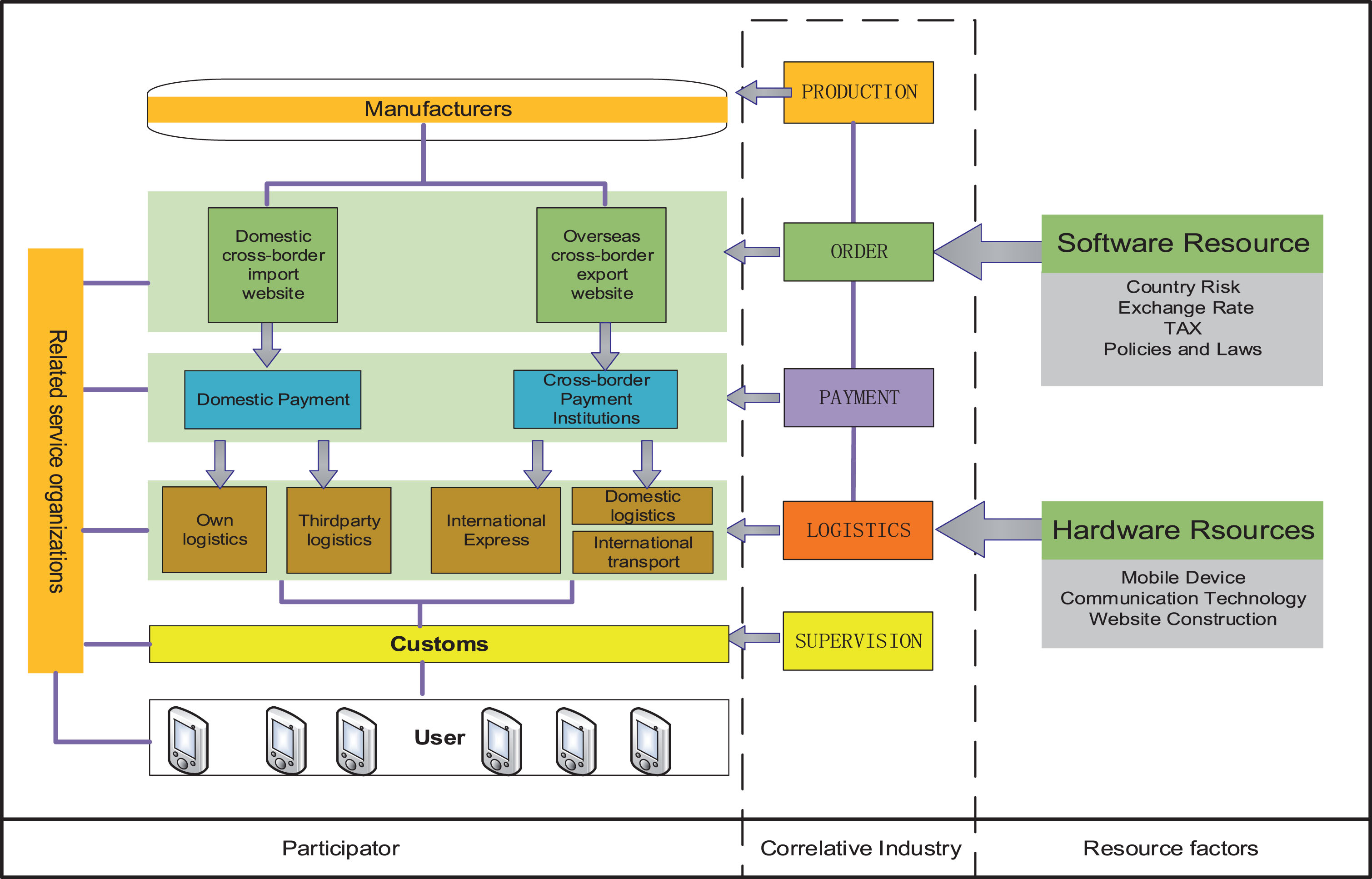
The architecture of cross-border e-commerce platforms in a layered view.
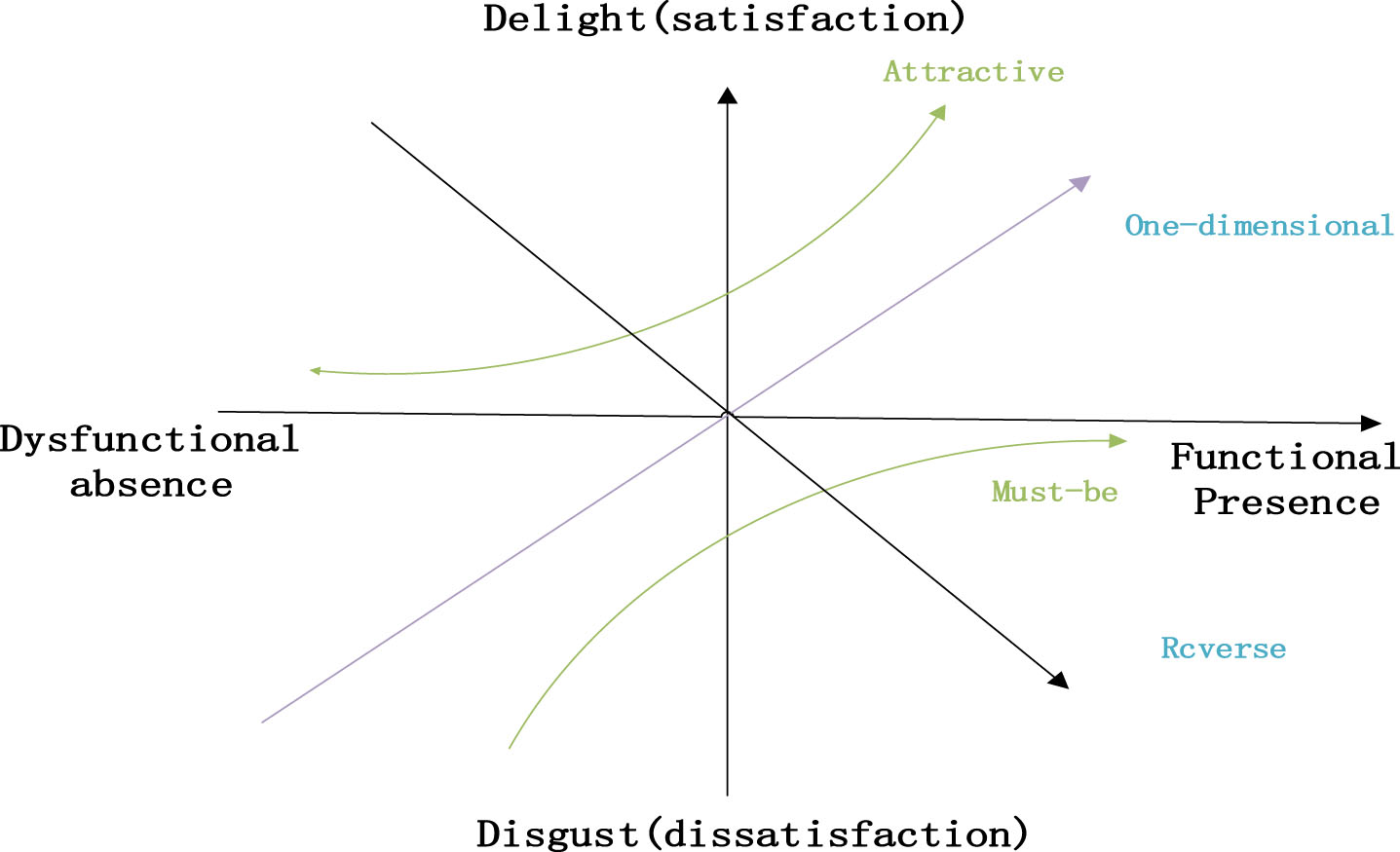
Customer satisfaction based on Kano model.
The fuzzy set theory was firstly proposed by Zadeh in 1965. We can extend research object from the certain phenomenon to the fuzzy phenomenon through fuzzy set theory. It is widely used in management decision [24]. The fuzzy set theory can reasonably explain the inaccurate and incomplete information problem. Enterprise data information is quickly updated under e-commerce that even the experts in that field have understand deviation [25]. Their judgments and preferences tend to be ambiguity enough to use exact numerical estimate. Angle fuzzy set is also called triangle fuzzy number. It is very intuitive due to that it converts the expert evaluation from fuzzy language to a specific value, effectively reduce the subjective differences [26]. Some basic definitions about fuzzy set are described below.
Where 0 < l ≤ m ≤ r, l and r indicate lower value and upper value of fuzzy number respectively, and m is stand for the maximum probable value.
Fontela first proposed DEMATEL(Decision Making and Trial Evaluation Laboratory) in 1971, The method combined graph with matrix to analyze system factors synthetically. It is an effective method to analyze the complex relationships among influences. The most basic function is to select the key factors of the system by integrating the centrality and causality of system factors. Centrality indicates the status and role of factors in the system. Causality reflects whether the system factor is cause or result. The DEMATEL method can calculate the cause and effect of each factor and select the most important factors. The process of DEMATEL is described in Fig. 3. However, traditional DEMATEL method require experts to give precise values to determine the level of influences. There is a certain fuzziness and subjectivity in expert thinking. It is difficult to judge the interaction between influences accurately. Conventional causal mapping has strong subjectivity.

Process DEMATEL flow.
The rise of cross-border e-commerce platforms, such as eBay and DHgate, has allowed SMEs to sell products online in wordwide market. These SMEs try to ward off fierce competition in domestic markets and to seek a commercial opportunity in cross-border online transaction. Cross-border transaction brings more challenges owing to the enormous differences in culture, language, and legal institutions between countries. In cross-border e-commerce, there are high information uncertainty among transacting parties. In domestic e-commerce risk studies, chargeback fraud is major risks faced by SMEs. Which refers to consumer demand a refund for delivered goods without returning the product based on made-up excuse [27]. Compared to domestic online transaction, the risk of cross-border e-commerce is more complex. Because SMEs face more challenges to international logistics, there are higher risk of payment in cross-border online transaction. For example, cross-border logistics is easy to delay and make mistakes. In additon, it is more likely to be affected by external factor, such as national risk, exchange rate, and tariff. Therefore, We need a more effective method to identify and evaluate risk factor for cross-border e-commerce SMEs and improve customer satisfaction. We assess the overall risk factors from the seller’s perspective based on the customer requirement and balanced the risks of both sides to maintain online transactions, as to determine the risk priority for cross-border e-commerce SMEs.
The proposed model and methodology for risk factors analysis
Based on the research gaps of risk assessment discussed in Section 2 and the relevant definitions of integrated approaches mentioned in Section 3. We extend the traditional DEMATEL method to deal with qualitative and quantitative criteria in cross-border e-commerce SMEs risk assessment in our study. In the method, DEMATEL adopts a composite influence matrix to discover causal relationships among the risk factors. It solves the dependence and causal relation among the factors. The fuzzy set theory is employed to deal with uncertain information in expert risk evaluation, we get the importance of each customer requirement based on the Kano model. We present a hybrid Kano-fuzzy-DEMATEL model to select the important risk factors of cross-border e-commerce SMEs. This method is intended to be used by cross-border e-commerce SMEs’ managers when they attempt to analyze the key risk factors to mitigate risks and fulfill customer requirements. As described in Fig. 4, the proposed approach is composed of two phases: Phase I for customer requirement analysis based on Kano model to determine the weight according to the influence of customer requirements on satisfaction. Phase II for risk factors evaluation based on Fuzzy and DEMATEL to determine the final important weight of risk factor. There are two main lines in this phase. The first one is constructed to link customer requirements and risk factors, calculating the initial important weight of risk factor to identify the importance of risk factors under the external influence of consumer requirements. The second aims at identifying the internal relationships among risk factors by the influence-important weight of risk factor. Both of two main lines combine to determine final important weight of risk factor. On this basis, we get the importance ranking of risk factors.
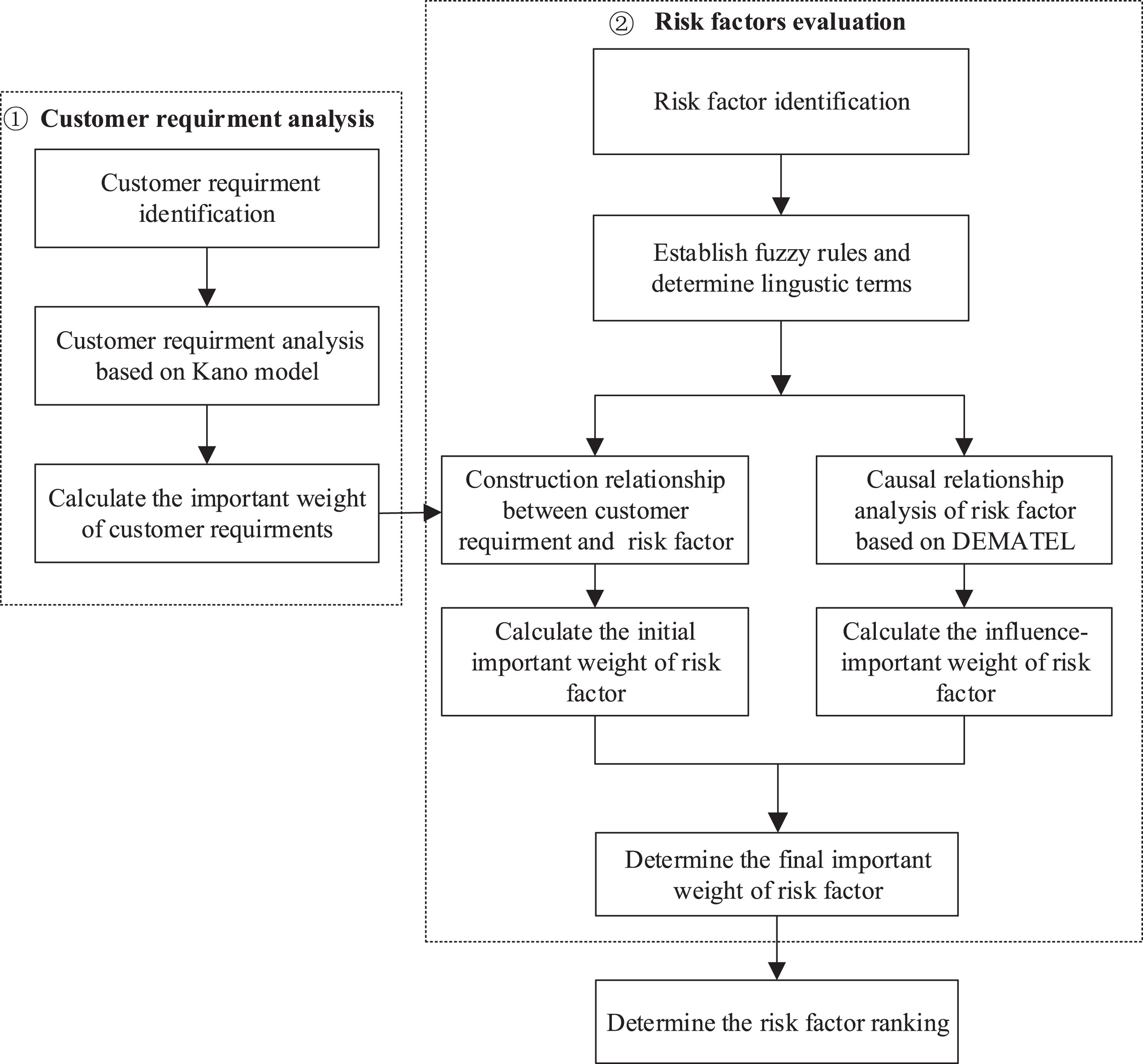
Steps of the proposed approach.
With growing customer requirement in global marketing competition, customer requirement plays an important role in the SMEs risk mitigation solution. SMEs’s performance is largely determined by customer satisfaction. The overall risk factors’ priority is determined by each customer requirement’s satisfaction level. Customer requirements can be classified into different Kano categories which are introduced into risk factors evaluation. We need to calculate the important weight of customer requirements to measure the different impacts on risk. Thus, the starting step of risk factors evaluation should involve capturing customer requirements. We select the key customer requirement based on the literature research and practical investigation first, then analyze the customer requirement to determine importance weight of customer requirement based on Kano model.
Identification of customer requirement
The SMEs can improve their competitiveness to fulfill the customer requirement and enhance customer satisfaction. In addtiton, it mitigate risks from customer dissatisfaction. The major customer requirements are identified based on characteristics of cross-border e-commerce. It can be derived into five categories, including online trading, payment, logistics, policy and culture. Kumar investigated that the adoption of e-commerce and improved customer satisfaction have a direct link. Low cost of product raised customer satisfaction if product quality meet consumer expectation [28]. The customer service variables were classified into four stages by Kursunluoglu. Such as atmosphere, incentive, encounter, payment. The customer payment security affected customer satisfaction which were tested through multiple regression analyses [29]. Zhang indicated strong, positive, and direct relationships between flexible logistics and customer satisfaction using structural equation modeling [30]. Gomez examined options available to policy makers to boost cross-border online transaction in the EU Digital Single Market. The security of payments systems is a significant driving force for EU e-commerce. Norizan Kassim showed that cross cultural have a significant impact on customer satisfaction through a survey method [31].
Customer requirement analysis based on Kano model
The two dimensions according to a function presence or absence will put into one type of attribute. There are six categories: Must-be, One-dimensional, Attractive, Indifferent, Reverse and Questionable. As shown in Table 2. The concrete explanations of each category can be described. Must be (M): The customer satisfaction will not be improved if the property exists, but the customer satisfaction will drop sharply if it does not exist. One-dimensional (O): The customer satisfaction will be improved if the property exists, the user will not be disappointed if it does not exist. Attractive (A): The user satisfaction will have a greatly improved if the property exists, the user will not be disappointed if it does not exist. Indifferent (I): It means there will be no impact on the user satisfaction whether the property exists or not. Reverse (R): The user satisfaction will drop if the property exists. The Kano model provides different categories to represent the corresponding requirements under different attitude dimensions.
Kano’s evaluation
Kano’s evaluation
Based on Kano survey of customer requirements, the important weight of customer requirements can be derived via Equations (4–7) [32]. GRW
i
denotes importance weight of customer requirement.
We identify the key risk factors for SMEs’ risk evaluation. The direct impact relationship between risk factors is scored according to the evaluation of expert group. Adapting triangular fuzzy number to quantify the uncertain information in expert risk assessment. We analyze relationship among risk factor based on DEMATEL. Then determine the final importance of risk factors by introducing the weight of customer requirement influence which we obtain from relationship construction between customer requirement and risk factor based on the above customer requirement analysis.
Identification of the potential risk factor
Cross-border e-commerce SMEs risk refers to potential danger or loss caused by the information asymmetry and the change of external environment. Cross-border e-commerce activities involve a variety of links, such as internet information, online trading, payment platform and logistics. In addition, It will be affected by policy, economy, culture from different countries. Each link has different levels of potential risk. Previous studies have investigated the risk factors of cross-border electronic commerce from different perspectives. On the SMEs sellers side, most of these studies centered on consumer fraud risk [33–35]. The structural equation model was used to extract electronic customs clearance risk, legal risk, network marketing risk, payment risk, logistics risk and credit risk [36]. Gomez indicated that consumer differences, cross-border payment, logistics and credit security can affect operating models of cross-border e-commerce. Greenstein draw an analogy between the risks of e-commerce and the problems of the biological immune syste. Considering various risk factors as antigens, an e-commerce risk assessment model based on antibody concentration was proposed. Tansakul summarized five types of risk: business model risk, the logistics model risk, network architecture risk, application architecture risk and management risk, then analyzed the risk of cross-border electric business platform by using the AHP method [37]. Various indicators used to assess risk of cross-border e-commerce SMEs have been described in previous literature.
Determine fuzzy rules
Relevant risk factor was collected in the above section. We can define the major element. Then the value of 0–4 is used to represent the direct influence intensity between factors, where 0, 1, 2, 3 and 4 represent “very low influence”, “low influence”, “medium “, “high influence” and “very high influence” respectively. Table 3 show the linguistic terms and their fuzzy numbers used for evaluating the risk factors. The direct impact relationship between risk factors is scored according to the evaluation of expert group. The center of gravity method is used to defuzzification. Because the center of gravity method is simple and does not need to consider the preference of decision makers [38]. Therefore, we use the method to transform the triangular fuzzy number into a clear number for the next matrix operation. x* represents the specific value obtained after Equation (8).
Commonly used linguistic variables expressed in triangular fuzzy numbers
Tracing the relationships between customer requirement and risk factor may be very confusing, because each customer requirement may influence one or more risk factor. Experts are invited to use the triangle fuzzy number in Table 3 to express the relationship strength between customer requirement and risk factor. The matrix R is used to represent the relationship between customer requirement and risk factor. The results is standardized by Equation (9). After obtaining the relation matrix for customer requirement and risk factor, the initial weight of risk factor can be calculated following Equation (10).
First, we should establish the direct impact matrix. The direct influence matrix is established to reflect the direct influence relationship between two factors, where n is the number of factors; and x
ij
express the direct influence of element i on element j, x
ij
represents the direct influence of factors. At that time, let the influence of the factors on themselves be 0, so that all the elements on the main diagonal of the matrix X are 0. Let’s assume the number of experts is P, evaluation matrix for each expert is is
The direct impact matrix is standardized by Equation (12). Get the normalized matrix G. The formula make sure that one of the rows and columns will be normalized at least. It improves the accuracy of calculation.
Then, calculating the total influence matrix. T is generated by G (I - G) -1, and can be treated as comprehensive impact matrix. Centrality and causality can be calculated from T.
We determine the centrality and causality. Each row of comprehensive impact matrix was summed to obtain the value indicated by f, and the summation of each column obtain the value indicated by e. CE
j
is the centrality which denots the importance of the factor in the system. The larger centrality value implies the more important of the risk factor. meanwhile, CA
j
denots the causality, if the value of causality is positive, the risk factor tends to affect other factors. It is generally regarded as a cause, and a negative value implies the risk factor is easy to be affected by other factors, which is considered as an effect.
The causal diagram of risk factors can be depicted based on the value of centrality and causality. The centrality can be regarded as the importance in the system. and the causality is viewed as the effect in the system. The value of centrality is distributed on the abscissa. The value of causality determines the position of ordinate. The risk factors are categorized into two groups. If the value of causality are positive, it falls into cause group. Which implies the risk factor is easy to influenc other factors, can be considered as a cause. If the value of causality are negative, it falls into effect group. Which implies the risk factor is easy to be influenced by other factors. The causal diagram makes causal relationship among risk factors visible. Based on centrality and causality, risk factors’s influence-importance can be determined by Equation (18). The normalized influence-importance is calculated by Equation (19), which indicates the predominance among risk factors.
Based on the analysis results with Kano model and DEMATEL, the final importance of risk factors can be calculated through the initial weight considering customer requirements and influence-importance of risk factors, CRI
j
and FIW
j
are the relative weights of initial importance and influence-importance among risk factors respectively. The values of α and β can be determined by the domain experts, where α + β = 1.
To illustrate the application of the hybrid model for risk factor evaluation and ranking, company M, which is a cross-border e-commerce SMEs in China, is introduced to conduct the case study. Due to the ever-increasing customer requirements, and various kinds of risk factors during cross-border online transaction. It is necessary for company M to design effective risk identification mechanism to mitigate risks and satisfy customer requirements. Company M have tried to conduct risk identification mechanism, but managers are still not sure how to prioritize risk factors considering customer requirements. Moreover, managers attempt to investigate a systematic method to determine priority of risk, taking customer requirements into consideration. In order to achieve this objective, the proposed model is applied to Company M. Primary data used in the case are provided by expert via interviews in the field of cross-border e-commerce who has professional knowledge and rich experience.
Customer requirement analysis
We identify eight customer requirement based on the literature research and practical investigation first. Then analyzed 100 questionnaires from online customers on the basis of Kano model. We obtain importance of each customer requirement through Kano analysis and relevant formulas.
Based on the literature research, customer requirement can be derived into five categories, including online trading, payment, logistics, policy, culture. Through further analysis, eight critical customer requirements are recognized as core demands. The online trading aspect includes ‘cost and price competitive’, ‘quality of products’, and ‘enhanced customer service’. The payment and logistics considered in this case are ‘payment security and convenience’ and ‘on-time delivery’. Besides, ‘legislation compliance’ and ‘local culture compliance’ are identified as policy and culture requirement respectively in this case. As shown in Table 4.
Customer requirement
Customer requirement
To conduct customer requirement analysis, the Kano questionnaires are designed and distributed to online customers. In the case study, 100 valid questionnaires are obtained. According to their responses and the evaluation table of Kano model (Table 2), the Kano category for each customer requirement is obtained. And then we obtain importance of each customer requirement by Equations (4–7). The results are presented in Table 5.
Customers requirements analysis based on Kano model
We select thirteen risk factors from five categories based on characteristics of cross-border e-commerce. Then we use the center of gravity method to defuzzify expert scores. We calculate the initial important weight of risk factor to identify the importance of risk factors under the external influence of consumer requirements. Causal relationships analysis among risk factors based on the DEMATEL to obtain the influence-important weight of risk factor. We depict the causal diagram to distinguish cause factors from effect factors. Then, we combine them to determine final important weight of risk factor.
Based on the literature research on the cross-border e-commerce risk factor, the critical risk factors existing in SMEs M are identified. The risk factors can be derived into five categories based on characteristics of cross-border e-commerce. As shown in Table 6. There are thirteen risk factors recognized as core elements. The details of the identified factors are summarized in Table 7.
Dimension descriptions
Dimension descriptions
Risk factors of SMEs
We invite expert on cross-border e-commerce to give score of the influence between customer requirement and risk factor. Then, the expert grade for the importance among the risk factors. The experts don’t need to assess the risk factor by exact values, they can give the evaluation result in a range based on Table 3. We use the center of gravity method for defuzzification. According to Equation (8). We can transform experts semantic to a precise value by triangular fuzzy number and the center of gravity method. The score of the influence between customer requirement and risk factor after defuzzification are presented in Table 8. In additon. The score of the importance among risk factors after defuzzification are presented in Table 9. It can be regarded as direct-relation matrix for risk factors.
We standardize the data from Table 8 by Equation (9). After obtaining the relation matrix for customer requirement and risk factor, the initial weight of risk factor can be calculated by Equation (10). The result are presented at the bottom of Table 10. CRIj stand for the influence between customer requirement and risk factor.
The defuzzification score of the influence between customer requirements and risk factors
The defuzzification score of the importance among risk factors
The initial weight of risk factors
We standardize the data from Table 9 by Equation (12). Then, we obtain the normalized direct-relation matrix for risk factors in Table 11. According to Equation (13). We generate the total-relation matrix for risk factors in Table 12. Each row of comprehensive impact matrix is summed to obtain the value indicated by f, and the summation of each column obtain the value indicated by e. We can get the centrality and causality by Equations 17). We depict the causal diagram in Fig. 5 and make causal relationship among risk factors visible. Obviously, RF3, RF6, RF7, and RF9 are result factors. The other factors denote causal variable.
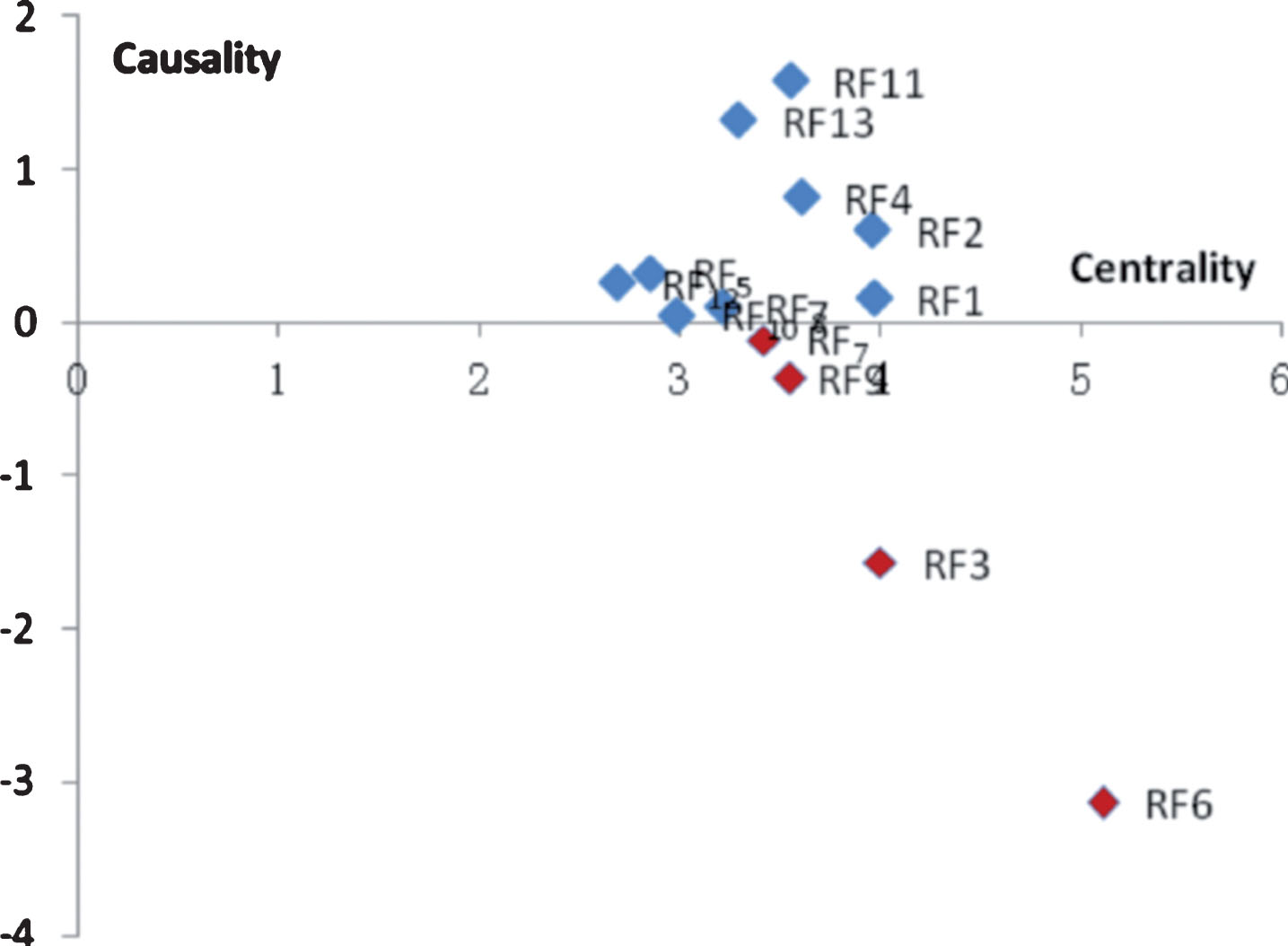
The causal diagram.
The normalized direct-relation matrix for risk factors
The total-relation matrix for risk factors
Then, the risk factors’s influence-importance can be determined by Equations 19). The final importance of risk factors can be calculated through the weighted sum of initial importance and influence-importance by Equation (20). α and β are assumed to be 0.5, generally. We summarize the result of calculation in Table 13.
The final importance of risk factors
Since DEMATEL offer the importance of each risk factor, and we consider the importance of customer requirement based on Kano model. We combine them rather than depending only on the degree of importance from DEMATEL. For instance, RF1 is ranked fourth in DEMATEL, if we consider the infulence of customer requirements, then its overall importance ranking is seventh. As shown in Table 14. Thus, the overrall ranking imply final importance, which provides a method to select key factors. We compare the ranking rusults mainly in the following three conditions: The risk factors of RF2, RF8, RF9, RF10 and RF13 become more important if we consider the influence of customer requirement. They are “market requirement and the price of competitors uncertainty”, “ the ability of logistics and warehousing to cope with the trading peak”, “arrange the delivery time reasonably”, “intellectual property of products” and “restrict of cultural differences”. In the customer-oriented market, consumer satisfaction is a critical objective for cross-border online SMEs. The competitive price in comparison to competitors and quality assurance through intellectual property are still core factors of cross-border online transaction. The logistics efficiency and storage capacity, specifically in shopping day, are important factors consumer care about. In addition, the products and service SMEs provided during the online transactions should be comply with the local culture. Therefore, SMEs need to avoid risks, such as unreasonable price, intellectual property absence, logistics efficiency, storage capacity and cross-cultural differences. Which are important factors to improve customer satisfaction. The risk factors of RF1, RF4, RF6 and RF7 and become less important if we consider the influence of customer requirement. They are “lack of understanding the credit situation of foreign customers”, “vulnerability of cross-border e-commerce platform”, “capital losses” and “efficiency and time of customs”. These factors lead to cross-border e-commerce SMEs’ risk. To some extent they cause certain restrictions to consumer. For example, customer should provide credit certificate and identification to help SMEs to avoid risks from RF1 and RF7. It needs to share the losses for consumers from RF4 and RF6. There are some risk factors can not be affected by customer requirement, such as RF1, RF5, RF11 and RF12, they are “unconditional return”, “threats in passwords leaked and hackers broke during the cross-border electronic payment”, “the national security” and “exchange rate fluctuation”. But it doesn’t mean the risk factors are not impotant. The risks are usually caused by factors out of control. Such as policy, exchange rates and hackers broke.
The overall ranking for the risk factors
The overall ranking for the risk factors
While the perceived risk are core link to obtain success of the cross-border online transaction. Only few literature is concerned with seller’risk. This study paid attention to protecting SMEs sellers from the risks considering the influence of consumer requirements. We developped a hybrid model to examine the importance of SMEs’ risk factors in the context of cross-border online transaction. Therefore, the study contributed to the cross-border e-commerce research as follows. The analysis result illustrated that we can not only consider internal relationships between risk factors, but also to mitigate the SMEs’ risk considing external influence from customer requirements. We emphasized the importance of offering a security mechanism for sellers in online transactions, which contrast sharply with the mainstream view in the provious literature about the importance to prevent buyers from the online risk. We expanded the range of extant research by designing a balanced mechanisms to protect transacting parties in cross-border online transactions. According to the results of our analysis, some risks become more important if we consider the influence of customer requirement. Such as unreasonable price, intellectual property absence, logistics efficiency, storage capacity and cross-cultural differences. Hybrid Kano-fuzzy-DEMATEL model offered a more measurable and precise way to determine the risk priority for cross-border e-commerce SMEs. Some existing studies selected the important risk factors based on the value of centrality. They neglected the negative of causality value. The method of selecting important factors is one-sided. We considered the centrality and causality [57]. We obtained the important risk factors in the system by calculating the influence intensity between the factors based on DEMATEL. But the weight of each factor is equal in the assumption of DEMATEL. In fact, the weight of factors is ignor. We introduced the weight through the importance of customer requirements based on Kano model [58]. Triangular fuzzy number is applied to quantify the uncertain information in risk assessment. Our study provided useful advice for cross-border platform developers and cross-border transaction policy makers. The platforms should devote reasonable resources to develop security mechanisms to protect sellers, especially SMEs. In addition, if cross-border e-commerce SMEs want to avoid the risks from customer satisfaction. They need to pay more attention to investigating competitors’ price to guarantee reasonable pricing. It is necessary to develop series of products with independent intelligence property. SMEs should upgrade “pour goods model” to “value-branding model” to increase the added value and improve the SMEs’ core competitiveness. SMEs should focus more on the cross-border differences result from national financial systems, payment habits and national regulatory systems. They can solve the payment security problems based on blockchain technology [59]. Which is a promising payment candidate allow to pay for services and products without any human intervention. The platforms should reinforce the mechanism regarding the national identity of consumer. Because SMEs usually deem residence country as a credible signal, cross-border platforms should remind SMEs the potential risks associated with buyers from countries of low national integrity and security [60]. The online signature mechanism and biometric-based identification technologies could be applied into mobile app of a cross-border platform to avoid SMEs’ risk. The biometric-based identification is more reliable because it identifies the person and related information [61].
However, there are several limitations which could be a direction in our future research. First, the risk factors were selected from literature research, we need to identify the risk factors with a more objective approach in the further research. Second, we used expert ratings to get the relationship between the factors. The data of customer requirement were obtained by questionnaire. We consider getting more reliable data by crawler technology in the future research. Third, the effectiveness of the proposed method in our research is different for various types of enterprises. We will test our hybrid model to other companies, such as large-scale enterprises. Thus, we will revalidate these method we mentioned above according to different types of enterprises in future research.
Footnotes
Acknowledgments
We would like to thank the editor and the anonymous reviewers for their comments, which have greatly improved our paper.