



Abstract
In reliability field, the probabilities of basic events are often treated as exact values in conventional fault tree analysis. However, for many practical systems, because the concept of events may be ambiguous, the factors affecting the occurrence of events are complex and changeable, so it is difficult to obtain accurate values of the occurrence probability of events. Fuzzy sets can well deal with these situations. Thus this paper will develop a novel fault tree analysis method in the assumption of the values of probability of basic events expressed with triangular intuitionistic fuzzy numbers. First, a new ranking function of triangular intuitionistic numbers is established, which can reflect the behavior factors of the decision maker. Then a novel fault tree analysis method is put forward on the basis of operational laws and the proposed ranking function of triangular intuitionistic numbers. Finally, an example of weapon system “automatic gun” is employed to show that the proposed fault tree analysis method is feasible and effective.
Introduction
With the development of science and technology and the improvement of people’s living standards, safety production and risk analysis in production practice are becoming more and more important [1]. Fault tree analysis (FTA) is an effective tool for reliability and security analysis of complex systems, and it is the most effectual method to improve system reliability and security at the same time. At present, as a method of system reliability and safety analysis, FTA has been widely used in nuclear energy, aerospace, chemical industry and other industries [2–9]. In traditional FTA, the probabilities of bottom events are treated as exact values. However, for many practical systems, the concept of events may be ambiguous, the factors affecting the occurrence of events are complex and changeable, so it is difficult to obtain accurate values of the occurrence probability of events. In 1965, Professor Zadeh first proposed the concept of fuzzy set, which can better model the vague characters of objective things than crisp number, and since then the study and application of fuzzy have received great attention [10–14]. In recent years, many researchers have studied fault tree problem under fuzzy environment in which the probabilities of bottom and top events are expressed with the triangular fuzzy numbers, trapezoidal fuzzy numbers or normal fuzzy numbers. For example, Hua et al. [15] considered normal fuzzy numbers to describe the fuzzy probability of bottom events. They put forward a simple formula for calculating the universal fuzzy probability of top events, and the importance of fuzzy probability of bottom events was also derived. Yu and Yang [16] established the fault tree of a new fire control computer system assuming the probability of basic events expressed with triangular fuzzy numbers, and they also observed the confidence interval of the probability of top events and the fuzzy importance of basic events. Zheng [17] studied the reliability analysis of a drug intelligent packaging system using the fuzzy fault tree theory by assuming the triangular fuzzy failure rate of bottom event and top event of the fault tree, and the fuzzy importance of bottom event was also calculated by using fuzzy median method. Liu et al. [18] used trapezoidal fuzzy numbers to describe the probabilities of occurrence of basic and top events in a fault tree analysis, and they proposed a fault tree analysis method for reliability of grinding wheel frame system of CNC grinder. The results showed that their method could effectively solve fault tree analysis of CNC grinding machine, which the probabilities of events are difficult to be assigned accurately.
In fuzzy fault tree analysis, one key step is to quantify the assessment of probability of bottom and top events which are provided by experts according to their experience or historical data information [19, 20]. The experts’ evaluation information often consists of three aspects: support, opposition and hesitation, while fuzzy numbers, such as triangular fuzzy numbers, normal fuzzy numbers have only membership degree parameter, which can only model the information of support and opposition [21, 22]. To overcome the shortcoming of Zadeh’s fuzzy sets, an intuitionistic fuzzy set is developed and introduced by Atanassov in 1996 [23]. Since then, fuzzy and some extensions of intuitionistic fuzzy sets, such as interval-valued intuitionistic fuzzy set, triangular intuitionistic fuzzy numbers received great attention and have been applied in various field [24–26]. In recent years, intuitionistic fuzzy numbers are applied in a fault tree analysis by some researchers. For example, Wang and Fu [27] introduced interval-valued intuitionistic fuzzy numbers to a fault tree analysis for the assessment of pipeline failure probability by experts. Kumar and Yadav [28] proposed a fault-tree analysis based on intuitionistic fuzzy number to evaluate system reliability and to find the most critical system component which can affect the system reliability. Shu et al. [29] introduced an algorithm of the trapezoidal intuitionistic fuzzy fault-tree analysis to calculate fault interval of system components and to find the most critical system component for the managerial decision-making and applied the proposed method to analyze the failure problem of printed circuit board assembly. Wang et al. [30] proposed novel improved arithmetic operations and logical operators for triangular intuitionistic fuzzy numbers and applies them to fault tree analysis for reliability analysis of a printed circuit board assembly system. For more details about fuzzy fault analysis methods, one can also refer to [31–34].
In the actual fault tree analysis process, decision makers (experts) often have subjective risk preferences. However, the existing fuzzy fault analysis methods are based on the expected utility theory assuming that decision makers are completely rational. To overcome this shortcoming, this paper will first propose a new ranking function of triangular intuitionistic fuzzy numbers by introducing a risk attitude factor, which can reflect the risk attitude of decision makers (experts) in the fault assessment process. Then this paper develops a novel fuzzy fault tree analysis method based on the proposed ranking function. Finally, an example is used to illustrate the feasibility and effectiveness of the new assessment method.
Material and methods
Preliminary knowledge
Some basic concepts and properties of triangular intuitionistic fuzzy number are introduced in this section, and one can find them in references [29, 30].
Here
Note that, if a′ = a and c′ = c, then the fuzzy number
and
If If if if
If
In particular, if
Let
and β-cut is defined as
By straightforward calculation, we can get
In real fuzzy decision making process, decision results are often affected by the different attitudes of decision-makers [35, 36]. Although there are some documents already considering the influence of different attitude behaviour for the MADM problems in which attributes values are expressed by interval number and triangular fuzzy number [37–39]. However, for the fuzzy fault tree analysis problem in which attributes values are expressed with triangular intuitionistic fuzzy numbers, most of the literature do not consider the decision maker’s attitude in analysis process. Thus, this article will take into account the decision maker’s attitude into the analysis process, and put forward a new fuzzy fault tree analysis method.
To construct the new ranking function of a triangular intuitionistic fuzzy number, some concepts are first recalled.
Considering the α - cut sets of triangular fuzzy numbers are still interval numbers, and α is an arbitrary value in [0,1], to eliminate the arbitrariness and reflect the decision maker’s attitude behaviour. Ren and Liu [39] developed a new ranking function of triangular fuzzy number given by Definition 6.
Obviously,
According to Definition 6, Ren and Liu [39] proposed the following rule for comparing two triangular fuzzy numbers
(i) For any λ ∈ [0, 1], if
then
(ii) For any λ ∈ [0, 1], if
then
(iii) For any λ ∈ [0, r] ⊂ [0, 1], if
Then for the decision maker whose attitude is pessimistic, the ranking result is
Motivated by Definition 4, we will develop a new ranking function of triangular intuitionistic fuzzy number as follows:
Let
Particularly, if P (α) = αr+1, Q (β) = (1 - β) r+1, we can easily derive the specific form of
Some basic concepts in the figure of fault tree
Thus, we have
With similar discussion of Definition 1, the parameter λ is an attitude index. Then
(i) For λ ∈ [0, 1], if
then
(ii) For λ ∈ [0, 1], if
then triangular fuzzy number A1 is equal to A2, and noted A1 = A2:
(iii) For λ ∈ [0, r] ⊂ [0, 1], if
then when the decision maker whose attitude is pessimistic, then
This section first introduces some concepts of fault tree, which are provided in Table 1, and then gives some definitions of “AND” and “OR” operations. Finally, a new calculation method of fuzzy significance analysis is put forward.
In the following definitions, we assume that A1 and A2 are two fault events, and their failure possibility is expressed with triangular fuzzy numbers
Here
In the following, we will re-define influence degrees of every bottom event (i.e. the leaf node in the fault tree) in Definition 9.
The descriptions of the events of fault Tree
The possible range of bottom event failure
To verify the effectiveness and feasibility of proposed approach, an example adopted from [28] of weapon system “automatic gun” is used to illustrate it. The fuzzy fault tree of this example is shown in Fig. 1. The corresponding descriptions of Top-event, sub-events and bottom events in Fig. 1 are listed in Table 2. Some language values such as “High probability of an event” or “Very high” are commonly used in reliability analysis to assess the probability of an event occurring. Experts evaluate the probability of an event in language terms, such as very small, small, medium, very large, and the experts use this language values to evaluate the size of the probability of determining the underlying event in the failure tree. Then we can give a corresponding relationship of linguistic terms with triangular intuitionistic fuzzy numbers similar method used in Ye [40] by discussing the experts. To facilitate comparative analysis, we use the data in [23] for analysis. The possible ranges of the bottom events are expressed with triangular intuitionistic fuzzy numbers, which are listed in Table 3.
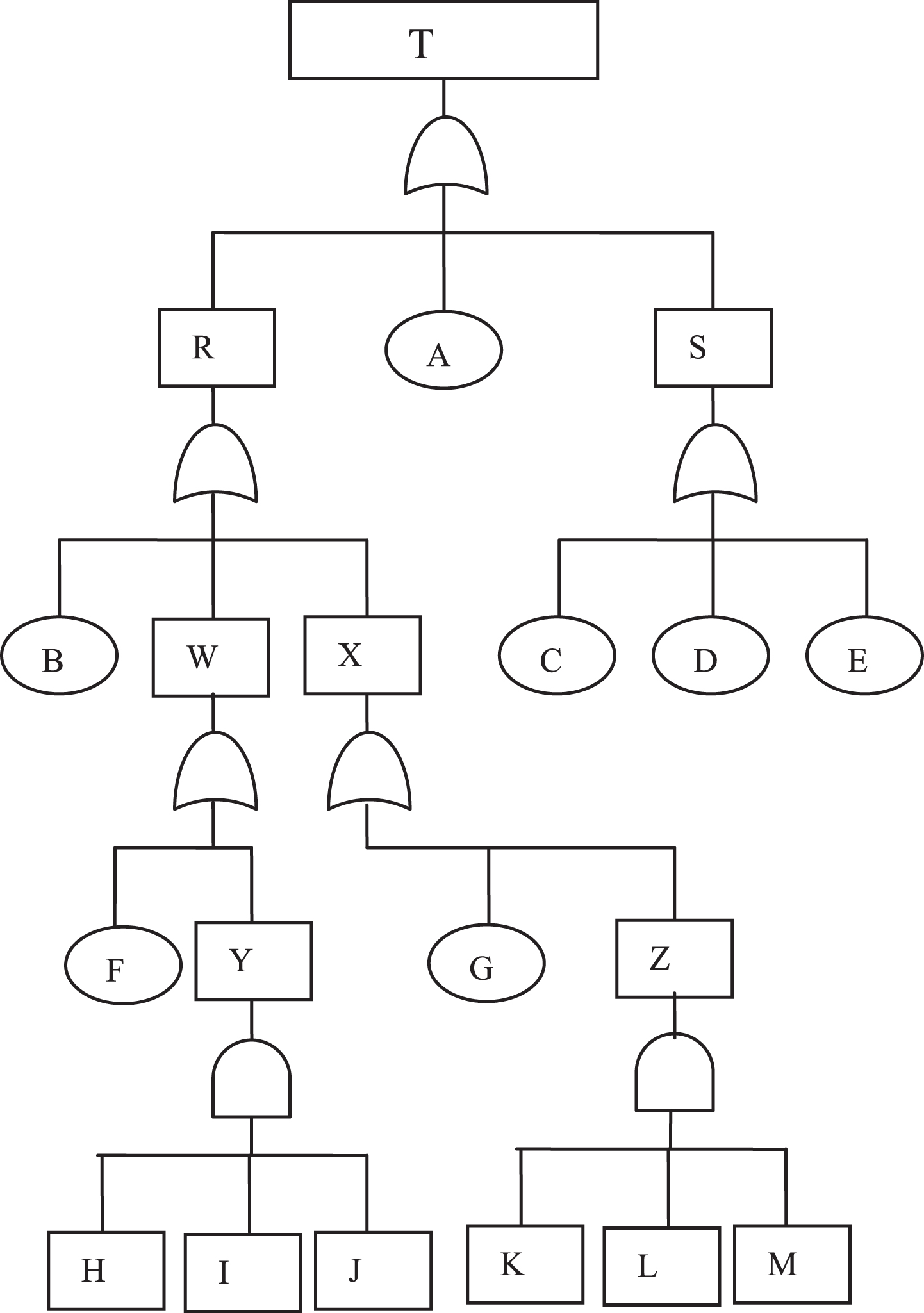
Fuzzy fault tree of weapon system “automatic gun”.
The values of q T and q T A , . . . , q T M
For connecting the fault tree diagram of “automatic gun cannot fire”, in this section we use logical node to describe “AND” gate with the sign of ∩, and “OR” gate with the sign of ∪. Then from Fig. 1, we know that
Let q
i
and T represent the possibility of failure of unit i and possibility of total system failure, respectively. Then according to equations (10), (11), we can easily get the failure possibilities of R, S, W, X, Y and Z. Then, according to Definition 7 to Definition 9, the failure possibility of top event “automatic gun cannot fire”, noted by
According to Definition 9,
For example,
Similarly, we can get q T B , q T C , . . . , q T M .
Then according to Definition 4, Equation (5) and the above formulas, we can easily get the values of q T , q T A , . . . , q T M , and these values are listed in Table 4.
For given λ = 0.5, r = 1, V
T
i
in Definition 8 are obtained as
The most significant failure events are “Feed frame failure” (i.e. event “E ”) and “Failure of magazine spring” (i.e. event “D”) according to the ranking, and the ranking of significant failure events is:
These two factors are also the most significant factor of influence on gun firing reliability. Therefore, at the managerial level, if we want to get higher reliability of gun firing, “Feed frame failure” and “Failure of magazine spring” problems should be taken more concern. This result is in agreement with [28]. The reference [28] also provided a comparison result between their method with other methods. The main advantage of our method is the consideration of decision makers’ risk attitude, which can well reflect the practical decision process.
In the example we assume that the decision maker is a moderate attitude dealing with the decision result, then we set λ = 0.5. If the decision maker is pessimistic facing decision result, then we can set the value of λ smaller than 0.5.
Most of the existing fault analysis models are proposed based on crisp numbers, which are difficult to model vague characters of the object things. There are also some references studying the fault analysis under fuzzy numbers or triangular intuitionistic fuzzy environment. However, most of them are studied based on the expected utility theory assuming that decision makers (experts) are completely rational. However, in the actual fault analysis process, decision makers often have subjective risk preferences, such as psychological and behavioral factor for alternatives, so it is important to consider the risk attitude of decision makers (experts) in the fault tree analysis process. Here, we first propose a novel ranking function of triangular intuitionistic fuzzy numbers which can reflect the attitude of decision makers. Then we develop a new fault tree analysis method based on the new proposed ranking function. The new fault tree analysis method can well reflect experts’ risk preference.
Conclusions
Fuzzy fault tree analysis overcomes the disadvantage of traditional fault tree analysis method, which regards fault occurrence probability as exact value. It not only reflects the fuzziness of probability itself, but also combines experimental data with the experience of engineers and technicians. It has strong flexibility and adaptability. Triangular intuitionistic fuzzy numbers can reflect the hesitation of decision makers when decision makers are limited in time, energy and knowledge. At this point, it is a better tool in fuzzy fault analysis. Most of the literature do not consider the decision maker’s attitude in ranking problems of triangular intuitionistic fuzzy numbers. But decision makers’ attitude often affects the final ranking result. By considering the decision maker’s behaviour, the new proposed ranking function is used in fuzzy fault analysis, and it is more in agreement with the reliability than existing fuzzy fault analysis methods. The calculation results show that it is reasonable and feasible to use the fuzzy fault tree analysis method to analyze the reliability of gun firing system, which has a certain reference value for carrying out the reliability research of other equipment.
Footnotes
Acknowledgments
This research was financially supported by National Natural Science Foundation of China (Grant No.71661012), Key Projects of Science Research of Jiangxi Educational Committee (No. GJJ170496 and No. GJJ180829) and Startup Foundation for Doctors of Jiangxi university of Science and Technology.