



Abstract
In this work, we will be investigating, developing and implementing an intelligent RFID system in conjunction with a fuzzy data classification system, to greatly enhance and secure financial transactions and improve operational efficiency in the banking environment. The innovative part of this research is to provide an efficient solution to the challenge that may arise from the need to expertly and automatically match the profile of customer and banker and solve the vagueness in customer/banking profiling. Our proposal offers an expert, secure, efficient and comprehensive framework, methodology and its application in financial environments to develop customer to banker profile matching and availability via an expert agent multi level fuzzy data classification system. Foremost, according to clients and banking staff members weighted attributes, exact match has been established according to highest degree of relevance by utilizing Matlab fuzzy inference system. Then, to communicate output of a match profile engine from one party to another, to show profiling effectiveness and to do implementation; secure, privacy preserving, and comprehensive intelligent RFID profiling authentication system has been designed and verified by Scyther tool.
Keywords
Introduction
The wide deployment of wireless sensing technologies for the monitoring and autonomous identification of financial activities have affected financial institutions in the past decade. However, wider utilization of radio frequency identification (RFID) technologies in the banking sector have introduced challenges, like how to develop and design a framework which not only secure personal or professional financial data but also operate and manage the data efficiently. Thus, a need for an intelligent banking system has arisen that provides safe and seamless operations and reduces the complexity of end users, labour cost, operation cost etc. in such a way that it will in turn increase the return over investment [1]. RFID system has the potential to infiltrate and reduce the cost in numerous areas of personal or commercial banking environments by automatically identifying objects and persons.
Automatic identification, non contact and non line of sight RFID system generally consists of a set of low cost RFID tags, a few RFID readers and a secure back-end server [2–4]. The tags can be passive, active or semi active depending upon the features like internal battery, transmitter, inbuilt sensors, tag life, etc. The coiled antenna is utilized to release radio waves during tag activation and provides several features to it like read or write financial data. RFID integrated banking system employs low cost RFID tags to communicate in malicious communication environments. Using near field communication [5] or bluetooth, RFID readers communicate with a number of tags which are spread over the whole banking environment [6]. The communication channel between reader and server is generally wired, which is assumed to be secure, while reader and tag or user’s smart device communicates through a radio frequency wireless channel, which is insecure and can be intercepted or modified by an eavesdropper in such a way that legitimate recipient does not detect the manipulation [7, 8].
However, any violation in data security can cause extensive financial and legal ramifications and even affects operations in the financial body. Besides this, it can affect the customer privacy and community trust on such financial systems.
Foremost, Sarma et al. [9] mentioned the scarcity of tag resources as a primary challenge. Weis et al. [10] proposed a hash-based access control approach HAC to protect the tag, which stores the hash of a random key as its metaID. But the scheme allows the tag to be tracked as the same metaID is used repeatedly. Henrici and Muller [11] proposed hash-based ID variation scheme HIDV, which uses one way hash function to protect location privacy by changing the ID after each session. But still after an unsuccessful session, it replied with the same hashed ID, which makes it vulnerable to traceability attack, impersonation attack and backward traceability. Lim and Kwon [12] pioneered the concept of forward untraceability in security authentication protocols, which is similar to backward untraceability, but focuses on issues of tag identification in future sessions of communication. Chien and Chen [13] proposed RFID mutual authentication protocol conforming to EPC Class 1 Generation 2 standards. But Lopez et al. [14] proved that their protocol is vulnerable to denial of service attack, tag as well as server impersonation attacks and suffers forward tracing due to the feature of linearity of cyclic redundancy code function. Wang et al. [15] proved de-synchronization attack and passive disclosure attack via exhaustive search on [16]. In addition, to get rid of these vulnerabilities, [15] gave modified SRP++ protocol in accordance with EPC Class 1 Generation 2 standard which resist disclosure attack via exhaustive search. Kumari et al. [17] proposed an upgraded remote user authentication scheme with key agreement to overcome security weaknesses of [18] and claimed that their scheme is more suitable, secure and efficient for real life applications. Later, Kaul et al. [19] have pointed out that [17] is completely insecure as an adversary can easily obtain not only the security parameters of the protocol but also gets the common session key of future communication between user and the server.
A number of researchers have addressed this issue by proposing new RFID authentication protocols utilizing various symmetric or public key cryptographic methods. But most of the work still has security and privacy breach [20–23]. However, still RFID applications are utilized to collect personal and financial data of the customers with proper care [24]. RFID technology provides banking industry the means to authenticate their potential customers, customers profile matching to bankers, lock/unlock door of locker, vault operation, track customers file and assets, manage and monitor data and equipment, secure the movement of fixed assets and data center servers, enlarge profitability, resist unauthorized access and other banking zones where the system can be flawlessly incorporated with existing RFID system to support automatic identification [24–26]. Especially in this work we are using RFID to resolve customers profile matching to bankers, but to resolve this, we have also to deal with profiling vagueness and this can only be possible by utilizing fuzzy system [27].
A fuzzy set A in universal set X = {x} is a set of ordered pairs A = {(x, μ A (x)) : x ∈ X} where μ A (x) is the ’membership grade’ of x in A, μ A : X → [0, 1] [28]. Fuzzy technology has become one of the most successful system for developing and designing sophisticated control systems and it handles such applications in a perfect manner as it has an ability to make precise decision and provide appropriate solutions from the set of approximate or exact data [28, 29]. This is one of the reasons this research utilizes a fuzzy logic system in profile matching as it has the ability to cover the gap between purely mathematical or purely logic based approaches in our designed system [30, 31].
Fuzzy membership function editor in Matlab Fuzzy logic toolbox provides the interactive environment and specifically utilized to design and alter the relevant linguistic variable parameters like shape, size, count, domain, range, etc. This research utilizes the triangular membership function editor for quantification which is characterized by three scalar parameters α1, α2 and α3 such that α1 ≤ α2 ≤ α3, in which height is defined by h and support of A is [α1, α3]. Thus, it is defined by
While variables in mathematics usually take numerical values, in fuzzy logic applications, the non-numeric linguistic variables are often used to facilitate the expression of rules and facts [28]. Linguistic variables are characterized by five parameters (σ, T (σ) , X, g, m), in which σ is the linguistic variable, T (σ) is the set of linguistic values σ can take, X is the universe of discourse in which the linguistic variable σ takes its crisp values, g is a syntactic rule for generating linguistic terms and m is a semantic rule that relates each linguistic value in T (σ) with a fuzzy set in X, i.e. m : T (σ) → ϝ (X).
This work provides a framework and implementation of an innovative idea, that describes how to establish profiling in the banking sector. The establishment of a profiling system is extremely helpful in reducing the weighting time or long queues over the banks. It also provides better client acquisition, that helps in knowing the best client and in turn assist to look for prospects with the similar characteristics. In parallel, the proposed work maintains the client’s security and privacy in the network communication process. Further, it helps in improving the client experience while knowing the fact that client’s data is extremely crucial. Thus, it helps in connecting the right people at the right time, that drives better outcomes. Furthermore, it has an ability to tailor communications based on client’s priorities which will enhance experience, commitments and dealing. Hence, the proposed intelligent and secure RFID multilevel fuzzy inference system for client to banker profiling will revolutionize the banking sector by increasing efficiency, decreasing cost and providing more secure and privacy sensitive financial data communication and transactions.
Profiling is basically a rule base matching algorithm between the parties. Profiling in banking environment is an innovative part, however, tremendous work have already been done in various other sectors of profiling like health, schema matching, information extraction, retrieval, etc. [25, 32] and demonstrate promising output. Bajtos et al. [35] gives network intrusion detection with threat agent profiling system that presents K-means, PAM, and CLARA clustering algorithms for security incident profiling and having focus on grouping similar threat agents based on attributes of security events. Improving data security and privacy based on a fuzzy logic classifier work explores the use of fuzzy logic in classification of data and suggests a method that can determine requirements for data security and privacy in organizations based on organizational needs and government policies imposed on data [30, 31]. Yang et al. [36] presents interest profiling for security monitoring and forensic investigation to automatically generate user interest profiles and then develop a model that can discover and output multi-word phrases to describe topics, which facilitates the human interpretation of unorganized texts. For patient classification, fuzzy logic based warning system has been given by Dmour et al. [33] and they claim to provide the results in agreement with the current modified early warning score system. A detailed survey that describes state-of-the-art, challenges, and solutions in profiling is given in [34]. The proposed architecture is based on vector of weighted parameter attributes and allows client profiling and matching in a time intensive important scenario as described in [31].
Motivation
Our motivation comes from the question of how to resolve the security while autonomously maintaining the client information system. As, in this system, a client’s tag is automatically scanned by the reader which is distributed within the banking environment, immediately upon his arrival. The notifications about the desired services are communicated to the staff members autonomously by the client information system. During this autonomous acquisition process, client’s data is communicated and managed to satisfy each customer service efficiently and securely on priority basis and any violation in data security can cause extensive harm to the society. Thus, to secure the RFID profiling system expertly, there is a need for a secure and privacy preserving authentication system, in which the server’s computed matching value corresponding to client’s query survey, is communicated securely via client mobile application. This urge of need motivates us to do this research work.
Contribution
In this paper, we foremost describe the terms that affect the profiling of client and banking staff, but as the defined terms are linguistic or fuzzy, we have to utilize a fuzzy inference system to solve the vagueness. Next, by utilizing Matlab FIS, we are able to develop the system which correctly finds the match between client and banking staff depending upon their defined attributes. Further, an intelligent RFID cloud system has been introduced in which clients can fill the query survey depending upon their service request so that the server can generate a profile matching value. Furthermore, a secure and safe authentication system has been developed to communicate the profile match value from server to client mobile application in RFID network. Finally, the security of the proposed authentication mechanism has been verified by an automatic formal verifier Scyther and as well as informally.
The rest of the paper is organized as follows: In section 2, fuzzy classification system preliminaries have been discussed while in section 3, client to banker agent profiling model has been described. Multilevel fuzzy inference profiling system has been proposed in section 4 which includes the following subsections: linguistic variables in client to banker profiling, rule associated to profile matching and fuzzy inference and defuzzification results. Section 5 presents RFID client to banker profiling scenario describing system architecture, procedure, profile matching authentication system. Formal and informal security verification have been presented in section 6 and performance evaluation in section 7. Finally, the work has been concluded and future directions have been given in section 8.
Preliminaries: Fuzzy classification system
In general, client to banker profile matching characteristics are linguistic or vague and depend upon different weighted attributes. To deal with this vagueness, we will be utilizing a fuzzy classification system [29]. Our proposed fuzzy inference mechanism experiment utilizes the Matlab fuzzy logic toolbox to infer the two main components of profiling, i.e. staff profiling parameters and customer priority parameters. The inference results of fuzzy logic toolbox provide better and more accurate match of both the agents and ultimately save operational time cost [37]. As described in Figure 1, fuzzy inference system consists of following functions [32]: Fuzzifier: Transform the input value into its fuzzy linguistic variable. Inference engine: Decision making process and use fuzzy rule base to map fuzzy input into fuzzy output. Defuzzifier: Transfer truth value into crisp conclusion to derive the control mechanism. Fuzzy knowledge base: Consist of fuzzy rule base and data base where rule base is a set of “If-then” type fuzzy functions.
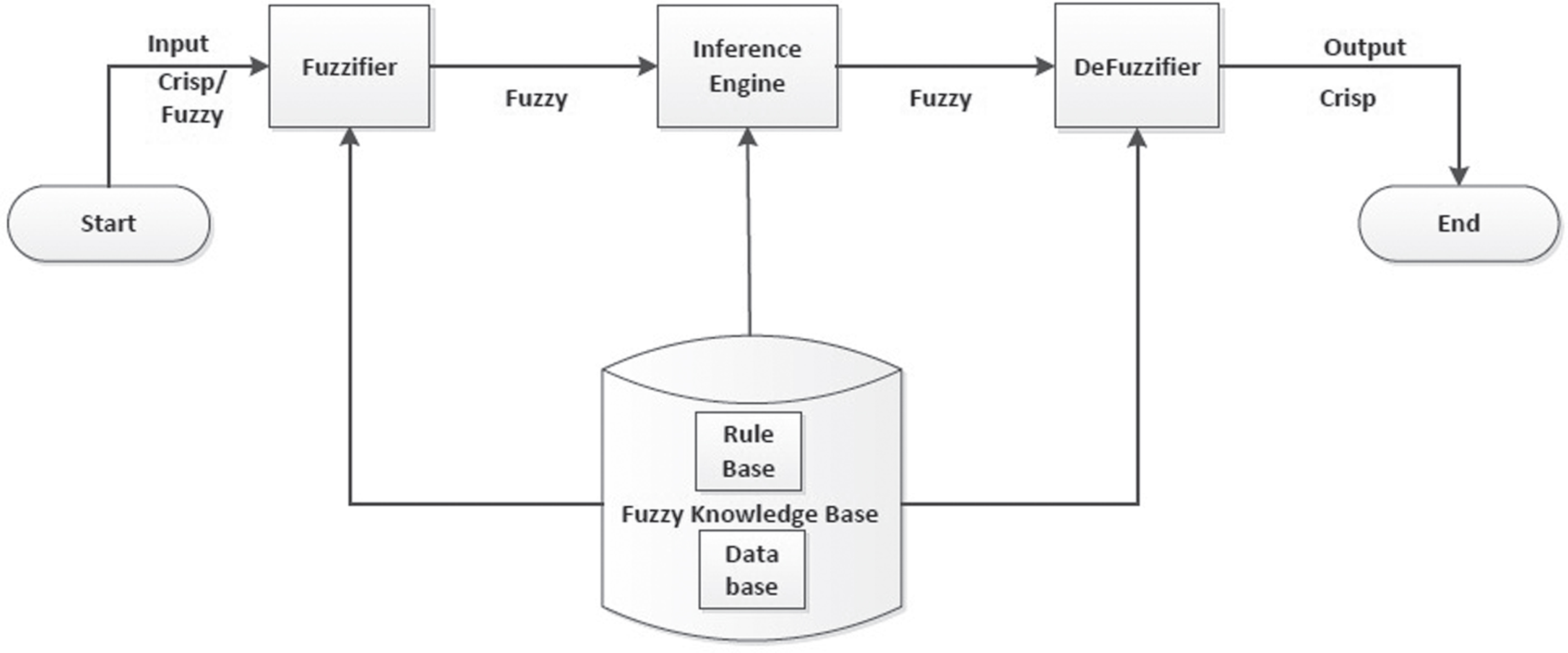
Fuzzy Controller Block Diagram.
Our proposed fuzzy inference system (FIS) similar to Matlab FIS workflow, followed the following procedure, as described in Figure 2: Initially, fuzzification interface modifies and converts the inserted value into its fuzzy linguistic variable via utilizing fuzzy knowledge base membership function so that it’s rule can be defined and compared in the rule base. The set of related “If-then” type functions are kept in the fuzzy rule base to best control the system. Correspondingly, decision-making fuzzy inference engines utilize that rule to map fuzzy input into fuzzy conclusions. Finally, the defuzzification interface combines and converts prior activated actions into an equivalent single crisp output to derive the control mechanism.

FIS work flow in Matlab.
The proposed architecture is based on a vector of weighted parameter attributes and allows client profiling and matching in a time intensive important scenario. Further, the architecture utilizes rule base algorithms to find the associated match between the client and banking staff. Customer to banker profiling is mainly based on vector of Customer weighted priorities Staff or asset weighted attributes
Then via utilizing an intelligent agent rule base system, the proposed profiling system matches the customer attribute against the banker. The process of profiling is described in Figure 3 which helps in matching a staff member’s specification and access rights according to the need of the customer. Next issue is to define the level of match between client and staff member because it has been infeasible to always provide an exact match between them. Thus, the rules based on this system can be demonstrated in human linguistic terms which are clearly vague and can’t be represented formally. Customer to banker profiling utilizes a fuzzy rule base system to match the profiling between them and to handle such vagueness [27]. Then real-time decision-making agent system using inference results of fuzzy logic toolbox decides the priority of serving a particular customer to automatically match customers with the banker’s profiles and to quickly facilitate appropriate service [1].
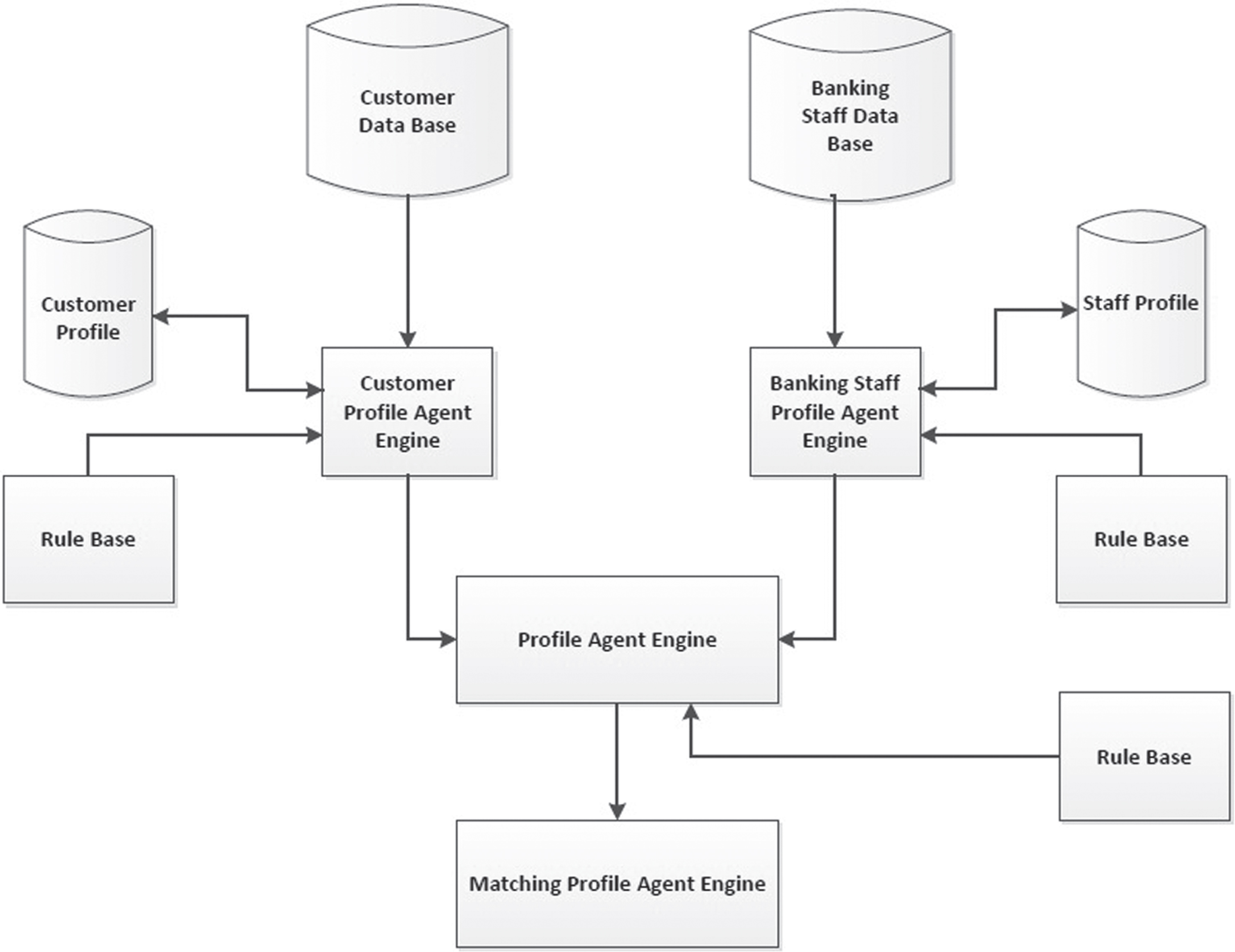
Proposed Client to Banker Agent Profiling Model.
This research makes inference and prediction of the best match between client and banking staff based on the factors of staff or asset accessibility and client priority affecting the computational and operational time cost using fuzzy logic toolbox [38]. As shown in Figure 4, the whole profiling model is divided into following different terminologies according to [38–45]:
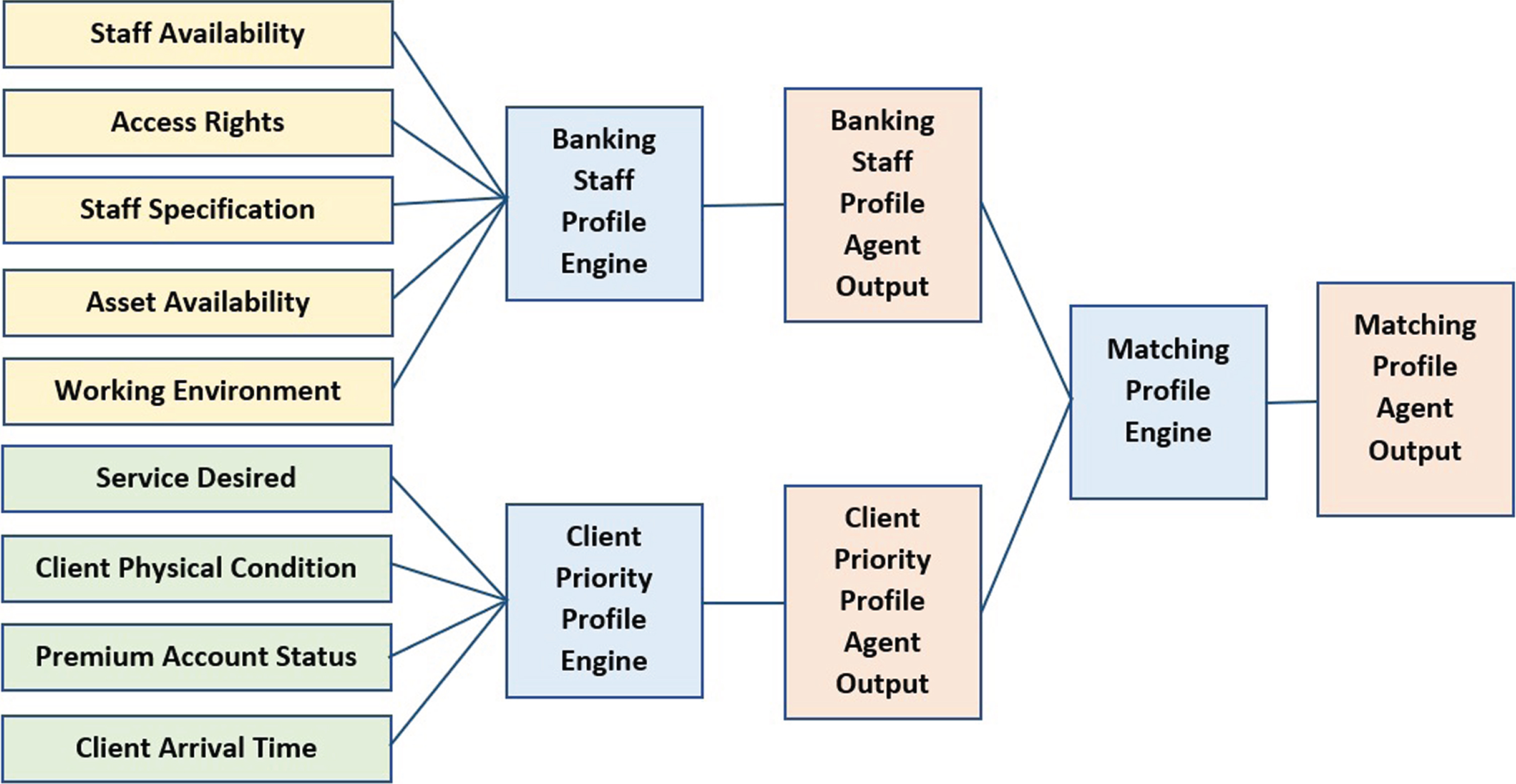
Proposed Client to Banker Match Profiling Model.
In order to obtain the best profile match or a measured match value between client to banker, we initially converted our collected data or required stored database into fuzzy sets via fuzzification. In fuzzification, we have developed membership functions of each and every variable affecting the profiling model and have shown its linguistic variable scope in Table 1. The affecting linguistic variables data obtained from various financial reports and articles [39–45] are divided and then converted into following membership functions: Staff Availability (α): Staff member’s on the spot availability to serve any client is the main feature of the banking staff profile agent engine and it’s membership function is splitted into four fuzzy linguistic terms: Low availability (σB11), Medium availability (σB12), High availability (σB13) and Extreme high availability (σB14) according to staff active enrollment domain of discourse [1, 10] is divided into four sublevels: less than 4, 3 to 6, 5 to 9, greater than 8 respectively in the banking environment. Staff Access Rights (β): Staff degree of designated duties and their access rights to perform any operation to serve the client request is one of the main factors affecting staff profiling agent engine. This research categorized the staff access rights linguistic variable level range [1,5, 1,5] into four fuzzy sub terms: No access (σB21), Slight access (σB22), Average access (σB23), Top access (σB24) according to it’s value less than 2, lies between 1 to 3, lies between 2 to 4 or greater than 3 respectively. Staff Specification (γ): Banking staff member’s knowledge to efficiently handle any nominated task undoubtedly affects the output of banking staff profiling. The linguistic variable staff specification divides the level range [1,10, 1,10] into three linguistic terms: Insufficient knowledge (σB31), Partial trained (σB32), Domain expert (σB33) according to it’s fuzzy value is less than 5, lies between 4 to 9 or greater than 8 respectively. Asset Availability (δ): Banking assets or server availability to upgrade, add or delete any client request in the database affecting operational time and ultimately affecting banking agent profiling; has three linguistic terms: If value of it’s level range [1,5, 1,5] is less than 2, then it has Minimal availability (σB41), for level value in between 1 to 4, it has More or Less availability (σB42) and for greater than 3 value, it has Ideal availability (σB43) to perform any financial task. Working Environment (η): There are various additional parameters which affect staff profiling and its efficiency like work pressure, willingness to work, staff personal or professional interface, working conditions or any additional responsibility given. Thus working environment linguistic variable is in Not good condition (σB51), Normal condition (σB52), Acceptable condition (σB53) or Healthy condition (σB54) for semantic rule value less than 4, lies in the interval [3,6, 3,6], lies in the interval [5,9, 5,9] or greater than 8 respectively corresponding to the linguistic variable domain of discourse [1,10]. Banking Staff Profile Engine Output (θ): The output variable of the membership function indicates the degree of adequacy of a particular staff member as shown in Figure 5. When scope output is less than 5 then the particular staff member is Inadequate to serve client (σB1); in the scope output of [2.5,7.5], it indicate linguistic term Moderate to serve client (σB2) and finally the scope output greater than 5 has feature Adequate to serve client (σB3) for staff member. Priority According Service Desired (ζ): Any service desired by the clients has already been assigned various grades in the database from [1,10] to deal with the issue of priority. It’s membership function has been categorized priority into three linguistic terms: Utmost important (σC11), Important(σC12) and Regular service (σC13) according to the assigned grade value is less than 4, lies between 3 to 6 or greater than 5 respectively. Client Physical Condition (μ): The physical urgency of any client is the main factor affecting the client’s priority profile agent engine. The linguistic variable client physical condition divides the domain of discourse [1,10, 1,10] into three linguistic terms: Greatest priority (σC21), Good priority (σC22) and Ordinary priority (σC23) according to it’s fuzzy value less than 2, lies between 1 to 4 or greater than 3 respectively. Premium Account Status (ν): Financial organization for the sake of its own organizational benefit wants to give high priority to the customer’s having premium account status. Thus the linguistic variable has been categorized grade level [1,10, 1,10] into Highest priority (σC31), Above average priority (σC32) and Average priority (σC33) according to its scope value less than 5, lies between 3 to 7 or greater than 6 respectively. Client Arrival Time (ξ): First come first serve factor or have an appointment undeniably strongly affects client priority profile engine. High level priority (σC41) fuzzy set has been assigned for the grade value less than 3 and Common priority (σC42) fuzzy set has been assigned for the grade value greater than 2 corresponding to the universe of discourse [1,5, 1,5]. Client Priority Profile Engine Output (ϑ): The output variable of the membership function indicates the degree of priority to be served any service for any particular client, as shown in Figure 6. When scope output is less than 5 then that particular client has Supreme priority (σC1); in the scope output of [2.5,7.5], it indicate linguistic term Good priority (σC2) and finally the scope output greater than 5 has feature Moderate priority (σC3) for that particular customer. Matching Profile Engine Output (ω): The comprehensive matching scope is established according to the membership function degree of each and every variable scope of Banking staff profile engine output (θ) and Client priority profile engine output (ϑ), in order to provide the good match between both the entities. The output variable of the membership function indicates the comprehensive degree of match between any particular client with any staff member as shown in Figure 7. When scope output is less than 3 then that particular client and staff has No client to banker profiling match (σM1); in the scope output of [2,6], it indicates linguistic term Average client to banker profiling match (σM2); the scope output of [5,9], represents Good client to banker profiling match (σM3) and finally, the scope output greater than 8 has feature High client to banker profiling match (σM4).
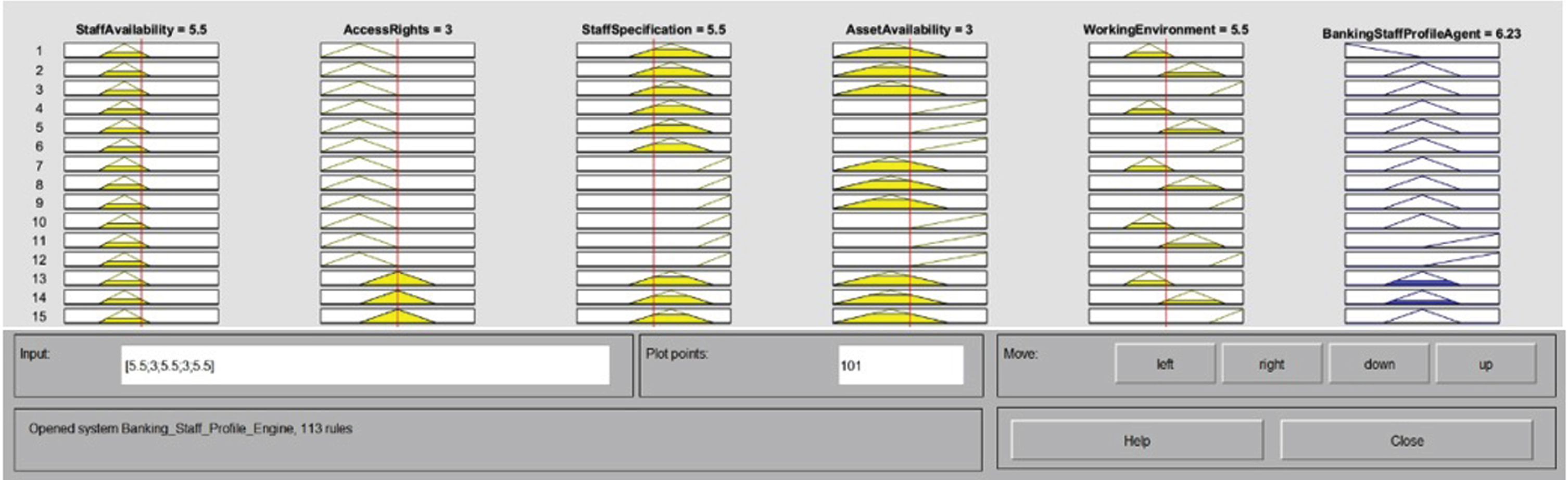
Fuzzy Profiling Inference Rules.

Fuzzy Profiling Inference Rules.

Fuzzy Profile Matching Inference Rules.
Linguistic Variables Scope
To control the fuzzy inference system in a best manner, a fuzzy rule base holds all the knowledge of a profile matching system in the form of a set of well-defined rules. We utilize Matlab fuzzy rules editor to design and modify 176 “If-then” type fuzzy rules and collection of these ’if-then’ type fuzzy rules express the combination of all possible states of membership functions which further helps us to divide the match profiling fuzzy base into three different bases: Banking staff profile agent engine, Client priority profile agent engine and Matching profile agent engine to obtain the best match surface value [38]. Fuzzy inference rule base described below is based on the related literature references and the ability to make considered decisions or intelligence of this research: Banking staff profile agent rule base is a set of 113 “If-then” type fuzzy rules which is based on combination of five membership functions α, β, γ, δ and η. Rule base lead low staff profiling component like σB11, σB21, σB31,σB41, σB51 to inadequate to serve client output. As all these five membership functions α, β, γ, δ, η are equally likely important for profiling so the combination of any 3 or higher top staff profiling component σB13, σB14, σB23, σB24, σB33, σB43, σB53, σB54 lead staff fuzzy profiling towards adequate to serve clients or otherwise for 2 or less components present in the combination of rule base of staff profiling out of these 8 components σB13, σB14, σB23, σB24, σB33, σB43, σB53, σB54 will lead the inference system towards moderate to serve clients. Client priority profile agent rule base is a set of 54 “If-then” type fuzzy rules which is based on combination of 4 membership functions ζ, μ, ν and ξ. Rule base lead combination of regular priority component σC13, σC23, σC33 and σC42 towards moderate priority output and client physical condition greatest priority function (σC21) towards supreme priority profiling output. As all the remaining 6 components σC11, σC12, σC22, σC31, σC32 and σC41 are equally likely important so fuzzy combination of any 3 or more lead the system towards supreme client priority output and any 2 or 1 variable present in the combination of rule base out of these linguistic terms σC11, σC12, σC22, σC31, σC32 and σC41 generate the good client priority fuzzy output. Matching profile agent rule base is a set of 9 “If-then” type fuzzy rules which controls the whole system by combination of 2 membership functions θ and ϑ, as described in Table 2: Matching profile agent rule base
In this research, we established a defuzzified match profiling system on the staff profiling and client priority fuzzy base and allow the system to predict and make decisions regarding their match using mobile Application or RFID system. Defuzzification in our research utilizes the gravity method and can be made by adjusting the red line of the input variable as shown in Figure 5, 6, 7. Fuzzy inference results of the system are as follows: Inference results of banking staff profile agent engine θ are described in Figure 5 and it can be generalized for any particular case via adjusting the values of input variables: α, β, γ, δ and η. For instance, as described in Table 3, three scenarios have been considered and the output value yield by these values indicates staff member inadequacy, moderate and adequacy to serve any client corresponding to case 1, 2 and 3 respectively. Inference results of client priority agent engine ϑ are described in Figure 6 and it can be generalized for any particular case via adjusting the values of input variables: ζ, μ, ν and ξ. For instance, as described in Table 4, three scenarios have been considered and the output value yielded by these values indicates client supreme, moderate and good priority corresponding to case 1, 2 and 3 respectively. Inference results of matching profile agent engine ω are described in Figure 7 and it can be generalized for any value of banking staff profile agent engine output (θ) and client priority profile agent engine output (ϑ). For instance, as described in Table 5 the previous cases output have been considered and the output value yield by these scenarios indicates the following match defuzzified value between client and staff member: Case study results of θ Case study results of ϑ Case study results of ω
The inputs which we obtained are validated with MATLAB fuzzy inference system to have the matching result. All the linguistic variable that we define in 1 pass through FIS engine and can be made by adjusting red line of input variable as shown in Figure 5, 6 and 7. Then, in Figure 8, fuzzy profile matching inference surface view for each linguistic variable utilized in our research have been demonstrated, which shows the interconnection of linguistic variables and their effects on the corresponding output variable. From top to bottom and left to write 17 inference surfaces in Figure 8, describes the interconnection of linguistic variable, (θ, α, β), (θ, γ, α), (θ, δ, α), (θ, η, α), (θ, β, γ), (θ, δ, β), (θ, η, β), (θ, γ, δ), (θ, γ, η), (θ, η, δ), (ϑ, ζ, μ), (ϑ, ν, ζ), (ϑ, ξ, ζ), (ϑ, μ, ν), (ϑ, ξ, μ), (ϑ, ξ, ν), (ω, θ, ϑ) respectively. As for instance, inference results of matching profile agent engine is ω and it can be generalized for any value of banking staff profile agent engine output (θ) and client priority profile agent engine output (ϑ). Last surface view in Figure 8, fuzzy profile matching inference surface view has been demonstrated, which shows the interconnection of linguistic variables and their effects on the corresponding output variable. Surface view indicates the impact on match profiling corresponding to both grids input fields: staff profiling and client priority and provide robust and reliable match control.
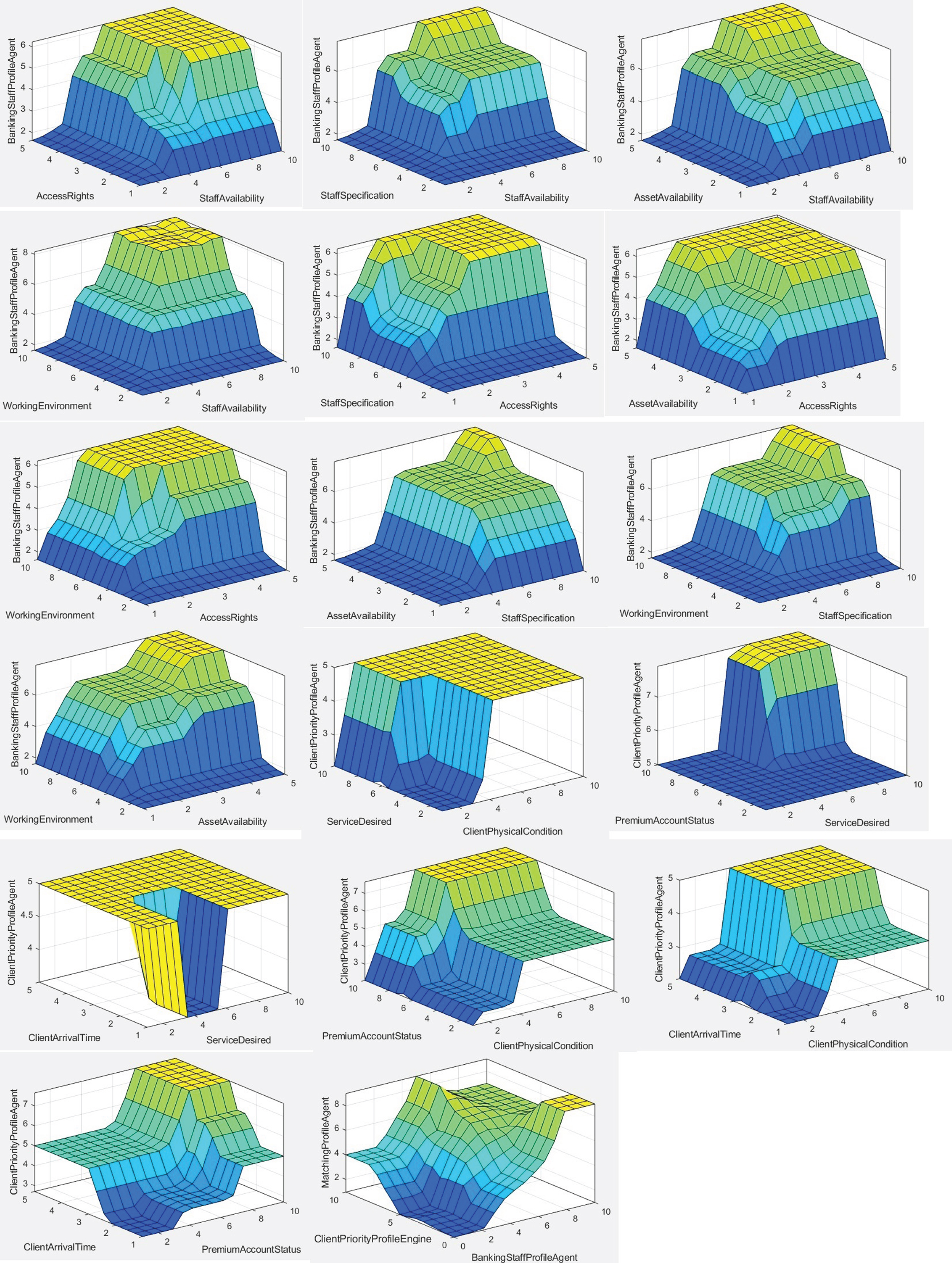
Fuzzy Profile Matching Inference Surfaces.
In this section, we implement our proposed profiling system for RFID cloud network environment. Generally, banking sectors utilized fixed as well as handheld RFID readers for collecting and managing customers data. RFID chips are embedded on staff ID cards, IT equipment, bank cards, passbooks, banking record files and assets such that tracking of assets, equipment, data or individuals will be done in a matter of minutes without interrupting any bank operations [24]. For example, Wells Fargo and Bank of America have hundreds of data centers that need IT fixed asset tracking software in order to ensure labor savings [5]. Even RFID is utilized to collect customers data upon their arrival in the banking environment via providing RFID chip enabled cards to customers [6]. Banking staff member’s netbooks, computer systems or tablets are equipped with RFIDs and virtual private networks and similarly the client’s mobile APP is also linked with the corresponding user RFID tag. This implementation is divided into following subsections: System architecture, System procedure and Authentication system.
System architecture
Proposed intelligent RFID match profiling system has the following main components:
System procedure
As described in Figure 9, proposed intelligent RFID client to banker match profiling system follows the following procedure on the entrance of any customer to the bank: After that via mobile android application, client authenticates them and input the query survey regarding service desired request only if their RFID tag status has been activated. That is, when the customer is in the banking environment only, then he can input the service desired request via his mobile APP. Further via web portal, App sends client request information along with time stamp and identity to the server. After that the server accumulates, manages and compares data to find any abnormality in the transaction. Hence, an intelligent system along with RFID is required to verify the unusual pattern and make suitable decisions to satisfy each customer service efficiently and securely on priority basis. After successful user authentication, an expert fuzzy profile match algorithm runs and finds the suitable match corresponding to the client and sends the final output regarding staff information to the client mobile. Then, for normal financial transactions, service is provided immediately to the clients and correspondingly update their database.
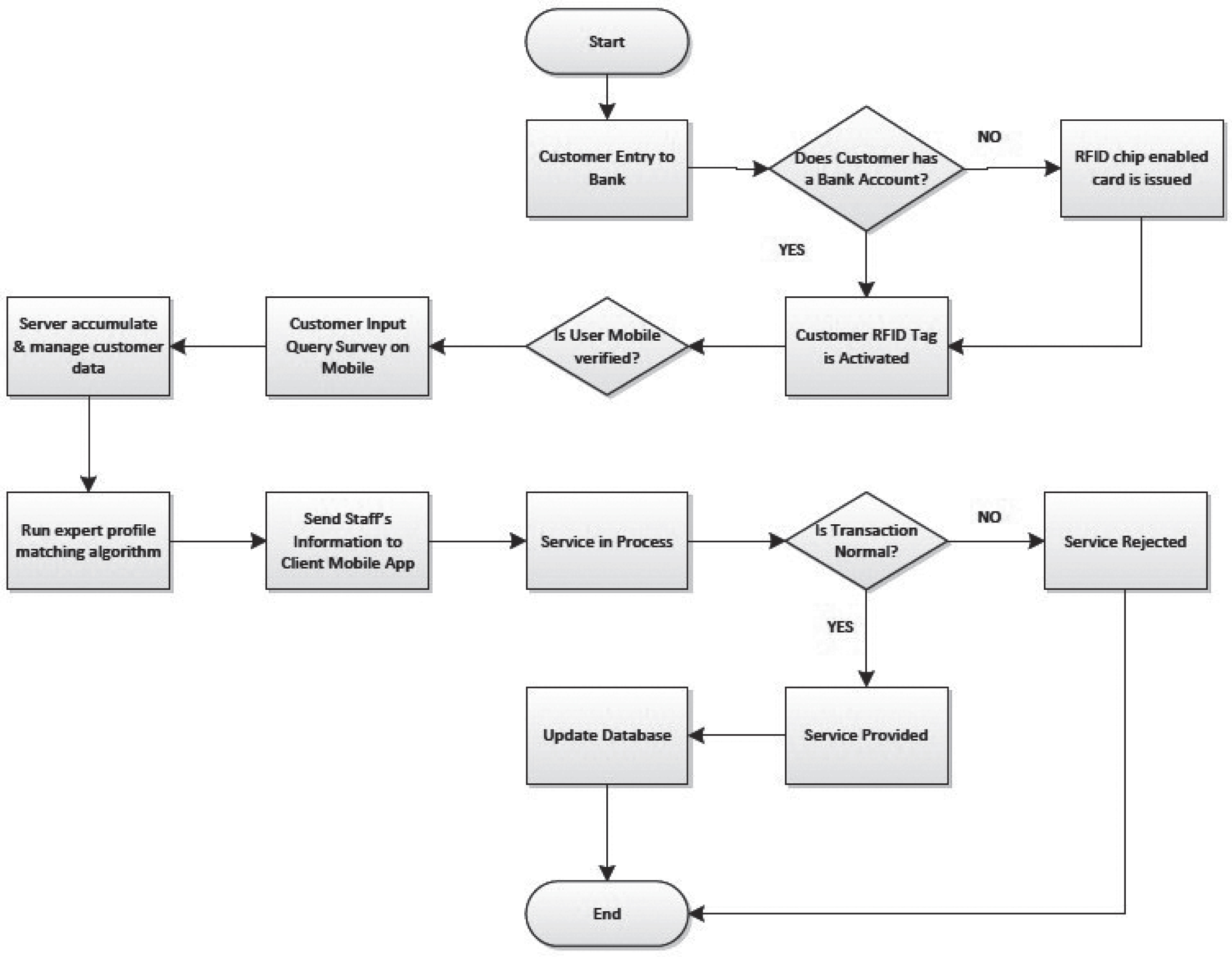
RFID Profiling Expert Authentication System.
In this section, we have designed a framework of authentication systems required for profile matching. Notations used in the authentication process are described in Table 6. At the time of registration of any tag, its identity TID and secret K
T
is kept on tag side. Further, mobile App having client identity CID and secret K
A
is linked with tag TID and all these parameters TID, CID, K
T
and K
A
are stored securely in the server database. In general, proposed algorithm communicate the profile match value from server to client mobile application in RFID network and it is described in 10. Server, tag and mobile App follow the following step by step procedure, as described in Table 7, to mutually authenticate each other:
Foremost server sends the Hello message to tag to start communication. Tag generates random number r1 and sends messages {M1, M2} along with current time t1 to the server where M1 = r1 ⊕ h (TID ∥ K
T
) and M2 = h (TID ∥ K
T
∥ r1 ∥ t1). Upon receiving the message, server first verify the time frame by verifying After receiving message from server, tag computes In the mobile application user inputs his credentials CID, PW
C
and authenticates himself. Android app verifies user’s authenticity by computing confidence is less than or equal to threshold value. After verification, the mobile application sends the message ’Verified’ to the server via internet and then further server sends the message ’Tag Activated’ to App, which makes users possible to insert or input query survey QS as per their need for service. Now app generates random number r3 and sends message {M5, M6, M7, t2} to the server, where M5 = r3 ⊕ h (TID ∥ CID ∥ K
A
), M6 = QS ⊕ h (TID ⊕ CID ⊕ K
A
) and M7 = h (TID ∥ CID ∥ K
A
∥ r3 ∥ QS ∥ t2). After receiving the message, server checks the time stamp by verifying Again RFID chip equipped mobile application obtains Eventually, for mutual authentication purposes, the server computes and verifies the message
Notations
Notations
RFID Authentication Procedure for Profiling
In this section, we describe the security verification of our proposed work from several active or passive attacks informally as well as formally by Scyther tool.
Informal verification
Informal verification of proposed work from various known security and privacy attacks is as described below:
Hence, as per technical report [4], our proposed authentication protocol provides data integrity, confidentiality, user anonymity, mutual authentication and resistance to various attacks like replay, traceability, impersonation and full disclosure attack.
Formal verification
In this section, we have described the formal verification of security analysis of our protocol by Scyther tool which is the formal verification tool of Python and designed particularly for an automatic verification of security of any authentication protocol [46]. We have utilized scyther version v1.1.3 and compromise-0.9.2 for Windows and a 32-bit package of graphical user interface over Python 2.7 background. To do the verification of the authentication protocol, each specification like communication, messages, secrets, claim, random generation, entity roles, etc. has been written in spdl language (Security Protocol Description Language) as described in Appendix 2. Then claim of authenticity, synchronization, secrecy, weakness, alive and confidentiality has been evaluated depending upon each entity communication role. The result as shown in Figure 11, demonstrates that the proposed protocol is secure against all the known active and passive attacks. The Scyther tool box gives ’OK’ output everywhere to indicate that the designed system is secure.

Proposed Profiling Authentication Algorithm.
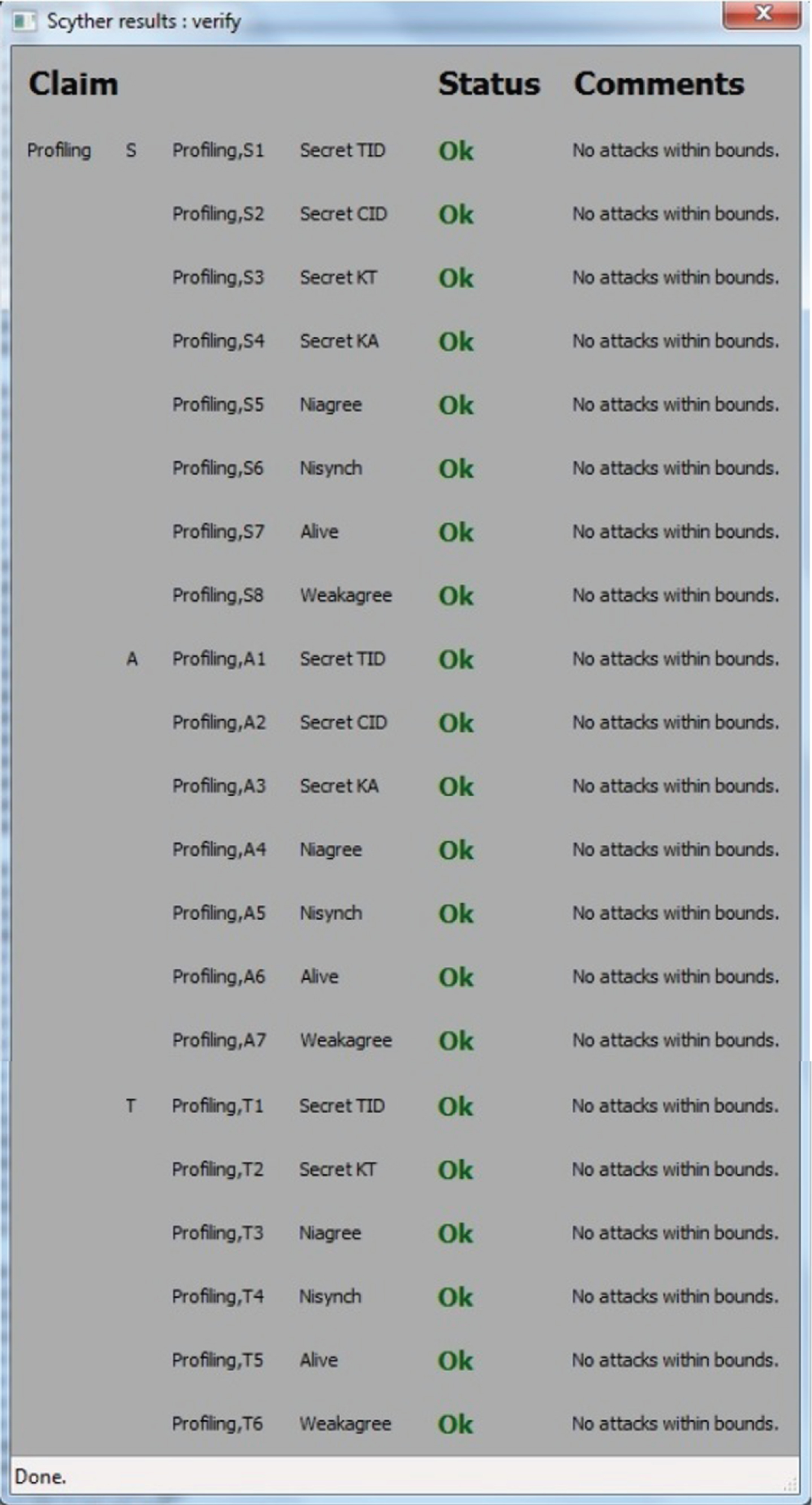
Formal Verification.
Let t h denotes the time complexity for hash operation, t p denotes the time complexity for PUF evaluation, t xor denotes the time complexity for xor operation, t rot denotes the time complexity for rotation function and t rec denotes the time complexity for reconstruction function. Since the time complexity for xor operation is negligible, thus we ignore the computational complexity for xor operation. W.l.o.g we assume that the random numbers and the time stamp are as long as the output of one way hash function say, l and the identity message ID j is padded with zero bits to make the bit size of ID j as long as l. Efficiency of our authentication protocol with the related [47–52] schemes in terms of storage, tag computation and communication cost has been analyzed, evaluated, compared and described in table 8. Then proposed protocol performance has been evaluated and compared with the related research works [22, 52]. Performance has been evaluated on various types of active and passive security as well as privacy attacks and it is shown in table 9.
Efficiency Evaluation
Efficiency Evaluation
Performance Evaluation
In this work, an innovative and new idea of profiling in the banking zone is proposed by conjunction of various already existing technology enhancements like RFID technology, intelligent system and fuzzy classification system. An expert RFID system utilizing Matlab fuzzy inference system has been designed for profile matching. The vagueness in profiling is compared according to customers attributes distinctions and match with the one having the highest degree of extent using knowledge of domain experts in real time. Further, we proposed a RFID based comprehensive authentication intelligent framework to show profiling implementation. To secure the RFID profiling system expertly, an authentication system has been described, in which the server’s computed matching value corresponding to users query survey, is communicated to the user securely via his mobile application. Moreover, the proposed protocol security from several active and passive attacks is verified by utilizing Scyther tool. Thus, we can demonstrate that the proposed innovations and technological developments will revolutionize the banking sector by increasing efficiency, decreasing cost and providing more secure and privacy sensitive financial data communication and transactions.
Profiling in the banking zone and its vagueness is compared in this work according to customer’s attributes distinctions and match with the one having the highest degree of extent using knowledge of domain experts in real time. In future, this will give a scope of utilizing machine learning algorithms along with intelligent RFID systems so that client’s data is managed and compared to find any abnormality in the transaction. If there is some unusual pattern, then the system will take suitable decisions to satisfy each customer service efficiently and securely on priority basis. In this way, by analyzing client’s records, intelligent software agents will provide the active vehicle in the interpretation profiling of the data and reporting capacity while the RFID system will provide the passive vehicle to obtain the data via its monitoring capabilities.
Footnotes
Acknowledgment
This research is supported by Royal Bank of Canada, Mitacs Elevate Program and University of Toronto.