



Abstract
MCCPI (Multiple Criteria Correlation Preference Information) is a kind of 2 dimensional decision preference information obtained by pairwise comparison on the importance and interaction of decision criteria. In this paper, we introduce the nonadditivity index to replace the Shapley simultaneous interaction index and construct an undated MCCPI based decision scheme. We firstly propose a diagram to help decision maker obtain the nonadditivity index type MCCPI, then establish transform equations to normalize them into desired capacity and finally adopt a random generation MCCPI based comprehensive decision aid algorithm to explore the dominance relationships and creditable ranking orders of all decision alternatives. An illustrative example is also given to demonstrate the feasibility and effectiveness of the proposed decision scheme. It’s shown that based on some good properties of nonadditivity index in practice, the updated MCCPI model can deal with the internal interaction among decision criteria with relatively less model construction and calculation effort.
Keywords
Introduction
Compared with the probability additive measure, the capacity [7], also called fuzzy measure [25], nonadditive measure [3], has a major merit in representing various interaction situations among multiple correlative criteria. This merit of capacity basically roots from its monotonicity property with respect to set inclusion, or more explicitly, the nonadditivity with respect to disjoint subsets. It is commonly accepted that superadditive (subadditive) capacities mean positive (negative) interactions among decision criteria. The combination of capacity and Choquet integral [7] is the most widely adopted pattern for dealing with and aggregating the interdependent multiple criteria associated decision information.
The capacity and Choquet integral based decision pattern usually begins with decision maker’s preference information on importance and interaction of decision criteria and ends with overall evaluations (Choquet integrals) or a consistent ranking order on all alternatives. The decision preference information can be generally represented by a special type of capacity, e.g., k-additive capacity [11] only concerns at most k-order interaction and neglects the higher ones; p-symmetric capacity [23] represents decision with p groups of anonymous referees or indifferent criteria, k-order representative capacity only uses upper or lower k-order subsets to define the multicriteria decision context [29] and so on [5]. The preference information can also be represented in detail in terms of an equivalent transform of capacity, e.g., capacity value itself just represents the importance of criteria subset, the Shapley interaction index [10, 16] describes the simultaneous interaction among criteria, the nonadditivity index [3, 28] shows interaction phenomenon of criteria associated with the nonadditivity. The preference information can be further implicitly represented through some partial orders on some decision alternatives in terms of the Choquet integral or other type of nonlinear integral [2, 26]. Usually, these three types of representation approaches for preference information are given in terms of interval ranges or comparison forms [12]. With them, many capacity identification methods, such as least-squares approach [12, 22], the maximum split method [21, 22], the least absolute deviation method [1], the maximum entropy approach [16, 20], the compromise method [31] and so on [4], are proposed and applied to obtain the most satisfactory capacity, by which the final overall evaluations or ranking order can be naturally generated.
Lately, a special form of preference information, called the MCCPI (Multiple Criteria Correlation Preference Information), has been introduced and studied [30], which is basically a set of 2-dimensional (importance, interaction) pairwise comparison preference information and can be regarded as a natural generation of the 1-dimensional (only importance) pairwise comparison information obtained by another well-known decision method, AHP (Analytic Hierarchy Process) [24]. The MCCPI can be obtained through an aid tool called the refined diamond diagram, which holistically composes all the situations of the overall importance and the simultaneous interaction between two criteria. With MCCPI, some optimization models, like the least squares based nonlinear programming model and the least absolute deviation based linear programming model, are established to get the most desired 2-additive or ordinal capacity for closely catering to the decision maker’s preference and judgments [30, 32]. Furthermore, a random generation based comprehensive decision aid algorithm with the Shapley importance and interaction indices is proposed to show the whole view of allowable dominance relationships among all decision alternatives [32].
Although the Shapley simultaneous interaction index, along with other types of probabilistic simultaneous interaction indices [10, 15], e.g., Möbius representation [6] and Banzhaf simultaneous interaction index, has some outstanding axiomatic characteristics, but meanwhile it has some shortcomings for multiple criteria decision making [3, 28]. For example, with 2, 3, 4 and 5 criteria, it ranges in [-1, 1], [-2, 1], [-3, 3] and [-4, 6]. This changeable range for different cardinalities brings difficulties in directly comparing these indices values. Superadditive capacity can have a negative simultaneous value, i.e., these indices values do not precisely reflect the interaction kind associated with nonadditivity and disobey some commons sense in decision context. Furthermore, the interaction of criteria subset that includes as long as one dummy criterion will always be zero, regardless of the kind or degree of the interaction existed among other non-dummy criteria, which also conflicts with people’s intuition.
In view of these disadvantages with existing interaction indices, we recently proposed the concept of nonadditivity index [27] to explicitly express the interaction degree and kind associated with nonadditivity, which has an uniform range, consistent with nonadditivity, moderate compromise with the effect of dummy. Albeit a type of internal interaction index, the nonadditivity index, also a one-to-one linear mapping of capacity, can be served as a good alternative of simultaneous interaction index in multiple criteria decision making in consideration of its advantages in practice and easy understanding in decision context.
In this paper, we first construct a different diagram to aid the decision maker to explicitly represent nonadditivity index form MCCPI of every pair of decision criteria, where the relative importance and interaction between two criteria are both divided into nine categories and result into 68 intersection regions for the choice of pairwise comparison. Then by adopting the least square divergence principle as well as least absolute deviation principle, we establish some optimization models to transform the MCCPI of multiple criteria into the ordinary or special types of capacities with the consideration of the boundary and monotonicity condition and other specific and complex preference constraints on 3 or more decision criteria. Finally, to reveal the whole view of dominance situation between all decision criteria with the given acceptable intersection regions, a random simulation based comprehensive decision aid algorithm is proposed to generate all the three types dominance relationships of all pairs of alternatives together with credibility frequencies and finally to achieve the most creditable ranking order of all decision alternatives.
This paper is organized as follows. After the introduction, we collect some basic knowledge about the capacity, Shapley simultaneous interaction index and nonadditivity index in Section 2. In Section 3, we briefly show the Shapley interaction based MCCPI and its decision making scheme and steps. In Section 4, we present some tools and rules to obtain the nonadditivity index based MCCPI. Sections 5 and 6 are for the identification models to derive the capacities directly from the MCCPI and the random generation based comprehensive decision aid algorithm, respectively. Section 7 provides an empirical analysis of the updated decision scheme. Finally, we conclude the paper in Section 8.
Capacity and its interaction indices
Let N = {1, 2, …, n}, n ≥ 2, be the decision criteria set,
μ (∅) =0, μ (N) =1 ; (boundary condition) ∀A, B ⊆ N, A ⊆ B implies μ (A) ≤ μ (B). (monotonicity condition)
The capacity value of a decision subset is usually regarded as its importance to the decision problem, the minimum and maximum importances are normalized as 0 and 1, respectively. The monotonicity of capacity value with respect to set inclusion means a new criterion’s join can not decrease the importance of original coalition. An explicit representation of monotonicity is the nonadditivity with respect to disjoint subsets, which leads to a common sense of interaction among multiple criteria.
It is commonly accepted that an additive (superadditive, subadditive) capacity means that decision criteria are mutually independent (complementary, substitutive), or their interactions are all zero (nonnegative, nonpositive).
The interaction phenomenon could be represented by the Shapley simultaneous interaction index.
The Shapley interaction index, as well as the probabilistic simultaneous interaction indices, has many outstanding axiomatic characteristics [10, 16] but fails to represent the interaction kind and degree associated with nonadditivity [27, 28].
The nonadditivity index has the following properties: If μ on N is ★-additive, then n
μ
(A) -1 ≤ n
μ
(A) ≤1, ∀A ⊆ N. n
μ
(A) =1 ⇔
This means nonadditivity index is consistent with nonadditivity, with uniform range, and gets its extremely interaction cases with
Same to the Shapley interaction index, the nonadditivity index is also a linear representation (one to one mapping) of the capacity [28]. A capacity μ on N can be represented through nonadditivity index n μ as
The Choquet integral is a generally adopted form of nonlinear integral to aggregate the capacity based decision information and also has many brilliant aggregation function properties [3].
Suppose criteria set N = {i, j}, we can have
which can be reflected by the points in a diamond diagram [30, 32], see Fig. 1 for its refined version, where the segment
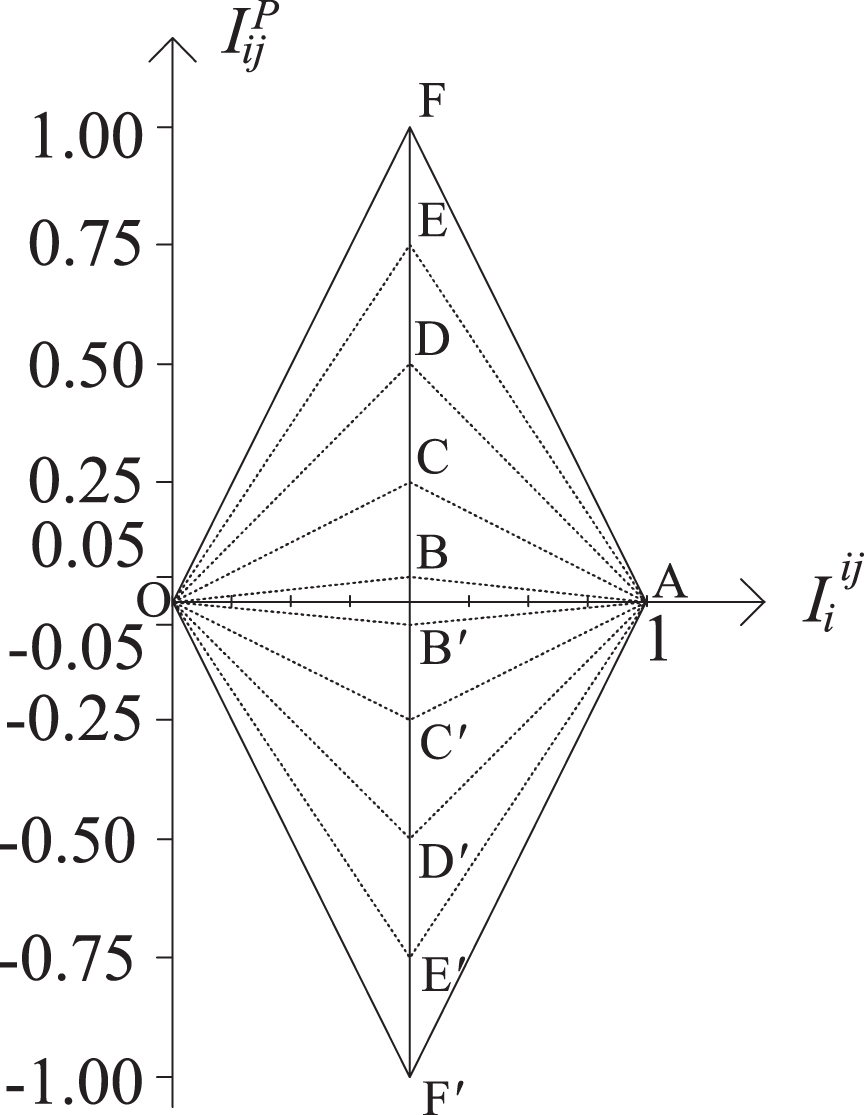
Refined diamond diagram.
Specifically, if the point’s first coordinate falls into [0.00, 0.125) (resp [0.125, 0.25), [0.25, 0.375), [0.375, 0.50), [0.50, 0.50], (0.50, 0.625], (0.625, 0.75], (0.75, 0.875], (0.875, 1]), then it means the criterion i is extremely less (resp. very strongly less, strongly less, slightly less, equally, slightly more, strongly more, very strongly more, and extremely more) important than j. If the point belongs to sub-diamond
By using the above 9 × 9 = 81 refined segments in the diamond, decision maker can get the relative importance and partial interaction of all pairs of decision criteria, denoted as
By introducing the distance measure and the boundary and monotonicity conditions, we can construct a capacity identification model as follows:
where D (x, y) is a distance between x and y, the optimal capacity can be ordinary or any particular type of capacity, and the higher order preference can be given in comparison or interval form as in works [8, 30].
Different points in the acceptable segments of same MCCPI may lead to different optimal capacities, and at larger chance the different overall evaluations and final ranking orders of decision alternatives. In order to show the whole dominance situation and get the most creditable ranking order, a random generation MCCPI based comprehensive decision aid algorithm has been proposed, see reference [32], whose main idea will be shown and succeeded in algorithm 1 in this paper.
As mentioned previously, compared to Shapley interaction index, nonadditivity has advantages in representing decision maker’s preference information. It’s better to combine the nonadditivity index with MCCPI as well as its comprehensive decision aid algorithm. We’ll finish these tasks in the following sections.
MCCPI obtains decision maker’s preference information by pairwise comparison of decision criteria through a 2-dimension perspective, i.e., the relative importance and partial interaction. If adopt nonadditivity index as an intermediary to show this type of 2-dimensional preference information, the Fig. 2 can be taken as an identification aid tool.

The diagram of nonadditivity index type MCCPI.
Suppose the decision criteria set only consists of two elements N = {i, j}, then
First, the relative importance between criteria i and j is represented by their capacity values. For example, point the points in line the points in ▵ the points in ▵ the points in ▵ the points in ▵ the points in ▵ the points in ▵ the points in ▵ the points in ▵
Second, the partial interaction among two criteria i and j can be represented by the nonadditivity index. For example, in Fig. 2, the nonadditivity index of point the points of ▵ the points of trapezoid the points of trapezoid the points of trapezoid the points of line the points of trapezoid the points of trapezoid the points of trapezoid the points of ▵
In brief, in Fig. 2, the relative importance of two criteria is defined by the ratio of their capacity with the critical values of 4, 2, 4/3, 1, 3/4, 1/2 and 1/4 to show the cases ranging from extremely more important to extremely less important; the interaction between two criteria is classified by the nonadditivity index of their union set with the critical values of -0.75, -0.5, -0.25, 0, 0.25, 0.5 and 0.75 to represent the cases ranging from extremely negative to extremely positive. One can see that, in Fig. 2, there are 69 types of 2-dimensional preference information of two criteria, e.g., the point
Suppose the nonadditivity index type MCCPI of decision criteria pair {i, j} ⊆ N is given as
The objective of model (9) is to minimize the divergence between two hand sides of Eq. (8), i.e., the deviation between the MCCPI and the optimal capacity. If adopt the absolute distance, we have a chance to present the above model into the multiple goals linear programming by introducing the positive and negative deviation variables. According to model (9), we can construct the following linear programming:
It should be pointed out that the boundary and monotonicity conditions are linear combination of capacity; most of constraints for special types of capacity, like k-additive capacity, p-symmetric capacity, k-order representative capacity can also be represented as linear constraints (see [1, 29]); and preference on higher order subsets is usually given in terms of linear equivalent representation of capacity, e.g., Shapley interaction index and nonadditivity index, with comparison or interval forms, which is essentially the linear combination of capacity. Furthermore, the multiple goals linear programming of model (10) can take any linear equivalent representation (one-to-one mapping) of capacity as variable and the linear property of the model will not change. For example, by Eq. (3), we can use the nonadditivity index to construct the boundary and monotonicity conditions as follows [28]:
Also, the optimization identification methods can be rewritten in matrix representation or marginal contribution representation form, see e.g., [3, 27].
As mentioned before, one can also imagine that different representative points of given acceptable intersection of same MCCPI may lead to different overall evaluations and then the different ranking orders of decision alternatives. We can resort the random simulation method to sketch out a general view of allowable dominance relationships of all alternatives. Algorithm 1 is the comprehensive decision aid algorithm based on random generation of nonadditivity index type of MCCPI.
Empirical analysis on an example
See the application example in References [30, 32]: a decision maker has to rank seven cars according to four criteria: price, acceleration time, maximum speed and consumption, denoted as criteria 1, 2, 3, and 4. These cars’ partial evaluations on four criteria are given in Table 1.
The partial evaluations of the seven types of cars
The partial evaluations of the seven types of cars
The decision maker gives the nonadditivity index type of MCCPI as follows: Criterion 1 is strongly more important than 2 and their partial interaction is extremely positive; Criterion 1 is strongly more important than 3 and their partial interaction is strongly positive; Criterion 1 is slightly less important than 4 and their partial interaction is extremely negative; Criterion 2 is strongly more important than 3 and their partial interaction is slightly negative; Criterion 2 is slightly less important than 4 and their partial interaction is strongly negative; Criterion 3 is strongly less important than 4 and their partial interaction is strongly positive.
After six times of 2-dimensional pairwise comparisons, the above MCCPI can be specifically represented as the points in Fig. 3, where the points (0.1, 0.05), (0.3, 0.1), (0.85, 0.95), (0.8, 0.3), (0.75, 0.8) and (0.1, 0.3) are adopted to represent the MCCPI of the criteria pairs (1, 2), (1, 3), (1, 4), (2, 3), (2, 4) and (3, 4), respectively.

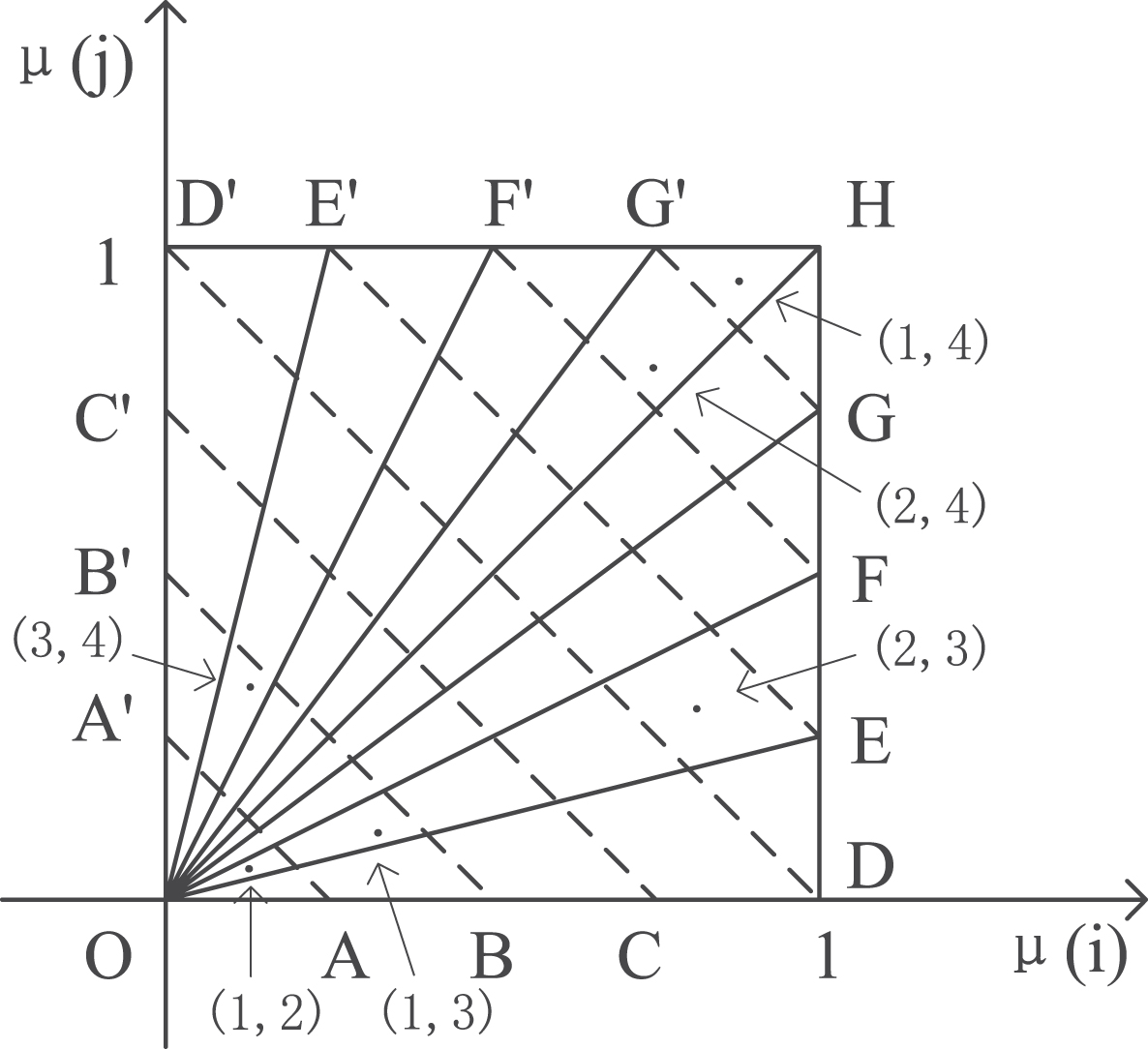
MCCPI of the four criteria.
According to model (10), we have the following linear programming:
Solving the above model, we have the optimal capacity and its nonadditivity index, as shown in Table 2.
The optimal capacity and its nonadditivity index
By the capacity in Table 2, we can calculate the Choquet integrals of all cars and have the following ranking order:
Now we further test the random generation based comprehensive decision aid algorithm (1). We choose the random values from the intervals (2, 4], (2, 4], [3/4, 1), (2, 4], [3/4, 1), 1/4,1/2) to show the ratio of capacity values of pair criteria (1, 2), (1, 3), (1, 4), (2, 3), (2, 4) and (3, 4), and choose the random values from the intervals (0.75, 1], (0.5,0.75], [-1,-0.75), [-0.25,0), [-0.75,-0.50) and (0.5,0.75] to their partial interactions. By executing the algorithm 1 with
d≻ (
If set
d≻ (
If set
d≻ (
One can have a conclusion that the frequencies of all dominance relationships are relatively stable. By calculating the dominance scores of all cars, we can obtain the most credible overall ranking order with the generated MCCPI, which is same as that in Eq. (12). So, the car
In this paper, we construct a nonadditivity index type MCCPI based multiple criteria decision aid scheme, which is an update version of the Shapely interaction index type MCCPI and its comprehensive decision algorithm. The nonadditivity index type MCCPI can be obtained by 2-dimensional comparison in terms of a rectangular diagram subdivided with different degrees of relative importance and partial interaction. On the grounds of a random generation of MCCPI, a random simulation algorithm is proposed to reveal the whole view of dominance relationships of all alternatives as well as the most creditable ranking order on them. The major advantage and convenience of this updated decision scheme root from the good properties and easy understanding of nonadditivity index. Since nonadditivity index is basically an internal interaction index and with less coefficients compared with some comprehensive interaction indices, the nonadditivity index type MCCPI method can lead to some extreme interaction situations in practice. The further research task will focus on more empirical studies of different MCCPI methods on some real decision problems and the rules and tools for MCCPI’s inconsistency recognition and adjustment as well as some corresponding decision aid software packages. Furthermore, some decision issues in traditional independent criteria context, like strategic weight manipulation [33], minimum, averaging and maximum ranking positions of decision alternatives [9, 19] also have potential necessities and feasibilities to be extended into the interactive criteria context with the capacity and nonlinear integral.
Footnotes
Acknowledgments
The work was supported by the National Natural Science Foundation of China (No. 71671096).