



Abstract
In this paper, we investigate all relative relationships between two fuzzy numbers. Then, we introduce new relative measures to compare two fuzzy numbers instead of using absolute value to represent the fuzzy number. These measures address the dominant level that one fuzzy number is better than the other in terms of its position and shape. The so-called absolute fuzzy dominant degree and relative fuzzy dominant degree are developed to measure the differences between two fuzzy numbers applying for different types of constraint. These measures could capture all the shape’s characteristics and relative positions of fuzzy numbers. Finally, the fully fuzzy multi-objective decision making (FFMODM) problem is solved by using these fuzzy dominant degrees. For validation, we compare our approach to the fuzzy ranking method of the linear ranking function. Our obtained results show better performance.
Keywords
Introduction
Solving fuzzy related optimization problems is a challenging job due to the difficulty of ranking fuzzy numbers. The main approaches for ranking fuzzy numbers are using the linear ranking function [1], the different distances [2–5], comparing different values [6–10]. The main difference between these methods is the way to capture the information of fuzzy numbers. Most of the above methods measure the equivalent value of the fuzzy number. Few approaches start considering the shape characteristics by using the areas among fuzzy numbers [11, 12]. However, these methods do not investigate completely all relative relationships among fuzzy numbers.
One of the direct applications of fuzzy ranking methods is to solve the fully fuzzy multi-objective linear programming (FFMOLP) problem. The general direction for solving FFMOLP is using some fuzzy comparison/ranking indices to solve the equivalent single objective fully fuzzy linear programming (FFLP) problem. Then, multi-objective decision-making approaches such as the fuzzy compromise programming method (FCPM, using min-max operators), global criteria method (GCM), or weighted sum method (WSM) are applied. The differences between the methods are actually based on the ranking method of fuzzy numbers [13–18]. The most popular direction is to transfer the FFMOLPP into the deterministic one by using some fuzzy ranking methods for different types of fuzzy numbers. Many approaches [1, 27] have used ranking functions such as linear ranking function, distance function. Vencheh et al. [14] used the weighted vector and max-min operator to transfer the fully fuzzy multiple objectives into a single objective function. Then, the linear ranking function is used to convert the fuzzy objective function into a deterministic one. The main concern of this method is the way to separate elements of triangular fuzzy numbers in the constraints. Chandrasekaran et al. [15] applied a ranking procedure based on hexagonal fuzzy numbers to transform the fuzzy multi-objective linear programming problem into a crisp value problem. In fact, the ranking method based on the hexagonal fuzzy number is a special linear ranking function. Bharati and Singh [5] also defined a distance function between two trapezoidal fuzzy numbers which satisfies all the properties of metric and a degree of deviation between two triangular fuzzy numbers. The proposed degree of deviation has been used to solve a fully fuzzy multi-objective linear programming problem (FMOLPP). Compaoré et al. [18] applied the ranking function developed by Hosseinzadeh and Edalatpanah [19] to convert the fuzzy program into a deterministic program. Then, the MOMA-plus method [20] is adapted to find all Pareto optimal solutions of fully fuzzy L-R triangular multi-objective linear optimization problems obtained after conversion. Recently, the linear ranking function is also used to convert FFMOLP problem into a semi fully fuzzy multi-objective linear programming (SFFMLP) problem [1]. The obtained SFFMLP problems were gathered together and solved by four different aggregating methods of fuzzy objectives to find a fuzzy compromise solution. Recently, Nasseri and Mahmoudi [30] have pointed out that the ranking method of Ezzati et al. [31] is not correct. Then, they proposed a new lexicographic ordering algorithm to solve the fully fuzzy linear programming (FFLP) problem by converting it to its equivalent, a MOLP problem.
Other interesting approaches are using other measures to represent fuzzy numbers such as expected value, expected interval, lexicographic ordering, nearest interval approximation, and some other indices together such as location index number, left, and right fuzziness function. Ren et al. [16] used a fuzzy relation in the form of expected interval and expected value to compare fuzzy numbers to transform the fully fuzzy bilevel linear programming problem into a deterministic bilevel problem. Then, an interactive programming approach is developed to find a balanced solution to the fully fuzzy bilevel programming problem. Das et al. [21] proposed the lexicographic ordering method to solve the FFMOLP for trapezoidal fuzzy numbers. Najafi et al. [22] dealt with the fully fuzzy linear programming (FFLP) with unrestricted fuzzy coefficients and fuzzy variables. They defined a simple arithmetic ranking function to convert any triangular fuzzy number to an equivalent value to compare two fuzzy numbers. Then, the splitting technique is used to convert the FFLP into the crisp nonlinear programming with a simple structure. The optimal solutions can be obtained by solving the crisp non-linear programming problem. Sharma and Aggarwal [17] focused on solving the FFMOLP with the more generalized version of fuzzy numbers - the LR flat fuzzy numbers. They first converted the FFMOLP into the Multi-Objective Interval Linear Programming (MOILP) problem. Then, taking the help of fuzzy slack variable, fuzzy surplus variables, nearest interval approximation of fuzzy numbers and scalarization technique, MOILP is then converted into the Crisp Linear Programming (CLP) problem. Although Mohanaselvi and Ganesan [13] solved the FFMOLPP without converting to the crisp equivalent problem, they still used location index, left fuzziness index function, and right fuzziness index function, respectively, to represent fuzzy numbers. Recently, Jiménez [23] proposed an interesting approach to convert the fully fuzzy linear programming problem into a multi-objective linear programming problem without ranking functions. Then, they used the multi-objective algorithm to generate nondominated solutions to solve the fully fuzzy linear programming problem.
In summary, the existing methods for solving the FFMOLP can be classified into two main directions: Convert a fuzzy number into a simple ranking function to compare two fuzzy numbers. Using this ranking function to transform the FFMOLP into an equivalent deterministic one. Define other measures to capture characteristics of fuzzy numbers to represent them. Then, these measures are used to compare two fuzzy numbers. These measures are used to convert the FFMOLP into an equivalent one or solved the FFMOLP directly.
Up to the best of our knowledge, no work so far has investigated completely all relative relationships between two fuzzy numbers. This main research gap leads to two questions that need to be answered: Is there any fuzzy ranking method that considers all relative relationships between two fuzzy numbers that cover both shape characteristics and relative positions between them? If there is/are such relative comparison measure(s), can we use it to solve a complicated application such as the fully fuzzy multi-objective linear programming (FFMOLP) problem?
In this paper, we introduce new relative measures between two fuzzy numbers to answer two questions above. These measures address the dominant level that one fuzzy number is better than the others in terms of its position and shape. In real life, the use of the dominant principle for decision making in unclear information situations is quite popular. These circumstances often happen in order planning, supplier selection, development strategy, supply chain design, and scheduling problems, in which the described conditions (objectives, constraints, coefficients) cannot be determined precisely. A simple example to illustrate the application of the use of the dominant principle in fuzzy decision making is the case of election. Each candidate has a number of qualitative attributes that are expressed in fuzzy numbers. The winner is voted by the population if his or her attributes relatively dominate to the others.
Another illustrated application of the dominant principle in solving fully fuzzy multi-objective linear programming could be the case of the printed circuit boards (PCBs) assembly scheduling problem in the electronics industry. There are n PCBs that need to be processed sequentially by an assembly machine. Each PCB i has m i number of components or component types. Therefore, two objectives of maximizing similarities between PCBs and minimizing setup time are often considered in this type of problem. These objectives can be expressed as fuzzy numbers. The setup time of a new board cannot be predetermined as in a regular scheduling situation, as it depends on the previous jobs. It depends on the current set of components on the magazine and the additional requirements for the incoming job. For the assembly, total setup time on a machine would include the time to fix all PCBs on the machine and the time to exchange components. The set-up time is fluctuating and hard to estimate precisely. The similarity among boards does not only depend on the number of common components between two boards but also the difference between the maximum and minimum loads for the uploading and unloading boards on/to the machine. In addition, available resources, demand, and constraints’ coefficients can also be modelled as fuzzy numbers because of the vague perceptions with hard statistical data in several environmental conditions such as seasonal factors, market prices, and suppliers which contribute to constraint parameters. To handle fuzzy information, we will priories them by comparing the relative dominant levels of fuzzy setup time, similarity measure, demand, associated resources and so on to sequence boards properly.
These examples motivate the author to propose a new model for solving fully fuzzy multi-objective linear programming problems by using dominant measures to compare two fuzzy numbers instead of using absolute value to represent them. We capture all the shape characteristics and the relative relationships of fuzzy numbers in the form of dominant degrees in which the relative positions between fuzzy numbers at all α– cut levels will be integrated to cover all shape of the fuzzy memberships. In this paper, different fuzzy dominant degrees are defined to apply for different cases of constraint. Using these results, we convert directly the FFMOLP problem into an equivalent single deterministic linear programming problem. The rest of the paper is organized as follows. The next section will summarize some important results of our previous work in comparing fuzzy numbers by fuzzy dominant degree. Then, some extensions of fuzzy dominant degrees are developed. The complete definitions of the fuzzy dominant degree are the basis to solve the FFMOLP problem in Section 3. In Section 4, we first compare our approach with the Hamadameen and Hassan [1] by using their numerical example. Then, we conduct numerical experiments to confirm the advantage of our method with the linear ranking function approach. Finally, section 5 presents the conclusions, discussions and possible future research directions.
Fuzzy numbers comparison
In this section, we develop a new concept of fuzzy dominant degree and its associated measures. Starting from the basic order relation between α-cut of fuzzy numbers, these α-cut ranking values are then aggregated into a composite measure, namely, the dominant degree. For further development, some basic notations and results from Ren et al. [16] are summarized as follows:
P
α
: α-cut of fuzzy number FFMODM: the fully fuzzy multi-objective decision making (FFMODM) problem/model RD(.): relative (fuzzy) dominant degree AD(.): absolute (fuzzy) dominant degree LRF: linear ranking function (NADM): the area of the trapezoid (NADM) RHS: Righ-Hand-Side of a constraint LHS: Left-Hand-Side of a constraint
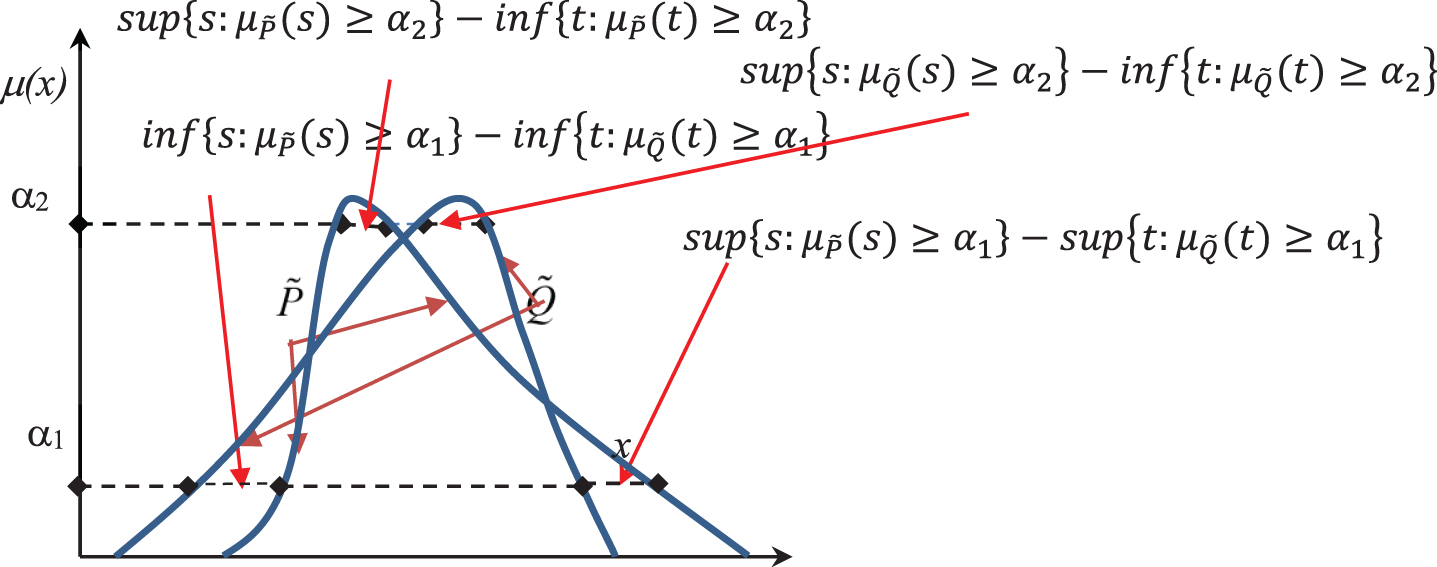
The Dominant at α-Level.
From Fig. 1, we can see that if P
α
1
≥ Q
α
1
then
So, it is difficult to justify
If
If
If
To cover both cases of
Dominant degree calculation
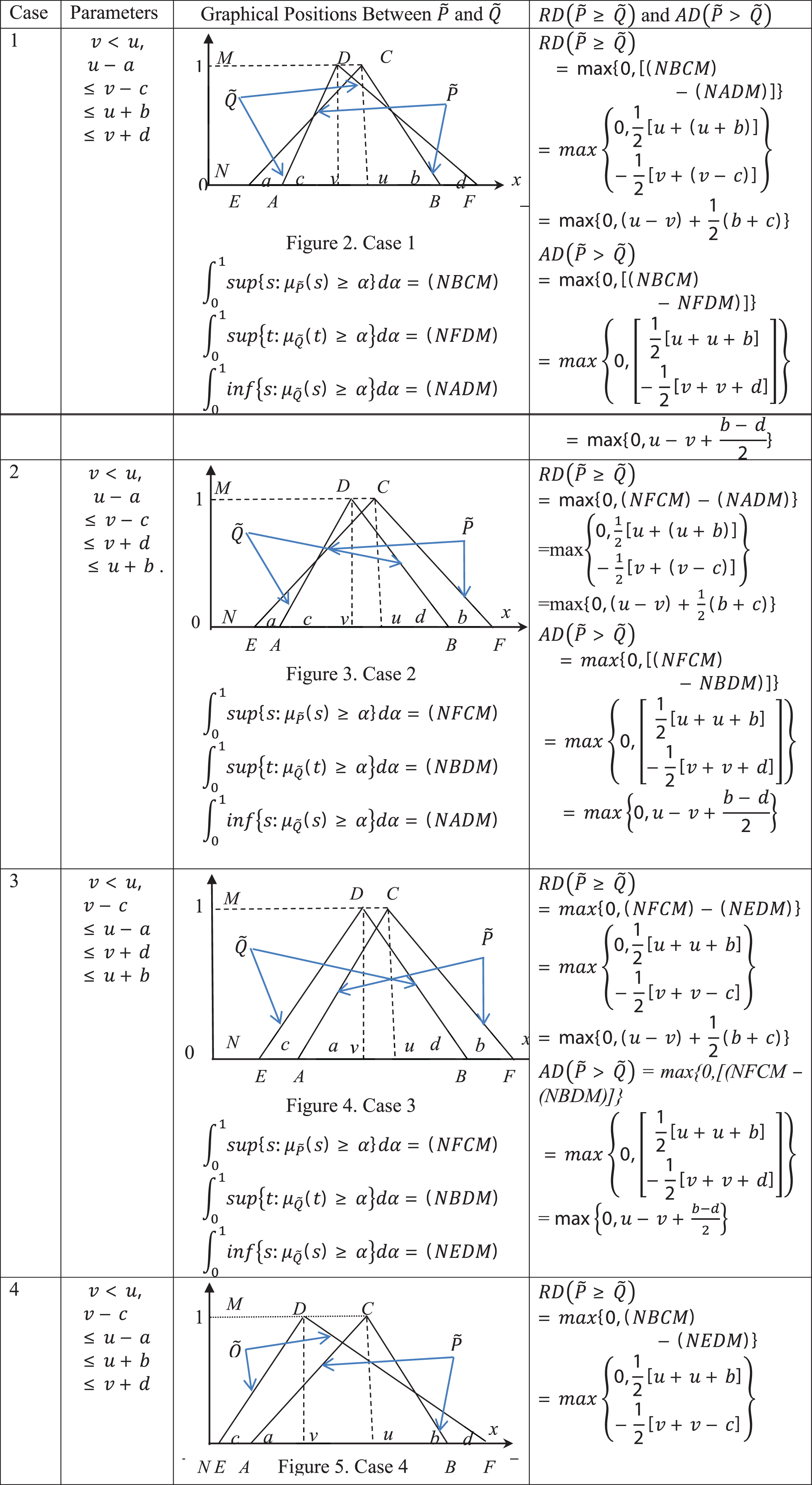
However, when
Definitions 3 and 4 have compared two fuzzy numbers
Similarly, we have the following propositions:
The relative dominant degree and absolute dominant degree of two normal trapezoidal fuzzy numbers
With the results of fuzzy dominant degree, the relative positions between fuzzy numbers now can be converted into the corresponding deterministic measure that covers all shape characteristics as well as relative relationships between them. We are using these results to solve the fully fuzzy multi-objective linear programming problem in the following section.
In this section, we reconsider the fully fuzzy multi-objective linear programming (FFMOLP) problem stated in the work of Hamadameen and Hassan [1] in which the coefficients of the objective functions, constraints, right-hand-side parameters and variables are of the triangular fuzzy numbers. The FFMOLP problem can be formulated as follows:
Subject to
Where
In this model, we want to maximize
Subject to:
It is noticed that the set of original constraints in (8) are transformed to the relative fuzzy dominant degree (RD) to cover the cases of “≤ ” constraints. For the case of “< ” constraints, the absolute fuzzy dominant degree (AD) will be used. Now, we need to check further steps to secure that the solutions of the model (8.1) – (8.5) will be the solutions of the original model (6.1) – (6.4) by the following theorems.
Without loss of generality, we assume that all fuzzy numbers and variables in the model (8.1) – (8.5) are triangular fuzzy numbers/variables. From definition (4.1), constraints (8.2) – (8.4) could be expressed as follows:
These correspond to:
Therefore, the model (8.1) - (8.5) will correspond to the following model:
Subject to:
This model (8.1’) – (8.5’) is finally the standard deterministic linear programming model and can be solved by simplex method via standard optimization packages such as LINGO or CPLEX.□
(⇒) Let
(⇐) Let
From above results, we propose the following procedure to solve the FFMODM problem by using fuzzy dominant degrees. First the original FFMODM model is converted to the equivalent model (8.1) – (8.5). Then, all RD(.) or AD(.) values are calculated by applying the results of Propositions 1 or 2. Finally, the obtained the deterministic linear programming model is solved by the standard optimization software such as LINGO or CPLEX.
Step 1. Convert the original FFMODM model to the equivalent model (8.1) – (8.5)
Step 2. Apply (4.1), (4.2) or (5.1), (5.2) to calculate the values of RD(.) or AD(.) for each constraint
Step 3. Solve the obtained deterministic linear programming model by LINGO or CPLEX
In this section, we will show the efficiency and robustness of our relative ranking method. First, the dominant degree approach for solving FFMOLP is compared with a popular approach in literature: the fuzzy linear ranking function (LRF) based. For ease of reading, we summarize the concept of the linear ranking function and its properties in the following definitions and property [1].
Numerical example for comparison
Here, the numerical example of Hamadameen and Hassan [1] is reconsidered as follows:
Subject to:
Applying (8.1) – (8.5), the model (9.1) – (9.9) will be:
Subject to
Let
Solution comparison
Subject to
Our solution is
Processing time and material consumptions
We compare this obtained result with the solution of Hamadameen and Hassan [1] in Table 2. It can be seen that our solution is better than the solution of Hamadameen and Hassan [1] for the case of
To confirm the advantage of our approach over the linear ranking function approach, we introduce a real case application. Both AD and RD for “< ” and “≤” constraints, respectively, are also used in this example.
We consider a certain chocolate manufacturer company (Chocoman) to produce three products: chocolate bar (B); chocolate candy (C); and chocolate wafer (W). To produce 1 kg of chocolate bar (B), chocolate candy (C) and chocolate wafer (W) are manufactured approximately in 0.4 h, 0.6 h, and 0.5 h, respectively. Subject to many factors such as the machine breakdown, waiting for materials, bottleneck, the available time of machines is approximately less than 35 h in a week. In addition, products are needed to be mixed with two main kinds of materials: milk chocolate mix and flour powder. Usage of these raw materials varies for each product is hard to measure exactly due to many factors. The common factors are transportation loss, season, working conditions (temperature, humidity, cleanliness), processing technology and processing parameters. It is noticed that the total weight of finished goods is not more than the total weight of all raw materials. All materials are measured by weight in kilograms and estimated as an approximate number in the form of fuzzy numbers. The estimated raw materials consumption for each product are given in Table 3.
The impact of each product on the company’s profitability is about $30, $20 and $40 for 1 kg chocolate bar, chocolate candy, and chocolate wafer, respectively. In addition, the processes for these chocolate products are not easy to control. The lost or defect is mainly created in three key processes: mixing, cutting and forming. The level of defects depends on the adjustment of the machine and labour skills. The details of the data are given in Table 4 as follows.
Profit and defect rate
Profit and defect rate
To decide which mix of these products should be produced for a week, management of the company wants to maximize the company’s total profit and minimize the total defect rate.
Let x1 = the approximated amount of chocolate bars to be produced in a week (kgs)
x2 = the approximated amount of chocolate candy to be produced in a week (kgs)
x3 = the approximated amount of chocolate waffer to be produced in a week (kgs)
As results, we have the following FFMOLP model:
Subject to:
In this model, objective function (12.1) expresses total profit obtained from producing three products of chocolate bar, chocolate candy, and chocolate wafer, respectively. Objective function (12.2) indicates the total defect rate from all three products. Constraints (12.3) – (12.5) guarantee that the total processing time and material consumptions should not over available amounts. Constraint (12.6) limits total production quantity for all three products. Constraint (12.7) is the non-negative condition for amount of each product to be produced. Applying (8.1) – (8.5), the model (12.1) – (12.7) will be:
Subject to
Solution comparison
Similar to by Hamadameen and Hassan [1], the Linear Ranking Function (LRF) of Mahdavi-Amiti and Naseri26 will be applied because it transforms the fuzzy numbers into a value within the interval. For a triangle fuzzy number
Apply the linear ranking function approach, the model (13.1) – (13.8) will be:
Subject to
Testing cases
Solving this model, we have the solution of the LRF approach for the product mix model of Chocoman is
Now, we check the dominant value between our solution and LRF results as in Table 5. The comparisons show that our approach gives better solution than the LRF method in terms of dominant degree between the obtained objective values.
To validate our approach, we conduct 10 tested cases to compare with the LRF approach of Hamadameen and Hassan [1] in which all parameters are generated randomly (see Table 6). As results, consider the following general FFMOLP model:
Subject to
Experimental results
Here, the model (16.1)– (16.5) is defuzzified completely by the Linear Ranking Functions (LRF) for all fuzzy parameters and variables instead of only
Subject to
Now, applying Linear Ranking Functions, we have:
Subject to
To solve the normal deterministic multi-objective linear programming model (18.1) – (18.5), the objectives are simply combined in the form of constraints as follows:
Dominant Degree between Our Solutions and the LRF Solutions
Subject to
The obtained results of the 10 tested cases are presented in Table 7. Table 8 shows our solutions give better performance both for maximum and minimum objectives. The reason for this is that our method compares fuzzy numbers based on relative positions among fuzzy numbers. These relative relationships will relax the constraints more than the absolute values as the linear ranking function method. In addition, in our approach, the spreads of fuzzy numbers have a significant influence on the comparison results. The more spread the fuzzy number has, the more relaxation will be. Take the example of
From the obtained results, it is clear that the proposed method gives a better solution than the linear ranking function method. The main reason for these results is that the proposed method compares fuzzy numbers based on their relative relationships. This comparison will relax the constraints from the deterministic ones better than the absolute ranking based method of LRF.
In this paper, we developed new measures of fuzzy dominant degree that capture all shape characteristics and relative relationships between two fuzzy numbers. These measures will be the basis to solve efficiently the fully fuzzy multi-objective linear programming problem. We have validated our method with two typical ranking methods of the linear ranking function and the magnitude value. In addition, the new method is also illustrated its performance in different applications of the fully fuzzy multi-objective linear programming problem in a numerical example of Hamadameen and Hassan [1] and a real-life application. Our obtained solutions show better results in all investigated cases. The reason that makes our ranking method gives better results than the linear ranking function method because it measures the relative positions among fuzzy numbers. These relative relationships will give more relaxation of the constraints. Moreover, in our relative fuzzy ranking approach, the spreads of fuzzy numbers have a significant influence on the comparison results. The more spread the fuzzy number has, the more relaxation will be. The main reason comes from the fact that our approach covers the overlapping areas and reflects better the relationship between two fuzzy numbers. In the future, we may extend our approach to apply for some more complicated cases such as logistics network design problems formulated as an FFMOLP or Solving Fully Fuzzy Multi-Objective Supplier Selection Problem. In addition, similar direction of using some universal measures that could capture all shape characteristics and relative positions of fuzzy numbers could also be extended to the area of Fuzzy Multi-Attribute Decision Making or Fuzzy Stochastic Optimization problems.