



Abstract
Fuzzy Incidence graph (FIG) is one of the most suitable ways to model real life problems when there is an influence of the vertices on the edges. Domination in FIG is a novel concept which has many applications. The study aims to introduce a new concept of domination in fuzzy incidence graphs using strong pairs and define strong incidence domination number (SIDN) using weight of strong pairs. Minimal strong incidence dominating set (MSIDS) is defined and some of its properties are discussed. Bounds for the SIDN and the properties of strong incidence dominating sets (SIDS) of some FIGs are investigated. Also a social application of the SIDN is obtained.
Keywords
Introduction
A graph is one of the most effective and explicit ways to represent information and relation between various entities. The vertex set V of the graph represents elements and, the edge set E⊆V × V represents the relation between them. A weighted graph depicts relational strength between the vertices. Domination in graphs is one of the most significant areas of research due of its application in various fields. It was in the 1850s that the idea of domination originated through the chessboard domination problem. The study of domination was initiated in 1962, by Ore [21] and Berge[5] and, Hedetniemi and Cockayne[6, 13] further studied it. The vague or ambiguous nature of the elements and their relationship instigated the concept of Fuzzy graphs (FGs). Rosenfeld[25] introduced the study on FGs and the fuzzy analog of graph concepts like cycle, paths, trees, connectedness, etc, in 1975. FG models are beneficial than graph models because FG models acknowledge the vagueness and uncertainty in the entities considered in the modeling. Somasundaram and Somasundaram[27] introduced the idea of FG domination using effective arcs. Nagoor Gani and Chandrashekharan[18] proposed the notion of domination in FGs using strong arcs. Manjusha et al. [15] examined domination number in FG using the weight of strong arcs. Many authors including Parvathi and Thamizhendi[23], Karunambigai[14], Debnath[11], Borzooei and Rashmanlou[7] have also contributed towards the domination in several types of FGs like intuitionistic FG, bipolar FG, interval-valued FG and vague graphs respectively. Sahoo et al. [26] studied covering and paired domination in intuitionistic fuzzy graphs. Bera et al. [4] introduced a new concept of domination in m-polar interval valued fuzzy graphs. The recent developments in fuzzy graph theory are in [22]. The FG model proves to be an inadequate model to represent the data when the elements of set V have a certain influence over the elements of set V × V. For example, suppose the vertices of a graph are represented as cities and edges as the roads connecting them. The elements of the form (c, cd) represent the ramp from city c to road cd. If the population is taken as vertex weight, and extent of traffic as edge weight, it results in a FG model with an additional property of vertices having some influence over the edges. This is because, more population in a city result in more ramps from the city to the roads. This problem encouraged the researchers to introduce the notion of Fuzzy Incidence Graph (FIG). Dinesh[12] defined the term FIG and established several of its properties. Mordeson et al. [16, 17] presented the connectivity concepts, notion of fuzzy end nodes and vertex connectivity and edge connectivity in FIGs. Akram et al. [2, 3] explored the concept of neutrosophic incidence graphs and also the application of bipolar neutrosophic sets to incidence graphs. Nazeer et al.[19, 20] developed the idea of FIG domination using effective pairs and have also defined strong domination in FIG and their join. Rao et al.[24] explored domination in vague incidence graphs. Recently, Afsharmanesh et al. [1] introduced domination based on valid edges in FIGs. Some significant developments in the vertex domination in Graphs, FGs and FIGs is illustrated in Figure 1.
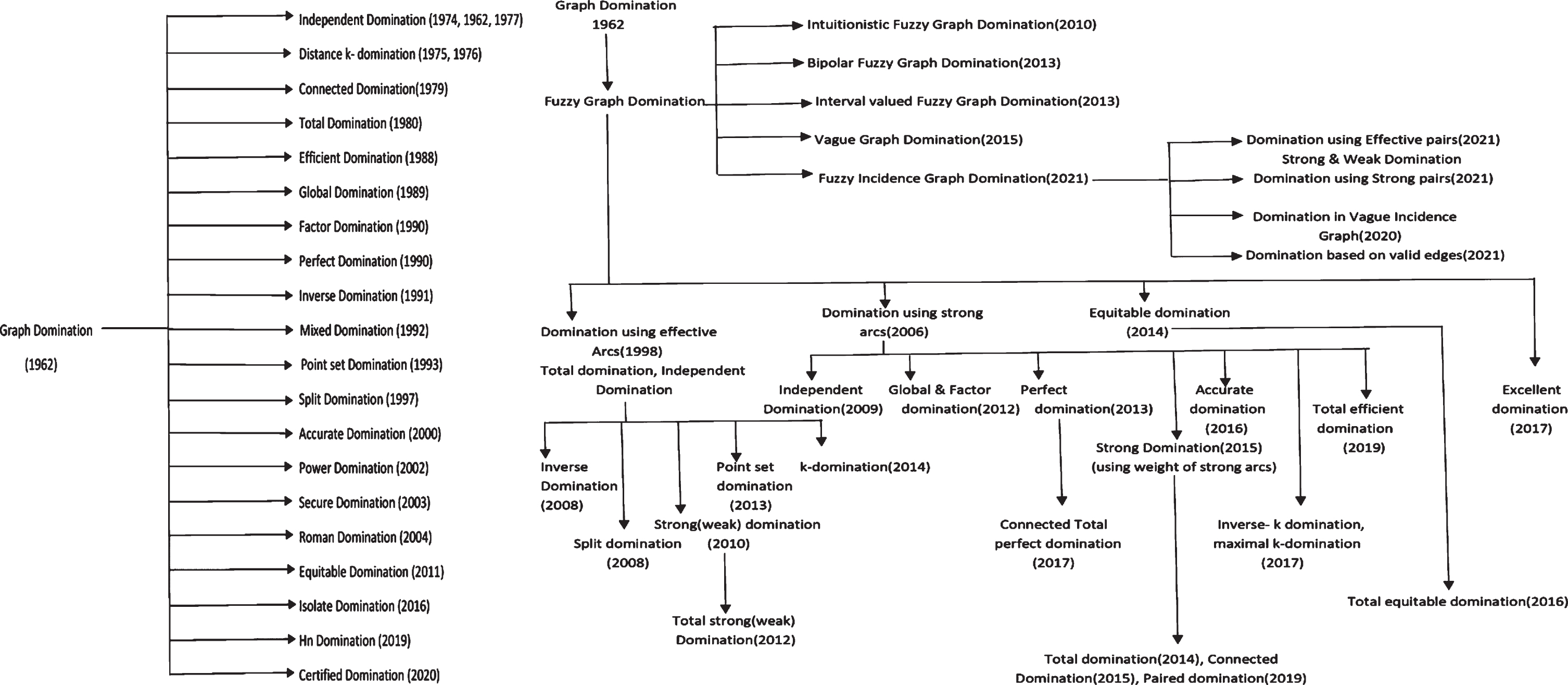
Vertex dominations in graphs, FGs and FIGs.
This article intends to introduce a new concept of strong incidence domination (SID) in FIGs. The motivation for studying the notion of strong incidence domination is that, the domination parameters introduced by other authors is defined using effective pairs and incidence valid edges. When a fuzzy incidence graph is used to model a real-world problem it is not always possible to obtain a fuzzy incidence graph with incidence valid edges or effective pairs. But the concept of strong incidence domination defined in this study can always be used in any fuzzy incidence graphs, since the pairs can be classified into strong and non strong pairs in any FIG. Also, unlike other domination parameters which are defined using the weight of vertices, strong incidence domination is defined using the weight of strong pairs. Hence, the least value is obtained using the strong incidence domination.
The article is organised as follows: Section 2 elucidates some basic definition in FGs and FIGs. Section 3 introduces the concept of SIDS and SIDN on FIGs. Degree of a vertex using strong pairs is defined. A characterisation for the domination number to be half of the order of FIG is proved. Minimal strong incidence dominating sets (MSIDS) and bounds for the SIDN is also provided in this section. Some properties of SIDS and SIDN of some FIGs is examined. Section 4 discusses a social application of the SIDN. Section 5 is a comparative study of different types of dominations in FIG.
Throughout the paper, ∧ and ∨ represents minimum and maximum operators respectively. The following definitions are from [12, 27].
An incidence graph (IG), is a triple G = (V, E, I) where V is non-empty, E ⊆ V × V and I ⊆ V × E.
Elements in I are of the form (b, cd) where b ∈ V and e = cd ∈ E, and are called incidence pairs or simply pairs.
The edges ab and cd will be considered adjacent only if (a, ab) , (b, ba) , (c, cd) and (d, dc) are in I.
An incidence subgraph H of an IG, G is such that all its vertices, edges and pairs are in G.
Let G be an IG, an incidence walk from c′ to d′ where c′, d′ ∈ V ∪ E is a sequence of elements of V, E and I starting at c′ and ending at d′. An incidence walk is called incidence trail if the pairs in it are distinct. Similarly incidence walk is called incidence path if the vertices in it are distinct. A connected IG is an IG in which all pairs of vertices are joined by a path. A maximally connected incidence subgraph of an IG is called a component of the IG.
Let φ, ρ and ζ be fuzzy subsets of V, E ⊆ V × V and V × E respectively. If ρ (cd) ≤ φ (c) ∧ φ (d) for all c, d ∈ V, then
Now, φ*, ρ* and ζ* are supports of φ, ρ and ζ respectively defined as follows: φ* = {c ∈ V : φ (c) >0}, ρ* = {e ∈ E : ρ (e) >0}, and ζ* = {(c, cd) ∈ I : ζ (c, cd) >0}. A FIG is trivial if |φ*|=1.
Here,
Let cd ∈ ρ*, and (c, cd) , (d, dc) ∈ ζ*, then cd is an edge of the FIG
A FIG,
Let
A FIG,
If the FIG,
Let
The edge cd is called a bridge if ρ′∞ (a, b) < ρ∞ (a, b) for some a, b ∈ φ* and ρ′ = ρE\cd. Let b ∈ V and E′ = E \ K where K is set of edges with b as end vertex. If ρ′∞ (c, d) < ρ∞ (c, d) for some c, d ∈ φ* and c ≠ b ≠ d where ρ′ = ρE′, then b is called a cutvertex of
An edge cd in a FG is α- strong if ρ (cd) > ρ′∞ (c, d), β- strong if ρ (cd) = ρ′∞ (c, d) and δ edge if ρ (cd) < ρ′∞ (c, d). An edge is strong if it is either α- strong or β- strong. Similarly, in FIG,
The strong domination in FG,
Strong incidence domination in fuzzy incidence graph
A new domination parameter in a fuzzy incidence graph (FIG) using the strong pairs is discussed in this section. The definition of SIDN is obtained using weight of strong pairs. Also, bounds for the SIDN are examined. The MSIDS is considered and the result that each vertex in a FIG with non-trivial components will dominate at least one vertex other than itself is proved. A method to construct a spanning subgraph of the FIG which is a tree with only strong pairs is discussed. Some properties of SIDS and SIDN of fuzzy incidence path, FIC, FIT, CFIG and complete bipartite FIG are also explored subsequently. This section begins with some definitions:
In all the following definitions let

Illustration of SIDN in FIG.
The converse of Proposition 3.12 is not always true as in Example 3.13.

FIG with γ IS = 0.1.
The following proposition gives a sufficient condition for a pair to be strong in a FIG.
Example 3.16 illustrates that the converse of Proposition 3.15 is not true.
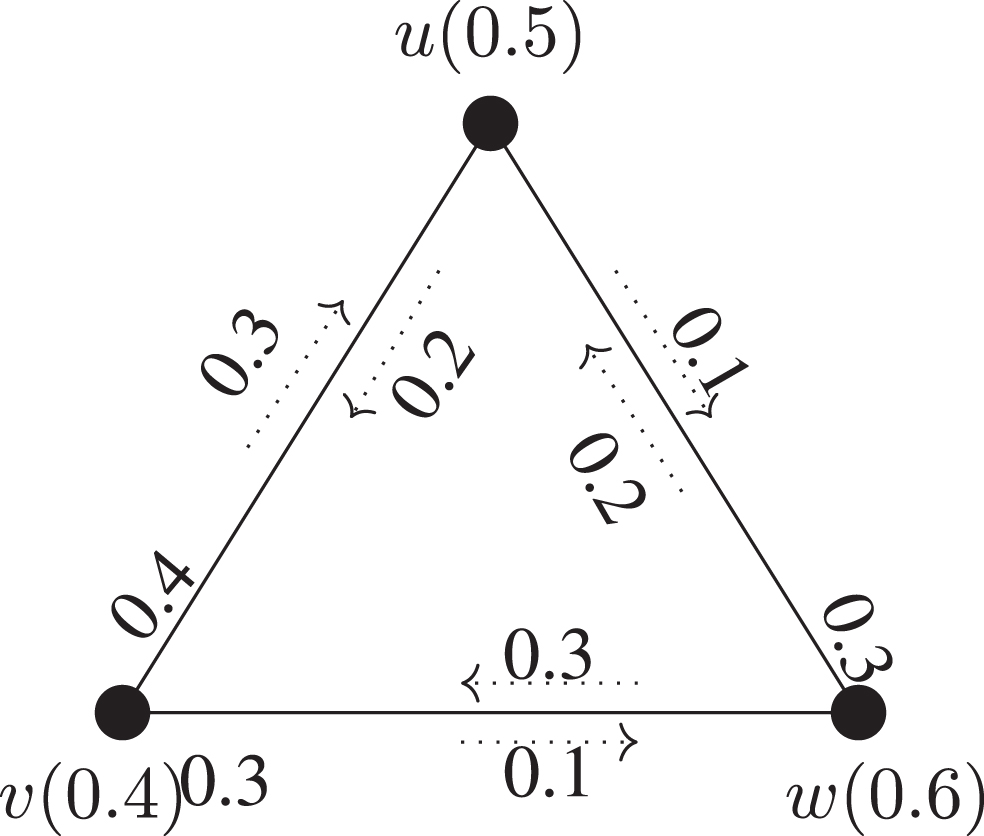
FIG with strong pairs.
Conversely, suppose that
Since the weight of only one pair incident at the vertex in the SIDS contributes to the SIDN, in this case
Now, assume that
Next, MSIDS of a FIG is defined and some of its properties are established.
s is an isolated vertex of There exists a vertex
Conversely suppose
Next, bounds for the SIDN are obtained in Theorems 3.23 and 3.25.
For the second inequality, let u be a vertex such that d ISN (u) = Δ ISN . Then V \ N IS (u) is a SIDS. Therefore, γ IS ≤ W (V \ N IS (u)) ≤ p - Δ ISN .
Case1:
If
Then
Suppose that γ
IS
> O - Δ
sp
. Then we will get
Since the sum of weight of the pairs in S′ is included in W, the sum of weight of pairs in S′ is less than ζ (u, uv1). Then, consider the set
Case 2:
Hence the result.
Example 3.26 gives an example of a FIG for which the bound in Theorem 3.25 is sharp.

FIG with γ IS = O - Δ sp .
Next, the result that, in a FIG with non-trivial components each vertex is dominated by at least one distinct vertex is proved in Theorem 3.28.
Case 1: There are no edges in
This clearly implies that all the pairs are strong, a contradiction.
Case 2: There are edges in
Let xy be one such edge. Consider u and the edge xy. There will not be any SIP from u to xy, which is not possible by Theorem 3.27. Therefore, every vertex in
In the case of a disconnected FIG, each component is a connected FIG. Therefore each vertex will be dominated by a vertex in the same component and can be proved in a similar way as done in the case of connected FIG.
Construction: Consider a connected FIG,
If (c, cd) and (d, dc) are strong pairs, it need not imply that edge cd is strong. Similarly (c, cd) and (d, dc) need not be strong if edge cd is strong. Hence in general γ IS and γ S are not comparable as given in Example 3.32.

FIG with γ S > γ IS .
Now for the FIG in Figure 7, all edges are strong but the pairs (v, uv) and (x, xv) are not strong. Hence, γ S = 0.2 and γ IS = 0.4 .
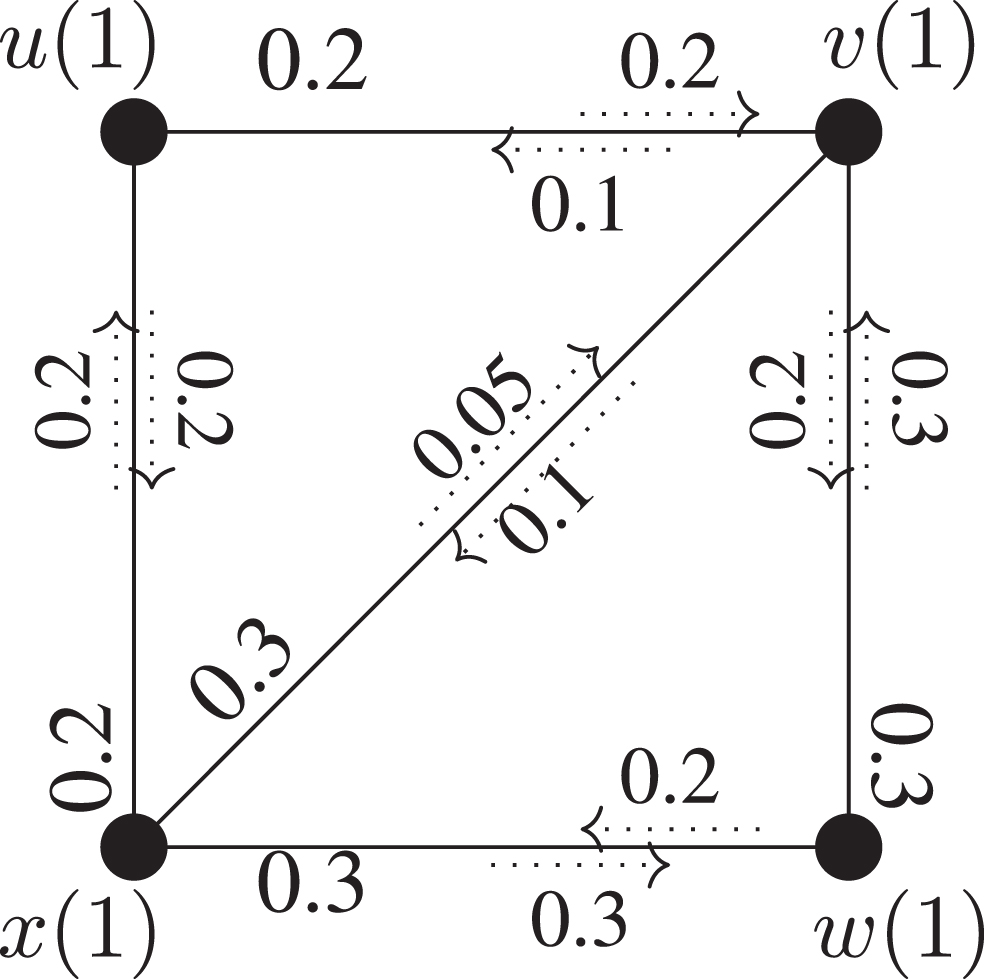
FIG with γ S < γ IS .

FIG with γ S = γ IS .
Next, definition of a complete bipartite FIG is provided in Definition 3.38 and the SIDN is obtained for it in Theorem 3.39.
Properties of SIDS in FITs are discussed in Propositions 3.48, 3.50 and in Theorem 3.49.
Claim: v is a FICV
Proof of claim: Suppose that v is not a FICV. Then v is FIEV. Hence v has only one strong neighbor which is uv. Then all other incidence pairs at v will be δ pairs. Since u is also a FIEV, all pairs at u except (u, uv) are δ pairs. Now, since |φ*|≥3 there exists a y such that either uy ∈ ρ* or vy ∈ ρ*. Therefore, if vertex u and edge uy or vy is considered, there will not be any SIP from u to uy orto vy, which is not possible by Theorem 3.27. Hence the claim.
By the claim every FIEV is dominated by a FICV. Hence the set of all FICVs forms a SIDS.
Conversely assume that every FICV has at least one FIEV as its SIN. Let
A social application of strong incidence domination is discussed in this section. In today’s busy world, people are related to each other in one way or another. People come into contact with other people in their daily lives leading to the spread of infectious diseases. Most diseases spread through social contact. Here, the SIDS and SIDN can be used to find the minimum possibility of a group of related people getting infected by a contagious disease.
To analyze the situation, construct a FIG as follows. The vertices in set V represent people in a group, and the edge set E represents the relation between them. If a person u is related to a person v in some way, then represent this relation by an edge uv in the graph. The weight of the vertex is the extent to which he/she is exposed to the disease from outside the group. For example, if a person is a homemaker, then his/her chance of getting infected is less than that of a social worker. Now the edge weight is taken as the degree of the relationship between the people of the group. If a person u is closely related to v i.e, if u and v are related in such a way that they come in close proximity or they share a closed space for very long time then, the edge uv gets weight close to 1. The weight of the incidence pair (u, uv) is the chance of person v getting infected by u, i.e., if ζ (u, uv) =0.4, it means that the chance that u will infect v is 0.4. If person u does not take preventive measures or does not maintain social distance from others then he/she has more chance of infecting others than a person who takes all necessary precautions. By an α- pair (u, uv), it means that the chance of person v getting infected from u directly is more than the chance he/she gets infected from u indirectly. A β- pair (u, uv), means that the chance of person v getting infected from u directly is same as the chance he/she gets infected from u indirectly. Similarly, δ- pair (u, uv), means that the chance of person v getting infected from u directly is less than the chance he/she gets infected from u indirectly. An application of SIDS and SIDN to find the minimum chance of the entire group getting infected is illustrated with the help of an example as follows:
Suppose there is a group of 8 people. The vertex set, V = {p1, p2, p3, . . . , p8} where each p i represent a person in the group. Consider the FIG in the Figure 9.
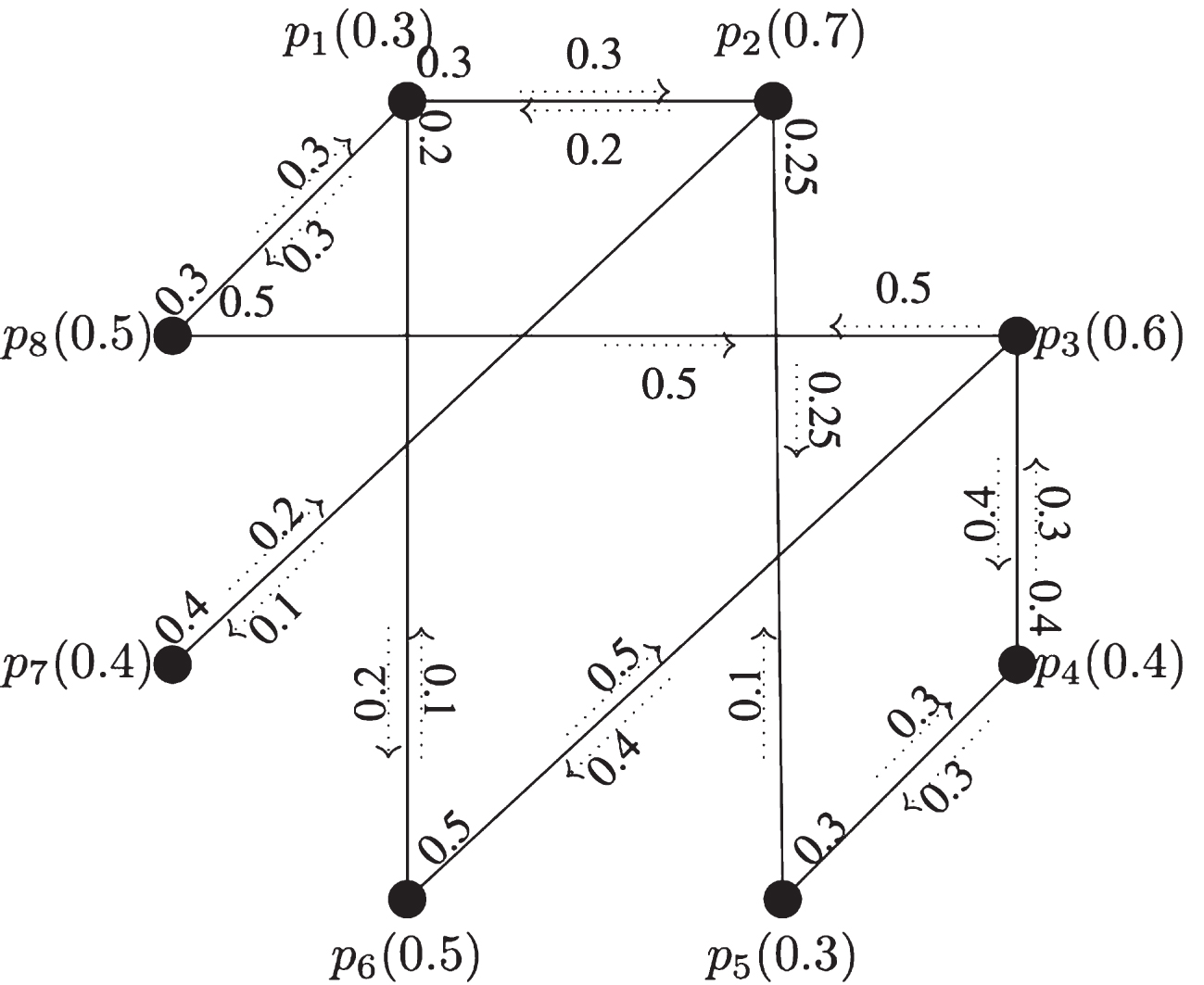
Illustration of application of SID in a FIG.
For the FIG in Figure 9, all pairs except (p6, p6p1) and (p5, p5p2) are strong pairs. The δ- pair is not considered for domination because in the case of the pair (p6, p6p1), the chance of person p6 getting infected from p3 is more than p6 getting infected from p1. Hence a vertex u dominates v only if u has more or equal chance of getting infected from v directly than getting infected from v indirectly and vise versa. Hence to find the minimum chance of the entire group getting infected, find the SIDS. Here the set D = {p2, p3, p5} is a minimum dominating set with SIDN 0.8, which means that, if persons p2, p3 and p5 are getting infected, then the minimum chance of entire group getting infected is 0.8.
Thus the concept of SIDS and SIDN is used to construct a FIG in which vertices represent people of a social group. The weight of a vertex is the extent to which the person is exposed to the disease. The edge weight indicates the degree of relation between the people, and weight of a pair represents the chance of a person infecting another person. The SIDN of the FIG obtained gives the minimum chance of the entire group of socially related people getting infected when the people in the SIDS get infected.
Domination in FIG is considerably a new area of research. A comparative study on different domination parameters in FIG is discussed in this section. Afsharmanesh et al.[1] defined domination in FIG using incidence valid edges, i.e, a vertex c dominates vertex d if,
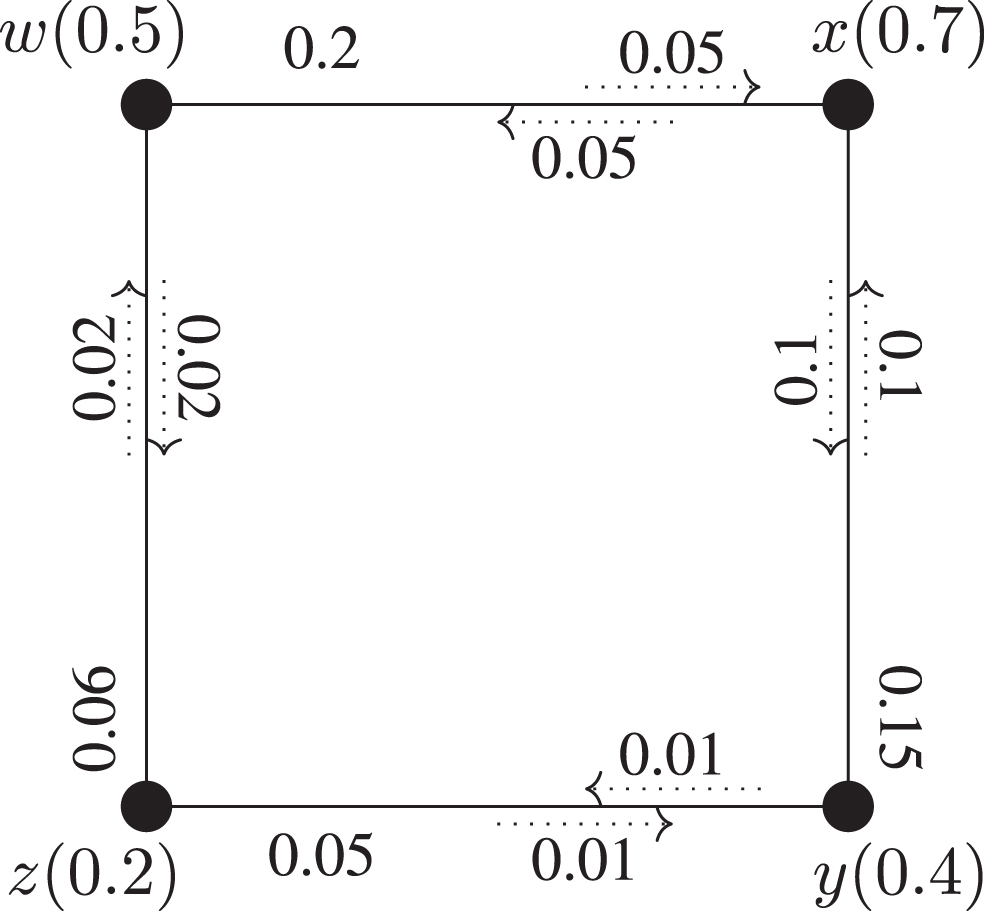
FIG
For the FIG in Figure 10, there are no incidence valid edges or effective pairs. Hence, as per [1], the minimum dominating set is the vertex set {w, x, y, z}, and γ
i
= 0.5 + 0.7 + 0.2 + 0.4 = 1.8. As per [19], the minimal dominating set is {w, x, y, z}, and γ
FI
= 1.8. Since all pairs are strong γ
s
= 0.2 + 0.4 = 0.6 and the minimal dominating set is {y, z}. Now using the concept of SID, the domination number can always be minimised since, for SIDN defined in Definition 3.8, weight of strong pair is used and ζ (c, cd) ≤ φ (c) ∧ ρ (cd). Hence a SIDS,
Domination in graphs is one of the most rigorously studied research areas, having applications in various fields. The introduction of fuzzy graphs followed by fuzzy incidence graphs opened up a vast area of research. It helped researchers to model real-world situations which were earlier considered to be difficult using graphs. This article intends to explore a new domination parameter in FIGs using the strong pairs. Strong incidence domination number is introduced using weight of strong pairs. Some bounds and properties of SIDN are discussed for FIGs. Also, SIDN and characteristics of SIDS are explored in CFIGs, complete bipartite FIGs, FIC, fuzzy incidence paths and FITs. An application of the SID is also discussed. A comparative study of different types of FIG domination is carried out.
Footnotes
Acknowledgement
The first author gratefully acknowledges the financial support of Council of Science and Industrial Research (CSIR), Government of India.
The authors would like to thank the DST, Government of India, for providing support to carry out this work under the scheme ’FIST’ (No.SR/FST/MSI/2019/40).