



Abstract
With the rapid growth of the global population and economy, energy consumption and demad are increasing sharply. As an essential renewable energy, biomass energy can promote the reform of energy production and consumption. Considering the characteristics of long investment cycle and large investment scale of agroforestry biomass power generation (AFBPG) projects, this study establishes a decision support framework for risk ranking of AFBPG project under picture fuzzy environment. The proposed framework considers not only the fuzziness and uncertainty of decision-making problems but also the decision-makers’ (DMs) psychological behavior. First, given the integrity of information representation, DMs provide risk assessment information expressed with picture fuzzy numbers, and then gives the distance of the picture fuzzy set (PFS) to maximize the PFS information. Second, the entropy weight method is used to compute the objective weight. Third, the VIKOR (Vlse Kriterijumska Optimizacija I Kompromisno Resenje) – TODIM (an acronym in Portuguese for an interactive multi-criteria decision making) method is suggested for ranking risk factors, which reflects the behavioral psychology of DMs. Moreover, the proposed evaluation model is successfully applied in a practical case. The results show that the model is valid for ranking risk factors under picture fuzzy environment. Last but not least, comparison and sensitivity analysis are implemented to verify the effectiveness and applicability of the proposed method and some suggestions for practical application are put forward.
Keywords
Introduction
Energy plays an important role in daily life and economic development. With the acceleration of development, energy demand and consumption are also increasing rapidly. In general, the major energy supplies include coal, oil and natural gas, which are non-renewable and easily exhausted. Meantime, the overuse of fossil fuels has caused serious environmental problems [1], such as global warming and climate change, which severely hampers the development of circular economy. Therefore, the energy supply must shift from fossil fuel-based supply to clean energy based supply [2]. As an important renewable energy source, biomass energy is dependable, green and widespread. The rational utilization and development of biomass resources can effectively promote the reform of energy production and consumption, and biomass power generation is the principal and achievable way to convert biomass resource into green energy [3]. Biomass power generation can not only provide a continuous source of electricity, but also flexibly change its output as balancing capacity [4]. Biomass power generation includes agroforestry biomass, garbage incineration and biogas power generation. However, no matter what type of power generation, waste materials are inevitable. China is a large agricultural country with sufficient agricultural and forestry residues, so the development of agroforestry biomass power generation (AFBPG) projects in China has great potential. Furthermore, the development of agriculture and forestry industries can be economically promoted and environmental problems can be ameliorated by making rational use of agroforestry residues.
With the unremitting efforts of scholars, many lines of research on biomass power generation have been carried out from different perspectives, and the technical and economic evaluation of biomass power generation project is a relatively common research subject. Stich et al. [5] established a cost-optimization approach to determine the cost-benefit options for generating electricity from biomass residues using various conversion technologies. Zhang et al. [6] presented a detailed method for estimating the cost of straw-based power generation with life cycle analysis and identified the main causes for the financial deficits of plants. In addition, site selections and the development potential have been also analyzed [7]; however the valid studies on the risk assessment of AFBPG project are inadequate. Wu et al. [8] identified the key risk factors through a questionnaire survey and then calculated the occurrence probability, influence degree and comprehensive risk level through a fuzzy evaluation method. By combining the cloud model with two-dimensional linguistic variables, Wu et al. [9] established the risk assessment framework of a public-private partnership (PPP) incineration project. Due to the characteristics of long cycle and large investment, many uncertain risks exist in the AFBPG project life cycle with limited resources. To comprehensively evaluate various risks, it is necessary to put forward a reasonable risk decision model to determine risk priority, which is conducive to the formulation of risk avoidance and prevention measures. Therefore, the decision problem with multiple risk factors and criteria can be regarded as a typical multi-criteria decision-making (MCDM) problem to be solved [10, 11].
Considering that risk assessment is implemented in the early phase of the project and is an advance estimate of future events, the assessment values are generally uncertain [12]. Moreover, due to the comprehensiveness and complexity of the project, evaluation information is usually provided by experts based on their background knowledge and practical experience. Therefore, fuzzy numbers are more suitable than real numbers to express evaluation values with fuzziness and uncertainty [13]. For example, Pythagorean fuzzy set is an effective way to represent uncertain information, which has more power than fuzzy set and intuitionistic fuzzy set. However, it only satisfies the situation where the square sum of membership and non-membership degree is less than or equal to 1 [14]. By contrast, picture fuzzy set (PFS) proposed by Cuong [15] can comprehensively describe the evaluation information and avoid the loss of original information. When faced with four choices of positive, negative, neutral and refusal, experts can give corresponding degrees of membership based on their preferences. With further research, many scholars have extended PFSs to picture fuzzy soft set [16, 17], interval-valued PFS [18], linguistic PFS [19], picture hesitant fuzzy rough set [20] and hesitant picture fuzzy linguistic set [21]. In addition, MCDM methods under picture fuzzy environment are widely used to solve sustainable supplier selection [22], tourism recommendation [23] and tourism environmental impact assessment problems [24].
To reduce computational complexity and information loss, some scholars studied the picture fuzzy measures of PFSs. A picture fuzzy number (PFN) is composed of the positive membership degree, neutral membership degree and negative membership degree. Thus, some studies defined the overall measures to scale the differences between PFNs. For instance, Cuong [15] developed the normalized Hamming distance and normalized Euclidean distance for PFSs; Wang et al. [25] defined the picture fuzzy normalized weighted Bonferroni distance and applied it to the risk evaluation of energy performance contracting project; Ganie et al. [26] introduced the correlation coefficients of PFSs and applied it to pattern recognition and medical diagnosis; Jin et al. [27] developed a new correlation coefficient for PFSs, based on which a Pearson’s correlation-based model is further presented to address picture fuzzy MCDM problems; Son [28] investigated the similarity measures for PFSs; Thao [29] introduced the similarity measures of PFSs based on entropy and applied it to suppliers selection; Wei [30] proposed the picture fuzzy projection model and applied it to potential evaluation of emerging technology commercialization. To overcome the limitations of existing projection model of PFSs, Wang et al. [31] proposed a picture fuzzy normalized projection model. However, only measuring the differences of the positive membership degree, neutral membership degree and negative membership degree cannot fully reflect the superiority of PFNs. The PFN also contains the degree of refusal membership. In order to maximize the original picture fuzzy information, we propose new PFSs’ distances combining Hausdorff measure with the commonly used Euclidean and Hamming distance.
Over the past few years, various tools have been presented to solve practical MCDM problems. Common methods can be divided into the aggregation operator-based methods [32], measure-based methods [33, 34] and outranking relationships-based methods [35, 36]. The VlseKriterijumska optimizacija I Kompromisno (VIKOR) method focuses on determining a compromise solution for decision-making problems with conflicting attributes. In the process of risk ranking, determining a risk factor that satisfies all criteria simultaneously is difficult. Thus, risk factors are assessed by considering compromise between group utility and individual regret is necessary. Given the practicability of VIKOR method, many studies extend it to intuitionistic fuzzy set, hesitate fuzzy set, probabilistic linguistic term set and complex q-rung orthopair fuzzy set [37]. In addition, due to incomplete information and cognitive limitations, people usually show limited rationality in practical MCDM problems. To comply with the practical decision-making environment, various studies have combined prospect theory with MCDM methods to reflect the risk preferences and psychological behavior of decision-makers (DMs) [38, 39]. However, it is difficult for prospect theory-based methods to define the aspiration level of criteria in advance [40]. As an extension of prospect theory, a Portuguese acronym meaning Interactive Multi-Criteria Decision Making (TODIM) method can also deal with the behavioral characteristics of MCDM problems with risk and uncertainty. Therefore, this study introduces TODIM into the VIKOR method to rank risk factors.
According to the preceding analysis, the motivations of this paper can be summarized as follows. First, biomass power is an important renewable energy because of its environmental friendliness and abundant raw materials. Therefore, the risk evaluation of AFBPG projects is investigated to promote the development and smooth progress of the AFBPG projects. Second, PFNs are introduced to accurately describe the evaluation information in the decision-making problems. Due to the limitations of expert knowledge and the complexity of decision-making environment, uncertain and fuzzy information is included in the process of risk evaluation. Compared with the existing fuzzy numbers, PFNs can cover all possible assessment information and avoid the loss of original information. Third, the new distances of PFSs are proposed to measure the differences between PFSs. Considering the location sensitivity and discreteness of Hausdorff measure, we put forward the hybrid distance combining Hausdorff distance with the commonly used Hamming and Euclidean distance. The new distances take the degree of positive, negative, neutral and rejection membership into account, which effectively avoids the loss of evaluation information. Fourth, people usually express limited rationality in practical decision-making problems because of the incomplete information and cognitive limitation. To overcome this defect, we combine VIKOR method with TODIM method to rank the risk factors of AFBPG project under picture fuzzy environment. This method can not only solve the ambiguity of decision-making problem, but also determine the group utility value and individual regret value by considering the behavior preference of DMs. With the aforementioned motivations, a risk ranking model for AFBPG projects under picture fuzzy environment is established by the integration of PFNs, VIKOR method and TODIM method.
This paper is structured as follows: Section 2 presents the theory and method used in this study. Section 3 introduces the MCDM framework of risk ranking for AFBPG projects. Section 4 conducts the practical application, comparative and sensitive analyses. Section 5 presents the implications for practice. Lastly, Section 6 draws the conclusion.
Preliminaries
For convenience of following contents, risk factors and evaluation criteria of AFBPG project are summarized. Then basic knowledge and new distance measurement of PFS are also presented.
Risk factors and the evaluation criteria of AFBPG projects
Compared with other power-generation projects, AFBPG projects have unique characteristics; AFBPG projects provide sufficient raw materials for the smooth operation of projects, while the distribution of electricity generated by projects is limited. In addition to the impact of some external uncertainties, such as immature related policies and laws [8], the implementation and promotion of AFBPG project will be affected by many risk factors. Only when we correctly judge and control these potential risk factors, can we promote the development of the projects. Considering the importance of risk factors, many scholars have studied the possible risk factors in the AFBPG projects.
The most common risk factors in the literature are economic, technical, policy and environmental risks [41, 42]. Wu et al. [8] investigated the risks of a PPP straw power generation project from four key risk groups, namely, political/legal, project participants, technical and economic/financial risks. Wu et al. [9] used macro-economic, construction and operational, government and legal/social risk indicators to establish the risk evaluation system of the PPP waste-to-energy incineration project. Xu et al. [43] identified five key risk factors affecting waste incineration projects by analyzing actual risk events of 14 PPP waste incineration plants: environmental risk, undersupply risk, payment risk, unlicensed waste access risk and infrastructure support risk. Zhang et al. [6] analyzed the cost estimation of straw power generation through life cycle analysis and found out the main reasons for the financial deficit of straw power generation enterprises. The concrete risk factors from the literature are listed in Table 1.
Risk factors in the literatures
Risk factors in the literatures
The selection of evaluation criteria also plays an essential role in decision-making. The probability of risk occurrence and risk impact are the common criteria for evaluating risk factors. However, Ward [45] raised the shortcomings of these two criteria in guiding risk analysis and management. Further research has shown that feasible response and available response time are considered necessary criteria for risk assessment. To assess risk more comprehensively, Wu et al. [9] added the criterion of severity. Moreover, Wang et al. [25] used risk impact, risk occurring probability, risk response ability and risk exposure to improve risk evaluation criteria.
The definition, operation rules, aggregate operators and comparison method of PFS are introduced in this subsection.
The operation rules of fuzzy sets are important to fuzzy information integration in MCDM problems. Therefore, scholars have discussed the operation rules and aggregation operators of PFNs successively [46–48]. For instance, Garg [49] introduced the operational laws on the PFSs based on t-norm and t-conorm. Then the corresponding aggregation operators were proposed to aggregate the different preference of the DMs during the practical decision-making problems. Thus, information aggregation process plays an important role in the decision-making process. However, the operators defined by Wei et al. [48] cannot satisfy the closure property. Motivated by the operation rules of intuitionistic fuzzy number, Wang et al. [46] defined the operation rules of PFNs and corresponding geometric aggregation operator from the viewpoint of probability. The PFN operators and picture fuzzy weighted geometric (PFWG) operator a stated as follows:
To compare two PFNs, we introduce the following comparison methods:
(i) If S (b1) > S (b2), then b1 > b2;
(ii) S (b1) = S (b2), then
(1) H (b1) = H (b2) , represents b1 = b2;
(2) H (b1) > H (b2) , represents b1 > b2.
IFSs contain three parameters, and its distance measure ce divided into two-dimensional and three-dimensional distances. According to a study by Yang and Chiclana [50], the results yielded by using three-dimensional distance of IFS are different from the two-dimensional distance. PFS has four parameters, but the existing distance only covers three parameters. Therefore, ignoring the refusal membership degree leads to the loss of original information. In addition, there may be a specific situation where the difference between PFSs cannot be distinguished and some unreasonable or inconsistent results appear in practical applications. Since the Hausdorff distance measures the distance between two subsets of a space, it has the advantages of location sensitivity and discreteness. Therefore, hybrid distances are proposed to represent the differences between PFSs more completely. Specifically, when p = 1, it is the hybrid distance of the Hausdorff and Hamming distances; when p = 2, it is the hybrid distance of the Hausdorff and Euclidean distances.
(1) Normalized Hausdorff-Hamming distance dH-H (B1, B2):
(2) Normalized Hausdorff-Euclidean distance dH-E (B1, B2):
(3) Generalized distance d
H
(B1, B2):
0 ⩽ d
H
(B1, B2) ⩽ 1; d
H
(B1, B2) = 0 ⇔ B1 = B2; d
H
(B1, B2) = d
H
(B2, B1); If A ⊆ B ⊆ C, then d
H
(A, B) ⩽ d
H
(A, C) and d
H
(B, C) ⩽ d
H
(A, C). d
H
(A, B) + d
H
(B, C) ⩾ d
H
(A, C).
This section mainly introduces the decision support framework of risk ranking for AFBPG projects. The specific process is presented in Fig. 1. The details of decision model are discussed as follows:
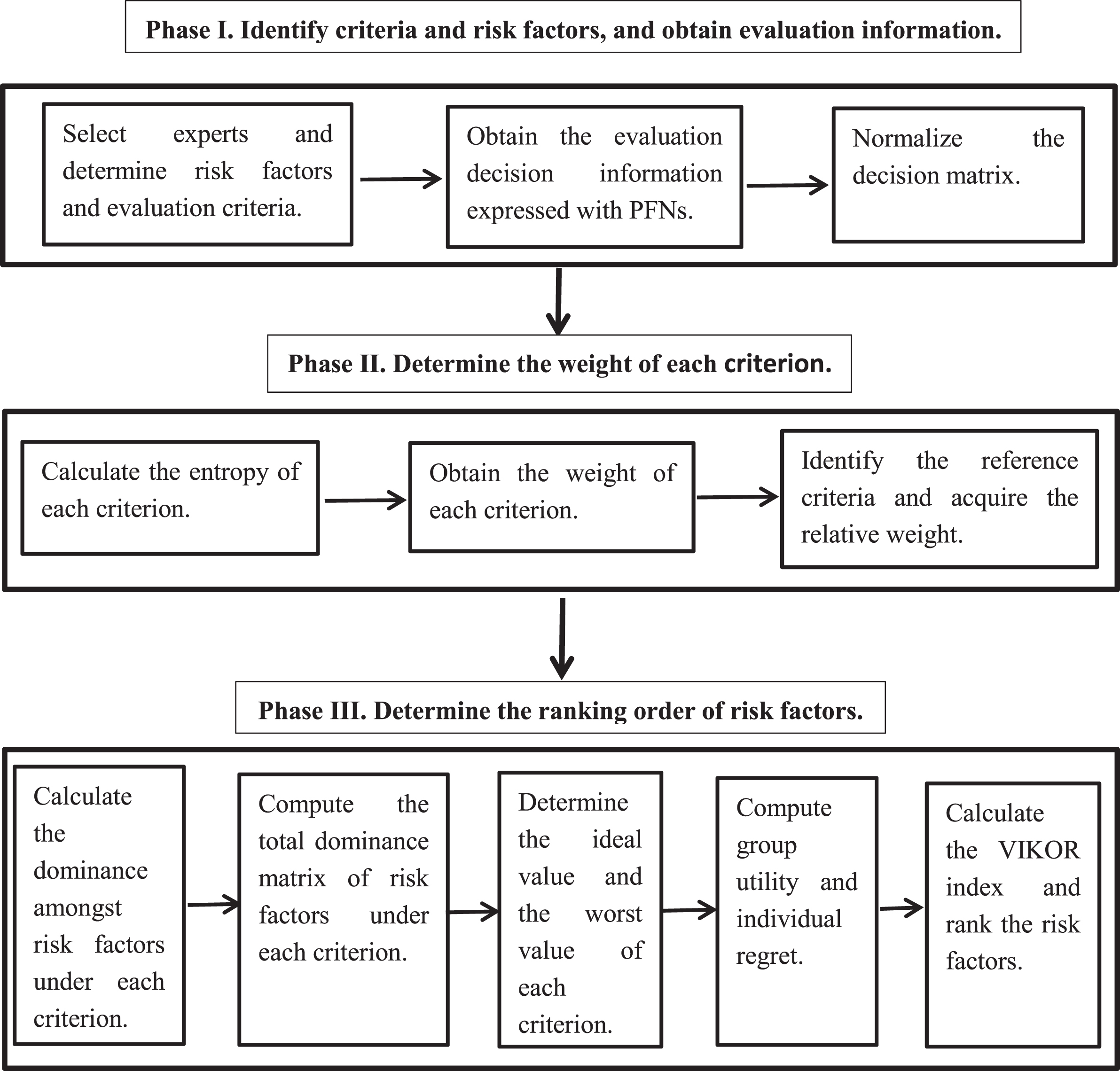
Ranking decision support framework of an AFBPG project.
Risk assessment information is provided by selected experts based on their professional knowledge. And evaluation decision matrix is normalized. Considering the complexity of the decision-making environment and the limitation of expert knowledge, fuzzy numbers are suitable to represent risk evaluation information. Therefore, PFNs are selected to describe decision matrix to ensure the integrity of original evaluation information.
Given the complexity and professionalism of risk evaluation, risk factors and criteria must be determined based on experts’ professional knowledge of relevant fields. Considering the limited knowledge of experts, we invite a group of experts to provide selection and evaluation to assure the professionalism and rationality of risk evaluation. In this study, 10 experts from the biomass energy committee of the Chinese Renewable Energy Society (CRES) are invited. The CRES is a national, academic and nonprofit social organization composed of scientific workers and related units engaged in the research, development and application of renewable energy. It is one of the most influential academic groups in China’s renewable energy field with multidisciplinary and comprehensive characteristics.
According to the summary of risk factors and criteria combined with experts’ background knowledge, final risk factors and evaluation criteria can be determined.
By combining background knowledge with relevant literature, experts provide the risk degree of risk factor under each criterion with PFNs, which is more convincing than crisp values. Suppose that m (R1, R2, …, R m ) risk factors and n (C1, C2, …, C n ) criteria exist. Accordingly, M = (ρ ij ) m×n can express the picture fuzzy decision matrix, where ρ ij = 〈μ ij , η ij , v ij 〉 is the evaluation value of ith factor under jth criterion. If an expert considers that the risk degree of R i under C j is high (low), then he/she can support (oppose) R i under C j . If the judgement of R i under C j is ordinary, then his/her assessment on the performance of R i under C j is neutral. If an expert is not confident in his/her evaluation of R i under C j , then he/she can refuse to vote. For instance, we invite 10 experts to provide evaluation values. If three experts deem that the risk degree of R1 under C3 is high, one expert deems that the risk degree of R1 under C3 is general, and five experts deem that the risk degree of R1 under C3 is low, then we can obtain the evaluation value of R1 under C3, which can be expressed as ρ13 = 〈0.3, 0.1, 0.5〉, and the degree of refusal membership, which is written as π13 = 0.1. In this way, a picture fuzzy decision matrix M = (ρ ij ) m×n can be obtained.
The criteria can be divided into two categories: cost and benefit. The higher the evaluation value is under the benefit criteria, the higher the priority of risk factor is. Howeve the higher the evaluation value is under the cost criteria, the lower the priority of the risk factor is. To ensure comparability between the two criteria, the cost criteria need to be normalized based on the complement of PFSs defined in Definition 2. Then, we can acquire the normalized decision matrix S = (r
ij
) m×n through Equation (5).
In the process of risk ranking of AFBPG projects, the determination of criteria weight is important because it has great impact on the ranking order. Due to the complexity of the decision-making environment and the limitation of professional knowledge, it is unreasonable for experts to assign the criteria weight directly. Thus, it is necessary to calculate the weight of criteria with objective method. From the perspective of probability theory, the concept of entropy was proposed, which can measure the uncertainty of information. For example, Li et al. [51] presented a new technique to measure the uncertainty of discrete Z-numbers based on Shannon entropy. The smaller the information entropy of the criterion is, the higher the diversity of the criterion data is, and the larger the criterion weight is. To comprehensively consider the influence of different criteria and reduce uncertainty, the entropy weight method is a reasonable method to obtain objective weight of criteria. This stage mainly uses the entropy weight method to compute the criteria weight. The details are stated as follows.
where w
j
⩾ 0 and
According to the weight vector of criteria obtained from step 5, we can identify the reference criterion wc as follows:
If the weights are equal, then we can select anyone as the reference cterion. The relative weight of each criterion can be calculated as
In this stage, the TODIM-VIKOR method is adopted to rank risk factors. VIKOR, as a common MCDM method, can assist DMs in acquiring compromise solutions. The classic VIKOR method assumes that DMs are completely rational when dealing with MCDM problems. However, DMs’ psychological behaviour can affect the final decisions in many practical decision-making problems. Therefore, the TODIM method is introduced to make the decision more reasonable and practical. The steps of risk ranking are stated as follows:
Next, we can obtain the dominance matrix I by computing the set of n criteria:
Ranking risk factors by ascending order of U i , Z i and Q i are subject to satisfying two conditions simultaneously
Condition 1:
Condition 2: R(1) must be the highest when ranked using U i and/or Z i .
If one of the two conditions is not satisfied, then the following compromise solutions are obtained:
(1) R(1) and R(2) are the compromise solutions if condition is not satisfied.
(2) R(1), R(2), ... ,R(p) are the compromise solution if condition 2 is not satisfied. The maximum value of p can be obtained using the following equation:
The section uses an example to verify the applicability and feasibility of the proposed risk-ranking framework for AFBPG projects.
Problem description
Compared with other renewable energy, biomass power has been developing relatively slowly in China. Due to abundant biomass resources, the development of biomass power generation has great potential. The AFBPG projects using agricultural and forestry residues as raw material is an effective way of energy utilization. Such projects can improve environmental pollution by consuming agricultural and forestry residual while providing electricity. As a large agricultural province, Henan Province has abundant agroforestry biomass resources, such as crop straw and agricultural residua. Therefore, developing AFBPG projects has great potential and advantages. In the 13th Five-Year Renewable Energy Development Plan of Henan Province, different key construction projects of biomass energy are proposed. First, a biomass thermal power project is implemented in areas with abundant agroforestry biomass straw resources. Second, to strengthen the binding force of renewable energy planning and execution, relevant government departments are strictly instructed on the implementation of the construction of new energy projects. In Changheng, Xinxiang City, an AFBPG project is implemented. To ensure the smooth progress of this project, the priority of risk factors must be determined before construction. In this way, the proper prevention and safeguard measures for risks can be made. Specific risk ranking decision process is described in the next section.
Decision process
The decision-making process of risk ranking for AFBPG projects primarily includes the following steps:
Ten experts from the biomass energy committee of the CRES are selected. Given that the risk assessment information is mainly determined by experts with relevant field expertise, the choice of experts is crucial. The selected experts should 1) have deep biomass energy expertise and 2) have rich biomass energy project experience. Detailed information about the 10 selected experts is shown in Table 2.
Information about the 10 selected experts
Information about the 10 selected experts
According to the relevant literature in Section 2.1, experts can select appropriate risk factors and evaluation criteria for AFBPG projects by combining practical experience and professional knowledge. The selected risks and criteria are shown in Tables 3 and 4.
Risk factors of AFBPG project
Evaluation criteria
The invited experts provide their assessment information for each risk factor under each criterion, which is presented in Appendix 1. Afterwards, the risk evaluation information is converted into PFNs. For example, two experts think that the risk impact of R4 is high, one expert deems that the risk impact of R4 is medium, and seven expert think that the risk impact of R4 is low. Thus, the evaluation value of R4 under C2 can be expressed as ρ42 = (0.2, 0.1, 0.7) by PFN. Accordingly, the risk evaluation matrix shown in Table 5 is obtained.
Risk evaluation matrix
In this case, the higher the probability of occurrence, impact and urgency of a risk factor, the higher the priority of the risk factor. Therefore, the probability of risk occurrence, risk impact and risk urgency are benefit criteria. By contrast, the lower the exposure and response capacity of a risk factor, the higher the priority of the risk factor. Thus, the exposure of risk and respond capacity are cost criteria. To maintain a uniform dimension, the criteria c3 and c4 must be normalized. For example, the evaluation value of R4 under C3 is ρ42 = (0.2, 0.2, 0.5), which can be normalized by exchanging the value of high risk exposure and low risk exposure. Then, the normalized evaluation value of R4 under C3 becomes ρ42 = (0.5, 0.2, 0.2). On the basis of Equation (5), the normalized evaluation matrix is listed in Table 6.
Normalized decision matrix
According to Equation (6), the entropy of each criterion is listed in the second row of Table 7.
According to Equation (7), we can obtain the criteria weight shown in the last row of Table 7.
Entropy and weight value of each criterion
On the basis of Equation (8), the reference criteria can be identified as w c = w5 = 0.221. By using Equation (9), we can acquire the relative weight of each criterion w jc = (0.886, 0.909, 0.795, 0.932, 1) (j = 1, 2, 3, 4).
Using Equation (10) and Equation (11), we can compute the dominance of risk factor R i over other risk factors R s under each criterion. To be line with the actual situation, we assume θ is 2.5. Last, the dominance matrices φ1 - φ5 can be obtained, per the Appendix 2.
On the basis of Equations (12) and (13), the total dominance matrix can be acquired as follows.
According to Equations (14) and (15), we can identify the ideal and worst values of each criterion based on the results in step 8.
I*= (1.8917, 1.7426, 1.7057, 1.8652, 2.2280); and
I-= (– 4.7888, – 4.3341, – 4.6364, – 4.4809, – 3.8316)
According to Equations (16) and (17), the results of group benefit value U i and individual regret value Z i are shown in the second and third row of Table 8.
Value of VIKOR index
Based on Equation (18), we can obtain the result of Q i shown in the last row of Table 8.
Step 12: Rank the risk factors
The ranking orders of risk factors using the value of U i , Z i and Q i are listed in Table 9.
Ranking order of U i , Z i and Q i
Condition 1:
Condition 2: R2 ranks first in the list rank by U i and Z i . Thus, condition 2 is satisfied.
Accordingly, the final ranking order of risk factors is R2 > R6 > R5 > R8 > R3 > R4 > R1 > R7.
This section mainly discusses whether the change of parameter v and θ values can affect final ranking order of risk factors by the practical case of this paper, and compares the sensitivity analysis with other two methods.
As described in step 7, the value of θ in Equation (10) can affect the dominance degrees when there is a loss. Different values of parameter θ indicate that different attitudes for loss of DMs, which may lead to different ranking orders of risk factors. Therefore, we investigate how parameter θ affects ranking order and verify the stability of the final ranking order by comparing the ranking orders obtained under different values of θ. We let θ = 6, 5, 4, 3, 2.5, 2, 1, 0.8, 0.5, 0.3, 0.1, and then the corresponding ranking order can be acquired. The results are shown in Table 10. From the results, we can see that the highest risk factor is always R2, followed by R6. And the lowest risk factor remains at R7. With the decrease of θ, the order of R3 and R4 gets swapped. When θ ⩽ 0.5, the order of R4 and R1 is also reversed. However, these changes cannot have much influence on the final decision making. In the case study, we set θ = 2.5 to obtain the same decision-making results: the highest risk factor is R2 and the lowest risk factor is R7. Thus, the stability and robustness of the proposed method can be verified. The TODIM method can consider the behavior characteristics of DMs and DMs tend to reduce the risk of losses in practical decision-making problems. Then, DMs can determine parameters based on their own risk experience a the specific environment. Whatever DMs’ attitudes towards the risk of loss, R2 is always the highest risk factor.
Ranking orders of risk factors with different θ
Ranking orders of risk factors with different θ
The parameter v in Equation (18) reflects the weight of group utility. Let v vary from 0 to 1. If v > 0.5, then final result of risk ranking is dominated by group benefit. If v < 0.5, then final result of risk ranking is dominated by individual regret. If v = 0.5, then the effects are equal. In a decision-making process, DMs can choose different v values based on their preferences. The effect of different v values on the final ranking order is shown in Fig. 2. Evidently, the final ranking order of risk factors is affected by v, but not all risk factors are affected. The highest risk factor is always R2, and the lowest risk factor is always R7. Moreover, the ranking order of R3 increases as v increases. By contrast, the ranking order of R1 decreases as v increases. When v > 0.5, risk factor R4 first decreases and then increases before finally settling in the sixth position. The result indicates that when DMs are inclined to group utility, R3 exhibits a high level, whereas when DMs focus on individual regret, R1 exhibits a high level.
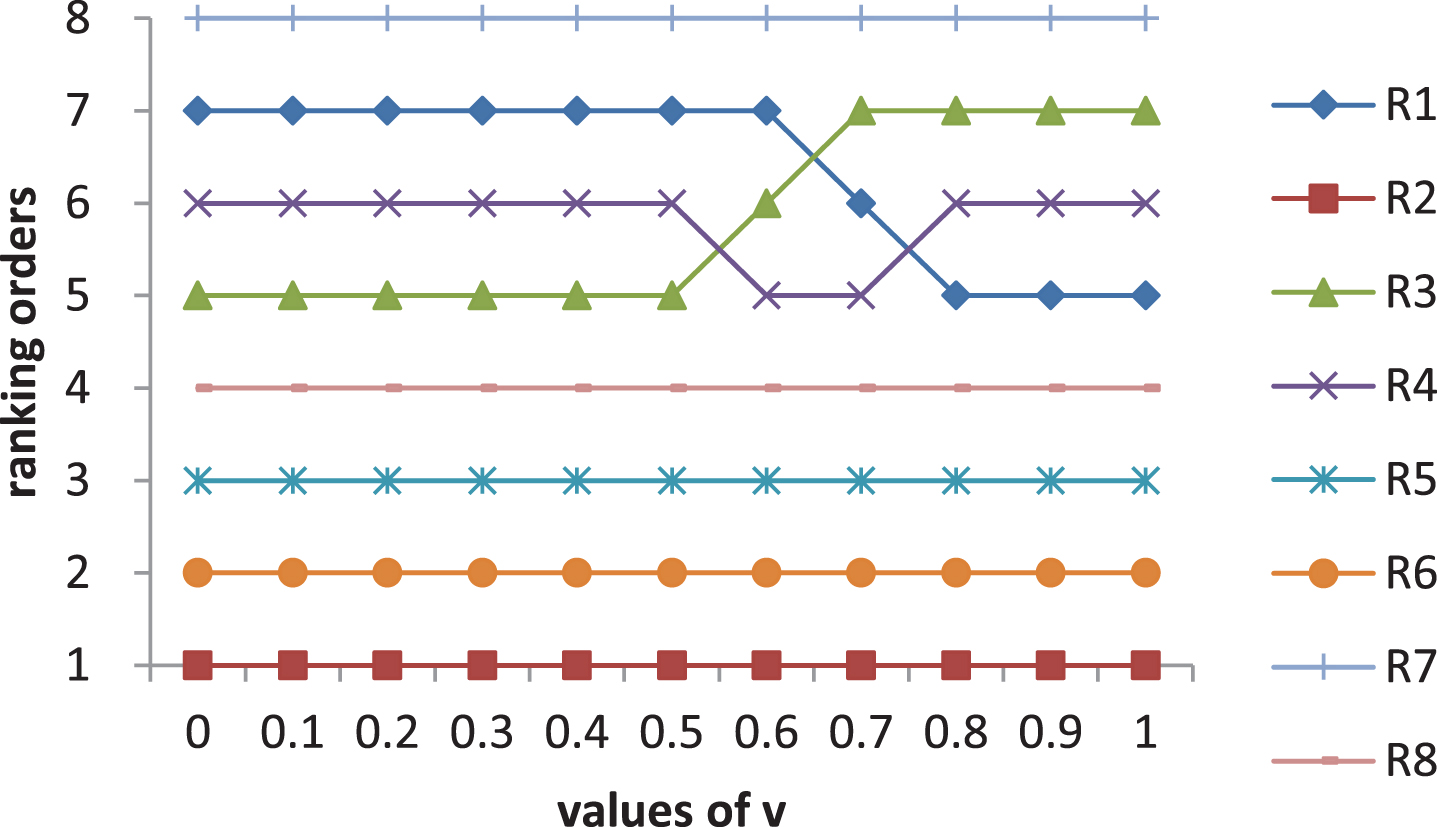
Variation trend of the ranking orders with different values of v in proposed method.
To further verify the superiority of the proposed method, we compare the sensitivity analysis of the proposed with other two methods, namely VIKOR method and picture fuzzy normalized projection-based VIKOR (PFNP-VIKOR) proposed by Wang et al. [31]. The effect of different v values on the final ranking order in two methods are shown in Fig. 3 and Fig. 4. With the change of v values, the ranking results of the other two methods changed significantly. For VIKOR method, the highest risk factor is always R2, but the lowest risk factor changes from R6 to R7 as the v value increases. For PFNP-VIKOR method, the highest risk factor and lowest risk factor may change with the change of v value. Obviously, the stability of the other two methods cannot be guaranteed. The ranking results of risk factors are easily affected by DMs’ preferences in VIKOR and PFNP-VIKOR methods. By contrast, the proposed method in this paper has advantages.

Variation trend of the ranking orders with different values of v in VIKOR method.
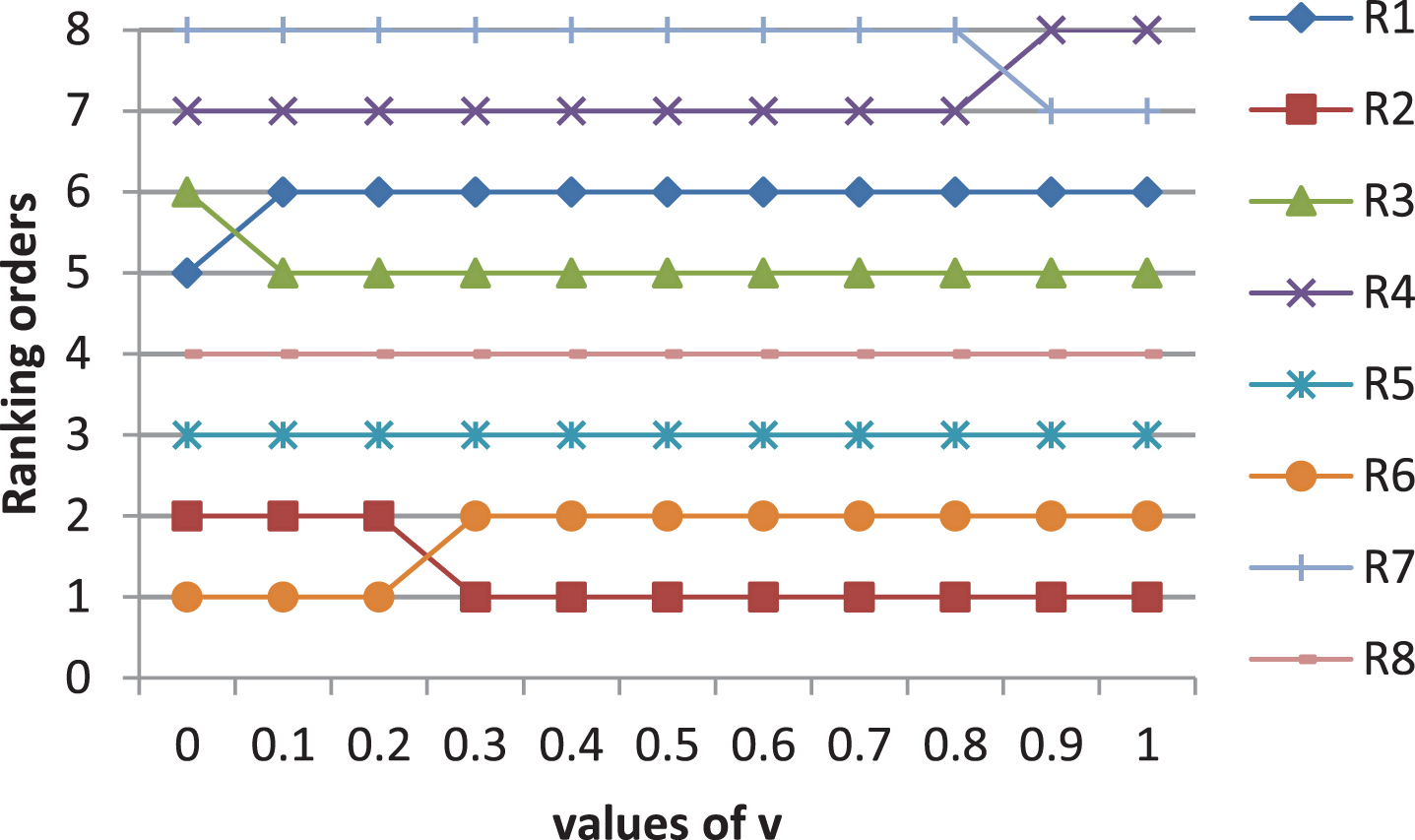
Variation trend of the ranking orders with different values of v in PFNP-VIKOR method.
To validate the effectiveness and feasibility of the proposed method, this section compares the proposed approach with other three related methods by using a case study. The concrete situations of the comparison method are as follows:
For the picture fuzzy MCDM problems, the aggregation operators are used to aggregate the evaluation information, and the final ranking orders can be acquired based on the score function. Thus, the first method is the aggregation operators, including the PFWG operator proposed by Wang et al. [46], picture fuzzy Dombi weighted average (PFDWA) operator [52] and picture fuzzy weighted interaction geometric (PFWIG) operator [53]. The second method is the VIKOR with picture fuzzy information, which is computed using the distance matrix based on Equations (2) and (4) instead of the dominance matrix in Equation (13). The final method is the PFNP-VIKOR, in which PFNP is applied to scale the difference between PFNs. Since those methods cannot work when the criteria weight is unknown, we determine the weight as w = (0.196, 0.201, 0.176, 0.206, 0.221) T .
Table 11 shows the ranking results of comparative analysis. Although ranking orders are slightly different, the highest and lowest risk factors acquired by the six methods are consistently R2 and R7, respectively. The finding reflects the feasibility and robustness of the proposed approach to some degree.
Results of ranking order using different methods
Results of ranking order using different methods
Given that different MCDM methods have different principles, they all have their own characteristics. The aggregation operator is mainly used to gather evaluation information, whose results are easily affected by aggregation rules and score function. PFNP only considers the three parameters of PFNs and overlooks the degree of refusal membership. The VIKOR method uses the distance matrix to measure the difference between PFNs. However, none of the above methods consider the psychological behavior of DMs. The proposed method defines new distances of PFSs to measure the differences between PFSs comprehensively and considers the bounded rationality of DMs through the dominance matrix of TODIM. The group benefits and individual regrets are also considered in combination with the VIKOR method. Therefore, our method is more comprehensive than the other six methods. In summary, the proposed method is applicable, effective and feasible.
Based on risk ranking results shown in Table 9, this section provides corresponding mitigation countermeasures for different priority levels of risk factors. From Table 9, we can see that risk R2 and R6are of high priority, which need to be controlled as much as possible to prevent impact on project progress. In contrast, risk R1 and R7 are of low priority, which can be left unchecked in the case of limited resources. Then, practical references are provided for DMs, government departments and project leaders.
According to the possible causes of risks, the corresponding risk mitigation measures can be proposed. In practical situations, various unexpected risks may be encountered. Thus, sequencing the risk factors in advance is necessary and practical.
Conclusion
With the increase of conventional energy consumption and the deterioration of the environment, the development of green renewable energy becomes more and more important. Biomass energy, with its green and abundant in raw materials, plays an essential role in energy production and reform. Moreover, the use of biomass energy is considered to be an effective way to solve energy shortage and environmental problem. Therefore, AFBPG projects have gradually attracted the attention of the government and their number is increasing. Considering the long period and large investment of AFBPG projects, many risks may appear in the process of project construction. To ensure the smooth progress of the project, we establish a decision support model for the risk ranking of AFBPG projects under picture fuzzy environment in this paper. First, the risk factors and criteria are determined from the literature and expert knowledge. Then, the risk evaluation information expressed with PFNs can be obtained from experts’ evaluation. Moreover, the mixed distance measure of PFSs is defined to represent the differences between PFSs comprehensively. Based on the new distance measure, we introduce the TODIM-VIKOR method to rank the risk factors of AFBPG projects. Moreover, we discuss the effect of parameter v and θ on final ranking order. According to the obtained results, we also propose some suggestions to mitigate the risks for relevant departments.
The contributions of this study are concluded as follows. First, considering the importance of AFBPG projects to energy reform and consumption, we determine the risk factors and risk evaluation criteria for AFBPG projects to rank the risk factors. Second, PFNs are used to solve the situations in which experts provide evaluation information for risk ranking of AFBPG projects under uncertainty and fuzzy environment. PFNs can represent various risk assessment attitudes of experts, so the reliability and integrity of the evaluation information can be ensured. Third, the mixed distances of PFSs are defined to measure the differences between PFSs and broaden the existing theory. Last but not least, the TODIM-VIKOR method is proposed to rank risk factors by considering the psychological behavior and bounded rationality of DMs. Meantime, the compromise solutions are acquired by considering group utility and individual regret under complex decision-making environment.
Although certain theoretical and practical contributions are observed, some limitations remain. First, the interrelationship amongst the criteria is not considered. Second, the proposed method has shortcomings in dealing with substantial data. Third, risk factors and criteria should be reasonably adjusted in accordance with the specific circumstances of a project. These problems should be addressed in future research. In addition, some hybrid methods can be considered to solve practical problems in future studies. For example, the fuzzy set with probability information is used to quantify gesture information in brain hemorrhage patients. Then some complex practical decision-making problems can be solved better.
Conflicts of interest
None
Footnotes
Appendix 1
The original evaluation information of experts Note: High = "H” Medium = "M” Low = "L” Refusal = "R".
Expert 1
Expert 2
C
1
C
2
C
3
C
4
C
5
C
1
C
2
C
3
C
4
C
5
R
1
M
H
M
L
H
H
L
H
H
M
R
2
H
H
H
L
M
M
H
H
L
H
R
3
M
H
L
H
L
H
L
M
M
R
R
4
L
M
L
L
H
M
H
L
L
H
R
5
H
L
H
L
H
L
M
H
L
H
R
6
H
H
M
M
H
M
H
L
M
H
R
7
L
M
M
H
L
H
L
M
M
L
R
8
H
H
R
L
M
H
H
L
H
L
Expert 3
Expert 4
C
1
C
2
C
3
C
4
C
5
C
1
C
2
C
3
C
4
C
5
R
1
M
H
L
H
L
L
H
M
L
H
R
2
H
M
H
L
H
H
H
M
H
H
R
3
M
H
M
M
H
M
L
M
L
M
R
4
L
L
M
R
L
R
L
L
H
L
R
5
R
H
H
M
H
M
H
H
L
H
R
6
H
M
L
H
M
H
H
M
L
H
R
7
M
H
L
M
L
L
M
M
H
M
R
8
L
M
H
L
L
H
L
H
L
L
Expert 5
Expert 6
C
1
C
2
C
3
C
4
C
5
C
1
C
2
C
3
C
4
C
5
R
1
H
L
M
H
H
H
H
L
H
L
R
2
H
H
M
L
H
L
H
H
L
H
R
3
M
H
L
M
L
H
L
M
M
L
R
4
L
L
H
L
L
L
H
L
L
M
R
5
M
H
H
R
M
H
L
H
L
H
R
6
H
L
H
M
H
H
M
L
H
M
R
7
M
M
L
M
L
M
L
M
M
L
R
8
L
H
H
L
R
H
H
M
H
L
Expert 7
Expert 8
C
1
C
2
C
3
C
4
C
5
C
1
C
2
C
3
C
4
C
5
R
1
L
H
M
H
M
M
H
R
M
H
R
2
H
L
H
L
H
H
H
L
H
H
R
3
M
H
L
R
H
R
L
H
M
L
R
4
L
L
M
L
L
H
L
L
M
L
R
5
H
H
H
L
H
H
H
L
H
R
R
6
L
M
H
M
H
M
H
L
M
H
R
7
H
M
M
L
M
M
M
R
M
L
R
8
M
R
H
L
L
H
L
H
L
H
Expert 9
Expert 10
C
1
C
2
C
3
C
4
C
5
C
1
C
2
C
3
C
4
C
5
R
1
L
M
H
H
L
L
H
M
H
H
R
2
H
H
M
L
H
H
H
L
M
H
R
3
L
M
M
H
L
M
H
M
L
L
R
4
L
L
H
L
M
L
L
R
L
H
R
5
H
H
M
H
L
M
H
H
R
H
R
6
H
L
L
M
H
H
H
M
M
H
R
7
M
M
H
L
H
M
L
M
M
L
R
8
H
H
H
M
R
H
M
H
L
H
Appendix 2
Dominance matrices φ1 - φ5obtained in step 7.
Acknowledgments
The authors are very grateful to the anonymous reviewers for their valuable comments and suggestions to help improve the overall quality of this paper. This work was supported by the National Natural Science Foundation of China (No. 71871228).