This article puts forward an innovative notion of complex picture fuzzy set (CPFS) which is particularly an extension and a generalization of picture fuzzy sets (PFSs) by the addition of phase term in the description of PFSs. The uniqueness of CPFS lies in the capability to manage the uncertainty and periodicity, simultaneously, due to the presence of phase term which broadens the range of CPFS from a real plane to the complex plane of unit disk. We describe and verify the fundamental operations and properties of CPFSs. We introduce the aggregation operators, namely; complex picture fuzzy power averaging and complex picture fuzzy power geometric operators in CPFSs environment, based on weighted and ordered weighted averaging and geometric operators. We construct multi-criteria decision making (MCDM) problem, using these operators and describe a numerical example to illustrate the validity and competence of this article. Finally, we discuss the advantages of this generalized concept of aggregation technique and analyze a comparative study to demonstrate the superiority and consistency of our model.
For selecting the optimal alternative(s) from the expedient set of accessible data, the multi-criteria decision making (MCDM) [17] is one of the most ubiquitous and an important authentic technique. Generally, a decision expert or a group of decision experts [33] is needed to evaluate a report about the alternatives by examining various given criteria. Many researchers had done a significant work to solve the MCDM issues under the fields of fuzzy set (FS) [53], intuitionistic fuzzy set (IFS) [9] and under some generalized fields [3, 4]. An influential and considerable study has been done by Li et al. [31, 32] in the field of generalized orthopair fuzzy sets to solve the decision making problems. Thus, for the certain acknowledgements the decision experts have to employ fuzzy variables. Many researchers have been made different efforts to solve the MCDM issues by utilizing various aggregation operators [12, 38] and distance measure [19, 40] under different data sets. Aggregation operator (AO) is a mathematical function which converts the set of data or inputs into single datum. Aggregation operators play a significant role in decision-making processes. An ordered weighted averaging (OWA) and ordered weighted geometric (OWG) operators were introduced by Yager [51] and Chiclana et al. [14], respectively, in which they assigned the weights to all values of set or data with respect to their ranking order. Lin and Xu et al. [25] presented the OWA operators whose weights can be determined by using kernal density estimation. Yager [49] had utilized the AOs for the fuzzy systems modeling. With the intuitionistic fuzzy (IF) data, Xu [45] proposed the weighted averaging (WA) operator and Xu and Yager [47] introduced the geometric AOs. Lin et al. [22] introduced the heronian mean AOs in the generalized field of fuzzy sets. Liu and Wang [30] proposed the MCDM technique for the IFSs. To solve the MCDM issues Ye [52] proposed the hybrid geometric and averaging operators with IFS information. For the aggregation of various choices of experts to select the alternatives, the most appropriate aggregation operator must be chosen, among all of these distinct notions. An interrelated element among the alternatives is the most imperative element to be erected during an aggregation plan. But it is concluded from all the discussed strategies that the choices of expert(s) are independent and there is an absence of basic interrelationship among the expert opinions. To deal with such circumstances, Yager [50] introduced the power aggregation (PA) operators, which exhibits the relation among the choices and these choices strengthen up each other during the aggregation plan. Later on, Wei et al. [44] proposed the PA operators under fuzzy environment and Xu and Yager [48] presented the PA operators for the IFSs. Xu [46] had solved the MCDM issues by using PA operator for the IFSs. However, the environment of FSs and IFSs give the incomplete information about the elements of data set. Cuong [16] presented the innovative idea of picture fuzzy set (PFS) which is characterized by the non-membership, membership and neutral membership functions which shows the information about the human decisions like; yes, refrain, no and refusal. He [15] also gave some results on PFS. Khan et al. [21] introduced the Einstein operations on PFSs. Recently, Wei [43] utilized the Hamachar operators in PFSs. Garg [18] also contributed to present the aggregation strategy under PFSs environment. Lin et al. [23] introduced a novel concept, namely; MULTIMOORA of solving MCDM technique by utilizing PFS information. The aggregation operators utilized by some authors under different environments which have not been discussed over here are given in [29, 42].
It has been figured out that the MCDM issues solved as for above existing studies in FS, IFS and extended sets such as PFSs, environments are only capable to handle the vagueness and ambiguity of the data. The ignorance in time period and insensitivity of data can not be dealt by all these models. Though the periodicity and the uncertainty of the data can be handled simultaneously by a complex data set. Ramot et al. [34, 35] had put forward the concept of complex fuzzy set (CFS) to handle these situations. They proposed that the membership degree of a CFS is given as μeiφμ whose range is extended to the unit disk in a complex plane, where μ ∈ [0, 1] and φμ ∈ [0, 2π] . Some operational laws and properties of a CFS were proposed by Zhang et al. [54]. A wide range of applications of CFSs have been introduced since its appearance in various real life fields, e.g., audio databases, biometric process, medical researches and etc. Bi et al. [10, 11] introduced the geometric and arithmetic AOs in the field of CFSs. Akram and Bashir [1] proposed the innovative notion of ordered weighted quadratic averaging operators using CF data. The CFS is not sufficient to tell the discrepancies of an element in the data set. Then the generalization of CFS, complex intuitionistic fuzzy set (CIFS) was recommended by Alkouri and Salleh [8] in which they had introduced the membership as well the non-membership of an element. They defined union, complement and the intersection of the CIFS. Later on, Rani and Garg [36] proposed the power AOs, using CIFS data to solve the MCDM problems. But CIFS is not capable to deal with slightly ignored data such as CIFS only exhibits values of membership degrees of an element of a data set in a complex plane but it can not tell about the abstain choice (neutral value) or refusal of an information. This lack of information in CIFS theory leads us to a novel concept of complex picture fuzzy set (CPFS) which is characterized by membership, neutral membership and non-membership values in a unit disk of a complex plane. For some remaining discussion about aggregation operators and MCDM techniques which is not discussed here, the readers are referred to [2, 41].
The CPFS is more general than the PFS, CFS and CIFS due to the wider range because of the presences of neutral membership along with existing membership degrees. CPFSs can inform about an object with much more details and can discuss uncertainties and periodicity concurrently more generally than the other existing models. The motivation of proposed model is summarized as follows:
The membership degrees of a CPFS are complex valued consisting of amplitude and phase terms. The amplitude term of neutral membership (membership, non-membership) function refers to the abstain (acceptance, nonacceptance) value whereas the phase term corresponding to neutral membership (membership, non-membership) function shows the further material, generally about periodicity.
The CPFS is differentiated from the established model of PFS by the new specification of phase term. Because the PFS can only handle one dimensional data whose outcome is a loss in data. However, in real life phenomena, we deal with the situations in which the second dimension is necessary to be added in all membership degrees.
The power AOs utilized in the proposed model are more appropriate than any other aggregation plan to solve the the MCDM problems as these operators have ability to exhibit the interdependence of arguments and most importantly the preferences strengthen up each other during the aggregation process.
The presented approach is based on complex picture fuzzy (CPF) data whose expedient potential to represent the two dimensional phenomena makes it preferable to handle the spontaneous and uncertain data. Secondly, the PA operators become more advantageous and effective under the generalized environment of CPFS to resolve the real life complex issues and constructive problem.
The main contributions of this paper are:
The notion of CPFS is interpreted with some fundamental operations and properties which are discussed and verified. Score and accuracy functions are also defined for the CPFSs.
The PA technique including averaging and geometric operators, is examined under CPFS environment. Some results and properties of PA operators are also described by utilizing CPF information.
The advantages and significance of the PA operators under the generalized environment of CPFS are interpreted by analyzing the MCDM scheme. Finally, a comparative study is explained to exhibit the superiority and authenticity of the proposed aggregation operators.
The layout of this manuscript is interpreted as follows: We describe some fundamental notions in Section 2 which are helpful to understand this manuscript. Section 3 presents the novel concept of complex picture fuzzy set (CPFS). Here, we explain some properties and operational laws for CPFS. We also define the score and accuracy functions of the CPFSs. Section 4 exhibits analyzed results and properties of power averaging AOs including weighted and ordered weighted averaging operators under CPFSs environment. In Section 5, we put forward the concept of CPFPG, CPFPWG and CPFPOWG operators. We prove some properties and results for these operators. In Section 6, we discuss a MCDM model to evaluate the best alternative with a case study and the validity criteria to prove the consistency of proposed work. In Section 7, we compare the presented model with some already existing techniques to exhibit the superiority and influence of our manuscript and discuss some merits of proposed model. Finally, we write the concluding remarks and some future directions, in Section 8.
Preliminaries
Definition 2.1. [35] A set defined on a universe given as follows:
is called complex fuzzy set (CFS) such that the membership function refers a complex-valued grade of membership to any element Thus may receive all the values from a unit disk in a complex plane, i.e., where and both are real and and are called the amplitude and phase terms, respectively.
Definition 2.2. [8] A set defined on a universe expressed as follows:
is called complex intuitionistic fuzzy set (CIFS) such that where and are the membership and non-membership functions, respectively, that assign a complex-valued membership degrees to any element Thus and and their sum may receive all the values from a unit disk in a complex plane, i.e., and where and both are real and belong to the interval [0, 1] with the restriction Also, are real valued with the restriction
Definition 2.3. [36] The score and the accuracy functions of a CIFN are given as follows:
respectively. Thus, if and are two CIFNs, then if
or
Definition 2.4. [37] The distance measures between any two CIFNs and can be expressed as follows:
Definition 2.5. [16] A set defined on a universe denoted as follows:
is called picture fuzzy set (PFS) such that ∈[0, 1] are called positive membership, neutral membership and negative membership functions, respectively, of the element j in with the condition The refusal membership function of a PFS is given as for all
Definition 2.6. [50] The power averaging operator for a data set om = (m = 1, 2, …, p) can be determined as follows:
where The similarity index Sup (om, or) is the support of om from or which obeys the following axioms:
Sup (om, or) ∈ [0, 1] .
Sup (om, or) = Sup (or, om) .
If |om - or| ≤ |ok - ol|, then Sup (om, or) ≥ Sup (or, om) .
Complex picture fuzzy sets
Definition 3.1. A complex picture fuzzy set (CPFS) ξ on a universe ϝ is expressed in the form:
where μξ (f) , ζξ (f) , νξ (f) ∈ [0, 1] are amplitude terms and αξ (f) , γξ (f) , βξ (f) ∈ [0, 2π] are the phase terms of membership, neutral membership and non-membership degrees, respectively, which are restricted by the conditions μξ (f) + ζξ (f) + νξ (f) ≤1 and αξ (f) + γξ (f) + βξ (f) ≤2π, for all f ∈ ϝ . The degree of rejection of f in ξ is given as follows:
for all f ∈ ϝ .
Definition 3.2. For any two CPFSs on a universe ϝ, the operations of inclusion, intersection, union and compliment are interpreted in the following:
ξ1 ⊆ ξ2 if and only if μξ1 (f) ≤ μξ2 (f) , ζξ1 (f) ≥ ζξ2 (f) and νξ1 (f) ≥ νξ2 (f) , for amplitude terms and αξ1 (f) ≤ αξ2 (f) , γξ1 (f) ≥ γξ2 (f) and βξ1 (f) ≥ βξ2 (f) , for phase terms, for all f ∈ ϝ .
For convenience, we suppose that ξ = (μξeiαξ, ζξeiγξ, νξeiβξ) is a complex picture fuzzy number (CPFN), where μξ (f) , ζξ (f) , νξ (f) ∈ [0, 1] and αξ (f) , γξ (f) , βξ (f) ∈ [0, 2π] restricted with conditions μξ (f) + ζξ (f) + νξ (f) ≤1 and αξ (f) + γξ (f) + βξ (f) ≤2π, for all f ∈ ϝ , respectively.
Definition 3.3. The score functionS of a CPFN ξ = (μξeiαξ, ζξeiγξ, νξeiβξ) is presented as follows:
where S (ξ) ∈ [-2, 2] . The score function is essential for the ranking of CPFNs.
Example 3.1. Let ξ1 = (0.2ei0.1π, 0.3ei0.8π, 0.4ei0.3π) and ξ2 = (0.4ei0.6π, 0.1ei1.1π, 0.2ei0.2π) be two CPFNs. Then S (ξ1) = -1 and S (ξ2) = -0.25 . This shows that S (ξ2) > S (ξ1) and so, ξ2 > ξ1 .
Sometimes score function fails to rank the CPFNs. In case, if ξ1 = (0.3ei0.1π, 0.3ei0.8π, 0.4ei0.3π) and ξ2 = (0.2ei0.6π, 0.3ei1.1π, 0.2ei0.2π) , then S (ξ1) = S (ξ2) , which makes it impossible to know the bigger value. The accuracy function, given as follows, can handle this situation.
Definition 3.4. The accuracy functionH of a CPFN ξ = (μξeiαξ, ζξeiγξ, νξeiβξ) is presented as follows:
where H (ξ) ∈ [0, 2] .
According to the accuracy (H) and score (S) functions, the order relation between any two CPFNs is defined in the following:
Definition 3.5. Let ξ1 = (μξ1eiαξ1, ζξ1eiγξ1, νξ1eiβξ1) and ξ2 = (μξ2eiαξ2, ζξ2eiγξ2, νξ2eiβξ2) be two CPFNs, then their score functions and accuracy functions are given as follows:
For two CPFSs ξ1 < ξ2, if S (ξ1) < S (ξ2). There are two conditions if S (ξ1) = S (ξ2) , given as follows:
If H (ξ1) < H (ξ2) , then ξ1 < ξ2 .
If H (ξ1) = H (ξ2) , then ξ1 = ξ2, i.e., ξ1 and ξ2 exhibit the same information.
Definition 3.6. Let ξ1 = (μξ1eiαξ1, ζξ1eiγξ1, νξ1eiβξ1) and ξ2 = (μξ2eiαξ2, ζξ2eiγξ2, νξ2eiβξ2) be two CPFNs, then
where Similar expression holds for ζξ1eiγξ1 · ζξ2eiγξ2 and νξ1eiβξ1 · νξ2eiβξ2 .
Theorem 3.1. Let ξ1 = (μξ1eiαξ1, ζξ1eiγξ1, νξ1eiβξ1) and ξ2 = (μξ2eiαξ2, ζξ2eiγξ2, νξ2eiβξ2) be two CPFNs, 0 ≤ ℵ , ℵ 1, ℵ 2 ≤ 1, then
ξ1 ⊕ ξ2 = ξ2 ⊕ ξ1 .
ℵ (ξ1 ⊕ ξ2) = ℵ ξ1 ⊕ ℵ ξ2 .
ℵ1ξ1 ⊕ ℵ 2ξ1 = (ℵ 1 + ℵ 2) ξ1 .
Proof.
Since, ξ1, ξ2 are CPFNs
According to Definition 3.6,
Hence, ℵ (ξ1 ⊕ ξ2) = ℵ ξ1 ⊕ ℵ ξ2.
Since, ξ1, ξ2 are CPFNs
According to Definition 3.6,
Hence, .
The remaining results can be verified in the similar manners.
Power averaging operator under complex picture fuzzy environment
In this section, we shall examine the aggregation values of CPFNs by utilizing PA aggregation operators, based on the recommended operations of CPFSs. For this purpose, we define the hamming distance for CPFNs in the following:
Definition 4.1. The distance measures between any two CPFNs ξ1 = (μξ1eiαξ1, ζξ1eiγξ1, νξ1eiβξ1) and ξ2 = (μξ2eiαξ2, ζξ2eiγξ2, νξ2eiβξ2) can be expressed as follows:
Definition 4.2. The complex picture fuzzy power averaging (CPFPA) operator, for a data collection of CPFNs ξm = (μξmeiαξm, ζξmeiγξm, νξmeiβξm) (m = 1, 2, …, s) is defined by a mapping CPFPA : Θs → Θ such that
where and Sup (ξm, ξn) represents the support of ξm from ξn obeying the axioms mentioned in Definition 2.6 such that Sup (ξm, ξn) =1 - d (ξm, ξn) , where d is the hamming distance, expressed in Definition 4.1.
Theorem 4.1.Consider a collection of CPFNs ξm = (μξmei2παξm, ζξmei2πγξm, νξmei2πβξm) , for m = 1, 2, …, s . Then the CPFPA operator generates the CPFN as a result of aggregation which is given as follows:
Proof. We can obtain the result by applying induction method on s, as shown in the following steps.
: For s = 2, we have and Then, we have
CPFPA (ξ1, ξ2)
So the result is true for s = 2 .
: Suppose that the result is true for s = t, i.e.,
CPFPA (ξ1, ξ2, …, ξt)
Now, we shall examine the result for s = t + 1 in the following:
CPFPA (ξ1, ξ2, …, ξt+1)
which proves the result for s = t + 1 .
Hence, the result is true for all s .
Example 4.1. Consider ξ1 = (0.4e0.7π, 0.1e0.4π, 0.4e0.9π) , ξ2 = (0.55e0.6π, 0.2e0.5π, 0.25e0.3π) and ξ3 = (0.3e0.6π, 0.3e0.2π, 0.15e1.1π) are three CPFNs. Then by Definition 4.1, the distance can be calculated as follows:
Similarly, d (ξ1, ξ3) =0.1333 and d (ξ2, ξ3) =0.1667 . According to Definition 4.2, Sup (ξm, ξn) =1 - d (ξm, ξn) , for m ≠ n, m, n = (1, 2, 3) . Thus, Sup (ξ1, ξ2) =0.8667, Sup (ξ1, ξ3) =0.8667 and Sup (ξ2, ξ3) =0.8333 . Therefore,
Also,
Hence, we can determine i.e., ϱ1 = 0.3361, ϱ2 = 0.3320 and ϱ3 = 0.3320 . Moreover,
Hence, CPFPA (ξ1, ξ2, ξ3) = (0.4260ei0.6345π, 0.1812e0.3422π, 0.2471ei0.6679π) is a CPFN.
In the following, we shall discuss and examine some properties of CPFPA operator.
Theorem 4.2. Consider a collection of CPFNs ξm = (μξmeiαξm, ζξmeiγξm, νξmeiβξm) (m = 1, 2, …, s) . Then the following properties are possessed by the CPFPA operator.
: If ξm = ξ, for all m, then
:
where , and for m = 1, 2, …, s .
: Suppose that is the permutation of (ξ1, ξ2, …, ξs) over m = 1, 2, …, s . Then
Proof.
Suppose that ξ = (μξeiαξ, ζξeiγxi, νξeiβξ) and ξm (m = 1, 2, …, s) = (μξmeiαξm, ζξmeiγξm, νξmeiβξm) . If ξm = ξ, for all m, then μξm = μξ, ζξm = ζξ, νξm = νξ, for amplitude terms and αξm = αξ, γξm = γxi, βξm = βξ, for phase terms. Also, Definition 4.2 implies that Thus, according to Theorem 4.1, we have
For CPFN μξm, we have
Also,
On the basis of similar arguments, we can say that Similarly, the expressions for phase terms can be determined, i.e., and Now according to the Definition 3.3
which shows that S (ξ-) ≤ S (ξ) ≤ S (ξ+) and hence,
For an arbitrary adjustment of (ξ1, ξ2, …, ξs) , we have
Remark 4.1. The CPFPA operator does not possess monotonicity because for some data set of CPFNs ξm and (m = 1, 2, …, s) , but We shall prove this with the help of counter example, in the following.
Example 4.2. Let ξm and be the two data sets of CPFNs such that ξ1 = (0.3ei0.5π, 0.2e0.7π, 0.1e0.2π) , ξ2 = (0.4e0.6π, 0.15e0.4π, 0.2e0.4π) and Then
Thus,
Complex picture fuzzy weighted power averaging operator
In this section, we shall assign the weight vectors to the CPFNs and determine the aggregated values.
Definition 4.3. The complex picture fuzzy weighted power averaging (CPFWPA) operator, for a data collection of CPFNs ξm = (μξmeiαξm, ζξmeiγξm, νξmeiβξm) (m = 1, 2, …, s) is defined by a mapping CPFWPA : Θs → Θ such that
where and Ψm > 0 is the weight vector referred to the CPFNs ξm such that
Theorem 4.3.Consider a collection of CPFNs ξm = (μξmei2παξm, ζξmei2πγξm, νξmei2πβξm) , for m = 1, 2, …, s and the weight vector Ψ = (Ψ1, Ψ2 … , Ψs) T . Then the CPFWPA operator generates the CPFN as a result of aggregation which is given as follows:
Proof. The proof is based on the similar arguments as given for Theorem 4.1, so we exclude it.
Example 4.3. Consider ξ1 = (0.4e0.7π, 0.1e0.4π, 0.4e0.9π) , ξ2 = (0.55e0.6π, 0.2e0.5π, 0.25e0.3π) and ξ3 = (0.3e0.6π, 0.3e0.2π, 0.15e1.1π) are three CPFNs and the selected weight vector for ξm is Ψm = (0.35, 0.4, 0.25) T, for m = 1, 2, 3 . Then, from Example 4.1, we have Sup (ξ1, ξ2) =0.8667, Sup (ξ1, ξ3) =0.8667 and Sup (ξ2, ξ3) =0.8333 . Therefore,
Also,
Hence, we can determine i.e., ϒ1 = 0.3505, ϒ2 = 0.3874 and ϒ3 = 0.2621 . Moreover,
Hence, CPFWPA (ξ1, ξ2, ξ3) = (0.4411ei0.6359π, 0.1745e0.3637π, 0 . 2578i0.6198π) is a CPFN.
In the following, we express some properties of CPFWPA operator.
Theorem 4.4. Let ξm (m = 1, 2, …, s) = (μξmeiαξm, ζξmeiγξm, νξmeiβξm) be the collection of CPFNs and Ψm > 0 is the weight vector for CPFNs such that Then, the following properties exist for CPFWPA operator.
: If ξm = ξ, for all m, then
:
where , is upper bound and is lower bound, for m = 1, 2, …, s .
: Suppose that is the permutation of (ξ1, ξ2, …, ξs) over m = 1, 2, …, s . Then
: Consider two data sets ξm and for m = 1, 2, …, s such that then CPFWPA operator may or may not fulfill the following condition.
Proof. The proof is similar as for Theorem 4.2.
Complex picture fuzzy ordered weighted power averaging operator
Here we shall elaborate the above presented operator into the ordered weighted operator and analyze some results.
Definition 4.4. The complex picture fuzzy ordered weighted power averaging (CPFOWPA) operator, for a data collection of CPFNs ξm = (μξmeiαξm, ζξmeiγξm, νξmeiβξm) (m = 1, 2, …, s) is defined by a mapping CPFOWPA : Θs → Θ such that
where ϖ (m) represents the permutation of m such that ξϖ(m-1) ≥ ξϖ(m), for m = 1, 2, …, s . Moreover, the weight vector Φm is given as follows:
Also, and ϑ : [0, 1] → [0, 1] represents a unit interval monotonic function which satisfies the following axioms.
Theorem 4.5.Consider a collection of CPFNs ξm = (μξmei2παξm, ζξmei2πγξm, νξmei2πβξm) , for m = 1, 2, …, s and the weight vector Φ = (Φ1, Φ2 … , Φs) T . Then the CPFOWPA operator generates the CPFN as a result of aggregation which is given as follows:
Proof. The proof is based on the similar arguments as for Theorem 4.1.
Example 4.4. Consider ξ1 = (0.4e0.7π, 0.1e0.4π, 0.4e0.9π) , ξ2 = (0.55e0.6π, 0.2e0.5π, 0.25e0.3π) and ξ3 = (0.3e0.6π, 0.3e0.2π, 0.15e1.1π) are three CPFNs. According to Definition 3.3, we have S (ξ1) = -0.4, S (ξ2) =0.0, S (ξ3) = -0.5 which implies that S (ξ2) > S (ξ1) > S (ξ3) . Then, we can arrange the CPFNs as ξϖ(1) = (0.55e0.6π, 0.2e0.5π, 0.25e0.3π) , ξϖ(2) = (0.4e0.7π, 0.1e0.4π, 0.4e0.9π) and ξϖ(3) = (0.3e0.6π, 0.3e0.2π, 0.15e1.1π) .
In accordance with this arrangement, the distance measure between CPFNs is estimated as d (ξ1, ξ2) =0.1333, d (ξ1, ξ3) =0.1667 and d (ξ2, ξ3) =0.1333 . Hence, Sup (ξ1, ξ2) =0.8667, Sup (ξ1, ξ3) =0.8333 and Sup (ξ2, ξ3) =0.8667 . Therefore,
Thus, U1 = 1.3000, U2 = 2.5666, U3 = 3.8666 and Now, consider ϑ (r) = r2, then Φm can be calculated as follows:
Hence,
Hence, CPFOWPA (ξ1, ξ2, ξ3) = (0.3669ei0.6336π, 0.1999e0.2995π, 0 . 2191i0.8894π) is a CPFN.
Theorem 4.6. Let ξm (m = 1, 2, …, s) = (μξmeiαξm, ζξmeiγξm, νξmeiβξm) be the collection of CPFNs and Φm > 0 is the weight vector for CPFNs such that Then, the following properties exist for CPFOWPA operator.
: If ξm = ξ, for all m, then
:
where , is upper bound and is lower bound, for m = 1, 2, …, s .
: Suppose that is the permutation of (ξ1, ξ2, …, ξs) over m = 1, 2, …, s . Then
: Consider two data sets ξm and for m = 1, 2, …, s such that then CPFOWPA operator may or may not fulfill the following condition.
Power geometric aggregation operator under complex picture fuzzy environment
In this section, we shall define the aggregation techniques, namely; power geometric, weighted power geometric and ordered weighted power geometric operators by utilizing the CPF information.
Definition 5.1. The complex picture fuzzy power geometric (CPFPG) operator, for a data collection of CPFNs ξm = (μξmeiαξm, ζξmeiγξm, νξmeiβξm) (m = 1, 2, …, s) is defined by a mapping CPFPA : Θs → Θ such that
where and Sup (ξm, ξn) represents the support of ξm from ξn obeying the axioms mentioned in Definition 2.6 such that Sup (ξm, ξn) =1 - d (ξm, ξn) , where d is the hamming distance, expressed in Definition 4.1.
Theorem 5.1.Consider a collection of CPFNs ξm = (μξmei2παξm, ζξmei2πγξm, νξmei2πβξm) , for m = 1, 2, …, s . Then the CPFPG operator generates the CPFN as a result of aggregation which is given as follows:
Proof. This proof is similar as Theorem 4.1.
Definition 5.2. The complex picture fuzzy weighted power geometric (CPFWPG) operator, for a data collection of CPFNs ξm = (μξmeiαξm, ζξmeiγξm, νξmeiβξm) (m = 1, 2, …, s) is defined by a mapping CPFWPG : Θs → Θ such that
where and Ψm > 0 is the weight vector referred to the CPFNs ξm such that
Theorem 5.2.Consider a collection of CPFNs ξm = (μξmei2παξm, ζξmei2πγξm, νξmei2πβξm) , for m = 1, 2, …, s and the weight vector Ψ = (Ψ1, Ψ2 … , Ψs) T . Then the CPFWPG operator generates the CPFN as a result of aggregation which is given as follows:
Proof. The proof is based on the similar arguments as given for Theorem 4.1.
Definition 5.3. The complex picture fuzzy ordered weighted power geometric (CPFOWPG) operator, for a data collection of CPFNs ξm = (μξmeiαξm, ζξmeiγξm, νξmeiβξm) (m = 1, 2, …, s) is defined by a mapping CPFOWPG : Θs → Θ such that
where ϖ (m) represents the permutation of m such that ξϖ(m-1) ≥ ξϖ(m), for m = 1, 2, …, s . Moreover, the weight vector Φm is given as follows:
Also, and ϑ : [0, 1] → [0, 1] represents a unit interval monotonic function which satisfies the following axioms.
Theorem 5.3.Consider a collection of CPFNs ξm = (μξmei2παξm, ζξmei2πγξm, νξmei2πβξm) , for m = 1, 2, …, s and the weight vector Φ = (Φ1, Φ2 … , Φs) T . Then the CPFOWPG operator generates the CPFN as a result of aggregation which is given as follows:
Proof. The proof is based on the similar arguments as for Theorem 4.1.
Moreover, the idempotency, boundedness and commutative properties can also be possessed by geometric power aggregation operators which are defined above and can easily be proved.
Multiple criteria decision making scheme using proposed operators
In this section, a procedure to solve multi-criteria decision making (MCDM) issues is presented with the help of proposed operators under CPF environment. This strategy commence with the steps as follows: select the field for evaluation and elect a person or the pertinent team for decision making; for the appraisal of alternatives, assume a set of criteria; compose a decision matrix (DM) based on the information about alternatives and criteria; normalize the DM; apply the aggregation technique to the normalized DM and evaluate the score values; rank the alternatives according to their score values and determine the optimal result.
Consider a decision making issue consisting of a discrete set of alternatives which can be classified in accordance with the criteria ℑs = (ℑ 1, ℑ 2, …, ℑ r). Suppose decision expert who assesses the alternatives by utilizing distinct criteria. All the alternatives are assessed by the expert under CPFS environment and the evaluated results are stated in form of CPFNs ξps = (μξpseiαξps, ζξpseiγξps, νξpseiβξps) , where p = 1, 2, …, q and s = 1, 2, …, r with the conditions 0 ≤ μξps, ζξps, νξps ≤ 1, 0 ≤ μξps + ζξps + νξps ≤ 1, 0 ≤ αξps, γξps, βξps ≤ 1 and 0 ≤ αξps + γξps + βξps ≤ 2π . The weight vector Ψs > 0 for distinct criteria is given by Ψs = (Ψ1, Ψ2, …, Ψr) T such that Then, according to the following steps the presented operators evaluate the optimal alternative(s) by establishing a MCDM scheme under CPF information.
Algorithm 1: Steps to evaluate optimal result using CPFP aggregation operators.
: Input
Ψs (s = 1, 2, …, r): weight vector.
ℑs (s = 1, 2, …, r): criteria.
: alternatives.
: According to the choice of decision expert categorize each alternative and compose a DM given as follows:
: Normalize the DM Commonly, there are two types of criteria, namely; cost type and benefit type. If both of these types are used in a MCDM method, then we normalize the DM otherwise, for same criteria (either cost or benefit) we do not apply the normalization process. The formula to normalize the DM is given as follows:
where is a compliment of
: Apply any of proposed power averaging or geometric aggregation operators to the DM For example, if we employ CPFPA operator, then we have the general estimated value as follows:
λp = CPFPA (λp1, λp2, …, λpr)
Also, we can utilize CPFPG operator to get the aggregated results as follows:
Similarly, we can use CPFWPA and CPFWPG operators to the DM to evaluate the results.
: Determine the score values of λp = (μλpeiαλp, ζλpeiγλp, νλpeiβλp) by using the formula
If the score function computes the same values for any two CPFNs λp1 and λp2, then we utilize the accuracy function for the evaluation of alternatives.
: According to the score values, rank the alternatives
Output: The alternative with the highest score value is optimal.
Descriptive Example
In this example, we shall examine the mathematical evaluation of selecting the best manufacturer of solar panels for purchasing purpose by utilizing the power aggregation operators under CPFSs environment. Firstly, we shall give a brief detail of solar panel and mechanism behind its working, in the following.
Particularly, a photo-voltaic (PV) unit is termed as solar panel. A collection of PV cells, fixed in a structure for installation, is called a PV unit. PV cells generate direct electric current by utilizing the sunlight as a source of energy. An assembly of these PV units is known as PV panel and a network of these panels is called an Array. Basically, the solar electric power is supplied to the electrical appliances through these Arrays.
There are many top ranked SGS certified companies and manufacturers of solar panels in the world, where SGS is a multinational company which basically assures the certification and validation of traded furnishings by inspecting their weight, quality and quantity. This inspection is based on the testing of products on the bases of their quality and working against the different health and safety standards. Among all of them five SGS certified companies are taken as the alternatives given as follows:
Sunpower
Panasonic
REC
LG
Trina solar
Consider Mr. Y (decision expert) who has to choose the best manufacturer(s) on the basis of his expertise of taking decisions. The criteria and sub-criteria ℑs (s = 1, 2, …, 5) which may effect the selection scheme, considered by the expert are given as follows.
Production (ℑ 1)
• amount of electricity produced.
• number of cells.
• percentage value of power and voltage temperature coefficient.
Environmental characteristics (ℑ 2)
• area.
• equipments and material.
Financial features and manufacturer’s qualities (ℑ 3)
• governmental taxes.
• original price.
• expense per watt.
• percentage productivity.
• power rating.
• others.
Battery power (ℑ 4)
• battery life.
• charging duration.
• power storage.
Durability (ℑ 5)
• working time period.
• percentage working efficiency.
In the following, the MCDM approach based on the above information is presented with step by step procedure.
: The weight vector Ψs (s = 1, 2, …, 5) assigned to the criteria ℑs (s = 1, 2, …, 5) is (0.3, 0.25, 0.2, 0.15, 0.1) T, where the alternatives to be evaluated are
: The decision matrix of decision expert is given in Table 1. The expert gives the opinion in term of CPFS data for the selection of optimal alternative.
: In this appraisal of alternatives, ℑ2, ℑ3 are cost type criteria where ℑ1, ℑ4 and ℑ5 are benefit type criteria. So, we normalize the DM given in Table 1. The Table 2 represents the normalized DM.
: The aggregated results, obtained from CPFWPA and CPFWPG operators are given in the Table 3.
: The score values of all the entries given in Table 3, evaluated by the formula given in Definition 3.3 are presented by Table 4.
: The ordering or ranking, based on the score values of Table 4 is given in the following Table 5 where the sign ≻ shows the succession of alternatives to each other. The ranking presents that is the best alternative among all of given alternatives.
Output: LG is the optimal alternative for purchasing of solar panels, according to score values.
Desired scheme of alternatives presented by Mr. Y
ℑ1
ℑ2
ℑ3
(0.30ei0.40π, 0.10ei0.50π, 0.40ei0.60π)
(0.10ei0.30π, 0.20ei0.40π, 0.40ei0.90π)
(0.10ei0.40π, 0.20ei0.40π, 0.50ei0.90π)
(0.55ei1.10π, 0.15ei0.30π, 0.25ei0.20π)
(0.25ei0.70π, 0.10ei0.30π, 0.45ei0.80π)
(0.15ei0.30π, 0.10ei0.30π, 0.50ei0.60π)
(0.40ei0.70π, 0.30ei0.10π, 0.10ei0.50π)
(0.30ei0.60π, 0.30ei0.20π, 0.35ei0.80π)
(0.20ei0.70π, 0.20ei0.20π, 0.50ei0.90π)
(0.50ei0.90π, 0.20ei0.40π, 0.10ei0.50π)
(0.20ei0.40π, 0.30ei0.20π, 0.20ei0.70π)
(0.10ei0.20π, 0.15ei0.30π, 0.50ei1.20π)
(0.60ei1.20π, 0.15ei0.10π, 0.25ei0.40π)
(0.25ei0.70π, 0.10ei0.10π, 0.35ei0.90π)
(0.25ei0.10π, 0.20ei0.40π, 0.50ei1.10π)
ℑ4
ℑ5
(0.45ei0.60π, 0.15ei0.70π, 0.35ei0.70π)
(0.20ei0.50π, 0.30ei0.10π, 0.35ei0.70π)
(0.30ei0.90π, 0.30ei0.20π, 0.40ei0.60π)
(0.30ei0.60π, 0.40ei0.50π, 0.20ei0.40π)
(0.50ei0.80π, 0.20ei0.30π, 0.20ei0.70π)
(0.45ei0.70π, 0.15ei0.60π, 0.30ei0.70π)
(0.40ei1.20π, 0.10ei0.30π, 0.20ei0.10π)
(0.40ei0.90π, 0.10ei0.10π, 0.15ei0.20π)
(0.35ei0.70π, 0.20ei0.40π, 0.25ei0.50π)
(0.35ei0.70π, 0.20ei0.10π, 0.35ei0.50π)
Normalized data
ℑ1
ℑ2
ℑ3
(0.30ei0.40π, 0.10ei0.50π, 0.40ei0.60π)
(0.40ei0.90π, 0.20ei0.40π, 0.10ei0.30π)
(0.50ei0.90π, 0.20ei0.40π, 0.10ei0.40π)
(0.55ei1.10π, 0.15ei0.30π, 0.25ei0.20π)
(0.45ei0.80π, 0.10ei0.30π, 0.25ei0.70π)
(0.50ei0.60π, 0.10ei0.30π, 0.15ei0.30π)
(0.40ei0.70π, 0.30ei0.10π, 0.10ei0.50π)
(0.35ei0.80π, 0.30ei0.20π, 0.30ei0.60π)
(0.50ei0.90π, 0.20ei0.20π, 0.20ei0.70π)
(0.50ei0.90π, 0.20ei0.40π, 0.10ei0.50π)
(0.20ei0.70π, 0.30ei0.20π, 0.20ei0.40π)
(0.50ei1.20π, 0.15ei0.30π, 0.10ei0.20π)
(0.60ei1.20π, 0.15ei0.10π, 0.25ei0.40π)
(0.35ei0.90π, 0.10ei0.10π, 0.25ei0.70π)
(0.50ei1.10π, 0.20ei0.40π, 0.25ei0.10π)
ℑ4
ℑ5
(0.45ei0.60π, 0.15ei0.70π, 0.35ei0.70π)
(0.20ei0.50π, 0.30ei0.10π, 0.35ei0.70π)
(0.30ei0.90π, 0.30ei0.20π, 0.40ei0.60π)
(0.30ei0.60π, 0.40ei0.50π, 0.20ei0.40π)
(0.50ei0.80π, 0.20ei0.30π, 0.20ei0.70π)
(0.45ei0.70π, 0.15ei0.60π, 0.30ei0.70π)
(0.40ei1.20π, 0.10ei0.30π, 0.20ei0.10π)
(0.40ei0.90π, 0.10ei0.10π, 0.15ei0.20π)
(0.35ei0.70π, 0.20ei0.40π, 0.25ei0.50π)
(0.35ei0.70π, 0.20ei0.10π, 0.35ei0.50π)
Aggregation results evaluated by CPFWPA and CPFWPG operators
The flowchart diagram of the MCDM scheme is shown in Fig. 1.
Steps to determine the optimal alternative.
Comparative study
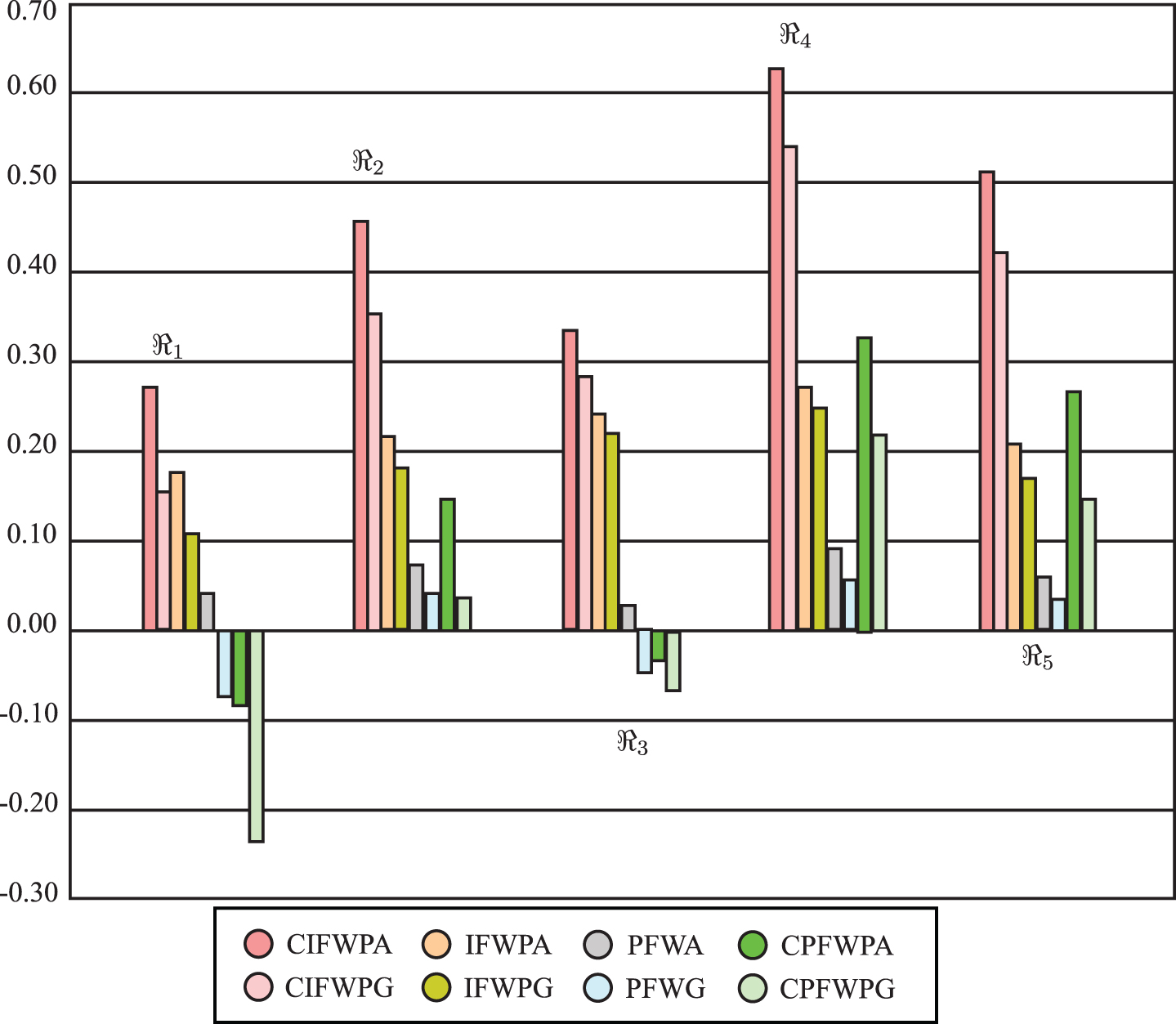
In this section, we analyze the comparison of presented model with some existing models. The existing models which we have chosen for the comparison are based on the operators defined under IFS [46], CIFS [36] and PFS [43]. For IFS and PFS, we put the phase term and neutral membership zero related to each CPFN of given data. To compare the proposed model with CIFS, we take complex grade of neutral membership of each CPFN zero. Then the results based on given information are exhibited by Table 6.
Based on the calculations, presented by Table 6 is the optimal alternative which shows that the given model is logical and reliable. Due to the fluctuating circumstances of choices, a slight difference appears in the ranking of alternatives, i.e., the aggregated results are obtained either with different operators or under different environments.
Despite the fact that the best alternative is same for all discussed techniques examined by the MCDM method, the CPFWP operators are superior than the existing models. Because the CPFWP operators can exhibit two dimensional information and the generalized form of IFS, CIFS and PFS.
The comparative analysis is graphically shown in the Fig. 2
Comparison of proposed and existing models.
Merits of proposed technique
The preeminence and some advantages of the proposed technique, based on the comparative study are illustrated in the following aspect.
The dominance of CPFSs rely on the ability of exhibiting two dimensional phenomenon. This ability makes these sets more effective as these sets can possess more relevant information about an object during a strategy. Therefore, CPFS is the most generalized form of CIFS [8] and PFS [16] which can be illustrated as follows:
CIFSs can deal with two dimensional data but only exhibit the information about the membership and non-membership degrees. PFS has ability to discuss the membership, non-membership as well as neutral membership degree but it fails to handle the periodicity due to absence of phase term. The CPFS not only possesses the knowledge about membership, neutral membership, non-membership and hesitancy values, but also deals with imprecision and periodicity simultaneously. In this manner, the proposed aggregation technique under CPFSs is more generalized than the other existing models.
Furthermore, CIFS [8] and PFS [16] are the special cases of CPFS. Because, the CPFS can be converted either into the CIFS or PFS by taking neutral membership or phase term zero, respectively. Therefore, the aggregation methods described in [18, 43] can be easily explained under CPFSs environment but the proposed method can not be expressed under the existing environments.
Most importantly, the distinct and noticeable feature of the presented MCDM technique is to explore the pertinent and valid information for the appraisal of alternatives with minimum data loss. The PA technique makes it more easier and comfortable for the decision maker(s) to develop the interdependent interactions among the arguments for appraisal of optimal result as these operators have capacity to display the relationship of contentions and above all the inclinations fortify up one another during the aggregation cycle. Therefore, the presented method is more reliable and convenient for handling the MCDM issues.
Conclusion
The CPFS is a generalization of PFS and CIFS as the PFS can not deal with two-dimensional data whereas, CIFS lacks the information about an item viable. Fundamentally, the expansion of neutral membership degree to the meaning of CIFS fortifies the significance of set which gives more angles to know about an object under consideration. The membership degrees of a CPFS are complex valued consisting of amplitude and phase terms which make CPFS more effective and influential mechanism to deal with the imprecision and periodicity of data, simultaneously, to solve the MCDM issues and provide many different ways to the decision expert for making the best choice of desired alternatives. In this research, we present a novel concept of CPFSs and define the basic properties and some operational laws which are helpful to understand the CPFSs. We have proposed an aggregation technique namely; complex picture fuzzy power averaging and geometric operators, including weighted and ordered weighted aggregation techniques and explained their importance and authenticity by proposing a MCDM model, based on an algorithm and a descriptive example. The analysis of proposed and existing models has been done to illustrate the superiority and consistency of presented approach. This analysis has proven our model more general and flexible for decision makers to access an alternative in the most desirable environment. Finally, we have expressed the merits of presented model. In future research, we extend our work to Prioritized and Einstein aggregation operators under CPFSs environment.
Conflict of Interest: The authors declare no conflict of interest.
AkramM., BashirA. and GargH., Decision-making model under complex picture fuzzy Hamacher aggregation operators, Computational and Applied Mathematics39(2020), https://doi.org/10.1007/s40314-020-01251-2.
3.
AkramM., DudekW.A. and DarJ.M., Pythagorean Dombi fuzzy aggregation operators with application in multi-criteria decision-making, International Journal of Intelligent Systems34 (2019), 3000–3019.
4.
AkramM., DudekW.A. and IlyasF., Group decision making based on Pythagorean fuzzy TOPSIS method, International Journal of Intelligent Systems34 (2019), 1455–1475.
5.
AkramM., GargH. and ZahidK., Extensions of ELECTRE-I and TOPSIS methods for group decisionmaking under complex Pythagorean fuzzy environment, Iranian Journal of Fuzzy Systems17(5) (2020), 147–164.
6.
AkramM., KhanA. and SaeidA.B., Complex Pythagorean Dombi fuzzy operators using aggregation operators and their decision-making, Expert Systems (2020), https://doi.org/10.1111/exsy.12626.
7.
AkramM., PengX. and SattarA., Multi-criteria decision-making model using complex Pythagorean fuzzy Yager aggregation operators. Arabian Journal for Science and Engineering, (2020). https://doi.org/10.1007/s13369-020-04864-1.
8.
AlkouriA. and SallehA., Complex intuitionistic fuzzy sets, 2nd international conference on fundamental and applied sciences1482(2012), 464–470.
9.
AtanassovK., Intuitionistic fuzzy sets, Fuzzy Sets and Systems20(1) (1986), 87–96.
BiL., DaiS., HuB. and LiS., Complex fuzzy arithmetic aggregation operators, Journal of Intelligent and Fuzzy Systems36(3) (2019), 2765–2771.
12.
ChenS.M. and ChangC.H., Fuzzy multi-attribute decision making based on transformation techniques of intuitionistic fuzzy values and intuitionistic fuzzy geometric averaging operators, Information Sciences (2016), 352–353, 133–149.
13.
ChenS.M. and TanJ.M., Handling multi-criteria fuzzy decision-making problems based on vague set theory, Fuzzy Sets and Systems167 (1994), 163–172.
14.
ChiclanaF., HerreraF. and Herrera-ViedmaE., The ordered weighted geometric operator, Properties and application. In: Proc of 8th Int Conf on Information Processing and Management of Uncertainty in Knowledgebased Systems, Madrid, (2000), 985–991.
15.
CuongB., Picture fuzzy sets-first results, Neuro-Fuzzy Systems with Applications, Institute of Mathematics, Hanoi, (2013).
16.
CuongB.C. and KreinovichV., Picture Fuzzy Sets-a new concept for computational intelligence problems. In 2013 Third World Congress on Information and Communication Technologies (WICT 2013) (2013), 1–6.
17.
FigueiraJ., GrecoS. and EhrgottM., Multiple criteria decision analysis, SpringerNew York, (2016).
18.
GargH., Some picture fuzzy aggregation operators and their applications to multi-criteria decision making, Arabian Journal for Science and Engineering42(12) (2017), 5275–5290.
19.
GargH., Distance and similarity measure for intuitionistic multiplicative preference relation and its application, International Journal for Uncertainty Quantification7(2) (2017), 117–133.
20.
GargH. and RaniD., Some generalized complex intuitionistic fuzzy aggregation operators and their application to multi-criteria decision-making process, Arabian Journal for Science and Engineering44(3) (2019), 2679–2698.
21.
KhanS., AbdullahS. and AshrafS., Picture fuzzy aggregation information based on Einstein operations and their application in decision making, Mathematical Sciences13(3) (2019), 213–229.
22.
LinM., LiX. and ChenL., Linguistic q-rung orthopair fuzzy sets and their interactional partitioned Heronian mean aggregation operators, International Journal of Intelligent Systems35(2) (2020), 217–249.
23.
LinM., HuangC. and XuZ., MULTIMOORA based MCDM model for site selection of car sharing station under picture fuzzy environment, Sustainable Cities and Society53 (2020), 101873.
24.
LinM., WeiJ., XuZ. and ChenR., Multi-attribute group decision-making based on linguistic Pythagorean fuzzy interaction partitioned bonferroni mean aggregation operators, Complexity (2018). https://doi.org/10.1155/2018/9531064.
25.
LinM., XuW., LinZ. and ChenR., Determine OWA operator weights using kernel density estimation, Economic Research-Ekonomska Istra đ ivanja33(1) (2020), 1441–1464.
26.
LiuP., AkramM. and SattarA., Extensions Of prioritized weighted aggregation operators for decisionmaking under complex q-rung orthopair fuzzy information, Journal of Intelligent and Fuzzy Systems (2020). DOI:10.3233/JIFS-200789
27.
LiuP., ChenS.M. and WangY., Multi-attribute group decision making based on intuitionistic fuzzy partitioned Maclaurin symmetric mean operators, Information Sciences512 (2020), 830–854.
28.
LiuP., ShahzadiG. and AkramM., Specific types of q-rung picture fuzzy Yager aggregation operators for decision-making, International Journal of Computational Intelligence Systems13(1) (2020), 1072–1091.
29.
LiuP., LiuJ. and ChenS.M., Some intuitionistic fuzzy Dombi Bonferroni mean operators and their application to multi-attribute group decision making, Journal of the Operational Research Society69(1) (2018), 1–24.
30.
LiuH.W. and WangG.J., Multi-criteria decision-making methods based on intuitionistic fuzzy sets, European Journal of Operational Research179(1) (2007), 220–233.
31.
LiuZ., WangS. and LiuP., Multiple attribute group decision making based on q-rung orthopair fuzzy Heronian mean operators, International Journal of Intelligent Systems33(12) (2018), 2341–2363.
32.
LiuZ., WangX., LiL., ZhaoX. and LiuP., q-rung orthopair fuzzy multiple attribute group decisionmaking method based on normalized bidirectional projection model and generalized knowledgebased entropy measure, Journal of Ambient Intelligence and Humanized Computing (2020). https://doi.org/10.1007/s12652-020-02433-w.
33.
PasiG. and YagerR.R., Modelling the concept of majority opinion in group decision making, Information Sciences176 (2006), 390–414.
34.
RamotD., FriedmanM., LangholzG. and KandelA., Complex fuzzy logic, IEEE Transactions on Fuzzy Systems11(4) (2003), 450–461.
35.
RamotD., MiloR., FriedmanM. and KandelA., Complex fuzzy sets, IEEE Transactions on Fuzzy Systems10(2) (2002), 171–186.
36.
RaniD. and GargH., Complex intuitionistic fuzzy power aggregation operators and their applications in multi-criteria decision-making, Expert System (2018).
37.
RaniD. and GargH., Distance measures between the complex intuitionistic fuzzy sets and its applications to the decision-making process, International Journal for Uncertainty Quantification7(5) (2017), 423–439.
38.
ShahzadiG., AkramM. and Al-KenaniA.N., Decision making approach under Pythagorean fuzzy Yager weighted operators, Mathematics8(1) (2020), 70.
39.
Shumaiza, AkramM., Al-KenaniA.N. and AlcantudJ.C.R., Group Decision-Making Based on the VIKOR Method with Trapezoidal Bipolar Fuzzy Information, Symmetry11(10) (2019), 1313.
40.
SinghS. and GargH., Distance measures between type-2 intuitionistic fuzzy sets and their application to multicriteria decision-making process, Applied Intelligence46(4) (2017), 788–799.
41.
WangX. and TriantaphyllouE., Ranking irregularities when evaluating alternatives by using some ELECTRE methods, Omega36 (2008), 45–63.
42.
WaseemN., AkramM. and AlcantudJ.C.R., Multi-attribute decision-making based on m-polar fuzzy Hamacher aggregation operators, Symmetry11(12) (2019), 1498.
43.
WeiG.W., Picture fuzzy aggregation operators and their application to multiple attribute decision making, Journal of Intelligent and Fuzzy Systems33(2) (2017), 713–724.
44.
WeiG., ZhaoX., WangH. and LinR., Fuzzy power aggregation operators and their application to multiple attribute group decision making, Technological and Economic Development of Economy19(3) (2013), 377–396.
XuZ., Approaches to multiple attribute group decision making based on intuitionistic fuzzy power aggregation operators, Knowledge-Based Systems24(6) (2011), 749–760.
47.
XuZ.S. and YagerR.R., Some geometric aggregation operators based on intuitionistic fuzzy sets, International Journal of General Systems35(2006), 417–433.
48.
XuZ. and YagerR.R., Power-geometric operators and their use in group decision making, IEEE Transactions on Fuzzy Systems18(1) (2010), 94–105.
49.
YagerR.R., Aggregation operators and fuzzy systems modeling, Fuzzy Sets and Systems67(2) (1994), 129–145.
50.
YagerR.R., The power average operator, IEEE Systems, Man, and Cybernetics Society31(6) (2001), 724–731.
51.
YagerR.R., On ordered weighted averaging aggregation operators in multicriteria decision making, IEEE Transactions on Systems Man and Cybernetics18(1) (1988), 183–190.
52.
YeJ., Intuitionistic fuzzy hybrid arithmetic and geometric aggregation operators for the decisionmaking of mechanical design schemes, Applied Intelligence47 (2017), 743–751.
53.
ZadehL.A., Fuzzy sets, Information and Control8(3) (1965), 338–356.
54.
ZhangG.T., DillonS, CaiK.Y., MaJ. and LuJ., Operation properties and ä-equalities of complex fuzzy sets, International Journal of Approximate Reasoning50 (2009), 1227–1249.