




Abstract
Scientific customer stratification method can help enterprises identify valuable customers, thus effectively improving the operating profit of enterprises. However, current customer stratification methods have not considered the impact of cost to service (CTS) on customer value (such as the RFM model). In this paper, K-mean clustering method is adopted to classify customers into four categories, namely 1) the most valuable customers, 2) valuable customers, 3) general customers and 4) customers with low contribution. By adding a new evaluation dimension of CTS, the original RFM model is improved. In this way, the RFMC model is built and can provide more comprehensive evaluation on customer value. Finally, the results show that the addition of CTS index significantly changes the clustering results of the original RFM model and the overall consideration of consumption amount and CTS truly reflect the customer value. Thus, the improved RFMC model optimizes the results of customer stratification and it can effectively sort out the valuable customers for enterprises. Enterprises will be more dedicated to serving the valuable customers so as to maximize profits and reduce service costs of customers with lower value to make up for profit losses.
Introduction
As market economy and information technology are developing, modern enterprises are prone to have a large number of customers but the customers may not be just loyal to just one brand. As the cost of retaining customer continues to increase, enterprises find it imperative to adopt varied management strategies for different customers so as to save costs and maximize profits. As a result, it is necessary to carry out customer stratification and customer stratification should become the active strategic choice for marketers (Homburg C, 2008) [7]. Customer stratification is different from traditional market segmentation (Lawrence F B, 2010) [14], because for every profit-oriented company, the most critical difference between different consumers does not come from demand, but lies in the difference in their profit contribution rate to the enterprise (Randall, 2015) [21]. Customer stratification is able to sort out customers who bring profits and values to an enterprise and who will make most contribution to the enterprise’s profits, effectively reduce the cost of customer service (Fowler A, 2016) [4] and double pre-tax profit (EBITDA) for the enterprises.
Literature review shows that study on customer stratification can effectively boost profits for both industrial and commercial enterprises, but a correct stratification approach is a must. Most stratification approaches focus on common weighting of multiple dimensions, instead of the contribution from an important but invisible dimension –“cost to services (CTS)". More scholars start to focus on CTS during their evaluation on customer value. If an enterprise must pay enormous CTS to complete a transaction or maintain a relationship with a customer, the enterprise cannot make a high profit from the customer (Lahutta D, 2014) [13]. CTS is an important factor in evaluating customers’ value and should be considered as one dimension for evaluating customers’ value. This paper tries to quantify the cost of customer service and build a model, to test for the effect of CTS-based customer stratification. Through the research, it hopes to prove the role of CTS in customer stratification and thus improve the profit margin of enterprises.
Many studies focus on customers in the consumer market. In fact, the organizational market (especially the producer market) is an economic lifeline in a country (Fare R, 1994) [3], and the major indicator of industrial strength (Lee J, 1995) [16]. More researches should be conducted on the sellers and buyers in the organizational market. Many studies on retail enterprises show that in e-commerce, as customers have more choices of businesses and commodities, their purchase choices continue to increase, but their loyalty decreases (Zheng Wenjun, 2015) [29]. In contrast, stable suppliers can help industrial enterprises reduce cost and maintain product quality (Zhou Yingfen, Xu Ming, 2018; Gao Yuan, 2017) [5, 31]. Due to the high turnover of industrial products, the loyal of customers to one brand is very important and an enterprise need to maintain a good relationship with important customers. As a result, customers in the producer market usually have a high loyalty to the brand and a long-term cooperative relationship with enterprises. More interactions between the sellers and the buyers can bring about higher CTS (Zhou Yang, 2017; Zhang Donghui, 2016) [27, 30]. To remain competitive, modern enterprises have to be service-oriented (Long Yue, 2011) [19].
Therefore, the research on CTS and customer stratification should focus more on the organizational market than the consumer market. In this paper, a manufacturing enterprise is chosen as the research target so as to find a more suitable customer stratification approach for reducing CTS and increasing profit margin. This approach needs to effectively sort out high-value customers for enterprises to increase CTS and maximize profits. The CTS for low-value customers will be reduced to make up for the profit loss.
Theoretical Analysis and Research Hypotheses
The theory of customer stratification
Many studies have proved that enterprises should deal with customers differently so as to improve business profits. Different customers bring different values to enterprises. Bellis-Jones (1989) proposed that serving some customers required most companies to invest a considerable amount of money and bear partial losses of profits. Therefore, enterprises should firstly determine the customers that deserve the high CTS. Homburg (2008) [7], a German scholar, put forward the theory of customer prioritization and emphasized that different customers should receive differential treatment in marketing based on their importance. He offered a self-inspection table of customer prioritization, which helped assess the effects of prioritization in terms of products, services, price, sales, process and communications.
Based on the conclusions above, Lawrence F B (2010) [14], an American scholar, formally proposed the customer stratification. This approach clearly stratified customers by how much value they brought to the enterprises, and ranked customers based on the value. The value of customers to business operators was measured through process metrics and financial elements. In addition, some scholars put forward their own views based on the characteristics of the enterprise they studied: Fowler (2016) [4], for example, proposed to stratify customers based on the maintenance or repair costs the enterprise spent on.
The research on customer stratification in China began with Liu Qian (2002) [18]. Liu Qian proposed a “customer pyramid”. Liu held that enterprises should provide the best services to customers with the highest rate of profit contribution. Li Yanchen (2008) [17] proposed to stratify customers and apply different marketing tools to different customers. With the ultimate goal of maximizing profits, Li even encouraged enterprises to give up some customers if necessary.
Thus, customer stratification is a differentiated classification method of customers based on their contribution rate or values to the enterprises. Customer stratification also belongs to the commercial development, because customer stratification is made based on the data from the actual sales. It is a feedback to the previous strategies and a tool for making future strategies (Lawrence F B, 2010; Smith WR, 1956; Wang Xiaowen, Shen Si, et al., 2017) [14, 23]. In this regard, if more valuable customers can be identified by customer stratification, it indicates that the marketing strategy of the enterprise is successful. Otherwise, the enterprise needs to change its marketing strategies to attract or find valuable customers in the market.
The significance of customer stratification theory
Realistic economic significance. According to the classification results, enterprises can reduce service expenditures of the customer that have low contributions to the enterprises, so as to directly save the enterprise’s operating and marketing costs, and improve the company’s profit margin. Improving the loyalty of VIP customers. According to the results of the classification, the enterprises will increase the service expenditures on those customers who have made high contributions to the enterprises, so these customers will increase their loyalty to the enterprises’ products or services, and enterprises will also benefit from the higher returns. Accurately tapping potential customers. By customer stratification, enterprises can obtain more customer information, increase investment for those potential customers, effectively tap the potential value of customers, provide precise services and improve enterprises’ profits.
To sum up, customer stratification is essential in the business process of enterprises. It not only tests an enterprise’s business strategy, but also effectively identifies the loopholes and deficiencies in a business strategy. High-value customers can provide directions for the development of business, and transform the enterprise from being product-driven to customer-driven. Moreover, a differentiated business strategy reduces the expenses and increases the operating profit of the enterprises (Kim, 2006; Andy Fred Wali, 2018) [1, 12].
Adoption and evaluation of customer stratification method
It was not until 1997 that the specific business-oriented method of customer stratification was put forward: Kotler, and Rossiter & Percy were the first to propose the method of customer stratification. The theory of Kotler was mainly based on the consumption frequency of customers while Rossiter & Percy based on the loyalty of customers to the brand. At that time, the stratification method only involved one dimension. In 2008, Homburg made empirical analysis on the method, used a customer optimization and self-inspection table to select 310 enterprises and carried out the analysis on stratification prioritization. Based on his analysis, customer stratification would produce higher average customer profit and sales return. Zhu Zhenda (2009) [33] proposed that strengthening the stratification of old customers was one of the strategies to manage the value of customer share. Zhu used two variables, i.e. years and purchase quantity, to determine the most valuable customers and estimate the value they create for the enterprise. Gu Wei (2015) [6] proposed a customer stratification management system designed for Drupal system based on PHP development language and MySQL database.
To sum up, customer value can be measured though different stratification variables, including consumption frequency, purchase volume, product sales, and service life, but none of the above-mentioned studies have a specific measurement model. The literature review found that it was imperative to study data about the online customer behavior at the era of online marketing. Arthur Hughes’ RFM analysis depends on regency, frequency and monetary for customer stratification. The model is widely used in various fields (Hughes, 1994) [8]. Regency (R) refers to the number of days between the latest purchase time and time of analysis. If the value is small, it indicates that the customer has just made a purchase recently. The smaller the value, the more likely the customer is to repeat the purchase, and thus the higher value of the customer; frequency (f) stands for the number of times that the customer purchases products or services during the calculation period. Generally speaking, the higher the frequency of customer purchases, the more loyal the customer, and the greater the customer value. Monetary (m) means the total amount of money customers spend during the calculation period. If monetary value is higher, customers are more loyal to the enterprises and thus bring about greater value (Zhao Meng, Qi Jiayin, 2014) [28].
As can be known from the theory of customer stratification, the three indexes of RFM model and the customer stratification variables are well matched. Whether in B2B or B2C market, indexes of regency, frequency and monetary reflect the loyalty of customers to an enterprise, the purchasing power of customers, and the rate of return. All these factors constitute the overall value of customers to the enterprise.
Therefore, many scholars at home and abroad have improved the basic RFM model so that RFM model can be more widely used. Jonker (2009) [10] created a new decision system based on RFM model to mobilize customers to purchase by determining the best frequency to email customers. Ji Xiaofen and Jia Zhenji (2015) used RFM model to analyze the loyalty and activeness of VIP customers for garment enterprises. They built a judgment matrix based on fuzzy mathematical method and changed three-dimensional data (RFM score) into one-dimensional data for comparison. The RFM model provided a reference for enterprises to manage and serve VIP customers from multiple perspectives [9]. Wang Yuan (2013) [24] calculated the R, F and M values of each customer based on the historical data of customer transactions. The value of customers was determined by the RFM model. Customer value is determined by customer demand model. For customers in different value categories, collaborative filtering technology based on customer preference was adopted to provide personalized product recommendation. In this way, customers were more willing to purchase products again. Lu Na et al. (2018) [20] conducted a segmentation study based on the RFM model to measure the value of online customers.
Another method is to use the RFM model as a data collection indicator, and use different mathematical calculation models to classify customers and evaluate their value. It is not only used in the marketing. For instance, Yan Chun, Sun Haitang, et al. (2018) [25] combined the random forest algorithm with the RFM model for the classification of property insurance customers; Wang Rui, Li Di, et al. (2018) [22] will combine improved RFM model and rough set index weight calculation method to study the MOOC learner loyalty measurement model for evidence reasoning; Yu Shouhua and Zhang Bin (2018) [26] conducted an empirical study on the customers of Y Company using the two-step clustering algorithm based on the RFM model indexes.
In summary, scholars may redefine the RFM model, improve the content of the three indexes R, F and M according to their research topics or the realities of the enterprises, or propose new and more applicable RFM model after adding new indexes to RFM model. After obtaining the required data, scholars adopt other mathematical calculation methods to reasonably evaluate the value of customers or conduct hierarchical management of customers. This is also the most important research philosophy in this paper.
Significance of CTS and its regulation effect on customer stratification
In terms of various improved RFM models, the value that customers bring to the enterprise is evaluated from various perspectives. However, in actual business operation, managers always concentrate on how to reduce the production cost rather than the costs of serving customers (Braithwaite and Samakh, 1998; Norek and Pohlen, 2001) [2]. The enterprises have to make investment to maintain the relationship with some customers or provide higher-services to customers, which will significantly the cost of enterprises. If the increased cost is greater than the potential value of the customer, the enterprise may suffer from reduced profits or even a loss (Lahutta D, 2014) [13]. Therefore, current stratification approaches, especially the RFM model, have not considered the important but invisible dimension of “CTS", which greatly affect the customer value. In fact, “CTS” depends on the customers’ behavior rather than the enterprises that provide services (Kaplan and Narayanan, 2001) [11].
Therefore, CTS plays an important role in evaluating customers’ value. However, the three indexes in the basic RFM model, which only consider the enterprise value generated by customer consumption, do not include the factor of CTS. The impact of CTS on the actual profits of enterprises has been widely recognized by scholars: although some customers spend a large amount of money, enterprises have to cover extra costs for them (such as customization fees, high transportation fees, and return fees). Therefore, the return rate from this kind of customers is low. By contrast, some customers may not buy products frequently, but their actual trading value is higher, due to their high average order amount, ordering through reservation or buying high percentage of unsaleable products. Therefore, this paper improves RFM model by adding CTS to the original RFM model. The improved RFMC model integrates the K-means clustering algorithm. In this way, the value of customers can be comprehensively evaluated. The addition of CTS will inevitably affect the stratification of the original RFM model. The improved RFM model can effectively identify high-value customers for the enterprises because it uses high return rate instead of large purchase amount as the criteria. Instead of concentrating on consumption, the original model is transformed into an improved model that prioritizes value. Therefore, following hypotheses are proposed:
H1: because of the introduction of the cost of service (CTS) indicator, the new RFMC model can change customers with lower value evaluations in the clustering results of the basic RFM model into customers with higher value evaluations.
H2: because of the introduction of the cost of service (CTS) indicator, the new RFMC model can change customers with higher value evaluations in the clustering results of the basic RFM model into customers with lower value evaluations. Only by quantifying the value of customers in an all-round way and fully considering the service costs paid by the enterprises can enterprises discover the customers who are truly valuable to the enterprises and help enterprises maximize their operating profits.
H3 is proposed: the new RFMC model can reduce service costs and create higher profits for enterprises.
Research design: modeling
Based on the summary of 2.3, this paper believes that RFM model can effectively reflect the value of customers. The content and implications of the model is very useful for customer stratification. Therefore, RFM model is selected as the basic model to study customer stratification.
This paper added CTS into the traditional RFM model. The customer data of R, F, M and CTS were collected and each customer was scored based on the data. The higher the average score of the total score, the higher the customer value. The customers with high scores can be classified into customers with high values. Besides, the K-means clustering method was used to divide customers into four categories, and the customers with similar average scores were clustered into the same category. Customers were ranked from high to low based on the clustering results and divided into four categories: 1) the most valuable customers, 2) valuable customers, 3) general customers, and 4) low-contribution customers. As CTS was discussed in this paper, the content of model was designed based on the actual business indexes of the enterprise, and all the stratification indexes came from a manufacturing enterprise.
Basic RFM model
Based on the research results (Hughes, 1994) [8], a basic RFM model is built: R (the number of days between the latest date of signing the contract to the set date), F (the number of contracts signed between the same customer and the enterprise within one operating year before the set date), M (total contract amount signed between the same customer and the enterprise within one operating year before the set date).
CTS model establishment
(1) cost to service (CTS)
The CTS actually goes through the entire life cycle of providing the customer services. Therefore, the service cost in this paper is defined as all the cost items that the enterprise pays to maintain the customer relationship for the purpose of finishing the transaction between the enterprises and customers. Because it is hard to calculate the amount of expense incurred in some projects, and quantify the service cost (for example, when companies provide customers with more sophisticated service details), companies have paid a lot of invisible costs without knowing it. Therefore, the existing customer stratification methods, especially the RFM model, do not fully consider CTS when judging the customers’ value.
Therefore, many scholars have proposed the CTS measurement method from the perspective of customers’ purchase. For example, according to F. B. Lawrence (2011) [15] who was the first to propose CTS method, the service costs paid by the enterprises to customers can be divided into seven aspects: (1) average order size, (2) average number of line item, (3) average days to pay, (4) will-call-order, (5) same-day deliver, (6) C&D item accessed, and (7) number of returns.
(2) Model establishment
This paper attempts to build an improved RFM model “RFMC model” (adding the dimension of CTS) to comprehensively evaluate the value of customers to the enterprises. As the service cost dimension is added, the stratification results of the original RFM model will inevitably be affected. As it does not make judgement based on large purchase amount, RFMC can more effectively discover those customers with a high return rate: it focuses on the value rather than the consumption amount.
Based on the data from the customer group of a manufacturing company in Shandong Province, the research results of F.B. Lawrence (2011) [15] and the actual purchase indexes of the enterprise’s customers, this paper finally determined four indexes to measure customer service costs, ➀ average order size, ➁ average days to pay, ➂ will-call-order, and ➃ salesperson return. The first three indexes can represent the typical purchase performance of manufacturing enterprise customers, while the fourth indicator takes into account the service cost of the enterprise’s own salespersons, which is an innovative research highlight. In summary, the structure model is built as follows:
To sum up, the following structural model is built (Fig. 1):
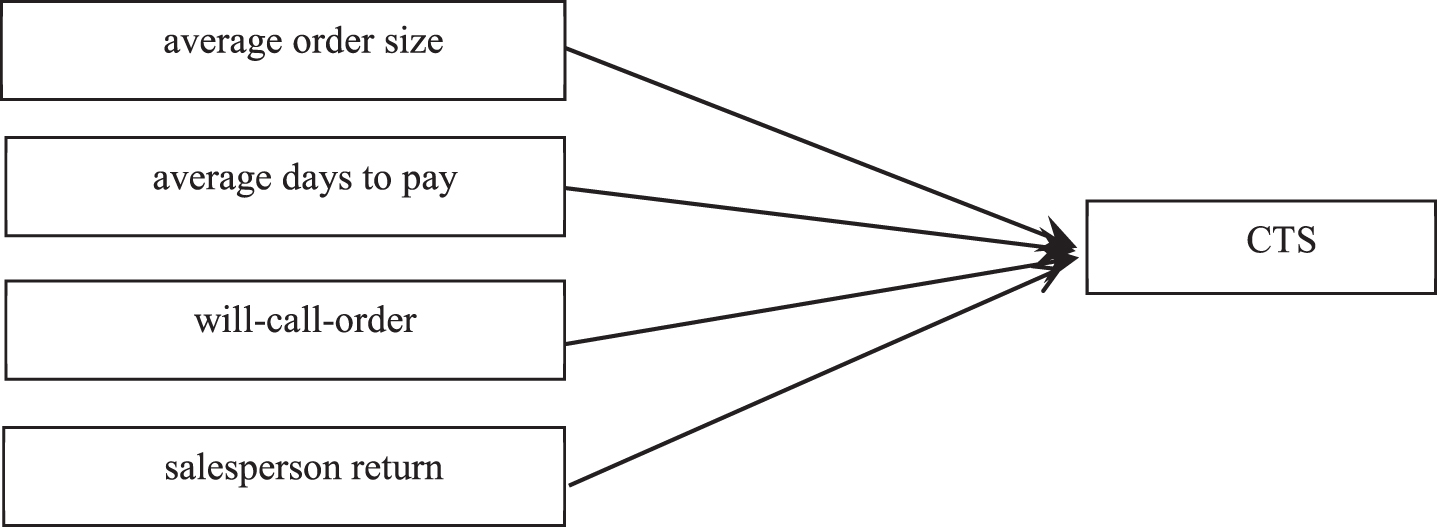
CTS Model Building.
Then,
In formula (1), X
n
represents the four measurement indexes of CTS in Fig. 1 (n = 1,2,3,4), namely ➀ X1: average order size, ➁ X2: average days to pay, ➂ X3: will-call-order, ➃ X4: salesperson return. So how to determine the value of µ
n
which refers to coefficient weight? According to F.B. Lawrence, the four indexes are first arranged in order of importance. The principle is based on the influence of the index on the operating profit of the enterprise. X1 (average order size) represents the cash flow of enterprises and is highly valued by enterprises, so µ1 has the largest weight; X2 (average days to pay) will also have a certain impact on corporate profits and cash flow, but as the impact is indirect, so the weight ratio of µ2 is smaller than µ1. X3 (will-call-order) more indirectly affects corporate profits, but this effect will take a certain amount of time to unveil. Therefore, the weight ratio µ3< µ2. In terms of X4 (salesperson return), it is conducive to the long-term development of the enterprises and can help enterprises determine which customers need the least service costs. However, as it cannot be directly converted into corporate profits, the weight ratio µ4 is the lowest. Based on the above analysis, it can be roughly determined that the weight difference between the indexes, so the points can be assigned according to m = 4.3,2,1, then,
Then, a certain domain of definition was designed for all indexes. The indexes were divided into four levels: A, B, C and D. For example, for the average order amount (yuan), we had A (≥500,000), B (300000 ⩽ n ⩽ 500, 000), C (200, 000 ⩽ n ⩽ 300, 000) and D (⩽200, 000). Each level had its own scores, such as A = 40, B = 30, C = 20, D = 10. Then, all parameters were plugged into formula (1) to calculate the total score of CTS.
It is important to note that the four-level assignment intervals of A, B, C, and D in the above are divided based on the business of the studied enterprise. The assignment in this paper is based on the principle of arithmetic sequence of equilibrium distribution (weights are 40, 30, 20 and 10 respectively), and the range is fixed. The data points on the coordinates are divided equally so as to avoid the bias caused by artificial data selection. If the data has not been divided in the correct position, the clustering method will witness a small amount of extreme values in a certain interval in, so some enterprises will experience deviations in the scores of some items and the overall clustering result will be affected. Therefore, if the assignment of A, B, C, and D is changed, under the clustering algorithm, the results of customer stratification will be affected. The details were as follows:
Compared with other models, the RFMC model can more comprehensively evaluate the value of customers to the enterprises. In addition, based on the RFMC model, this paper innovatively used the K-means clustering algorithm for customer rating and evaluation.
Based on the approach above, four dimensions of R, F, M and CTS were obtained to comprehensively evaluate the values of enterprises’ customers (check Fig. 2 for details). However, as indexes were designed based on different dimensions, a large difference in values might not help realize a unified evaluation. Therefore, the data were first classified into four grades (i.e. a unified dimension), and their corresponding scores were shown in Table 2:
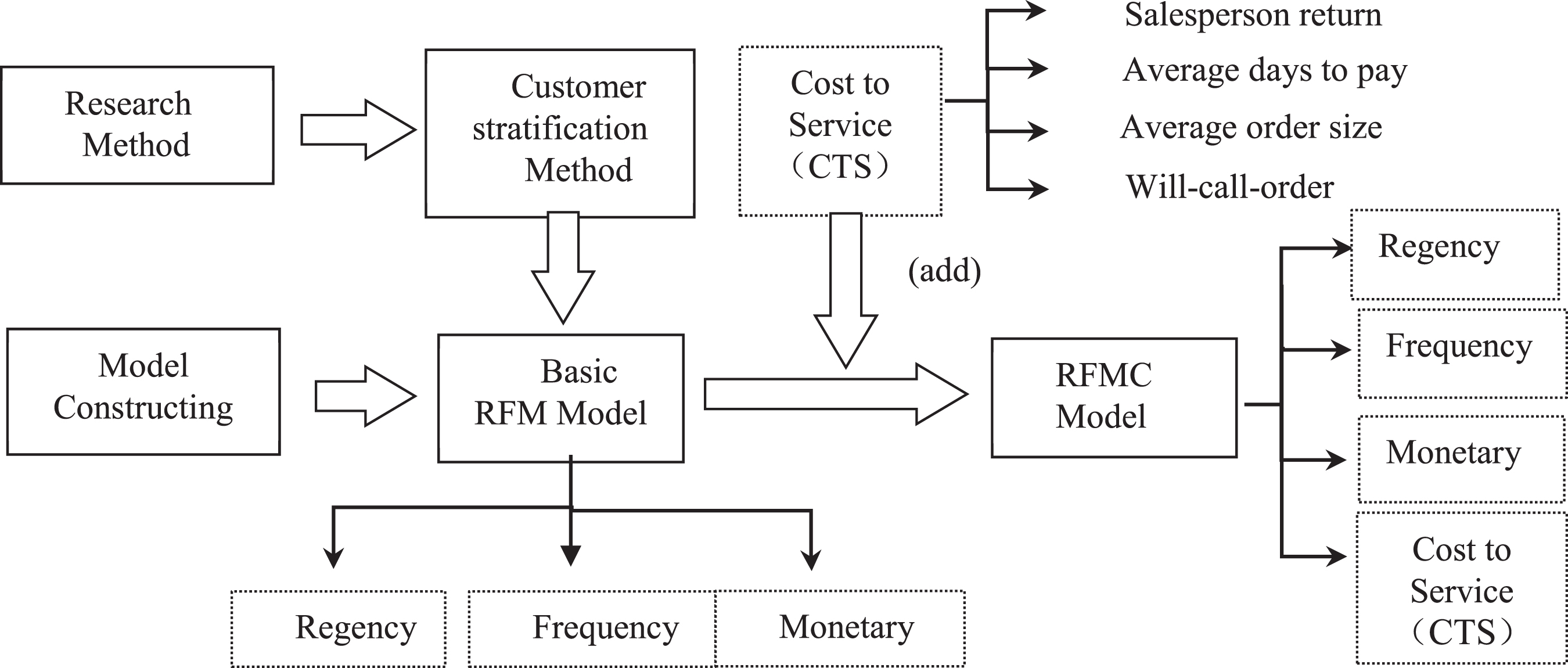
RFMC Model Building.
Based on the above table, all indexes were divided and provided with corresponding scores. Besides, the assigned variables were re-marked as RC, FC, MC and CTSC. A four-dimensional coordinate system was built: for example, in the case of enterprise No. 1, the R index scored 4, the F index scored 1, the M index scored 1, and the CTS index scored 4. The coordinates of the enterprise were (4,1,1,4), indicating that the company had recently purchased the products in a low frequency. This was a new customer who would bring a high return to the enterprise although its purchase amount was not high. This kind of customers were worth investment and continuous attention.
Based on the method above, the enterprises’ customers were divided into 256 types, including (4,4,4,4), (4,4,4,3)..., and (1,1,1,1) (check Tab.3 for details).. The coordinates were analyzed by K-mean clustering (check 4.2).
Sample and data collection
The data of this paper was collected by field research. The operation data of a manufacturing enterprise within one year (from October 1st, 2017 to October 31th, 2018) were obtained. The research targets were all customers who traded with the enterprise during this period. The total number of the samples was 167. All data indexes were collected in accordance with the requirements of the four dimensions in the improved RFMC model. The RFMC was adopted for the following reasons: First, due to the characteristics of industrial products, customers pay relatively large amounts and mostly adopt installment payments. Also, a large amount of invisible costs is usually generated due to transportation means and customer retention issues. Therefore, the RFMC model indicators (purchase time, frequency, amount, service cost) are very suitable for this situation; second, the data of the manufacturing enterprise is really available, because its customers are mostly small and medium-sized enterprises, and most of them have repeated purchase experience. It should be noted that: R represents the number of days between the last time when the same customer purchased an enterprise product and October 31, 2018; CTS indexes were collected in accordance with the requirements of Table 1; and all indexes were converted and followed a unified measurement based on the method in Part 3.
Scores of CTS indexes
Scores of CTS indexes
Grading of R, F, M and CTS
According to the description and statistical analysis in Table 4, the measurement indexes listed in this paper had large variance except for the predetermined proportion. In other words, purchase behaviors varied among customers of this enterprise. The customers were different from each other.
Example analysis of customer categories
Results of descriptive statistics
Therefore, they should be treated differently.
Figure 3 shows that only 4 out of the 167 customers have purchase amounts far greater than that other customers (all of the four customers have purchased products worth more than 8 million yuan and all the other customers have purchased products worth less than 6 million yuan). The purchase amount of most customers was less than 200,000 yuan. Therefore, it is necessary to select more indicators for further value analysis, because the traditional method, which determines the type of customers based on the product value will cause extreme imbalance of customer level.
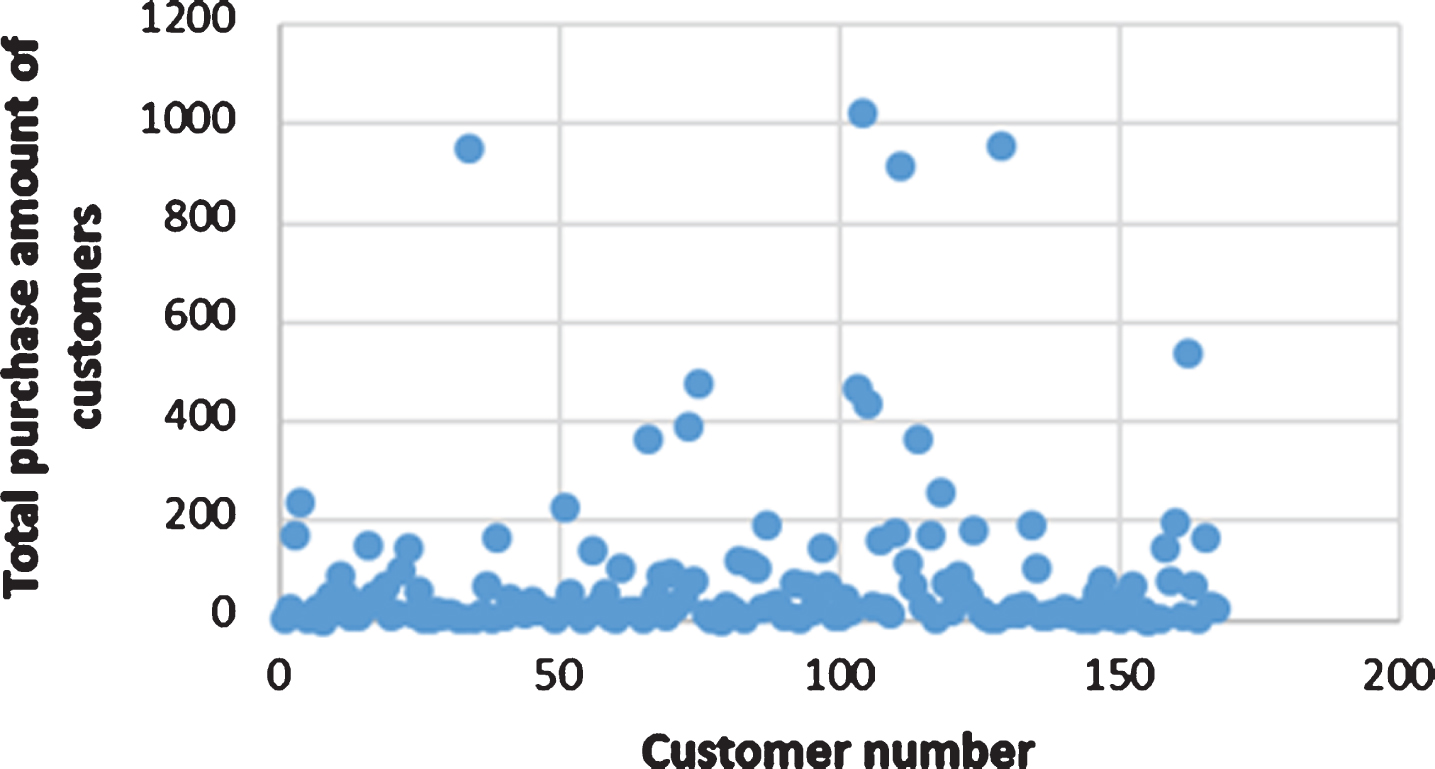
Total purchase amount of customers.
K-means clustering analysis, an iterative clustering analysis algorithm, has the virtue of determining a K-value, or the clustering center, in the clustering results. Clustering attempts to divide the samples in the data set into several usually disjoint subsets. Each subset is called a “cluster". The value of cluster center represents the average level of the objects in this category. If K-means clustering analysis is applied to the stratification process, different categories of customers can be selected.
This paper chooses to use the K-means clustering method for three main reasons: (1) Although the idea and method of customer grading have existed for a long period of time, in actual research, due to the large differences between different industries and enterprises, it is necessary to redesign the customer classification method suitable for the sampling object-a manufacturing enterprise (B2B channel) according to the specific characteristics of the industry. (2) The contribution of customers to the enterprise is gradually reflected in the entire life cycle. Therefore, it is more necessary to distinguish customers with higher potential value and eliminate customers with excessive service costs in order to increase the profits of the enterprise. The biggest advantage of the K-means clustering method is that it can determine k cluster center points according to the sample data, and the value of each cluster center point represents the average of that category. In terms of customer grading, each cluster center point represents a type of customer value (four levels: most valuable customers, valuable customers, general customers and customers with low contribution). In this way, different groups of customers can be directly determined, and a comprehensive evaluation of these types of customers can be made according to the corresponding cluster center values: for example, which index in the RFMC model score higher and what value it has. In addition, in the K-means method, the overall algorithm is not too complicated, the idea is clear, the method is easy to implement, and the data processing can be finished fast. Multiple iterations can be used to eliminate the error of the initial cluster center point.
Therefore, this paper adopts K-means clustering analysis to group customers into different categories and derive cluster center values for those categories. Based on the cluster center value, researchers are able to know in which aspect a customer generates high score and what value does a customer have. Such analysis facilitates the comprehensive evaluation of customers, so that enterprises can develop targeted strategies to attract customers. This paper uses SPSS20 software to cluster the data and the results are as follows.
According to the clustering results in Table 5, customers of the third category have the shortest time period with an average of only 52 days, between the date of their latest purchase and the analysis date. Compared with the same variable of the other three customer groups, customers of the third category are more likely to purchase again, thus owning the highest value. Moreover, customers of the third category have the highest average number of purchases during research cycle (one year), indicating that they have the greatest loyalty to the brand compared with other three categories of customers. Finally, customers of the third category have the highest average purchase amount than other three categories, and their contribution to the enterprise is also the largest. To sum up, customers of the third category have the highest potential value, loyalty and contribution to the enterprise, so they are classified as the most valuable customers. Based on the same analysis method and clustering results in Table 5, 167 customers of the enterprise were studied in RFM model. It is found that 4 are the most valuable customers, taking up 2.4% of the total, 10 are valuable customers, accounting for 6.0%, 96 are general customers, accounting for 57.5%, and 57 are low contribution customers, which accounts for 34.1% of the total.
Clustering results of RFM model
Clustering results of RFM model
According to the results of cluster analysis in the RFMC model, as shown in Table 6, the average score of the fourth category of customers is 3.32, which is the highest among the four categories of customers. It can be concluded that customers of the fourth category are the most valuable. The RFMC model sorts out 38 most valuable customers, accounting for 22.8%; 54 valuable customers, accounting for 32.3%; 29 general customers, taking 17.4%, and 46 low contribution customers, accounting for 27.5% of the total.
Clustering results of RFMC model
The stratification results by different models in Table 7 and Fig. 4 show that the proportion of super valuable customers increases by 20.4%; that of valuable customers increases by 26.3%; that of general customers decreases by 40.1%; and that of low contribution customers decreases by 6.6%. According to the clustering results generated in the RFMC model, some low-contribution customers in the RFM model are upgraded to the category of high contribution customers while some customers rated as high-level customers are downgraded to the lower ranks. For the purpose of analyzing the rationality, ten customers with significant ranking changes are selected for analysis, as shown in Table 8;
Customer stratification by RFM model and RFMC model, respectively
Customer stratification by RFM model and RFMC model, respectively
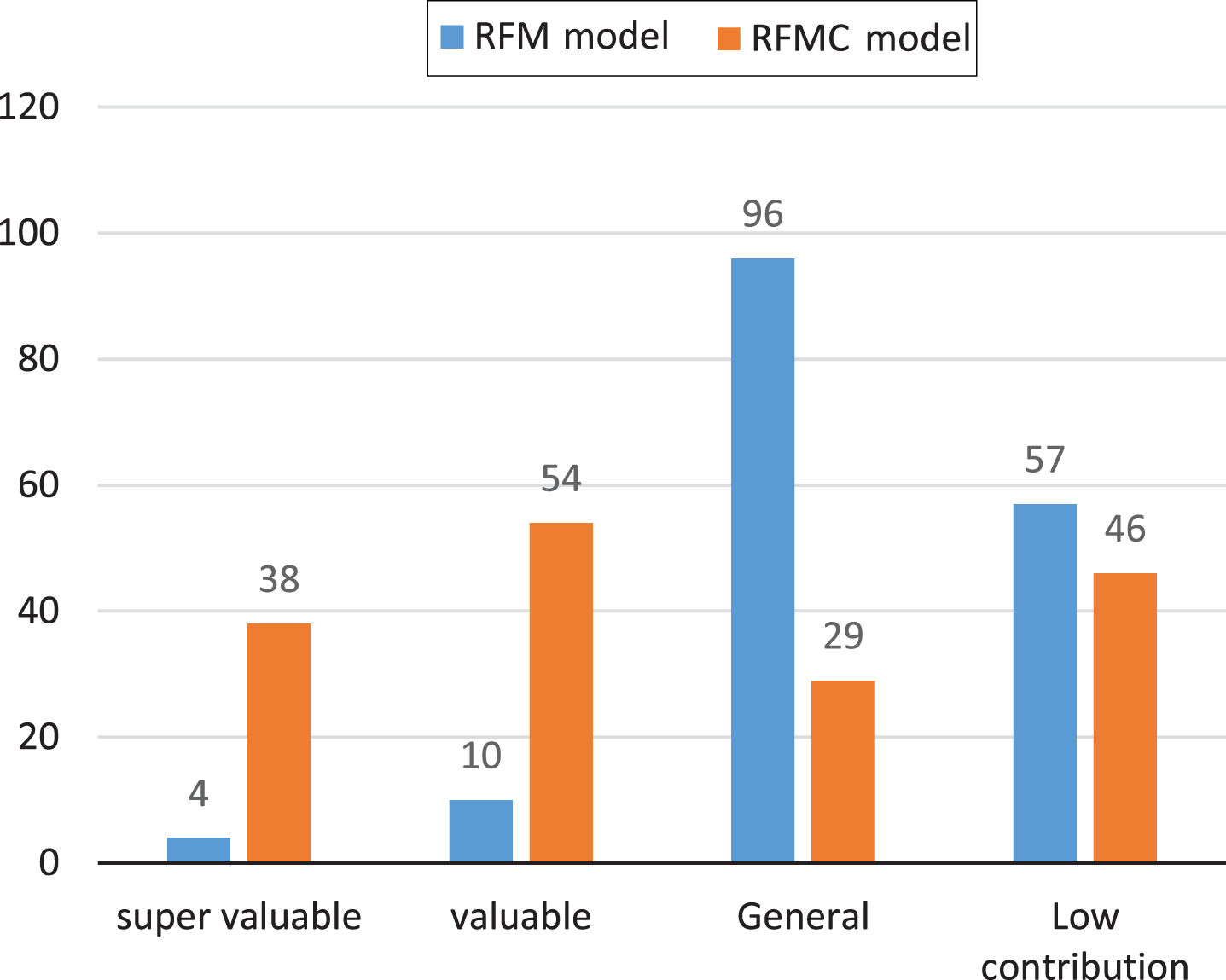
Customer stratification by RFM model and RFMC model, respectively.
Comparison between stratification by RFM model and RFMC model
This paper selects 10 enterprises with significant stratification changes during the comparison between the two models. Customer No. 1, 3, and 4 were all rated as general customers in the RFM model because their purchase amount is far from the average purchase amount of very valuable customers in Table 5. Customer No. 2 was rated as a valuable customer because of the high purchase amount, which proves that RFM model affects the clustering results by outliers in the clustering process. However, in the RFMC model, 4 customers were rated as very valuable customers. The main reason is the introduction of CTS indexes. The service cost paid by the enterprise for Customers No. 1, 3, and 4 is relatively small. Although their purchase amount is not as large as that of Customer No. 2, Customer No. 2 requires the most service cost. The four customers have purchased products from the enterprise several times recently, with the purchase amount of 700,000 yuan and above. Therefore, the rating results are the same: their loyalty to the company’s products is high and can bring higher value to the enterprise, so they have been updated from general customers to very valuable customers. The hypothesis H1 is verified.
Customer No. 8 and 9 were both rated as valuable customers in the RFM model, but they are rated as general customers and low-contribution customers in the RFMC model. The reason is that although customers No. 8 and 9 perform well in terms of the three indexes of the RFM model and have relatively high purchase amount. However, it can be seen that their ratings on service cost are very low. It means that the enterprise may have to pay huge service fees for such customers, but the value return is not high, and the overall profit margin is low or even negative. This type of customer does not deserve the company to pay more to maintain the relationship. Therefore, these customers with higher evaluations in the RFM model are reduced to customers with lower evaluations, which validates the hypothesis H2.
Customer No. 5, 6, and 7 were rated as low-contribution customers and general customers in the RFM model, but were rated as valuable customers in the RFMC model. It can be clearly seen that the scores of Customer No. 5, 6, and 7 in the CTS indexes are 4, 3, and 4 respectively. That is to say, the service cost paid by the enterprise for these three customers is quite low. Although their purchase amount is not very high, the net profit that the enterprise finally obtains is higher, so they are also more valuable customers. After the introduction of CTS indexes, the analysis of customer value is obviously more comprehensive, and more valuable customers have been tapped. The problems of less dimensions and partial value analysis of the RFM model have been greatly alleviated. The hypothesis H3 is verified.
Research conclusions
(1) Service cost significantly affects the value judgment of the enterprise for customers
Based on the investigation of the customers of a B2B manufacturing enterprise and the study of customer stratification, this paper finds that the service cost is an indispensable factor for measuring customer value. Enterprises must pay corresponding service costs to maintain customer relationships, but if they blindly pursue customer satisfaction and invest too much service costs (such as customized service models, unconditional returns and exchanges), the cost increase will exceed the rate of return (that is, the customer’s potential value) and the profit rate will inevitably decline. Therefore, service cost cannot be ignored in the process of measuring customer value. Enterprises must pay attention to the service cost so as to select the truly valuable customers.
(2). The RFMC model can help companies determine valuable customers
As companies increase their marketing awareness, using cost management to obtain higher profits has become the business goals of more companies. Therefore, the customer stratification theory will become more and more important in the entire enterprise supply chain. The improved RFMC model can distinguish the value levels of different customers, arrange them from high to low, guide companies to fully take service costs into consideration, improve the reasonable stratification of customers, and develop targeted marketing strategies for customers of different values.
The empirical research results show that this paper provides a new way of quantifying customer value. The improved RFMC model in combination with the K-means clustering algorithm can accurately determine the cost of serving customers for enterprises, thereby obtaining higher profits and changing the drawbacks of relying on the customer data to judge the customers’ value in the original RFM model. Great changes will occur in customer stratification. Only by quantifying the value of customers in an all-round way and fully considering the level of service costs paid by the enterprises can enterprises discover the customers who truly bring value to the enterprises and help enterprises maximize their operating profits.
Practical implications recommendations on the management policies of enterprises based on customer stratification
Based on the service cost philosophy provided in this paper, enterprises should determine the service cost measurement indicators tailored for the performance of the customers based on the industry characteristics, the type of marketing channels, and the customer groups; Based on the characteristics of its own customer groups, enterprises should use big data technology, interviews, research and other methods to collect data related to the customer purchasing behavior, service and cost, and establish a basic database for backup. Enterprises must actively select customers based on their value in order to maximize profits. Therefore, enterprises need to design a complete profit and value feedback system in the actual business process. First, a grading system should be designed to meet the characteristics of customer groups, develop APP or corresponding programs to realize the full-cycle tracking of customers; secondly, targeted and differential marketing strategies should be developed for different levels of customers: very valuable customers (with low service costs) should be provided with more concessions or benefits, such as raising the membership of VIP. For customers with lower value levels (higher service costs), they should reduce their attention and establish a withdrawal mechanism to avoid losses of profits.
Funding
Research on customer stratification management based on cost to service measurement in Internet Era (Philosophy and social science project (TJGL18-036), Tianjin, China).