The Zagreb index (ZI) is a very important graph parameter and it is extensively used in molecular chemistry, spectral graph theory, network theory and several fields of mathematics and chemistry. In this article, the first ZI is studied for several fuzzy graphs like path, cycle, star, fuzzy subgraph, etc. and presented an ample number of results. Also, it is established that the complete fuzzy graph has maximal first ZI among n-vertex fuzzy graphs. Some bounds of first ZI are discussed for Cartesian product, composition, union and join of two fuzzy graphs. An algorithm has been designed to calculate the first ZI of a fuzzy graph. At the end of the article, a multi-criteria decision making (MCDM) method is provided using the first ZI of a fuzzy graph to find the best employee in a company. Also a comparison is provided among related indices on the result of application and shown that our method gives better results.
Nowadays, due to various applications of fuzzy graph theory (FGT), a huge number of researchers are working on topological indices (TIs). In 1965, the idea of fuzzy set (FS) was first introduced by Zadeh [52]. Motivated by this, in 1975, Rosenfeld [36] defined the fuzzy graph (FG). At the same time, Yeh et al. [51] also introduced the FG independently and defined some connectivity parameters of a FG and their applications. In [48, 49], Sunitha et al. studied the fuzzy block (FB), fuzzy bridge (FBg), fuzzy cut vertex, fuzzy tree (FT), fuzzy forest, partial fuzzy subgraph (PFSG), fuzzy subgraph (FSG), complete fuzzy graph (CFG), etc. Samanta and Pal discussed a fuzzy planar graph in [41]. In [37–39] Sahoo and Pal provided a product of intuitionistic fuzzy graphs. In [31, 32] interval-valued FG is studied by Rashmanlou and Pal. Degree of a vertex in a FG is also discussed in [29]. In [1–6, 43] one can see more details on FGT. In the field of molecular chemistry, TIs are molecular descriptors which are calculated on the molecular graph (MG) of a chemical compound. These TIs are numerical quantities of a graph which describes its topology. In [26–28] Mondal et al. studied some neighbourhood degree-based TIs. Zagreb index (ZI) is one such TIs which is degree-based TI and introduced by Gutman and Trinajstic in 1972 [12] and this TI is used to calculate π-electron energy of a conjugate system. In [44] Sarkar et al. studied ZI of some graph operations and also they calculated general ZIs of some carbon structure in [45]. In [7, 47], one can see for further work related to this topic. In [11, 50], one can see for different types of TIs. But those indices are defined in a crisp graph. As fuzzy graphs is the generalization of crisp graphs and many real life problems cannot be handled by crisp graphs, those indices in fuzzy graphs have more applications. In this article, the first Zagreb index for fuzzy graphs is introduced which is a more generalization of the first Zagreb index for crisp graphs and it is extensively used in spectral fuzzy graph theory, fuzzy network theory, fuzzy graph theory and several fields of fuzzy mathematics and chemistry. This index is studied for both theoretical and application point of view also.
Research question
In this paper, the following questions are discussed: (i) In [13] Hosamani and Basavanagoud provided the upper bound of the first Zagreb index for crisp graphs. What is the upper bound of the first Zagreb index for fuzzy graphs?
(ii)What are the exact values/bounds of the first Zagreb index for path, cycle, star, complete fuzzy graph, etc.?
(iii) For n-vertex crisp graph, complete graph has maximum first Zagreb index. Is this result true for fuzzy graphs also?
(iv) In [21] Khalifeh et al. has given the exact expressions of the first Zagreb index for crisp graph operations (Cartesian product, composition, join, union). What are the exact expressions of the first Zagreb index for fuzzy graph operations (Cartesian product, composition, join, union)?
(v) What is the application of this index? Is this index providing better results for this application among other indices?
Objective of the work
Different types of topological index of a graph has many applications and many results are available for crisp graphs. But in many practical applications it is seen that many situations cannot be modeled using crisp graphs. In these cases, to handle such a situation, those topological indices are needed to define a fuzzy graph. In this paper, modification of the first Zagreb index is defined and given some bounds for various fuzzy graphs like path, cycle, star, complete fuzzy graph (CFG), etc. In this paper, n-vertex maximal fuzzy graph is determined with respect to the first Zagreb index. Some bounds of first ZI are discussed for Cartesian product, composition, union and join of two fuzzy graphs. An algorithm has been also designed to calculate the first ZI of a fuzzy graph. At the end of the article, a MCDM method is provided using the first Zagreb index of a fuzzy graph to find the best employee in a company. Also a comparison is provided among related indices on the result of application and shown that our method gives better results.
Structure of the study
Structure of the article is as follows: Section 2 provides basic definitions which are essential to develop our main results. In section 3, first ZI of a FG is studied and provides the value of it for different FGs and also discusses their bounds. In Section 4, some bounds of first ZIs are discussed during FG operations (Cartesian product, composition, union, join). In Section 5, an algorithm is designed to compute the first ZI of a FG. An application of ZI in MCDM problem has been considered in Section 6. In Section 7, a comparison is provided among related indices on the result of application and shown that our method gives better results.
Preliminaries
In this Section, we give some basic definitions which are essential to develop our results. Let X be a universal set. A FS S on X is a mapping Ω : X → [0, 1]. Here Ω is called the membership function of the FS S. Generally a FS is denoted by S = (x, Ω). Let X (≠ φ) be a given finite set. The FG is a triplet, , where is nonempty finite subset of X with and satisfying Ω (x, y) ≤ Ψ (x) ∧ Ψ (y), where ∧ represents the minimum. The set is the set of vertices and is the set of edges of the FG. Ψ (x) represents the MV of the vertex x and Ω (x, y) represents the membership value (MV) of the edge (x, y) (or simply xy). Let be a FG. Then is called partial fuzzy subgraph (PFSG) of the FG if for all . If Ψ′ (x) = Ψ (x) and Ω′ (x, y) ≤ Ω (x, y) for all then is called fuzzy subgraph (FSG) of the FG . For , we denote is a FSG of the FG with Ψ (x) =0 and for , represents the FSG of the FG with Ω (xy) =0. Let x0, x1, ⋯ , xn be distinct vertices of a FG . Then the sequence of vertices P (x0x1 ⋯ xn) is called a path in if Ω (xi, xi+1) ≠0 for i = 0, 1, ⋯ , n - 1. For this case the length of the path is n. The path, P is called a cycle if Ω (x0, xn) >0. Let be a FG. is called a connected FG if for any two vertices vi and vj, there exists a path containing vi and vj. Let x0, x1, ⋯ , xn be the vertices of a FG . Then is called a star if Ω (x0, xi) ≠0 for i = 0, 1, ⋯ , n. Here x0 is called the center of the star. Let be a FG. is called a complete fuzzy graph (CFG) if for all . Two FGs and are called isomorphic if there exist a bijective map with any and Ω2 (h (x) , h (y)) = Ω1 (x, y). Let be a vertex of a FG . Then the degree of v is denoted by or simply d (v) and defined as Let or Δ be the maximum degree of and defined as and or δ be the minimum degree of G and defined as . The total degree of is denoted by or simply T, i.e. . Throughout this article, we consider, with n1-vertices, m1-edges and with n2-vertices, m2-edges be two FGs and Cartesian product of two FGs are defined below:
Definition 2.1. [29] Cartesian product of and is a FG , where , and Composition of two FGs are defined below:
Definition 2.2. [29] Let be two FGs. Then the composition of and is a FG , where , and Join of two FGs are defined below:
Definition 2.3. [29] Let be two FGs. Then the join of and is a FG , where , , and Union of two FGs are defined below:
Definition 2.4. [29] Let be two FGs. Then the union of and is a FG , where , , and
First Zagreb index of fuzzy graphs
Different types of Zagreb index for crisp graphs are shown Table 1. In 2019, Kalathian et al. [22] defined first ZI for a FG as follows:
Types of Zagreb index for crisp graph
First Zagreb index
Second Zagreb index
Multiplicative first Zagreb index
Multiplicative second Zagreb index
Definition 3.1. [22] Let be a FG. Then first ZI of the FG is denoted by and is defined by:
To maintain the similarity of the first ZI for crisp graphs, in this section, we define the modified ZI of a FG and provide some results on it. Also it is shown that this index gives the better result among other indices for MCDM problems. The definition is given below:
Definition 3.2. Let be a FG. Then modified first ZI of the FG is denoted by and is defined by:
We call this index the first Zagreb index for fuzzy graphs. First ZI is studied for several fuzzy graphs like path, cycle, star, fuzzy subgraph, etc. and presented many results on it. Also, we have established that the complete fuzzy graph has maximal first Zagreb index among n-vertex fuzzy graphs. Some bounds of first ZI are discussed for Cartesian product, composition, union and join of two fuzzy graphs. An algorithm has been also designed to calculate the first ZI of a fuzzy graph. At the end of the article, a MCDM method is provided using the first Zagreb index of a fuzzy graph to find the best employee in a company. Also a comparison is provided among related indices on the result of application and shown that our method gives better results. An upper bound of first ZI for any FG is given for any FG is given below.
Theorem 3.1.Let be n-vertex FG with m edges. Then (i) , (ii) .
Proof. (i) Using the fact Ψ (v) ≤1, the following inequality holds:
(ii) Using (i) and the fact , the required inequality follows.
Now, the first ZI at a vertex of a FG is defined below.
Definition 3.3. Let be a FG. Then first ZI at a vertex v of the FG is denoted by or simply ZF1 (v) and is defined by
In the next example, first ZI of the FG in Fig. 1 is calculated.
A FG with .
Example 3.1. Let be a FG shown in Fig. 1 with vertex set such that, Ψ (v1) =0.9, Ψ (v2) =0.5, Ψ (v3) =0.4, Ψ (v4) = 0.6, Ψ (v5) =0.7, Ω (v1, v2) =0.3, Ω (v1, v4) =0.5, Ω (v2, v3) =0.4, Ω (v3, v4) =0.4, Ω (v3, v5) =0.3, Ω (v4, v5) =0.6. Then d (v1) =0.8, d (v2) =0.7, d (v3) =1.1, d (v4) =1.5, d (v5) =0.9. Therefore,
The next example shows that the first ZI of a FSG is less than the first ZI of the original FG.
Example 3.2. Let be a FSG of the FG shown in Fig. 2 obtained by deletion of the edge v3v4. Then d (v1) =0.8, d (v2) =0.7, d (v3) =0.7, d (v4) =1.1, d (v5) =0.9. Then,
Proof. As is PFSG of then for any and Ω′ (uv) ≤ Ω (uv). so, Therefore, Hence, .
Corollary 3.1.Let be a FSG of a FG . Then . Let 0 ≤ α ≤ 1, the FG is a FSG of the FG and is defined as and Ψ′ (v) = Ψ (v) , Ω′ (uv) = Ω (uv) for .
Theorem 3.2.Let be a FG and let 0 ≤ p1 ≤ p2 ≤ 1. Then .
Proof. is PFSG of . Then by Proposition 3, the result follows.
Corollary 3.2.Let be a FG and let 0 ≤ p1 ≤ p2 ≤ ⋯ ≤ pn ≤ 1. Then In the next theorem, the first ZI of a path is discussed.
Theorem 3.3.Let P (v0, v1, ⋯ , vn) be a path. Then (i) (ii) ZF1 (P) ≤2 (2n - 1) , where Ψ (vi) = Ψi and Ω (vi-1, vi) = Ωi for i = 1, 2, ⋯ , n.
Proof. (i) As P (v0, v1, ⋯ , vn) be a path, then d (v0) = Ω1, d (vn) = Ωn and d (vi) = Ωi + Ωi+1 for i = 1, 2, ⋯ , n - 1. Therefore, (ii) As Ψi ≤ 1, Ωi ≤ 1, then by using (i) followings are hold: First ZI of a cycle is studied in the next theorem.
Theorem 3.4.Let C (v0, v1, ⋯ , vn) be a cycle. Then (i) (ii)ZF1 (C) ≤4 (n + 1) , where Ψ (vi) = Ψi, Ω (v0, vn) = Ωn and Ω (vi, vi+1) = Ωi for i = 0, 1, ⋯ , n - 1. The proof is similar to the proof of Theorem 3.3.
In the next theorem, the first ZI of a star is studied.
Theorem 3.5.Let S (v0, v1, ⋯ , vn) be a fuzzy star. Then (i) (ii) ZF1 (S) ≤ n (n + 1) , where Ψ (vi) = Ψi and Ω (v0, vi) = Ωi for i = 1, 2, ⋯ , n - 1. The proof is similar to the proof of Theorem 3.3.
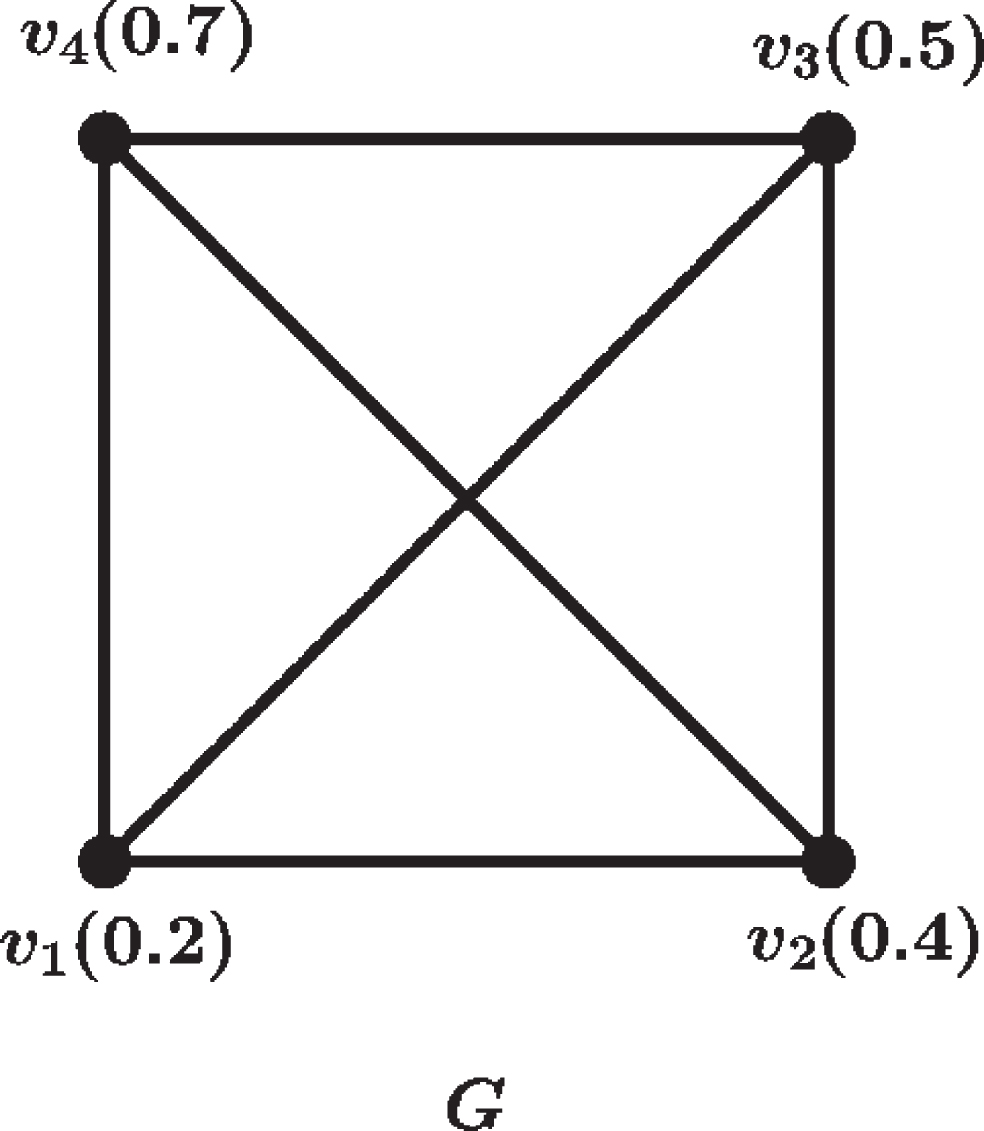
In the next example, the first ZI of the CFG shown in Fig. 3 is calculated below:
A CFG with .
Example 3.3. Suppose be a CFG depicted in Fig. 3 where {v1, v2, v3, v4} is vertex set and Ψ (v1) =0.2, Ψ (v2) =0.4, Ψ (v3) =0.5, Ψ (v4) =0.7. Then d (v1) =0.6, d (v2) =1, d (v3) =1.1, d (v4) =1.1. Therefore, First ZI of a CFG is studied in the next theorem.
Theorem 3.6.Let be a CFG with vertex set . Then (i) , (ii) , where Ψ (vi) = Ψi and Ψ1 ≤ Ψ2 ≤ ⋯ ≤ Ψn for i = 1, 2, ⋯ , n.
Proof. (i) As be a CFG, then . Therefore, (ii) From (i) and Ψ0 ≤ Ψi ≤ Ψn, the following inequalities holds: Other inequalities follow similarly. Let be a FG. The FG is constructed as Ωc (uv) = ∧ {Ψ (u) , Ψ (v)} and we called the FG is completion fuzzy graph of the FG .
Theorem 3.7.Let be a FG. Then .
Proof. As is completion fuzzy graph of the FG , then for any . So, is PFSG of . Then by Proposition 3, the result follows.
Corollary 3.3.For any n-vertex FG , . In the next theorem, first ZI is discussed for isomorphic FGs.
Theorem 3.8.Let and be isomorphic. Then .
Proof. As and are isomorphic FGs, there exist a mapping which is a bijection and for all and Ω1 (uv) = Ω2 (Φ (u) , Φ (v)). Then, Therefore, This completes the proof.
The bounds for the first ZI of any FG are calculated below.
Theorem 3.9.Let be a n-vertex FG with size m. Then .
Proof. Now for . Therefore, . Then, Again, This completes the proof.
Bounds of first Zagreb index of fuzzy graphs during operations
In this section, some bounds of first ZI are discussed during FG operations.
Theorem 4.1..
Proof. As is CPG of and , then for and Now first ZI of is:
Corollary 4.1.(i) (ii) (iii) .
Proof. (i) From Theorem 4.1 and 3.9, the following inequalities are holds: (ii) Using (i) and the facts Δ1 ≤ n1 - 1 and Δ2 ≤ n2 - 1, the result follows. (iii) Using the inequalities in Theorem 4.1, 3.1 and the facts Δ1 ≤ n1 - 1 and Δ2 ≤ n2 - 1, the inequality hold.
Theorem 4.2..
Proof. As is composition graph of and , then for and Then Then first ZI of is:
Corollary 4.2.(i) and (ii) .
Theorem 4.3..
Proof. As is join of and , then for , Then the degree of the vertex u is given below: Again, from equation (1), the following hold: Then first ZI of is:
Now,
Where and Now Similarly, .
Hence the result follows.
Corollary 4.3.(i) and (ii) .
Theorem 4.4., where k = |V1 ∩ V2|, Δ = max {Δ1, Δ2}.
Proof. As is union of and , then for and
Then the degree of a vertex u is given below:
Algorithm to compute first Zagreb index of a fuzzy graph
In this section, we present an algorithm to calculate the first ZI of a FG. The algorithm is given below: Input: A FG . Output: First ZI of the FG and of any vertex of the FG. Step 1: Evaluate the degree of every vertex in as . Step 2: Construct the FSG for each . Step 3: Calculate the first ZI of the FG as Step 4: Calculate the first ZI of a vertex v of the FG as Step 5: End.
Model for MCDM problem using first Zagreb index of a fuzzy graph
There are many real life problems which can be described by FGs. In this section, a MCDM problem is presented and solved by first ZI. For various MCDM problems, one can see [8, 16–20]. In the study of human group behavior in a network, it is noticed that individual ideas have considerable influence on others. First ZI of a FG can be used to model such behavior. Let A = {A1, A2, ⋯ , An} be the set of alternatives and B = {B1, B2, ⋯ , Bm} be the set of attributes, W = {w1, w2, ⋯ , wm} be the weight vector of the attributes, where . Now our aim is to find the best alternative. To find the best alternative, first we construct a FGs for each attribute whose vertex set is the set of alternatives A and edges are the influence relation between the alternatives. Then the following algorithm is performed to select the most appropriate alternatives. The algorithm is given below:
Input: The FG GBi corresponding to the attribute Bi with vertex set is the set of alternatives A and edge represents the influence relation between the vertices, for each i = 1, 2, ⋯ , m.
Output: Best alternatives.
Step 1: Compute the first ZI for each vertex of every FGs by using the algorithm presented in the section 5.
Step 2: Calculate the score of each vertex by using the formula
Step 3: Calculate the normalized score of each vertex by using the formula
Step 4: Compare Ai, Aj by NS (Ai) , NS (Aj). That is if NS (Ai) > NS (Aj) then Ai ≻ Aj and we call it Ai is better than Aj.
Step 5: Find the best alternative Ak for some k = 1, 2, ⋯ , n where Ak ≻ Ai for all i = 1, 2, ⋯ , k - 1, k + 1, k + 2, ⋯ , n.
A case study
In this part, we shall present a MCDM problem to show the application of the proposed method. Suppose a company wants to know who is the most valuable employee among all workers in the company. Let, the employees (alternatives) A, B, C, D and the parameters (attributes) which used to evaluate their quality-value be P1, P2, P3, P4, P5, P6. The parameters are defined as P1 = hard working, P2 = ambitious, P3 = creative, P4 = team spirit, P5 = cooperative, P6 = committed. These parameters need not be the same for all employees. But, all the parameters have their importance to evaluate their performance. Since these parameters are linguesting terms, there are no fixed values for them. These terms can be mathematically represented by assigning membership values corresponding to each parameter. The employees and parameters can be represented by a FG. For this, we need to develop a FGs corresponding to each parameter whose vertex set is the set of employees and the edge represents the influence relation between the vertices. Suppose the company provided the score value of each employee and score value of the influence relation between the employees for each parameter in the Table 2 and 3 respectively. Note that all score values are calculated out of 1 by the company. From the Table 2 and 3 one can construct several graphs GPi shown in Fig. 4. The FG, GPi is constructed whose vertex set is the set of employees A, B, C, D. The MV of a vertex is the score value of corresponding employee (taken from Table 2) and there is an edge between two (employees) vertices if the score value of the influence relation between the employees is positive (shown in the Table 3) and this score value is the MV of that edge. The weights of the parameters P1, P2, P3, P4, P5 and P6 are taken as 0.3, 0.2, 0.2, 0.1, 0.1, 0.1 respectively.
Score value of employees (given by the company)
Employee
P1
P2
P3
P4
P5
P6
A
0.5
0.6
0.7
0.4
0.9
0.4
B
0.4
0.3
0.6
0.7
0.7
0.5
C
0.6
0.5
0.8
0.5
0.5
0.6
D
0.7
0.7
0.5
0.6
0.6
0.5
Score value of the influence relation between the employees (given by the company)
P1
A
B
C
D
P2
A
B
C
D
P3
A
B
C
D
A
0.4
0.0
0.3
A
0.3
0.5
0.5
A
0.6
0.0
0.0
B
0.4
0.3
0.4
B
0.3
0.3
0.0
B
0.6
0.5
0.4
C
0.0
0.3
0.4
C
0.5
0.3
0.4
C
0.0
0.5
0.5
D
0.3
0.4
0.4
D
0.5
0.0
0.4
D
0.0
0.4
0.5
P1
A
B
C
D
P2
A
B
C
D
P3
A
B
C
D
A
0.4
0.4
0.3
A
0.7
0.4
0.6
A
0.6
0.0
0.0
B
0.4
0.0
0.6
B
0.7
0.3
0.5
B
0.6
0.5
0.4
C
0.4
0.0
0.4
C
0.4
0.3
0.0
C
0.0
0.5
0.5
D
0.3
0.6
0.4
D
0.6
0.5
0.0
D
0.0
0.4
0.5
FG representation of the MCDM problem.
Solve by using first Zagreb index
Step 1: Using the algorithm presented in Section 5, first ZI of each employee are given in the Table 4.
First ZI of the employee corresponding to the graph in Fig. 4.
ZF1
GP1
GP2
GP3
GP4
GP5
GP6
ZF1 (A)
0.5170
1.1887
0.6948
0.8756
3.5754
0.3409
ZF1 (B)
0.7652
0.4383
1.6064
1.0372
3.0219
0.4989
ZF1 (C)
0.6204
1.0367
1.2525
0.5920
1.4914
0.1749
ZF1 (D)
0.9346
0.9749
1.0569
1.2312
2.4089
0.3553
Step 2: Then the score of each employee is calculated and shown in the Table 5.
Score and normalized score of the employees.
A
B
C
D
Score
1.01099
1.09430
0.86979
1.08628
Normalized Score
0.599066
0.648432
0.515389
0.64368
Step 3: Then the normalized score of the each employee is calculated and shown in the Table 5.
Step 4: So the order of the alternatives is B ≻ D ≻ A ≻ C.
Step 5: Therefore the B is the most valuable employee.
Analysis of first Zagreb index and its comparison with existing indices on result of application
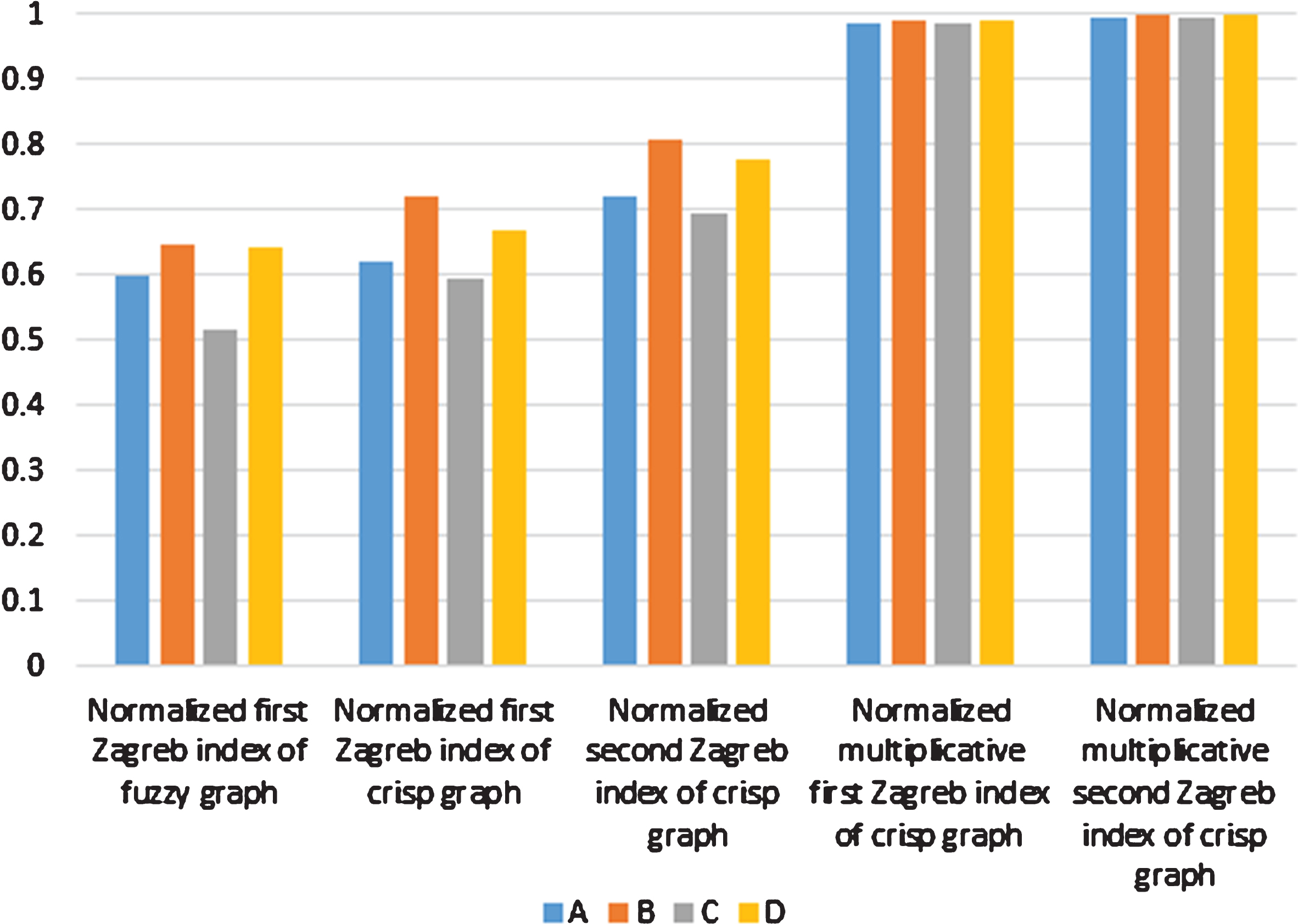
For this comparison, we considered the MCDM problem described in the Subsection 6.1 and compared with first Zagreb index, second Zagreb index, multiplicative first Zagreb index and multiplicative second Zagreb index of a crisp graph. It is noticed that other indices depend only on the number of neighbours of each employee but not depends on the nature of the neighbour. Here the first Zagreb index of fuzzy graphs not only depends on the degree of a vertex but also depends on nature of the vertex and nature of the neighbours. So this index for MCDM problems always shows a realistic result compared to other existing indices. The score and normalized score of each employee for those indices are shown in Table 6. The comparison table of those normalized indices are presented in Table 7. It is observed that each index provides a similar decision. But, from Table 7, It is seen that other indices are giving higher normalized score values compared to our index. It is also observed that the difference between normalized scores of each employee are very small for normalized multiplicative first Zagreb index and normalized multiplicative second Zagreb index of crisp graph but our index provides the higher differences.
Score and Normalized Score of Employees
Employee Name
First Zagreb index of fuzzy graph
Normalized First Zagreb index of fuzzy graph
First Zagreb index of crisp graph
Normalized First Zagreb index of crisp graph
Second Zagreb index of crisp graph
Normalized Second Zagreb index of crisp graph
Multiplicative First Zagreb index of crisp graph
Normalized Multiplicative First Zagreb index of crisp graph
Multiplicative Second Zagreb index of crisp graph
Normalized Multiplicative Second Zagreb index of crisp graph
A
1.011
0.599066
14.6
0.618644
20.8
0.722222
2708.5
0.986703
8260.4
0.995901
B
1.0943
0.648432
17
0.720339
23.3
0.809028
2721.9
0.991585
8273.3
0.997456
C
0.8698
0.515389
14
0.59322
20
0.694444
2703
0.984699
8254.4
0.995177
D
1.0863
0.64368
15.8
0.669492
22.4
0.777778
2719.5
0.99071
8278.4
0.998071
Comparison Table
Limitations of the paper
The limitations of the paper are: (i) Good upper bound of the first Zagreb index for path, cycle, star, complete fuzzy graph, etc. are presented here but we cannot provide the good lower bound. (ii) In this paper, it is shown that for n-vertex fuzzy graphs, the complete fuzzy graph has a maximum first Zagreb index. But for which n-vertex fuzzy graph has the minimum first Zagreb index? (iii) which n-vertex tree (fuzzy) has the maximum first Zagreb index? (iv) which n-vertex tree (fuzzy) has the minimum first Zagreb index? (v) In [21] Khalifeh et al. has given the exact expressions of the first Zagreb index for crisp graph operations (Cartesian product, composition, join, union). But for fuzzy graph operations, we cannot provide the exact values of the first Zagreb index.
Conclusion
Zagreb index has an important role in spectral graph theory, chemical graph theory, biochemistry, etc. In this article, the first Zagreb for fuzzy graphs is discussed and provides some upper bound of such TIs for path, star, complete fuzzy graph etc. In this article, it is shown that a complete fuzzy graph is the maximal fuzzy graph with respect to first ZIs for a given vertex set. Some bounds of first ZIs are established for Cartesian product, composition, union, join of two FGs. An algorithm is also designed to compute the first ZI of a FG. At the end, a MCDM method is provided using the first Zagreb index of a fuzzy graph to find the best employee in a company. Also a comparison is provided among related indices on the result of application and shown that our method gives better results. One can introduce the second Zagreb index and other TIs for fuzzy graphs and establish those types of results also.
Footnotes
Acknowledgments
The authors are highly thankful to the honorable Editor in Chief and anonymous reviewers for their valuable suggestions which significantly improved the quality and representation of the paper. The first author is thankful to the University Grant Commission (UGC) Govt. of India for financial support under UGC-Ref. No.: 1144/ (CSIR-UGC NET JUNE 2017) dated 26/12/2018.
Compliance with ethical standards
Disclosure statement No potential conflict of interest was reported by the authors.
Ethical approval This article does not contain any studies with human participants or animals performed by any of the authors.
References
1.
BeraS. and PalM., Certain types of m-polar intervalvalued fuzzy graph, Journal of Intelligent and Fuzzy Systems (2020). DOI:10.3233/IFS-191587
2.
BhutaniK.R., On automorphisms of fuzzy graphs, Pattern Recognit Lett9 (1989), 159–162.
3.
BinuM., MathewS. and MordesonJ.N., Connectivity index of a fuzzy graph and its application to human trafficking, Fuzzy Sets Syst360 (2019), 117–136.
4.
BinuM., MathewS. and MordesonJ.N., Wiener index of a fuzzy graph and application to illegal immigration networks, Fuzzy Sets Syst384 (2020), 132–147.
5.
DasK., NaseemU., SamantaS., KhanS.K. and DeK., Fuzzy mixed graphs and its application to identification of COVID19 affected central regions in India, Journal of Intelligent and Fuzzy Systems40(1) (2020), 1–14.
6.
DasK., NaseemU., SamantaS., KhanS.K. and DeK., Ranking of educational institutions using fuzzy logic: a mathematical approach, Afrika Matematika (2020). DOI:10.1007/s13370-020-00796-z
7.
DeN., NayeemS.M.A. and PalA., Reformulated First Zagreb index of Some Graph Operations, Mathematics3 (2015), 945–960.
8.
DeyA., SenapatiT., PalM. and ChenG., Anovel approach to hesitant multi-fuzzy soft set based decision-making, AIMS Mathematics (2020). DOI:10.3934/Math.2020.x.xxx
9.
DeyA. and PalM., Genelalised multi-fuzzy soft set and its application in decision making, Pacific Science Review A: Natural Science and Engineering17(1) (2015), 23–28.
10.
DobryninA.A., GutmanI., KlavzarS. and ZigertP., Wiener index of hexagonal systems, Acta Appl Math72 (2002), 247–294.
11.
EstradaE., Characterization of 3D molecular structure, Chem Phys Lett319 (2000), 7–13.
12.
GutmanI. and TrinajsticN., Graph theory and molecular orbitals. Total π-electron energy of alternant hydrocarbons, Chem Phys Lett17 (1972), 535–538.
13.
HosamaniS.M. and BasavanagoudB., New upper bounds for the first Zagreb index, Match Commun Math Comput Chem74 (2015), 97–101.
14.
HosoyaH., Topological index. A newly proposed quantity characterizing the topological nature of structural isomers of saturated hydrocarbons, Bull Chem Sco Japan44(9) (1971), 2332–2339.
15.
IslamS.R., MaityS. and PalM., Comment on Wiener index of a fuzzy graph and application to illegal immigration networks, Fuzzy Sets Syst384 (2020), 148–151.
16.
JanaC., MuhiuddinG. and PalM., Trapezoidal neutrosophic aggregation operators and its application in multiple attribute decision-making process, Scientia Iranica (2018), 24. https://doi.org/10.24200/sci.2018.51136.2024.
17.
JanaC., PalM., KaraaslanF. and WangJ.Q., Some Dombi aggregation of Q-rung orthopair fuzzy numbers in multipleattribute decision making, Int J Intell Syst34(12) (2019), 3220–3240.
18.
JanaC. and PalM., A robust single-valued neutrosophic soft aggregation operators in multi-criteria decision making, Symmetry11(1) (2019), 110.https://doi.org/10.3390/sym11010110.
19.
JanaC., SenapatiT. and PalM., Pythagorean fuzzy Dombi aggregation operators and its applications in multiple attribute decision-making, Int J Intell Syst34 (2019), 2019–2038.
KhalifehM.H., Yousefi-AzariH. and AshrafiA.R., The first and second Zagreb indices of some graph operations, Discrete Appl Math157 (2009), 804–811.
22.
KalathianS., RamalingamS., RamanS. and SrinivasanN., Some topological indices in fuzzy graphs, INFUS 2019: Intelligent and fuzzy Techniques in Big Data analytics and Decision Making (2019), 73–81.
23.
KulliV.R., Multiplicative Hyper-Zagreb indices and coindices of graphs: computing these indicesof some nanostructures, International Research Journal of Pure Algebra (2016), 1–6.
24.
KulliV.R., Multiplicative Connectivity Indices of nanostructures, Journal of Ultra Scientist of Physical Sciences-A29(1) (2017), 1–10.
25.
MahapatraR., SamantaS., PalM. and XinQ., RSM index: a new way of link prediction in social networks, Journal of Intelligent and Fuzzy Systems37(2) (2019), 2137–2151.
26.
MondalS., DeN. and PalA., Topological properties of Graphene using some novel neighborhood degree-based topological indices, International Journal of Mathematics for Industry11(1) (2019), 1950006 (14 Pages).
27.
MondalS., DeN. and PalA., On some new neighbourhood degree based indices, Acta Chem Iasi27(1) (2019), 31–46.
28.
MondalS., DeN. and PalA., On some new neighborhood degree-based indices for some oxide and silicate networks, J Multidiscip Sci J2(3) (2019), 384–409.
29.
MordesonJ.N. and MathewS., Advanced Topics in Fuzzy Graph Theory, Springer (2019).
30.
RandicM., Novel molecular descriptor for structureproperty studies, Chemical Physics Letters211(10) (1993), 478–483.
31.
RashmanlouH. and PalM., Antipodal interval-valued fuzzy 396 graphs, International Journal of Applications of Fuzzy Sets and Artificial Intelligence3 (2013), 107–130.
32.
RashmanlouH. and PalM., Balanced interval-valued fuzzy graph, Journal of Physical Sciences17 (2013), 43–57.
33.
RashmanlouH., SamantaS., PalM. and BorzooeiR.A., A study on bipolar fuzzy graphs, Journal of Intelligent and Fuzzy Systems28 (2015), 571–580.
34.
RashmanlouH., PalM., RautS. and MofidnakhaeiF., Novel concepts in intuitionistic fuzzy graphs with application,(3), Journal of Intelligent and Fuzzy Systems37 (2019), 3743–3749.
35.
RautS., PalM. and GhoraiG., Fuzzy permutation garph and its complements, Journal of Intelligent and Fuzzy Systems35 (2018), 2199–2213.
36.
RosenfeldA., Fuzzy graphs, in: L.A. Zadeh, K.S. Fu, M. Shimura (Eds.), Fuzzy Sets and Their Applications, Academic Press, New York, (1975), 77–95.
37.
SahooS. and PalM., Intuitionistic fuzzy tolerance graphs with application, Journal of Applied Mathematics and Computing55(1–2) (2017), 495–511.
38.
SahooS. and PalM., Product of intuitionistic fuzzy graphs and degree, Journal of Intelligent and Fuzzy Systems32(1) (2016), 1059–1067.
39.
SahooS. and PalM., Different types of products on intuitionistic fuzzy graphs, Pacific Science Review A: Natural Science and Engineering17(3) (2015), 87–96.
40.
SamantaS., SarkarB., ShinD. and PalM., Completeness and regularity of generalized fuzzy graphs, Springer Plus5(1) (2016), 1979.
41.
SamantaS. and PalM., Fuzzy planar graphs, IEEE Trans23(6) (2015), 1936–1942.
42.
SamantaS. and PalM., Telecommunication system based on fuzzy graphs, J Telecommunication Syst Manage3(1) (2013), 1–6.
43.
SamantaS. and PalM., A new approach to social networks based on fuzzy graphs, Turkish Journal of fuzzy system5(2) (2014), 78–99.
44.
SarkarP., DeN. and PalA., The Zagreb indices of Graphs Based on New Operations Related to the Join of Graphs, Bulletin of the International Mathematical Virtual Institute7 (2017), 445–473.
45.
SarkarP., DeN. and PalA., The generalized Zagreb indices of some carbon structures, Acta Chem Iasi26(1) (2018), 91–104.
46.
SarkarP., DeN and PalA., The (a; b)-Zagreb index of nanostar dendrimers, U.P.B. Sci. Bull80(4) (2018), 67–82.
47.
SarkarP., DeN., ConguiI.N. and PalA., The (a; b)-Zagreb index of some derived networks, J Taibah Univ Sci13(1) (2019), 79–86.
48.
SunithaM.S. and VijayakumarA., A characterization of fuzzy trees, Inf Sci (1999), 293–300.
49.
SunithaM.S. and VijayakumarA., Blocks in fuzzy graphs, J Fuzzy Math13(1) (2005), 13–23.
50.
WinerH., Structural determination of paraffin boiling points, J Am Chem Soc69 (1947), 17–20.
51.
YehR.T. and BangS.Y., Fuzzy relations, fuzzy graphs and their applications to clustering analysis, in: L.A. Zadeh, K.S. Fu, M. Shimura (Eds.). Fuzzy Sets and Their Applications, Academic Press, (1975), 125–149.