Recently, Jun et al. have introduced the concept of cubic set as a generalization of the concept of fuzzy set and that of the interval valued fuzzy set. This concept has been widely applied in many circumstances like pattern recognition, decision making etc. So far, no attention has been paid towards graph of cubic set therefore leads us in this manuscript to study the concepts of interval valued bipolar fuzzy graph (IVBFG) and cubic bipolar fuzzy graph (CBFG). Some graph theoretic terms for CBFGs are defined along with the several operations. Illustrative examples are provided to explain the defined terms and several results are discussed. As application, a cubic bipolar fuzzy influence graph in a social group is elaborated.
The study of cubic set (CS) has been started in 2012 when Jun et al. [1] proposed this concept. Basically, CS is a combination of a fuzzy set (FS) and an interval-valued fuzzy set (IVFS). After its development, much work is being done on cubic sets. In [2], the neutrosophic CS is developed and in [3] some applications of neutrosophic CS in pattern recognition are given. Khan et al. [4] introduced CS in semi-group theory and Yaqoob et al. [5] developed KU-ideals and KU-algebras for CSs. Some cosine similarity measures for CSs were developed in [6] by Lu and Ye and they applied these similarity measures in decision making. The notion of cubic soft set, introduced by Mohiuddin and Al-roqi [7], has gained much importance and some aspects of this notion are discussed in [8]. The notions of G-algebras and G-subalgebras for CSs along with ideals for CSs in semigroup theory are discussed in [9, 10]. For more recent advancements in CSs and their applications, one may be referred to see [11–14].
After Zadeh introduced the notion of FS [15], the concept of fuzzy graph (FG) was proposed in [16] by Rosenfield which has now become a rich research field [17–20]. Bhutani [21] defined automorphisms for FGs and Gomez et al. [22] used FGs in image classifications while Mathew and Sunitha [23] discussed the connectivity of nodes of FGs. For some other work on FGs, one may refer to [24–34].
The theory of interval valued fuzzy set (IVFS) [35] provided a base for interval valued fuzzy graph (IVFG) [36]. IVFG has equal importance in handling uncertain situations as compared to the other notions. Rashmanlou and Jun [37] introduced the notion of complete IVFG and Pal and Rashmanlou [38] initiated the concept of irregular IVFG. Akram [39] introduced IVF line graphs and Rashmanlou and Pal [40, 41] developed the notion of balanced IVFG and isometry on IVFG. Talebi and Rashmanlou [42] worked on isomorphism of IVFG and Pramanik et al. [43] studied the notion of IVF planner graphs. Jan et al. [44] recently challenged some basic concepts and results of FG theory and redefined those concepts demonstrated by examples. Davvaz et al. [45] introduced a novel concept of intuitionistic FGs of nth type and studied their applications in social networks. The concept of picture FG is also introduced by Jan et al. [46] and an improved algorithm has been proposed for clustering and further utilized in human decision making. Jan et al. [47] also introduced the idea of interval valued q-rung ortho pair FGs and analyse some social, communication and transportation networks based on proposed work. For some other notable work, one is referred as [48–53].
The recent developments in FSs have shown some good improvements among which the concept of Bipolar FS (BFS) [54, 55] is a prominent one. A BFS improved the concept of FS by enlarging its range. The concept of BFS leads to the development of bipolar fuzzy graph (BFG) [56, 57]. For some other work in this direction, one may refer to [58–63]. Motivated by the developments of FGs, IVFGs and BFGs, this article aims to provide the concept of CBFGs and demonstrates various graph theoretic concepts. Further, the proposed concept of CBFGs shall be utilized in a social network.
This manuscript is about CBFGs which involves the theory of BFGs as well as IVBFGs. The manuscript is based on seven sections. In section one, some history is recalled and some remarkable work on FG, IVFG, BFG and CFG have been discussed. In section Two, some basic definitions are presented. In section Three, the idea of CBFG is introduced as a generalization of FG, IVFG and BFG and related terms are discussed. Section Four is based on operations on CBFG and their results. Section Five contains the concept of strong CBFG and their results. Application of CBFG is discussed in section Six and some concluding remarks are added in section Seven at the end of the article.
Preliminaries
This section is about a short introduction of FS, CS, FG and IVFG which are helpful for our graphical work on CBFGs.
Definition 1. [15] A FS in is defined as where is a non-empty set and is the membership function of the FS on A.
Definition 2. [1] Let X be a non-empty set. A CS is a structure where A (x) an interval valued FS and is a FS of x in C and it is denoted by .
Definition 3. [16, 17] A pair Ǧ = is known as FG if
and is the association degree of ;
and .
Where s2 (vi, vj) ≤ min [s1 (vi) , s1 (vj)] for all
.
Definition 4. [36] A pair Ǥ = of a graph Ǧ = is said to be IVFG where is an IVFS and be the IVF relation on satisfying the following condition:
such that , represents the degree of membership of the element .
The functions , such that )), )) for all .
Definition 5. [44, 45] Let X be a non-empty set. Then a mapping a bipolar fuzzy relation on X such that ) ∈ [0, 1] and ) ∈ [-1, 0].
Definition 6. [46, 47] A pair Ǥ = with underlying graph Ǧ = is said to be BFG where is an BFS and is an BF relation on such that )), )),for all x
Definition 7. [52] A pair Ǥ = of a graph Ǧ = is said to CFG where is a cubic FS and be the cubic fuzzy relation on
satisfying the following condition:
such that , ,and represents the degree of membership of the element .
The functions : × → [0, 1], × → [0, 1] and × → [0, 1] are such that ≤ , , ≤ , ()) and ≤ (SA (x), SA ()) for all x
Example 1. The following graph is an example of CFG.
Cubic fuzzy graph.
Cubic bipolar fuzzy graph
Definition 8. A pair Ǥ = with underlying graph Ǧ = is said to be an IVBFG where is an IVBFS and is an interval valued bipolar fuzzy relation on such that )), )) with a condition (x) ≥ , ()) and (x) ≥ , )), (x) ≥ , )) with a condition ≥ , ())forallx
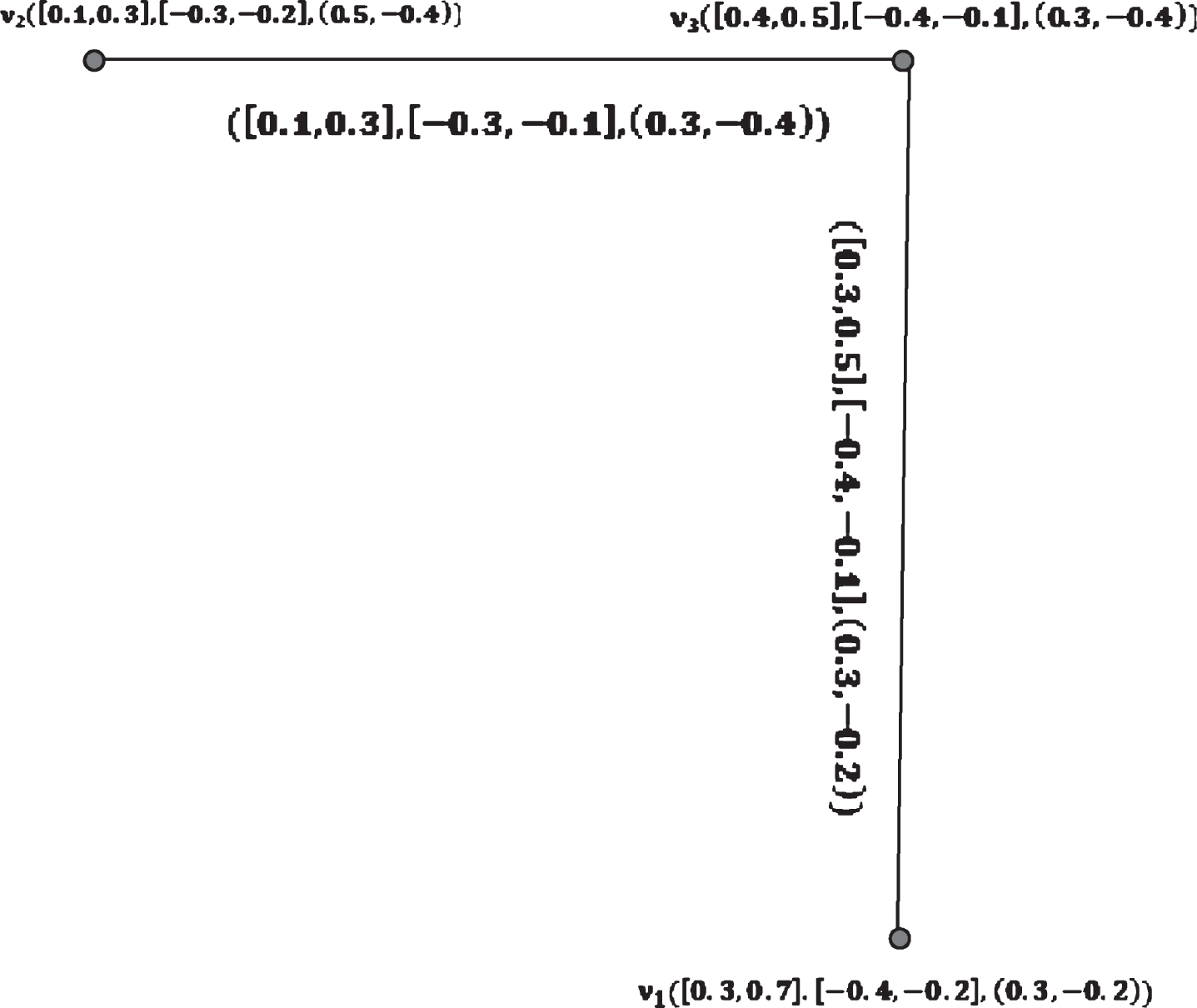
Example 2. Let Ǧ = be a IVBFG where be the set of vertices and
be the set of edges. Then
Interval valued bipolar fuzzy graph.
Definition 9. A pair Ǥ = with underlying graph Ǧ = is said to be CBFG where is a CBFS and is a cubic bipolar fuzzy relation on such that (x) ≤ , ()), (x) ≤ , )) with a condition (x) ≥ , )), (x) ≥ , )), (x) ≥ , )) with a condition ) ≥ , )) and ) ≤ , )) ) ≥ , )) for all
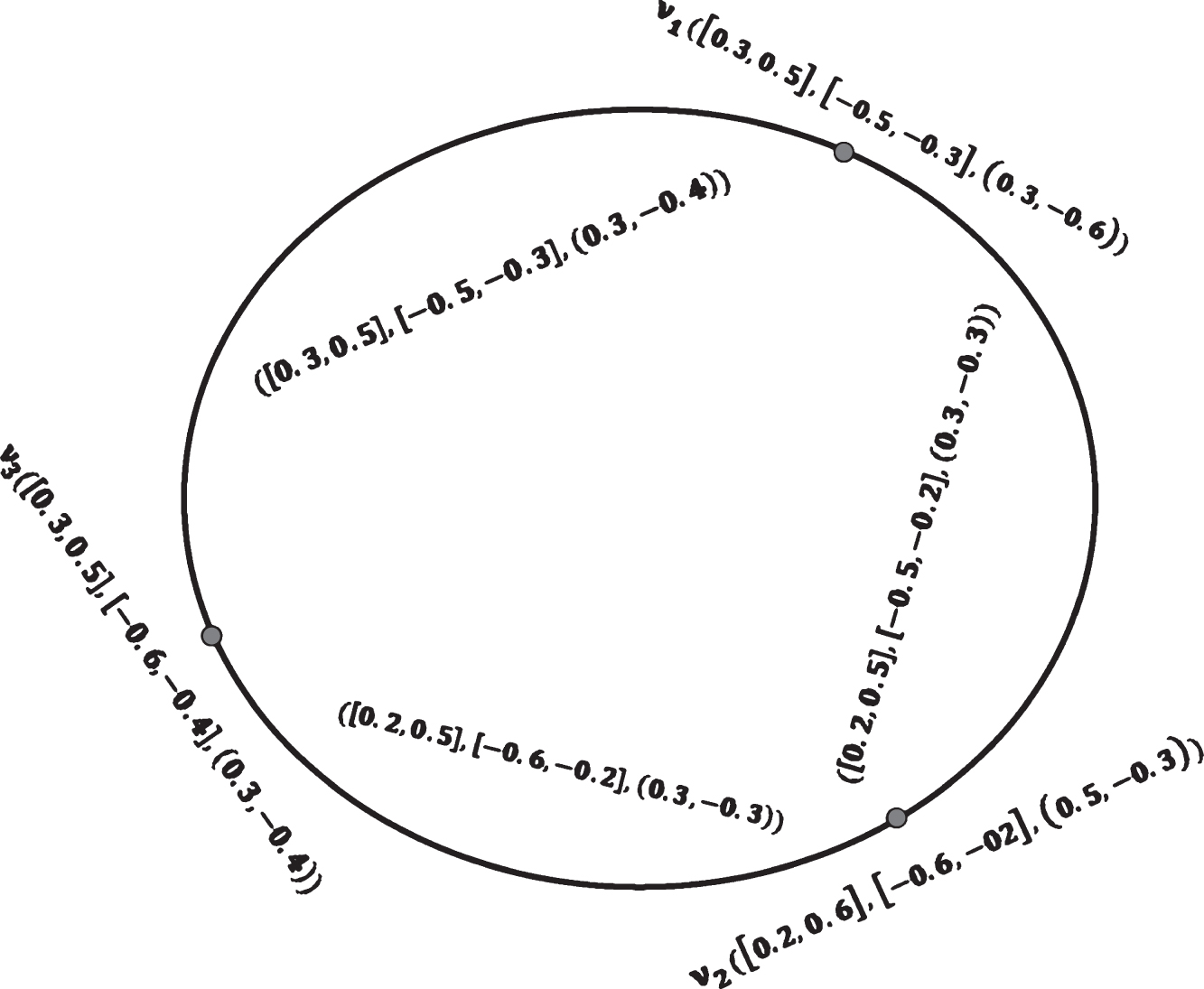
Example 3. The following graph is an example of CBFG.
Cubic bipolar fuzzy graph.
The values of all the vertices shown separately in Table 1 below.
Definition 10. The order of a CBFG Ǧ = is denoted and defined by
Here represents the sum of all the positive lower and upper values and represents the sum of all the negative lower and upper values in an interval bipolar fuzzy numbers and represents the sum of all the values of positive and negative bipolar fuzzy numbers respectively in .
And the size of cubic graph Ǧ is:
Definition 11. The degree of a vertex in a CBFG Ǧ = (
) is denoted and defined by
Where = ∑x≠x∈Y), = ∑x≠x∈Y), = ∑x≠x∈Y), = ∑x≠x∈Y) and = ∑x≠x∈Y), = ∑x≠x∈Y)
here ∑x≠x∈Y), ∑x≠x∈Y), represents the sum of all the positive lower and positive upper values in an interval bipolar fuzzy numbers, ∑x≠x∈Y), ∑x≠x∈Y) denote the sum of all the negative lower and negative upper values of bipolar fuzzy numbers and ∑x≠x∈Y)
, ∑x≠x∈Y) represents the sum of the values of positive and negative bipolar fuzzy numbers respectively in
Example 4. Let Ǧ = (
) be a CBFG where be the set of vertices and be the set of edges. Then
This result shows the significance of the new concept as it is the generalization of all the existing structures and can deal with the situations where the existing structures fail due to their limitations.
Definition 12. In a CBFG, a set of distinct nodes vi (i = 1, 2, 3 . . . m) is considered as a path if there exist an edge between every two vertices vi and Vj for i, j = 1, 2, 3 . . . m.
Example 5. Let Ǧ = be a CBFG where be the set of vertices and be the set of edges. Then
Cubic bipolar fuzzy graph for a path.
Here v1v4v5 is a path.
Definition 13. An edge in a CBFG Ǧ = is said to be bridge, if deleting that edge reduces the strength of connectedness between some pair of vertices.
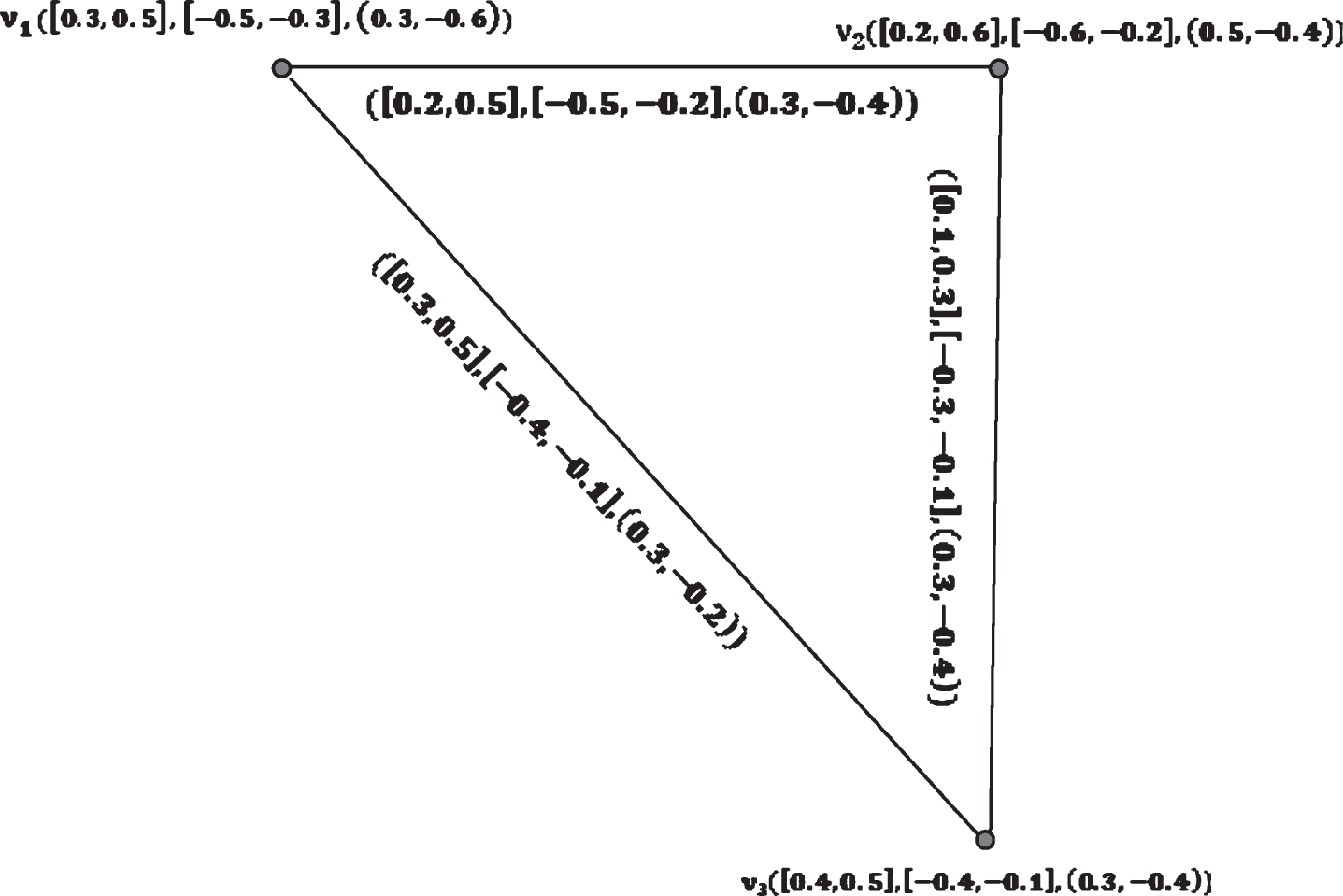
Example 6. Let Ǧ = be a graph such that and . Then the following graph is an example of CBFG for an edge.
Cubic bipolar fuzzy graph for a bridge.
The strength of v1v3 in Ǧ is ([0.2,0.4], [-0.3, -0.1], (0.1, -0.3)) by definition of (13), (v1, v3) is a bridge.
Definition 14. The power of edge relation in a CBFG is defined as , , , , = (eij * eij = (eij, , , , = (eij * eij * eij = (eij, , , and , , , . Here , = , , , = , and = , = are the s-strength and of the connectedness between two vertices (vi, vj).
Theorem 2.Consider Ǧ = be a CBFG. Then for anyvi, vj in Ǧ, the following are equivalent.
(vi, vj) is a bridge.
< , < , > , > and < , >
(vi, vj) is not an edge of any cycle.
Proof. (ii) ⇒ (i) suppose and . To prove (vi, vj) is a bridge, then and and . Which is contradiction. Therefore, (vi, vj) is a bridge. Now (i) ⇒(iii) Consider (vi, vj) is a bridge. To show that (vi, vj) is not an edge of any cycle. Then any path involving the edge (vi, vj) can be converted into a path involving (vi, vj) by using the rest of the cycle as a path from vi and vj. This implies (vi, vj) can not be bridge which is contradiction. Therefore, (vi, vj) is not an edge of any cycle. Now (iii)⇒ (i) suppose (vi, vj) is not an edge of any cycle. To show that and . Suppose that , and . Then there is a path from vi to vj not involving (vi, vj) that has strength greater are equal to and less are equal to . Which is contradiction. Hence and. Therefore, the statements (i), (ii) and (iii) are equivalent.
Definition 15. A vertex in a CBFG Ǧ = is said to be cut-vertex if deleting that vertex reduces the strength of connectedness between some pair of vertices.
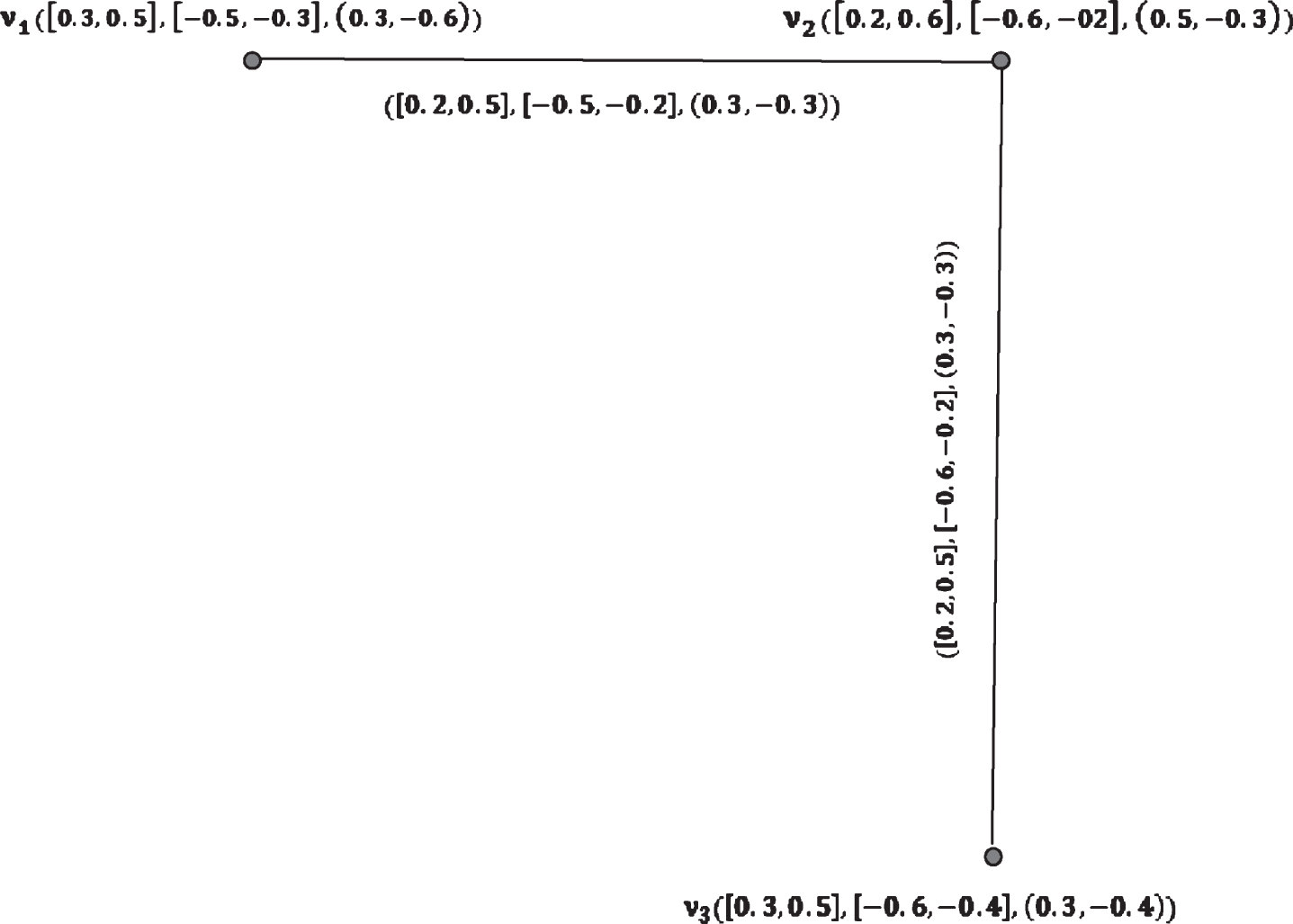
Example 7. Let Ǧ = be a CBFG where be the set of vertices and be the set of edges. Then
Cubic bipolar fuzzy graph for a cut-vertex.
Here v1 is a cut-vertex.
Operations on cubic bipolar fuzzy graph
In this section, the operations on CBFG are defined and their results are studied.
Definition 16. The Cartesian product of two CBFGs Ǧ1 = and Ǧ2 = Ǧ1 × Ǧ2 = of the CBFGs Ǥ1 and Ǥ2 is defined as:
For all
For all and
For all and .
Proposition 1.The Cartesian product Ǧ1× Ǧ2 = of two CBFGs Ǧ1 and Ǧ2is a CBFG.
Proof. The condition on A1 × A2 is obvious, we need only to verify the conditions for .
Assume that and
And
For and
we have
And
Definition 17. The composition of two CBFGs Ǧ1 and Ǧ2 = with underlying CBFGs Ǥ1 and Ǥ2 is denoted by Ǧ1 Ǧ2 = and defined by:
For all
For all and
For all and .
For all .
Proposition 2.The Composition of two CBFGs Ǧ1 and Ǧ2, Ǧ1 [Ǧ2] = , is CBFG
Proof. The condition on A1 × A2 is obvious, we only need to verify the conditions for .
Assume that and
And
Next, For and the proof is same now for we have and x2 ≠ y2
And
Definition 18. The union of two CBFGs Ǧ1 and Ǧ2 is denoted by Ǧ1 ∪ Ǧ2 = of defined by
Ǧ1 Cubic bipolar fuzzy graph.
Ǧ2 Cubic bipolar fuzzy graph.
Ǧ1 ∪ Ǧ2 Cubic bipolar fuzzy graph.
Example 8. Consider the graphs Ǧ1 = and Ǧ2 = such that A1 = {v1, v2, v3, v4, v5}, A2 = {v1, v2, v3, v4, v6} and , . Then
Proposition 2.The union of two CBFGs is a CBFG.
Proof. Assume that Ǧ1 = and Ǧ2 = be two CBFGs of the graphs Ǧ1 and Ǧ2. We have to prove that Ǧ1 ∪ Ǧ2 = is CBFG. Therefore A1 ∪ A2 is obviously satisfy all the conditions we have only to verify the conditions for .
First we assume that for Then
If and , then
If and , then
Definition 19. The join of two CBFGs Ǥ1 and Ǥ2 Ǥ1 + Ǥ1 = + of the CBFGs Ǧ1 and Ǧ2 is defined as:
If .
If .
If , where represents the set of all edges joining the vertices of and .
Proposition 3.The join of two CBFGs is a CBFG.
Proof. Straightforward.
Strong cubic bipolar fuzzy graph
Definition 20. A pair is known as strong CBFG if (x) = , )), ) = , )), ) = , )), ) = , )) and ) = , )), ) = )), for all
.
Example 9. Let Ǧ = be a strong CBFG where be the set of vertices and
be the set of edges. Then
Strong cubic bipolar fuzzy graph.
Clearly we note that Ǧis a strong CBFG.
Proposition 4.If Ǥ1 and Ǥ2are two strong CBFGs, then Ǥ1 × Ǥ2, Ǥ1 [Ǥ2] and Ǥ1 + Ǥ2are strong CBFGs.
Proof. The proof follows from Proposition 2.
Remark 1. The union of two strong CBFGs may or may not be a strong CBFG.
The following example supports the above Remark 1.
Example 10. The following graphs support the above remark 1.
Ǧ1 Strong cubic bipolar fuzzy graph.
Ǧ2 Strong cubic bipolar fuzzy graph.
Ǧ1 ∪ Ǧ2.
Proposition 5.If Ǥ1 × Ǥ2is strong CBFG, then at least Ǥ1 or Ǥ2must be strong CBFG.
Proof. Obvious.
Proposition 6.If Ǥ1 [Ǥ2]be strong, then at least Ǥ1 or Ǥ2must be strong CBFG.
Proof. Obvious.
Definition 21. The complement of strong CBFG Ǥ = of Ǧ = ,
)
is denoted by = , , , and = , and defined by
(1)
(2) and for all .
and
Definition 22. A strong CBFG is known as self-complementary if
Example 11. The following graphs is an example of complement of CBFGs.
Proposition 7.If Ǧ is self-complementary strong CBFG. Then
and
Proof. Obvious.
Proposition 8.If Ǧ is strong CBFG and if) = , )) ) = )), ) = )) and) = )), ) = )), ) = , )) for all Then Ǧ is self-complementary.
Proof. Obvious.
Proposition 9. if Ǥ1 and Ǥ2 be strong CBFG, then Ǥ1 ≅ Ǥ2 iff .
Proof. Straight forward.
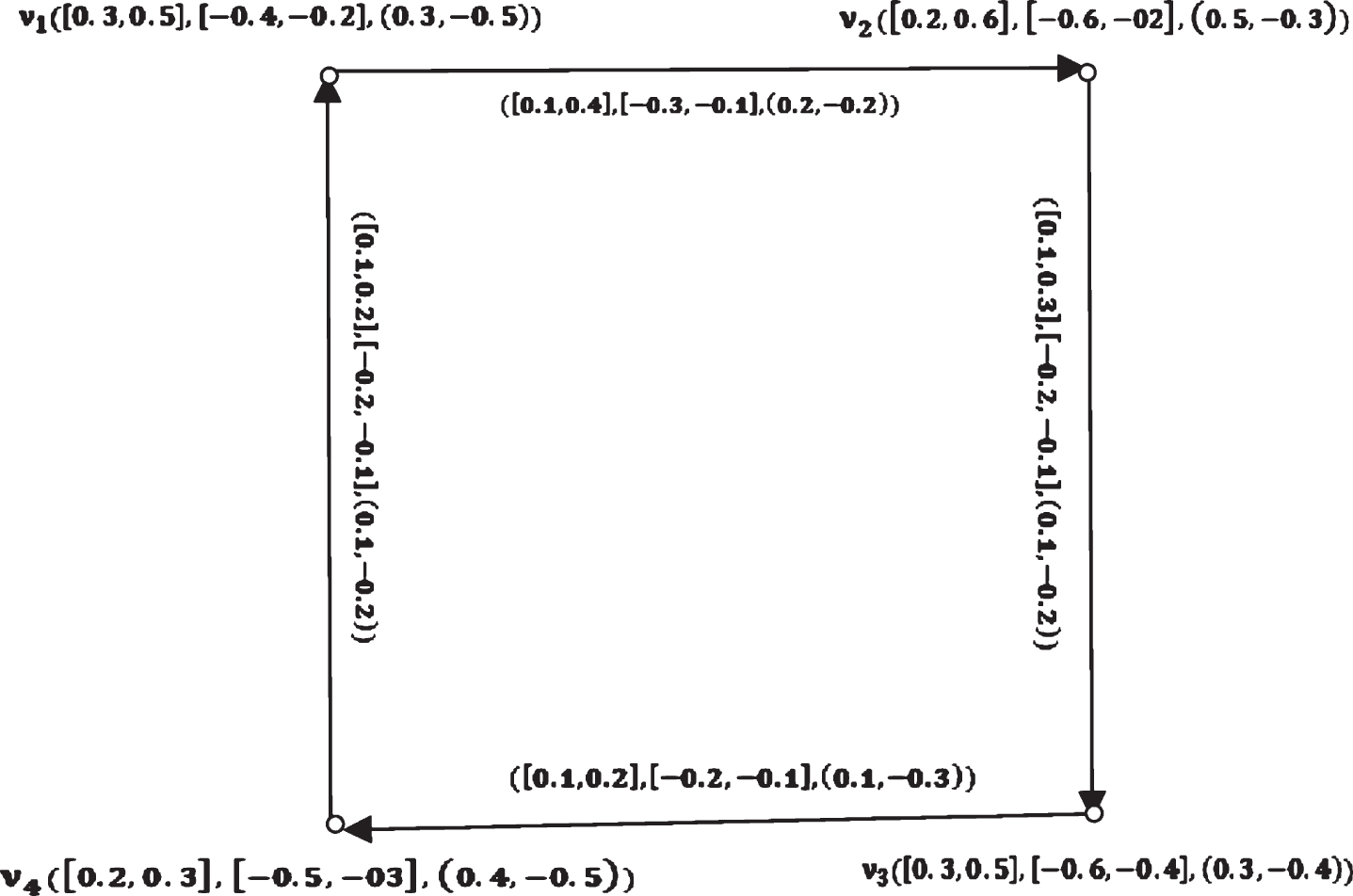
Definition 23. A pair with underlying graph Ǧ = is said to be cubic bipolar fuzzy digraph where is an IVBFS and is an IVBF relation on
such that )), )) with a condition )), )), )) with a condition ))
and )),)), for all
We note that need not be symmetric.
Example 12. The graph is an example of cubic bipolar fuzzy digraph.
Bipolar fuzzy diagraph.
The above digraph represented by the following adjacency matrix.
Application
Graph models utilize extensive range of application in various areas. Item models are required to adjust more structure than simply the adjacencies between vertices. In graph behaviour studies it is a common observation, that specific people can impact thoughts of others. A directed graph, known as an influence graph can be employed to structure the behaviour. Each individual of a group is nominated by a vertex.
There is a directed edge from vertex x to vertex y when the person represented by vertex x influences the person represented by vertex y. This graph lacks loops and multiple direct edges. In influence graph an authority and strength are represented by a vertex (node) and impact of a person on another person in the social group is represented by an edge. The impact of an individual on another possess a fuzzy boundary, that results in a well representation in the fuzzy digraph that has vertex denoting a person and its membership the power of person within that group. In our work, a fuzzy impact and a cubic bipolar influence graph are employed to investigate the more influential person within social group.
Bipolar fuzzy influence graph
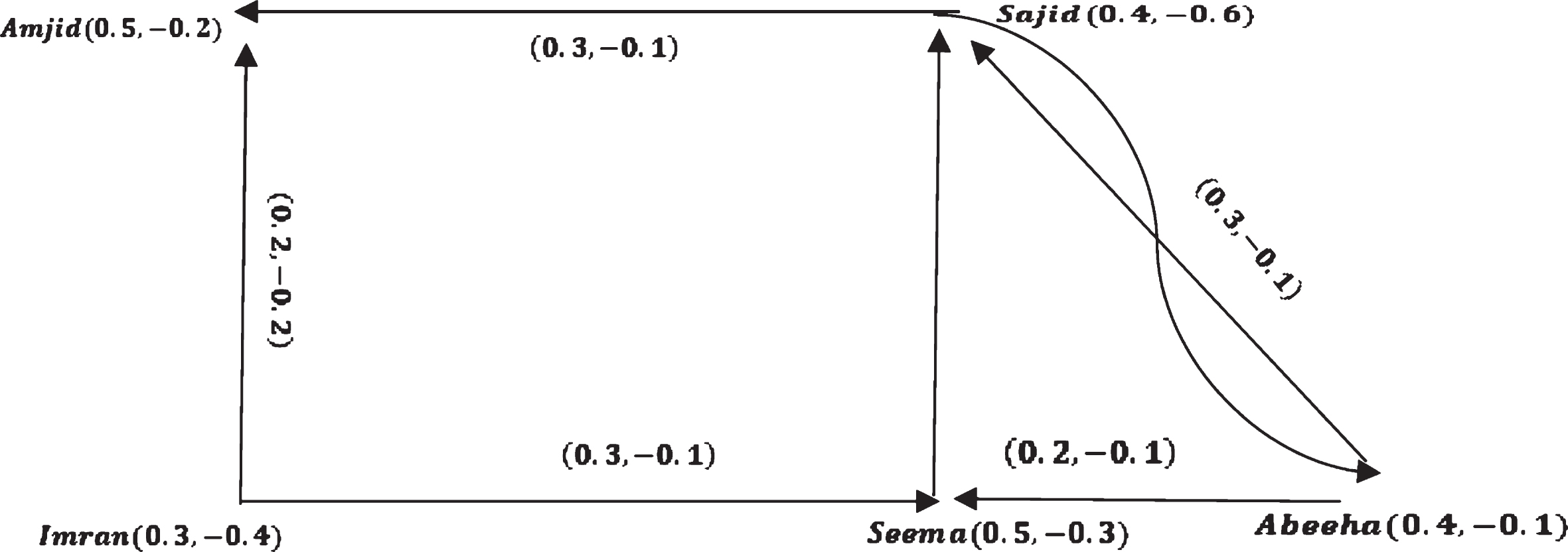
We follow a bipolar fuzzy influence graph of a social group depicted in Fig. 19 where the nodes demonstrating the level of strength that a person possesses and associated to a social group. The level of power or strength is explained in for of its positive and negative membership. Level of positive membership can be evaluated as amount of strength an individual possess and negative membership that how much strength is losses, e.g., Amjid possess 50% positive but 20% negative power of influency within the social group. The corners of a graph show the impact of one individual upon another individual. The level of positive membership of edges can be explained as ratio or percentage of positive and negative membership e.g. Seema’s positive influence on Abeeha is 20% while its negative influence is 10%.
Bipolar influence graph.
Cubic bipolar fuzzy influence graph
A human impact does not stand always positive. If two individuals have some disharmony, then the impact stands negative on another person and cubic bipolar graph is employed. Cubic bipolar fuzzy influence graph of a social group is depicted in Fig. 20 where the nodes used show the strength of a person of a social group and its level of strength is evaluated based on positive (inter valued positive) membership and negative (inter valued negative) membership. Degree of positive membership can be explained as the amount of power in future and inter valued positive membership represents the power in present that an individual possesses. Similarly, negative membership can be explained as the amount of power in future and interval valued negative membership represents in present that an individual loss. Amjid has 30% to 60% strengths for the present and 10% strengths for the future in a social group, yet he losses 20% to 60% strength for the present and 50% for the future in the same group. The edges of a graph demonstrate the impact of one person upon the other. And the level of positive membership and interval valued positive membership and negative membership and interval valued negative non-membership of edges can be explained as the percentage of positive and negative impacts for present time and future time. e.g Seema accepts 20% to 40% views of Abeeha for present and 50 % for future yet she does not accept Abeeha’s point of view upto 10% to 30% for present and 30% for future.
Cubic bipolar influence graph.
Conclusions
In this paper, we have introduced the notion of CBFG which extends the notion of cubic graph as well as bipolar fuzzy graph. The novelty and significance of new concept is demonstrated with the help of examples. We have developed many operations on CBFGs such as the union, the join, the cartesian product and the composition. Each of the operation is supported with examples. We have also utilized the concept of CBFG is a social network to examine its practicality and analyse its advantages. In near future, the concept of isomorphism and complete graphs can be developed and further the applications of CBFGs can be studied in database theory, expert system, neural system and transportation networks.
Conflict of interest
We declare that there are no conflicts of interest regarding the publication of this paper.
References
1.
JunY.B., KimC.S. and YangK.O., Cubic sets, Annals of fuzzy Mathematics and Informatics4(1) (2012), 83–98.
2.
JunY.B., SmarandacheF. and KimC.S., Neutrosophic cubic sets, New mathematics and natural computation13(01) (2017), 41–54.
3.
AliM., DeliI. and SmarandacheF., The theory of neutrosophic cubic sets and their applications in pattern recognition, Journal of Intelligent & Fuzzy Systems30(4) (2016), 1957–1963.
4.
KhanM., JunY.B., GulistanM. and YaqoobN., The generalized version of Jun’s cubic sets in semigroups, Journal of Intelligent & Fuzzy Systems28(2) (2015), 947–960.
5.
YaqoobN., MostafaS.M. and AnsariM.A., On cubic KU-ideals of KU-algebras, ISRN Algebra (2013).
6.
LuZ. and YeJ., Cosine measures of neutrosophic cubic sets for multiple attribute decision-making, Symmetry9(7) (2017)121.
7.
MuhiuddinG. and Al-RoqiA.M., Cubic soft sets with applications in BCK/BCI-algebras, Annals of Fuzzy Mathematics and Informatics8 (2014)291–304.
8.
MuhiuddinG., FengF. and JunY.B., Subalgebras of BCK/BCI-algebras based on cubic soft sets, The Scientific World Journal, 2014.
9.
JunY.B. and KhanA., Cubic ideals in semigroups, Honam Mathematical Journal35(4) (2013), 607–623.
10.
JanaC. and SenapatiT., Cubic G-subalgebras of G-algebras, Annals of Pure and Applied Mathematics10(1) (2015), 105–115.
11.
JunY.B., SongS.Z. and KimS.J., Cubic Interval-Valued Intuitionistic Fuzzy Sets and Their Application in BCK/BCI-Algebras, Axioms7(1) (2018) 7.
12.
PramanikS., DalapatiS., AlamS. and RoyT.K., Some Operations and Properties of Neutrosophic Cubic Soft Set, Global Journal of Research and Review4(2), 2017.
13.
MehmoodF., MahmoodT. and KhanQ., Cubic Hesitant Fuzzy Sets and Their Applications to Multi Criteria Decision Making, International Journal of Algebra and Statistics5(1) (2016), 19–51.
14.
MahmoodT., MehmoodF. and KhanQ., Some Generalized Aggregation Operators for Cubic Hesitant Fuzzy Sets and Their Applications to Multi Criteria Decision Making, Journal of Mathematics49(1) (2017), 31–49.
15.
ZadehL.A., Fuzzy sets, Information and control8(3) (1965), 338–353.
16.
RosenfeldA., Fuzzy graphs, in Fuzzy sets and their applications to cognitive and decision processes. (1975), Elsevier, pp. 77–95.
17.
KaufmannA., Introduction á la théorie des sous-ensembles flous á l’usage des ingénieurs: Éléments théoriques de base. Vol. 1. 1973: Masson.
18.
SunithaM. and VijayakumarA., Complement of a fuzzy graph, Indian Journal of Pure and Applied Mathematics33(9) (2002), 1451–1464.
19.
MathewS. and SunithaM., Types of arcs in a fuzzy graph, Information Sciences179(11) (2009), 1760–1768.
20.
BhattacharyaP., Some remarks on fuzzy graphs, Pattern Recognition Letters6(5) (1987), 297–302.
21.
BhutaniK.R., On automorphisms of fuzzy graphs, Pattern Recognition Letters9(3) (1989), 159–162.
22.
GómezD., MonteroJ. and YáñezJ., A coloring fuzzy graph approach for image classification, Information Sciences176(24) (2006), 3645–3657.
23.
MathewS. and SunithaM., Node connectivity and arc connectivity of a fuzzy graph, Information Sciences180(4) (2010), 519–531.
24.
SomasundaramA. and SomasundaramS., Domination in fuzzy graphs–I, Pattern Recognition Letters19(9) (1998), 787–791.
25.
BhutaniK.R. and RosenfeldA., Strong arcs in fuzzy graphs, Information sciences152 (2003), 319–322.
26.
GaniA.N. and RadhaK., On regular fuzzy graphs, 2008.
27.
MordesonJ.N., Fuzzy line graphs, Pattern Recognition Letters14(5) (1993), 381–384.
28.
SamantaS., PalM. and PalA., New concepts of fuzzy planar graph, International Journal of Advanced Research in Artificial Intelligence3(1) (2014), 52–59.
29.
GaniA.N. and LathaS., On irregular fuzzy graphs, Applied Mathematical Sciences6(11) (2012), 517–523.
30.
YehR.T. and BangS., Fuzzy relations, fuzzy graphs, and their applications to clustering analysis, in Fuzzy sets and their applications to Cognitive and Decision Processes. 1975, Elsevier. pp. 125–149.
31.
RobertsD.W., Analysis of forest succession with fuzzy graph theory, Ecological Modelling45(4) (1989), 261–274.
32.
GaniA.N. and AhamedM.B., Order, Size in Fuzzy Graphs, Bulletin of Pure and Applied Sciences22(1) (2003), 145–148.
33.
DelgadoM., VerdegayJ. and VilaM., On fuzzy tree definition, European Journal of Operational Research22(2) (1985), 243–249.
34.
SunithaM. and MathewS., Fuzzy graph theory: A survey, Annals of Pure and Applied mathematics4(1) (2013), 92–110.
35.
ZadehL.A., The concept of a linguistic variable and its application to approximate reasoning—I, Information sciences8(3) (1975), 199–249.
36.
AkramM. and DudekW.A., Interval-valued fuzzy graphs, Computers & Mathematics with Applications61(2) (2011), 289–299.
37.
RashmanlouH. and JunY.B., Complete interval-valued fuzzy graphs, Annals of Fuzzy Mathematics and Informatics6(3) (2013), 677–687.
AkramM., Interval-valued fuzzy line graphs, Neural Computing and Applications21(1) (2012), 145–150.
40.
RashmanlouH. and PalM., Balanced interval-valued fuzzy graphs, 2013.
41.
RashmanlouH. and PalM., Isometry on interval-valued fuzzy graphs. arXiv preprint arXiv: 2014. 1405.6003.
42.
TalebiA. and RashmanlouH., Isomorphism on interval-valued fuzzy graphs, Annals of Fuzzy Mathematics and Informatics6(1) (2013), 47–58.
43.
PramanikT., SamantaS. and PalM., Interval-valued fuzzy planar graphs, International Journal of Machine Learning and Cybernetics7(4) (2016), 653–664.
44.
JanN., UllahK., MahmoodT., GargH., DavvazB., SaeidA.B., BroumiS. and Some Root, Level Modifications in Interval Valued Fuzzy Graphs and Their Generalizations Including Neutrosophic Graphs, Mathematics7(1) (2018), 72–93.
45.
DavvazB., JanN., MahmoodT. and Ullah.K., Intuitionistic fuzzy graphs of n th type with applications, Journal of Intelligent & Fuzzy Systems36(4) (2019), 3923–3932.
46.
JanN., ZedamL., MahmoodT., UllahK., DavvazB. and AliZ., An Improved Clustering Algorithm for Picture Fuzzy Graphs and its Applications in Human Decision Making, International Journal of Fuzzy Systems, 2018. Doi: 10.1007/s40815-019-00634-w
47.
JanN., MahmoodT., ZedamL., UllahK., AlcantudJ.C.R. and DavvazB., Analysis of Social Networks, Communication Networks and Shortest Path Problems in the Environment of Interval-Valued q-Rung Ortho Pair Fuzzy Information, International Journal of Fuzzy Systems. 2019. Doi: 10.1007/s40815-019-00643-9.
48.
UllahK., MahmoodT., JanN., BroumiS. and KhanQ., On Bipolar-Valued Hesitant Fuzzy Sets and Their Applications in Multi-Attribute Decision Making, The Nucleus55(2) (2018), pp. 85–93.
49.
UllahK., MahmoodT. and JanN., Similarity Measures for T-Spherical Fuzzy Sets with Applications in Pattern Recognition, Symmetry10(6) (2018), 193.
50.
UllahK., HassanN., MahmoodT. and JanN., Evaluation of Investment Policy Based on Multi-Attribute Decision-Making Using Interval Valued T-Spherical Fuzzy Aggregation Operators, Symmetry11(3) (2019) https://doi.org/10.3390/sym11030357.
51.
UllahK., MahmoodT., JanN. and AliZ., A Note on Geometric Aggregation Operators in Spherical Fuzzy Environment and its Application in Multi-Attribute Decision Making, Journal of Engineering and Applied Sciences37(2) 2018. https://doi.org/10.25211/jeas.v37i2.2871
52.
UllahK., GargH., MahmoodT., JanN. and AliZ., Correlation coefficients for T-spherical fuzzy sets and their applications in clustering and multi-attribute decision making, Soft Computing, 2019, https://doi.org/10.1007/s00500-019-03993-6.
53.
MahmoodT., UllahK., KhanQ. and JanN., An Approach Towards Decision Making and Medical Diagnosis Problems Using the Concept of Spherical Fuzzy Sets, Neural Computing and Applications, 2018, https://doi.org/10.1007/s00521-018-3521-2.
54.
ZhangW.R., Bipolar fuzzy sets and relations: A computational framework for cognitive modeling and multiagent decision analysis. In Fuzzy Information Processing Society Biannual Conference 1994. Industrial Fuzzy Control and Intelligent Systems Conference, and the NASA Joint Technology Workshop on Neural Networks and Fuzzy Logic, IEEE (1994), pp. 305–309.
55.
ZhangW.R., (Yin)(Yang) bipolar fuzzy sets. In Fuzzy Systems Proceedings, 1998. IEEE World Congress on Computational Intelligence, The 1998 IEEE International Conference1 (1998), pp. 835–840.
56.
AkramM., Bipolar fuzzy graphs, Information sciences181(24) (2011), 5548–5564.
57.
AkramM., Bipolar fuzzy graphs with applications, Knowledge-Based Systems39 (2013), 1–8.
58.
RashmanlouH., SamantaS., PalM. and BorzooeiR.A., A study on bipolar fuzzygraphs, Journal of Intelligent & Fuzzy Systems28(2) (2015), 571–580.
59.
AkramM. and DudekW.A., Regular bipolar fuzzy graphs, Neural Computing and Applications21(1) (2012), 197–205.
60.
YangH.L., LiG.S., YangW.H. and LuY., Notes on Bipolar fuzzy graphs, Information Sciences242 (2013), 113–121.
61.
SinghP.K. and KumarC.A., Bipolar fuzzy graph representation of concept Lattice, Information Sciences288 (2014), 437–448.
62.
RashidS., YaqoobN., AkramM. and GulistanM., Cubic graphs with application, International Journal of Analysis and Applications16(5) (2018), 733–750.
63.
JanN., AliZ., MahmoodT. and UllahK., Some Generalized Distance and Similarity Measures for Picture Hesitant Fuzzy Sets and Their Applications in Building Material Recognition and Multi-Attribute Decision Making, Punjab University Journal of Mathematics51(7) (2019), 51–70.




 )) and


 x∈Y
x∈Y