



Abstract
The article presents a thorough analysis of fuzzy inference introduced by Baldwin and compares this approach to Zaheh’s compositional rule of inference. The comparison is performed in order to analyze the equivalence of the two methods and describe practical aspects of this fact for simple and compound premises, indicating advantages and disadvantages of both approaches. The main aim of the analysis is focus on the computational complexity of the methods. The most important feature of Baldwin’s inference is transfer of the inference process into a truth space, unified for all input variables. Such environment allows to obtain one fuzzy truth value describing a compound premise in a sequence of low dimensional computations. The article proves equality of such approach with the compositional rule of inference. Therefore, this solution is much more computationally efficient in case of compound cases, for which compositional rule of inference is multidimensional.
Introduction
The approximate inference based on a fuzzy truth value was introduced for the first time by Baldwin in a research report at Bristol University in 1977 [1], four years after Zadeh had presented the compositional rule of inference [43]. However, the following paper [2], published in 1979, has become more popular, thus, more frequently quoted position.
There are a few things that make Baldwin’s approach so intriguing. First of all, it eventuates directly from the extension of classical logic [2]. Second of all, emphasized by the author himself [2], it is devoid of the problem of multidimensionality in case of rules with a compound premise, which is observed for compositional rule of inference [17, 20]. It results from transferring the inference process into the truth space, which is a unified environment for all input variables of a fuzzy system. However, Baldwin probably did not realize that his more complex solution equates to Zadeh’s approach in terms of the results obtained. He did not also consider the most common in applications, simple singleton approach, which reduces Zadeh’s inference to a very efficient mechanism. Zadeh and Baldwin’s techniques - the two completely different views on fuzzy inference. The first one is extremely popular, the second one is practically forgotten. This situation raises many questions. For example, when is it worth to use Baldwin’s inference and when not? Is Baldwin’s solution really too complex to implement? Can we simplify the method using singletons as membership functions for input variables? Will this make the method as efficient as those commonly used? This article answers these questions. Subsequent sections present a detailed analysis of Baldwin’s approximate inference, based on a fuzzy truth value. This approach is compared with the classical solution, based on Zadeh’s compositional rule of inference, where the equivalence of both systems has been demonstrated. However, the main purpose of the comparison focuses on computational complexity, showing the advantages of Baldwin’s inference. The presented analysis extends the key theory of this subject. This allows to implement a computationally efficient fuzzy systems without the simplifying assumptions that are commonly used in practice. This subject has never been analyzed in the literature and it is a very important aspect from the practical applications point of view.
In further sections of this paper, both approaches to fuzzy inference will be referred to as Baldwin’s inference and Zadeh’s inference.
Related works
Unfortunately, considering a tremendous extent of literature in the field of fuzzy reasoning systems, Baldwin’s inference is hardly ever referred to. In the summary of his pioneer article [2] the author himself emphasizes that the concept is just in the initial phase and a lot of research is required to develop the method and its applications, which has also been planned. However, in the following research the obligations have not been fulfilled. Fortunately, the approach has not been forgotten and is available in books concerning fuzzy sets and approximate reasoning [6, 31].
The possible reason of such situation could be the paper [37], where authors question the idea of inverse truth function modification and criticize the approach based on it. The authors show that the fuzzy inference presented by Baldwin can be converted back to the direct approach, as they call Zadeh’s solution. Generally, the equivalence of the two methods is proven, therefore, as they suggest, any modifications transforming direct approach into truth space and back are redundant.
The main problem in this analysis is involved with computational complexity. The authors show, using Baldwin’s definition, that the inverse truth functional modification in case of a multi-dimensional antecedent is problematic, because obtaining a compound truth function is as complex as operating on multi-dimensional relation in direct approach.
Unfortunately, the authors did not consider obtaining a truth function of a compound statement by joining one truth function after another, working all the time in a low-dimensional environment. Without other simplifying assumptions it is not possible in direct approach, because of different spaces in which subsequent premises are defined. The advantage of Baldwin’s approach can be noticed in this very aspect of the inference process, because obtaining truth functions representing relationships between facts and premises creates a unified environment, which allows the approach to perform subsequent compositions of only two truth functions at a time. Therefore, the computational effort does not exist and complexity is linear according to the number of premises in a compound rule. These advantages are also briefly shown in [17, 20].
Other research referencing to the approach are [3, 39] and [4]. The paper [39] considers using various fuzzy implications in Baldwin’s inference, as well as implements some simplifications which allow to lower the computational complexity of calculating a truth function of conclusion. In papers [3] and [4] Baldwin refers to his pioneer work [2], proposes simple algorithmic implementation and analyzes a fuzzy implication in various approximate inference solutions.
Dubois and Prade have also made a significant contribution to the field of a fuzzy truth value. They refer to Baldwin’s paper in [12, 13], however, their research only mention the topic of a fuzzy truth value and does not concern Baldwin’s method in particular. Similar situation can be encountered in case of other papers. For instance, the authors of [11, 30] propose different methods of an approximate inference using both fuzzy and non fuzzy truth value. Yang et al. [41] recommend transferring the inference mechanism based on classical sets to fuzzy sets using the extension principle. In both papers the Baldwin’s method is not analyzed or compared to the proposed approaches.
Jantzen [16] suggests an interesting matrix solution, where a fuzzy truth value is a three-element vector of values from [0, 1] range. Again, the Baldwin’s method is listed only as an example of work contributing to the field of fuzzy inference and a fuzzy truth value.
Authors refer to Baldwin’s research primarily in the introductions to the above-mentioned papers in which the authors enumerate various approaches in the state of the art.
The remaining papers only quote the publication [2] emphasizing the author’s contribution to the field of fuzzy inference, but in fact they focus on other problems. The following papers are good examples of research belonging to this group: [15, 29] and [34].
In more recent studies, references to Baldwin’s work can be found in the field of type-2 fuzzy sets. They refer to the fuzzy truth value of each element of a type-2 fuzzy set, but not to the method of inference based on it. The following papers are examples of such research: [14] and [27].
Equivalence of different approximate inference solutions [35, 47] for certain conditions is discussed in [42] for Zadeh and Tsukamato’s approach and in [40] where Sugeno and Takagi’s approaches are compared and equivalence of all mentioned were concerned for Mamdani and Assilan’s conjunction. The work [26] is also worth mentioning due to the fact that it compares solutions proposed by Zadeh, Mamdani and Mizumoto. However, comparisons of Baldwin’s approach to other inference methods, except already mentioned [37], can not be found.
In recent years, the literature offers proposals for a new approach to approximate inference methods: optimal fuzzy inference [22], and fractional fuzzy inference system [24]. Both approaches propose approximate inference methods, alternative to Zadeh’s compositional rule of inference. The method described in [22] reduces the inference process to the optimization task. We are looking for the result of inference so that the fuzzy relation arising from the fact and this result of inference is ‘similar’ to the fuzzy relation containing knowledge. The similarity can be assessed on the basis of several criteria: the sum of the modulus of the differences, the sum of the squared differences, and the maximum difference. This method is drastically different from both Zadeh’s compositional rule of inference and Baldwin’s method. So far, no one has proposed extending this method to linguistically defined degrees of truth. In turn, the method described in [24] is based on an alternative concept of the membership function of a set, ie. on the fractional horizontal membership function. The membership function of this set uses a new variable called relative-distance-measure or the horizontal index. Using the concept of fractional horizontal membership function in [24], the extension of Zadeh’s compositional rule of inference is introduced. An interesting feature of these systems is that the original Zadeh method is their special case (for a fractional index equal to 1). Also, no extension to the Baldwin’s inference method has been developed for this approach. Summing up, it should be stated that the new methods of approximate inference currently have only incidental applications and the Zadeh method is still the leader among approximate inference methods.
Analysis of the state of the art shows that the interesting approach to fuzzy inference introduced by Baldwin, has not been further developed or even applied in practice. It is particularly hard to find documented use cases of this method, as well as papers confronting it with other widely used solutions. There are two possible reasons of such situation. First, the criticism in paper [37], published three years after the method was introduced, may have influenced many scientists not to pursue their research in the field. The second reason may be related with apparently higher degree of complexity compared to other simplified solutions. Therefore, the authors of this paper intentionally focused on comparing the solution with the compositional rule of inference, as well as on the problems associated with the possible application of this approach.
The following sections are organized as follows. First, in Section 2, Baldwin’s and Zadeh’s inference methods are analyzed in a simplified environment (assuming facts as singletons). Further, in Section 3, the methods are compared in the general case, where the membership functions of facts are not limited. The special case with singletons is analyzed mainly for educational purposes, as equivalence in this situation can be shown directly and the process is much easier. In both cases, the equality of Baldwin’s and Zadeh’s solutions is proven, and most importantly, the paper discusses the practical aspects of this fact. Finally, in Section 3.6, the problem of the associativity of truth functions is analyzed. This is an important contribution to the theory and particularly important to the computational complexity of inference. Section 3.7 describes the results of numerical examinations, performed on analysed fuzzy inference methods, in order to test the real computational complexity and to evaluate approaches in the context of practical applications
Equivalence in case of facts in a form of singletons
This section focuses on comparison of Baldwin’s and Zadeh’s approaches, assuming the simplest form of a fact membership function, which is a singleton. The analysis is divided into two stages. The first stage focuses on non compound premise, further described as a simple premise, following the generalized modus ponendo ponens [43].
Throughout the paper, the membership functions of facts A′ are denoted by μA′ for the simple premise and
Fuzzification of an input variable using singletons makes the process of fuzzy inference much less complicated. The analysis presented in this section assumes the fact membership function μA′ defined as follows
In case of a simple premise (1), according to Zadeh’s compositional rule of inference [43], the fuzzy result B′ described by a membership function μB′ is obtained as follows [8, 32].
For a chosen point y n from the domain Y the given equation takes the following form
where, on the basis of T-norm’s boundary condition, the intersection with a fact membership function can be skipped because only for x w it is equal to 1. Thus, the final form is obtained as follows
Fig. 1 presents a given problem of obtaining the μB′ function in two sample points y1, y2 of the domain Y, in which a membership function of conclusion μ
B
(y1) =0 and

Obtaining a membership function μB′ for a sample situation (membership functions of a conclusion B, a premise A and a singleton fact A′). In the example the T-norm minimum and Lukasiewicz’s implication have been used. On the Y axis, the thick dashed line corresponds to an output membership function μB′. In the domain X, the thick dashed line corresponds to an implication function I. The result of an intersection of the singleton and the implication function has been marked with the thick, light grey solid line.
In both examples it can be noticed, that an intersection of a membership function of a fact and a function of implication is different than 0 only for value x w in the domain X.
Baldwin’s fuzzy inference is based on truth functions [2]. Considering the example (1), first the truth function of a premise τ P is obtained, which precisely describes a relationship between the fact A′ and the premise A. Then, the inference is performed in a truth space using the obtained truth function and implication. The result of this process is the truth function of conclusion τ B , which allows to obtain conclusion B′ by a truth functional modification [5].
The following expression presents obtaining a conclusion membership function μB′, by truth functional modification of μ
B
using τ
B
Taking into account that the fact membership function μA′ is in a singleton form, the following equation can be written
Fig. 2 shows obtaining the truth function of a premise for given assumptions. It illustrates three different examples. In a situation a) a fact is rather not compatible with a premise, which results in obtaining the truth function that is close to the absolute false [2].

Obtaining the truth function of a premise for facts in a form of singletons. In the domain X a membership function of a premise and a fact has been presented. Thick line corresponds to the output truth functions of premises.
The next example is characterized by higher compatibility of the fact with the premise and therefore, the truth function is getting closer to the absolute truth [2], which is obtained in the situation c) for full compatibility.
In case a) it has been shown how to obtain two points of the truth function τ P for levels η = 0.25 and η = 0.75. For the level 0.25 two points of the domain X are obtained, in which the membership function of a premise intersects this value. For these points the value of the truth function of a premise is obtained and as a result of supremum the higher value is selected - in this case the one equal to 1. The second η value taken into consideration illustrates a situation, where the fact membership function is equal to 0 in given points of the domain. It can be noticed, that such result is obtained for all values η ≠ 0.25.
The example b) precisely shows the procedure of obtaining only one point, for which a non-zero result is obtained. In the example c) a detailed process for level η = 1 has not been shown, because in such situation the supremum operation is performed for the whole range of the domain X, in which the membership function of a premise is equal to 1.
The truth function of a premise τ P in a form of (11) extended in the expression (9) will allow to skip the supremum operation, because an intersection of τ P with a function I will be different than 0 only for η = μ A (x w )
The compound premise, like shown in (2), is the most common case in rule-based fuzzy systems. To simplify further analysis let us consider (2) with only two simple premises in composition (N = 2). In such case the equation describing Zadeh’s compositional rule of inference takes the following form
Considering facts in a singleton form, the operation ★
T
will give a result different than 0 only for these points of the domains X1 and X2, in which functions μA1′, and μA2′ are equal to 1. Let’s mark these points respectively x1w and x2w. Thus, in this situation (14) is reduced to
It is worth noticing, that the above mentioned expression will also be true for a larger composition. Therefore, for a selected point y n of the domain Y, in case of N simple premises, it can be written as follows
An equation illustrating Baldwin’s inference in case of a larger number of simple premises looks the same as in case of one premise. The difference lies in the truth function τ P , which in this case combines all truth functions of premises in the rule. The following equation, suggested by Baldwin [2], defines τ P for the rule with two premises joined by an “ AND” operation, modeled by a T-norm ★ T 1
Taking into account the above, a compound truth function τ
P
, described by the expression (17), will also take a form of a singleton
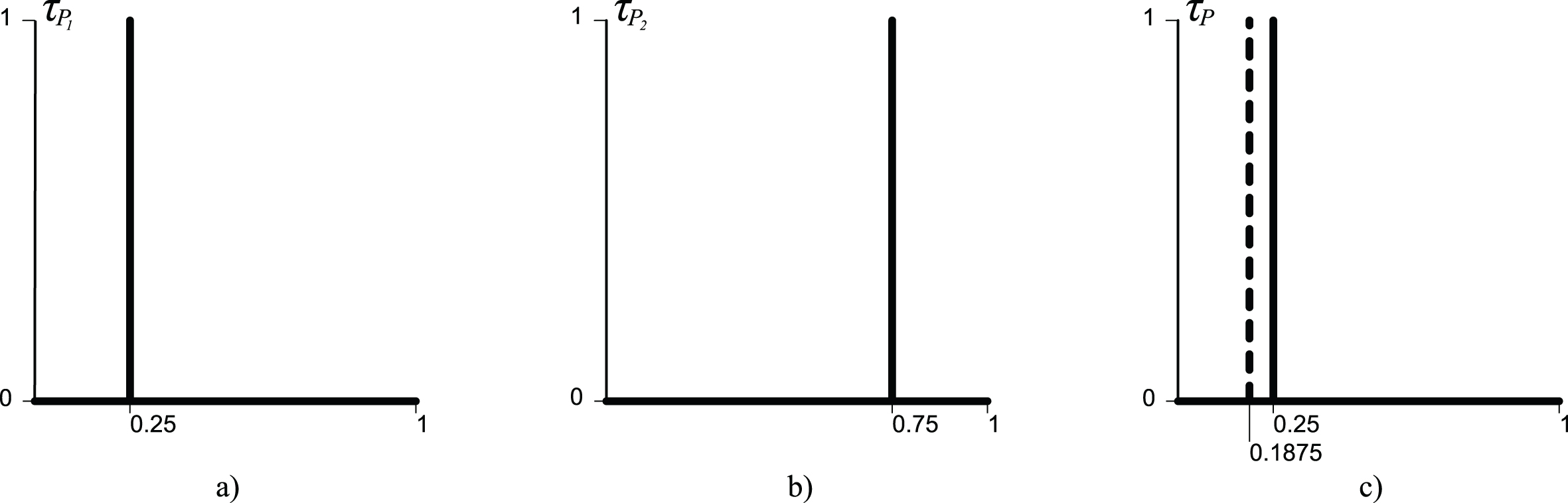
Obtaining a compound truth function for two premises: a) a truth function τ P 1 , b) a truth function τ P 2 , c) a result of τ P composition for two sample T-norms modeling a conjunction "AND" of premises (solid line - minimum, dashed line - product).
In case of N simple premises, the equation (17) takes the following form
Expanding (9) with (22) allows us to skip the supremum operation with regard to singleton form of τ
P
Skipping an intersection with τ
P
, which in this case is equal to 1 (on the basis of T-norm’s boundary condition), the final form is obtained
In this way the equivalence of Zadeh and Baldwin’s approach in case of a compound premise has been shown, assuming that the membership functions of facts are in a form of singletons.
Simplified approaches reduce relationship between the fact A′ and the premise A to one real number from [0, 1] range (naturally 1 for full compatibility and 0 for no compatibility). Therefore, a computational complexity of algorithms implementing such solutions is very low (linear, O (n), according to the number of simple premises in a rule). The linear complexity is shown in results of numerical examinations presented further in Section 3.7.
Comparison of the two analyzed approaches in that simplified environment shows a slightly higher complexity of Baldwin’s solution. Singletons in Zadeh’s approach allow to tremendously reduce the analyzed space, which is particularly visible for the compounded premise (14)_simplified_by_singleton. Baldwin’s inference can be also strongly reduced, however, there is the additional step of computing the truth function of conclusion τ B modifying the conclusion fuzzy set to obtain the result, as shown in (9)Tb. Although the process is performed only once, regardless of the number of facts in a rule, the phase is omitted in Zadeh’s approach.
Generally, it is hard to think of an easier or more direct solution than (16). It is the reason of its popularity in practical applications.
Equivalence in case of fuzzy facts
This section presents similar analysis for given inference examples (1) and (2). This time, however, the inference process considers the general case, not limited to singletons.
An assumption that facts membership functions can take any form does not allow us to apply simplifications discussed in the previous section. Therefore, the comparative analysis of both approaches becomes more complicated. First of all, let us look at the first stage of Baldwin’s fuzzy inference, which is obtaining a truth function of a premise. Deep understanding of the method obtaining it, as well as what it represents, is really crucial before further stages.
Truth function of a premise
The following equation describes the method of obtaining the truth function of a premise τ p [2].
Fig. 4 presents obtaining the truth function of a premise according to (10)2 in six different situations. To make the graph clearer the axes have been described only in the first situation and do not change in next ones. Sample fact and premise membership functions have been described in domain X, which is oriented vertically. Trapezoidal membership function of a premise is constant in every of all six situations. However, the triangular fact membership function changes its position. Obtained truth functions have been marked with a thick, black line in domain [0, 1] × [0, 1].

Obtaining a truth function of a premise for fuzzy facts in six sample situations. Axes are described only in part a). The truth functions have been marked with a thick black line in a domain [0, 1] × [0, 1], whereas in a domain X a trapezoidal membership function of a premise μ A and triangular membership function of a fact μA′
The whole illustrates a process of moving the triangular membership function of a fact in the direction of smaller and smaller compatibility with a premise. It results in obtaining subsequent truth functions beginning with the
The least complicated example is illustarted in situation a), because a range of domain X, in which μ A = 1, entirely contains the area where μA′ > 0. The area has been marked with thick, gray line. Therefore, according to (10)2 for the part of the domain X, in which η = μ A = 1, the maximum value μA′ is chosen. In this case the maximum of μA′ is equal to 1 in point I, hence, this value is transferred as a value of the truth function τ P .
In such a way one point of the truth function for η = 1 is obtained. The same example presents how to obtain value of τ
P
for the level
In situation b) the thick, grey line similarly shows a part of μA′ existing in an area, where μ
A
= 1. In this situation for some areas of X, where μ
A
≠ 1, non-zero values of μA′ are present. They will obviously be appropriately mapped in obtained truth function. Calculations has been precisely presented for level
Situation c) is a boundary situation, in which the maximum of μA′ is still set in the area of μ
A
maximum. There can be obtained two characteristic points describing values of τ
P
≠ 0. The truth function begins to rise starting from the marked level
In the following situations d), e) and f) the maximum of μA′ is obtained for levels η ≠ 1. Situation e) is a characteristic stage in which the half-truth is obtained (τ
P
(0) =0,
To summarize the deliberations presented above, we can characterize the truth function of a premise saying that it contains the highest values of μA′ for every η in [0, 1]. However, each η level reversely mapped by μ A , indicates the area of X where to look for those values in μA′. This observation is crucial in further analysis because it shows what the truth function of a premise actually represents. Therefore, the equation (10)2 can be expressed in a form of the following, shortened corollary
where by the
Analogically to the Section 2_simple, analyzing the example (1), first let us consider the inference with one simple premise in general case. In this type of environment, an equivalence of the analyzed approaches, considering no simplifications, can be shown by moving both equations to the same domain. Baldwin’s inference changes the fact and premise’s domain into [0, 1] through the truth functions. By restoring the original domain both solutions can be directly compared.
Considering the process (1), obtaining the membership function of B′ by Baldwin’s inference can be described by the following equation
Expanding the space [0, 1] into X is presented in Fig. 5, which shows calculations for one given point of the domain Y (for μ B = 0). The mapping of values for the truth function and an implication in point x i has been precisely presented. It is worth noticing that the same values of the truth function and the implication have been repeated in different points of X, which of course results from ambiguity of a function μ A . It is clear, that the operation does not change the inference result. A projection from an intersection will be performed in a larger space on repeated values of both functions.

Transforming space [0, 1] to X for Baldwin’s inference according to (27). The figure shows a premise truth function and an implication function while calculating one point of a conclusion. The implication function I has been shown by a thick, grey line for μ B (y n ) =0. The thick, black line shows the premise truth function τ P . The trapezoidal membership function of a premise μ A has been shown below.
Obtaining the membership function of conclusion using Zadeh’s inference is described by the following equation
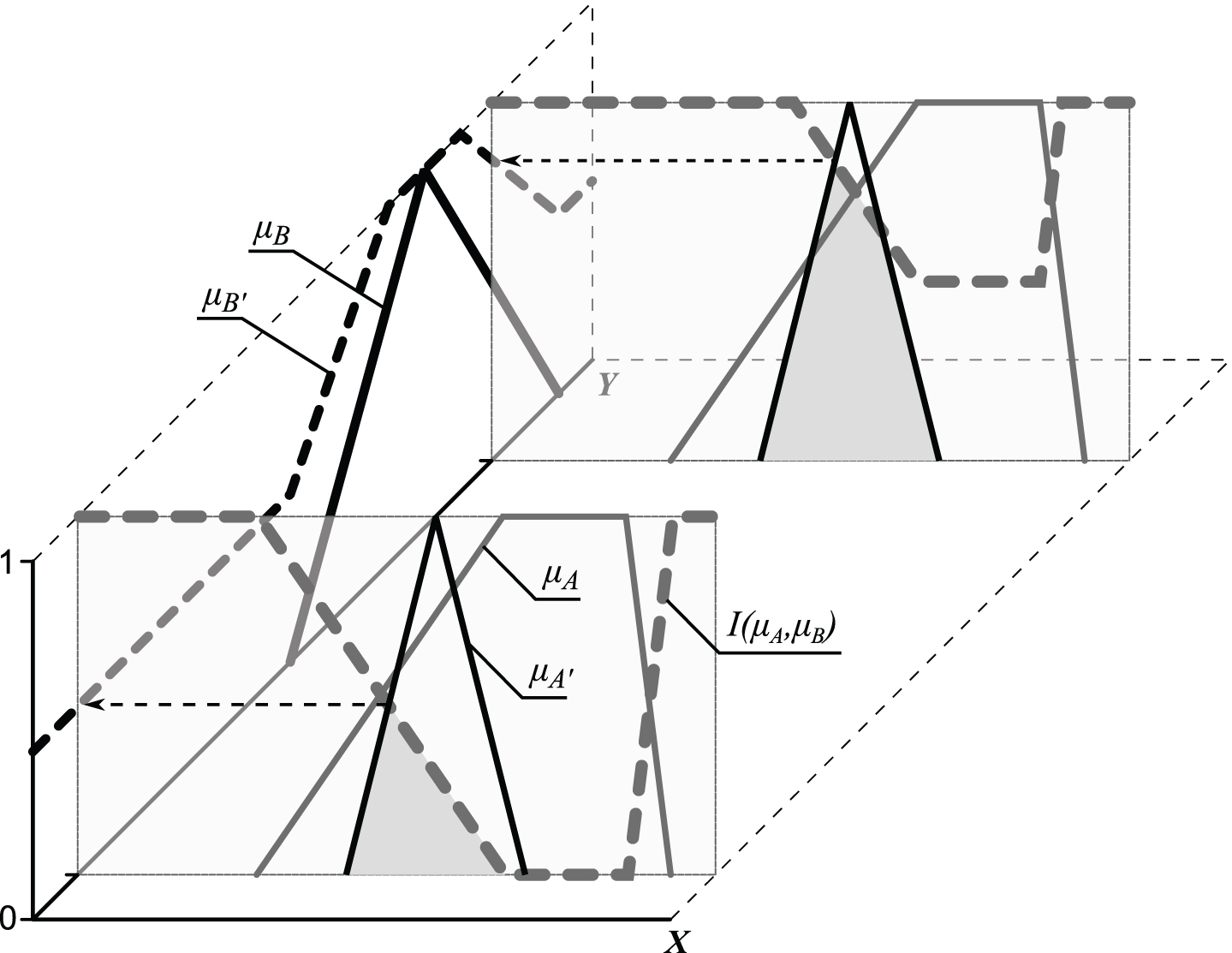
Obtaining a conclusion membership function B′ shown for two points in domain Y. In this example a minimum T-norm has been used as well as Łukasiewicz’s implication. On axis Y a thick solid line shows a conclusion membership function, whereas a dashed line shows a result of inference - membership function of B′. In domain X a solid line presents fact and premise membership functions. The fact with a black color, whereas the premise with a grey. A thick dashed line corresponds to an implication function. The outcome of intersection of a fact and an implication is shown with a light-grey area.
Comparing (27) with (5)2 it can be noticed, that the equations differ only with the left operand of ★ T T-norm. In Baldwin’s inference it is τ P (μ A (x)) whereas in case of Zadeh’s μA′ (x). The only direct connection is that τ P is created from values of μA′. Going further, according to (10)2, the statement τ P (μ A (x)) represents only the highest value of μA′ in these points of X, where a premise membership function is equal to μ A (x). In case of Zadeh’s approach μA′ is unchanged taking in these points, apart from the maximum value, also lower values.
Therefore, looking broader at the statement (5)2 one should think when an intersection μA′ (x) with an implication function reaches maximum, because by the supremum operation only the highest value makes a final result.
For given y n the only variable parameter of a function I in space X is μ A . Therefore, choosing only such points of the space in which μ A takes the same value the constant result of I function will also be obtained. In such constrained space X the maximum value of intersection with ★ T T-norm will be obtained only for the maximum value of μA′. Therefore, by dividing space X into all possible point groups, in which μ A obtains the same value, it is enough to have the maximum values of μA′ for each of the groups in order to obtain the highest results of intersection. Taking into account the corollary 3.1 it can be said that the exact requirements are fulfilled by the truth function of a premise, which proves the equality of (5)2 and (27). This allows us to look closer at the consequences of this equality.
The equivalence of the two approaches has been shown in Fig. 7 for a sample situation. The fact and the premise, described by functions μA′ and μ
A
respectively, have been shown in the bottom part of the graph. Examples are shown at the top. Situation presents obtaining the intersection of the truth function of a premise τ
P
with an implication function I for four selected points of Y space (conclusion space), where μ
B
takes the following values: 0,
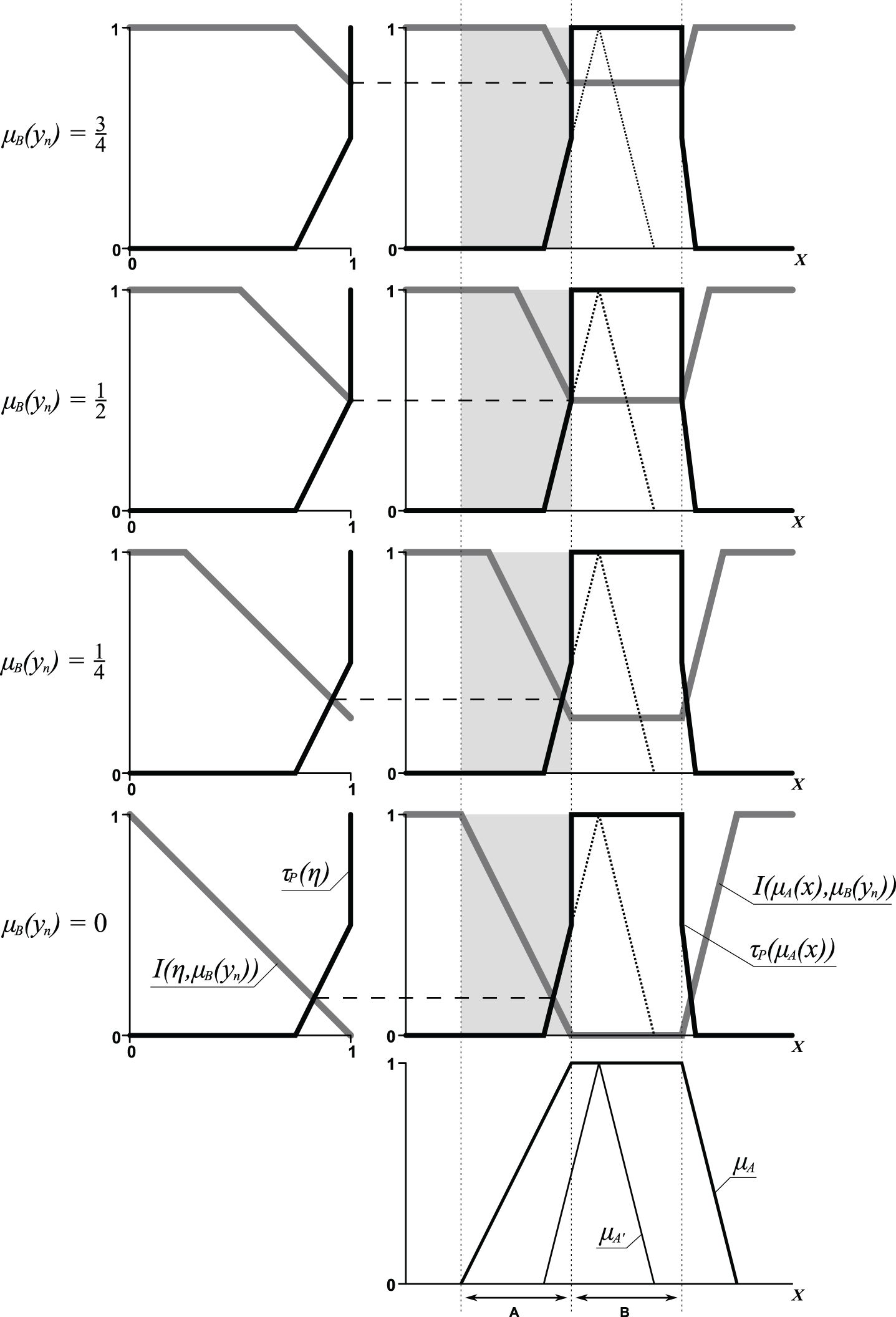
Equivalence of Baldwin and Zadeh’s inference in case of a simple premise
For each situation Baldwin’s inference has been shown in space [0, 1] and X, transferred according to relation η = μ A (x). Moreover, in space X dotted line shows the membership function of a fact μA′. In this way the graph illustrates also Zadeh’s inference by an intersection of μA′ with an implication function. The highest values of an intersection have been shown by a horizontal dashed line connecting both approaches.
In space X letters A and B indicate two intervals characterized by different variability of a premise membership function. In the interval B the function μ A is constant and takes the value 1, whereas in A the μ A function increases linearly from 0 to 1 therefore including all the possible truth values. Similar areas of X space can be distinguished for μ A = 0 and its descending slope, however, they are not as valuable because the fact membership function is then constant taking the 0 value.
The A interval has been marked with a grey background in each of inference cases. It presents a rescaled mapping of the truth function τ P and I function from charts in space [0, 1].
Comparing the graphs of τ P and μA′ functions it can be noticed that they overlap in the interval A. However, in the B interval τ P is constant and equal to the maximum value of μA′ in this area. Therefore, it can be said that Baldwin’s inference in obtaining τ P has left only this one value which can give the highest result in an intersection with implication function I. The rest of μA′ values in B has been skipped. In this way for inference purposes the whole space X is being considerably constrained (or compressed) to the set of only significant points. In a given situation the whole space X is being constrained to the interval A and only one point of B, where μA′ takes value 1.
Fig. 8 shows one important consequence of transforming the relationship between facts and premises into truth functions. It can be seen that given truth function can be obtained for two different facts, located within the area of both slopes of membership function of a premise. A truth function τ P obtained in this two situations would be identical. If μ A had symmetrical slopes it would not be possible to define a precise location of μA′ basing on τ P because there would be two possibilities. Therefore, it can be said that the truth function of a premise defines only the compatibility of a fact with a premise. An identical compatibility can be obtained in some cases for a different location of μ A ′ against μ A and thus the outcome of the inference process will be the same.
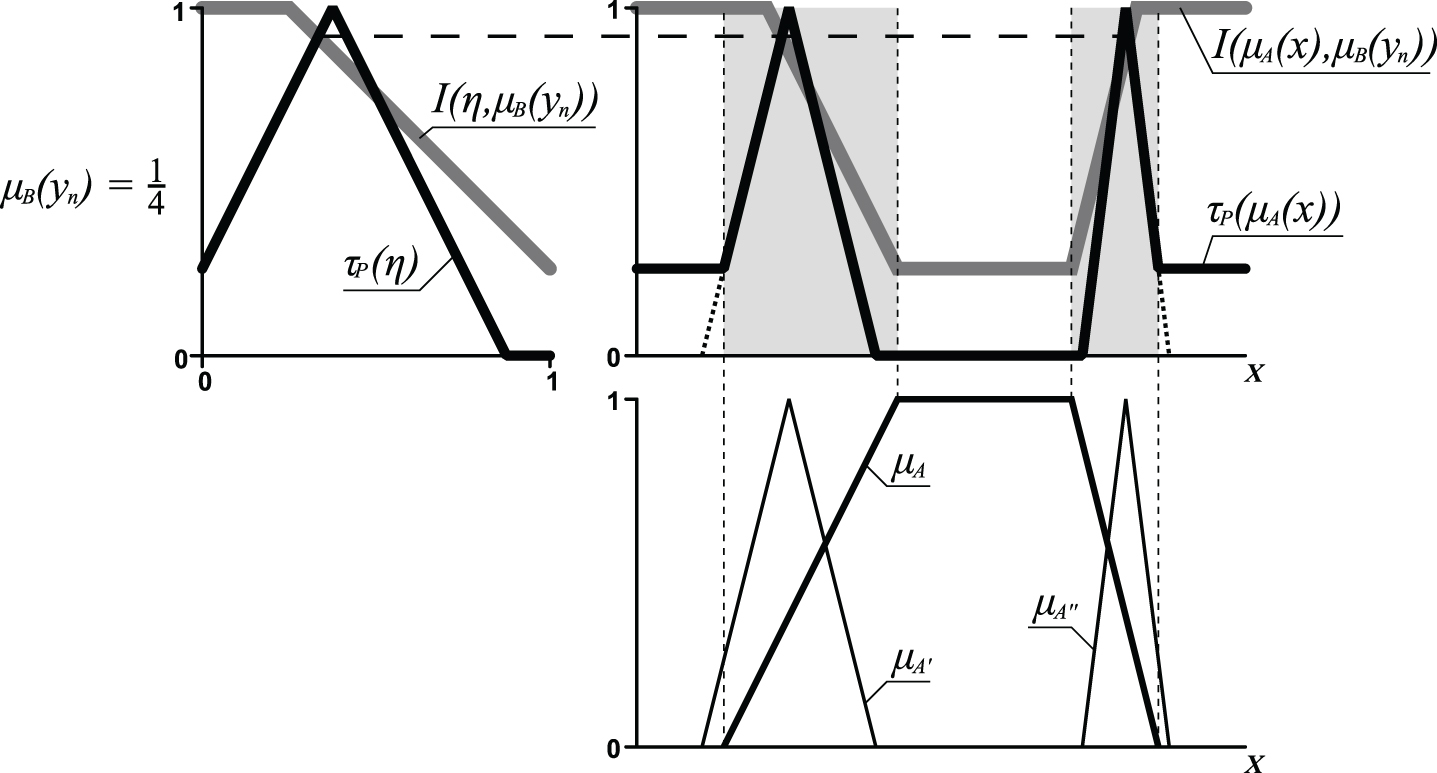
Ambiguity of Baldwin’s and Zadeh’s inference for a rule with a simple premise.
The given examples as well as the fact of equivalence show that Zadeh’s inference is characterized by the same feature. However, in Zadeh’s approach there is no stage where the compatibility between facts and premises are separately obtained. The result is calculated basing on fact, premise and conclusion altogether. Baldwin’s approach allows us to see this mechanism directly.
Now let us consider a compound premise like in the example (2), analogically to the previous Section 2_compound. However, this time in general case.
Baldwin defined obtaining a compound truth function for two premises in a rule joined with a conjunction "AND" as well as "OR" [2]. These solutions can also be obtained using the extension principle for operation on non fuzzy truth values [8]. Therefore, by extending F function of N truth values η i in the following form
Considering ★ i as any T-norm, where i = 1, ⋯ , (N - 1), we receive equation obtaining a compound truth functions in the case when the premises in a rule are joined with a conjunction “ AND”. Obviously, ★ i replaced with any S-norm results in “ OR” conjunction.
Mixed cases can also be encountered. However, it is important to notice that a canonical form of a rule contains only “ AND” conjunctions [9]. A compound truth function, where three premises are joined with different types of conjunctions, would be described as follows
Considering η
i
= μ
A
i
(x
i
) for i-th premise in (30) it is possible to define equation described in
According to the corollary 3.1, a truth function of i-th premise τ
P
i
represents the highest values of μA′
i
in these points of space X
i
where μ
A
i
obtains the same value η
i
. Obviously, in the case of many premises the same value η in (32) is obtained in these points of
Therefore, changing space into
Functions τ P i for each η i obtain the same value within the set of x i points, which are equal to the maximum of μA′ i in this set. On the other hand μA′ i in the set can take different values. However, according to T-norm definition, only the highest value influences the result of output supremum.
Therefore, the expression (32) can be transformed to the following form
For better understanding, the equality of (32) and (37) is visualized in Fig. 9 presenting a process of compounding two truth functions using the considered equation. The upper part presents membership functions defining sample situation of a rule with two premises joined with a conjunction “ AND”. Membership functions of premises have been marked as μ A 1 ,μ A 2 whereas facts as μA′1 and μA′2 respectively. The truth functions of premises τ P 1 and τ P 2 have also been illustrated.

Obtaining a compound truth function for a rule with two premises joined with a conjunction “ AND”. As an operation of intersection the minimum T-norm was used.
For the purposes of the example the minimum T-norms were used, therefore, the function F takes in this case the following form
Charts situated in the middle of the figure show intersections of corresponding membership functions in space X1 × X2. Starting from the left side, an intersection of premises membership functions are presented first, followed by the intersection of facts. The last chart presents the same situation but for truth functions of premises transferred into spaces X1 and X2. Obviously, the intersection of two membership functions is performed in three dimensions. Figures show projections of 3D views onto X1 × X2 plane, where solid line marks contours of 3D structures. Color white outside the contours represent value 0. Shades of gray represent values greater than 0 (darker color represents higher value). The bottom line of charts show only contours of relevant intersections in spaces X1 × X2 to clearly present only several analyzed levels. Dashed line depicts three sets of points, for which the operation of composition F is equal to
In the chart showing contours of intersection μA′1 ★
T
min
μA′2, the gray thick line stands for maximum values for this operation in each of marked sets of points. For
To summarize the analysis it is worth noting down the equation (37) in a form of the following shortened corollary:
where
Therefore, as it was shown earlier for simple premise, also a compound truth function represents only a relevant area of the universe of discourse - in this case an important area of facts’ intersection - preserving only the most valuable information.
Similarly to previous cases, the equivalence of Baldwin’s and Zadeh’s inference can be shown by moving (9)2 into
An expression describing Zadeh’s inference for n premises in a rule, joined by the function F, takes the following form
Comparing (41) to (40) it can be seen, that the equations differ only in the function on the left side of the operation ★ T . In case of Baldwin’s inference it is the compound truth function τ P and in case of Zadeh’s inference it is the relation of facts’ membership function TA′. Therefore, it is needed to resolve if that difference influences the inference outcome.
For specified y
n
the variability of I depends only on the variability of F. For the points of
Confronting this analysis with corollary 3.1N it can be noticed, that compound truth function of premises τ P fulfills the mentioned conditions of preserving only the highest values within defined sets. Thus, (40) and (41) can be considered equal, because for all y n ∈ Y the two equations produce the same result.
Equality of the two approaches for rules with a compound premise is hard to present graphically, because of the higher number of dimensions. However, the problem was analyzed similarly to the case of only one premise. Because of higher complexity and the possibility of usage of different junction operations for premises, it was helpful to analyze what the compound truth function represents and formulate the corollary 3.1N. This step allows for direct comparison of the two considered solutions.
The thorough analysis of simple and compound truth functions of a premise allows us to see their real nature. In the context of equality, the truth function can be understood as a particular fuzzy set preserving only relevant values of a fact membership function, chosen according to the relationship with a premise membership function.
It can be stated that the truth functions represent a complete fuzzy relationship (or compatibility) between relevant facts and premises. In simplified approaches such compatibility is mapped to only one value in [0, 1] range. It was precisely shown for singletons in the previous Section 2, where the truth functions were also in singleton form, defined by only one input value.
Analyzing the considered solutions in the context of computational complexity, it is now important to mention the criticism of inference based on the truth functional modification in [37]. If one assumes that the computation process would be based on (40), than there really is no advantage of Baldwin’s approach, because it also needs processing of a multi-dimensional space. However, in contrast to Zadeh’s approach, all truth functions are defined in the same truth space [0, 1]. This very fact allows for subsequent joins of only two truth functions at a time and completely changes the view on the computation process. In such case the complexity becomes linear according to the number of simple premises in a rule, because the whole process stays in the low-dimensional space. The compositional rule of inference, without any simplifications, is characterized by exponential complexity, because adding another simple premise to the rule extends the space of analysis by one dimension.
Therefore, to complete the comparison, it must be analyzed if obtaining the compound truth function by subsequent joins is equal to the general formula (30). Such analysis is presented in the following section.
Associativity of truth functions’ composition
Let us consider the following fuzzy rule with a premise composed of three simple premises
To simplify further analysis let the η1 be constant. In such case a variability of η depends only on a variability of η′, so actually η2 and η3. Thus, depending on given ★1 and ★2, a chosen η value is obtained for a set of points in η2 × η3. Let this set be denoted by Z. Within the set Z the operation of intersection is performed between τ
P
1
and the result of inner supremum. Taking into account the fact of constant η1, thus also τ
P
1
, the highest result depends only on the highest result of intersection τ
P
2
★
T
2
τ
P
3
obtained for all points in Z. The highest result is obviously provided by the inner supremum. However, by omitting this supremum, also other, lower values of τ
P
2
★
T
2
τ
P
3
, will be obtained in Z. Nevertheless, taking into account the outer supremum, it does not influence the outcome, because the lower values will be omitted again. Thus, (48) can be transformed into the following form
It should be noticed, that the same procedure can be applied to prove equality of (44) with the approach joining τ P 3 with composition of τ P 1 and τ P 2 . Thus, the operation is associative.
Analogical approach can be used in general case, for larger number of truth functions. Assuming that there is N truth functions, the partial truth function τP′ (η′) joining two last ones: τ
P
(N-1)
and τ
P
N
with the operator ★(N-1), will take the following form
Equality of (30) and the proposed associative approach is an important fact, especially in the context of proved equality of Baldwin’s and Zadeh’s inference methods. Significant reduction in computational complexity allows practical applications to implement a full version of inference mechanism, regardless to the type of applied triangular norms used as junction operators.
The Baldwin’s method, as well as Zadeh’s approach, was implemented in Java programming language [18]. Created library allowed to examine the computational complexity of Baldwin’s method in order to assess its potential in practical applications. Fuzzy sets in the library are defined by piecewise linear membership functions. This flexible form allows to create needed description using approximation or interpolation. The examination environment was based on Windows operating system and Intel processor with 2.4 GHz clock rate.
All examinations were performed for compound premises, therefore, a general fuzzy rule for all tests was as follows
Computations were performed for a variable N in simplified (based on singletons) and general case. Membership functions of facts, premises and conclusions were defined randomly using Gaussian function (piecewise linear interpolation with 23 points).
Simplified approaches, for facts fuzzyfied with singletons, were compared first. Examinations started for N = 100 and ended for N = 5000. Such large number of attributes in a dataset can occur e.g. in gene processing systems [10, 23]. The results of examinations are presented in Fig. 10.
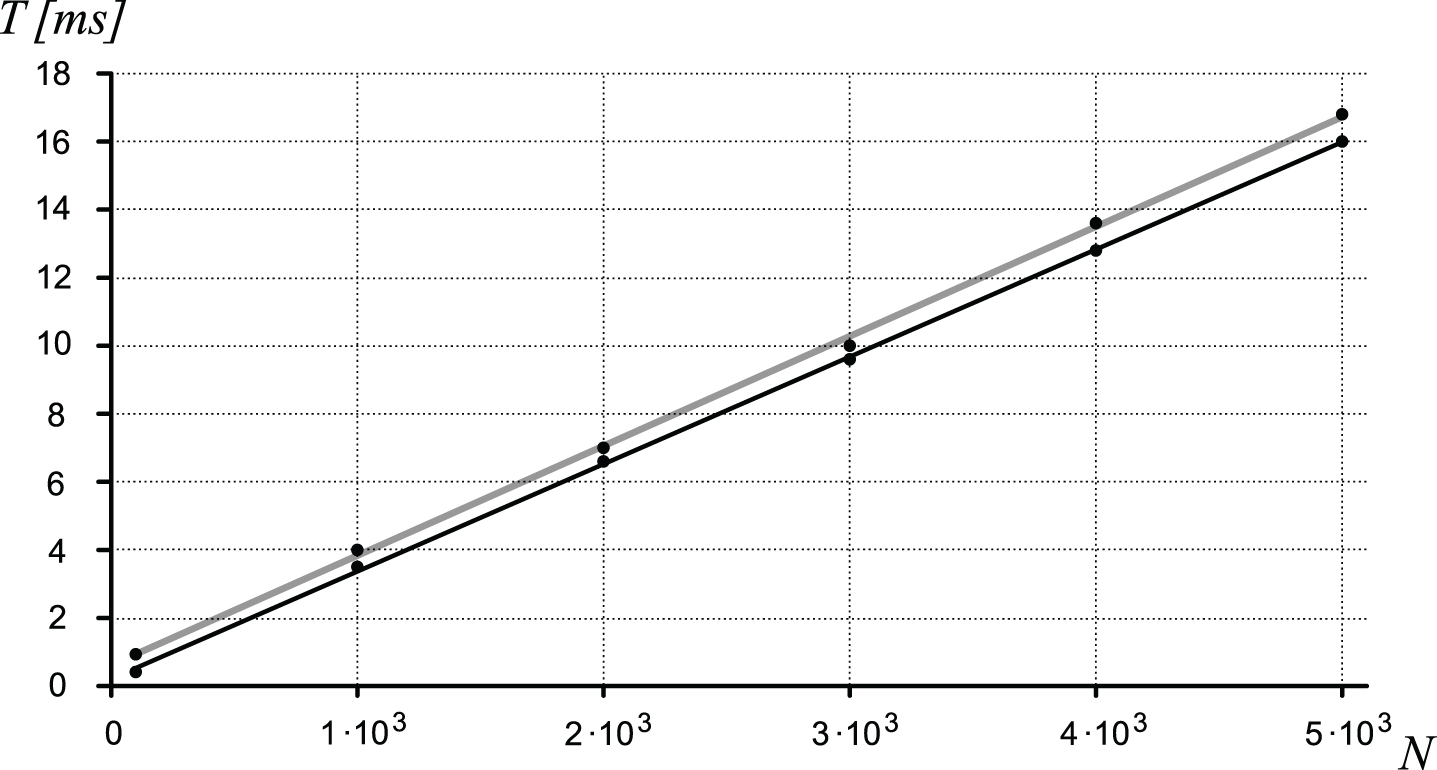
Average computation time of one rule for increasing complexity of antecedent, where N represents the number of simple premises. The results are obtained for both approaches with facts in form of singletons. Results for Baldwin’s system are marked with gray line and Zadeh’s with black.
It can be noticed, that Baldwin’s approach works slightly slower, because in comparison to (16) the algorithm needs to compute the truth function of conclusion, which is an additional step (the truth functions in these tests were described approximately by 50 points). However, it must be emphasized that the difference is very small and probably would not be significant in most practical implementations. Therefore, the results precisely support the theory described in the Section 2.
The most interesting from the practical application point of view is the general case. Increasing complexity of an antecedent makes the full implementation of compositional rule of inference practically useless for rules containing only several simple premises.
Fig. 11 presents results of tests obtained for Baldwin’s and Zadeh’s systems without simplifications, using facts described by Gaussian membership function. In this examination the truth functions were described by smaller number of points (10 to 20), because of higher complexity of the task. The variable N also represents the number of simple premises in a compound rule, which results in N - 1 compositions of partial truth functions in Baldwin’s approach and computations in N-dimensional space for Zadeh’s solution.

Average computation time of one rule for increasing complexity of antecedent, where N represents the number of simple premises. Fig. a) shows results for Baldwin’s system and b) for Zadeh’s. In this case facts are not limited to a singleton and described with Gaussian membership function.
Results for Baldwin’s approach are presented on the left and Zadeh’s on the right. It can be noticed that without simplifications the compositional rule of inference is characterized by an exponential complexity (please notice the logarithmic scale in chart b). The examinations in this case were performed only for 5 simple premises in a rule and the dotted part of the chart is an extrapolation, only indicating higher values for such complexity.
On the other hand, it can be observed that for Baldwin’s approach, even for composition of 10 thousand truth functions in a rule, the average time was less than 20 ms. This results clearly show that Baldwin’s system using sequential joins of truth functions, can be successfully applied even in a very complex environment, such as gene classification systems or other problems involving a large number of attributes. Moreover, the output results will be identical to those obtained by a compositional rule of inference.
Low computational complexity allows to consider the implementation of the analyzed inference using type-2 fuzzy sets [44]. Although the general concept of the type-2 fuzzy sets is rather to complex for practical use [25], the interval type-2 fuzzy sets are successfully applied in many fields like classification problems [7], medical data analysis [36] and even big data processing [33].
The article presented a thorough comparative analysis of Baldwin’s and Zadeh’s approaches to fuzzy inference, focusing on the practical consequences. From the mathematical point of view, the solution presented by Zadeh is direct [37] and therefore simpler in description.
As it has been shown for the case where facts are represented by singletons, the approach of Baldwin is characterized by an insignificantly higher computational complexity. Both approaches simplify considerably in such environment, however, in Baldwin’s solution the need of computing the truth function of conclusion causes an additional overhead. Although the consequences are not significant for the computation time, there are no arguments for using Baldwin’s method in simplified implementation. However, the great advantages of this method can be observed in complex environment, where fuzzy description of facts is not constrained to singletons only.
The compositional rule of inference is problematic in case of a multidimensional antecedent. Computing the inference result for a rule with only several simple premises is a very time consuming task. The problem does not exist in Baldwin’s approach, because the truth functions of simple premises are described in a unified space, thus, the truth functions can be subsequently joined in a sequence of computationally efficient operations. Equivalence of subsequent joins with multidimensional composition have been proved in final sections of the article.
Thorough analysis presented a character of the premise truth function. Generally speaking, it reflects the compatibility of a fact with a premise in a fuzzy form. Simplified approaches map the compatibility into one value in a [0, 1] range, like commonly used solution presented first by Mamdani and Assilan. In the context of equivalence it can be stated that the truth function preserves only valuable information of a fact membership function, describing its relationship (or compatibility) with a premise. Therefore, it allows to move the inference process into a unified truth space, where the truth functions, unlike different spaces in Zadeh’s approach, can be aggregated in a much more computationally efficient process (the complexity is linear versus exponential). The efficiency was acknowledged by presented results of numerical examinations. This is the strongest fact speaking in favour of Baldwin’s approach, but only when it is based on sequential joins of truth functions.
Described inference system can be compared in a way to the one of Mamdani and Assilan. It allows to analyze a compound antecedent of the rule premise after premise, obtaining partial results in a form of truth functions, instead of values in [0, 1] range. In the end the final result is aggregated in one compound truth function of a premise, just like in the Mamdani and Assilan’s approach with one rule activation level. Taking into account the equivalence it could be stated that Baldwin’s solution based on sequential joins of truth functions, optimizes the compositional rule of inference and makes it possible to apply it in its full form.
Low computational complexity allows to look further into application of the analyzed solution in real-life scenarios. Therefore, future work will focus on two major aspects. First, the general complexity of implemented method must be optimized, because the most common and simplified approaches are more time efficient. It can be achieved by simplifying the definition of truth function, using only two or three points of description. Such modification should preserve the overall process and give satisfactory results. Nevertheless, it must be implemented, compared and examined. The second aspect considers extending the method to apply type-2 fuzzy sets, which are more flexible in defining the uncertainty. However, their representation is much more complex and lower computational complexity of Baldwin’s approach should allow to perform data processing in real time.
Footnotes
Acknowledgment
The authors are grateful to anonymous referees for their constructive comments that have helped to improve the quality and presentation of this manuscript. The publication was partially supported by: the Rector’s research and development grant (J.L): Silesian University of Technology, grant no. 02/130/RGJ20/0001.