



Abstract
Agriculture is a crucial and strategic sector for developing countries. The agricultural sector in Turkey has been suffering from regression in recent years due to several reasons. In an attempt to reverse this process, we analyze the cultivation possibilities of high profit-margin crops in Turkish lands and develop a ranking among eight alternative crops. To perform a comprehensive analysis encompassing several dimensions, three MCDM methods are utilized; namely fuzzy AHP to determine the weights of evaluation criteria, and TOPSIS and PROMETHEE to develop a ranking among the crop alternatives. The crop alternatives are evaluated against several economic, technical, social and environmental criteria. The results favor the cultivation of soy bean, goji berry and buckwheat, while tamarind appears to be the least favored crop among the considered alternatives. The analysis results are enhanced with a sensitivity analysis.
Keywords
Introduction
Agriculture has always been a crucial and strategic sector for developing countries [26]. Turkey, which was once a self-sufficient country in terms of agricultural products, has recently lost this peculiarity and became highly export-dependent to satisfy the domestic demand. The reasons for this occurrence are manifold, ranging from restricted agricultural subsidies after IMF-induced policies in the 2000 s to elevated input costs in agriculture, small farm sizes resulting in diseconomies of scale, the low education level among farmers, and their lack of technical know-how, as well as limited irrigation opportunities [15]. Many farmers have now left their land, migrated to bigger cities, so the agricultural sector of Turkey has been suffering from abandonment of fertile, arable land.
In this paper, we would like to inquire whether it is possible to revert this process by improving the producer welfare via the cultivation of high profit-margin crops. Towards this end, we have selected 8 crops that are not widely known by farmers in Turkey although the domestic demand for these plants (as well as the global demand) increases day by day. Moreover, these crops sell at higher prices compared to many other crops cultivated extensively in Turkish lands today, leaving a high profit margin for the farmers. We would like to analyze whether cultivating one or some of these crops could be a solution for reinvigorating the Turkish agriculture sector and help alleviate the poverty problem of Turkish farmers. In our analysis, we do not only take into account the demand and wealth potential of these crops, but we also consider the issue from several other perspectives such as the appropriateness of the Turkish lands to cultivate each one of these crops, the labor requirement and expertise, and environmental effects among others. A fuzzy Analytical Hierarchy Process (AHP) analysis is utilized to determine the weights of the selected criteria to evaluate the cultivation decision; and TOPSIS (Technique for Order Preference by Similarity to Ideal Solution) and PROMETHEE II (Preference Ranking Organization Method for Enrichment Evaluations) methods are used to rank the crop alternatives. Fuzzy AHP method is selected for determining the criteria weights, since AHP combined with the fuzzy set theory is proven to achieve more flexibility in judgment and decision-making. Fuzzy AHP retains many of the advantages enjoyed by conventional AHP, in particular multiple criteria are considered smoothly and easily with this method, and a hierarchical structure is provided via pairwise comparison [49]. Furthermore, this method reflects the ambiguity in human cognition process, and takes into account the uncertainty in generating decisions. TOPSIS and PROMETHEE methods are selected mainly because they are well-known, well-renowned methods in the MCDM literature that prove to be successful in generating rankings of selected alternatives [43].
Furthermore, by the means of a sensitivity analysis conducted on the selected methods, the robustness of proposed solutions is discussed and the crop alternatives are further evaluated from various dimensions. The results could be illuminating not only for Turkish farmers, but also for the farmers in other countries who experience similar adversities as their Turkish counterparts. Moreover, our recommendations will be helpful for the policy-makers and experts in the agricultural sector in terms of developing more innovative, option-rich agricultural policies in the near future, hopefully leading to a stronger agricultural sector in Turkey.
The paper is structured as follows: In Section 2, a literature review regarding the applications of Multi-Criteria Decision Making (MCDM) methods in agriculture is presented; and the position of this work is stated. In Section 3, the details of our methodology are discussed. In Section 4, the background information regarding the relevant crop alternatives and the set of criteria are given, and the analysis is explained in detail. Finally, in Section 5, the results and potential policy implications for the policy-makers are discussed.
Literature review
MCDM models have been frequently applied in agricultural settings. They are used to solve various problems such as optimal site selection of the agricultural product warehouses [20], selection of post-harvest technology in cocoa production [31], developing climate decision support systems for tomato production [22], and the decision-making problem among different farming systems in a watershed [39]. Moreover, many researchers combine MCDM methods with Geographic Information Systems (GIS) techniques to identify the suitable zones for agriculture within a larger region [33, 38].
Despite the wide range of MCDM applications in agriculture, the works which consider the selection problem among potential crop alternatives are particularly relevant for our research. Biswas and Pal [5] utilize fuzzy goal programming in an attempt to tackle the land-use planning problem for production of the principal crops of the Nadia District in West Bengal. They compute the priority levels and optimal production plans for these crops. Gupta et al. [21] formulate a multi-objective fuzzy linear programming (MOLFP) area allocation model. They consider various conflicting objectives involved in irrigation planning, and select crops based on the criteria listed as domestic needs of a particular crop commodity, productivity, market value, regional balance, and resource requirements and their availability. According to the multi-attribute value technique, they find that the pigeon-pea crop stood at first rank followed by a high yielding wheat variety while fodder and cotton occupied the last two positions. Qiu [39] assesses the economic and environmental impacts of farming decisions in an agricultural watershed, and identifies the selection criteria as increasing net returns (NR), reducing economic risk (ER), improving drinking water quality (DW), enhancing aquatic ecosystem health (AE), and reducing soil loss (SL). Yuan et al. [53] consider crop planning subject to value at risk constraint in a fuzzy environment. They develop a heuristic algorithm integrating approximation approach (AA), neural network (NN) and genetic algorithm (GA) to solve the fuzzy crop production planning VaR model.
Cobuloğlu and Büyüktahtakin [12] consider the problem of selecting the most sustainable biomass crop type for biofuel production and propose a stochastic AHP model towards its solution. They apply the proposed model to biomass alternatives including switchgrass, miscanthus, sugarcane, corn, and wheat in Kansas. As a result, the score of switchgrass increases if environmental criteria are emphasized, whereas wheat and corn become more favorable if priority is given to economic factors.
In an attempt to derive the most appropriate crop to cultivate in Turkish lands, we use similar ideas discussed in this line of research. As in the aforementioned papers, several economic, technical, social, and environmental criteria are determined to judge the crop alternatives. These criteria are stated in Section 4.1 and weighted by using fuzzy AHP method in Section 4.2. Next, the crop alternatives are evaluated according to the given set of criteria, and the results are triangulated by using more than one MCDM method, namely TOPSIS and PROMETHEE, in Sections 4.3 and 4.4 respectively.
Despite these similarities, our work differs from the above line of research in several ways. Most of the past studies evaluate the crop alternatives regarding their cultivation possibilities in a small agricultural region. In contrast, our main objective in this work is to propose a holistic agricultural strategy for Turkish agriculture. Secondly, the crop alternatives evaluated in other studies are often already being cultivated in the given regions; while we want to introduce and evaluate crops that are unknown (or narrowly known) by Turkish farmers. Furthermore, the set of evaluation criteria we consider is widely comprehensive, ranging from environmental to technical, social and economic dimensions.
The methodology implemented in this paper is also unique in many aspects. Although fuzzy AHP, TOPSIS and PROMETHEE are well-known and highly utilized methodologies in the literature, a combination of the three methods in a single study is not often observed. Furthermore, the sensitivity analysis presented at the end of the analysis provides further robustness on the proposed recommendations of this study. We believe that both the methodology and the results could be illuminating for the policy-makers both in Turkey and around the world.
Methodology
In this research, first fuzzy AHP, then TOPSIS and PROMETHEE methods are utilized to analyze the problem. Figure 1 summarizes the steps of the proposed algorithm.
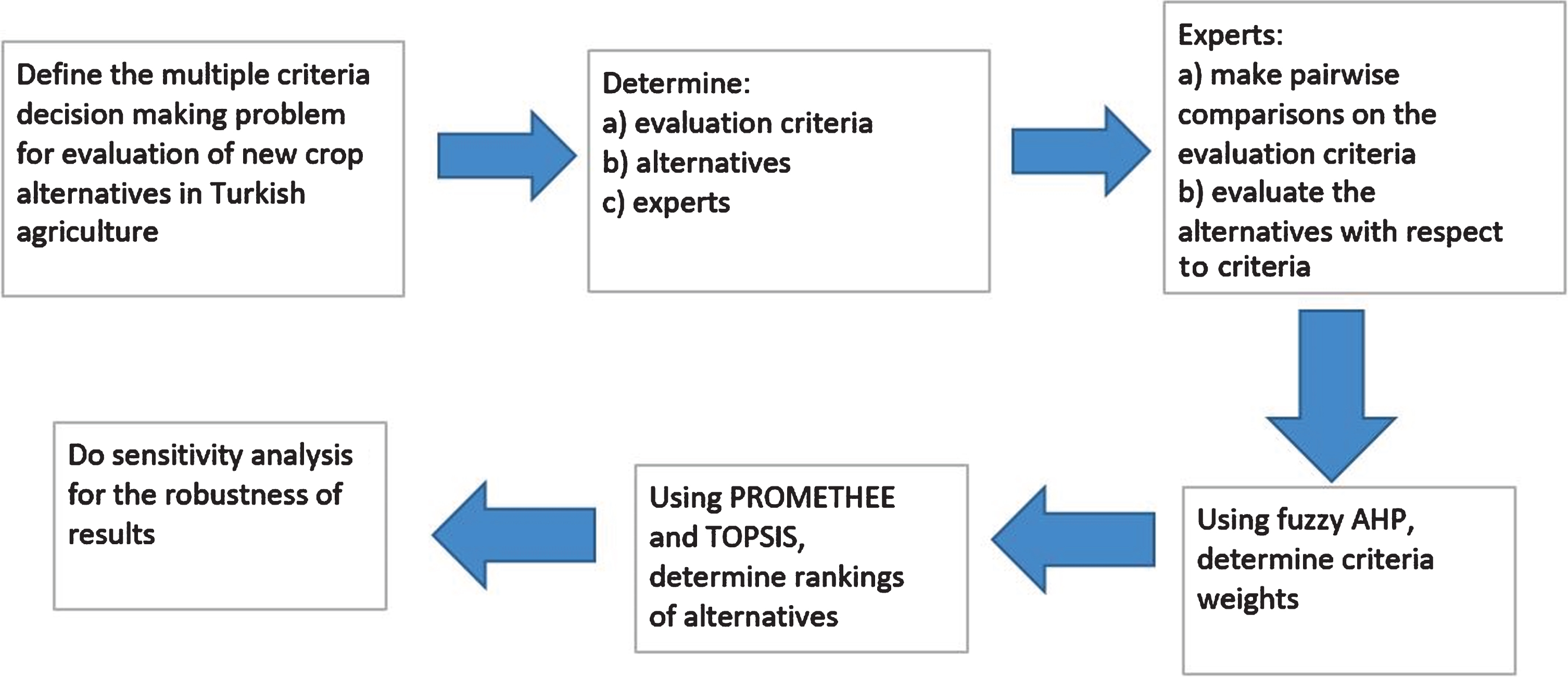
Procedure of the proposed methodology.
AHP is among the most prominently used multiple criteria decision-making techniques in the literature [41]. It enables building hierarchical relationships among different criteria to judge possible solution alternatives. In order to capture the ambiguity in human thinking style in a more accurate manner, fuzzy AHP, a fuzzy extension of AHP, was developed and several versions of this extension were tailored to address problems in many contexts [46]. In this work, we will utilize the same approach and compute the weights of the evaluation criteria using fuzzy AHP. The method is applied in accordance with the procedure described by Chang [10]. The steps of the application procedure are summarized below.
Step 1. Let X ={ x1, x2, x3, …, x
n
} be the criteria set and U ={ u1, u2, u3, …, u
m
} be the goal set. According to the method, an extent analysis is performed on each goal per each criterion, respectively. Therefore, one obtains m extent analysis values for each criterion, i.e.
Step 2. Next, the value of fuzzy synthetic extent with respect to the i-th criterion is defined according to the following equation:
To obtain
Step 3. In this phase, the significance vector is computed to measure the likelihood of one triangular fuzzy number being larger than another. To be more specific, the degree of possibility of M1 ⩾ M2 is defined as:
The possibility of a fuzzy number being larger than the other n-1 fuzzy numbers can be stated by the significance vector W = (d (A1) , d (A2) , … d (A n )) T . This vector is attained by normalizing W’ = (d’ (A1) , d’ (A2) , … d’ (A n )) T , where d′ (A i ) = minV (S i ⩾ S k ) , k = 1, 2, . . n, and k ≠ i.
Elements of W are calculated according to the formula:
Among several MCDM solution methodologies, TOPSIS and PROMETHEE methods are among the most frequently used ones. TOPSIS was initially developed by Hwang and Yoon in 1981 [23] as an alternative to ELECTRE (ELimination Et Choix Traduisant la REalité) method. The main idea in this methodology is to calculate the proximity of decision alternatives to the ideal solution. Ideal solution is defined as the best performance on each criterion; however, in general, different alternatives produce the ideal solution under each criterion making this value impossible to reach by selecting a single decision alternative. Therefore, the decision-maker proceeds with selecting the alternative in closest proximity to the ideal solution. Towards that end, the vector of “Positive Ideal Solution (PIS)”, which maximizes the profits and the vector of “Negative Ideal Solution (NIS)”, which maximizes the costs, are developed. According to TOPSIS, the selected point should be closest to PIS, and farthest from the NIS [35]. The general procedure consists of the following steps:
Step 1. Given the decision matrix, D, the “normalized decision matrix”, ND, is computed. The ijth entry (i.e. the value on the ith row and jth column) of ND is computed as:
Step 2. Given the normalized decision matrix, ND, the “weighted normalized decision matrix”, V, is computed. The ijth entry of V is calculated as:
Step 3. Given the weighted normalized decision matrix, V, the “positive ideal solution”, PIS, and “negative ideal solution”, NIS, are computed.
Step 4. Next, separation measures are calculated. The separation of each alternative from the positive ideal solution is given as:
Step 5. Finally, the relative closeness to the ideal solution is computed for each alternative. The closeness of the alternative i to the ideal solution set is defined as:
Clearly, the closer CIS value of an alternative is to 1, the relatively closer it will be to the ideal solution. Conversely, the closer CIS value is to 0, the closer it is to the negative solution. The alternatives can then be ranked according to their closeness to the ideal solution.
PROMETHEE is proposed by Jean Pierre Brans in 1982 [6], and has been updated as better versions later. We use the version developed in 1985 [7]. In this method, pairwise comparisons of alternatives are performed under each criterion, and common preference functions are computed. There are six different distributions to develop the preference functions. In our paper, we used type 5, namely “Criterion with Linear Preference and Indifference Area”, in order to create smoother comparisons rather than extreme “all or none” type of preferences. This preference function is defined as follows.
Next, a valued outranking graph is developed by using a preference index, which determines a total preorder on the set of possible actions [32]. Preference index of alternative a with respect to alternative b is computed according to the following formula.
The ranking of the alternatives can be then made according to the net flow values.
Background information
In an aim to search for new opportunities for Turkish farmers in the agriculture sector, a total of eight crops, namely asparagus, goji berry, tamarind, chia, quinoa, buckwheat, soy bean and mung bean have been selected as prospective cultivation candidates. The reasons for focusing on these crops are that a) they have a high profit margin and an increasing demand pattern, b) they are commonly preferred by dieticians and nutritionists in designing healthy diets, c) although pilot studies of growing these crops have been performed by individual growers in the last years and considerable success rates have been achieved, these crops are not recognized by the majority of farmers in Turkey. Hence, according to the results of our analysis, it will be possible to recommend the policy-makers adopt programs that could make some of these crops to be more broadly known and grown by farmers in Turkey.
The general characteristics of each one of the selected crops are stated as follows.
In order to search for prospective opportunities each of these crops can bring to the agricultural sector of Turkey, we decided to evaluate the crops according to the following set of criteria:
The data for the above criteria have been gathered from various sources, such as the websites of online retailers (e.g. Migros, Carrefour, Macromarket among many others), reports of TÜİK and other European and American trade foundations (e.g. Center for Promotion of Imports (CBI), Global Agricultural Information Network (GAIN), German Federal Ministry of Food and Agriculture, U.S. Foreign Agriculture Service (FAS) ...), educational videos provided for farmers, newspaper articles, and last but not least, by semi-formal interviews of the experts. Having combined the data collected from all of these sources, a “scoring index” for the crop alternatives across all of the given criteria is formed as seen in Table 1. This table also forms the decision matrix for TOPSIS and PROMETHEE analysis.
Scores of the Crop Alternatives across the Decision Criteria
Scores of the Crop Alternatives across the Decision Criteria
The objective of applying fuzzy AHP analysis on the different economic, social and environmental criteria is to understand how experts from the area perceive the importance of these features. To this end, we interviewed 4 experts from the faculty of agriculture in an emerging Turkish university and used fuzzy scale prepared by Chang [10] for them to compare each pair of criteria. According to this scale, linguistic variables “equally important”, “moderately important”, “important”, “very important”, “much more important” correspond to the fuzzy scales “(1,1,1)”, “(2/3,1,3/2)”, “(3/2,2,5/2)”, “(5/2,3,7/2)” and “(7/2,4,9/2)”, respectively.
By applying formula (1) on the fuzzied questionnaire responses, the fuzzy synthetic vectors were computed as in Table 2. Next, fuzzy significance vectors were calculated according to formula (3) as shown in Table 3. Finally, fuzzy significance vectors were translated into normalized W significance vectors. Based on the results of this analysis, Table 4 shows the perceived weights of the given eight features to determine the importance of each suggested crop.
Fuzzy Synthetic Vectors of the Evaluation Criteria
Fuzzy Synthetic Vectors of the Evaluation Criteria
Fuzzy Significance Vectors of the Evaluation Criteria
Weights of the Evaluation Criteria
Findings of the fuzzy AHP analysis indicate that profitability, domestic demand and climate and land compatibility are regarded as the most significant criteria by the experts for evaluating new crops, while labor requirement and strategic product characteristic happen to be the least favored criteria among all.
The TOPSIS analysis is performed starting with the “Decision Matrix”, which shows the scores of each alternative with respect to each criterion and was tabulated earlier in Table 1. This matrix is next converted to the “Normalized Decision Matrix” and “Weighted Normalized Decision Matrix” according to the procedure described in Section 3.2. Then, the positive ideal solution (PIS) and negative ideal solution (NIS) values of the evaluation criteria are computed as in Table 5. Finally, the PID, NID and CIS (closeness to ideal solution) values and the ranking of the crop alternatives are tabulated in Table 6.
PIS and NIS values
PIS and NIS values
Final Computations and Ranking According to TOPSIS
As a way to triangulate the results of TOPSIS, the PROMETHEE II methodology is applied next. The decision matrix presented in Table 1 is utilized in this approach, too, in order to create the pairwise comparisons. As argued before, the preference functions are of type 5 in Brans and Vincke [7]. The indifference area upper limit, s, is set to be 10 for all criteria while the linear preference parameter, r, is assumed to take a value of 30, leading to a linear preference upper limit of s + r = 40. These values amount to the following reasoning: if a crop scores at least 40 units higher than another crop according to a certain criterion, this is an indication that the former crop is superior to the latter for that criterion. If the difference of the scores is below 10, this is an indication that there is not enough evidence whether each of these crops is superior to the other per this criterion. Other steps of the approach are sustained according to the methodology explained in Section 3.3, and the final table showing the outgoing flow, incoming flow, the net flow and the ranking of the crop alternatives according to PROMETHEE II is presented as Table 7.
Final Computations and Ranking According to PROMETHEE
Final Computations and Ranking According to PROMETHEE
Although two MCDM methodologies (TOPSIS and PROMETHEE) are jointly utilized to establish a triangulation on the results, there can still arouse some doubts on the rankings of the crop alternatives. In particular, extent analysis of fuzzy AHP method is often criticized in the literature, regarding the fact that the weights determined by this method may not represent the real values of relative importance [51]. To overcome these problems, we add a sensitivity analysis on the criteria weights. Following Jain et al. [25] and Kaya and Kahraman [27], we define a total of 6 different cases (the initial one being the original case, referred to as “base case”) that attribute different weights to particular criteria. Table 8 presents the composition of criteria weights in the considered cases.
Criteria weights with respect to the considered cases
Criteria weights with respect to the considered cases
TOPSIS and PROMETHEE analysis are performed with the new weights of criteria in the new 5 cases. The rankings of the top 4 crop alternatives arising in each case are presented in Figs. 2 and 3, for TOPSIS and PROMETHEE, respectively.
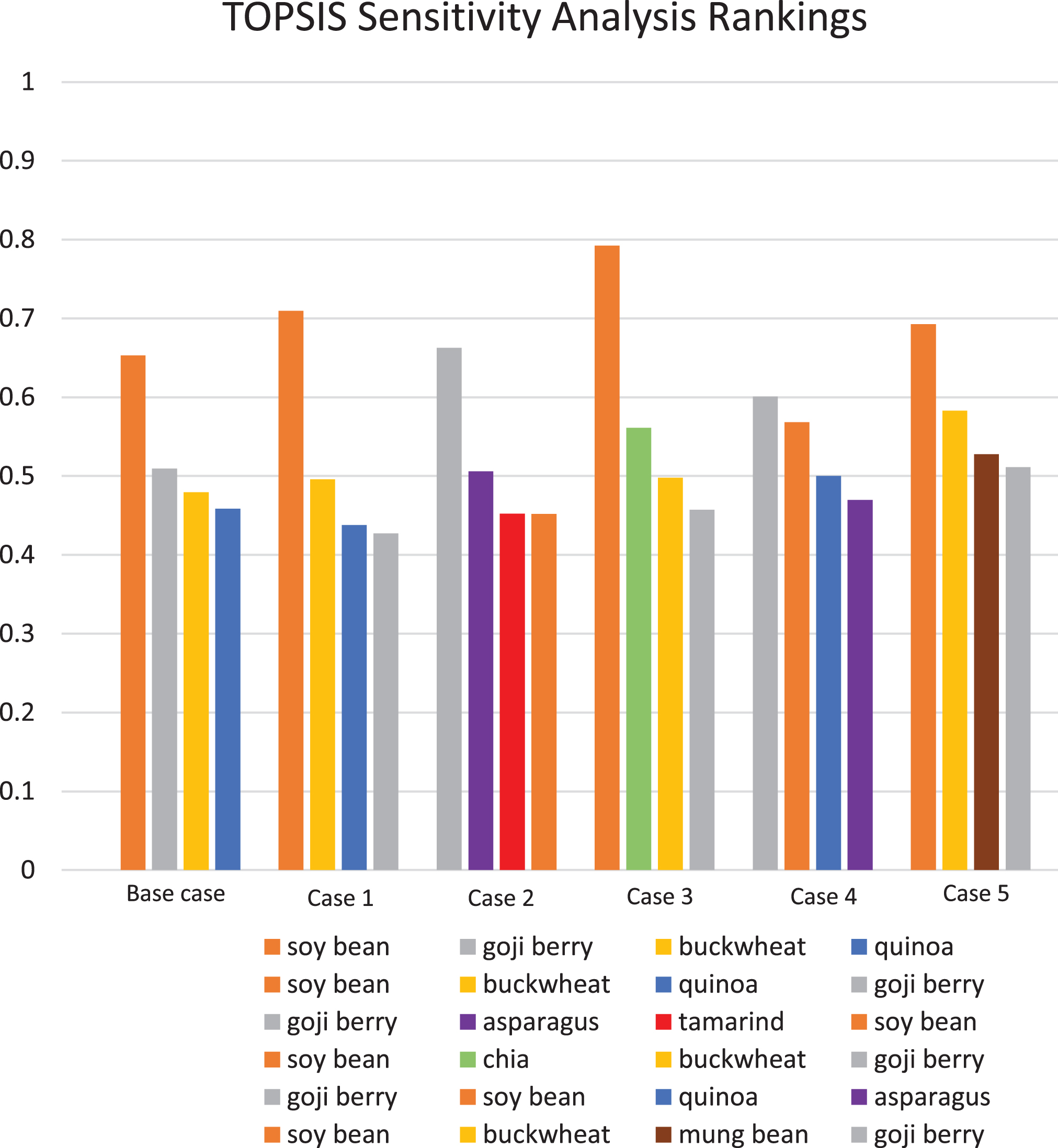
TOPSIS Rankings according to Sensitivity Analysis.
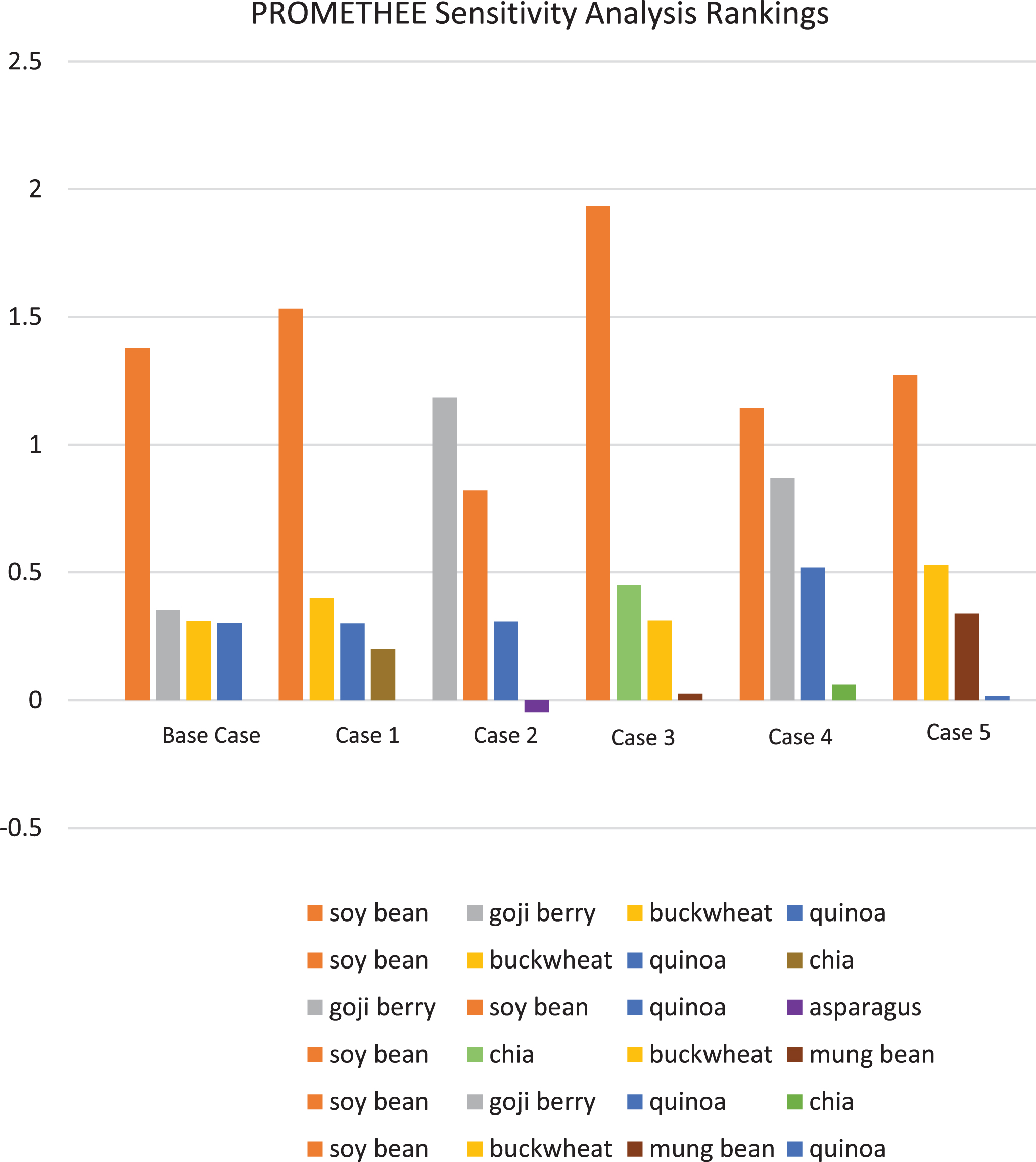
PROMETHEE II Rankings according to Sensitivity Analysis.
This paper aims to analyze a set of unfamiliar crop alternatives for Turkish agriculture and develop recommendations regarding their cultivation considering several economic, technical, social and environmental dimensions. To this end, the performed analysis provides promising results. In particular, the results of TOPSIS and PROMETHEE analysis are mainly compatible in the sense that they both advocate growing soy bean and goji berry with a strong preference, and place tamarind as the least favorable crop among all. Moreover, both methods state buckwheat and quinoa also as preferable alternatives, ranking as 3rd and 4th crops. In fact, the two methods only differ in the ranking of mung bean and asparagus; where TOPSIS states that asparagus should be the 6th preferable crop alternative and mung bean ranks the 7th while PROMETHEE ranks the two crops oppositely. However, in general, these results indicate that soy bean, goji berry and buckwheat are the strongest alternatives to grow for Turkish farmers, while tamarind may not be considered at all.
When the sensitivity analysis results are considered, it is seen that soy bean stands out as one of the best alternatives under both TOPSIS and PROMETHEE in almost all cases. Goji berry is a favored option when high profit margins and demand considerations are considered to be more significant. If environmental concerns attract higher priority, besides soy bean, buckwheat and chia are also among the favored crops. Finally, soy bean and buckwheat are again the most favored crops if climate and land compatibility are concerned. Again, these results are in consistency with the findings of the initial round of analysis; where soy bean, goji berry and buckwheat are the most favored new crop alternatives among the selected set of crops. Considering the dietary benefits, increasing popularity, high profit margins and climate- and land-compatibility of these crops, increasing their cultivation opportunities in Turkish land appears to be highly recommendable.
With the results stated above, this work clearly has certain limitations. First, selecting an entire country as the potential area for agricultural analysis might not bring the most accurate results, as the crop alternatives could be compatible with the climatic conditions in one region while not so much in other regions. However, we chose to ignore this limitation as the aim of the research was to give Turkish farmers and policy-makers some insights regarding new crop alternatives to grow. The same study can be applied to a smaller region in the country with micro-climatic conditions and more accurate conclusions can be reached. Second, the quantitative data was not at the desired level of accuracy as these crops are not well-known in Turkey. That is, in computing the domestic demand and export opportunities of some products, we sometimes had to rely on subjective expert opinions rather than exact numbers. Finally, we had to confine our analysis to eight crops, even though there can be other crops to consider (e.g. stevia, jostaberry, guava fruit ...). Obtaining data on these crops were even more difficult than the ones discussed here. Although we are aware of some limited efforts of growing other agricultural products in some regions of Turkey, we had to eliminate them from discussion. Despite these shortcomings, we believe that the method and the analysis provided here could be illuminating for the Turkish farmers and policy-makers. Moreover, the analysis could be extended to other settings by changing the parameters appropriately, resulting in a valid analysis for evaluating potential agricultural policies in other parts of the world.
Footnotes
Acknowledgments
The author thanks Ms. Zeynep Begüm Aykut and Dr. Damla Güvercin for their help in obtaining the necessary data.