



Abstract
The study aims to propose a novel model to define the role of spiritual leadership on the ethical climate for the banking industry. There are mainly three different stages in this model. Firstly, the criteria of each factor are selected with correlation coefficients by considering the balanced scorecard (BSC)-based linguistic evaluations. After that, these criteria are weighted by using interval type-2 (IT2) fuzzy decision-making trial and evaluation laboratory (DEMATEL). The third and the final stage aims to rank 5 biggest banks of Turkey which are quoted in İstanbul Stock Exchange. Within this framework, IT2 fuzzy technique for order preference by similarity to ideal solution (TOPSIS) approach is considered. The findings demonstrate that the spiritual leadership has a significant influence on the ethical climate. Altruistic love is the most important spiritual leadership dimension to improve ethical climate in the organization. On the other side, it is also concluded that private banks in Turkey are the most successful with respect to the ethical climate. The results give an idea that spiritual leader contributes to the improvement of the ties of love and respect among employees. The main reason is that altruistic love improves the judgement and sensitivity competencies of the ethical so that employees tend to be working in a more ethical way.
Keywords
Introduction
The increase in the motivation of the employees is a factor that significantly increases the organizational effectiveness of the companies. To achieve this objective, more prudent leaders are required in these organizations [1]. In modern business world, lack of commitment is an important problem making employees apathetic and unproductive. In this distressed atmosphere the need for more integrative, empirical, and ethical leadership has become prominent. In this point, workplace spirituality literature draws people’s attention to a relatively neglected dimension of work life, to our emotions and spirits to work. In spiritual theory, it is believed that people are not supposed to choose between economic prosperity and human well-being. In other words, we can be successful and effective while living our spirituality [2]. This unique type of leadership can lead modern organizations towards a more positive direction by using the goodness of humanity, care and morality [3].
Ethical climate is the perceptions that determine how individuals in the organization make decisions and what is right and wrong. In other words, ethical climate determines which behaviors are ethical within an organization. In addition, it helps to determine the appropriate criteria to behave when unethical behavior is encountered within the organization. It is possible to talk about many factors that affect the ethical climate. For example, corporate identity owned by organizations is an important issue in this process. Furthermore, developments within an organization are also important factors influencing the ethical climate. Ethical climate has many different benefits for the organization. For instance, there is a perception that unethical behaviors are followed in businesses where the ethical climate is open. This situation contributes to the minimization of negative behaviors within the organization [4].
Spiritual leadership serves both tangible and intangible ends by contributing to the performance of employees and organizational [5]. This holistic leadership style requires a holistic strategic management and performance management tool to be more beneficial. In this paper, it is aimed to understand the role of spiritual leadership on the ethical climate for the banking industry. Within this framework, BSC-based criteria are selected with correlation coefficients. After that, they are evaluated by using IT2 fuzzy DEMATEL approach. Additionally, the third and the final stage aims to rank the Turkish banks regarding the spiritual leadership by using IT2 fuzzy TOPSIS.
The main contributions of this study to the literature are to propose a set of criteria for the dimensions of spiritual leadership for the balanced scorecard-based evaluation of banking industry and to construct a hybrid decision making approach based on the correlation coefficient and interval-type 2 fuzzy methodology. Accordingly, the criteria of ethical climate are determined with respect to the spiritual leadership and measured the performance of banks by using the correlation coefficient and interval-type 2 fuzzy sets with multi-criteria decision-making models properly. So, it is possible to see which spiritual leadership dimensions are more significant for the ethical climate and which banks are more successful for the strategic managerial process of banking industry. The results can pave the way for managers to generate appropriate strategies and academicians to make further evaluations. Moreover, by making evaluation for banking industry, effective policies can be recommended for the banks to improve their performance.
Theoretical background
Spiritual leadership and ethical climate index
In spiritual leadership theory, “spirituality” is explained as the search for self-transcendence and the interconnectedness with all things in the universe. Spirituality can be seen both in organizations/groups and individuals. Marques et al. [6] defined workplace spirituality a kind of experience of interconnectedness, which is shared by all people in a workplace. Ashmos and Duchon [7] explained this concept as recognition of existence of an inner life that nourishes and is nourished by meaningful work. As Daniel [8] reflects that workplace spirituality is a central variable in developing the culture of trust, inclusion, and innovation within various workplaces. The concept of spirituality has been nourished from motivation theory. As in the case in self-actualization in Maslow’s [9] hierarchy of needs theory, in workplace spirituality theory fulling one’s spiritual needs is the highest level of one’s needs. These concepts are also valid principles in workplace spirituality. Finally, self-actualization is the situation in which individual balances both mental and spiritual sides of oneself with the aim of reaching the sustainable development, creativeness, positive mindset, and high motivation [10].
Spirituality is different from religion in the point that it is a kind of inner connectedness superior to any individual’s religion. Similarly, it is also above all individual differences such as ethnicity, status, world view, political view and so on. As Usman and Danish [11] suggest, spirituality at work, is a sanctified and blessed intangible asset for organizations’ sustainability and success. According to Moxley [12], body, mind, heart, and spirit quartet are the basis of spiritual leadership. Spiritual leaders nurture their followers with their respectful behaviors. Additionally, they demonstrate fair treatment, express caring and concern, and listen to others responsively. Spiritual leaders tend to encourage self-directed moral choice and contributes to the betterment of society by giving meaning and purpose to people about their tasks [13]. Historically, Fairholm [14] is one of the first theorists to develop a model on spiritual leadership. He has a holistic approach covering the private and professional lives of people in their organizations. The most famous leadership model in spiritual leadership literature comes from [15]. This model is shaped around the main elements of vision, altruism, hope/ belief that culminates meaningfulness at work.
Victor and Cullen [16] has explained ethical organizational climate as a collective perception regarding ethical attitudes, practices, and processes in a specific work environment. According to Aldazabal et al. [17], having a code of ethics is also among the most important antecedents of an ethical climate. On the one hand, Aziz et al. [18] claimed that supportive ethical climate is a very important factor leading to ethical organizational climate. Rest [19] also suggested an ethical climate model. He argued that for ethical work climate, individuals must engage in four basic processes: moral sensitivity, moral judgment, moral motivation, and moral character. Moreover, Arnould [20] also suggested some important dimensions for ethical work climate. In his study, collective moral sensitivity refers the prevalent norms existing in a group that leads to moral awareness and empathy. Later, Kaptein [21] also developed Corporate Ethical Virtues Model and a scale for this model. In his model the first dimension, clarity, refers to the extent to which an organization has clear expectations regarding ethical behavior.
Effects of spiritual leadership on ethical behavior
Leadership holds a clear influence on ethical and organizational climate. Specifically, spiritual leadership is one of the most important leadership styles that is quite related to morality and supports fairness, altruism, value congruence, integration, and interconnectedness. According to Sweeney and Fry [22], inner-life practices that are encouraged in workplace spirituality by spiritual leaders also enhance individuals’ capabilities in understanding and controlling their own thoughts, feelings, and behaviors. On the one hand, altruism is also an important component of spiritual leadership triggering ethical behavior. For instance, in their empirical study, Nair and Sivakumar [23] found that encouraging workplace spirituality leads to improved ethical behavior at both personal and organizational level. Naseer et al. [24] also confirmed that perceptions of workplace spirituality effect leaders’ and followers’ ethical behaviors, empathy, and gratitude levels.
Service organizations are considered as different from manufacturing companies owing to their customer-specific services and the inseparable interaction among the company, customer, and employee. In service organizations, customer satisfaction is key to success and competitive advantage depends on the quality of customer-employee-customer interaction. As Becker et al. [25] suggest, human capital is the most important competitive advantage in any service industry. This positive effect is empirically confirmed in Lee et al.’s [26] study positing that organizations possessing workplace spirituality and ethical climates tend to value, respect, humanism, and harmony. They can buffer the negative outputs of emotional labor which is mostly seen in service organizations. As Bodla and Ali [27] suggest, banking sector has experienced noteworthy and rapid changes in the last few decades.
Balanced scorecard
BSC, developed by Kaplan and Norton is a management tool for strategic control. It is an effective performance management method making performance of the whole organization with a holistic perspective. According to Kaplan and Norton [28] creating positive organizational capital necessitates a holistic approach in leading a successful strategic management process. In this context, organizational capital is a unique asset encompassing both tangible and intangible assets. Organizations having high organizational capital are often successful in integrating their tangible and intangible assets and they are good at culminating coherence among their vision, mission, and organizational strategies [29].
Organizations need a multi-dimensional and holistic evaluation and management systems that will make it possible to evaluate all organizational activities with all its dimensions. Thus, it is useful to transform a company’s vision, mission, and strategy it into physical measures through the four dimensions; financial, customer, internal processes and learning and development dimensions [30]. In customer dimension customers perceptions regarding the business is explained; in internal business processes dimension the processes that should be improved is explained; and learning and development dimension expresses how the continuity of creating and improving value can be achieved. A successfully developed scorecard can explain the grouping of key financial and non-financial metrics into this framework.
Fuzzy multi-criteria decision-making methods
Multi-criteria decision-making methods help to reach an optimal result when there are too many options. Some of these methods are taken into account in determining the weights of different criteria that affect a subject. As an example, analytical hierarchy process (AHP) and analytical network process (ANP) methods are widely used in the literature for this purpose. Wang et al. [31] calculated the weights of the factors affecting the selection of renewable energy sources with the help of AHP method. Mistarihi et al. [32] calculated the importance weights for engineering characteristics by considering fuzzy ANP approach. In addition, fuzzy entropy methodology was also preferred by many different researchers in the literature for this purpose [33, 34]. Moreover, DEMATEL methodology has also some superiorities in comparison with these approaches. With this method, impact-relation map of the items can be generated. Because of this advantage, this approach was used in many different studies [35, 36].
Some of these methods are also used to select the most optimal among different alternatives. Vlse Kriterijumska Optimizacija I Kompromisno Resenje in Serbian (VIKOR) methodology is one of the most popular approaches in this regard. Gul et al. [37] considered this approach with the aim of evaluating different risks. Similarly, Zhou and Chen [38] tried to select the best green supplier by using fuzzy VIKOR method. Moreover, TOPSIS is also another significant approach. This technique was also preferred for many different purposes in the literature [39,40, 39,40]. On the other side, multi-objective optimization method by ratio analysis (MOORA) was also used to rank different alternatives according to their importance [41, 42].
Methodology
In this section of the study, firstly, necessary information is given regarding IT2 fuzzy sets. Finally, proposed methodology is explained.
IT2 fuzzy sets
Type-2 fuzzy sets are shown as
Additionally,
The operational details of IT2 fuzzy sets are explained on the Equations (4)–(8) [45].
In this study, a novel model is proposed to understand the role of spiritual leadership on the ethical climate for the banking industry. This model consists of three different stages. In the first stage, the criteria of each factor are selected with correlation coefficients. For this purpose, firstly, BSC-based linguistic evaluations are provided for each factor and criteria. After that, the evaluations are converted into the trapezoidal fuzzy numbers. Thirdly, the matrices are deffuzified by the ranking method for the trapezoidal IT2 fuzzy sets by using the Equations (9)–(12) [46].
Where
Where
The fourth step is related to the calculation of the correlation of BSC-based factor A with the Equation (13).
On the other side, the correlation coefficient between the factor A and the criteria B is computed with the help of the Equation (14).
Finally, the greater values than average of the correlation coefficients are selected as the criteria.
The second stage includes the calculation of the weights of criteria with DEMATEL. Within this context, first, initial direct relation matrix is generated by considering the linguistic evaluations of the experts [47]. After that, they are converted into the IT2 fuzzy sets. Next, the normalization procedure has been performed by using the Equations (15)–(17) [48].
The fourth step is about the generation of the total influence matrix. In this context, the Equations (18)–(22) are taken into account [49].
In the next stage, the defuzzification process is applied and the weights of the factors are identified by considering the total values of rows and columns [50] by the Equations (23)–(26)
The third and the final stage aims to rank the alternatives. In the first two steps, the linguistic evaluations are provided and converted into IT2 fuzzy numbers. Thirdly, the values are defuzzified. After that, the weighted values of the matrix are calculated [51, 52]. The values of D+, D–and closeness coefficient CC
i
are calculated in the next steps so that the alternatives can be ranked. Within this context, the Equations (27)–(29) are considered [53, 54].
The analysis of this study consists of three different stages which are detailed as the subtitles. The flowchart of the proposed model is given in Fig. 1.
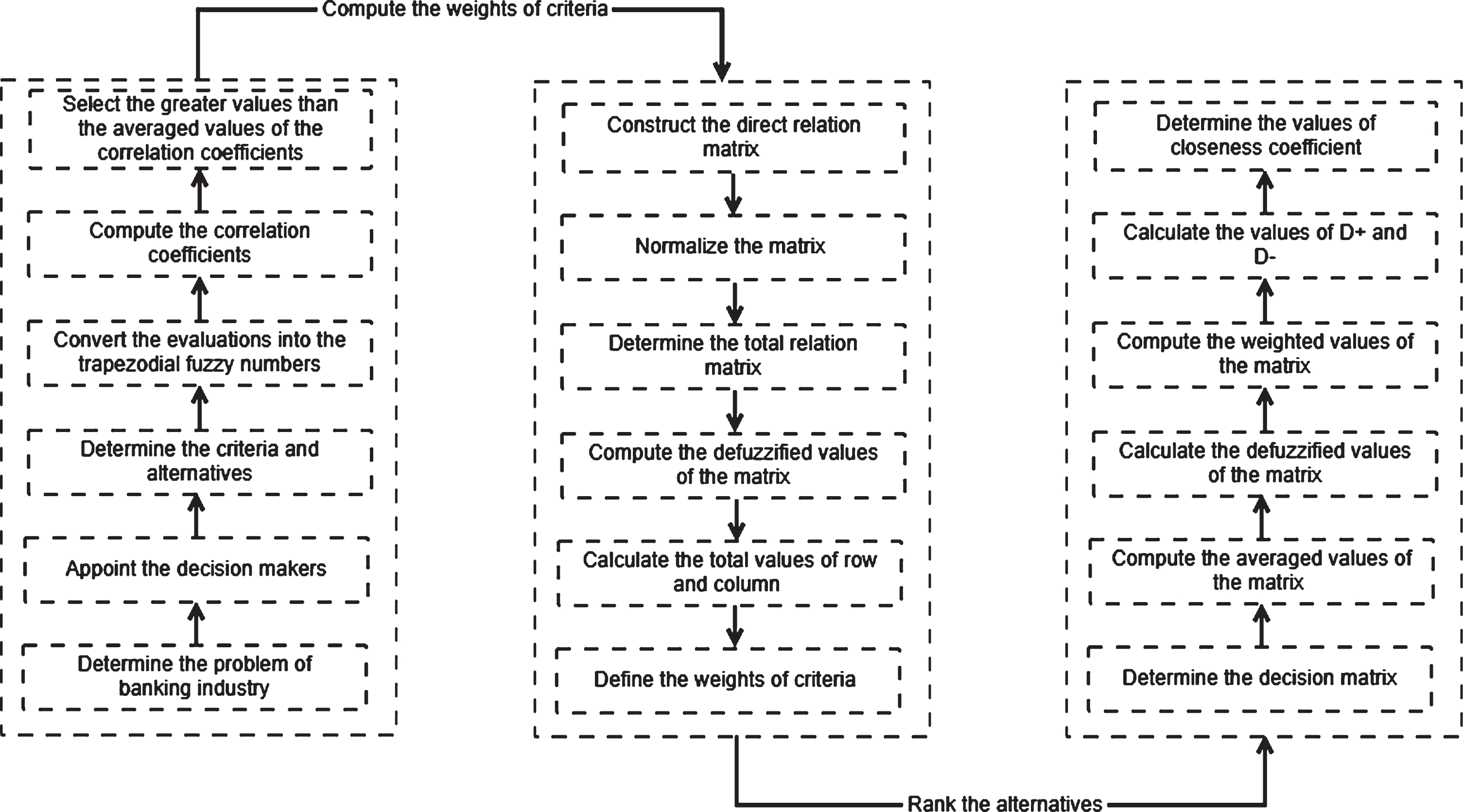
The flowchart of the proposed model.
In this study, it is aimed to propose a novel model to identify the role of spiritual leadership on the ethical climate for the banking industry. There are mainly three different stages in this model. In the first stage, the criteria of each factor are selected with correlation coefficients by considering the BSC-based linguistic evaluations. Moreover, these criteria are weighted in the second stage with the help of IT2 fuzzy DEMATEL. Finally, 5 biggest banks of Turkey which are quoted in İstanbul Stock Exchange are ranked by considering IT2 fuzzy TOPSIS.
The main reason of selecting DEMATEL approach is that impact-relation map between the factors can be identified. This situation provides opportunity to understand causal relationship among the criteria. This situation is accepted as a significant advantage of DEMATEL methodology in comparison with other similar approaches [55]. On the other side, BSC method has also some important advantages. The main benefit of this technique is that it considers both financial and nonfinancial issues in the analysis process at the same time [56]. Moreover, TOPSIS methodology has also superiority over other similar methods. Some of the methods consider only the distance to the positive ideal solution. However, the biggest advantage of TOPSIS is that it takes into consideration the distances to both positive and negative ideal solutions. This situation contributes to reach more appropriate results [57].
Additionally, in this proposed model, IT2 fuzzy sets are taken into account. The main reason of using these sets is to handle uncertainty more effectively [58]. Furthermore, in this study, a hybrid methodology is preferred by considering both DEMATEL and TOPSIS approaches. In order to rank the alternatives, some criteria are also used. The weights of these criteria can be accepted equal of these weights can be defined by the authors subjectively [59–61]. It is obvious that these issues have some disadvantages because it would be more appropriate to define the weights of the criteria objectively [62, 63]. In this framework, while using a hybrid methodology, firstly, criteria are weighted with DEMATEL. After that, alternatives are ranked by TOPSIS model. In the process of ranking the alternatives, weighted criteria by DEMATEL are taken into consideration. Hence, because of defining the weights of the criteria more objectively, it is thought that hybrid model has some advantages by comparing with other techniques [64, 65].
Firstly, the criteria of ethical climate index are defined as in Table 1.
Criteria of Ethical Climate Index
Criteria of Ethical Climate Index
On the other side, Table 2 gives information about the dimensions of spiritual leadership.
Dimensions of Spiritual leadership
The evaluations regarding spiritual leadership and ethical climate index are obtained from three different experts. These people consist of the academicians that have at least 13-year experience in this area. The details of the linguistic scales and IT2 fuzzy numbers are given on Table 3.
Linguistic Scales and IT2 Fuzzy Numbers for Correlation Coefficient
After that, the defuzzified values of the BSC-based decision matrix are calculated as in Table 4.
Defuzzified values of BSC-based decision matrix
Next, the values of the correlation coefficients are calculated. They are detailed on Table 5.
The values of correlation coefficients (mean value:0.865)
In the final step, recognitive ethical climate competencies for spiritual leadership are defined as in Table 6.
Recognitive ethical climate competencies for Spiritual leadership
The experts made evaluations regarding the criteria. After that, they are converted into the IT2 fuzzy numbers denoted in Table 7.
Linguistic scales and IT2 trapezoidal fuzzy numbers for DEMATEL
Linguistic scales and IT2 trapezoidal fuzzy numbers for DEMATEL
Next, direct relation matrix is generated. On the other side, the defuzzified total relation matrix is detailed on Table 8.
Defuzzified total relation matrix
Finally, the weights of the criteria are identified in Table 9.
Importance and influence degrees of the criteria
Table 9 indicates that the judgement is the most important ethical climate competency for spiritual leadership. Moreover, it is also defined that the sensitivity is another significant criterion in this framework.
In the final stage of the analysis, 5 biggest banks, which are quoted in İstanbul Stock Exchange, are examined. The details of these banks are given on Table 10.
Selected alternatives for banking industry
Selected alternatives for banking industry
The details of the expert evaluations are demonstrated on Table A5. After that, the defuzzified decision matrix is generated and depicted on Table 11.
Defuzzified Decision Matrix
In the next stage, the weighted decision matrix is calculated and detailed in Table 12.
Weighted Decision Matrix
Finally, alternatives are ranked, and the results are shared in Table 13.
Ranking results for alternatives
Table 13 explains that private banks are the most successful with respect to the ethical climate competencies for spiritual leadership.
Rapid changes in today’s modern society and divergence from traditional, bureaucratic, and high standardized organizations created the need for new forms of organizations differing radically from non-spiritual organizations. In the last few decades the burdens of capitalism have compelled organizations to turn from control and fear-oriented structure to more motivational-oriented flexible and humane structures [15], and so the need for more flexible, more people-oriented, empowering and caring leadership styles has increased. Hence, with the effect of latest developments in psychology and management literature, more positive, holistic and ethic leadership styles such as authentic leadership, servant leadership, ethical leadership, and spiritual leadership have emerged. Moreover, as Duthley [66] suggests spiritual leadership has come about as a viable solution to unethical practices of modern business life by emphasizing personal ethics, interconnectedness within organizational members and spiritually oriented practices and attitudes. Spiritual leaders sensitive about ethics, integrity, independence and justice [14]. Their holistic managerial approach is nourished by humanistic and moral practices leading to an ethical work climate and positive atmosphere escalating positivity among all organizational members [1].
In service sector, as in the case with banking sector, higher education levels of employees lead to higher expectations regarding managerial styles. On the one hand, nature of service sector, namely, oppressing working conditions, too much customer contact, heavy workload, burdensome performance goals and limited time for individual relaxation creates higher need for a more spiritually oriented leadership at workplaces. Moreover, disturbance from unethical and unfair practices of highly competitive modern business world make people search for meaning and alternative ways (including spirituality) to motivate themselves at work. Actually in the extant literature, there are already some empirical studies confirming the benefits of spiritual leadership in service sector for example; In Quinnine’s [67] study confirmed the importance of spiritual leadership for creating a more service-oriented organization, Norman [68] on lowering employees’ stress level and increase job satisfaction and organizational commitment. Furthermore, many sector specific empirical studies have given proof for spiritual leadership’s positive organizational effects, such as studies on hospitality [69], retailing sector [70], health industry [71] and public service organizations [72, 73]. This study revealed this positive effect on banking sector in Turkish context. When the extant literature although scarce in numbers, we can come across some studies applied in banking sector regarding ethical organizational climate criteria. For instance, Sunardi and Pradesa [74] investigated the most important factors reflecting ethical climate in rural banks in Indonesia. Their findings show that that ethical climate index is most reflected by collective moral sensitivity dimension, but in contrary boards of directors in rural banks also recognize the lowest perception in this dimension.
In this study, we assumed that spiritual leadership has a positive effect on easing the effect of these problems and will culminate a positive perception regarding ethical work climate in Turkish banking sector. On the one hand, in order to understand availability of spiritual leadership in this unique sector we wanted to examine the possible criteria for understanding existence of spiritual leadership and ethical work climate in Turkish banks
In figuring out the link between spiritual leadership and ethical work climate we embraced BSC methodology. As Fry and Slocum [5] suggest spiritual leadership has the culminate organizational transformation in maximizing the triple bottom line. Being inspired from this “People, Planet, Profit” business model, in this study we embraced a methodology BSC, a holistic literature balancing both financial and non-financial metrics in strategy implementation and performance management in linking the possible ethical outcomes of spiritual leadership, again a holistic leadership style encompassing both business goals and ethical goals, in creating ethical organizational climates.
Conclusions
In this study, it is aimed to determine the role of spiritual leadership on the ethical climate for the banking industry. Three different stages have been applied in the analysis process of the study. Firstly, the criteria are identified by using correlation coefficients. The second stage includes the calculation of the weights of criteria with IT2 fuzzy DEMATEL. The third and the final stage aims to rank 5 biggest banks of Turkey which are quoted in
The findings show that the spiritual leadership has an essential influence on the ethical climate. Additionally, altruistic love is found as the most important spiritual leadership dimension to improve ethical climate in the organization. It is concluded that the judgement is the most important ethical climate competency for spiritual leadership. Furthermore, it is also identified that the sensitivity is another significant criterion in this framework. Also, it is determined that private banks are the most successful with respect to the ethical climate competencies for spiritual leadership.
The main limitation of this study is evaluating only banking industry. However, the concepts of ethical climate and spiritual leadership are also important for other industries. Hence, in the future studies, different industries can be examined, such as telecommunication and energy. In addition, other multi-criteria decision-making methods can also be used in the analysis process. For instance, AHP method can be used to weight the criteria whereas the alternatives can be ranked by VIKOR methodology. On the other side, it can also be helpful to consider the self-confidence and social relationship of decision makers. For this purpose, consensus decision-making technique can contribute to reach more effective results in this process [75, 76]. Additionally, linguistic distribution assessment was also preferred in recent studies in order to represent uncertain preferences in large-scale group decision making [77].