



Abstract
Unmanned Aerial Vehicles (UAVs) are increasingly used in the military field. Especially in recent years, UAVs have been a very effective instrument in gaining airspace superiority and military success. Many countries compete with each other to develop better UAV technology or improve the technical features of UAVs. Therefore, it is critical to determine which UAV has the best performance, considering technical and operational characteristics, because the vehicles with more advanced performance can provide countries with strategic superiority. The purpose of this study is to investigate the technical, cost, and operational performance of Medium Altitude Long Endurance UAVs (MALE UAVs). In the study, as a result of a wide literature review, we determined a performance criterion for this type of vehicle. The model presented here uses an Interval Type-2 Fuzzy Analytical Hierarch Process (IT2FAHP) and an Interval Type-2 Fuzzy Technique for Order of Preference by Similarity to an Ideal Solution (IT2FTOPSIS) hybrid method. The findings indicate that some MALE UAVs have superior technical and operational performance over others and demonstrate that range, max take-off weight, and payload are important criteria in determining the performance and superiority of these vehicles.
Introduction
War has played a significant part in shaping history. According to one study, there have been 14,531 wars in the 5,560 years of human civilization, which means that, on average, only ten of 185 generations of humans never experienced war. It is not an exaggeration to say that the history of humanity is almost the history of wars, given that at least two wars occur every year on average. Sovereign states, who are prominent members of the international community, frequently resort to war because they believe it is their right [1]. Air superiority is critical to military victory in conventional modern warfare. Mastery of the air, according to airpower theorists, has long been a top priority for military success. Air superiority boosts combat power by allowing more force to be deployed at any given time and location. The actor will most likely win the engagement because of its superior air superiority and combat power. Air superiority also increases combined arms operations, maneuverability, and firepower, all of which aid war power [2].
Since 1917, air superiority has given countries the ability to win wars. In 1917, both sides used bold and creative air power to break the stalemate in the European land war [3]. Air superiority, particularly during WWII, was crucial to a country’s success and has proven to be the deciding factor in modern conflict since the implementation of an air-centered strategy during WWII [4]. Today, air superiority is more important than ever. The ability to control the country’s airspace and conduct military operations, in particular, ensures wartime success. UAVs are increasingly becoming one of the factors that give countries a strategic advantage and they are being used more widely in a variety of fields, including logistics, military operations, public safety, traffic surveillance, and monitoring, thanks to rapid technological advancements over the last decade [5].
In recent years, significant progress has been made in terms of the usability and capability of Unmanned Aerial Systems (UAS), also known as “drones”, UAVs, and Remotely Controlled Aircraft (RCA). These tools have grown in popularity and have become more widely used. Smaller batteries, cameras, flight control computers, and other important UAS components have been developed for these vehicles. The capabilities of UAS have also increased dramatically as systems in UAVs have become cheaper and more plentiful [6]. The modern air battlefield has been transformed by the increasing capability of UAVs and the global spread of these vehicles has accelerated in recent years [7]. From a strategic perspective, having armed drones has given many countries military advantages. Furthermore, armed unmanned aerial vehicles have proven to be a less expensive and more effective alternative to manned aircraft [8]. A new era of UAVs warfare has begun, involving even more players. Beyond counter-terrorism or insurgency, UAVs are used in wide-ranging conventional warfare. As technology becomes more complex, artificial intelligence-based UAVs are being developed. Although UAVs are not as capable as warplanes, states and non-state groups that can’t afford to buy fighter jets can gain access to air power through UAVs. At the same time, the high-resolution surveillance and precision strike power of UAVs can be quite deadly [9]. These features have prompted the increase in the demand for armed drones for military use by many countries. Military drones were only available in 60 countries in 2010, but by 2019 that number had risen to more than 100. UAVs are becoming more prevalent in global events, particularly in areas where geopolitical tensions are high [9, 10]. Because they are effective, pose fewer risks, and are less expensive, UAVs are expected to become more common in the future. Countries have begun to use a broader range of options to produce or acquire this technology and, as a result, the question of which UAVs perform better is becoming increasingly important.
In today’s world, uncertainty is encountered almost everywhere when important decisions are made by decision-makers at all levels of organizations along with many known criteria and objectives. To deal with such problems (1) using Multi Criteria Decision Making (MCDM) methods can easily provide solutions to such problems by taking into account the objectives and criteria of the problem in terms of a holistic approach [11]. Traditional MCDM methods based on human judgments with exact value judgments can be insufficient especially in uncertainty environment, furthermore, in such cases, it can be very difficult for decision-makers to make a decision by evaluating the issue with exact numbers since the criteria may have a special subjective and qualitative nature [12]. To deal with such situations (2) fuzzy set theory using approximate information represents the uncertainty and stated knowledge in more naturally and easily copes with this kind of decision-making problems [13]. Therefore, presenting a solution for decision-making problems with IT2FSs MCDM methods obtains more flexibility in the uncertainty of the model thanks to the three-dimensional membership functions used by IT2FSs [14–16]. When all these features are taken into account, the importance of MCDM methods in the decision-making processes of MALE UAV selection is increasing day by day, especially as their operational use is centered around highly uncertain environments. It is critical for countries to be able to use UAVs in war as these reduce the risk to the lives of their soldiers [17]. UAVs will be used more widely in the near future for this reason and the other military advantages they provide. Performance benchmarking is required for countries that will face the option of designing or purchasing UAVs. As a result, comparisons between UAVs in terms of technical and operational performance and cost are subjects that deserve research. Accordingly, the aim of this study is to compare MALE UAVs in terms of performance and technical features. In this way, we aim to identify which have the best performance and determined this based on performance criteria found in previous literature. Therefore, we also looked to reveal the most important performance indicators for these vehicles.
The remainder of this study is as follows. In the second section, we examine the studies in the literature. In the third section, we have included an explanation of the IT2FAHP and IT2FTOPSIS methods. The last section includes the discussion and conclusion.
Literature review
In this section, we have briefly outlined a literature review focusing on articles that consider the selection of UAVs and aircraft in the aviation industry by MCDM methods.
Appropriate aircraft selection is critical in both civil and military aviation. It allows airlines to make optimum fleet planning for commercial air transport as it facilitates the determination of the best aircraft, based on financial and operational performance, among aircraft appropriate for the flight network. In terms of military aviation, it is critical to choose aircraft appropriate for specific military purposes. The issue of military aircraft selection may be related to training aircraft as well as combat aircraft and UAVs. MCDM is the main method used to determine the most appropriate alternative for the purposes by considering more than one criterion. By using MCDM methods, it is possible to select the most appropriate alternative in an uncertain environment with group or expert opinion. In the current literature on aircraft selection, Bakır et al. [18] focused on regional aircraft selection. Fuzzy Pivot Pairwise Relative Criteria Importance Assessment (F-PIPRECIA) and fuzzy Measurement Alternatives and Ranking according to the Compromise Solution (F-MARCOS) methods were employed. In a similar study on aircraft selection, Dožić and Kalić [19] examined aircraft selection problems with the Analytic Hierarchy Process (AHP) and Fuzzy Analytic Hierarchy Process (FAHP) methods. Kiracı and Bakır [20] analyzed the commercial aircraft with the highest demand with the AHP, COPRAS, and MOORA methods and concluded that the Boeing 737–800 type aircraft was the most appropriate. Another study on the selection of commercial aircraft for airlines was carried out by Kiracı and Akan [21] and focused on the problem by using the Interval Type-2 Fuzzy Technique for Order of Preference by Similarity to an Ideal Solution (IT2FTOPSIS) and Interval Type-2 Fuzzy Analytical Hierarch Process (IT2FAHP) hybrid methods. According to the findings of the study, the Airbus A321neo aircraft was the most appropriate in terms of environmental, economic, and technical aspects. Dožić [22] studied a literature review in relation to MCDM methods in the field of civil aviation literature. It is shown that MCDM methods have been used from many different perspectives, such as performance, selection, service quality, and safety, however, MALE UAV nor UAV studies were not found in the review. Deveci et. al. [23] studied new route selection in North America by an airline. In the study, 5 new routes were analyzed by the IT2FTOPSIS method to select the most optimal route. The study consisted of 11 criteria from different perspectives. As a result of the study, by applying MCDM methodology, it was successfully shown that an optimal route could be selected in the aviation industry. Deveci et al. [24] analyzed the level of service quality of domestic airlines operating in Turkey and servicing between Istanbul and London. The aim was to improve their service quality by using the Interval type-2 hesitant fuzzy sets MCDM method. Görener et al. [25] proposed a methodology in relation to supplier performance evaluation by using IT2FFAHP and IT2FTOPSIS in the aviation industry.
There are studies in the literature that focus on aircraft selection problems other than those of commercial aircraft selection for airlines. In the military field, it is critical to determine the aircraft needed and these are not restricted only to aircraft used in wars but also for the aircraft to be selected for military training purposes. e.g.; S
The environmental issue in the aircraft selection problem is among the main issues that policymakers and companies have focused on recently. In the literature, it is seen that studies on carbon emissions, aircraft noise, and other environmental impacts of aircraft have been carried out. Miyoshi and Mason [28] analyzed aircraft carbon emissions for the North Atlantic, UK, and EU geographic markets. In the study using the DEFRA-type measurement approach, increasing the load factor and higher density cabin configurations were recommended. Mahahabde et al. [29] focused on the environmental impact of aircraft noise and emissions. In the study, the deficiencies in current decision-making practices related to the environmental policies in the aviation industry were analyzed. In addition, scientific and economic uncertainties underlying policy choices were identified. Lee et al. [30] analyzed historical cost data of aircraft performance to examine the potential rate of emission reduction from aircraft. Huang et al. [31] created a model of energy and emissions savings potential for light aircraft components and found that light aircraft parts could save 1.2–2.8 billing GJ of energy and 93–217 million tons of greenhouse gas (CO2).
In the current literature on MALE UAVs, Panagiotou and Yakinthos [32] examined the performance and efficiency of fixed-wing UAVs. In the study, guidelines were designed for scanning drag-reduction technologies on the UAV wing platform. The article contributed to future aerodynamic and performance improvement studies for UAVs. Elmeseiry et al. [33] focused on various applications of UAVs, such as search and rescue, real-time surveillance, reconnaissance, delivery, agriculture, environmental protection, and wireless communication. In addition, the article examined the possible future uses of UAVs. Siddappaji et al. [34] examined the applicability of the Internet of Things (IoT) technology on UAVs focusing on the integration of the IoT system with the recovery system, radio link, autopilot system, payload, and the launch and ground control stations (GCS). Hann et al. [35] looked at icing during atmospheric flight for UAVs. In the experimental study, two electro-thermal ice protection systems for fixed-wing UAVs were tested and Anti-Icing and De-Icing in the context of climatic effects in UAVs were examined.
MCDM methods are frequently used in uncertain environments where there is a selection problem. In the literature, studies on the shipping industry have been carried out using MCDM [36–38]. In other studies on MCDM, Çelik et al. [39] reviewed articles using MCDM approaches based on IT2FSs. Recent studies have used Integrated COPRAS and ARAS [40] and TOPSIS and Entropy MCDM techniques [41] on selection problems. Thus, IT2FSs integrated MCDM methods have successfully been applied in many study areas.
Accordingly, in our current study, MALE UAVs were evaluated by using expert opinions through IT2FAHP and IT2FTOPSIS multi-criteria decision-making methods.
Methodology
In this section, IT2FSs, IT2FAHP and IT2FTOPSIS were briefly introduced.
Interval Type-2 fuzzy sets
IT2FSs were developed by Zadeh [15] as extension of type-1 fuzzy sets having membership degree as type-1 fuzzy sets. A type 2 fuzzy set
Where J
x
states an interval [0,1]. The type-2 fuzzy set
Where J
x
⊆ [0, 1] and ∫state union over all admissible x and u. Let
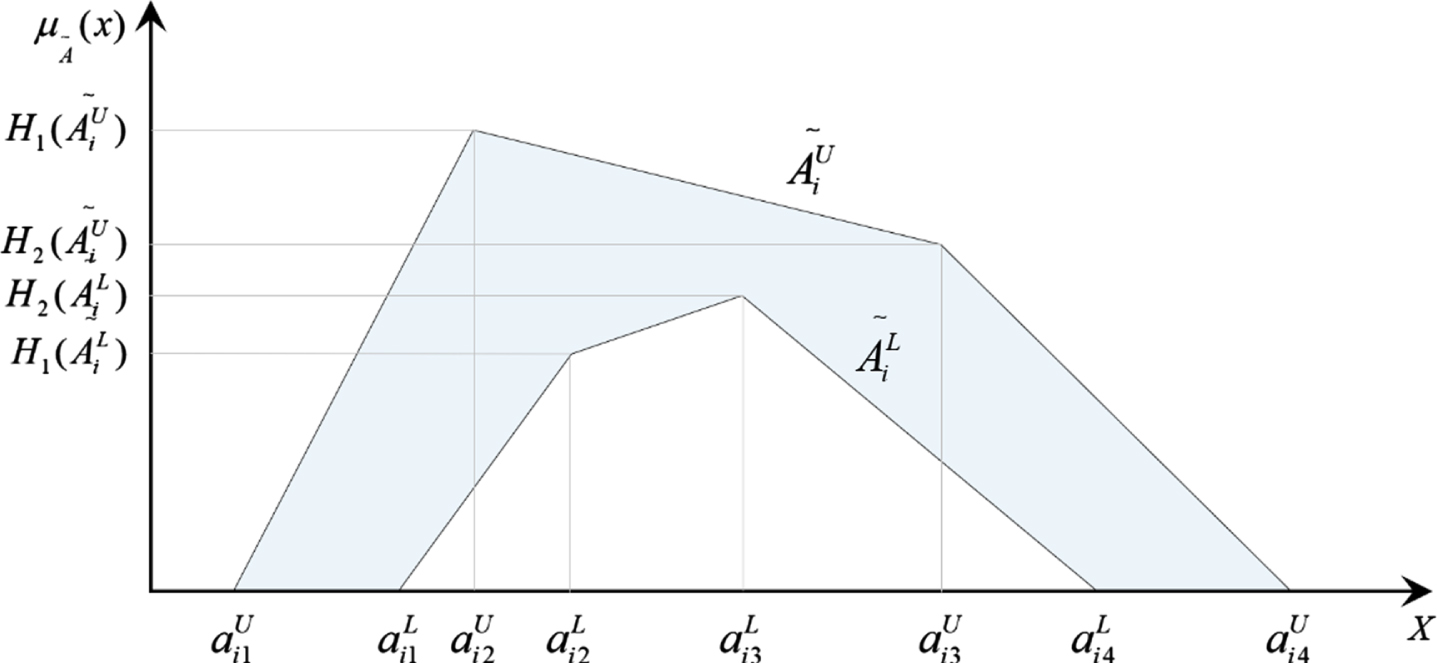
Trapezoidal interval type 2 fuzzy numbers.
A trapezoidal IT2FSs are defined as
The basic arithmetic operation of interval trapezoidal IT2FSs described as
The AHP method, proposed by Saaty [46], comprise an objective, alternatives, and a hierarchical structure in MCDM problems. The AHP evaluates a quantifying relative priority of the problem based on decision makers’ judgements with crisp numbers. However, decision makers may not evaluate judgement as crisp values in real life as evaluation contains some uncertainty and subjectivity. Fuzzy sets help decision making by increasing accuracy. Also, since IT2Fs were introduced, it gives better solution than IT1Fs as IT2Fs have flexible membership functions [47]. IT2FAHP has been applied to many problems since it was introduced to literature. The IT2Fs linguistic variables are presented in Table 1.
IT2FS linguistic variables [48]
IT2FS linguistic variables [48]
The IT2FAHP method is presented step by step as follows [48].
where,
The geometric mean of k IT2FSs are evaluated for k th decision makers. In Table 1, the linguistic variables are represented for evaluation. The decision makers’ decisions in the pairwise comparison matrices are aggregated by means of the geometric mean method in Equation (13). The IT2FSs linguistic variables are presented in Table 1.
where,
where,
where,
where a and β are the maximum membership degrees of the lower membership function of the considered IT2FSs. u U is the largest possible value, l U is the least possible value and, m1U and m2U are the second and third parameters in the upper membership function. Also, u L is the largest possible value, l L is the least possible value and, m1L and m2L are the second and third parameters in the lower membership function.
The TOPSIS strategy to begin with was proposed by Hwang and Yoon [49]. In this study IT2FTOPSIS is taken into consideration and handled based on fuzzy multiple attributes group decision-making problems [45, 50]. Expect that there’s a set X of options, where X ={ x1 , x2, . . , x n } and assume that there is a set F of attributes, where F ={ f1 , f2, . . , f m }. Assume that there are k decision-makers D1, D2, . . . , and D k . The set F of attributes can be divided into two sets F1 and F2, where F1 denotes the set of benefit attributes, F2 denotes the set of cost attributes F1 ∩ F2 = φ and F1 ∪ F2 = F. In Table 2, Linguistic terms and its corresponding IT2FSs has been used for TOPSIS [45]. The proposed method is now presented as follows:
Linguistic terms and its corresponding IT2FSs [45]
Linguistic terms and its corresponding IT2FSs [45]
Where
Where
Where
Where 1 ≤ i ≤ m. and 1 ≤ j ≤ n.
Lee and Chen [50] presented the concept of ranking values of trapezoidal IT2FSs. Let
Where
and
Where F1 denotes the set benefit attributes, F2 denotes the set of cost attributes, and 1 ≤ i ≤ m.
Where 1 ≤ j ≤ n. calculate the distance d- (x
j
) between each alternative x
j
and the negative ideal solution x-, shown as follows:
Where 1 ≤ j ≤ n.
Where 1 ≤ j ≤ n.
In this section, a methodology is presented as regards a selection problem of MALE UAV.
Definition of the problem and data collection
In this study, MALE UAVs were compared in terms of performance considering their technical features in IT2FSs environment, so a selection of MALE UAVs is proposed. A flowchart of the proposed methodology is presented in Fig. 2. The solution of the proposed methodology is designed based on IT2FAHP and IT2FTOPSIS. On the other hand, in Fig. 3, the hierarchical structure of MALE UAVs selection problem is illustrated. It consists of three level, the first is MALE UAVs to select, the second is the criteria for evaluation in selection process, and the third level is MALE UAVs to select. The solution of the problem consists of two phases.
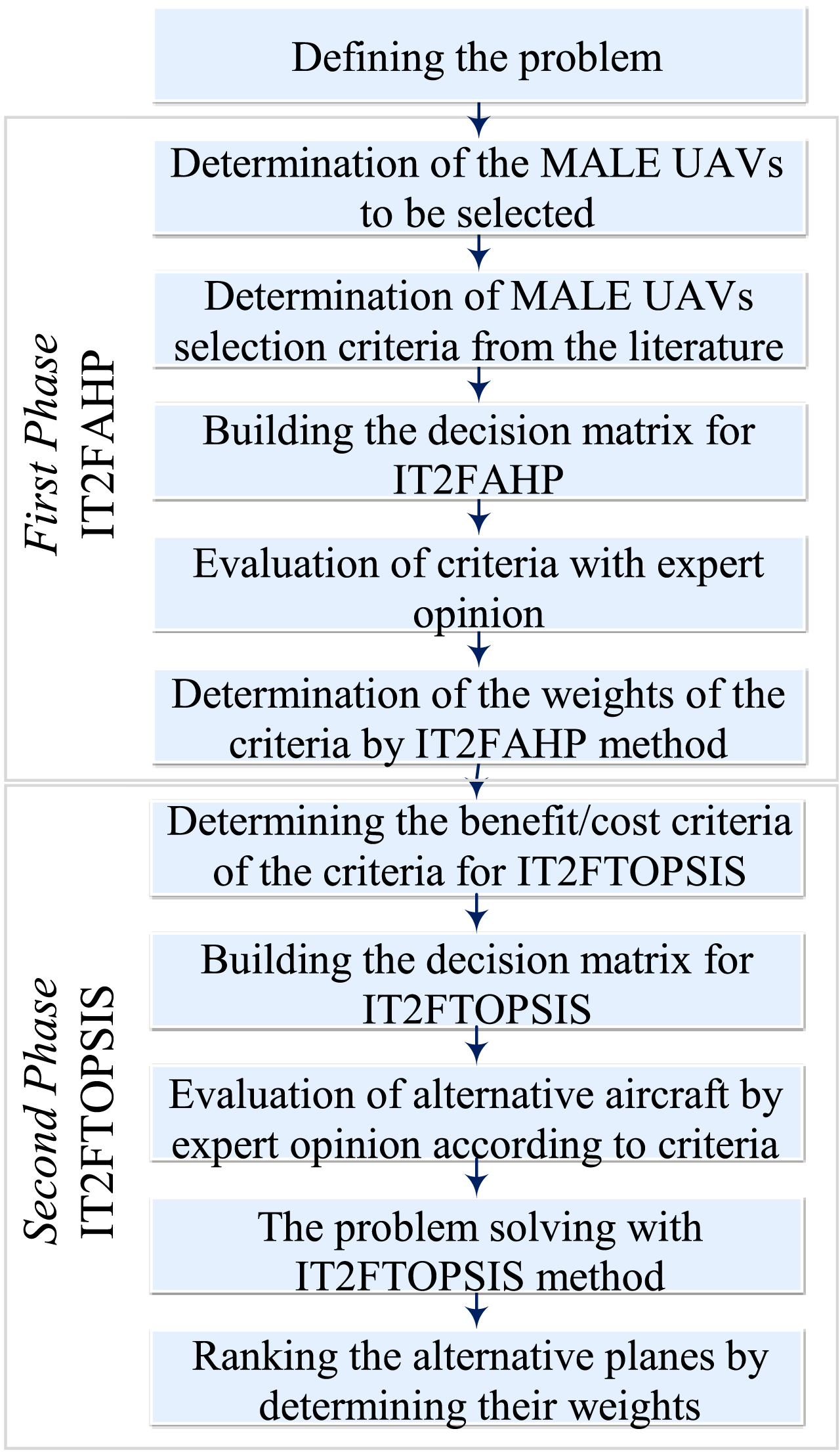
Proposed methodology.
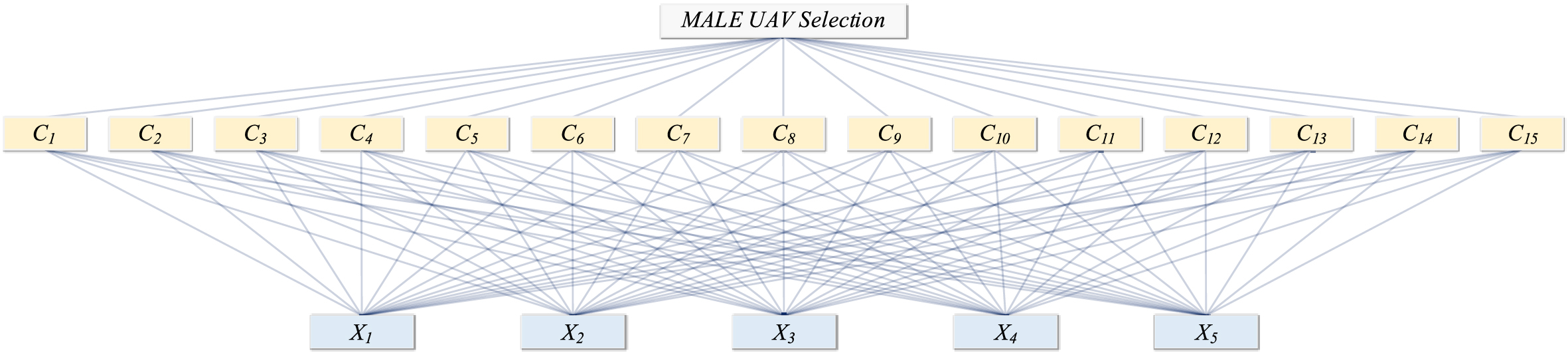
The hierarchical structure of selection model.
The first phase is about calculating weights of the MALE UAVs criteria. This stage is computed by IT2FAHP method. In this study, there are 15 criteria as C i ={ C1 , C2, . . , C15 }, i = 15, i > 0, i ∈ N. These criteria were collected by evaluating from the literature. The 15 criteria are presented as well as definition of the criteria in Table 4. Furthermore, the second phase is about determining the MALE UAVs after selection. This stage is computed by IT2FTOPSIS method. In this study, there are 5 MALE UAVs as X j ={ X1 , X2, . . , X5 }, j = 5, j > 0, j ∈ N. These MALE UAVs are actively operating and evaluated from the worldwide. In Table 3, the MALE UAVs to select are presented along with their specifications.
Specifications of MALE UAVs
Source: provided by authors from open sources.
The criteria of MALE UAV
On the other hand, in this study, 4 experts as decision makers evaluated MALE UAVs selection criteria for IT2FAHP method also, they evaluated ranking of MALE UAVs for IT2FTOPSIS method. The decision makers having experienced in MALE UAVs and, are academicians.
After all, the problem is consisting the steps as follows.
In this phase, it is aimed to determine weights of the 15 criteria. After decision makers evaluations of the criteria, the computing process was applied by IT2FAHP.
Linguistic variables of the pairwise comparison matrix for criteria
Linguistic variables of the pairwise comparison matrix for criteria
The calculations process was applied to the elements of remain the pairwise comparison matrices for
Linguistic variables of the pairwise comparison matrix for criteria (continue)
The calculations process applied to the elements of the remain rows as
Aggregated interval type-2 fuzzy pairwise comparison matrix for criteria
Aggregated interval type-2 fuzzy pairwise comparison matrix for criteria (continue)
The calculations process applied to the elements of the remain weights as
Also, calculated
Interval type-2 fuzzy and normalized weights of technical criteria
Aggregated interval type-2 fuzzy pairwise comparison matrix for criteria (continue)
In this phase, it is aimed to rank MALE UAVs by IT2FTOPSIS method in terms of selection. After decision makers evaluations of the criteria, the computing process was applied by IT2FTOPSIS. In previously phase, weight of criteria has been computed by means of IT2FAHP.
Decision matrix for evaluation of alternatives by experts
Decision matrix for evaluation of alternatives by experts
Hence, the remain
Decision matrix
Cost or Benefit criteria
Cost (C), Benefit (B).
The remain
Weighted decision matrix
The remain
Where 1 ≤ j ≤ 5, the remain C (x j ) are computed by the same way as C (x2) =0.25, C (x3) =0.14, C (x4) =0.87 and C (x5) =0.66.
In Table 15, the MALE UAVs selection ranking is given as a result of the application of the IT2FAHP and IT2FTOPSIS methods. With respect to the scope of the study, the MALE UAVs were evaluated in terms of different 15 criteria aspects such as technical, economic etc. The findings of the analysis show that the X4 is the most suitable MALE UAVs alternative for users. The second most suitable alternative is the X1.
Ranking of MALE UAV alternatives
The use of UAVs allows countries to gain airspace dominance, which has a positive impact on military success. In addition, owning UAVs has a number of advantages over other forms of conventional military hardware. UAVs, for example, have the advantage of being able to conduct military operations at a lower cost than other methods and are safer and lower-risk, and their use results in fewer military casualties. As a result, possessing UAVs allows countries to gain strategic superiority in the battle arena. In conventional warfare, UAVs also provide intelligence support, which is critical to success. They are used for this purpose because of their ability to stay in the air for long periods in remote or high-altitude mountainous regions Furthermore, their ability to detect targets, monitor movements, and hit targets makes military operations more successful. In many ways, UAVs are becoming a game-changer on the battlefield. As a result, various countries are attempting to acquire and better utilize UAV technology, which makes the performance of their UAVs more important.
In this study, we first identified vehicles in the MALE UAVs class in this research. There is no definite classification in this regard, but we identified 5 UAVs that can be included based on their technical features. The criteria for MALE UAVs are listed in Table 4. In the second stage, we used literature studies and expert opinions to determine the performance criteria. We looked at the MALE UAVs from a technical standpoint, trying to include as many performance criteria as possible. As a result, we examined the performance of the MALE UAVs using 15 performance criteria. The IT2FAHP method was used to determine the criteria weights in the study as this is one of the most frequently used methods for MCDM in the current literature [71–74]. The findings of our study show that the most important performance criterion was C5 Range. Control systems related to UAVs may limit their range or communication capabilities [75]. Therefore, UAVs with a long-range can provide strategic superiority in warfare. This situation also makes it possible to carry out operations in areas far from the border region. C3 Payload was identified as the second most important criterion for MALE UAVs. Payload capability is concerned with the weight of the ammunition carried, as well as all the equipment, such as computers and cameras [32], which must be on the UAVs in order to fulfill the mission. The high payload capacity of MALE UAVs in battles indicates that they have greater operational capability. Therefore, the payload weight of MALE UAVs is extremely critical. According to the analysis of the results of the study, we found that the next most important criterion was C4 Max Take-Off Weight (MTOW). MTOW is important as UAVs with a lower take-off weight may need to be transported nearer to the operational area by other vehicles, whereas UAVs with a greater MTOW will have fewer additional logistical overheads in their deployment [76]. However, MTOW is also one of the important criteria that determines range, payload, and endurance of MALE UAVs. In addition, when the innovations related to MALE UAVs were examined, it was seen that new technological aircraft with more MTOW have been developed. Two other important criteria within the scope of the study are C6 Maximum Speed and C3 Endurance. For MALE UAVs it is very important that operations be completed promptly. In this way, reaching the targets quickly can create a strategic advantage. Therefore, the maximum speed and endurance variables for MALE UAVs can make it easier to achieve strategic success. In the final stage, we used the IT2FTOPSIS method to rank the MALE UAVs. Expert assistance was provided in determining the criterion weights as well as ranking the MALE UAVs. The results of the study show that the X4 MALE UAV outperformed the other four options. X1 was identified as the MALE UAV with the second-best performance. In the results of ranking, there was a different weight value between the X1 and X4 and X2, X3, and X5 alternatives. The reason why these differences were noted during the evaluation of the alternatives was according to the criteria in IT2FTOPSIS. The C3, C4, and C5 criteria contributed significantly to this difference. However, the highest level of impact arose from the C5 criterion, which has an impact level approximately 3 times higher than the others when evaluating the MALE UAV alternatives. Therefore, the importance level of the C5 criterion was already calculated as the most important criterion in IT2FAHP in the first phase.
MCDM methods ensure more effective and efficient use of resources with respect to technical, operational, and cost factors in the aviation industry. Therefore, using MCDM methods in a fuzzy environment provides an advantage. The selection of the appropriate MALE UAV is a critical decision for military operations. Therefore, in order to take advantage of this military hardware, the parties should take into consideration the results found by scientific methods for appropriate MALE UAV selection. Additionally, by changing the criteria in the proposed model, different types of MALE UAVs can be applied depending on requirements.
The contributions of this study to the literature are as follows: The methodology using IT2FAHP and IT2FTOPSIS methods for MALE UAVs selection is presented for the first time. The criteria for MALE UAVs have been provided from aviation literature. With respect to the criteria, we evaluated MALE UAVs in terms of technical, operational, and costs aspects. And thus evaluated the MALE UAV alternatives for selection in terms of defined criteria. The proposed methodology can be applied by staff and experts. Depending on changing conditions in military strategy, the criteria can be applied to MALE UAV selection for any specific purpose. The methodology can be applied to not only the MALE UAV selection perspective but also other military requirements, such as engine selection in MALE UAVs, etc.
We expect this study to contribute to the literature, given the global developments in the use of UAVs as we determined which MALE UAVs had the best performance using performance indicators. The study has some limitations, which are important for the stakeholders who will use the information. The first of these limitations is that the findings presented here are based on the judgments of experts. Additionally, the criteria and alternatives were not evaluated from the perspective of expert military staff, we only showed how a methodology can be used to evaluate MALE UAVs with an MCDM method. As a result, military expert’s knowledge, experience, and judgment may have been useful in determining the ranking of performance. The second issue is the extent to which the 15-performance metrics evaluated by this study is comprehensive. Additional performance criteria could be included to consider other factors.
Our recommendations for future research are as follows. Firstly, it is possible that an important performance criterion for MALE UAV was overlooked in our research. Therefore, researchers can analyze the performance of MALE UAVs by adding new performance criteria. Secondly, as there are many classifications of UAVs, performance analysis can be made by making a new classification. Therefore, we recommend analyzing the performance of different UAVs in future research. In addition, MALE UAVs selection problems can be evaluated by alternative MCDM methods in a different fuzzy environment so, alternative MALE UAVs and their criteria can be varied depending on the operational needs in terms of military and the decision maker’s requirements.
Author contributions
Authors contributed to introduction, literature, conceptualization, methodology, writing and conclusion.
Declaration
Conflicts of interest
The authors declare that they have no conflict of interest.
Ethical approval
This material is the authors’ own original work, which has not been previously published elsewhere. The paper is not currently being considered for publication elsewhere. The paper reflects the authors’ own research and analysis in a truthful and complete manner.
Funding details (in case of funding)
No funds provided.
Informed consent
Not applicable.
Data availability
Not applicable.