



Abstract
Nowadays, numerous algorithms on power allocation have been proposed for maximizing the EE (Energy efficiency) and SE (Spectral efficiency) in the Distributed Antenna System (DAS). Moreover, the conservative techniques employed for power allocation seem to be problematic, due to their high computational complexity. The main objective of this paper focuses on optimizing the power allocation in order to enhance the EE and SE along with the improved antenna capacity using an effective optimization approach with the clustering model. To obtain the optimized power allocation and antenna capacity, Multi-scale resource Grasshopper Optimization Algorithm (Multi-scale resource GOA) scheme is proposed and employed. Furthermore, clustering is developed based on the Discriminative cluster-based Expectation maximization (DC-EM) clustering algorithms, which also helps to reduce the interference rate and computational complexity. The performance analysis is made under various scenarios and circumstances. The proposed system (DAS with GOA-EM) is assessed and compared with the existing approaches in terms of both the EE and SE, which demonstrates that its superiority.
Keywords
Introduction
During the past decade, there has been a considerable growth in cellular networks data traffic. The growing data system has led to an excessive demand on the cellular system infrastructure. Consequently, it is considered to be a vital problem for conveying high efficiency to the cellular systems [1]. A distributed antenna systems (DAS) that can decrease the average access distance among user equipment (UE) and remote access units (RAUs) for providing services with a high data rate has been extensively explored. The DAS is indeed a promising mechanism in the green communication for enhancing the capacity and EE [2, 3]. In addition to energy efficient wireless communication (green communication), the EE can substantially increase the energy consumption exponentially in the future wireless communication and networks [4, 5]. Moreover, the DAS is the key technology in the green communications for escalating the coverage and enhancing the energy efficiency [6].
As we know that a lot of methods have been studied in the DAS communication field for dealing with the power allocation issue. However, there is a need to sacrifice a large amount of time to calculate regarding the power allocation scheme [7]. This becomes impractical for the users, who are moving constantly in real life. In order to handle this problem, we have to find some better solutions for improving the speed and reducing the computational complexity. Machine learning technologies have been widely deployed in the field of wireless communication. To enhance the energy efficiency and spectral efficiency, designing an effective and efficient power allocation strategy is a very popular topic in the community [8, 9]. For example, the metaheuristic algorithm<s>s< /s>are employed to acquire the optimal efficiency [10].
In this paper, the antenna, base station, and number of users in the base stations are considered, and the allocated efficiency should be made available to all the users despite of their distances in the optimal manner. The major objectives of our work are given as follows: To optimize the power allocation for the DAS so as to enhance the EE and SE together with the improved antenna capacity. For the optimization of the antenna available and power allocation, the scheme of Multi-scale resource Grasshopper optimization algorithm (Multi-scale resource GOA) is employed. To use Discriminative cluster-based Expectation maximization (DC-EM) clustering algorithms in reducing the interference rate from other RAUs and computational complexity of the center unit. To obtain the optimal power allocation in the DAS with the maximal SE and EE.
The remainder of this paper is structured as follows: Section 2 presents some existing approaches in the DAS. Section 3 provides a detailed description of the proposed method. The performance comparison and analysis are illustrated in the following section. Some remarks and conclusions are given in Section 5.
Related work
In this section, some existing methods related to the distributed antenna system and their power allocation strategy are briefly explained. In [11], the authors investigated the huge prospective of the wireless communications and machine learning technology combination. Many researchers have developed optimization algorithms in the resource allocation for the distributed antenna systems (DASs). On the other hand, the traditional methodologies are difficult to employ, due to their high computational complexities. In this approach, a novel machine learning technique was considered for the DAS scenario, which has low computation complexity. In [12], the authors presented a new energy-efficient power allocation scheme for the downlink multiuser DAS to exploit the EE (energy efficiency) with the constraints on the per-antenna power transmits and relative rates of users’ data.
In [13], the authors discussed two different optimization problems for the DAS with D2D communication. The primary optimization objective was spectral efficiency (SE) maximization of DAS by means of D2D communication under the minimum SE necessities constraints of DAS and a D2D pair, remote access unit’s (RAU) maximum transmit power, and D2D transmitter’s maximum transmit power.
In [14], the authors presented a novel power allocation method based on the deep learning for the DAS. The conventional iterative techniques can be considered as the non-linear mapping between the channel user realization and the strategy of optimal power allocation. Thus, the DNN training for learning non-linear mapping with the traditional iterative algorithm was explored. A scheme of power allocation of the DNN was developed for maximizing the SE and EE for the DAS.
In [15], the authors proposed an optimal power allocation (PA) scheme for the DAS with the orthogonal frequency division multiplexing (DAS-OFDM) in excess of frequency-selective fading channels. The design of PA was to optimize the power of transmission in the subcarriers for the maximization of channel capacity subjected to a total power constriction. Depending on the conditions of Karush–Kuhn–Tucker optimality, the most favorable PA to a dispersed node for a subcarrier can be simplified for the power allocation to the largest channel gain node.
In [16], the authors introduced a new mechanism for merging the non-orthogonal multiple access with DAS. The study targeted at a total minimization of transmit power in every cell, power multiplexing, and user rate constriction. A few novel techniques for the suboptimal allocation of power were deployed for yielding a secure presentation to the optimized power allocation.
In [17], the authors presented a massively dense distributed antenna system (md-DAS) via virtual cells (VCs), in which an energy-efficiency-oriented coordinated power allocation (PA) scheme was developed with the interference of inter-VC in the downlink md-DAS. Thus, to formulate their tractable, the problem has been recast into a fractional programming quasi-concave sub-problem by using the successive Taylor expansion.
In [18], the authors discussed a total of three different optimization objectives for a DAS, i.e., (i) to maximize the sum-rate in the system requirements related to the minimum spectral efficiency (SE) constraints and the transmit power of every remote access unit (RAU) on the whole;(ii) to minimize the transmit power in general whereas fulfilling the minimum SE requirements of the system and each RAU’s transmit power; (iii) to maximize the EE on gratifying the minimum SE requirements of the system and each RAU’s overall transmit power.
In [19], the authors presented an objective of maximizing the ergodic secrecy rate (ESR) based on the power allocation optimization in the classified signal for every remote antenna (RA) under the constraints of per-antenna power. Particularly, random matrix theory exploitation established a logical expression of the attainable ESR, which was a non-convex optimization problem with the constraints of multiple non-convex in the form of high-order fixed-point equations form.
In [20], the authors aimed at dealing with the EE maximization complication for multicast services in a multiple input single-output (MISO) DAS. A novel iterative process was proposed for two sub problems in an iterative manner: power allocation and beam direction update.
In [21], the authors considered the communication of millimeter-wave (mmWave) as a candidate method. To avoid the loss of high transmission in mm Wave, the DAS comprises a base station (BS) connecting multiple remote radio units (RRUs) were applied for improving the energy efficiency.
In [22], the authors investigated the problems related to different power allocation optimization with the DAS interferences and user centric model of VC. The primary objective was to maximize the spectral efficiency (SE) of the DAS on the basis of the model of user centric virtual cells in the minimum SE requirements constraints of each user equipment (UE) and each remote access unit’s (RAU) maximum transmit power.
In [23], the authors presented a compact antenna of 3-D resolution for manufacturing automotive. The antenna solution was projected to an appropriate shark-fin case, which was fabricated from the PCB and metal sheet in the low-cost materials process. The antenna solution consisted of the GPS, WLAN, and LTE in the Wireless Access Vehicular Environment (WAVE) bands.
In [24], the authors targeted at maximizing the EE, which was defined as a ratio of transmission rate for the total power consumed, subjected to a maximum transmit power of each remote antenna requirement and QoS (target BER) constraint.
In [25], the authors introduced the EE defined as the average transmission rate ratio to the total power consumption. A new suboptimal EE power allocation (PA) scheme was developed for the DAS with the selection of an antenna over a composite fading channel.
In [26], the authors investigated the EE maximization problem in the DAS with the device-to-device communications. The optimization of the EE is based on the channel state information (CSI) and interference from the pairs of D2D to a CUE (cellular user equipment).
In [27], the authors presented a new optimization method in transmit covariance for maximizing the EE for a single-user DAS, where the RAUs and the user were equipped with the multiple antennas. The requirements of both the rate and selection of RAU were taken into consideration.
In [28], an energy-efficient resource allocation algorithm was proposed in the downlink of a multicell large-scale distributed antenna system. A non-convex optimization was employed for maximizing the EE of a network system.
In [29], the optimal downlink power allocation was investigated in the massive multiple-input multiple-output (MIMO) networks together with the distributed antenna arrays (DAAs) at the uncorrelated and correlated fading of channel.
In [30], the author coped with the EE maximization with SWIPT in the PS mode. In the SWIPT, this artefact offered an efficient adjustment between the EE and SE, which allocates the optimal power for each port of the distributed antenna.
Proposed method
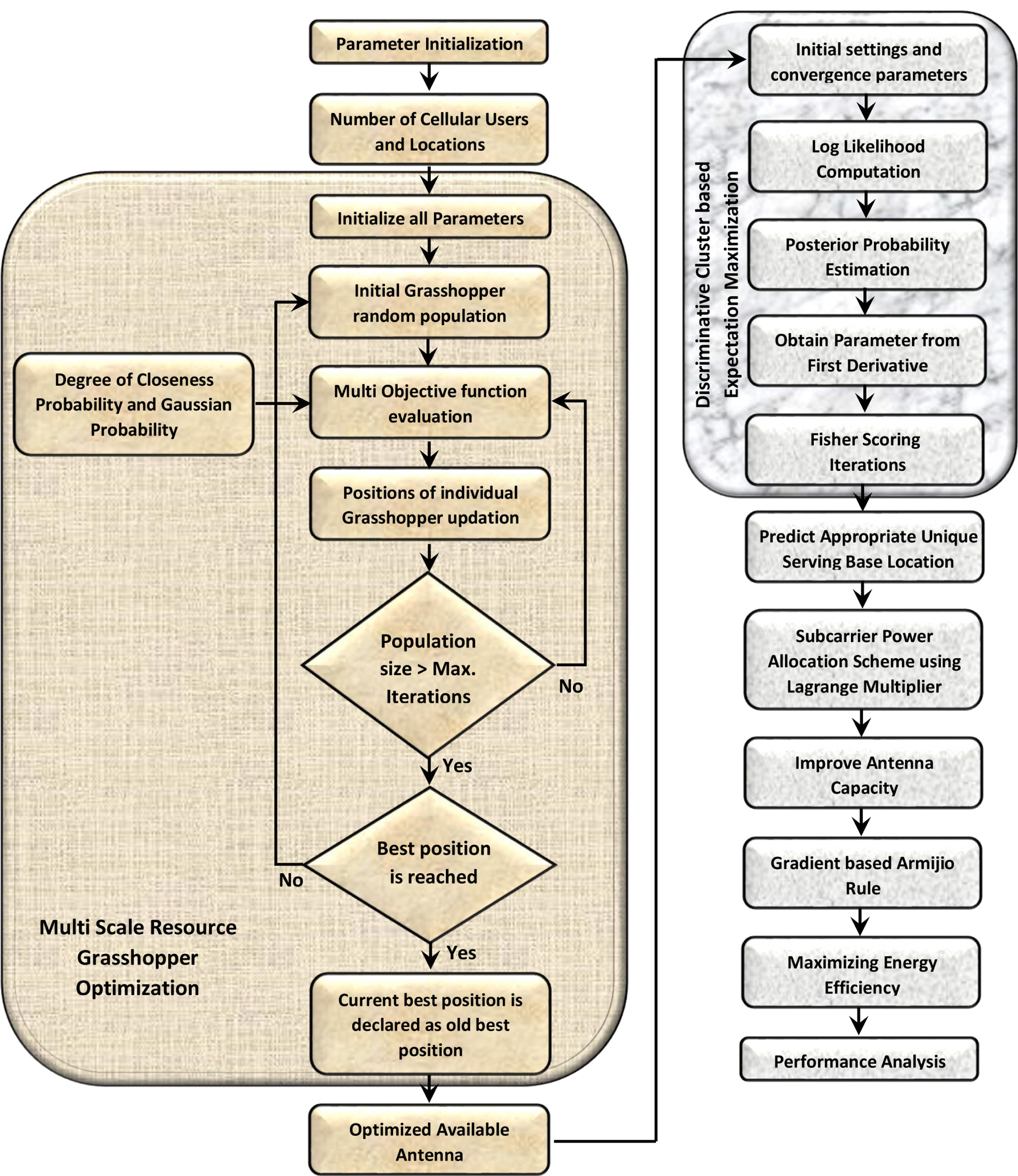
The flow chart of the proposed strategy is shown in Fig. 1.
Flow chart of the proposed strategy.
Firstly, the parameters are initialized, and the system model is generated based on the number of cellular users and their locations. The optimization process is carried out using the multiscale resource grasshopper optimization algorithm, in which the multi-objective function is evaluated by updating the positions of individual grasshopper. The multi-objective function is estimated based on the degree of closeness probability and Gaussian probability. If the population size exceeds the preset threshold, the best position is reached, and the current position is declared as the old best position. In case this condition fails, the above process is repeated. Finally, from the optimization outcome, the clustering process is carried out using discriminative cluster-based expectation maximization, in which the log likelihood computation is performed by estimating the posterior probability. The appropriate unique serving the base station is predicted, and the subcarrier power allocation is obtained available using Lagrange multiplier. Therefore, the antenna capacity and EE can be significantly improved.
The information regarding the number of users and base stations and radius at which the users are surrounded are set. For example, the radius r is 1000, the number of base stations is 5, and the number of users is 50. The noise power, minimum requirement of spectral efficiency, dynamic and static power, power of optical fiber, maximum power of the transmitter, path loss exponent α, and drain efficiency are considered as parameters to be initialized. This system model is shown in Fig. 2, in which a downlink scenario of DAS is explored. There are n remote access units (RAUs) with one antenna and k number of cellular User Equipment’s (UEs) together with the single antenna in DAS. The n RAUs are deployed uniformly in the cell and are linked to that of the central base station (BS). The k UEs are distributed randomly inside the cell, as shown in Fig. 2. hn,k is employed for denoting the frequency response of the channel among the nth RAU, and Kth UE that comprises of large-scale and small-scale fading is given as follows:

System model.
wn,k signifies the large-scale fading independent of gn,k.
gn,k signifies the small-scale fading among the nth
RAU and the kth UE,
As per the created co-ordinates, the distance is found via the shadow fading:
Based on this distance, the mean power and small-scale fading are estimated. The channel gain is estimated according to the x and y coordinates employed in attaining the values for large scale fading.
Once the above parameters are initialized in the system configuration, the number of cellular users with their locations is updated. The optimization is accomplished based on the multi scale resource grasshopper algorithm in the next section.
The Multi-scale resource Grasshopper optimization algorithm (Multi-scale resource GOA) is capable of attaining the best solutions. The analysis of our mechanism covers exploitation ability and convergence speed. The multi-scale resource GOA is a swarm-dependent multi-objective method, which makes use of the ordinary swarming ethnicity of grasshoppers and locusts. The grasshoppers can be established as separated individuals for intriguing swarms in the environment. One electrifying obsession about these swarms is that they can live in the larva and adult stages of the grasshopper growth. However, deliberate and tiny movement steps differrentiate the swarm of the larva. Indifference and mature swarms have the extended steps with abrupt jumps of swarm movement. Our research work explores the mature swarm progress and the larva swarms. More precisely, in this optimization process, the maximum iteration is set to be 1500. The other parameters are: maximum iterations, search agent number, dimensions of lower bound and upper bound, and estimated distance (x co-ordinate, y-coordinate, number of base stations, and power). The fitness function determines the enhancement of spectral and energy efficiency. Figure 3 shows the flow chart of our multi-scale resource GOA.

Flow chart of multi-scale resource GOA.
The aforementioned parameters are initialized with the random population of grasshopper. The multi-objective function is estimated by means of closeness and Gaussian probability degrees. The positions of individual grasshoppers are updated. The pseudo codes of this optimization algorithm are given below.
In the multi-scale resource grasshopper optimization approach, the input is the distance user. The parameters, such as cellular radius, number of base stations, number of users, noise power, maximum transmitted power, and path loss exponent are initialized. In the system channel model, the channel length is found using the channel scale fading and the distance, and the channel gain is estimated by using this distance formulation. In the optimization scheme, the maximal number of iterations is 500. The GH position is updated by the distance, new positions of GH and global positions. Therefore, the best fitness function and the optimized available antenna can be attained.
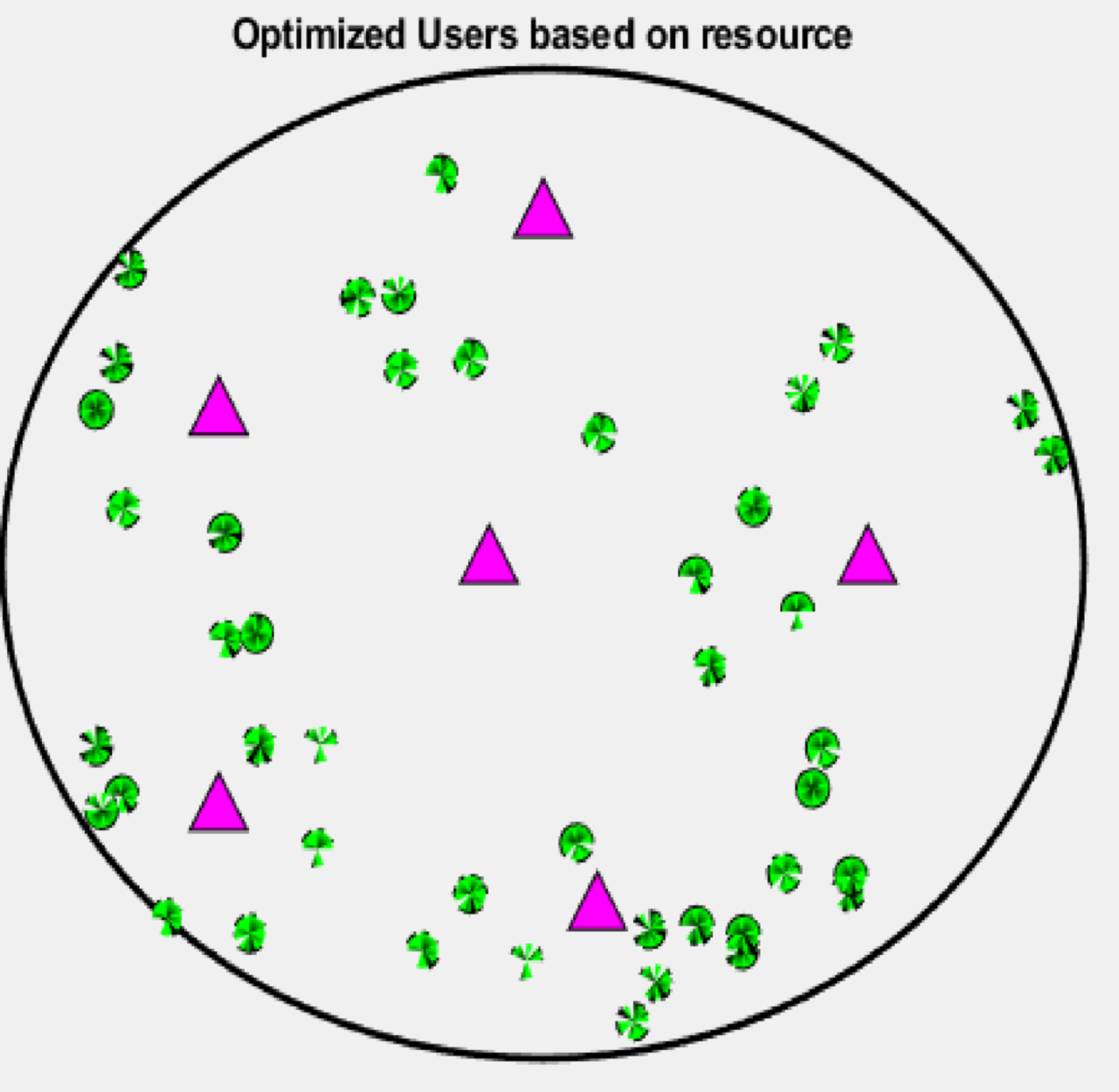
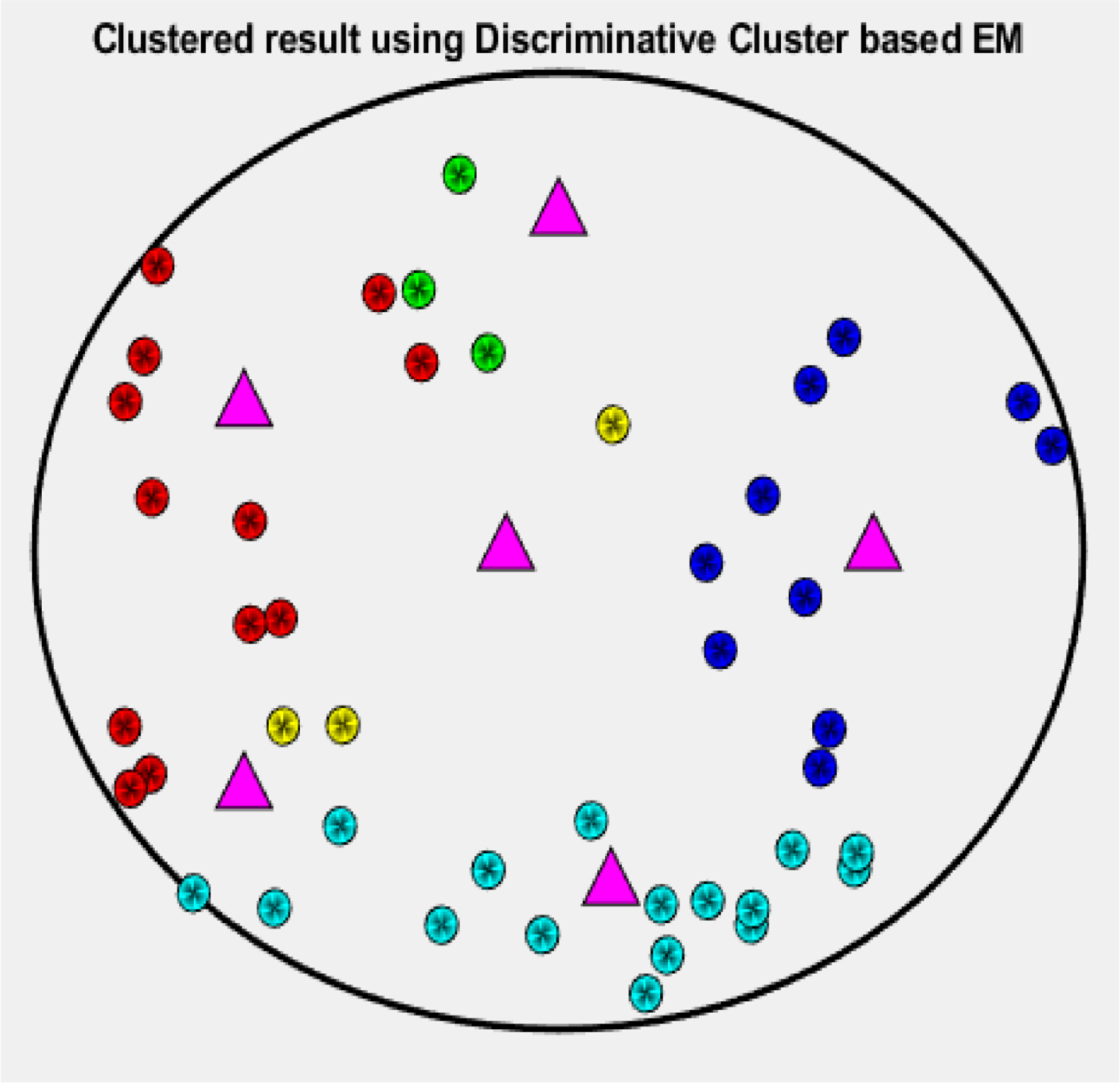
The optimized users are assembled based on the resource and clustered with the use of discriminative cluster-based Expectation Maximization (DC-EM), as shown in Fig. 4. As an example, the trajectory of the 1st grasshopper is illustrated in Fig. 5.
Optimized users based on the resource using multi-scale resource GOA.

Trajectory of 1st grasshopper.
To deal with huge dimensional data sets, clustering has merged as a popular solution. A novel approach on clustering, namely Discriminative cluster-based EM, is employed to enhance the power allocation strategy. The Expectation-Maximization (EM) can identify the maximum-likelihood intended for model parameters in case the data set is incomplete, and has unobserved (hidden) latent variables, or missing data samples. In our approach, the Log likelihood is computed by estimating the posterior probability and obtaining parameters from the first derivative and fisher scoring iteration, which is given as follows.
In the proposed method, the dynamic and static power of EE theory can be identified, and the maximum EE that is denoted as Emax is discovered. That is, the optimal power allocation with the maximal EE in the DAS is attained. The clustered results acquired with the utilization of the discriminative cluster-based EM are demonstrated in Fig. 6.
Clustered outcome attained using discriminative cluster-based EM.
The unique serving base station is predicted from the optimal result obtained as above. The subcarrier power allocation strategy is based on the use of Lagrange multiplier in order to enhance the antenna capacity. The gradient based Armijo rule is further applied for the maximization of energy and spectral efficiency. The performance estimation has been made to validate the effectiveness of our methods, which are also compared the existing techniques with regard to their efficiency.
Performance analysis
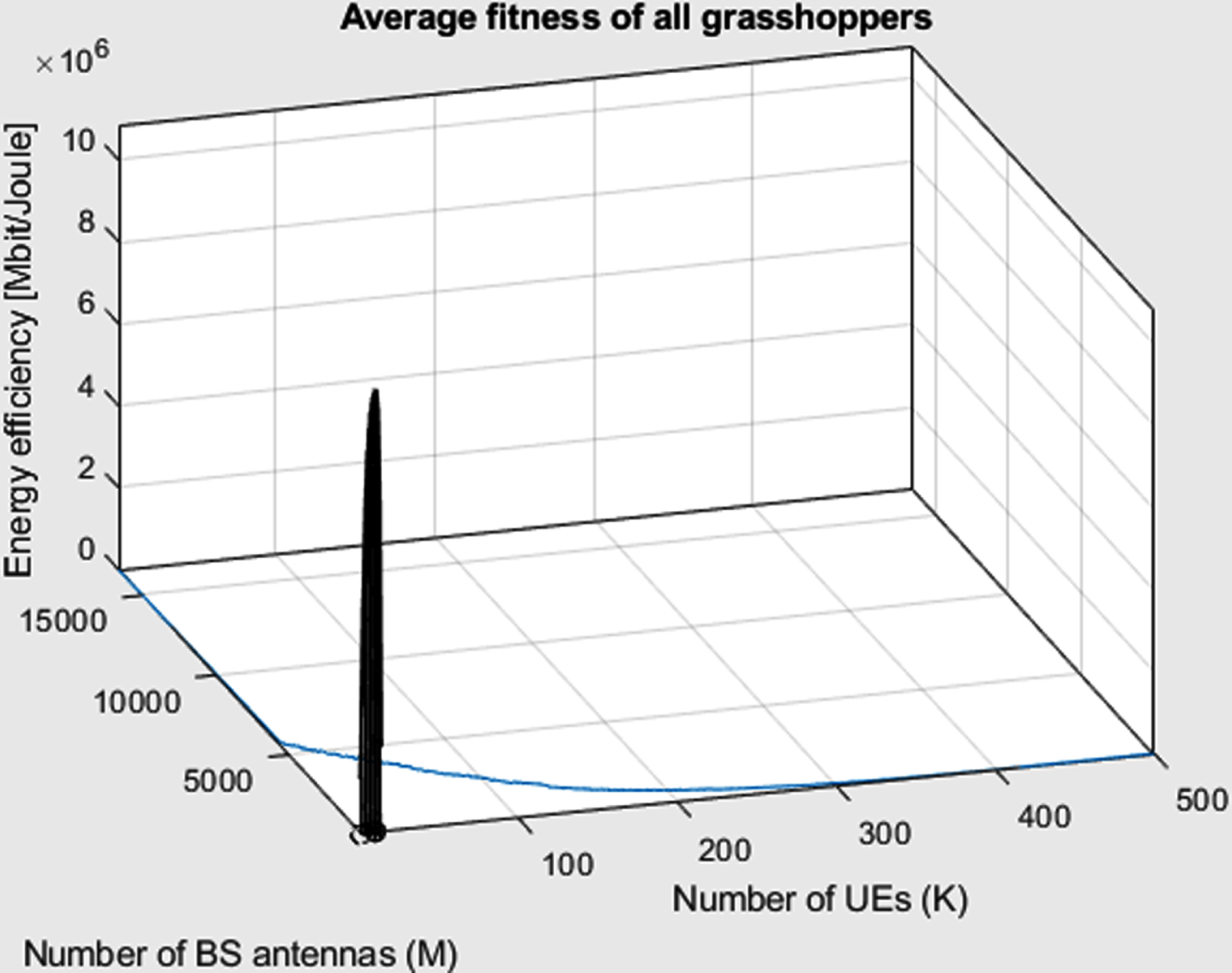
In this section, the power allocation for maximizing the SE and EE is investigated, and the numerical results are provided for validating the applied algorithms and comparing them with the conventional methods [4, 23]. The simulation parameters are given in Table 1. The analysis of the EE in terms of the number of UEs is shown in Fig. 7 concerning the number of base station antennas, where the attained average fitness of all grasshoppers is given. Figure 8 depicts the overall performance percentage of the antenna.
Average fitness of all grasshoppers.

Overall performance percentage of antenna.
Simulation parameters
The performance estimation is made for the EE in terms of the maximal transmit power for varying parameter γ, e.g., γ is 1, 3, and 7. The EE is mentioned in Mbit/Joule. The results are illustrated in Fig. 9 and Table 2.
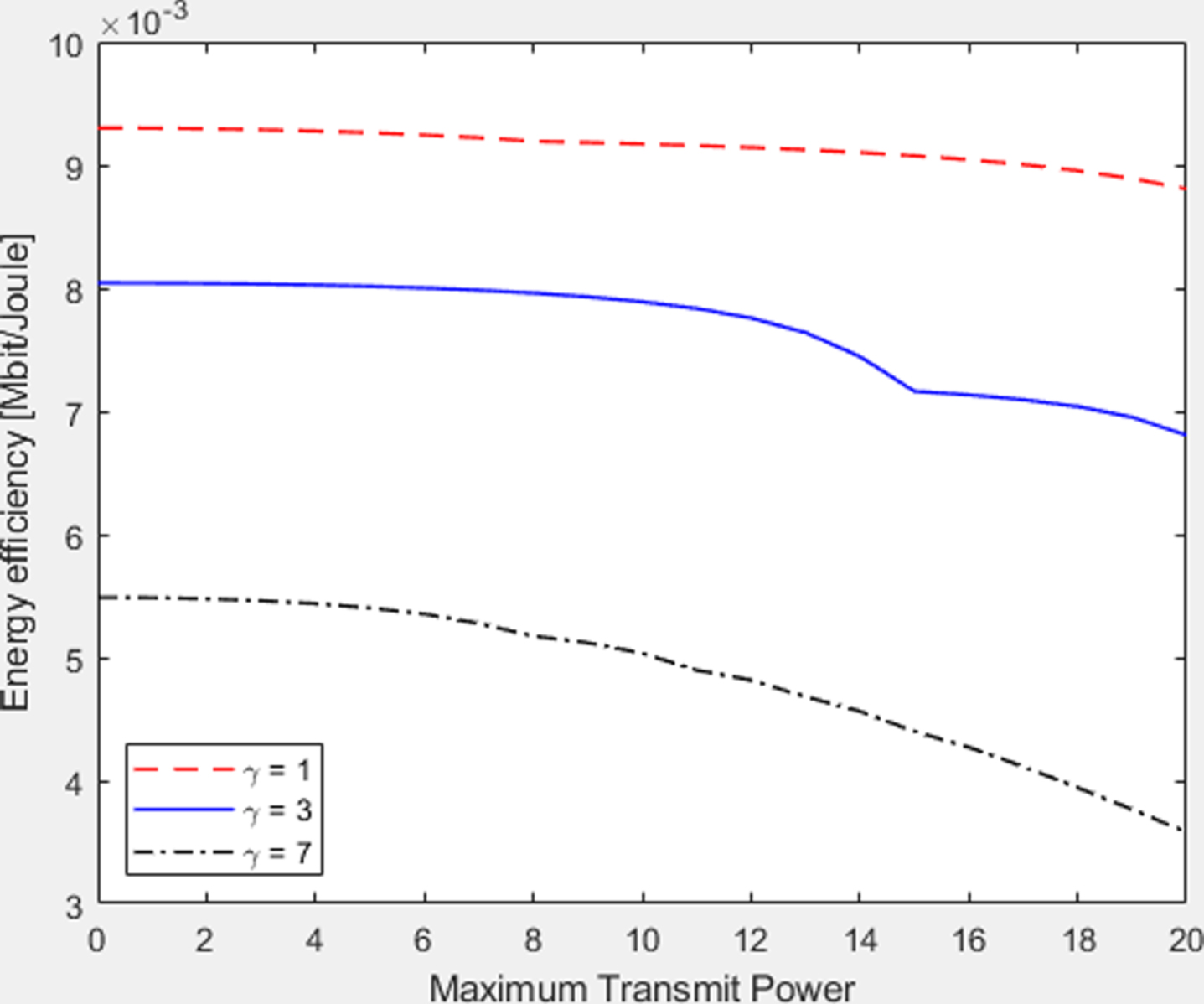
Performance analysis of Energy Efficiency (EE) with varying parameter γ.
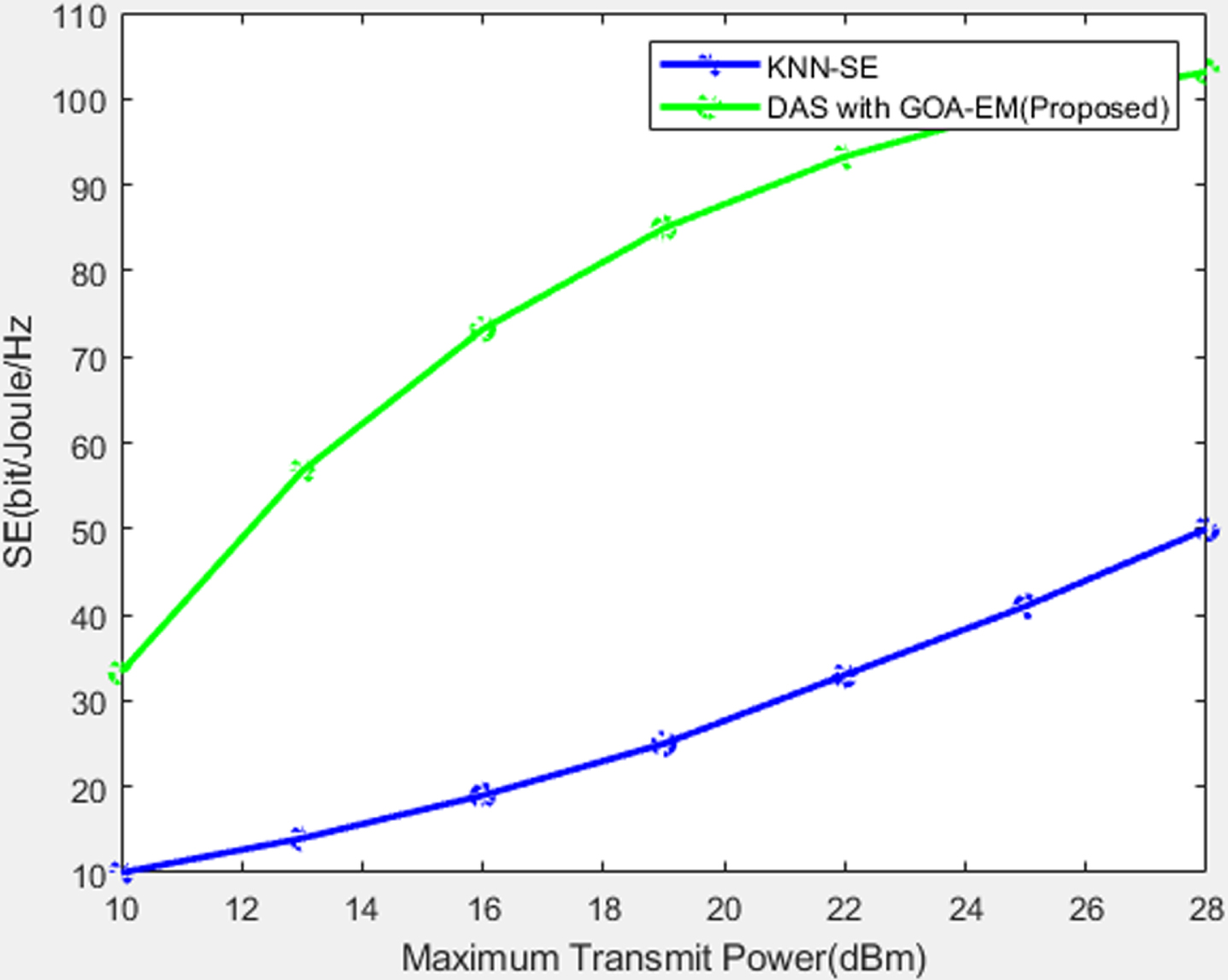
Comparative analysis of Spectral Efficiency (SE) in terms of bits/Joule/Hz.
Comparative analysis of Spectral Efficiency (SE) in terms of bits/Joule/Hz
The Spectral Efficiency (SE) is estimated on the basis of the maximal transmit power, and the comparison of the proposed outcome is made with the conventional method: KNN-SE. The SE is presented in bit/Joule/Hz. From the analysis, it is apparent that the proposed technique (DAS with GOA-EM) is better than the existing one. Table 3 depicts the performance comparison of the EE in terms of bits/Hz.
Comparative analysis of Energy Efficiency (EE) in terms of bits/Hz
Figure 11 and Table 4 show the comparative analysis of EE (bit/Hz) based on the maximal transmit power (dBm). The comparison is conducted between the KNN-SE and the proposed DAS with GOA-EM, which demonstrates that the latter is well capable of offering a higher EE than that of the former.
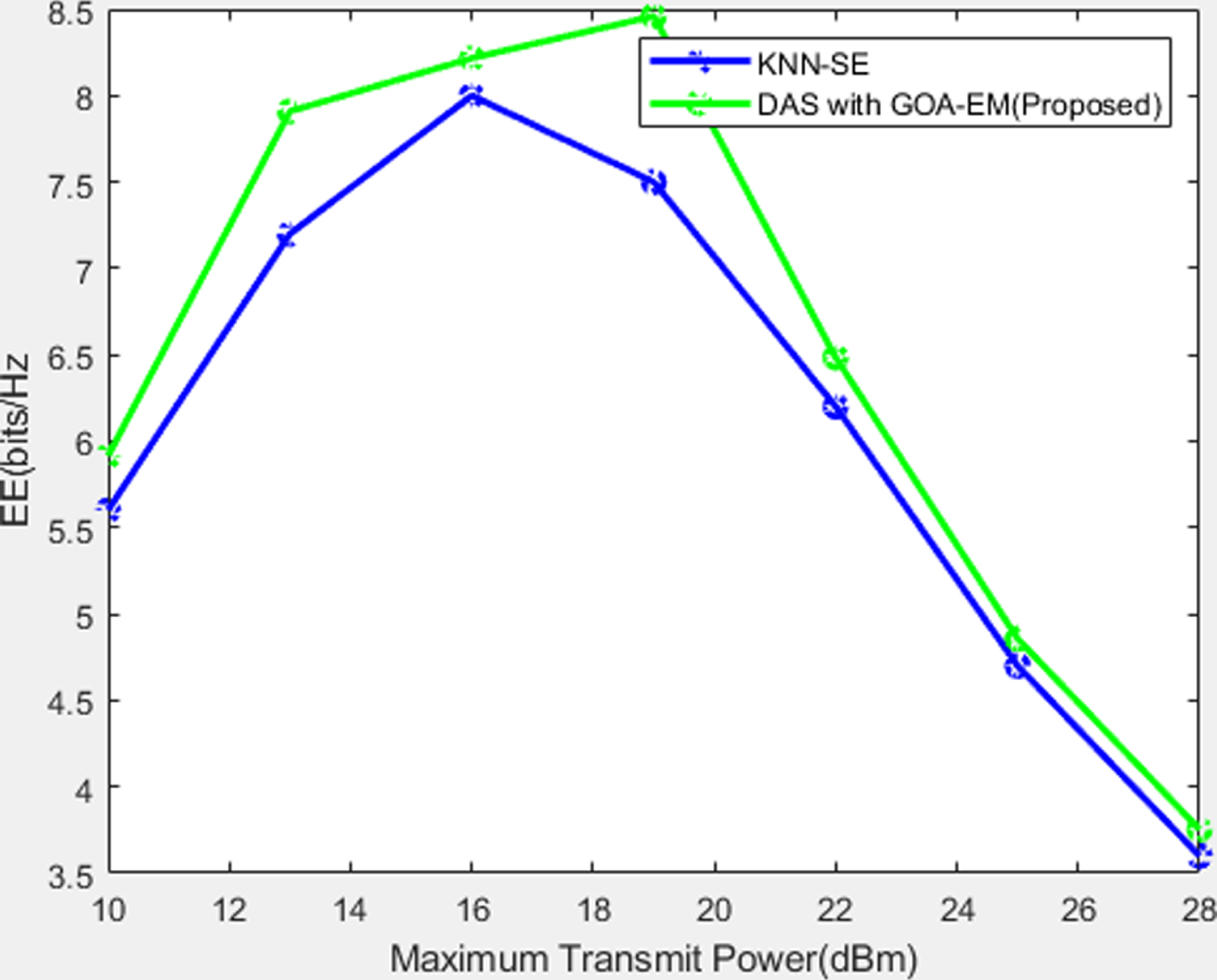
Comparative analysis of Energy Efficiency (EE) in terms of bits/Hz.
Comparative analysis of Spectral Efficiency (SE) in terms of bits/Hz
The comparative analysis of the SE (bit/Hz) in terms of the maximal transmit power (dBm) is illustrated in Fig. 12 and Table 5. The comparison is made between the conventional algorithm, DAS with K-means cluster, DAS with mixture of Gaussian cluster model [22], and the proposed DAS with GOA-EM. It is apparently visible that the proposed can offer a higher SE than the existing methods.
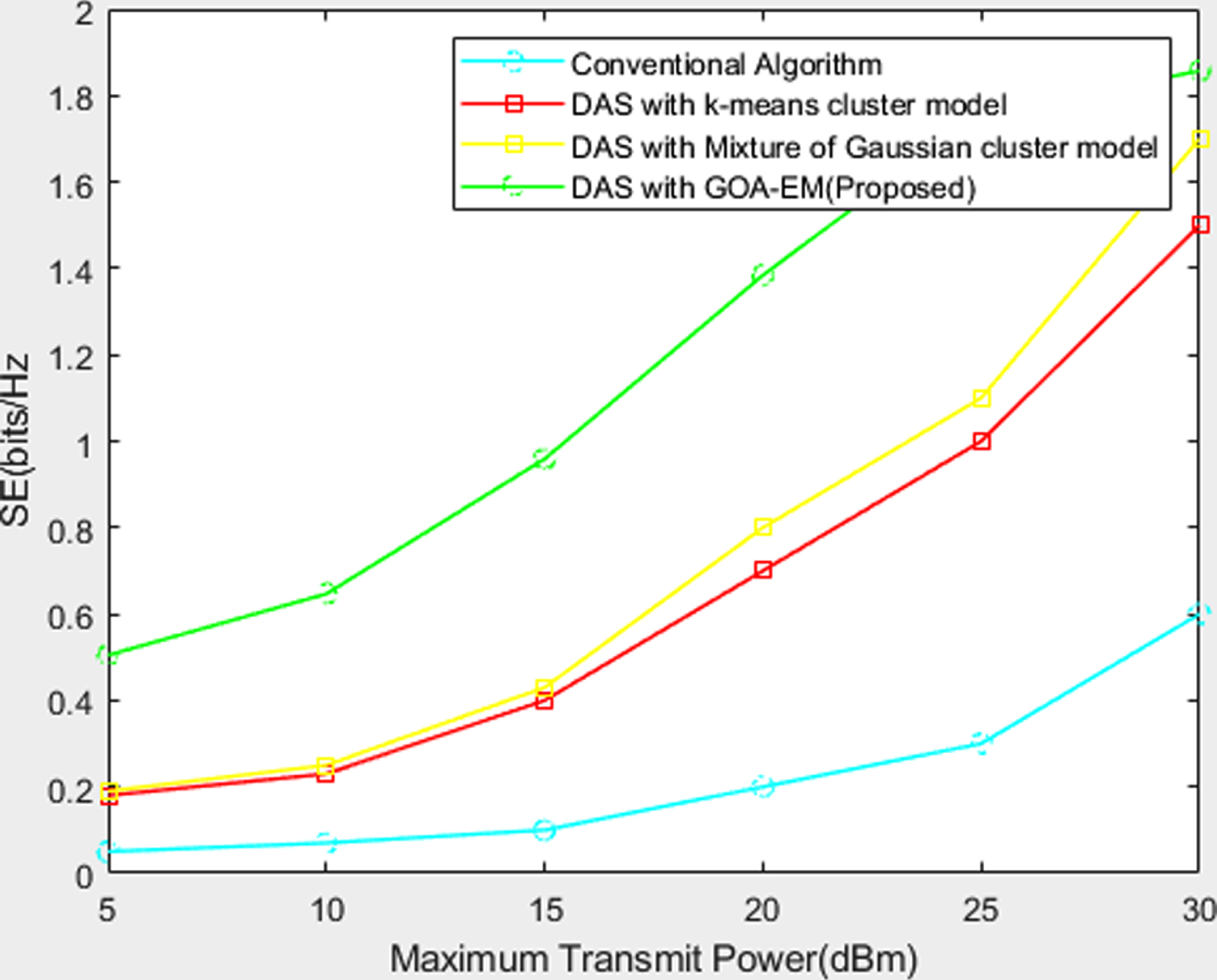
Comparative analysis of Spectral Efficiency (SE) in terms of bits/Hz.
Comparative analysis of Energy Efficiency (EE) in terms of bits/Joule/Hz
Figure 13 and Table 6 show the comparative analysis of EE (bit/joule/Hz) concerning the maximal transmit power (dBm). The comparison is made between the conventional algorithm, DAS with K-means cluster, DAS with mixture of Gaussian cluster model, and the proposed DAS with GOA-EM, in which a higher EE is achieved by our method.
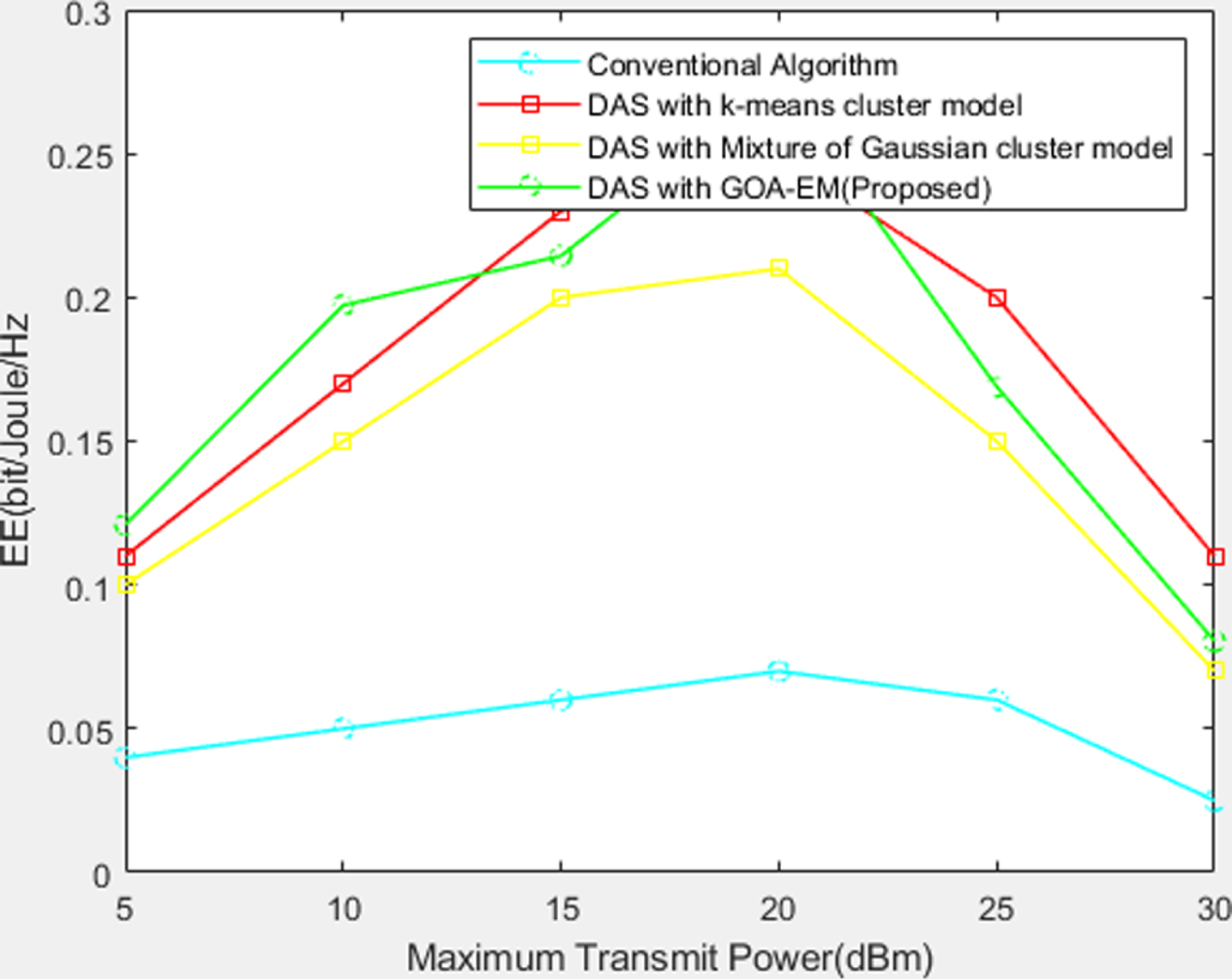
Comparative analysis of Energy Efficiency (EE) in terms of bits/Joule/Hz.
Comparative analysis of Spectral Efficiency (SE) in terms of bits/Hz
The comparative analysis of SE (bit/Hz) with regard to the maximal transmit power (dBm) is illustrated in Fig. 14 and Table 7. The comparison is based on the DAS with D2D communication [23], DAS and the proposed DAS with GOA-EM. Obviously, the proposed strategy is better than the conventional methods in providing a higher SE.

Comparative analysis of Spectral Efficiency (SE) in terms of bits/Hz.
Comparative analysis of Energy Efficiency (EE) in terms of bits/Joule/Hz
Figure 15 shows the comparative analysis of the EE (bit/joule/Hz) concerning the maximal transmitting power (dBm). The performance comparison is made between the DAS with D2D communication, DAS, and the proposed DAS with GOA-EM. It is shown that the proposed scheme is superior in providing a higher EE than the traditional technique.
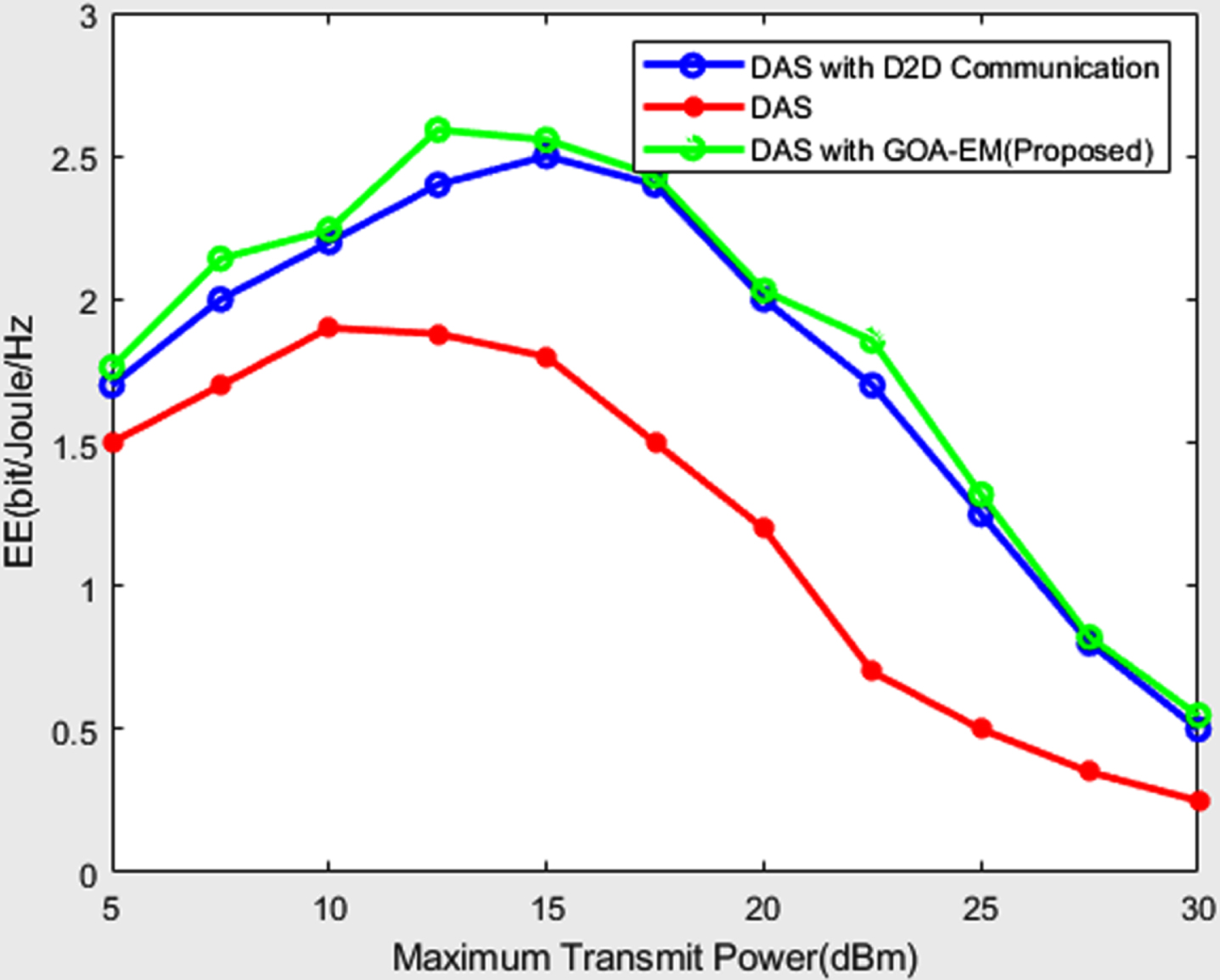
Comparative analysis of Energy Efficiency (EE) in terms of bits/Joule/Hz.
It should be emphasized that the clusters mode in DAS has a much improved performance rate for resolving the complications related to the EE and SE maximization. Thus, the attained power in the DAS via the cluster’s mode is significantly enhanced compared with the traditional schemes employed for power allocation. This, in turn, makes the proposed solution more effective in the EE and SE improvement with a reduced computational complexity.
In this paper, the energy efficient power allocation is considered as the major objective in the DAS. The two major viewpoints of our approach are optimization and clustering mechanism. The optimization is first performed using Multi-scale resource Grasshopper Optimization algorithm (Multi-scale resource GOA) to get the best fitness function and optimal antenna capacity for effective power allocation. Next, the clusters model is generated in the DAS with the discriminative cluster-based EM approach, which is different from the traditional DAS model. The subcarrier power allocation strategy is obtained based on the use of Lagrange multiplier in order to enhance the capacity of antenna. Finally, the gradient based Armijo rule is applied for the maximization of energy and spectral efficiency. The numerical simulations are made for validating the effectiveness of these algorithms on the basis of comparing the proposed model (DAS with GOA-EM) with the conventional methods, which demonstrate that the former is better than the latter in offering higher EE and SE.