



Abstract
With the rise in the global aging population, selecting sites for nursing homes for old-age care has become critical and challenging. The site selection of a nursing home can be considered as a multicriteria decision-making. Because of the increasing complexity and uncertainty of the socioeconomic environment, standard assessments cannot handle this multicriteria decision-making. Therefore, this study provides a multi-criteria decision-making method based on Interval 2 Fuzzy Sets (IT2FS). It obtains comprehensive weights through the AHP method and the CRITIC method. Compared with the traditional TOPSIS, the improved TOPSIS method reduces the difference between the evaluation results. This method is suitable for the site selection of nursing homes in a certain area. We use the data of nursing homes to show the application of these methods. By comparing with traditional methods, we find that the integrated approach can consider more uncertainties.
Keywords
Introduction
As the problem of aging has become more prominent, the existing solution is to allocate nursing homes to accommodate the elderly with the premise of giving them medical insurance [1]. The comprehensive service function of the nursing home affects the physical and mental health of the elderly, and its scientific layout cannot be ignored. Site selection for nursing homes is a key part in nursing home configuration. Nursing home location plays an important role in the health of the elderly. As the problem of population aging is becoming more and more serious, optimizing the nursing home has attracted increasing research attention.
Our research motivation is to provide decision-makers a more humanized nursing home location plan. The issue should be considered in the planning and decision-making of nursing homes, but policymakers disregard the uncertainties in all respects of site selection. Thus, the objective intention of this study is to propose a scientific decision-making method that can solve the problem of the choice of nursing home site location considering many uncertain factors.
Although previous studies have solved the problem of site selection from a technical, economic, and social perspective, gaps in academic research still exist. For example, to solve the decision-making problem of site selection, practitioners use weighted sum product evaluation methods and single-value smart devices to select the site location of waste incineration stations from an economic and environmental perspective [2]. Some researchers adopt the combined backpack algorithm and the comprehensive value model for sustainable assessment to select the best temporary housing after natural disasters and consider some uncertainties from an economic and environmental perspective [3]. Other researchers use geographic information systems (GIS) to select the one-time positioning of aquaculture planning and consider the uncertainty of site selection from an environmental, logistics, and socioeconomic perspective [4]. Some researchers employ the method of analytic hierarchy process (AHP) to select municipal landfills from a technical, economic, and social perspective by using the Super Decisions software to analyze opportunity costs and risks [5]. Therefore, first, we consider multicriteria decision-making, which combines social welfare and cost-effective decision-making. Second, we choose the nursing home location problem that few people pay attention to. To the best of our knowledge, few scholars have studied the site location of nursing homes considering both social welfare and cost-effectiveness.
In order to fill the gaps in academic research, we use the AHP and CRITIC methods based on interval 2 fuzzy sets to obtain comprehensive weights, ensuring that subjective weights and objective weights are considered at the same time. Then, an improved TOPSIS (technique for order preference by similarity to an ideal solution) integration method based on interval 2 fuzzy sets is used to reduce the numerical difference between the evaluation results. Type 2 fuzzy sets can represent more uncertainty [6], and can produce more accurate and reliable results [7, 8], so we use interval-based types 2 multi-criteria technology of fuzzy sets can make the decision-making process more reliable. In this study, we answer the following research questions: What are the key factors that determine the location of nursing homes? What are the key elements for the site selection of nursing homes?
To answer the research questions, first we propose a comprehensive method combining order preference technology and the AHP based on the interval type-2 fuzzy environment, which is close to the ideal solution, to settle the multicriteria decision problem in interval type-2 fuzzy sets [9]. The final weight comes from the subjective weight obtained by the AHP method and the objective weight obtained by the CRITIC method, and then the improved TOPSIS uses the obtained weight to rank the alternatives [10].
This study provides some theoretical contributions and practical implications. First, we propose decision-making criteria for the site of nursing homes from the view of social welfare and cost-effectiveness and contribute to the literature on the site location of social welfare projects. Second, this study considered subjective weights by using the AHP method, while using the CRITIC method to consider that the decision-making process is affected by objective weights. This article uses comprehensive weights that combine supervisor weights and objective weights to make the article more scientific. The improved TOPSIS method we use reduces the variance of multiple indicator scores, making the ranking more scientific and reasonable. Third, this study finds some new interesting results on which criteria are critical for the site location of nursing homes. At the same time, we also provide a new decision-making method for similar sites. Fourth, this study conducts a case study and a comparative analysis of traditional methods to support the research. Finally, this study finds that, unlike the medical facilities that older people think are more likely to be guaranteed, the elderly is more likely to pursue nursing homes with good greenery and many surrounding parks.
The framework is as follows: Section 2 reviews some participant literature on MCDM, AHP, TOPSIS, and site selection. In the third section, we describe in detail the preliminary concepts of interval type-2 fuzzy sets, AHP and TOPSIS based on interval type-2 fuzzy sets, and the proposed new method. The fourth section introduces the practical application of the new method to prove the adaptability and effectiveness of the arranged method. In the last section, we summarized the paper, put forward management enlightenment and shortcomings, and shared future research trends.
Literature review
Multiple-criteria decision-making
Recently, multitudes of studies have been conducted on multicriteria decision-making (e.g., [11, 12]). Scholars concentrate on multicriteria decision-making concepts in renewable energy development programs to address the optimization of energy alternatives [13]. Meanwhile quite a few professionals have proposed a comprehensive multicriteria decision-making approach in selecting green suppliers and addressing priority orders and rankings for alternative suppliers by viewing assorted ambient performance requirements and criteria [14]. Similarly, studies also utilize new multicriteria decision-making methods reposed on economic, social, and environmental standards for assessing the mass of family livelihood [15]. Scholars employ comprehensive multicriteria decisions to address a company’s options from a business benefit perspective [16]. Unlike previous studies, this study concentrates on new standards that combine social welfare and cost-effectiveness and adopts new multicriteria decision-making techniques to determine nursing home location.
AHP
In previous studies, a host of researchers use the AHP to solve multicriteria decision-making problems (e.g., [17, 18]). Quite a few experts first propose a provider option determination reinforcement model reposed on the AHP [19]. Then the numbers of scholars perform analytic hierarchy analysis to make the decision to stop the natural gas pipeline construction project [20]. They try to adopt analytic hierarchy analysis to derive and evaluate strategic priorities for drug development outsourcing partners [21]. Similarly, they also suggest a method for rating incident log-based fraud datasets using fuzzy analytic hierarchy analysis [22]. Unlike the above studies, our research employs an AHP reposed on interval type-2 fuzzy sets. Our method is more flexible than traditional AHP studies and considers more uncertain factors [7].
TOPSIS
Equally, previous literature has documented that the abovementioned problems can be solved by TOPSIS. Reposed on TOPSIS, certain professionals develop a new interval type-2 fuzzy multicriteria determination model [23–25]. On this basis, they propose a decision model, combining interval type-2 fuzzy sets with TOPSIS and applying it to the operational risk assessment of subway stations [26]. What is more, quite a few scholars are also based on the idea of sustainability, using fuzzy techniques to optimize site location of electric vehicle charging stations by similarity [27]. In addition, other specialists use interpretative structural modeling to evaluate agile supplier selection criteria and rank suppliers by combining them with fuzzy techniques for analyzing the similarity of order processes [28]. Unlike previous studies that used TOPSIS to solve problems, we combine TOPSIS with interval type-2 fuzzy sets and focus on the comparison of decision criteria for substitutes [29].
Site selection
The site location problem needs to be studied. In [4], Buitrago et al. utilize geographic information systems (GIS) to address the one-time positioning of aquaculture planning and considered the uncertainty of site selection from an environmental, logistics, and socioeconomic perspective. Moreover, several professors employ the AHP to select municipal landfills from a technical, economic, and social perspective as well as the Super Decisions software to analyze opportunity costs and risks [5]. Folks use weighted sum product evaluation methods and single-value smart devices to address the site location of waste incineration stations from an economic and environmental perspective [2]. Furthermore, quite a few scholars adopt a combined backpack algorithm and comprehensive value model for sustainable assessment to select the best temporary housing after natural disasters and consider some uncertainties from an economic and environmental perspective [3]. Unlike previous studies, this study focuses on the site location of nursing homes considering the well-being of people and uses decision-making criteria from the perspective of social welfare and cost-effectiveness, thus making the decision-making process more humane.
Modeling and problem description
Problem description
In recent years, because of the aging population, old-age care has gradually become a common concern of society and individuals. After reviewing relevant literature, we find that the popularity of nursing homes helps alleviate this problem. Nursing homes are special public facilities that ensure the normal life of some elderly people, and the choice of address affects their daily life. In addition, nursing homes account for a large degree of local social welfare and individual happiness. To minimize the negative impact of improper location, policymakers in government or private companies must choose the appropriate address for these facilities. Since a comprehensive assessment of key factors is required in properly selecting the appropriate criteria to determine a nursing home’s site location, this study proposes a new integrated approach to guide decision-makers.
Modeling
This section discusses in detail the reasoning backdrop of the methodology used in this study.
Interval type-2 fuzzy sets
In [30], Zadeh first proposes a new fuzzy set, which complements the type 1 fuzzy set in previous literature [31]. This fuzzy set, the type-2 fuzzy set, considers many practical uncertainties [6] and further reflected in scientific thinking [7, 8]. Even though the type-2 fuzzy set is superior to the interval type-2 fuzzy set in that the innovation is rich [32], more researchers are beginning to use the latter because computing has become more convenient and scientific [31]. The existence of the separation description 2 fuzzy set is to solve real multistandard decision problems, as mentioned earlier, the site selection of nursing homes was also a multi-criteria decision-making problem, and the traditional decision-making methods can no longer meet the scientific needs, that was, reducing the uncertainty in decision-making problems. Therefore, this research method is based on interval type 2 fuzzy sets [33]. This part describes type-2 fuzzy sets and interval type-2 fuzzy sets in detail.
If all
AHP reposed on interval type-2 fuzzy sets
The AHP is a decision-making method suitable for practical problems. Since the core of the analytical hierarchy process is to decompose complex selection problems through the combination of qualitative and quantitative analyses [36], it has expanded into a wide range of fields [36, 37]. However, in practice, decision-makers often judged the ratings of redundant standards and candidates through linguistic variables [38]. Fuzzy numbers were often used to represent linguistic variation [39]. Researchers also combined the interval description 1 fuzzy set with the AHP to consider uncertainty [40]. Several useful methods have been studied to extend the AHP under interval type-2 fuzzy sets. Researchers used the new vendor selection ranking method to complement the interval description 2 fuzzy set–based analysis hierarchy process [41]. Some combined the interval type-2 fuzzy set with the AHP to assess the key achievement limitations of humanitarian comfort logistics. In [42], Abdullah et al. proposed a fresh form of vague linguistic variable for assessing construction safety and prevention levels in harsh environments such as high temperatures. Other researchers utilized the AHP under interval type-2 fuzzy sets to evaluate the weight of strategic decision factors. In [43], Oztaysi adopted the AHP method under the interval type-2 fuzzy set to solve the problem of enterprise resource planning. Some practitioners used an AHP reposed on interval type-2 fuzzy sets to identify key sectors [44]. Next, the AHP reposed on interval type-2 fuzzy sets is used to study the main role of key performance weights, and the following methods are proposed:
Step 1. Linguistic variables are used by consulting pairwise performance indicator experts for pairwise comparisons. They can scientifically describe many uncertain factors in a multicriteria decision-making process [41].
Step 2. The homogeneity of fuzzy pairwise comparisons is deconstructed. In this process, if the results of the comparison matrix (A) obtained by pairwise matching are uniform, the results of the comparison matrix (
Step 3. Reposed on the interval type-2 fuzzy set in the core function indicator, a pairwise comparison matrix can be obtained [41]. The language scale is shown in Table 1.
Language scale describing the importance weight of core function indicators
Step 4. Select the geometric medical thinking to obtain the average fuzzy geometry value as shown below [41]:
Step 5. The fuzzy weight–specific algorithm for many core function indicators are shown as follows [41]:
Step 6. For the IF2FSs selection regionalization medium [41], the defuzzification technique aims to find the weight values of many core function indicators.
Step 7. Use the following formula to normalize the clear weight of core function indicators [41]:
TOPSIS is a multicriteria decision-making technique. This method can be described as follows: when concluding the best candidate, the shortest distance should be maintained between the positive ideal solution (PIS) for multiple-criteria decision-making and the negative ideal solution (NIS) for multiple-criteria decision-making [45]. This has been applied availably and widely in diverse fields. [46] and [47] present two literature reviews to demonstrate the wide application of TOPSIS. Through the introduction of the TOPSIS method in their papers, the following seven steps in the interval type-2 fuzzy set environment are obtained:
Step 1. Two evaluation matrices are formed according to requirements, including m preliminary plans and n core function index ((o, p) ∈ n, o + p = n). With the chiasm of many preliminary plans and core function index considered as and y ij , thus, we have matrices and (y ij ) m×p. In this process, the required language scale and related IT2F are described in Table 2. Using linguistic variables can suitably describe many uncertain factors in a multicriteria decision-making process [47].
Linguistic items for site selection
Linguistic items for site selection
Step 2. With the data as input, the standardized method is used to process the data to obtain a standardized decision matrix. The operation process of the standardized value r
ij
is as follows [47]:
Step 3. Use the following algorithm to obtain a standardized decision matrix with preferences, calculated as shown below [47]:
Step 4. The defuzzification value of interval type-2 fuzzy set is obtained by the following operation rules, and then the deblurring aggravated decision matrix is formed [47]:
Step 5. The active and passive ideal solutions are described by the definition as follows [47]:
Step 6. The calculation rules for the distance among many alternatives and active ideal solution
Step 7. The algorithm for approaching coefficient CC
i
is as follows [47]:
Step 8. The rule of the defined ordering is to use the order of the final values, that is, to sort the preparations in descending order [47].
In this section, we propose a new hybrid approach to guide decision-makers (government agencies or companies) who will make investment decisions for the choice of nursing home addresses, apply the AHP, CRITIC and TOPSIS in the interval type-2 fuzzy set environment and actual information, and follow system procedures.
Figure 1 shows a flow chart of the arranged method. It has two key steps in total. First, the moment weight of core function indicators is based on unbiased expert opinions describing core function indicators. In the next step, the adaptive core function index amplitude weight is combined with the objective weight obtained by the CRITIC method to obtain the comprehensive weight, which is used as the input information of TOPSIS in the interval type 2 fuzzy set environment. As a result of the data analysis, which is the primary critical step, the address chosen by the nursing home is assessed reposed on revenue and cost.
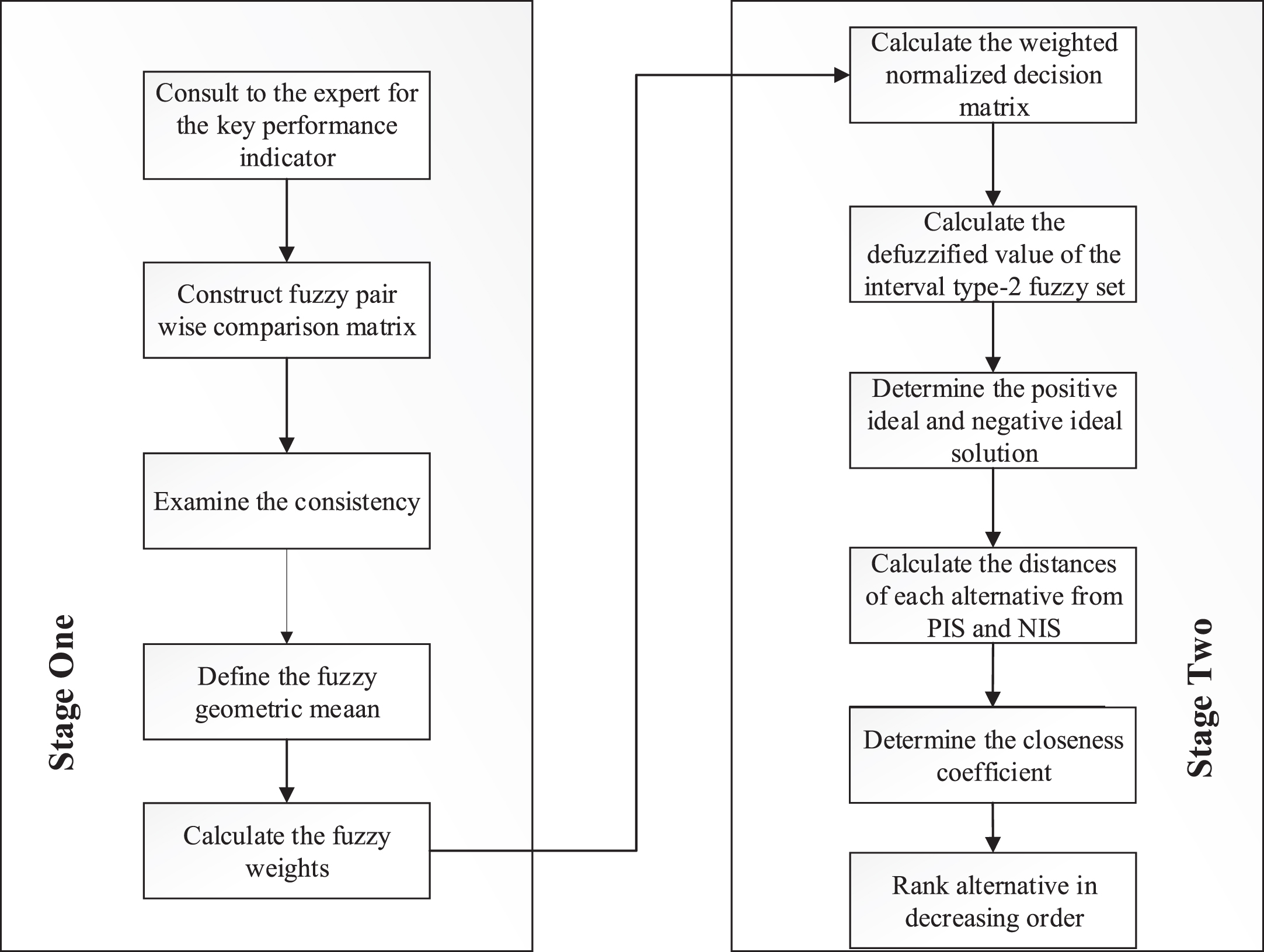
Systematic routine of the arranged methodology.

Core function indicators’ Rank.
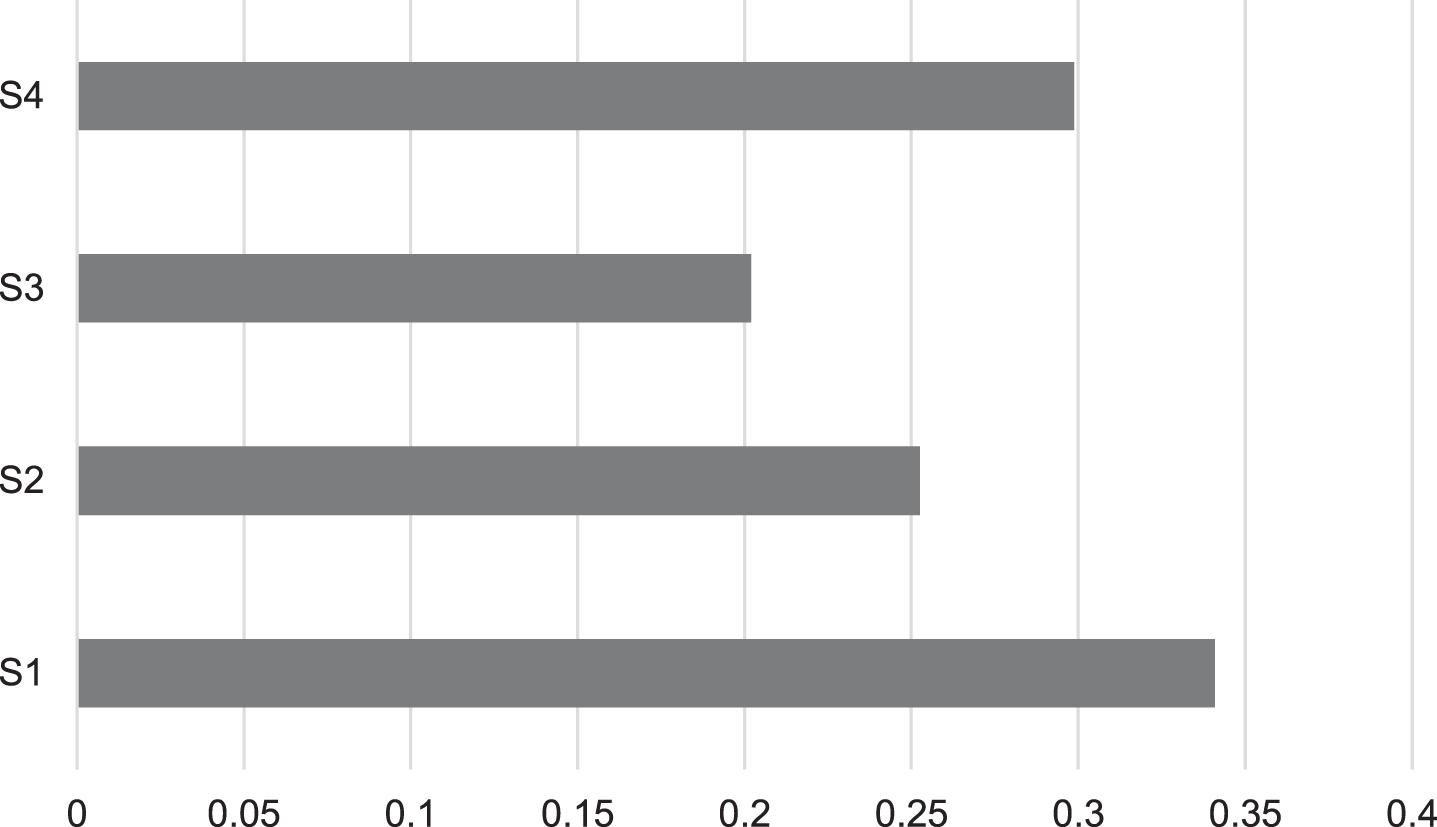
Closeness coefficients of candidates’ Rank.
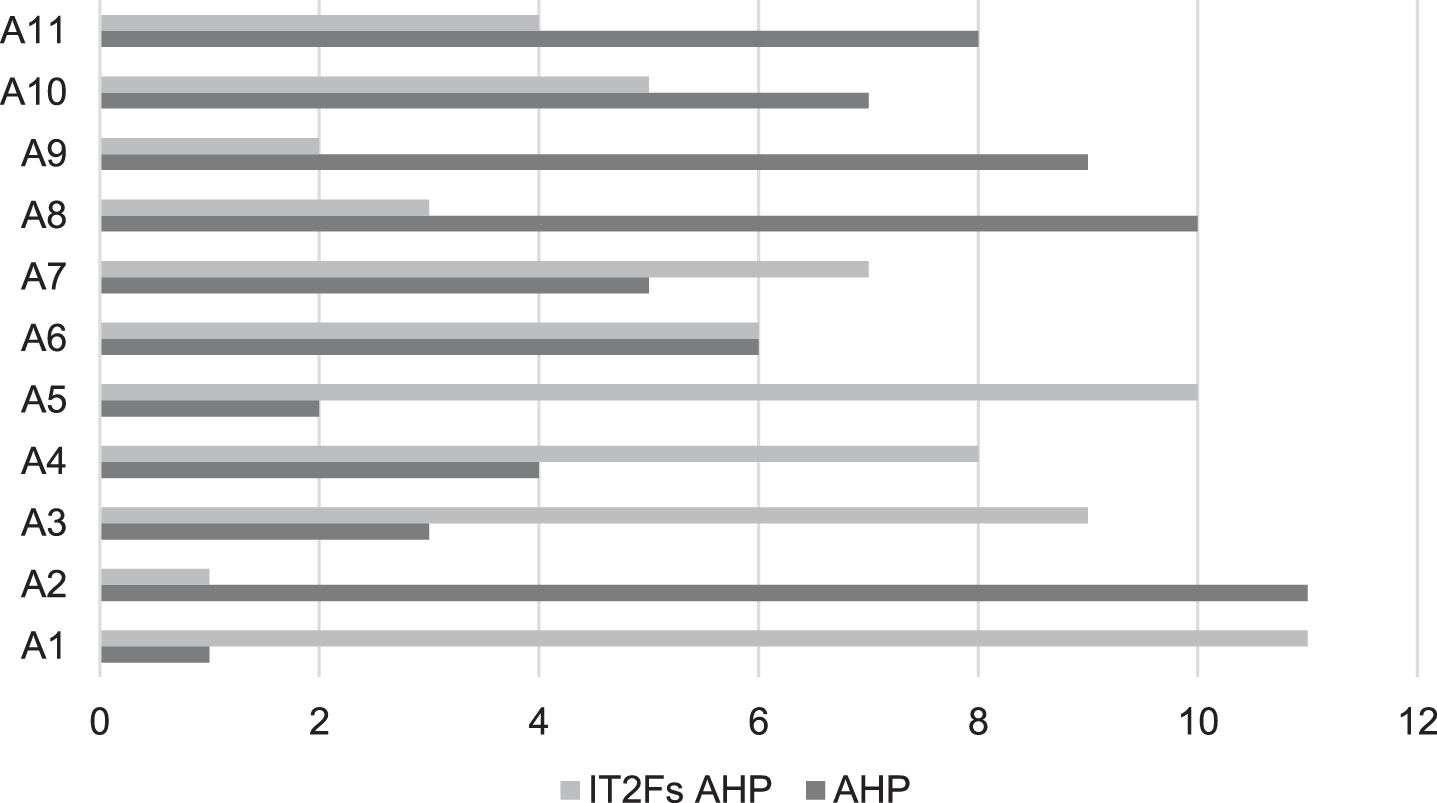
Comparison of AHP and IT2Fs AHP.
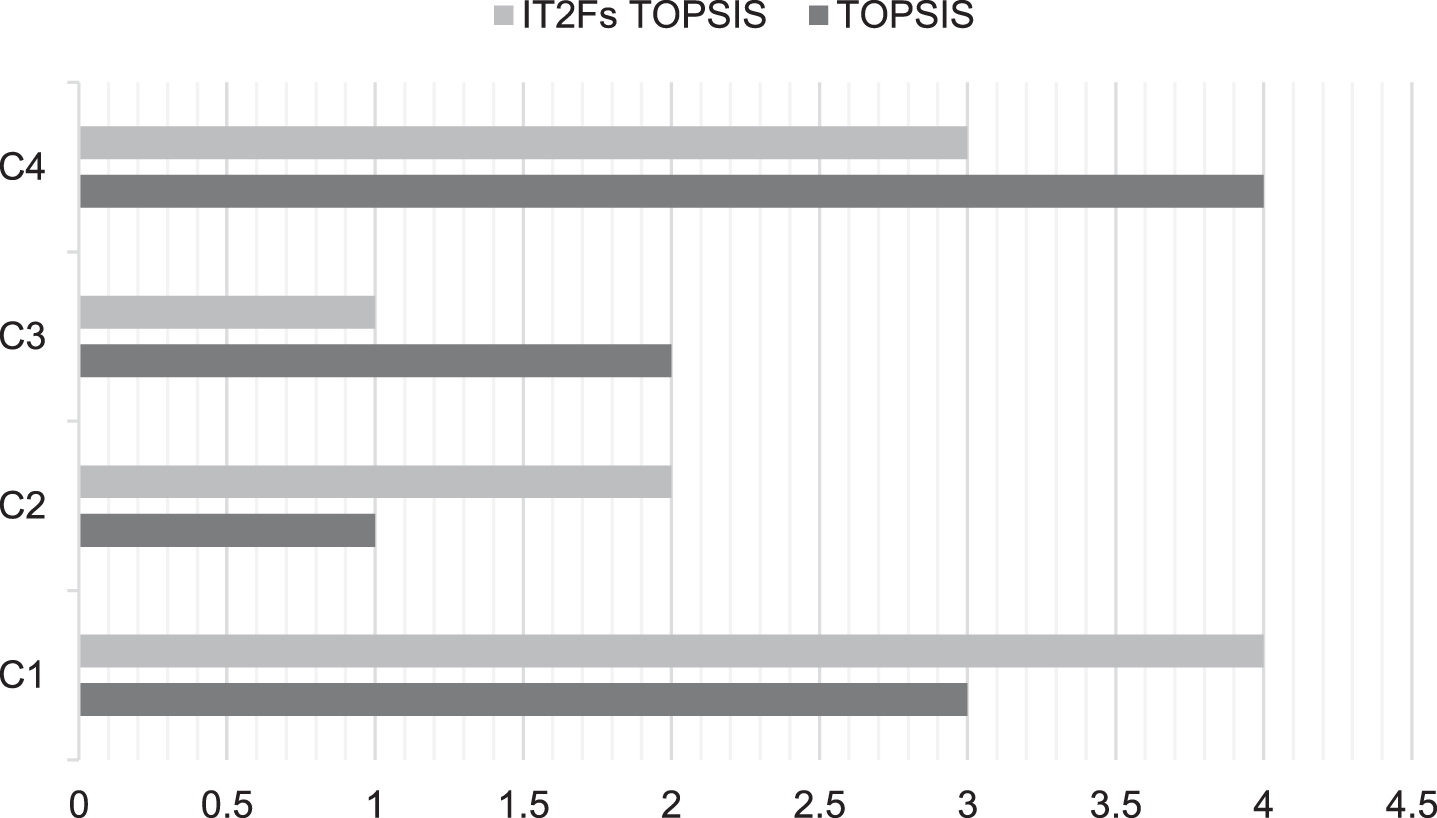
Comparison of TOPSIS and IT2FSs TOPSIS.
In this study, we implement a comprehensive method of AHP, CRITIC and TOPSIS reposed on interval type-2 fuzzy sets to rate the importance of the weight of core function indicators and select alternatives. From the beginning, scientists have proposed to provide a simple way to evaluate alternative projects and help decision makers to choose for Iran’s National Petroleum Corporation by using six criteria that compare investment alternatives as standards in AHP and fuzzy TOPSIS technology [48]. In recent years, researchers have worked to develop a mHealth application selection model by using a combination of AHP and fuzzy TOPSIS [49]. In [50], Konstantinoset proposed a combination of MCDM methods called AHP and GIS to determine the most suitable location for wind farm installation in 2019. TOPSIS is then used to rank the calculated locations in order to rank them based on installation suitability. The characteristic of this method was that we first used AHP to structure complex problems hierarchically, and through pairwise comparisons between competing standards. Then we used the TOPSIS method to evaluate alternatives by decision makers considering various criteria, then determine positive and negative ideal solutions, and finally we determined the best alternative that is the closest to the positive ideal solution and farthest from the negative ideal solution. At the same time, compared with the previous method, the combination of the above two methods based on interval type two fuzzy sets met the requirements of this paper for reducing uncertainty, maintaining scientific and computing convenience. The method steps used in this study are as follows:
Step 1. Linguistic variables are used by consulting pairwise performance indicator experts for pairwise comparisons. They can scientifically describe many uncertain factors in a multicriteria decision-making process [41].
Step 2. Deconstruct the homogeneity of fuzzy pairwise comparisons. In this process, if the results of the comparison matrix (A) obtained by the pairwise matching are uniform, the results of the comparison matrix (
Step 3. Reposed on the interval type-2 fuzzy set in the core function indicator, a pairwise comparison matrix can be obtained [41]. The language scale is shown in Table 3.
Linguistic scale for moment weights of core function indicators
where
Step 4. Select the geometric medical thinking to get the average fuzzy geometry value as shown below [41]:
where
Step 5. The fuzzy weight–specific algorithm for many core function indicators is as follows [41]:
Step 6. The alternative matrix and evaluation criterion matrix are transformed into standardized score matrix. By normalizing the performance matrix(U), a score matrix containing the relative scores of alternative schemes is obtained. The main elements of the performance matrix (U), column A (A1, A2...Am) is the standard, row is the alternative B (B1, B2...Bn), entry (Bij) are indicators of alternatives in the standard. For each standard value, determine the maximum within the standard (Max (b11:bn1) and the minimum within the standard (Min (b11: bn1)). The performance matrix is shown below
Step 7. Determine the standard deviation of each standard score (δ). Using standardized matrix Y and criterion A
j
(j = 1,2...m). By checking the jth criterion in isolation, we generate a vector β
j
that represents the score of all n alternatives. The characteristic of each vector β
j
is the standard deviation, which represents the intensity of the conflict or contrast of the corresponding criteria. The normalized matrix (Y) is shown below
Step 8. The correlation matrix is derived from the score matrix. A symmetric matrix is constructed, its dimension is m × m, and the general element θ
jk
is the linear coefficient between vector β
j
and β
k
. The greater the difference between alternative scores in standard j and k, the lower the θ
jk
value. Determine the conflicts among the decision criteria, and then determine the weight of each criterion. The following represents the conflict measures (P) for decisions created by standard j.
Step 9. The final performance score for each alternative, information quantity P
j
, is given by the jth standard in terms of conflict and comparison and determined by the multiplication aggregation formula. The higher the P
j
value, the more information in the criteria, and the higher the relative importance of the decision process. According to the following equation, value is standardized to obtain the target weight.
where P j = δ j P.
Step 10. Let λ be the preference coefficient, and then the comprehensive weight is shown as follows:
Step 11. Two evaluation matrices are formed according to requirements, including m preliminary plans and n core function index ((o, p) ∈ n, o + p = n). With the chiasm of many preliminary plans and core function index considered as and y ij , thus we have matrices and (y ij ) m×p. In this process, the required language scale and related IT2F are described in Table 4. Using linguistic variables can suitably describe many uncertain factors in a multicriteria decision-making process [47].
Linguistic jargons for site selection
Step 12. With the data as input, the standardized method is used to process the data to obtain a standardized decision matrix. The operation process of standardized value r
ij
is as follows [47]:
Step 13. Use the following algorithm to obtain a standardized decision matrix with preferences, calculated as shown below [47]:
Step 14. The defuzzification worth of interval type-2 fuzzy set is obtained by the following operation rules, and then the deblurring aggravated decision matrix is formed [47].
Step 15. The active and passive ideal solutions described by the definition are as follows [47].
Step 16. The calculation rules for the distance among many alternatives and active ideal solution
Step 17. In the multi-index space, the vertical distance between scheme point (yi1, yi2, . . . , y
in
) and space line y1 = y2 = , . . . , = y
n
is calculated, and the calculation formula of this weighted distance is [47]:
Core function indicators
Step 18. The algorithm for approaching coefficient CC
i
is as follows [47]:
Step 19. The rule of the defined ordering is to use the order of the final values, that is, to sort the preparations in descending order [47]. That is to say, the optimal preparation location is judged according to the order of preference rank of CC i . As can be seen from the literature, the optimal preparation is the one with the smallest absolute difference from the value of the ideal solution.
The hybrid approach we proposed is suitable for selecting the appropriate nursing home address through welfare indicators and cost indicators.
Problem description
A nursing home is a special public facility that ensures the normal life of the elderly, and its site selection plays a pivotal role in their happiness index. In addition, a nursing home represents the level of public facilities in a place. Defects in the consideration of site location of nursing homes can lead to inadequate care for the elderly. Some inconveniences for the elderly are the distance to medical facilities, the distance to fitness places, and the like. To minimize these deficiencies and improve the basic requirements of the elderly as well as their happiness, policymakers in government or private companies must choose the appropriate nursing home address. Since a comprehensive assessment of various key factors are needed in selecting the appropriate criteria to address the site location of nursing homes, this study proposes a new integrated approach to guide decision-makers.
Decision-maker analysis
The use of expert judgment may be the best way to solve this problem because of the lack of industry data on the site location of the previous sanatorium. When there are extensive selections for relevant standards in the decision-making procedure, the specialist’s opinion is regarded as the basis for such judgment. Practitioners who have worked on similar projects have exported research samples and professional opinions for this study. Currently, more than 11 criteria sets are chosen when considering the site location of a nursing home, and four alternative addresses are prepared. To reflect the opinions of the elderly and policymakers, several nursing home institutions have been visited. The expert information in this study is shown in Table 10.
Core function indicators
Core function indicators
Closeness coefficients of candidates
Comparison of AHP and IT2Fs AHP
Comparison of TOPSIS and IT2FSs TOPSIS
Core function indicators are used to assess the importance of the relevant criteria that should be considered when selecting a nursing home address.
Experts believe that a wide range of core function indicators has been identified in terms of benefits and costs. Table 5 shows these core function indicators. Number of communities (A1) refers to the number of communities around nursing homes [51]. Hospital distance (A2) refers to the distance between the nursing home and the nearest hospital. Number of supermarkets (A3) refers to the number of supermarkets around nursing homes [51]. Number of bus stops (A4) refers to the number of bus stops around nursing homes. Number of subway stations (A5) refers to the number of subway stations around nursing homes [51]. Number of parks (A6) refers to the number of parks around nursing homes. Greening (A7) refers to the degree of environmental greening around nursing homes. Noise (A8) refers to the sound (in decibels) around nursing homes. Number of surrounding roads (A9) refers to the number of roads around nursing homes. Construction income (A10) refers to the estimated income from the construction of nursing homes. Social influence (A11) refers to the contribution and influence of the nursing home to local old-age work after it is established [27]. For example, noise (A8) is an important core function indicator when assessing the site location of nursing homes, as less noise is vital to the physical and mental health of older people. Similarly, greening (A7) is another core function indicator that meets their physical and mental health needs. The hospital (A2) is vital, and it pertains to the basic living security of the elderly.
Data collection
Considering the key to choose the right nursing home address among the four alternative addresses, this study is supported by data (obtained from past actual case data) and some previous language statements. Data are collected by reviewing records of past cases and relevant papers and getting professional information support (A10, A11). On another side, for commercial reasons, the terminals are reluctant to share their data; thus, language information (A1, A2, A3, A4, A5, A6, A7, A8, A9) are received from the perspective of eight experts. Therefore, we use fuzzy logic to solve the problem of inaccurate and ambiguous metric data.
Selection of the nursing home address
The IT2F AHP is used to analyze the core function indexes to determine priorities and to rate the importance of each indicator. Eight experts working on the site location of nursing homes in the past use a nine-point table (as shown in Table 1) to assess the core function indicators. The pairwise comparison of core function indicator evaluations is performed by seven professionals selecting Eqs. (1)–(5).
In this paper, the TOPSIS method is used to determine what kind of address is suitable for building a nursing home. The arranged technique is reposed on separation description 2 vague sets (language) and digital data. Some core function indicators (greening, noise, number of nearby hospitals, number of parks, etc.) are assessed by a professional selecting the linguistic variables provided in Table 2. Others (construction gains, social impacts) are obtained from the data provided. According to the calculations of Eqs. (6)–(19) and TOPSIS mentioned in 3.3, in the operation, attention is paid to calculate the weight of each core function indicator under the type-2 fuzzy performance value to calculate each alternative aggravated type-2 fuzzy function value.
Discussion
The outcomes of the IT2F AHP are listed in Table 6. In addition, the weights of the 11 core function indicators are sorted relative to the standardized weights. Although the construction income (A10) is the most important core function indicator reposed on expert assessment, greening (A7) and Number of parks (A6) are identified as second and third. The construction income (A10) is the most important core function indicator instead of expert evaluation. This indicator may be more affected by practitioners with rich work experience. Greening (A7) and Number of parks (A6) may be viewed by nursing home users more influential. Noise (A8) and the number of surrounding roads (A9) are likely to be considered by the nursing home users.
Vital weights of each core function indicator were obtained using the IT2F AHP, and the ordering of the tight coefficients of the four alternatives is finally showed in Table 7, and we could know that Option S3 is the most ideal solution, that is, when the location of the nursing home in the example is selected, the location S3 should be selected. Among them, location S2 was an ideal location compared with locations S1 and S4. In practice, if location S3 is difficult to implement, we can try to choose location S2. Compared with Option S1, Option S4 is slightly stronger than Option S1. Likewise, when Options S2 and S3 are more difficult to implement, Option S4 can be selected. When combined with the previous standards, compared with the other three options Option S3 may be more in line with the requirements of construction revenue (A10), greening (A7) and Number of parks (A6).
Comparative analysis
a) Description
This study examines the effects of the AHP and TOPSIS and numerical data arranged in the traditional and interval type-2 fuzzy set language environment through comparative analysis to verify the superiority of the method used.
b) Discussion
By the comparison between the AHP and the IT2Fs AHP in Table 8, we find that the weight of some standards is different according to the method. The difference lies in the fact that the IT2Fs AHP considers more uncertainties and thus leads to deviations in the final result. For example, in the two rows of Table 8, the ordering of the standards was completely different. It is because that the interval type-2 fuzzy AHP method used changes in the preference matrix to generate more uncertainty, which results in differences in the standard ranking of the two groups of methods. The traditional AHP fails to consider more uncertain factors and limitations of the language scale. Therefore, it cannot rationally consider the problem. IT2Fs AHP solves these problems and provides more scientific weight for further decision-making. Table 9 shows the results of the author’s comparison between traditional TOPSIS techniques and IT2Fs -based TOPSIS techniques. The difference between the two approaches lies in the fact that IT2Fs technology uses a more scientific language scale and fuzzy logic to determine TOPSIS alternatives.
Conclusion
Nursing home site selection is one of the major problems of social life. From this perspective, the development and promotion of the new decision-making method proposed in this study is of great significance. First, we propose a comprehensive method based on interval type 2 fuzzy sets. This method uses a comprehensive weight combining the subjective weight of the AHP method and the objective weight of the CRITIC method, as well as the improved TOPSIS method that reduces the difference in index scores, which is sufficient Scientifically solve the problem of location selection of nursing homes in multi-criteria decision-making. Second, compared with traditional means, the outcome shows that the method is more reasonable, flexible, and straightforward to promote and more scientific than the traditional AHP and sequential preference technology. Finally, in the traditional sense, the elderly prefers nursing homes that are closer to hospitals. However, our research found that they prefer nursing homes with good greening and parks. Such a conclusion may overturn previous common sense perceptions.
Regarding the limitation of the research, although we have considered many influencing factors in the decision-making procedure, we need to supplement the relevant standards according to the actual situation in future research for different practical problems. Our research provides solutions to this type of problem.
In future research, it would be interesting to combine the comprehensive method proposed in this study with the traditional weighted aggregated sum product assessment, decision-making trial and evaluation laboratory, and other classical methods and consider more factors and indicators according to different real-world situations. In addition, this study considers that the method is expected to be applicable to other similar public facility location issues such as site locations of subway stations, shared car-charging stations, and quick deposits.
Footnotes
Acknowledgments
The authors gratefully acknowledge the editor and two anonymous referees for their valuable comments, which helped significantly improve this paper. This research was supported in part by the Natural Science Foundation of Guangdong Province (Grant No. 2021A1515011569) and the “13th Five-Year Plan” Foundation of Philosophy and Social Sciences of Guangdong Province (Grant No. GD20CGL55).
Appendix
Profile details of specialist
| Specialist No. | Work Unit | Position | Educational degree | Time accomplished | Age |
| 1 | Nursing home A | Operations manager | Master | 22 | 47 |
| 2 | Nursing home A | Operations manager | Undergraduate | 17 | 43 |
| 3 | Nursing home A | Operations manager | Undergraduate | 15 | 41 |
| 4 | Nursing home A | Operations manager | Master | 11 | 37 |
| 5 | Nursing home A | Operations manager | Undergraduate | 18 | 49 |
| 6 | Nursing home B | Operations manager | Master | 14 | 40 |
| 7 | Nursing home B | Director | Master | 16 | 44 |
| 8 | Nursing home B | Operations manager | Master | 19 | 45 |
| 9 | Nursing home B | Operations manager | Master | 19 | 50 |
| 10 | Nursing home B | Operations manager | Undergraduate | 20 | 55 |
| 11 | Nursing home C | Operations manager | Master | 35 | 65 |
| 12 | Nursing home C | Operations manager | Undergraduate | 28 | 57 |
| 13 | Nursing home C | Operations manager | Master | 25 | 48 |
| 14 | Nursing home C | Operations manager | Undergraduate | 25 | 52 |
| 15 | Nursing home C | Operations manager | Master | 11 | 37 |
| 16 | Nursing home D | Operations manager | Undergraduate | 18 | 49 |
| 17 | Nursing home D | Operations manager | Undergraduate | 14 | 40 |
| 18 | Nursing home D | Operations manager | Master | 16 | 44 |
| 19 | Nursing home D | Operations manager | Undergraduate | 19 | 45 |
| 20 | Nursing home D | Operations manager | Master | 19 | 50 |
| 21 | Nursing home E | Director | Master | 20 | 55 |
| 22 | Nursing home E | Operations manager | Master | 35 | 65 |
| 23 | Nursing home E | Operations manager | Master | 28 | 57 |
| 24 | Nursing home E | Operations manager | Undergraduate | 25 | 48 |
| 25 | Nursing home E | Operations manager | Master | 11 | 37 |
| 26 | Nursing home F | Operations manager | Undergraduate | 18 | 49 |
| 27 | Nursing home F | Operations manager | Undergraduate | 14 | 40 |
| 28 | Nursing home F | Operations manager | Master | 16 | 44 |
| 29 | Nursing home F | Operations manager | Undergraduate | 19 | 45 |
| 30 | Nursing home F | Director | Master | 19 | 50 |
| 31 | Government D | Operations manager | Master | 20 | 55 |
| 32 | Government D | Operations manager | Undergraduate | 35 | 65 |
| 33 | Government D | Operations manager | Undergraduate | 28 | 57 |
| 34 | Government D | Operations manager | Master | 25 | 48 |
| 35 | Government D | Operations manager | Undergraduate | 19 | 45 |
| 36 | Government D | Operations manager | Master | 19 | 50 |
| 37 | Government D | Director | Master | 20 | 55 |
| 38 | Government D | Operations manager | Master | 35 | 65 |
| 39 | Government D | Operations manager | Master | 28 | 57 |
| 40 | Government D | Operations manager | Undergraduate | 25 | 48 |
| 41 | Company E | Operations manager | Master | 11 | 37 |
| 42 | Company E | Operations manager | Undergraduate | 18 | 49 |
| 43 | Company F | Operations manager | Master | 14 | 40 |
| 44 | Company F | Operations manager | Undergraduate | 16 | 44 |
| 45 | Company G | Operations manager | Undergraduate | 19 | 45 |
| 46 | Company G | Operations manager | Master | 19 | 50 |
| 47 | Company H | Operations manager | Undergraduate | 20 | 55 |
| 48 | Company H | Operations manager | Master | 35 | 65 |
| 49 | Company I | Director | Master | 28 | 57 |
| 50 | Company I | Operations manager | Master | 25 | 48 |