



Abstract
In this research, UPQC (Unified Power Quality Conditioner) with optimized hybrid fuzzy controller based GBSSA (Gaussian Barebone Salp Swarm Algorithm) with EPLL (Enhanced Phase Locked Loop) have been proposed for power quality enhancement in power distribution networks. Using the proposed method, the difficulties in major of the power distribution system networks can be solved, related to power quality issues. GBSSA has been employed in this research, to improve solution accuracy and optimization efficiency. Given that, it is permissible to add some extra time cost to acquire a better solution, based on the Non-Free Lunch (NFL) theory, and that the time consumption of function evaluation is rather large, when addressing actual optimization problems, the extra time consumption can be overlooked to some extent. The EPLL control method improves the standard PLL, by reducing its fundamental flaw, which is the occurrence of main frequency errors, as well as double frequency errors. It controls the DC-bus voltage of unified power quality conditioners, during supply voltage and load voltage turbulences. The proposed UPQC control technique has been found to be resilient, to a variety of source and load perturbations, including unbalanced, transient distorted supply, voltage sag, unbalanced load and voltage swell. The proposed optimized GBSSA hybrid fuzzy controller with EPLL has been proven to be more effective in reducing the THD (Total Harmonic Distortion) to 3.22%. Moreover, comparative analysis with a conventional TSF-PLL has been performed with that of Takagi-Sugeno fuzzy controller and implemented using MATLAB (MATrix Laboratory).
Introduction
The importance of power quality distribution networks is being increased, in the current situation, due to the widespread distributed generation, based on renewable energy and expansion of non-linear demands. As a result, a motivation for the importance of Power Quality (PQ) is achieved [1]. The growth of the electronic devices is, because of the improvement in the power quality distribution networks. The faults in both source voltage and load current are dealt by using CPD (Circuit Protective Device), with harmonics through a common DC link voltage, by joining both the shunt and the series converters [2].
Advances in power electronic converters, on the other hand, have stimulated the interest in APF (Active Power Filter), which is considered to be one of the most critical component for obtaining optimal PQ. The injection of non-linear loads, with high amounts of harmonics and reactive power into the distribution network, has resulted in harmonic as well as grid voltage and current distortion [3].The series converter, on the other hand, can adjust for voltage unbalance, voltage distortion, voltage sag, voltage swell, thus ensuring perfect voltage regulation across the load, thus resulting in the creation of unique topologies and improved control systems for UPQC.
A power conditioner’s control system is critical to its overall performance [4]. UPQC is comprised of two voltage source converters, in light of Insulated Gate Bipolar Transistors (IGBTs), one shunt and one series, all associated through a common DC bus. It upholds the load and supply synchronous control with VAR. By utilizing the current harmonics, and changing the unified power factor, UPQC improves power quality [5]. Endeavours are being embraced to work on the nature of the power. In the present society, power quality has become a significant concern. Voltage and current harmonics and unbalances in the power system are the major issues encountered.
More ways to deal with power quality issues using UPQC have been discussed in the literatures, that employs hardware devices as diodes, thyristors, IGBTs, and diodes. APF (Active Power Filter) is utilized to eliminate harmonics from load side current, and make supply current absolutely sinusoidal, just as to mitigate supply voltage, for example, voltage sag/swell [6]. UPQC can be utilized to solve both voltage and current synchronization issues, and can be controlled, utilizing an assortment of methods. The responsive force hypothesis, which is appropriate for both transient and steady state, was used to re-enact a three stage three wire line. The hypothesis of prompt receptive force with linear loads is talked about in [7, 8].
UPQC’s are utilized to deal with power quality issues. The shunt active power filter is utilized to eliminate current harmonics, bringing about power quality and entire sinusoidal source current, and utilized for power factor correction. A series APF eliminates all voltage-related issues such as voltage fluctuation, voltage distortion, and voltage dips/rises, and makes the load side voltage constant. An UPQC is a device, made by associating a shunt APF and series APF, through a DC capacitor. Control systems employed for eliminating harmonics are presented in [10], that utilizes UPQC. The UPQC control methodology was intended to for a three stage four wire framework, in which the series APF and shunt APFs were connected in parallel with the DC capacitor, and the series APF was controlled utilizing the unit vector layout control procedure.
The essential prerequisites for compensation are the identification of the disturbance signal and the extraction of the reference signal, as quickly as possible. As a result, power system engineers are forced to use UPQC, in order to create effective and adaptable solutions to PQ challenges, that led to the development of enhanced control systems for UPQC and unique topologies [11]. In UPQC, the reactive power and active power was controlled effectively using control mechanism. Mauricio Aredesetal, by combining shunt and series APF, the active power line conditioner has been created and shared with a DC link capacictor. This structure, like a unified power flow controller, includes active harmonic reduction as well as compensated distortions at fundamental frequency [12]. A power conditioner’s control system is critical to its overall performance. Early detection of the disturbance signal and reference signal are key components during extraction for loseless compensation. Advanced control approaches for UPQC, such as SRF, PSO-based controllers, and neural networks, have been documented in the literature [13]. The distribution generator is connected to the UPQC’s DC connection in grid connected mode or islanding mode, and this topology can alleviate voltage interruption, voltage sag, swell, harmonic distortion and reactive power demand. At the installation site, this architecture can improve the PQ in a distribution system or an industrial power system [14]. However, these controllers are primarily employed for the generation of reference signals and less beneficial for the generation of pulse width modulation signals, thus decreasing the UPQC compensating capability. Many control strategies have recently been researched to meet the aforementioned drawbacks, including repetitive controller, deadbeat control and fuzzy PWM controller. To improve the transient response, a nonlinear observer strategy and harmonics elimination methods are used [15].
However, these control strategies make use of the converter’s average modelling technique. Power converters suffer from discontinuous control, because the state space equations of the converter fluctuate with switching states. Sliding Mode Controllers (SMC) are compatible with power converters’ inherent switching nature. Furthermore, the SMC is well-known for its frequent switching action, stability, good regulation, and durability under all load and supply voltage working conditions [16, 17] Many control strategies have been developed to address the PQ problems using UPQC. The capacitor voltage as the DC bus capacitor voltage control, was novel to UPQC, as were the majority of control schemes in the literature. In addition, constructing a PI-controller based on a DC bus voltage controller is simple and straightforward [18, 19]. In case of fluctuations, in the load and grid side, the performance of the PI controller are degraded. Unstable operation provided by PI Controller, causes more time for the system to recover, which is greater than or equal to 20%. As a result, numerous studies regard the DC bus voltage regulation for the TSF controller, and adapt the dynamic conditions of the power system. In the nonlinear mode, the TSF controller operates on the other hand, are insufficient, during dynamic conditions, as the large deviation of control gain is noticed. A compensating control approach, based on the UPQC model is proposed in this study [20]. Type 2 interval Fuzzy Logic Controller for multilayer shunt APF, have been proposed by Kala Rathi et al. [21]. Wu Deng et al. [22] have presented a higher-order differential mathematical technique for determining the fault severity. For seven level modular multilevel converters, Narasimhulu et al. [23] presented a fuzzy controller. For a single machine infinite bus system, Sambariya et al. [24] developed a fuzzy controller with various membership functions. However, implementing these controllers is quite difficult. In the field of control engineering, the use of fuzzy controllers has now reached a point where it is required [25]. The controller offers a wide variety of gaining control options, resulting in enhanced UPQC tracking during transients, unbalanced loads, and power distortions [26]. Salps are members of the Salpidae family and have a translucent barrel-shaped body. Salps frequently form a swarm known as a salp chain. Although the exact rationale for this behaviour is unknown, some researchers suggest that, it has been done to improve the mobility through rapid coordinated modifications and foraging [27, 28]. There isn’t much in the way of mathematical models of salps’ swarming behaviour and population [29]. Furthermore, while swarms have been widely studied and employed for addressing optimization issues, solving optimization problems for salp swarm there is no mathematical model.The mathematical model used to simulate salp chains can’t be used to address optimization problems directly. To put it another way, the model needs to be adjusted and it is suitable for optimization problems [30]. To identify the global optimum is the ultimate goal for single objective optimizer. In the salp swarm algorithm model, follower salps follow the leading salp, automatically the salp chain automatically travels towards it in the result. The global optimum is unknown, is the issue in optimization problems. The best solution obtained is assumed in this circumstance [31]. One of the most common approaches for determining the best threshold, is to use an optimization algorithm. Furthermore, the SSA technique is a new swarm intelligent optimization algorithm that was just released [32, 33]. UPQC is made up of two pulse-width modulated shunt inverters and series inverters and there is no shared DC link. Both configuration of a series unit (SEU) and the configuration of a series unit are same, as that of dynamic voltage restorer and a DSTATCOM, in general. There is also a rapid identification technique for both balanced and unbalanced sag/swell. The use of OUPQC in DN is investigated. A thorough examination of OUPQC’s SEU and SHU, as well as their capabilities, is offered. Hafezi et al. [34]. as compared with other SI optimization algorithms, the Salp Swarm algorithm still need to improve for better optimization efficiency and correctness. For this. integrated with the Gaussian Barebone Salp Swarm algorithm for better optimization, this study develops the GBSSA salp swarm algorithm, as compared to the SSA, used in UPQC for solving PQ issues, For solving optimization problems, the Gaussian Salp Swarm Algorithm (GSSA) is the best optimization technique with single objective and multiple objectives, and it provides better optimization. The model for the circuit is both shunt active power filters and series active filters. For overcoming power qualities issues, the Unified Power Quality Conditioner is the most promising power electronic circuit. As a result, the advantages of both power filters are combined for improved power quality mitigation. The advantages of the hybrid fuzzy controller are considered in this study, and a new control method for the Unified Power Quality Conditioner (UPQC) is proposed to minimise power quality issues in the distribution system. When comparing TSF controllers to the suggested optimised GBSSA hybrid fuzzy control and the control scheme with EPLL explored, the hybrid fuzzy controller provides improved DC bus voltage stabilisation and enhanced correctness of the solution and the efficiency of optimization.
The contribution of this paper is EPLL control strategy enhances the standard PLL which overcomes the main drawback that involves the presence of double frequency errors. An optimized GBSSA (Gaussian Barebone Salp Swarm Algorithm) based hybrid fuzzy control technique with EPLL for power quality enhancement in power distribution networks is proposed. Total Harmonic Distortion (THD) is reduced to 3.22%, as compared to existing techniques. The proposed technique has been found to be resilient to variety of source and load perturbations including unbalanced, transient distorted supply, voltage sag, unbalanced load and voltage swell.
The organization of the paper is as follows. Section 2 describes the proposed control scheme for UPQC. Section 3 presents simulation results and discusses them. Section 4 presents the concluding remarks and gives the suggestion for future work.
Proposed control scheme for UPQC
The accuracy, in which the power system voltages as well as the DC bus capacitor voltage is adjusted, determines the UPQC’s compensating ability. As a result, during power system turbulences, the control gain in nonlinear loads is modified by using the proposed optimized GBSSA hybrid fuzzy controller, and the DC bus capacitor to be allowing for fast regulation and as appropriate. Through the load, the one APF is connected and terminated, as shunt APF and series APF is connected in series with the power network. The three phase non-linear load, comprises of both inductive L L and resistive R L . In power network through the shunt inductor, the shunt APF is coupled. LC series transformer and passive filter are connected to the series APF. Figure 1 shows the proposed optimized GBSSA hybrid fuzzy controller and EPLL, it provides the suitable control signals v c abc and i c abc , after the input signals have been received, thus injecting the control signals into the series as well as shunt PWM converter. It provides the proper compensation for load perturbation and source perturbations. Grid synchronisation is also an important part of UPQC’s overall control and compensatory capabilities. In the power system, distorted unbalanced, and faulty supply situation, causes plenty of issues. Furthermore, the quality of grid synchronisation is a crucial component that impacts the whole control structure compensation capability of PQ difficulties. To accurately and quickly extract the positive signal from the grid voltage, Enhanced phase locked loop (EPLL) has been used.

Proposed hybrid fuzzy controller based on UPQC.
The non-linear adaptive filter estimates the basic component of distorted signal, and is naturally adaptable and effective. The changes are to be detected in the phase angle, input signal amplitude and the frequency. The filtering performance of UPQC under unbalanced voltage condition and heavily distorted condition, is the reason behind the changes in the conventional PLL. During this situation, the enhanced PLL overcomes the drawback, that is the presence of double frequency error, and estimates the amplitude of input signal. To remove the error, new loop can be used and also contains the filtered version of input signal. Because of the simplified current measuring system, the suggested control strategy is simple and easy to apply. The suggested EPLL increases UPQC’s performance for both source and load side disturbances. Positive sequence components from data from power systems are routinely extracted using the EPLL. The fundamental function of a shunt APF is to compensate for current harmonics induced by a nonlinear load. The active power is taken from the power source through the shunt APF to manage the DC bus voltage. Both the reference Udcset and DC bus voltage Udc is compared, and the equivalent error signal is sent to a Optimized GBSSA hybrid fuzzy controller
The UPQC Optimized GBSSA hybrid fuzzy control system for dc-bus voltage regulation is shown in Fig. 2(a). DC bus capacitor voltage is Udc and the reference value as Udc set, are sensed and analysed. For Takagi–Sugeno and Mamdani fuzzy, membership function is used, with input as analogous signals ɛ(n) and ∂ɛ(n) in dynamic power system for DC voltage regulation and it provide the low steady state error, quick settling and fast response and shown in Fig. 2(a). For Takagi sugeno fuzzy controller the appropriate gain is supplied and the matching input signal is processed by the Mamdani based fuzzy system for the reference DC bus voltage tracking to be accurate.
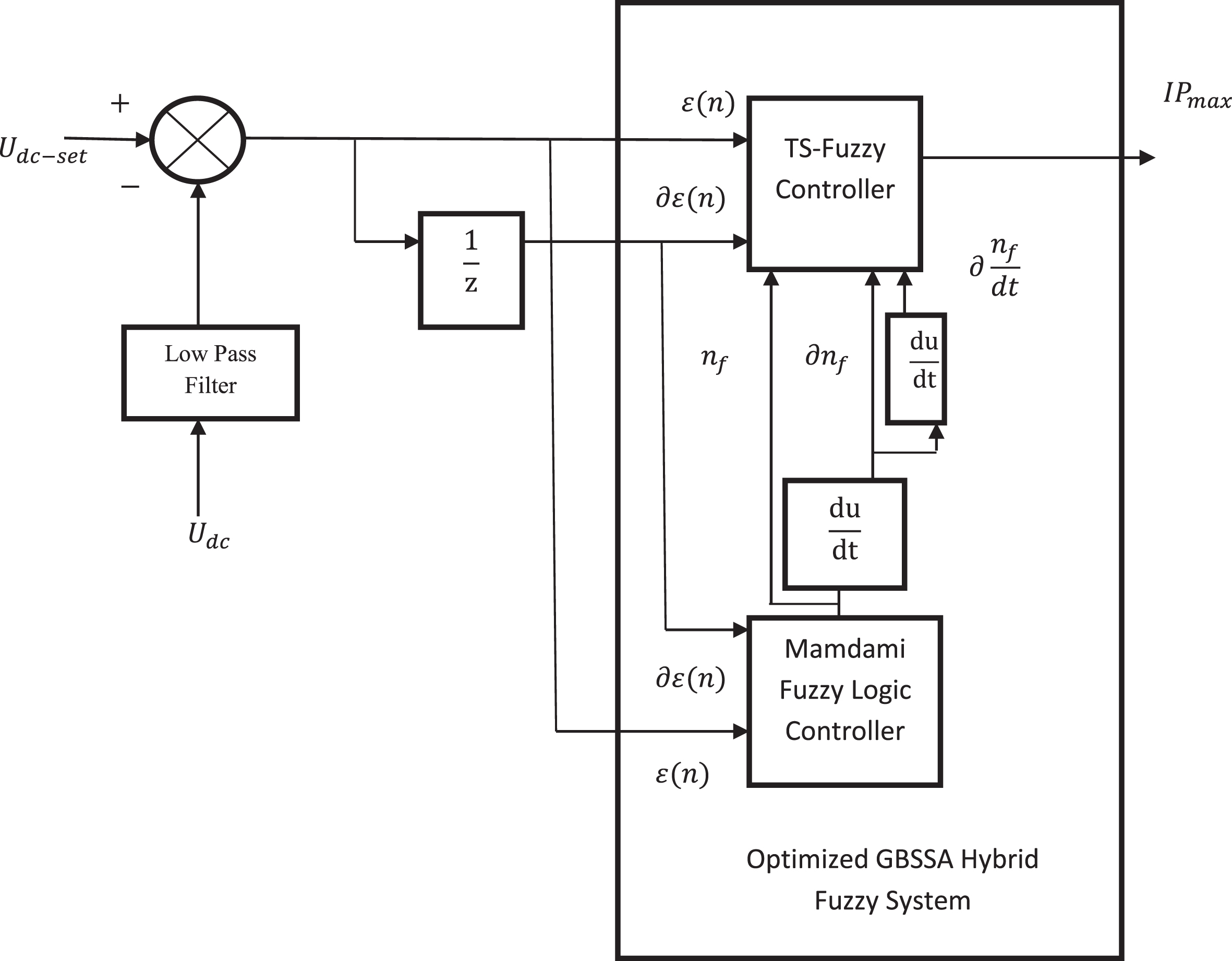
Optimized GBSSA Hybrid fuzzy control block.
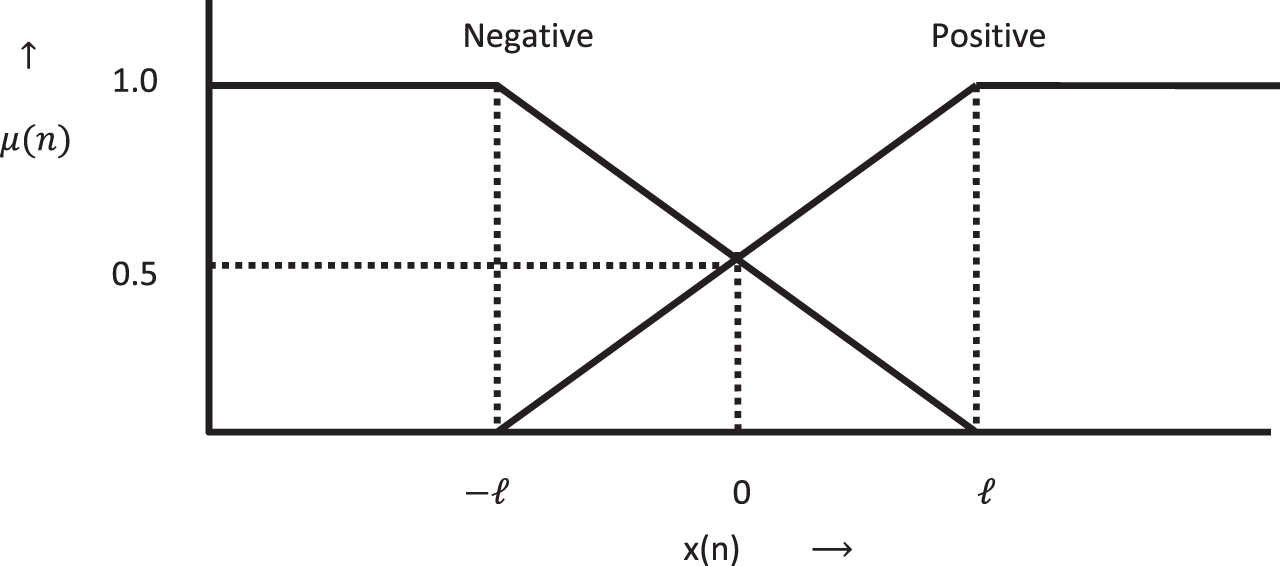
TS fuzzy controller’s membership function.
From Takagi-Sugeno controller’s output, the reference current signal IP max peak value has been derived. The membership functions for ɛ (n) and the ∂ɛ (n) are defined by fuzzifying them across positive, two input fuzzy sets, and negative as,
Xin, designates for the fuzzy controller where the error is applied, error applied for specifying the nth sampling instant is
and
Considering the negative-set membership function as
Figure 2(b) shows the membership functions values –ℓ and the –ℓ of are preferred with respect to the ɛ (n) and the ∂ɛ (n) for the uppermost value, where both are shown. The TS fuzzy controller is used in four simple rules, like as V1 (n) = i1 (a1
ɛ (n) + a2smallintɛ (n) + a3 (ɛ (n)) smallintɛ (n) if v2 (n) = i2v1 (n) if ɛ (n) is positive and ∂ɛ (n) is negative v2 (n) = i2v1 (n) if ɛ (n) is negative and ∂ɛ (n) is positive v2 (n) = i2v1 (n) if ɛ (n) is negative and ∂ɛ (n) is negative
The output value of the TS fuzzy controller is represented by the mentioned rule base v1, v2, v3 and v4.The equation can be defined as using Zadeh’s laws for AND operation and a common defuzzifier.
However, for ℓ=1, W ith v (n) given, we get the centroid defuzzifier
Where
As the result, the error (ɛ) and the changes in the error (∂ɛ) are determined by both the integral gains and the proportional gain.
The following equation can be written as
For the error in the consistent peak magnitude and changes in the error is represented as L1 and L2 respectively.
TS fuzzy controller defines the equation as nonlinear and the coefficients results are i1, i2 - . i3, i4 of controller gain the wide range. The optimum gain factors are also presented with regard of Mamdani-based fuzzy-controller in order to create a hybrid fuzzy controller. As shown in Fig. (2) the ɛ (n) and ∂ɛ(n) are represents as DC bus error signals is applied through mamdani-based fuzzy controller input. As shown in Table 1, a fuzzy rule table, is an important component of a fuzzy controller.
Comparitive analysis of proposed and existing method
For DC bus voltage regulation, a more detailed view of control effective tracking behaviour is depicted as
Whereas
Furthermore the effective gain parameter provided by Mamdani fuzzy system, which delivers the output function is represent as ∂n
f
and its outcome is ∂n
f
and
The values that are selected include: i1 = 1, i2 = 0, i3 = 1, i4 = 0 as well as η
f
(0, 0) = η
f
, ∂η
f
(0, 0) = η
f
, and
Besides this, optimized GBSSA hybrid fuzzy controller with EPLL control strategy is further applied to UPQC. Optimization efficiency and accuracy has been improved by using GBSSA. By adding extra time and cost, it is acceptable to obtain the best solution based on non-free lunch idea (NFL). Extra time consumption is needed for addressing actual optimization problems in function evaluation, but in some extent the extra time consumption is neglected. The computational complexity of GBSSA is the same as that of the basic SSA, O (N×D), during the initialization phase. The location of each salp is initially updated in the iterative process, and the computational difficulty is where L denotes the maximum number of iterations and ((L-1) × N × D) indicates the computational difficulty of updating individual positions through the GB. The original SSA’s computational complexity during the step of determining the best solution is O (L*N). Unbalanced, transiently distorted supply, voltage sag, unbalanced load, and voltage swell have all been found to be resilient to the proposed UPQC control technique.
The main limitations of existing controller is that it does not offer a wide range of variations in getting control over UPQC to solve various power quality problems during load transients and source voltage fluctuations. The proposed controller covers a diverse range of variation in taking control that results in enhanced tracking performances of UPQC during transient, unbalanced load and power system distortions [35].
To demonstrate the suggested technique’s potential for practical use. There are four parameters to consider: (1) cost, (2) time, (3) safety, and (4) practicality, in the PLL’s performance in a voltage distortion scenario. Here the comparison is performed for the existing PLL-TSF performance, to the proposed optimized GBBS hybrid fuzzy controller with EPLL.
Performance comparison of proposed and conventional UPQC
In Fig. 3(A), (B), (C), there is a comparison of compensation for PQ concerns. Due to the fixed gain for the controller and saturation limit, it fails to adjust PQ distortions for more than 30% sag, according to this investigation. PLL controllers with Vdc estimators and coordinated sharing of reactive power demand were used in the suggested scheme to improve PQ problem compensation, for 50% sag using the analytical method and for 80% sag utilising the proposed optimized GBBS hybrid fuzzy controller technology. The analysis revealed that the proposed hybrid fuzzy controller-based ACT can operate in a wide range of situations.
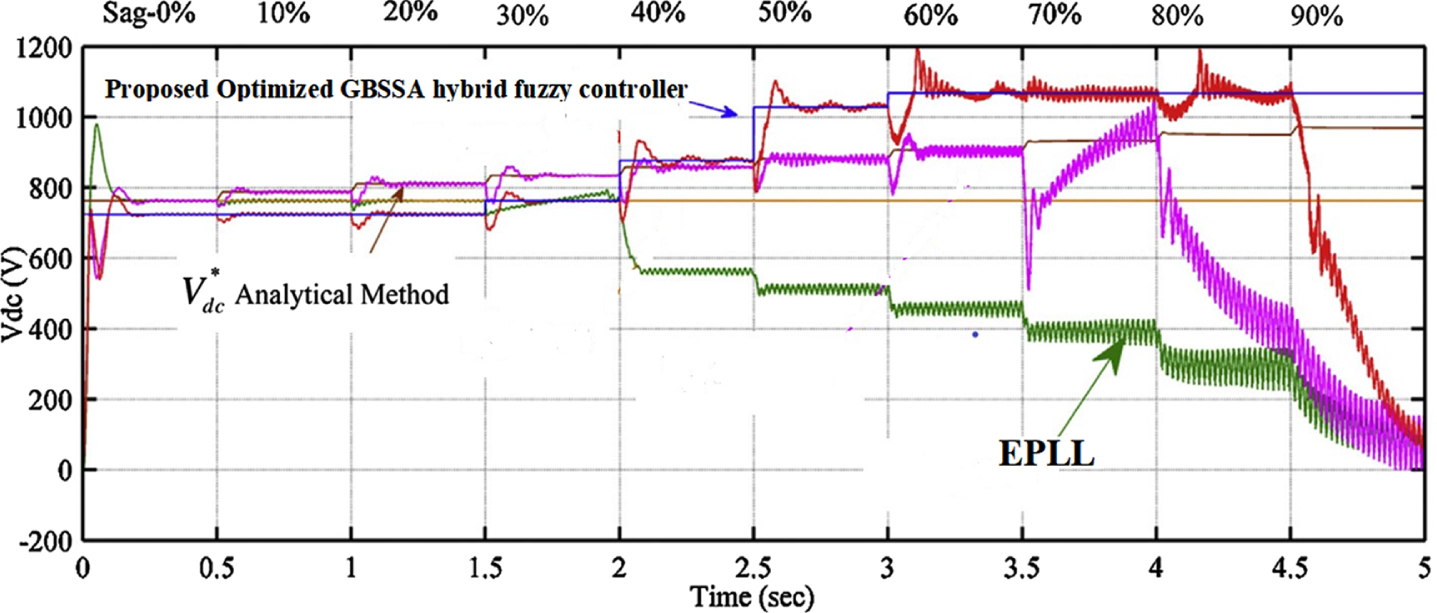
Proposed and conventional UPQC for DC link voltage regulation.
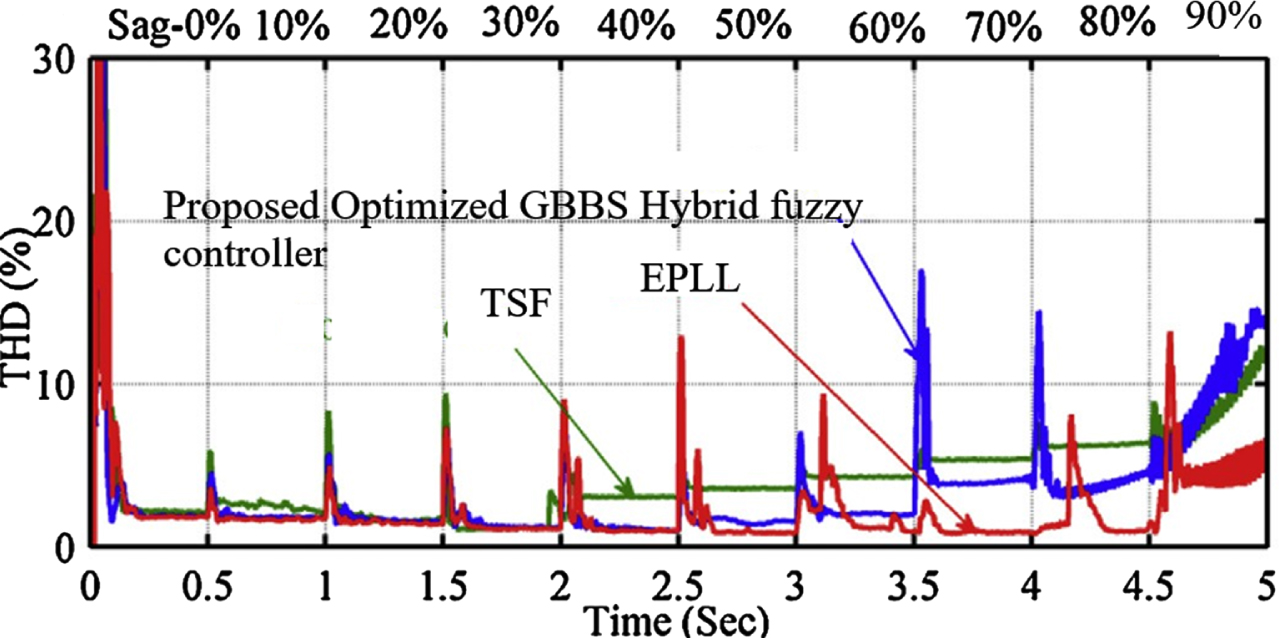
Using proposed and conventional UPQC for THD compensation.

Power angle estimation using proposed optimized GBSSA hybrid fuzzy controller and analytical based estimator.
Figure 4(a) shows the input membership function and Fig. 4(b) depicts the consistent output membership function used to fuzzy the aforementioned input signals.

(a) Input membership function for gain calculation (b) Output membership function for gain calculation.
The appropriate gain is generated by giving relevant rules to the fuzzy controller using the fuzzy interference system. As a result, the proposed controller achieves effective tracking performance, as shown in Fig. 5.
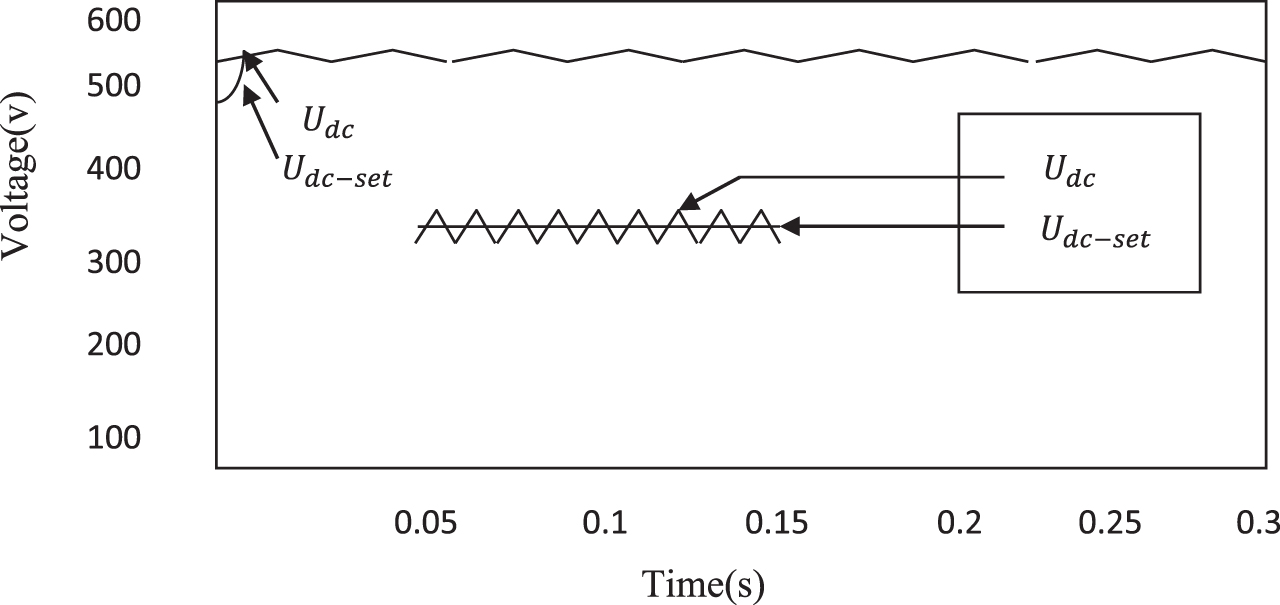
Hybrid fuzzy system’s DC voltage tracking performance.
The proposed optimized GBSSA Hybrid fuzzy controller with EPLL in UPQC compensates for real-time current-related PQ distortions and power quality distortions such voltage. Notch (0.4 s), voltage sag (0.5 to 0.6 s), swell (0.45 to 0.55 s), and unbalance source are the voltage-related PQ distortions (0.8 to 0.9 s). The harmonic distortion caused by the rectifier load (0.75 to 1.06 s) and reactive power demand load are the current associated PQ distortions (1.06s). Figure 6(A), (B), and (C) show the source voltage, load voltage, and compensation voltage, respectively. During voltage-related power quality problems, series APF plays an important role in compensating, ensuring that the rated load voltage is maintained across the load as indicated in Fig. 6(B).where the THD of source voltage, load voltage and compensation voltage is 4.07%, 1.9 %, 1.8%. Figure 6(D), (E), and (F) show the source current, load current, and compensation current, respectively. For current related PQ distortion, the shunt APF is important because it keeps the source, free of reactive power demand and harmonic distortions. In load current 4.07 % THD is created by the rectifier load, whereas the sinusoidal source current maintains by shunt APF with THD 1.9% and compensation current THD is 1.7%.

(A) Experimental results using the proposed technique under various supply voltage. conditions: voltage sag, voltage swelland unbalanced condition.
Transformation angle (vt) and Distorted supply voltage of traditional modified TSF-PLL technique, through a modified PLL, a unit vector signal derived as in Fig. 7(a) and that of Proposed optimized GBSSA hybrid fuzzy controller with EPLL unit vector signal is shown in Fig. 7(b). Table 1 shows the comparitive analysis of the proposed method with conventional method. It shows that harmonic compensation with the proposed controller is better as source current THD is 1.9%. The proposed optimized GBSSA hybrid fuzzy controller can mitigate the source current harmonics and load voltage harmonics better than the conventional controller.
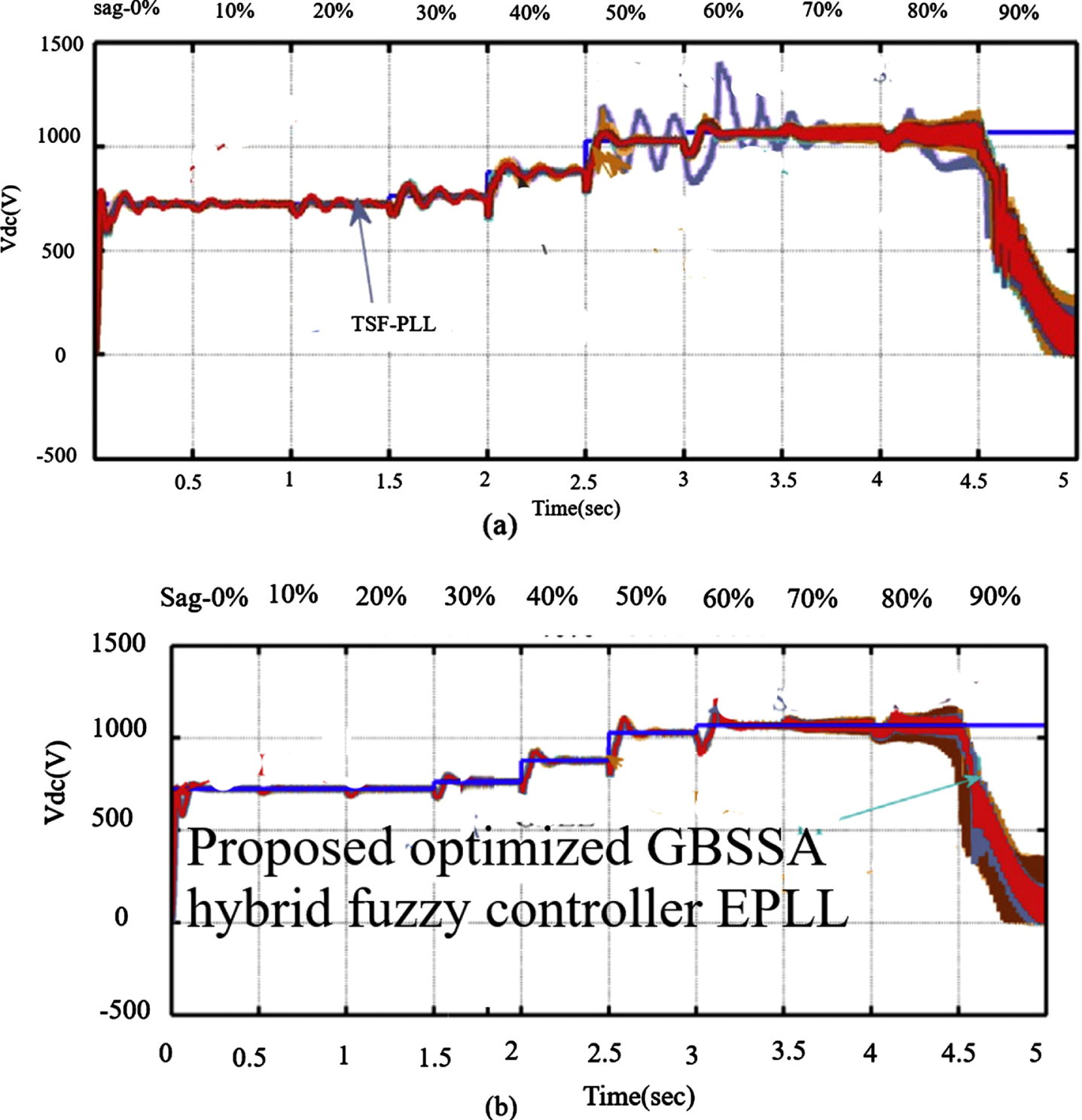
Under distorted supply conditions the experimental findings in real time for the a) conventional TSF-PLL b) Proposed method.
Figure 8 demonstrate the transformation angle (vt) and distorted supply voltage for the proposed optimized GBSS hybrid fuzzy controller with EPLL and conventional modified TSF-PLL approaches. The transformation angle (vt) of the EPLL, in comparison to the typical modified PLL, exhibits relatively small ripples at highly distorted conditions. As a result, with EPLL strategy using the proposed optimized GBSSA hybrid fuzzy controller to performs better and provide an adequate reference signal in all power system network operating circumstances. As a result, under all grid side and load side perturbations, the proposed EPLL technique has been found to provide a quick, simple, and reliable UPQC control action. Table 2 shows the comparison of Total Harmonic Distortion with the state of art techniques. From the table, it is analysed that the total harmonic distortion with the state of art is reduced to 3.22% as compared to other existing methods.
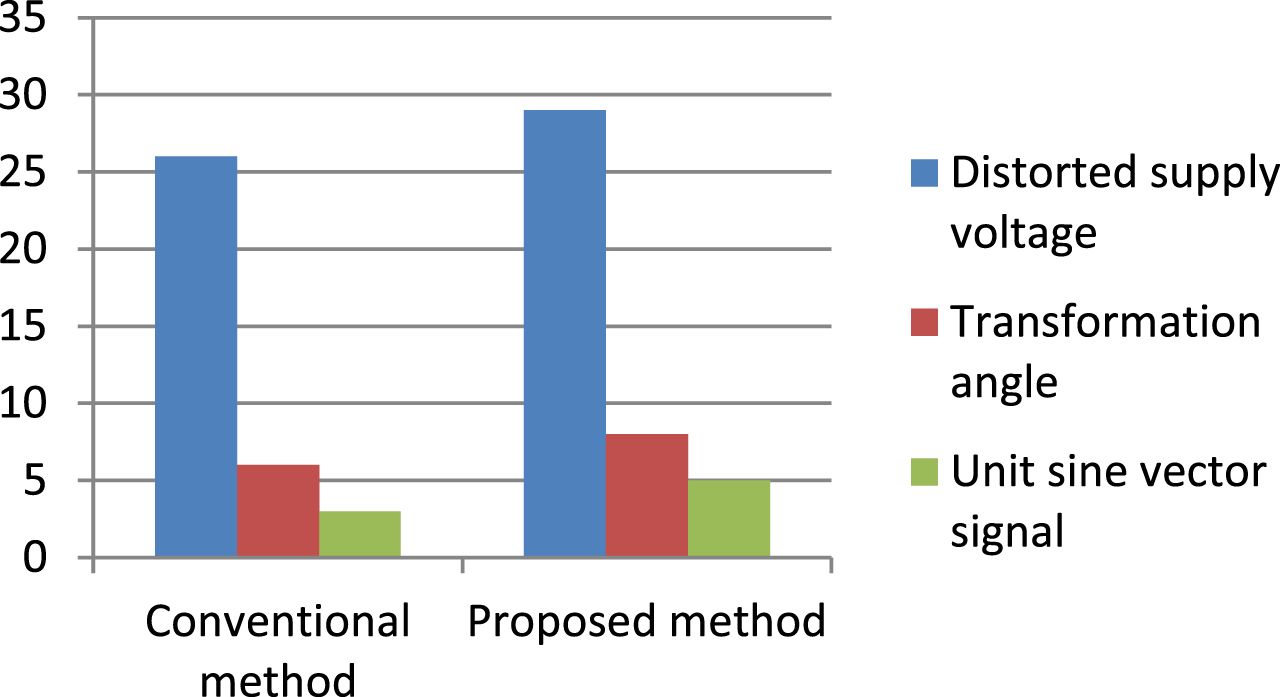
Analysis of the THD spectrum for conventional method and proposed method.
THD comparison with state-of art
In Takegi, Sugeno (2015), Torque sharing function (TSF) technique is implemented for the performance enhancement. The total harmonic distortion generated in this technique is 4.9% which is very high. In literature by David Robertson (2020), PLL technique is implemented that produces THD of 7.5% which is 1.3% greater than existing. The occurrence of double frequency error results in high THD. In literature by S. Shamshul Haq (2021), TSF technique is implemented that produces 1.3% higher THD compared to other literatures with the demerit of peak overshoot in magnitude.
In our proposed research, GBSSA Optimized Hybrid fuzzy controller with EPLL is implemented that produces total harmonic distortion of 3.22% which is 4.28% lower than existing techniques with remarkable reduction. Here main demerit of double frequency error is eliminated with EPLL.
The effort to improve power quality has become a relevant study topic among power electronic engineers and power system researchers. Nonlinear loads are becoming increasingly common. Unbalanced, transiently distorted supply, voltage sag, unbalanced load, and voltage swell are all demands, and the suggested UPQC management system has been shown to be resilient to a variety of source and load perturbations. To address power quality issues, the most promising power electronic circuit modules is Unified Power Quality Conditioner. This circuit is designed using both shunt active power filters and series active power filters. By providing power quality mitigation. both the power filter benefits are combined. The benefits of the hybrid fuzzy controller are investigated in this work, and a novel control approach for the Unified Power Quality Conditioner is proposed to reduce power quality issues in the distribution system. The recommended enhanced GBSSA hybrid fuzzy control and the control method with EPLL provide superior DC bus voltage stabilisation than TSF controllers, thus improving the accuracy and efficiency of the solution’s optimization. Extensive simulation experiments using MATLAB/Simulink were conducted, and it was determined that, the suggested method outperforms the existing strategy in terms of increasing power quality. The Gaussian Barebone Salp Swarm Algorithm is used for improved optimization in a systematic technique for constructing the hybrid fuzzy controller. The total harmonic distortion is effectively reduced to 3.22 percent using the suggested optimised GBSSA hybrid fuzzy controller with EPLL, and a comparative survey with a standard TSF-PLL has been conducted.
Other optimization strategies will be considered in the near future to help UPQC improve and solve power quality issues. Also hardware implementation to be performed and performance to be analyzed.