



Abstract
This study aims to create a strategy for reducing energy costs in hospitals to ensure the sustainability of health services. In this framework, a novel hybrid decision making approach is generated based on golden cut-oriented bipolar and q-rung orthopair fuzzy sets (q-ROFs). Firstly, balanced scorecard (BSC)-based criteria are evaluated by using multi stepwise weight assessment ratio analysis (M-SWARA) approach. Secondly, alternatives are examined with the help of technique for order preference by similarity to ideal solution (TOPSIS) technique. The novelty of this study is to find critical factors that affect the energy costs of health institutions with an original fuzzy decision-making model. This proposed model has also some superiorities by comparing with previous models in the literature. First, SWARA method is improved, and this technique is generated with the name of M-SWARA. Hence, the relationship between the criteria can be examined owing to this issue. Additionally, golden cut is taken into consideration to compute the degrees in bipolar q-ROFSs to achieve more accurate results. These two issues have an important impact on the originality of the proposed model. The findings demonstrate that consciousness level of employees has the highest weight with respect to the energy costs in hospitals. Additionally, the type of energy used also plays a significant role for this issue. Thus, renewable energy sources should be considered in meeting the energy needs of hospitals. Although the installation costs of these energy types are higher, it will be possible to significantly reduce energy costs in the long run.
Introduction
This part gives information about theoretical background, literature evaluation, novelties of the study and superiorities of the proposed model.
Background Information about the subject
Within the scope of social development, it is necessary to provide sustainable health services. For this purpose, it is important to control the costs of the investments. The biggest cost item for hospitals is personnel expenses, machinery, and equipment. However, it is difficult to minimize these cost items. One of the controllable cost items for hospitals is energy. Energy expenses have a very important share in the cost items of hospitals [1]. In this framework, the efficiency of these investments can be increased by reducing the energy costs of hospitals. The important issue in this process is to determine which issues should be prioritized to reduce the energy costs of hospitals.
Literature review
Hospitals use high-tech tools and devices [2]. In this context, it is very important to choose the equipment that consumes less energy [3]. Peter et al. [4] focused on the effectiveness of the health industry in COVID-19 period. They reached a conclusion that less energy consuming equipment should be used for this situation. Chen et al. [5] and Alirahmi et al. [6] studied the key items for the energy efficiency in health industry. They claimed that selecting appropriate equipment has a powerful impact on the energy cost reduction of the hospitals. Hospitals are large enterprises so that by heating of these buildings, high amount of energy is used. In this process, the energy need of the buildings with effective insulation becomes much less [7, 8]. This contributes significantly to the energy efficiency of hospitals. Nematchoua et al. [9] focused on the demands for energy in hospitals. They highlighted the importance of insulation to achieve this objective. Gaspari et al. [10] and Munsamy and Telukdarie [11] also evaluated healthcare energy management for different countries. They identified that the buildings should be insulated for energy effectiveness.
In addition, the level of awareness of the personnel working in the hospital has a very important role in energy saving [12]. Issues such as leaving the lights on in the rooms and leaving the appliances plugged into the sockets significantly increase the energy costs of the hospitals [13]. The most effective way to solve this problem is to increase the awareness level of the employees [14]. Personnel who have more knowledge about energy efficiency will ensure that energy is consumed less. This will significantly contribute to reducing the energy costs of hospitals. Halis and Halis [15] examined leading indicators of the energy efficiency in healthcare industry. They defined that the awareness of the staff should be increased in this regard. Moreover, Bertone et al. [16] and Nourdine and Saad [17] studied energy efficiency in hospitals and concluded that necessary trainings should be given to the staff to achieve this purpose.
The type of energy used is also very effective on the energy costs of hospitals. In this context, the initial cost will be low thanks to the selection of fossil fuels. However, this type of energy causes environmental pollution [18]. On the other hand, renewable energy sources both prevent the carbon emission problem and reduce the energy costs of hospitals in the long run [19]. Therefore, it would be appropriate for hospitals seeking a strategic solution to reduce energy costs [20, 21]. Cygańska and Kludacz-Alessandri [22] evaluated energy consumption in Poland. They determined that hospitals should give prioritization to the green energy alternatives. Guven et al. [23] also claimed that small scale solar panels can be adopted to the hospitals so that energy costs can be reduced. Billanes et al. [24] studied energy efficiency of the hospitals in the Philippines. They identified that micro wind turbines can be considered for the hospitals.
Purpose, motivation and novelties of the study
It is seen that energy costs are of vital importance for the efficiency and sustainability of hospitals. In this context, many researchers have focused on the factors that affect the energy costs of hospitals. However, due to budget constraints, it is very difficult for hospitals to make improvements for all these factors at the same time. Therefore, it is necessary to determine which of these factors are more important. With the help of finding more significant factors, the hospitals can allocate their budget to more important criteria so that efficiency in the cost management process can be provided. In the literature, there are limited studies that make priority analysis about the factors of cost management in health industry. This situation can be accepted as a significant literature gap. Consequently, there is a need for a new study that makes priority analysis for the factors affecting the energy costs of health institutions with a new and original method.
The aim of the study is to develop a strategy for reducing energy costs in hospitals to ensure the sustainability of health services. To develop a strategy, balanced scorecard (BSC)-based factors affecting the energy costs in hospitals will be determined in detail. In this framework, a novel hybrid decision making approach is constructed based on golden cut-oriented bipolar and q-ROF sets. Firstly, these criteria are evaluated by using M-SWARA. Secondly, alternatives for the costs are examined with the help of TOPSIS technique. Moreover, IFSs and PFSs are also taken into consideration to make a comparative evaluation.
The main novelty of this study is to present a set of criteria that affect the energy costs of health institutions. Moreover, energy costs are of vital importance especially for the budget and current account balance of energy importing countries. Therefore, reducing the energy costs of hospitals also contributes to the macroeconomic stability of the country. Moreover, because of the budget constraints, it is not very feasible for the hospitals to make improvements for all these factors at the same time. Therefore, more significant items can be identified. Owing to this issue, the hospitals can allocate their budget to more essential criteria. This situation has a powerful influence to increase the efficiency in the cost management process of the hospitals. On the other hand, in this study, an original fuzzy decision-making model was developed to determine the most important factors affecting energy costs. Therefore, this study also provides originality in methodological terms.
The superiorities of the proposed model
The proposed model has also significant superiorities by comparing with previous ones in the literature. First, in this model, the criteria are selected based on BSC perspectives. In many created models, factors are selected only from financial variables [25]. This situation has a limiting impact on the evaluation process. Because BSC approach considers both financial and nonfinancial issues, this situation increases the superiority of the proposed model compared to the others [26, 27] because it provides more comprehensive analysis. Secondly, q-ROFSs have also some advantages over other sets used in the literature. Because q-ROFSs are created with the extension of IFSs and PFSs, a wider space can be taken into consideration in the analysis process [28, 29]. This situation has a positive influence on the handling uncertainty in decision-making process more effectively [30].
Furthermore, bipolar fuzzy sets are also employed in the analysis process. Thus, positive and negative aspects can be evaluated that has a significant contribution to reach more accurate results [31–33]. This situation also helps to create detailed information set. Additionally, in the process of computing the degrees, golden cut is taken into consideration. Hence, the evaluations in this proposed model become more appropriate in comparison with the previous ones [34, 35]. The most important benefit of SWARA is providing chance to the experts to consider their priorities in decision-making process [36, 37]. Moreover, in this study, SWARA model is improved by the name of M-SWARA. Thus, causal relationship can be defined with this method [38]. However, in some models, only criteria weights are identified, but cause and effect analysis cannot be made because of the preferred methods [39–41]. These two new implementations have an increasing impact on the originality of the proposed model.
Moreover, TOPSIS technique has also some superiorities over other similar approaches used to rank alternatives [42]. In this context, TOPSIS considers both positive and negative ideal solutions [43, 44]. Nevertheless, some other models only focus on the positive solutions [45, 46]. Therefore, selecting TOPSIS can be accepted as a significant superiority of this proposed model. Finally, calculations are also made with IFSs and PFSs with the aim of making a comparative evaluation. Hence, the reliability of the findings can be checked. Nonetheless, some other models that consider only one fuzzy set do not have opportunity to evaluate the coherency of the results [47, 48].
In the following methodology is explained. In the third section, analysis results are presented. Fourthly, the discussions are highlighted. Finally, conclusions and future research directions are indicated.
Methodology
This section includes bipolar q-ROFSs, M-SWARA and TOPSIS.
Bipolar q-ROFSs with golden cut
Atanassov [49] introduced IFSs by using membership (MB) and non-membership (NMB) degrees (μ I , n I ) as in Equation (1).
Equation (2) represents the required condition.
Yager [50] generated PFSs with new degrees (μ p , n p ) in Equation (3).
The condition of these sets is defined in Equation (4).
While considering the extension of IFSs and PFSs, Yager [51] developed q-ROFSs as in Equation (5).
Equation (6) includes the required condition.
However, an extension of fuzzy information is introduced by Zhang to provide more comprehensive information in the wide range of an interval [0,1] and [–1,0] [52, 53]. This extension is named as bipolar fuzzy sets and it could be also employed to obtain the satisfaction levels of the MB and NMB degrees for the IFSs, PFSs and q-ROFSs. Accordingly, the extension of these fuzzy sets can be redefined with the bipolar fuzzy sets as in Equation (7) [54, 55].
In this equation,
Positive and negative degrees of bipolar IFS, PFS, and q-ROFSs.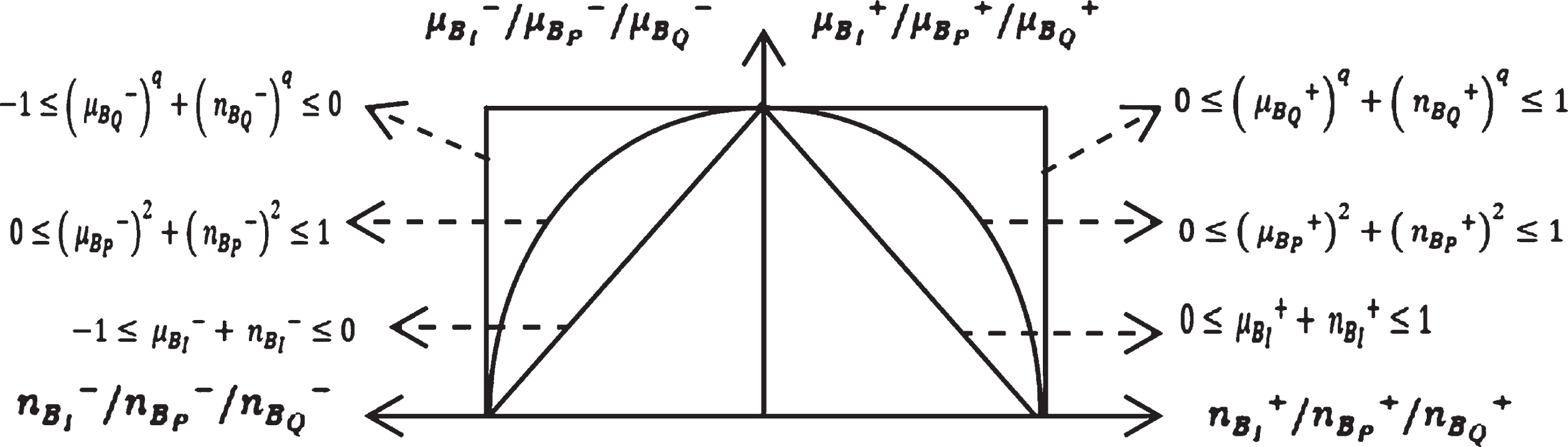
Kersuliene et al. [56] generated SWARA to weight criteria based on the hierarchical priorities of the evaluations. Additionally, this approach is extended as the name of M-SWARA in this study for the purpose of indicating the relationship more effectively. First, decision matrix is created by using the evaluations as in Equation (31).
TOPSIS is considered for the purpose of ranking various alternatives [42]. In this framework, decision matrix is constructed with linguistic evaluations as in Equation (35).
For the aim of generating effective strategies to reduce energy costs in hospitals, a novel hybrid decision making approach is constructed based on golden cut-oriented bipolar and q-ROF sets. Figure 2 explains the steps of this model.

Proposed model.
The details of the analysis results are presented below.
Step 1 –Determining the criteria for BSC-based costs: Criteria are selected by considering BSC perspectives as in Table 1.
Selected criteria for the BSC-based costs
Selected criteria for the BSC-based costs
The variety of instruments and devices used in hospitals is very large. For this reason, the energy consumption of the devices is also high in parallel with the usage. The use of new technology tools will ensure energy efficiency and reduce costs. Many people work in hospitals with different levels of expertise. Issues such as leaving the lights on in the rooms and leaving the appliances plugged in are related to the level of consciousness of the employees. Such situations cause unnecessary energy consumption and turn into costs. Hospitals are large enterprises in terms of structure. Heating of buildings of this size is also important. In the heating process, whether the buildings are insulated or not also affects the size of the energy consumed.
The type of energy used is also very effective on the energy costs of hospitals. For example, if the required energy is provided with fossil fuels, the initial cost is very low. On the other hand, there is a negative image because fossil fuels harm the environment. In addition, since fossil fuels are generally imported from abroad, there is an exchange rate risk. In other words, fossil fuels will become more costly if the domestic currency depreciates relative to foreign currencies. Another type of energy that can be considered for the energy needs of hospitals is renewable energies. The biggest disadvantage of these energies is the high initial cost. On the other hand, the hospital will be able to provide its own energy needs thanks to this type of energy, such as these solar panels. This will contribute to a significant reduction in energy costs in the long run.
Step 2 –Collecting the linguistic evaluations: Evaluations are collected based on the degrees and scales in Table 2.
Scales and Degrees
Evaluations are given in Table 3.
Evaluations
PD: positive degrees; ND: negative degrees.
Step 3 –Determining the average values of the degrees: Average values are calculated in Table 4.
Average values
PD: positive degrees; ND: negative degrees.
Step 4 –Computing the score function values: Score function values are presented in Table 5.
Score function values
Step 5 –Calculating Sj, kj, qj and wj values: Significant values are calculated in Table 6.
Significant values
Step 6 –Constructing the relation matrix: Relation matrix is generated in Table 7.
Relation matrix
Step 7 –Stable matrix and impact-relation results are determined: Stable matrix is created in Table 8.
Stable matrix
Table 8 indicates that consciousness level of employees (CLE) has the greatest weight regarding the energy costs in hospitals. Moreover, the type of energy used (TEU) also plays a significant role for this situation. Figure 3 indicates the causal diagrams of the factors.

Causal diagrams of the criteria.
Figure 3 states that use of energy-saving equipment (ESE) and type of energy used (TEU) have an influence on consciousness level of employees (CLE). Additionally, type of energy used (TEU) is influenced by issues related to building (IRB).
Step 8: Weighting priorities are compared: These calculations are also made with IFSs and PFSs. The results are also shown in Table 9.
Weights
Significant criteria are the same for all calculations. Therefore, this situation explains that the findings are reliable.
Step 9 –Collecting the linguistic evaluations for the alternatives: In the second phase of the proposed model, different hospital types are ranked according to the ownership type. Within this context, three different alternatives are selected that are foreign, public, and private. Evaluations of them are shown in Table 10.
Evaluations
Evaluations
PD: positive degrees; ND: negative degrees.
Step 10 –Average values and degrees are defined: Average values are computed in Table 11.
Average values
PD: positive degrees; ND: negative degrees.
Step 11 –Score function values are computed: Table 12 represents the score function values.
Score function values
Step 12 –Decision matrix is normalized: Normalized values are given in Table 13.
Normalized matrix
Step 13 –Weighted decision matrix is created: Weighted matrix is demonstrated in Table 14.
Weighted matrix
Step 14 –The values of D+, D-, RCi are calculated: D+, D- and RCi values are indicated in Table 15.
The values of D+, D-, RCi with bipolar q-ROFSs
Step 15 –Ranking results of the alternatives are compared: PFSs and IFSs are also considered to make comparative analysis. The results are shown in Table 16.
Comparative ranking results of the alternatives for the BSC-based costs
The ranking of the alternatives is similar for all calculations. It is understood that the findings are consistent. Private hospitals are the most successful business with respect to the energy cost management. Moreover, foreign hospitals are on the second rank. However, public hospitals have lower performance in this context.
It would be appropriate for hospital managements to provide their employees with comprehensive training on energy use. In this context, a comprehensive examination should be made and first, the areas that consume the most energy in hospitals should be determined. It should be ensured that the level of awareness of the personnel regarding these topics is increased. Many people work in hospitals with different levels of expertise. Issues such as leaving the lights on in the rooms and leaving the appliances plugged in are related to the level of consciousness of the employees. Such situations cause unnecessary energy consumption and turn into costs. Efforts should be made for more efficient use of equipment that consumes more energy, and the necessary information regarding this issue should be shared with the personnel. In this way, it will be possible to reduce the energy consumption of hospitals. Dinas et al. [57] and Bandecchi et al. [58] also focused on the energy efficiency in the hospitals and reached a conclusion that personnel awareness should be improved to reduce energy costs.
Another way to reduce energy costs in hospitals is to pay attention to the type of energy used. In this context, it is important to make long-term plans when choosing the type of energy to be used in hospitals. Fossil fuels are generally used to meet the energy needs of hospitals. The initial cost of these fuels is very low. On the other hand, a significant amount of carbon gas is emitted in energy production with fossil fuels. Therefore, renewable energy sources should also be considered in meeting the energy needs of hospitals. Although the installation costs of these energy types are higher, it will be possible to significantly reduce energy costs in the long run. Alotaibi et al. [59] and Ghanbari et al. [60] claimed that small scale solar panels can have a positive influence on the energy efficiency of the hospitals.
The proposed model has also some important superiorities by comparing with the previous models in the literature. In this proposed model, some improvements are made to SWARA, and new technique is generated by the name of M-SWARA. With the help of these new improvements, the causal impacts between the items can be identified. However, the models in which classical SWARA are considered cannot demonstrate cause and effect relationship [61–63]. Furthermore, in the calculation process of the degrees in q-ROFSs, golden cut is taken into consideration. This situation helps to reach more precise results. Therefore, this model can generate more effective results over the models that did not consider golden cut [64–66]. Owing to these two new improvements, the originality of the proposed model can be increased. However, the proposed model has also some limitations. Because of considering TOPSIS in the alternative ranking process, normalization process may depend on the evaluation unit of the function [67–69]. Hence, by considering some other techniques, this problem can be overcome.
Conclusions and future research directions
In this study, it is aimed to create a strategy for reducing energy costs in hospitals to ensure the sustainability of health services. Within this context, BSC-based factors affecting the energy costs in hospitals are identified. In this framework, a novel hybrid decision making approach is generated based on golden cut-oriented bipolar and q-ROF sets. Firstly, these criteria are evaluated by using SWARA approach. Secondly, alternatives are examined with the help of TOPSIS technique. Moreover, IFSs and PFSs are also taken into consideration to make a comparative evaluation. It is concluded that consciousness level of employees has the highest weight with respect to the energy costs in hospitals. Additionally, the type of energy used also plays a significant role for this issue. Private hospitals are the most successful business with respect to the energy cost management. Moreover, foreign hospitals are on the second rank. However, public hospitals have lower performance in this context. The results are the same for all calculations. Therefore, this situation explains that the findings are reliable.
The novelty of this study is to present a set of criteria that affect the energy costs of health institutions. However, in this study, an analysis has been performed for only health industry. With respect to the future research directions, different industries can be taken into consideration, such as automobile and banking. This situation provides an opportunity to compare the result of the different industries. Thus, more specific strategies can be provided for the companies. On the other side, the proposed model can also be improved in the following studies. For instance, alpha cuts can be considered to make sensitivity analysis. Therefore, the validity and coherency of the findings can be measured. Additionally, q-ROFSs can be considered with different operators for the purpose of minimizing uncertainties and reaching more effective findings [70, 71].