



Abstract
In order to ensure the safe transmission of the information of the secondary distribution system across the regional network, this paper studies a security monitoring method of the secondary distribution system across the regional network based on the Internet of things technology and the improved fuzzy clustering algorithm. The Internet of things technology is used to collect the information transmission in cross region network of the secondary power distribution system and store it in the database; Combined with the shadow set to improve the basic fuzzy C-means clustering algorithm, the improved fuzzy C-means clustering algorithm is obtained. The cross region information transmission in the clustering database is divided into two categories: security and risk, and the risk information obtained by clustering is divided into four risk types, so as to realize the security monitoring of information transmission in cross region network of secondary power distribution system. The results show that the average monitoring rate of this method can reach 93.93%, the information collection is efficient and accurate, the number of packet losses is low, and the clustering results are stable and reliable, which can ensure the safe information transmission of cross region network of the secondary power distribution system.
Keywords
Introduction
The secondary power distribution system mainly refers to the control and protection of primary system equipment and relevant systems supporting power dispatching tasks, including measurement, metering and protection of primary system equipment, power monitoring system, power data network communication, dispatching automation, etc. As an important part of the power system, the secondary power distribution system has higher professional integration and wider scope than the primary distribution system, which has laid a solid foundation for the information security construction of the power industry [1]. The secondary power distribution system plays an important role in the power generation, power supply and service of the power system. At the same time, it also escorts the security of the power grid dispatching control system to ensure the safe and stable operation of the power system. In addition, the security vulnerabilities (structure, technology, management, etc.) existing in the secondary power distribution system are vulnerable to attacks by hackers and hostile forces, resulting in a distribution system accident and great losses to the whole distribution system [2, 3]. For the secondary power distribution system, the primary task of its security protection is to ensure the information transmission security of the cross regional network. The goal is to resist the attack and destruction of the cross regional information transmitted by malicious code, virus, hacker and other means when the network transmits information across the region, and even attack and destroy the power secondary system, resulting in the collapse or paralysis of the primary or secondary system [4]. Therefore, in order to achieve the above objectives, it is necessary to implement security monitoring for the information transmission of cross region network of the secondary power distribution system, so as to realize the information transmission of cross region network of secondary power distribution system and ensure the stable and safe operation of the secondary system and the primary system [5].
For the security monitoring of cross regional information transmission, the primary premise is to obtain the information transmission of cross region network of secondary power distribution system in real time and accurately; The second is to classify the collected cross region transmission information, find out the risk cross region transmission information, and complete the information transmission security monitoring of cross region network of the secondary power distribution system. First of all, for the information collection methods, the traditional network information collection methods mostly have the problems of low efficiency or inaccurate collection of information. It is difficult to achieve the accurate and efficient collection of information transmission in cross region network of the secondary power distribution system, which will affect the effect of final security monitoring and even lead to distribution accidents due to attacks on the secondary power distribution system. For example, the heuristic network information collection model in cloud environment studied by Fu,Y [6] mainly analyzes the advantages of multi-user and high dynamic in cloud environment, as well as hidden dangers such as multiple attack surfaces and security threats, and uses the matching heuristic algorithm to create an information collection model to complete the task of network information collection. The information collected by the collection model has high reliability, but the rate of information collection is low; The web crawler spatial information collection method [7] proposed by Yang, Y and others mainly improves the matching accuracy of the institutional search list through a string similarity matrix algorithm based on word elements, and realizes the identification and extraction of administrative divisions in the address string in combination with the administrative division information identification and extraction algorithm of decision tree pattern. Although this method can realize the collection task of spatial information, the overall acquisition rate and accuracy are not ideal.
With the PID development of domestic surgical technology and the arrival of the era of cloud computing, big data and the Internet of things, data has become a key factor throughout the whole process of intelligent data acquisition. The new generation of information technology embeds intelligent receivers and sensors into various objects and environments such as factories, transportation, buildings, power equipment, networks and commodities, and forms the Internet of things through wired or wireless connections [8]. Internet of things technology is an information collection, exchange and processing technology based on Internet technology and sensor technology. It is a technology that can directly let customers participate and experience the process. This technology can collect a large amount of information data, has high information collection rate and accuracy [9, 10], and can meet the accurate and efficient collection requirements of information transmission in cross region network of secondary power distribution system. Secondly, for the information type division method, clustering algorithm is usually used. For example, the multi-objective automatic clustering algorithm based on gene expression programming [11] proposed by Xu, L et al. is based on gene expression programming algorithm, combined with generalized clustering algebraic operator and objective optimization function to determine the number of clusters and realize the effective division of data. The clustering algorithm can realize the clustering division of different types of data, but the clustering performance is not stable enough. Literature [12] designs a new network security monitoring system for power secondary system. Firstly, the framework is designed, and then the network security monitoring device is connected on this basis to complete the monitoring system design, so as to realize the network security monitoring of power secondary system. However, this method is time-consuming. Fuzzy C-means clustering algorithm can divide similar data samples together to form clustering, but this algorithm has some unsatisfactory aspects for network risk information data processing, such as unstable operation results and easy to fall into local minimum, resulting in low final security monitoring rate. Rough fuzzy C-means clustering algorithm based on shadow set combines fuzzy set with rough set by combining the characteristics of high uncertainty of network risk information data, and introduces shadow set for threshold selection, which improves the stability of clustering operation results, avoids falling into local minimum value, realizes more accurate clustering division of information types, and ensures the final high security monitoring rate [13].
In order to ensure the safe transmission of information across the regional network of the secondary distribution system, this paper combines the Internet of things technology and the improved rough fuzzy c-means clustering algorithm based on shadow set. Use the Internet of things technology to collect the information transmission of the secondary distribution system across the regional network, and store it in the database; Combined with shadow set, the basic fuzzy c-means clustering algorithm is improved, and the improved fuzzy c-means clustering algorithm is obtained. The cross regional information transmission in the cluster database is divided into security and risk, and the risk information obtained through the cluster is divided into four types of risk information, so as to realize the security monitoring of the cross regional network information transmission of the secondary distribution system.
Security monitoring method for cross region network of secondary power distribution system network
Information transmission in cross region network of secondary power distribution system
Framework of primary and secondary power distribution system
Primary power distribution refers to a system composed of transformers, circuit breakers, generators, transmission lines and other equipment for power generation, distribution, transmission and transformation. The secondary power distribution system is a composite system composed of business systems widely distributed in dispatching centers, power plants and substations at all levels through close or loose connections. It is also a large power system composed of control systems and power dispatching systems of power plants, substations and dispatching centers and power information systems at all levels [14]. The framework of primary and secondary power distribution system is shown in Fig. 1.
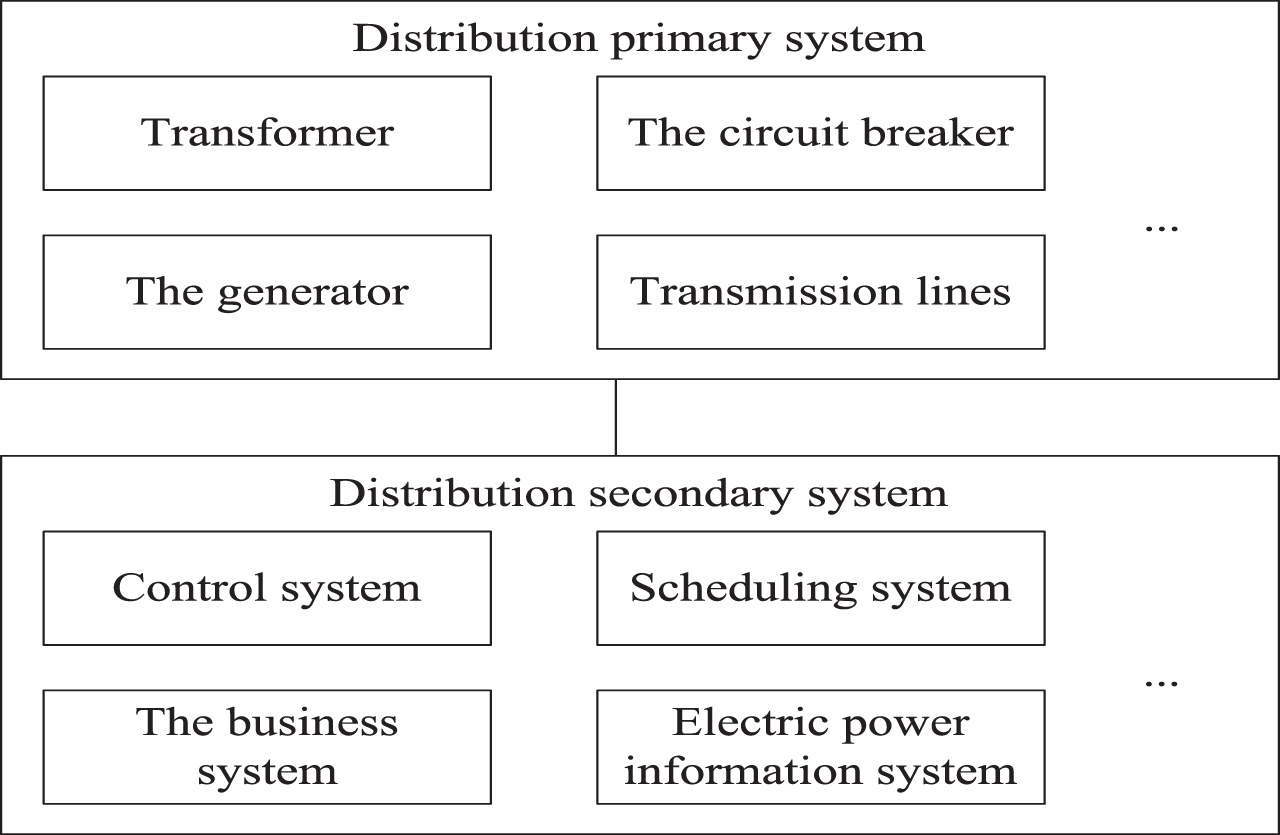
Frame diagram of primary and secondary power distribution system.
There are two kinds of information transmission methods for the cross region network of the whole secondary power distribution system: (1) from the internal network to the physical isolation device to the external network, which is called the forward transmission method; (2) From the external network to the physical isolation device to the internal network, which is called the reverse transmission method. Due to the unidirectional transmission characteristics of the physical isolation device, the forward and reverse isolation device is equivalent to the communication blocking point, so that the vast majority of network application software based on the traditional TCP / IP communication protocol cannot be deployed across regions directly [15]. To solve this problem, a data agent platform is usually set in a certain area of the secondary power distribution system to encapsulate the communication process with the forward and reverse isolation device, and exchange data through the internal and external network data agent platform. The basic structure of information transmission in cross region network of secondary power distribution system is shown in Fig. 2.
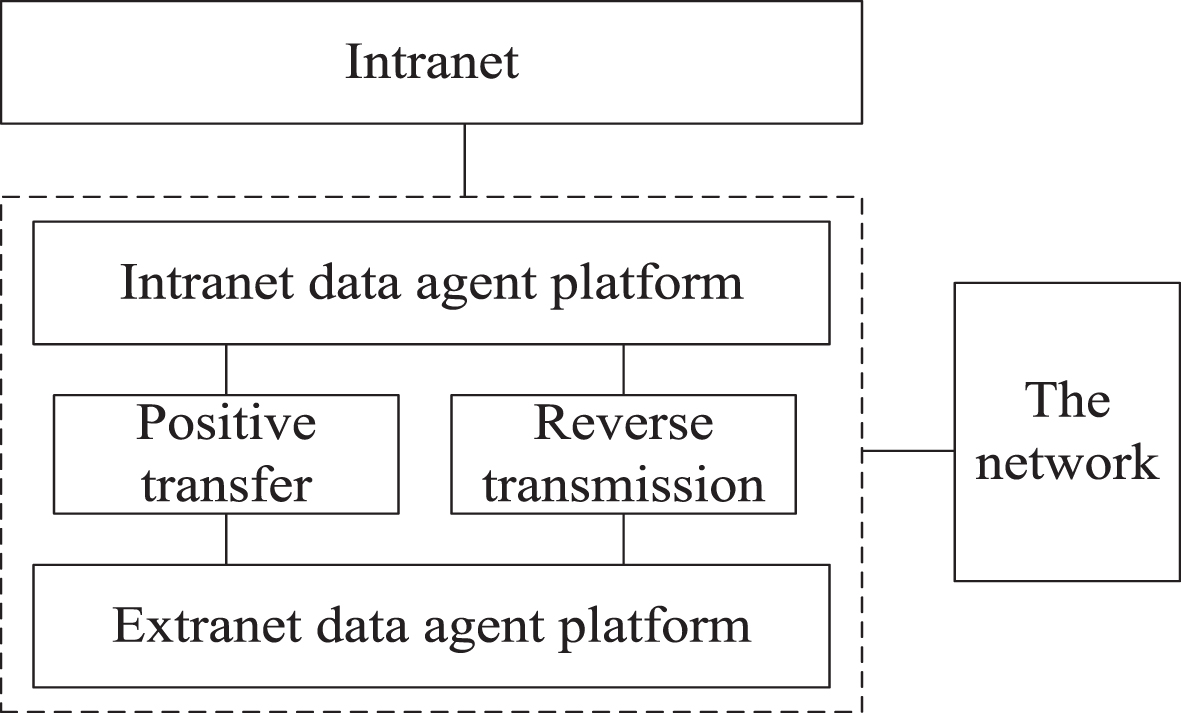
Basic structure diagram of cross region information transmission in secondary power distribution system network.
In Fig. 2, the internal and external network information transmission of the two transmission methods is realized through the set data agent platform. For the users and deployment personnel of the secondary distribution system, there is no need to consider the communication protocol and working mechanism of the forward and backward isolation device in the communication, and the former communication mode can still be used to transparently exchange data on the internal and external networks. However, the data proxy platform in this transmission structure can not effectively ensure the security of the information transmitted by the two cross regional information transmission methods. It is necessary to take appropriate methods to monitor the security of the transmitted information in real time in the process of cross regional information transmission, so as to ensure the stability and security of information transmission in cross region network of secondary power distribution system.
The key to the security monitoring of cross region network of secondary power distribution system is to monitor the security of its cross regional transmission information. The premise to achieve this monitoring purpose is to collect the cross regional transmission information and store the collected information in the corresponding database, so as to provide data support for subsequent information cluster analysis and monitoring.
Technical framework of Internet of things for transmission and information collection of cross region network of secondary power distribution system
Internet of things technology is an extension of the Internet and an innovative application. The soul and core of its development is the objective experience and needs of customers [16]. Therefore, based on the analysis of the information transmission structure in cross region network of the secondary power distribution system in the previous section, an Internet of things technical framework suitable for cross regional transmission information collection is constructed to realize the collection of transmission information in cross region network of the secondary power distribution system. The technical framework of the Internet of things is shown in Fig. 3.

Internet of Things technology framework for cross region transmission information collection of secondary power distribution system network.
The technical framework of the Internet of things can be divided into three layers: perception layer, network layer and application layer. The sensing layer is used to sense and receive the transmission information of cross region network of the secondary power distribution system; The network layer belongs to the core part of the technical framework. The main function of this layer is to transmit the transmission information of cross region network of the secondary power distribution system received by the sensing layer. Its performance directly determines the speed and accuracy of information transmission across the regional network of the secondary distribution system, and indirectly affects the speed and accuracy of the final safety monitoring; The key role of the application layer is to receive and store the trans regional network transmission information of the secondary distribution system transmitted through the network layer, and update the stored information in real time, so as to provide data support for the cluster analysis and security monitoring of the subsequent trans regional network transmission information of the secondary distribution system.
At present, there are many wireless communication technologies applied, such as Wi Fi, Bluetooth, power carrier technology, UWB wireless communication, WirelessUSB and ZigBee technology. Because ZigBee wireless communication technology has the characteristics of low power consumption and low cost, and has high network scalability, it can effectively improve the transmission rate of information [17, 18]. Therefore, ZigBee wireless communication technology is selected as the core network layer of the Internet of things technology.
ZigBee wireless communication technology is based on the communication technology related to networking and security of IEEE 802.15.4 protocol, whose frequency band is 2.4 GHz, has low-power, low-cost and short-range two-way wireless network technology [19]. The ZigBee wireless communication technology used in the network layer of the Internet of things technology applies the minimum system of CC2630 chip. Dual ARM core 32-bit CC2630 chip has faster operation speed and more stable performance. The working voltage of ZigBee wireless communication technology is 3.3 V, and the baud rate of serial port is between 1200 ∼ 115200bps. It has high anti-interference ability and transmission accuracy. The star network topology is adopted among its nodes, the data can be transmitted to the terminal equipment in real time, and the routing level can support 200 levels, which is much higher than the traditional chip. In addition, the gateway of ZigBee wireless communication technology is the coordinator, which plays a core control role. It can not only complete the networking and node distribution, but also be responsible for receiving the acquisition instructions of the host computer and sending the received acquisition instructions to the terminal acquisition node of the sensing layer, so as to ensure that the overall Internet of things technology can normally collect the information transmitted across the network of the secondary power distribution system. The operation process of the coordinator of ZigBee wireless communication technology in the network layer is shown in Fig. 4.

Operation process diagram of ZigBee wireless communication technology coordinator in the network layer.
The specific operation process of the coordinator of ZigBee wireless communication technology in the network layer is as follows: after the coordinator and ZigBee are initialized, the wireless network is automatically formed, and the terminal acquisition node in the sensing layer automatically joins the network; After receiving the acquisition instruction from the upper computer, the wireless network transmits the instruction to the terminal acquisition node of the sensing layer to complete the collection of transmission information in cross region network of the secondary power distribution system; The collected cross region transmission information is transmitted to the coordinator through ZigBee technology, packaged and stored in the corresponding database in the application layer.
Through the clustering process of the basic fuzzy C-means clustering algorithm, the existing defects are analyzed. Aiming at this defect, combined with the shadow set, the algorithm is improved to obtain the improved fuzzy C-means clustering algorithm; This algorithm is used to cluster the transmission information in cross region network of secondary power distribution system in the database of Internet of things technology framework, and divide this kind of transmission information into two categories: security category and risk category. On this basis, the algorithm is used to cluster the transmission information of risk grade obtained by clustering, and the transmission information of risk grade is divided into four risk types, so as to achieve the purpose of security monitoring of the transmission information of secondary distribution system across regional network.
Basic fuzzy C-means clustering algorithm
The transmission information in cross region network of secondary power distribution system collected by Internet of things technology and stored in the database is a given data set B ={ b1, b2, ⋯ , b
m
}. The basic fuzzy C-means clustering algorithm is a clustering algorithm that uses the membership degree to determine the membership degree of each transmission information in cross region network of secondary power distribution system in the data set. The basic fuzzy C-means clustering algorithm makes each secondary power distribution system transmit information across regions in network through fuzzy division. The membership degree with a value interval of 0∼1 is used to determine the degree of belonging to each group. According to the introduction of fuzzy partition, the membership matrix S allows elements with values between 0 and 1. Therefore, the sum of each subordinate area of the distribution system should be equal to 1, but the data should also be normalized according to the following rules:
Where, the number of transmission information b i (i = 1, 2, ⋯ , m) in cross region network of secondary power distribution system contained in a given data set B is expressed by m; The number of fuzzy sets divided by the transmission information in cross region network of each secondary power distribution system is expressed by a; The j-th membership value of the i-th transmission information in cross region network is represented by s ij , that is, the corresponding component value of the membership matrix S. Through the basic fuzzy C-means clustering algorithm, the transmission information b i (i = 1, 2, ⋯ , m) in cross region network of m secondary power distribution systems in a given data set B is divided into a fuzzy sets, and the clustering center of each fuzzy set is calculated to minimize the value function of dissimilarity index.
In order to achieve the above purpose, the general objective function established by the basic fuzzy C-means clustering algorithm is:
Where, the clustering center of the i-th fuzzy set of the transmission information in cross region network of the secondary power distribution system is represented by w i ; The Euclidean distance between the i-th cluster center and the j-th cross regional transmission information point is expressed by d ij ; e is a weighted index and e ∈ [1, ∞), which is used to control the fuzziness of clustering results.
The following new objective function is created to obtain the necessary conditions to make formula (2) reach the minimum value. The new objective function can be expressed as:
Where, the Lagrange multipliers of the m constraint formulas of formula (1) are expressed by γ
j
(j = 1, ⋯ , m). All input parameters are derived to obtain the necessary conditions to minimize formula (2), which can be expressed as:
Where, the Euclidean distance between the k-th input parameter and the j-th cross regional transmission information point is expressed by d
kj
. According to the two necessary conditions in formula (4), the basic fuzzy C-means clustering algorithm belongs to a simple iterative process. The specific process of determining the clustering center w
i
and the membership matrix S by the algorithm is asfollows: Input the given data set B, the number of clusters a and the weighting index e to be clustered; Randomly select a transmission information in cross region network of secondary power distribution system as the initial clustering center; Calculate the membership matrix with the following formula in formula (4) and transform it to meet the constraints in formula (1); Calculate the objective function value according to formula (2). If the calculated objective function value is less than a certain threshold, or the change of the objective function value relative to the objective function value obtained by the last operation is less than a certain threshold, or the operation algorithm has run the set number of cycles, the algorithm stops and outputs the cluster center; Use the above formula in formula (4) to calculate the new cluster center and return to step (3). Repeat the above process until the objective function generated by the current generation operation is very close to the objective function of the previous generation, which is usually less than an error threshold. At this time, the algorithm reaches convergence; Output a cluster centers.
The above basic fuzzy C-means clustering algorithm can also initialize the membership matrix S with the number between 0 and 1 (it must be standardized to meet the constraints of formula (1)), and then execute the iterative process. The performance of the algorithm depends on the initial clustering center. Two parameters need to be input, one is the number of clusters a and the other is the weighted index e. Generally speaking, the number of clusters a should be far less than the total number of cluster samples, and e > 1 should be guaranteed. For the weighted index e, it belongs to a parameter that controls the flexibility of the basic fuzzy C-means clustering algorithm. If this value is too large, the clustering effect will be very poor. If this value is too small, the basic fuzzy C-means clustering algorithm will be close to the k-means clustering algorithm.
In previous studies, people generally regard samples as points in the feature space, and believe that the characteristics of patterns are characterized by numerical values. Therefore, the basic fuzzy C-means clustering algorithm can only deal with numerical attributes. In practical cluster analysis, the dimensional characteristics of samples are not only numerical attributes, but also classification attributes. Most of the traditional basic fuzzy C-means clustering algorithms digitize the classification attributes. In this method, multiple classification attribute features are converted to binary features (0 and 1 respectively indicate whether there is a category or not), and the binary features are taken as values in such algorithms [20]. If this kind of basic fuzzy C-means clustering algorithm is used in the cluster analysis of transmission information in cross region network of secondary power distribution system, it needs to deal with a large number of binary features, because the data set in the cluster analysis of transmission information in cross region network of secondary power distribution system usually has a large number of classification attribute features, which will inevitably increase the amount of computation and memory space of this kind of algorithm; In addition, this kind of basic fuzzy c-means clustering algorithm also has another disadvantage, that is, the mean of each cluster is a real number between 0 and 1, which can not represent the characteristics of each cluster information.
Aiming at the defects of the basic fuzzy C-means clustering algorithm, this paper studies the rough fuzzy C-means clustering algorithm based on shadow set - improved fuzzy C-means clustering algorithm, and uses this improved fuzzy C-means clustering algorithm to cluster and analyze the transmission information in cross region network of secondary power distribution system. Cluster such transmission information into safety class and risk class, and continue to cluster and divide the risk class transmission information. In order to realize the safety monitoring of information transmission across the regional network in the secondary distribution system, four risk types are obtained.
The application of rough set to the clustering analysis of transmission information in cross region network is to expand each kind of transmission information clustering in cross region network as rough set, in which the characteristics of each rough set are its upper approximation set
Where, the weights of the upper approximation set and the lower approximation set are expressed by ωmax and ωmin respectively; The i-th membership matrix is represented by S i ; The j-th given transmission information data set in cross region network of secondary power distribution system is represented by B j .
By improving the fuzzy C-means clustering algorithm, all clustering centers of the given transmission information data set in cross region network of secondary power distribution system are obtained. The specific steps are as follows: Input the given transmission information data set in cross region network of secondary power distribution system B ={ b1, b2, ⋯ , b
m
}, the number of clusters a, the weighting index e, the upper and lower approximate centralization weights ωmax and ωmin, the iteration termination error threshold δ, and the maximum number of iterations A; Randomly initialize each cluster center w; According to formula (4), calculate the membership degree s
ij
for a clusters and m cross region transmission information; According to the shadow set optimization objective function, define smax as the maximum membership degree of each cluster, and determine the optimal threshold α
i
for a clusters, and α
i
= arg min(λ
i
), where λ
i
represents the risk coefficient, and its operation formula is:
Where, the transmission information in cross region network of the j-th secondary power distribution system is represented by b
j
. Obtain the optimal threshold α
i
of a clusters according to formula (6), and determine the membership boundaries The calculation method of membership boundary area AREA (S
i
) is:
Calculate the new cluster center according to formula (5); Repeat steps (3) to (6) until the termination conditions are met; Output all generated cluster centers and objective function values.
Compared with the basic fuzzy C-means clustering algorithm, the advantage of the improved fuzzy C-means clustering algorithm is the introduction of shadow set and rough set, which makes up for the defects of the basic fuzzy C-means clustering algorithm, can produce a more effective clustering division of transmission information in cross region network of secondary power distribution system, and improve the security monitoring performance of transmission information in cross region network of secondary power distribution system to a certain extent.
Due to the relatively small proportion of risk information in the transmission information in cross region network of secondary power distribution system, if it is subdivided into different risk information types, the proportion of the amount of information of each type relative to the amount of normal information is very small. Therefore, it is difficult to directly use the improved fuzzy C-means clustering algorithm to divide the transmission information in cross region network of secondary power distribution system into security information and various risk type information. The final performance of security monitoring cannot meet the requirements of practical applications. In order to solve this problem, this paper firstly uses the improved fuzzy C-means clustering algorithm to cluster the data set composed of the cross-area network transmission information of the secondary distribution system collected and stored by the Internet of Things technology, and finally divides it into two types: security information type and risk information type; On this basis, the information within the risk types obtained after partitioning is separated to form a risk information dataset. The improved fuzzy C-means clustering algorithm is continued to be used. Based on different risk information types, the risk information data set is divided into four risk information types: DOS, Probing, R2L and U2R, so as to realize the transmission information in cross region network of secondary power distribution system. The specific implementation process of cross regional network security monitoring of secondary power distribution system is shown in Fig. 5.
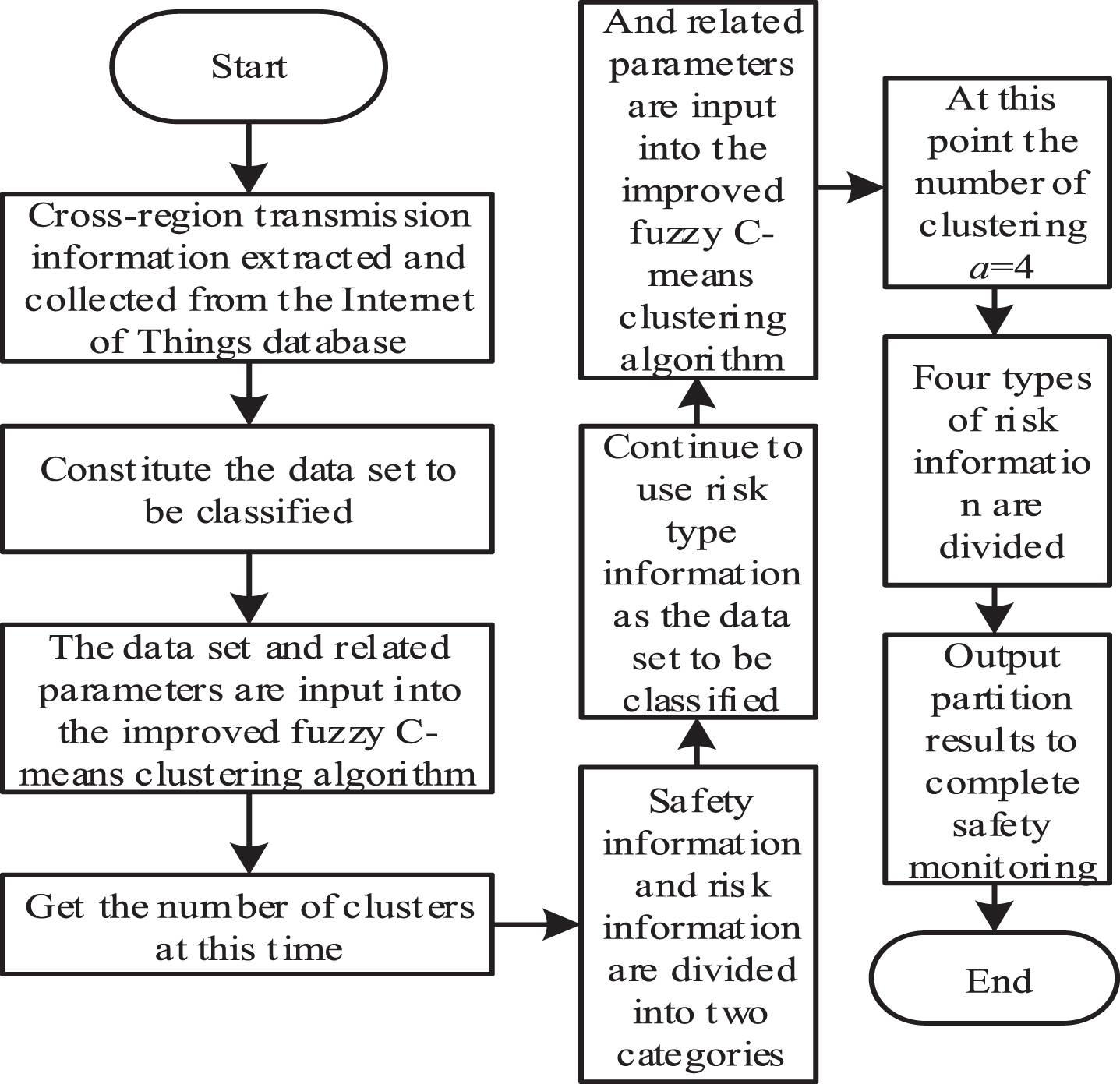
Flow chart of cross region network security monitoring of secondary power distribution system.
Taking the secondary distribution system of a power company as the experimental object, this method is used to realize the security monitoring of its cross regional network transmission information, in order to test the actual monitoring effect of this method. In the experiment, the practical application performance of this method is comprehensively tested through the historical transmission information and real-time transmission information of the experimental object network. Firstly, the monitoring results of this method are tested by using the historical transmission information in cross region network of the experimental secondary power distribution system, and 10 groups of historical transmission information data sets (A1∼A10) with four risk information types of Dos, Probing, R2L and U2R are selected. These data sets contain different amounts of historical transmission information and all have different amounts of risk information. In the experiment, the amount of security information and risk information in each data set is monitored by the method in this paper, and the monitoring results are compared with the actual situation of the historical data set to analyze the actual monitoring effect of this method. The comparison between the monitoring results of this method and the actual situation of the historical data set is shown in Table 1.
Comparison between the monitoring results of the proposed method and the actual situation of the historical data set
Comparison between the monitoring results of the proposed method and the actual situation of the historical data set
On this basis, it continues to use the proposed method to cluster monitor the risk types of risk information in each data set, obtain the amount of various risk type information contained in the risk information in each data set, compare this monitoring result with the actual situation of various risk type information in each historical data set, and test the monitoring effect of this method. The final risk information type monitoring results of this method are compared with the actual situation of the historical data set, and the results are shown in Fig. 6.
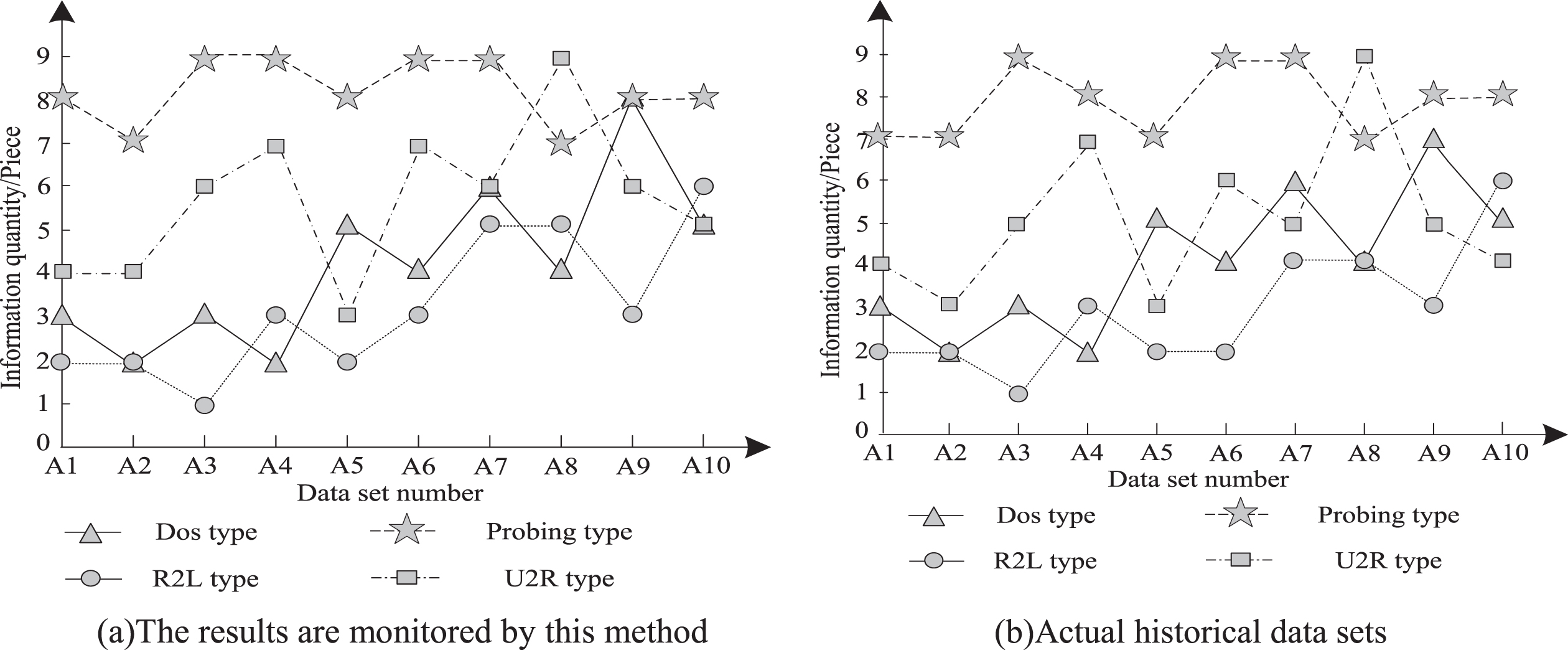
Comparison between the monitoring results of this method and the actual situation of risk information types.
According to Table 1 and Fig. 6, the total risk information of each historical data set monitored by the proposed method is very close to the actual situation, the monitoring rate is between 92.00% and 96.15%, and the average monitoring rate can reach 93.93%; The quantity distribution of each risk type information in the risk information in each historical data set is almost consistent with the actual situation. Therefore, the monitoring result of this method is reliable and the monitoring effect is ideal.
Next, security monitoring is carried out on the real-time transmission information in cross region network of the experimental secondary power distribution system, and one week is taken as the experimental monitoring cycle. The final monitoring results are shown in Table 2.
Real-time cross region transmission information security monitoring results of experimental secondary power distribution system network
It can be seen from Table 2 that the method in this paper can realize the security monitoring of real-time transmission information in cross region network of the experimental secondary power distribution system. The sum of the amount of risk information obtained from the monitoring can be completely consistent with the total amount of risk information, and the monitoring performance is superior.
During the security monitoring of real-time cross regional information transmission, continue to test the practical application performance of the two key stages of information collection and clustering. The time overhead and packet loss of this method, the method in literature [11] and the method in literature [12] are calculated. The results are shown in Fig. 7.

Time cost and packet loss results of different methods in information collection phase proposed method.
It can be seen from Fig. 7 that with the increase of the amount of information, the time cost and the number of information packet loss in the information acquisition stage of the proposed method show an upward trend in varying degrees in the process of real-time monitoring. However, generally speaking, the time cost and the number of information packet loss in the information acquisition stage of the porpose method are not high, indicating that the information acquisition stage of this method performs well in terms of acquisition speed and accuracy.
The statistical results of the time cost in the clustering phase in the real-time monitoring process of different methods are shown in Fig. 8.
It can be seen from Fig. 8 that, compared with the other two methods, the design method has the lowest time cost in the clustering phase of the real-time monitoring process. The results show that the time consumption of real-time monitoring clustering stage is ideal, the running time cost is relatively stable, and the comprehensive clustering performance is good.
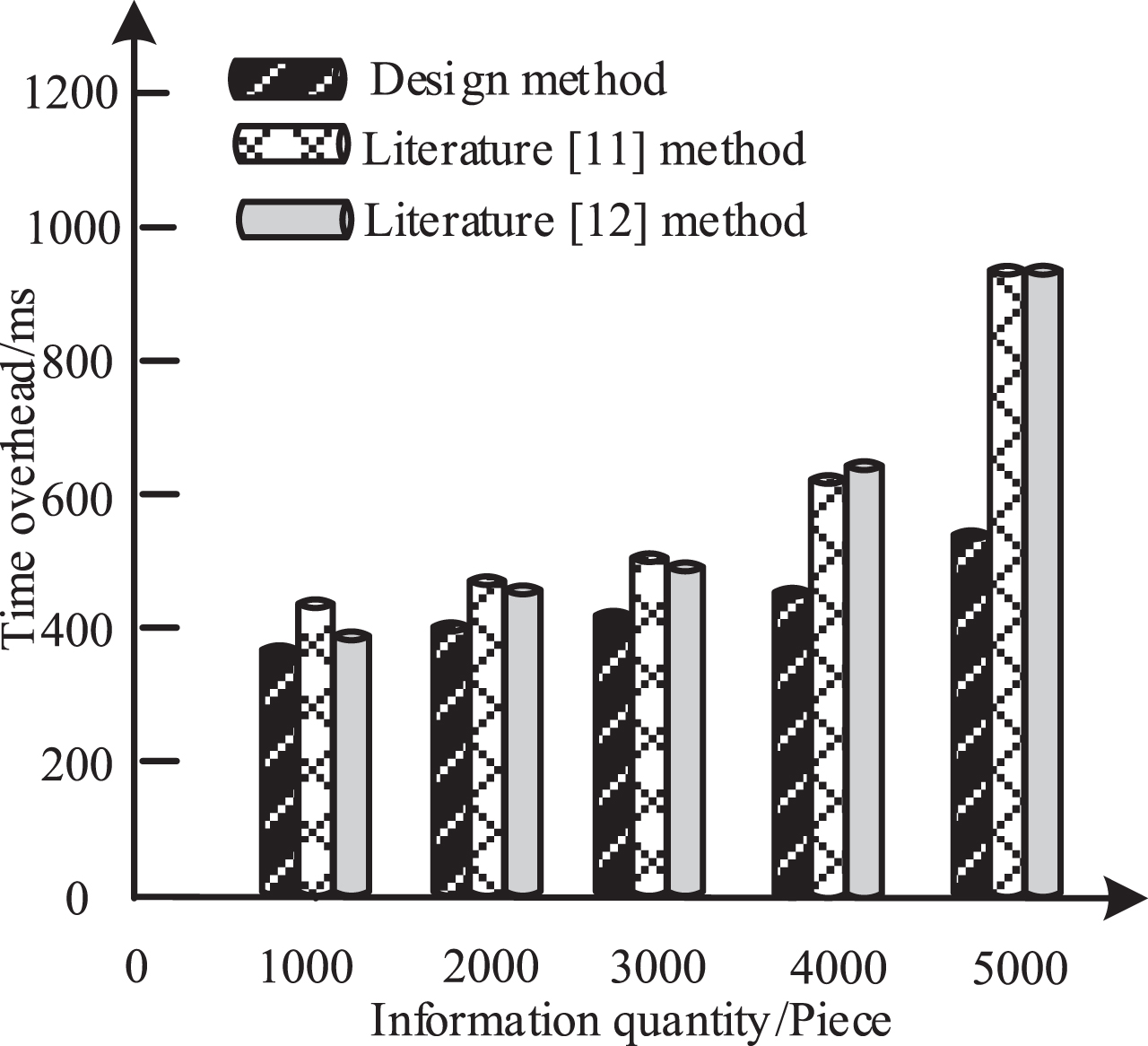
Statistical results of time cost in clustering phase during real-time monitoring by different methods.
The security monitoring method for cross region network of secondary power distribution system studied in this paper can realize security monitoring according to the historical transmission information and real-time transmission information in cross region network of secondary power distribution system, find out the risk information in two different types of cross region transmission information, effectively divide the four types of risk information, and analyze the distribution of various risk types of information; At the same time, in the process of real-time cross regional transmission information monitoring, this method adopts the Internet of things technology to realize the collection of real-time cross regional transmission information. In the actual collection, the comprehensive collection rate and accuracy are good; In addition, because this method uses the shadow set improved rough fuzzy C-means clustering algorithm to divide the risk categories of real-time cross regional transmission information, it has good operation efficiency and stability in the clustering division stage. However, this method only realizes security monitoring for four key risk types of information, and does not study other risk types with low probability. In future research, we should continue to study the security monitoring of such risk types of information, so as to further improve the comprehensive monitoring performance of this method.
Conclusion
The security of information transmission in cross region network of secondary power distribution system directly determines the safe and stable operation of the whole secondary power distribution system and the primary system. Therefore, this paper studies a security monitoring method for cross region network of secondary power distribution system based on Internet of things technology and improved fuzzy clustering algorithm. The information transmitted across regions of secondary power distribution system network is collected through Internet of things technology and stored in the corresponding database. The improved fuzzy C-means clustering algorithm is obtained by improving the fuzzy C-means clustering algorithm combined with the shadow set. Through the clustering analysis of the transmission information in cross region network of the secondary power distribution system collected in the database, the transmission information is divided into two categories: security and risk, and four risk types continue to be divided according to the risk information clustering, so as to achieve the purpose of monitoring the information transmission security in cross region network of the secondary power distribution system. The practical application results show that the average monitoring rate of 93.93% can be obtained in the security monitoring of historical transmission information in cross region network of secondary power distribution system, and the distribution of information of each risk type in the monitoring results can be consistent with the actual situation; In the security monitoring of real-time transmission information in cross region network of secondary power distribution system, the overall time overhead of information collection stage and clustering stage is low, the number of packet loss of information collection is low, it has high accuracy, and the comprehensive application performance is ideal, which can provide guarantee for the safe information transmission in cross region network of secondary power distribution system.
Footnotes
Acknowledgments
This work is supported by the project “Key technologies research and development for business security protection of distribution secondary system towards internet of things” (5400-202155408A-0-0-00) of the State Grid Corporation of China.